
Steven Kotler's Guide to Flow State Triggers
The Science of Doing Your Best Work
▶ Listen to the full episode More from The Knowledge Project
The brief
Flow, the total-absorption state Mihaly Csikszentmihalyi named decades ago, is trainable biology rather than mood, says flow researcher Steven Kotler. He maps the triggers: a four percent challenge-skill gap, 90 to 110 minute focus cycles, a protected primary flow activity, and reframed tasks that let people learn up to 230 percent faster and recover from burnout.
Steven Kotler spent three years of his life unable to walk across a room. Doctors had given up. Then a friend showed up at his apartment and refused to leave until he went surfing. He thought the idea was absurd. He caught a wave anyway, and for the first time in years his head went clear, the pain vanished, and time slowed to a crawl (55:25). He surfed four more waves that day, then didn't move for two weeks. On the fifteenth day he could walk again (56:07). Over the next six months, repeating that cycle of collapse and recovery, he went from ten percent functional to eighty (56:31). Kotler, a journalist turned flow researcher and cofounder of the Flow Research Collective, had stumbled into the thing he would spend the rest of his career trying to explain.
That thing is flow, a term the psychologist Mihaly Csikszentmihalyi coined after asking people around the world when they felt their best and performed their best. He found six consistent markers: total concentration, a merging of action and awareness, a quieted sense of self, a distorted sense of time, a feeling of control even under pressure, and an experience so good that people go out of their way to repeat it, a quality Csikszentmihalyi called autotelic, meaning an end in itself (00:54). Kotler is blunter about it. He calls flow "the most addictive state on Earth" (01:38).
What separates Kotler's account from wellness-industry mysticism is his insistence that flow is mechanism, not magic. He traces its evolutionary roots to runner's high and to flocking and mobbing behavior in animals, arguing that social mammals, some birds, and some insects show early versions of the same state (01:59). Peak performance, in his telling, isn't a secret reserved for elite athletes.
"Peak performance is nothing more or less than getting our biology to work for us rather than against us." — Steven Kotler [02:52]
Because flow runs on shared neurobiology, Kotler argues it is trainable, and the Flow Research Collective's flagship program showed participants a 73 percent boost in flow after eight weeks (03:58). The master rule underneath all of it: flow follows focus, and scientists have cataloged 26 to 28 triggers, conditions that pull attention into the present moment by raising dopamine or norepinephrine, or by lowering cognitive load, the mental clutter competing for attention (04:21). Clean your desk before writing and you are not performing a ritual, Kotler says, you are literally freeing processing power the brain then redirects toward focus (05:03).
One trigger matters more than the rest for ordinary people: the primary flow activity, whatever absorbed a person as a kid and still reliably does. For Kotler it is skiing, which gets him into flow roughly nine times out of ten (06:03). He warns that adults routinely abandon this activity once responsibilities pile up, which he calls one of the worst things a person can do, for three reasons. Flow is a trainable focusing skill, so practicing it anywhere makes it easier everywhere else (06:56). It calms the nervous system and lowers baseline anxiety, and anxiety is what blocks flow in the first place (07:22). And for anyone dealing with burnout, doubling down on two to four hours a week of a primary flow activity is, in Kotler's description of the research, close to the only reliable way back, since flow appears to be neuroprotective against burnout, PTSD, addiction, and depression (08:10). Reading, he notes almost as an aside, is statistically the most common flow state on the planet (08:48).
The Four Percent Rule
The most famous trigger is the challenge-skills balance. Csikszentmihalyi once teamed up with a Google mathematician to put a rough number on the sweet spot where a task's difficulty slightly exceeds ability, and they landed on four percent, a figure Kotler stresses was never meant as hard science, just a useful estimate (09:31). He says he validated something like it by measuring every feature on a mountain-biking hill: riders who kept each jump within that narrow band of difficulty never plateaued, while those who overshot it, something type-A personalities do constantly because bigger challenges feel more alive, made far less progress over a season (10:29). Paired with that is a separate finding from motivation research: a properly set, specific hard goal produces an 11 to 22 percent boost in motivation on its own (10:53).
Attention has its own clock. The brain's awake-and-alert cycle, Kotler says, runs about 90 to 110 minutes, the same length as a REM sleep cycle, which means it is built into human biology rather than invented by productivity culture (13:43). His advice is to start wherever current focus tops out, even ten minutes, and let sessions lengthen naturally as the underlying skill strengthens.
This same autonomy principle, Kotler argues, explains why conventional advice often fails people with ADHD. Working early in his career with Harvard psychiatrist Ned Hallowell, who is credited with coining the term ADHD, Kotler came to see the condition less as a focus deficit than as a mismatch.
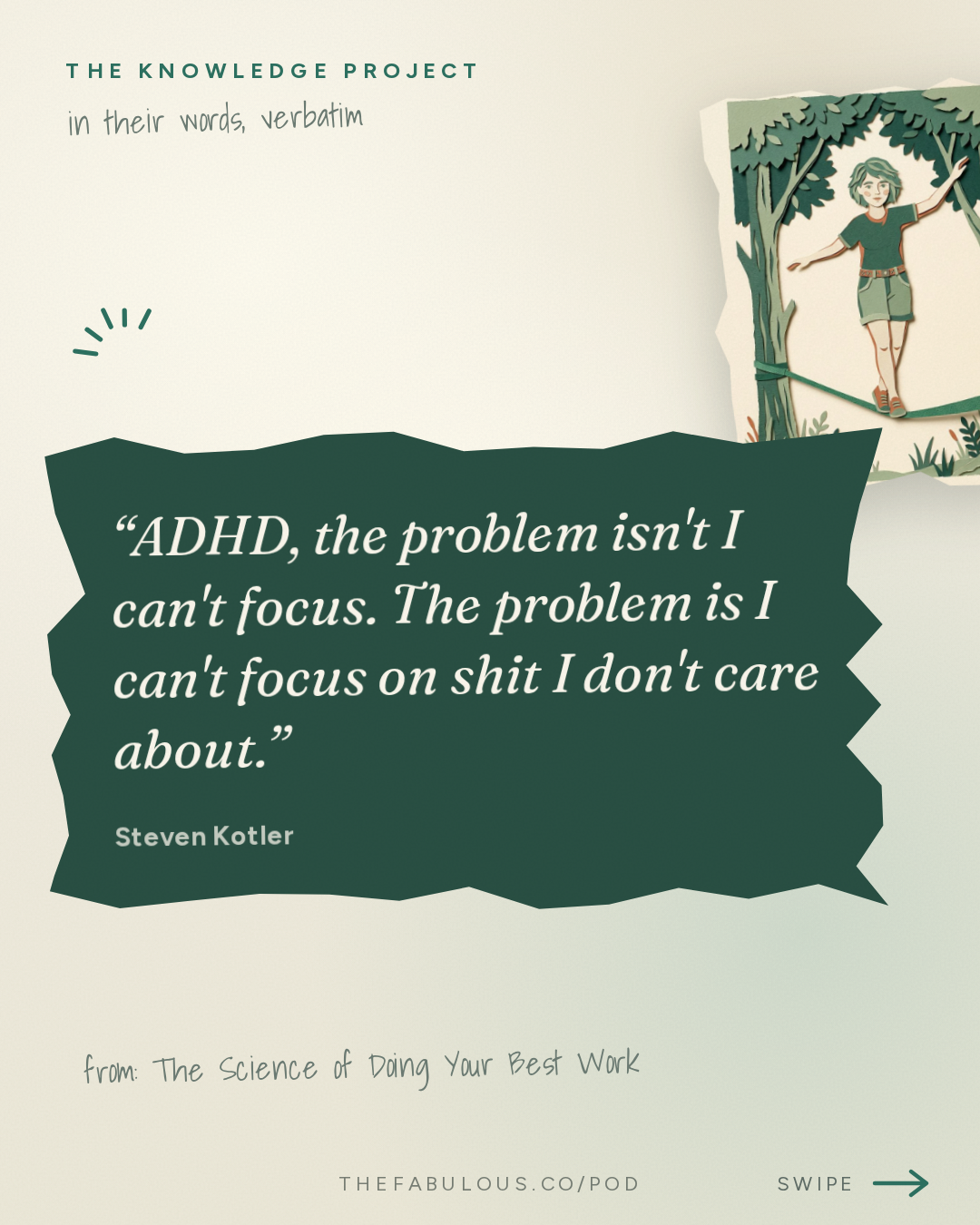
"ADHD, the problem isn't I can't focus. The problem is I can't focus on shit I don't care about." — Steven Kotler [16:08]
Autonomy and attention, he says, are coupled systems in the brain: a person who isn't choosing the direction of a task will struggle to commit real attention to it (16:32). His practical fix is reframing, finding the ten percent of an assigned task that connects to something the person actually cares about, then using that sliver as the entry point into focus.
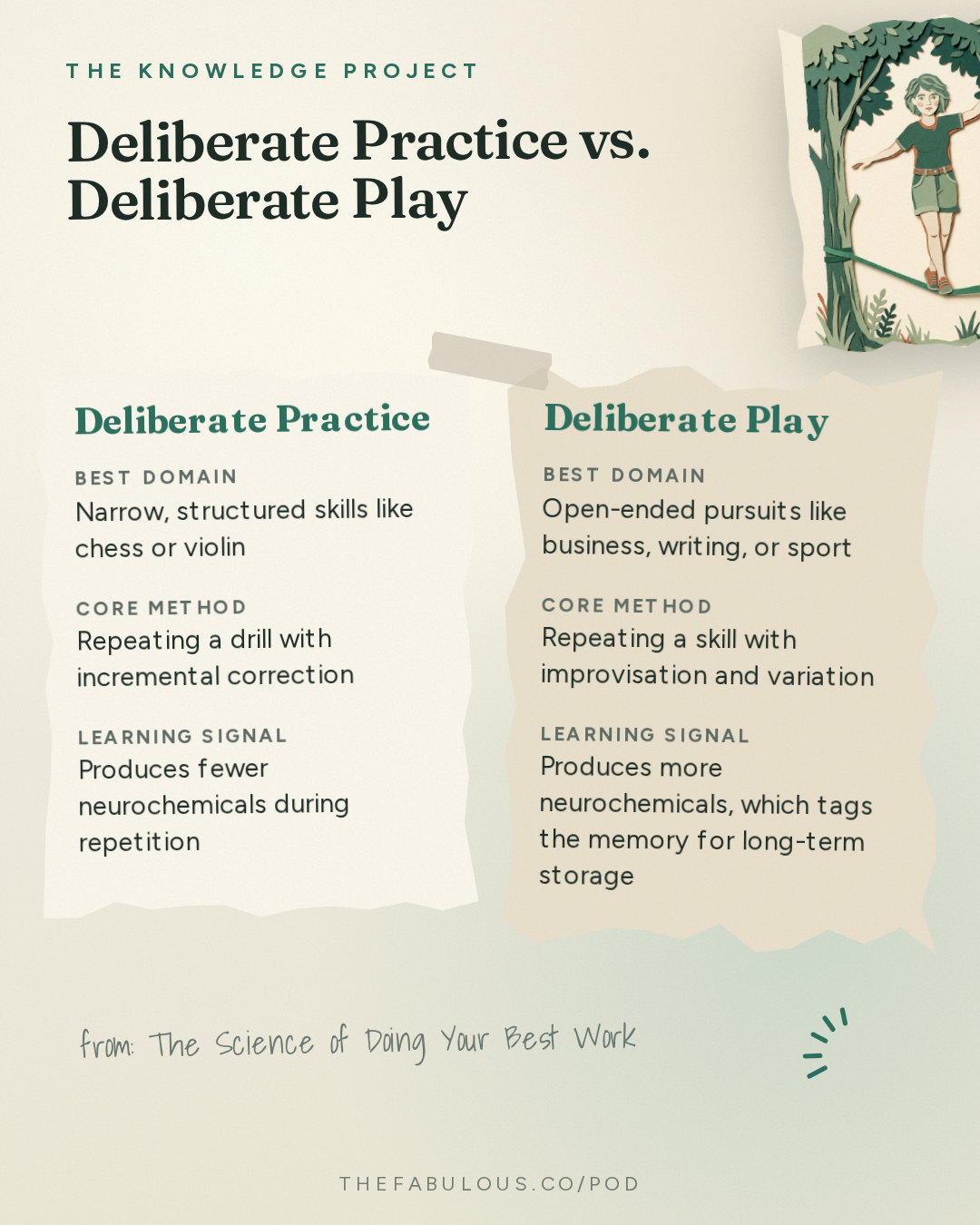
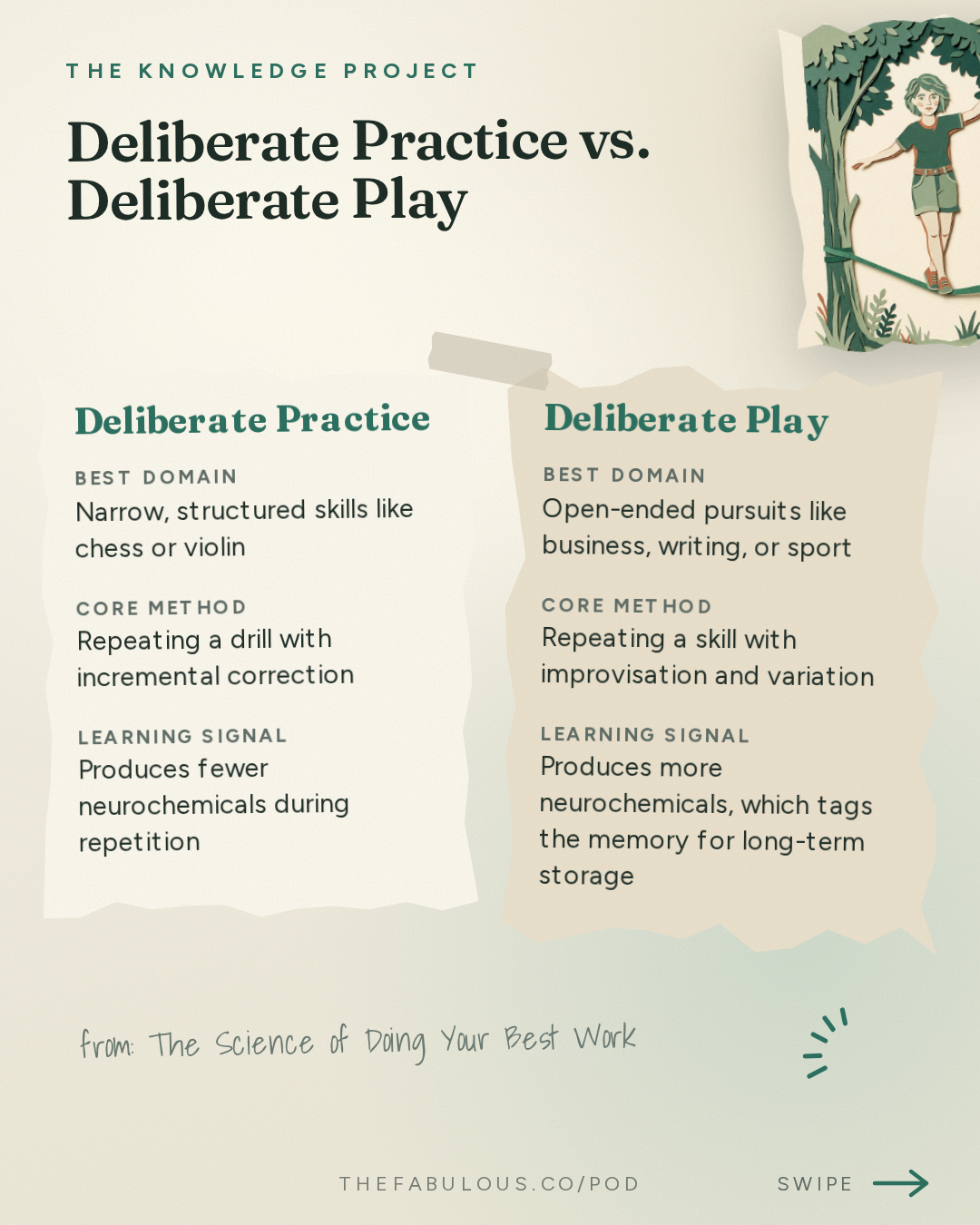
Flow also appears to accelerate learning dramatically. Citing Defense Department-funded research, Kotler notes that people learn roughly 230 percent faster in flow than under normal conditions (23:53), a figure that directly challenges the 10,000-hour framework for mastery, which Shane points out is actually associated with Malcolm Gladwell rather than the late psychologist Anders Ericsson (24:06). Kotler distinguishes two training modes: deliberate practice, repetition with incremental correction, which works well in narrow, bounded disciplines like chess or violin, and deliberate play, repetition with improvisation, which wins almost everywhere else, including business and writing, because play generates more of the neurochemical activity that tags an experience for long-term memory (24:50).
Underneath all of this sits a theory of motivation. Curiosity, driven by small amounts of dopamine, is the foundation. Passion forms where several curiosities intersect, and purpose appears when passion attaches to something bigger than the self, which adds serotonin, oxytocin, and endorphins to the mix, in Kotler's words simply "better drugs" (27:01). Even frustration, he argues, gets misread. Citing University of Michigan psychologist Colleen Seifert's work, he says the discomfort people feel while struggling to learn something is actually a sign the brain has overloaded working memory in exactly the way that precedes both a solved problem and, often, a slide into flow (33:44). To keep that cycle running, Kotler tells people he trains to read a minimum of 25 pages a day, mostly from books, to keep what he calls the pattern recognition system stocked with raw material.
"If you wanna think better, you have to start by reading more." — Steven Kotler [39:14]
When the Body Needs Resetting
The episode circles back to the body with Kotler's account of his own illness, three years of Lyme disease that left him near suicidal before surfing pulled him out. He later found a scientific anchor for what had happened to him in the work of Harvard cardiologist Herb Benson, known for describing the relaxation response, who mapped flow as a four-stage neurochemical cycle and argued in his book The Breakout Principle that flow underlies many cases of spontaneous healing (57:18). Kotler's explanation centers on nitric oxide, a gaseous signaling molecule released globally as a person enters flow, which pushes stress hormones out of the system and replaces them with dopamine, norepinephrine, serotonin, and anandamide, chemicals that also support immune function (58:03). For autoimmune conditions specifically, he argues the deeper problem is that the nervous system has lost track of its own baseline, and flow's reset effect helps restore it.
None of this reduces flow to a wellness trick. Kotler is careful to call it morally neutral, a tool that works whether the person chasing it is a soldier or a juvenile delinquent (22:12). What makes his version of the argument durable is that it refuses mystery at every turn, trading it for mechanism: a percentage, a cycle length, a neurochemical name. The payoff is a definition of success that sounds almost plain once he says it.
"You don't really know what you're capable of 'cause you can only find out inside a flow." — Steven Kotler [64:52]
Ask this episode anything
Pod's AI answers from the episode itself, with the minute mark so you can hear it yourself.
Or start with one of these
Ask this episode
Pod's AI listens to the whole episode to answer, and points you to the minute it comes from.
The rest of this answer, and any question after it
Answers come from the episode itself, never from a summary of it.
ContinueKey takeaways
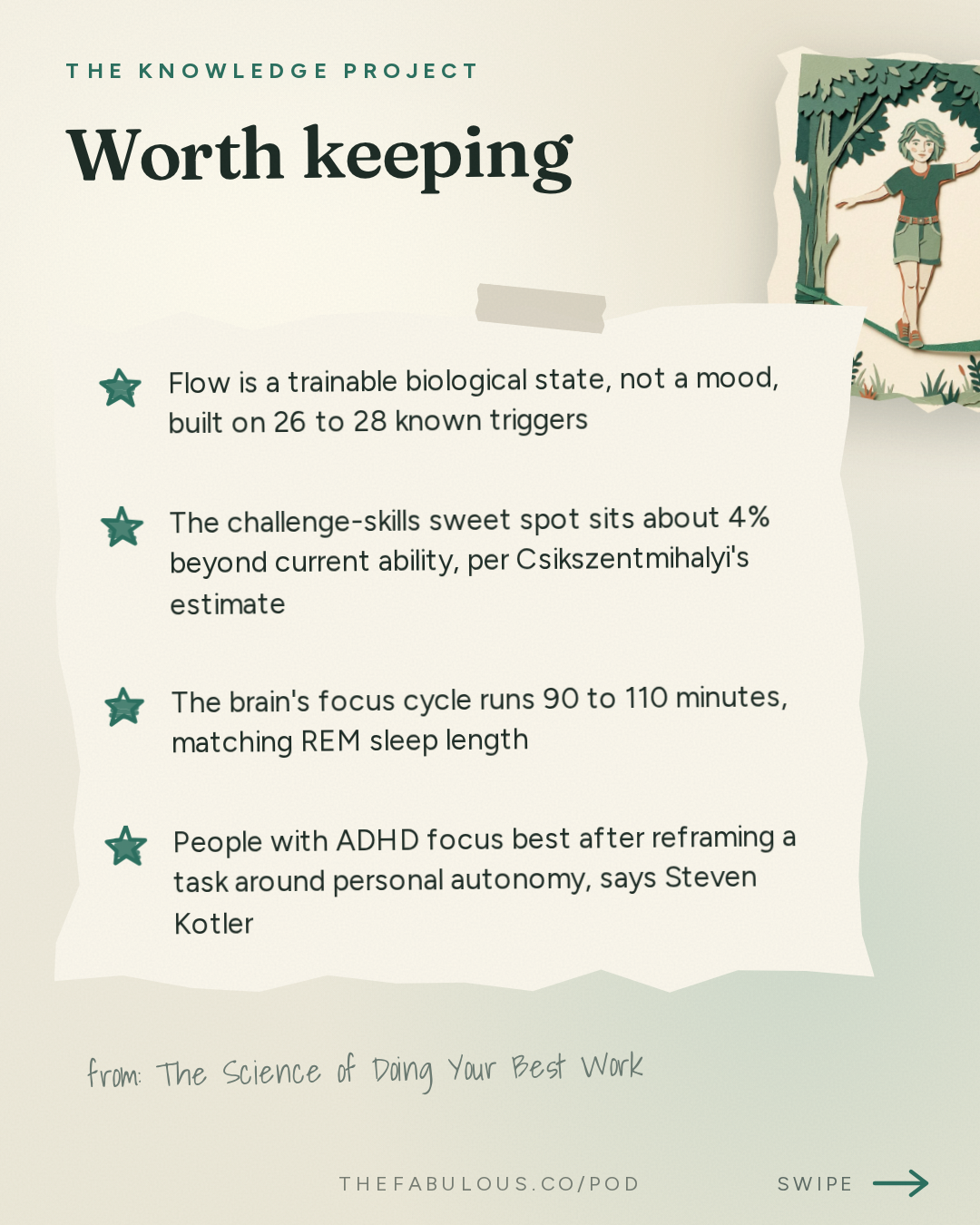
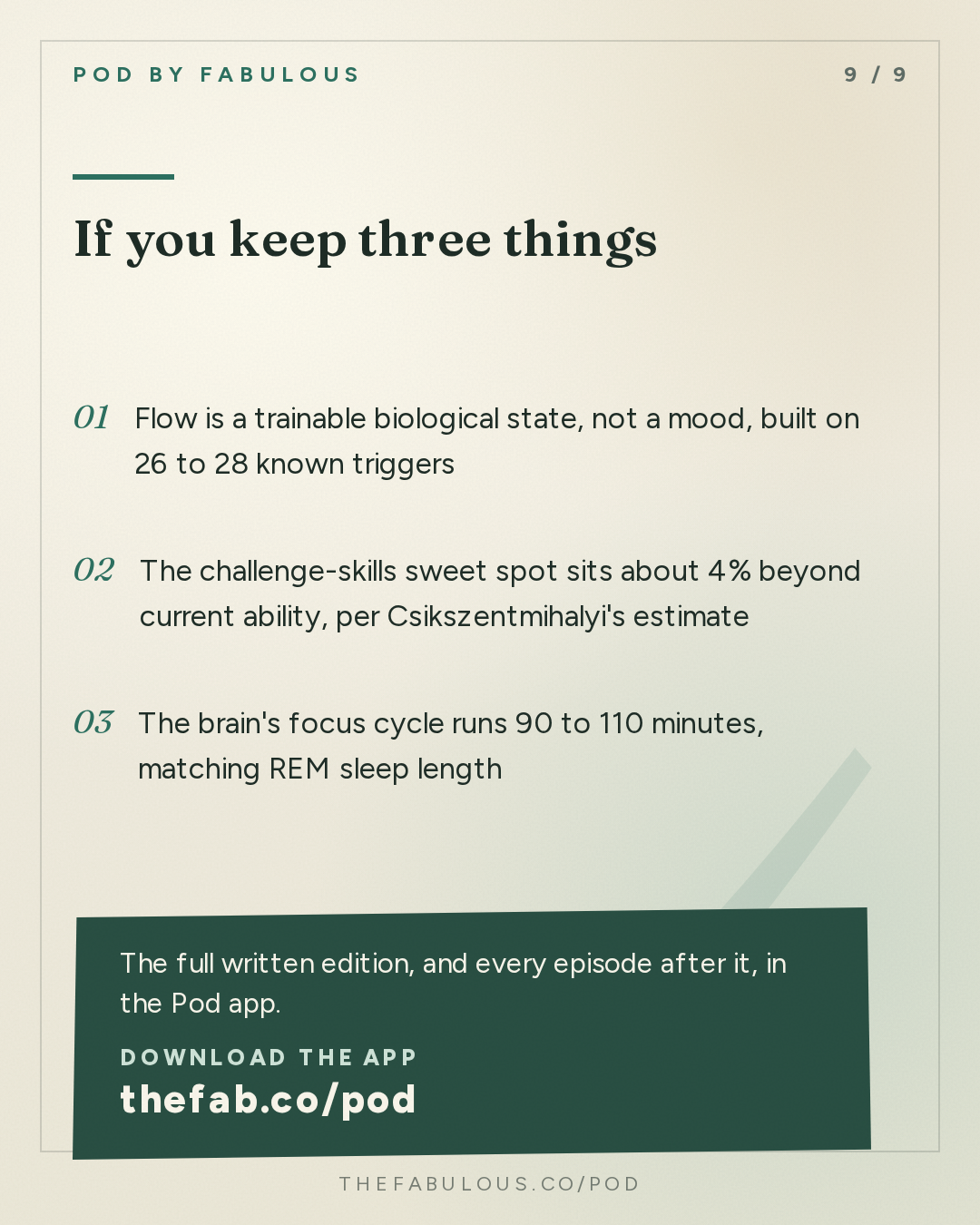
- Flow is a trainable biological state, not a mood, built on 26 to 28 known triggers
- The challenge-skills sweet spot sits about 4% beyond current ability, per Csikszentmihalyi's estimate (09:31)
- The brain's focus cycle runs 90 to 110 minutes, matching REM sleep length (13:43)
- People with ADHD focus best after reframing a task around personal autonomy, says Steven Kotler (16:32)
- Flow may speed learning by 230% and help reset the nervous system in autoimmune illness (24:06, 58:03)
The episode in cards


By the numbers
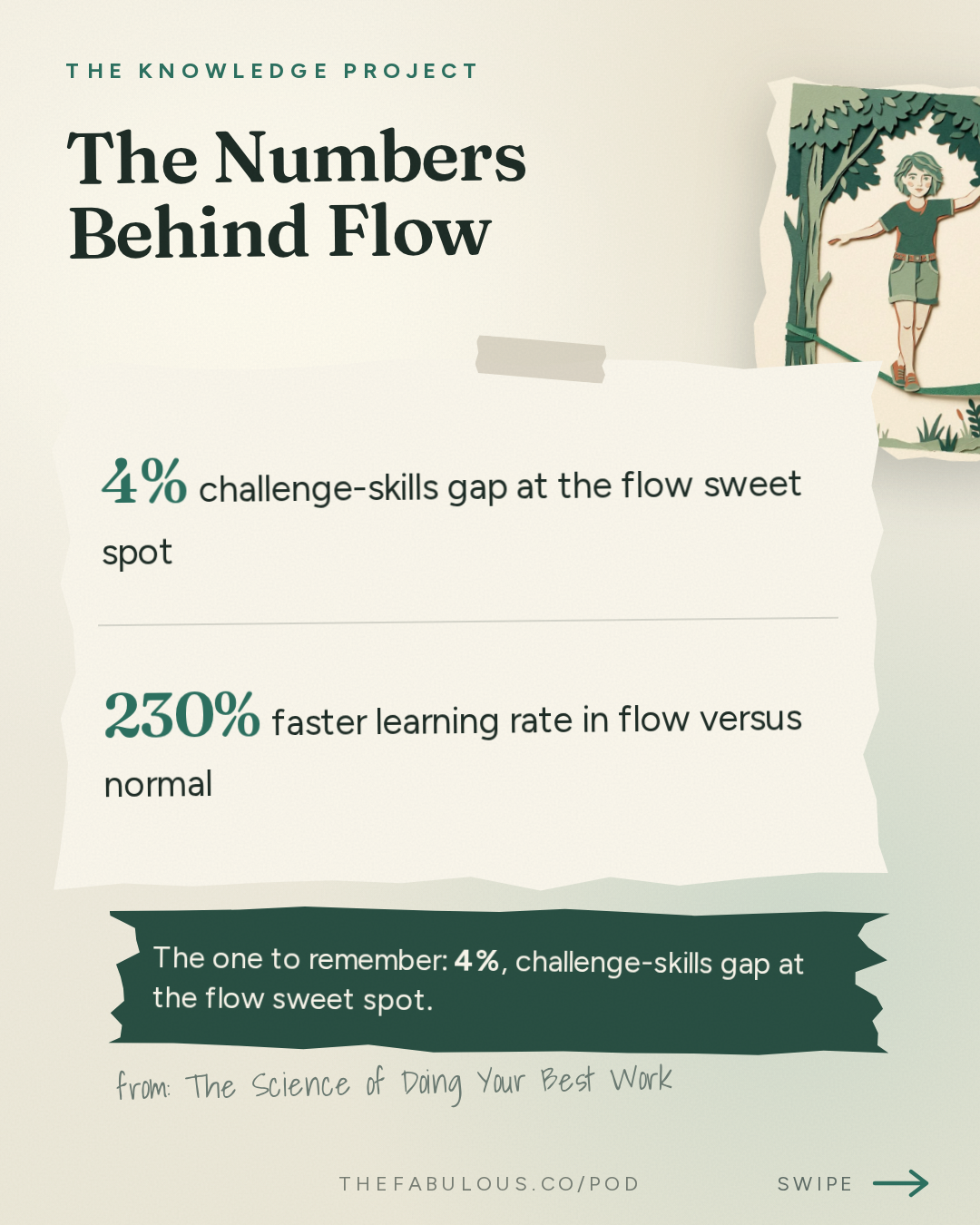
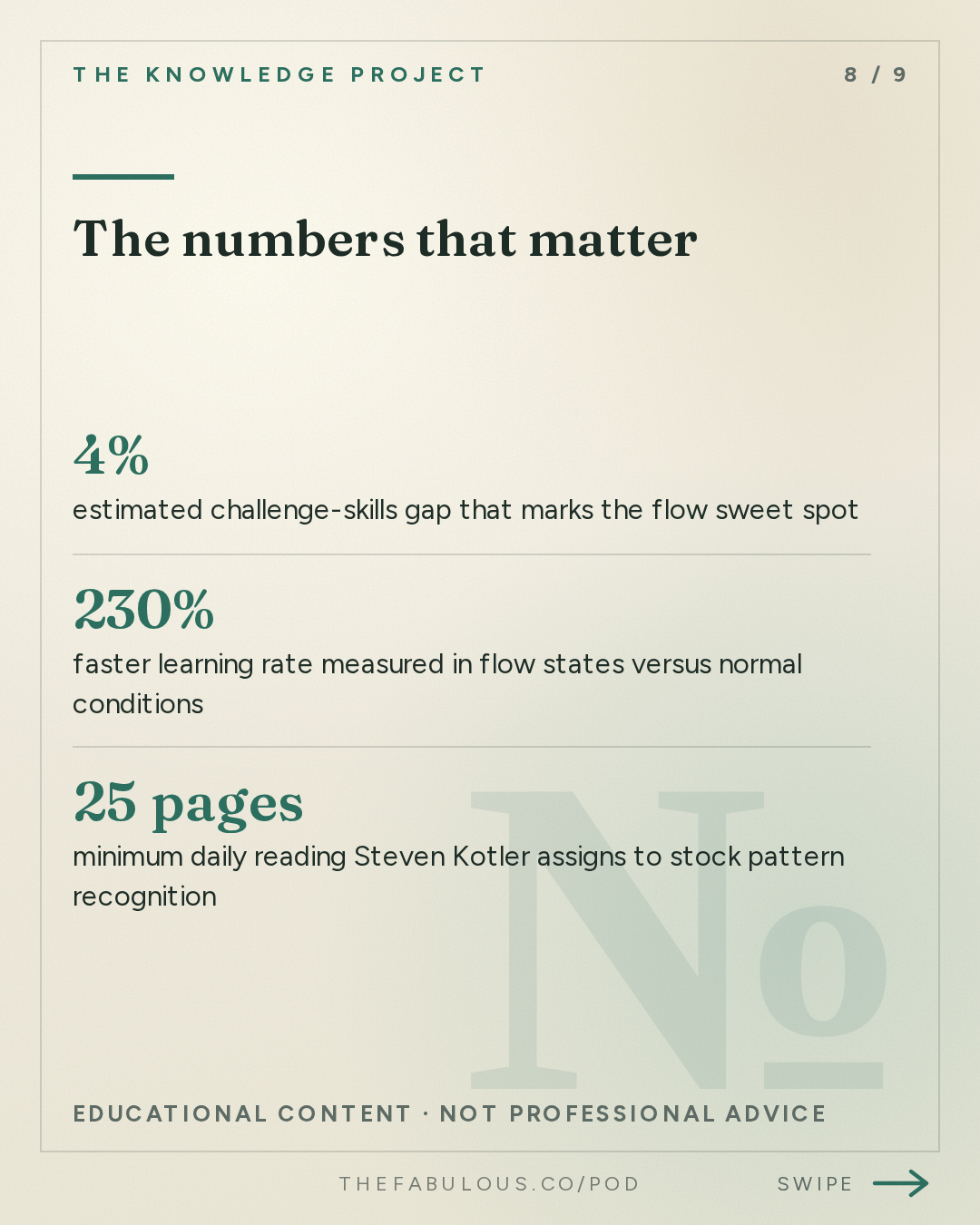
- 4% percent estimated challenge-skills gap that marks the flow sweet spot
- 230% percent faster learning rate measured in flow states versus normal conditions
- 25 pages minimum daily reading Steven Kotler assigns to stock pattern recognition
In their words
“But it's technically defined as an optimal state of consciousness where we feel our best and perform our best”
“ADHD, the problem isn't I can't focus. The problem is I can't focus on shit I don't care about.”
“If you wanna think better, you have to start by reading more.”
“You don't really know what you're capable of 'cause you can only find out inside a flow.”
Protocols
-
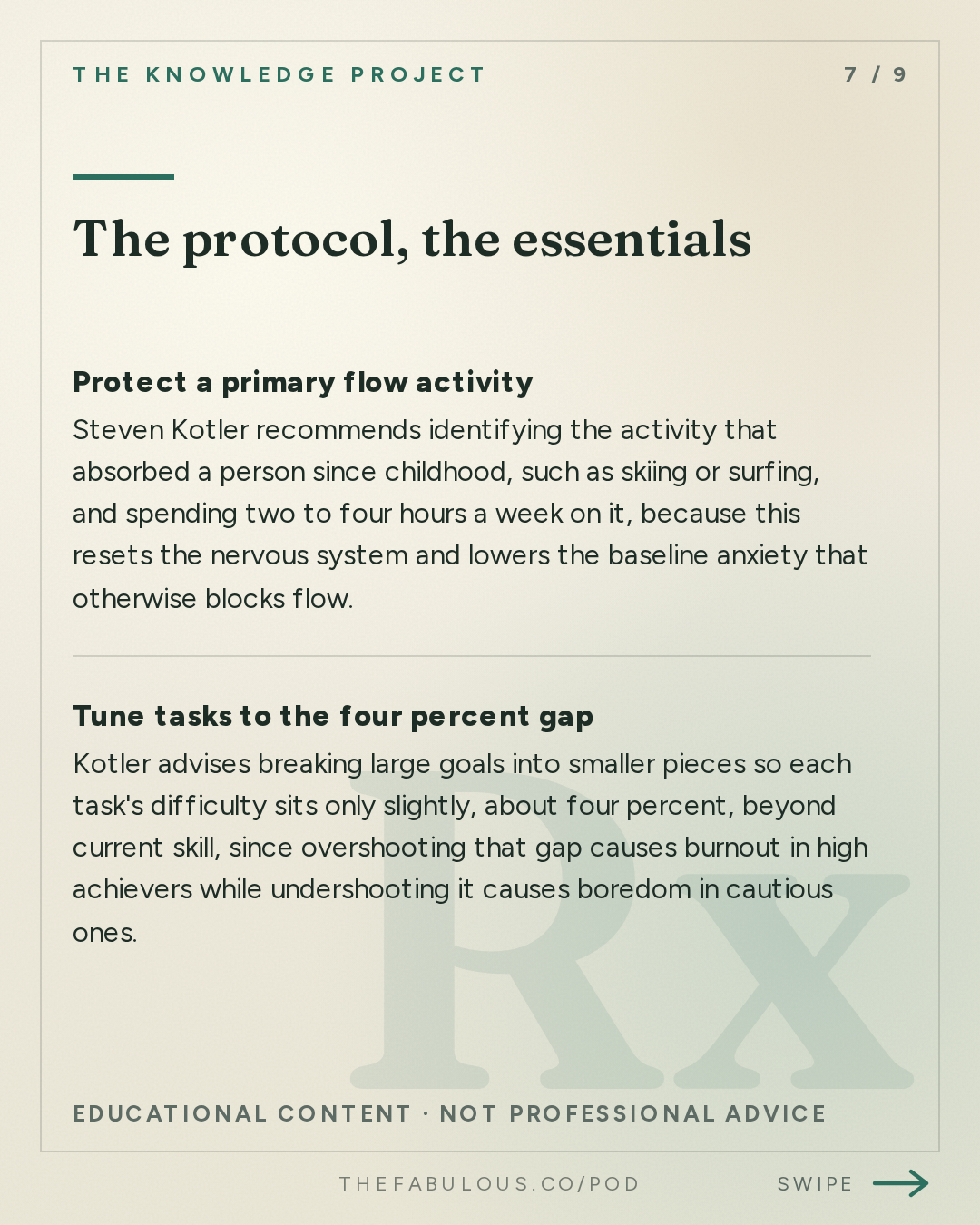
Protect a primary flow activity
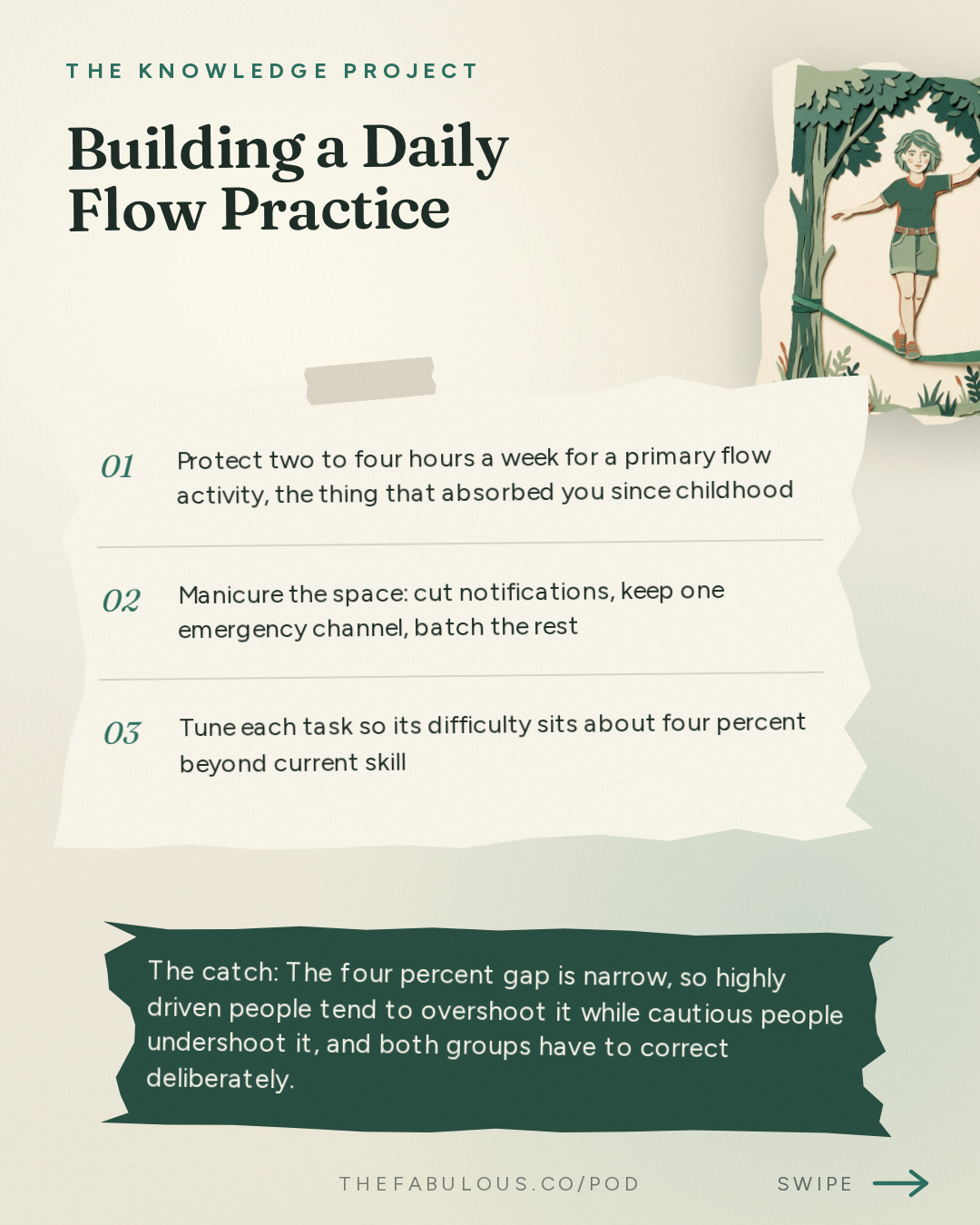
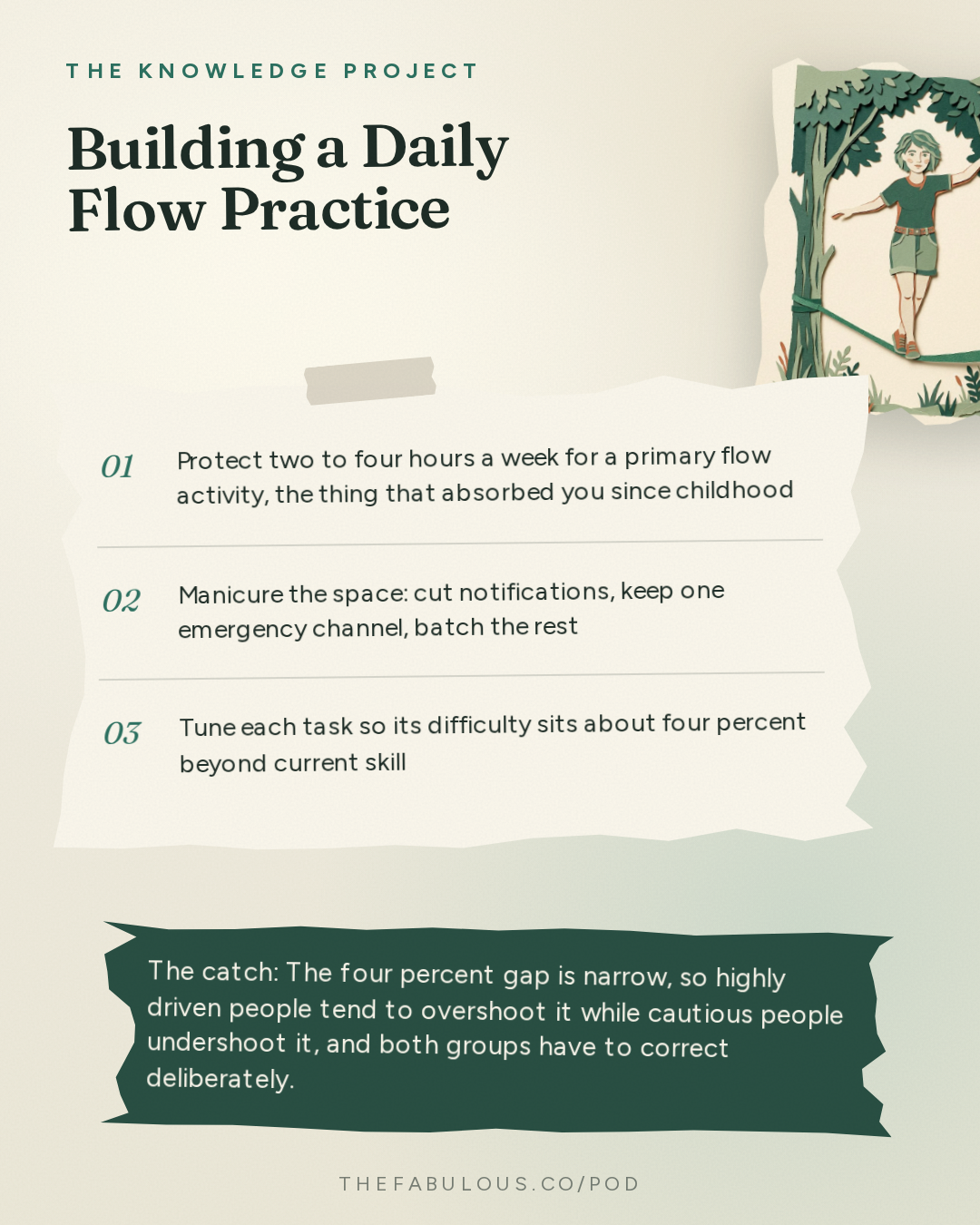
Steven Kotler recommends identifying the activity that absorbed a person since childhood, such as skiing or surfing, and spending two to four hours a week on it, because this resets the nervous system and lowers the baseline anxiety that otherwise blocks flow.
2 to 4 hours per week
-
Tune tasks to the four percent gap
Kotler advises breaking large goals into smaller pieces so each task's difficulty sits only slightly, about four percent, beyond current skill, since overshooting that gap causes burnout in high achievers while undershooting it causes boredom in cautious ones.
ongoing, task by task
-
Limit and batch communication channels
Kotler keeps only one communication channel open for true emergencies and batches all other messages to set times in the morning and evening, which lowers cognitive load and frees attention for deep focus.
daily
-
Read 25 pages a day
Kotler has clients read a minimum of 25 pages daily, mostly from books rather than articles, to keep feeding the brain's pattern recognition system new raw material, since without new input the brain has nothing fresh to connect into creative or strategic ideas.
daily
-
Reframe tasks around autonomy for ADHD
Kotler suggests finding the fraction of an assigned task that connects to personal purpose or goals before starting it, because attention and autonomy are coupled in the brain and focus will not commit fully to a direction someone else chose.
before each difficult task
Questions this episode answers
What are flow state triggers?
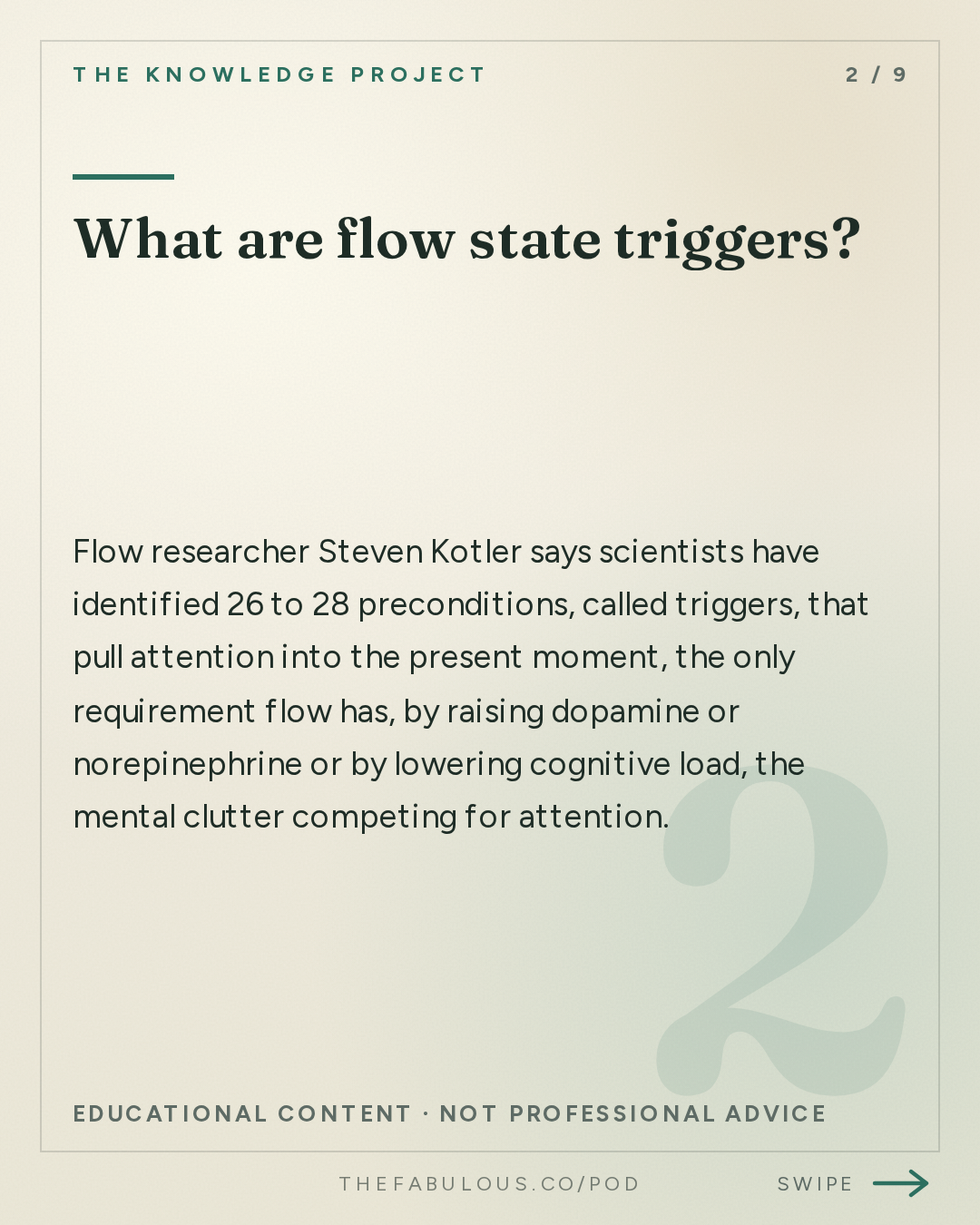
Flow researcher Steven Kotler says scientists have identified 26 to 28 preconditions, called triggers, that pull attention into the present moment, the only requirement flow has, by raising dopamine or norepinephrine or by lowering cognitive load, the mental clutter competing for attention (04:21).
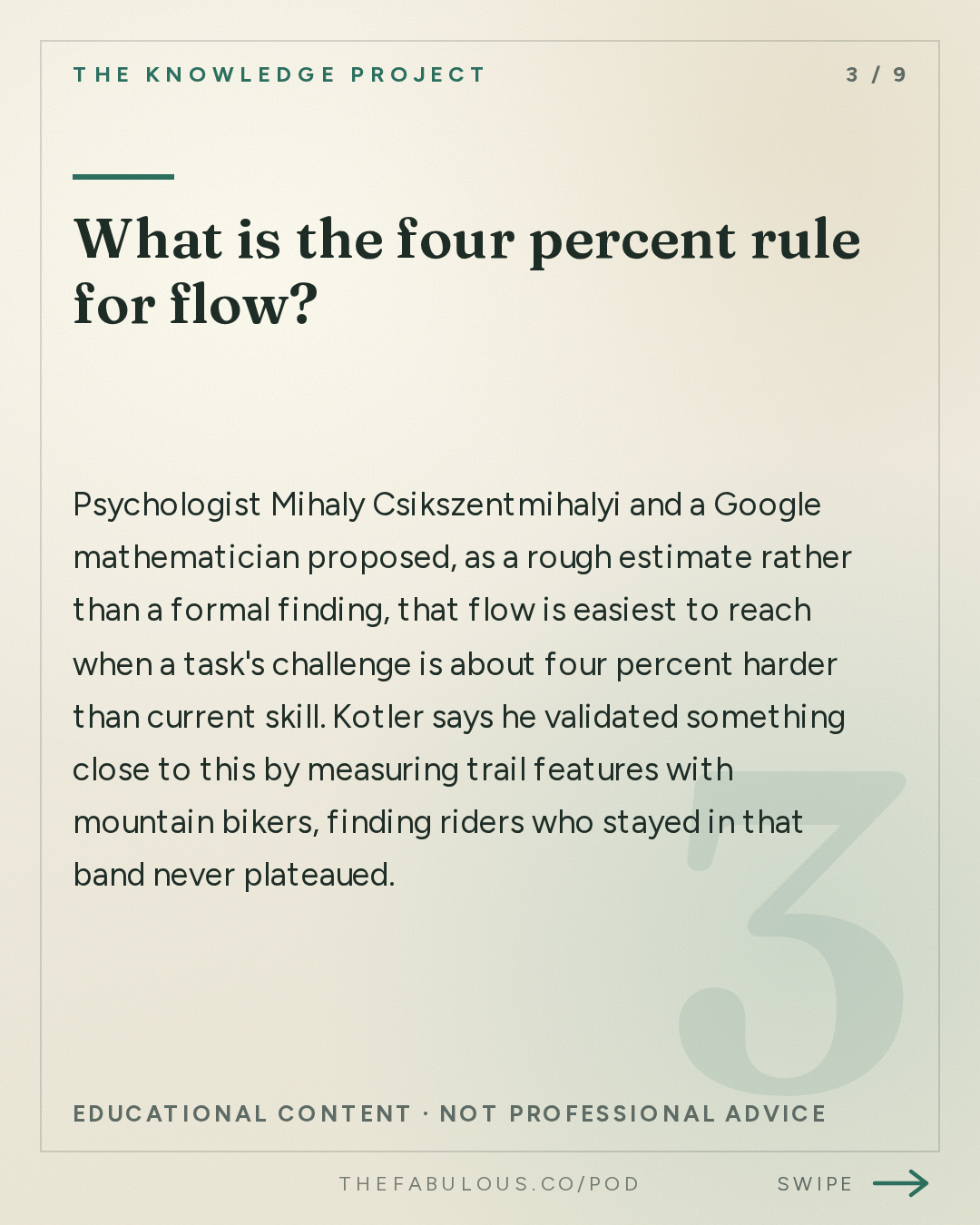
What is the four percent rule for flow?
Psychologist Mihaly Csikszentmihalyi and a Google mathematician proposed, as a rough estimate rather than a formal finding, that flow is easiest to reach when a task's challenge is about four percent harder than current skill. Kotler says he validated something close to this by measuring trail features with mountain bikers, finding riders who stayed in that band never plateaued (09:31).
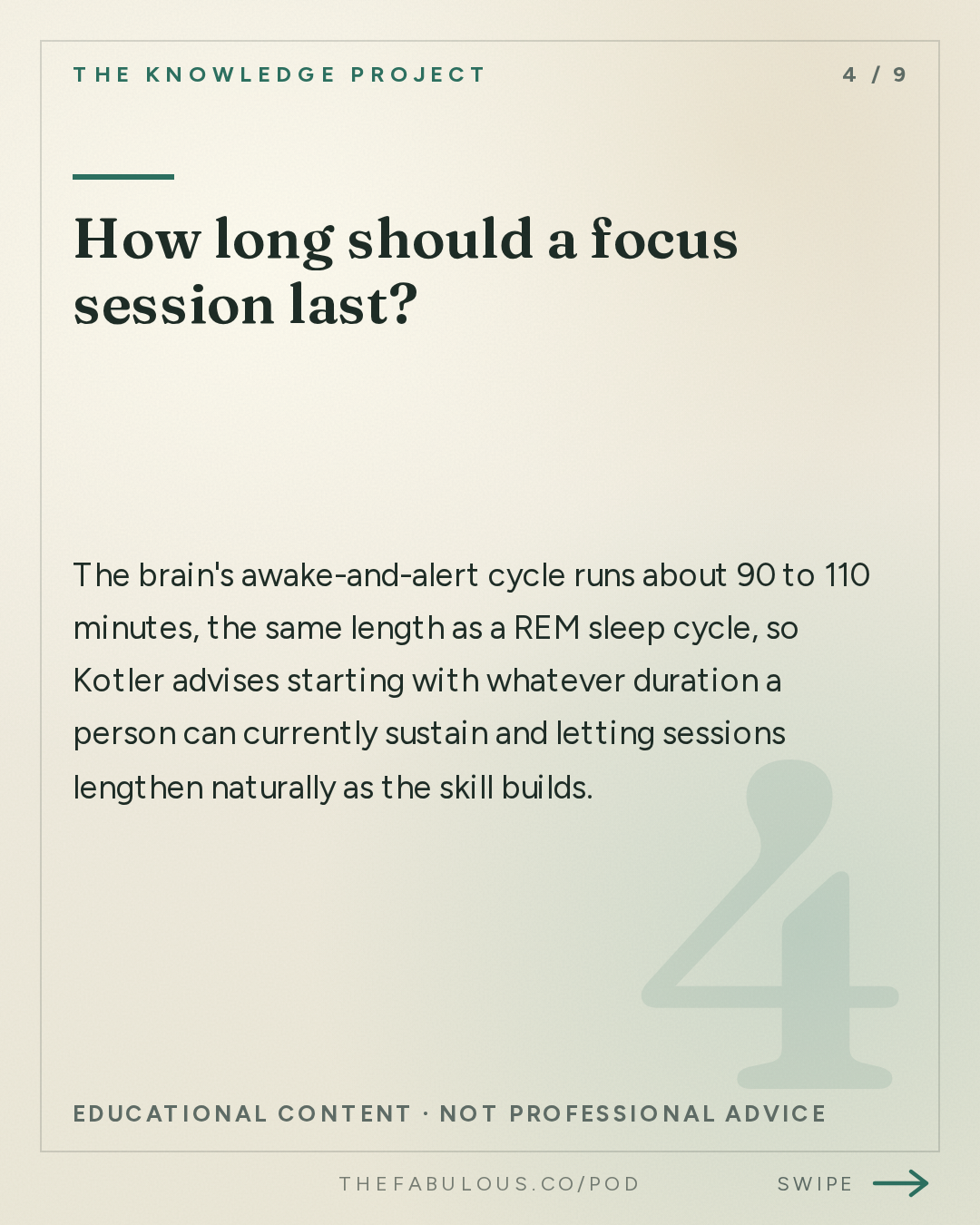
How long should a focus session last?
The brain's awake-and-alert cycle runs about 90 to 110 minutes, the same length as a REM sleep cycle, so Kotler advises starting with whatever duration a person can currently sustain and letting sessions lengthen naturally as the skill builds (13:43).
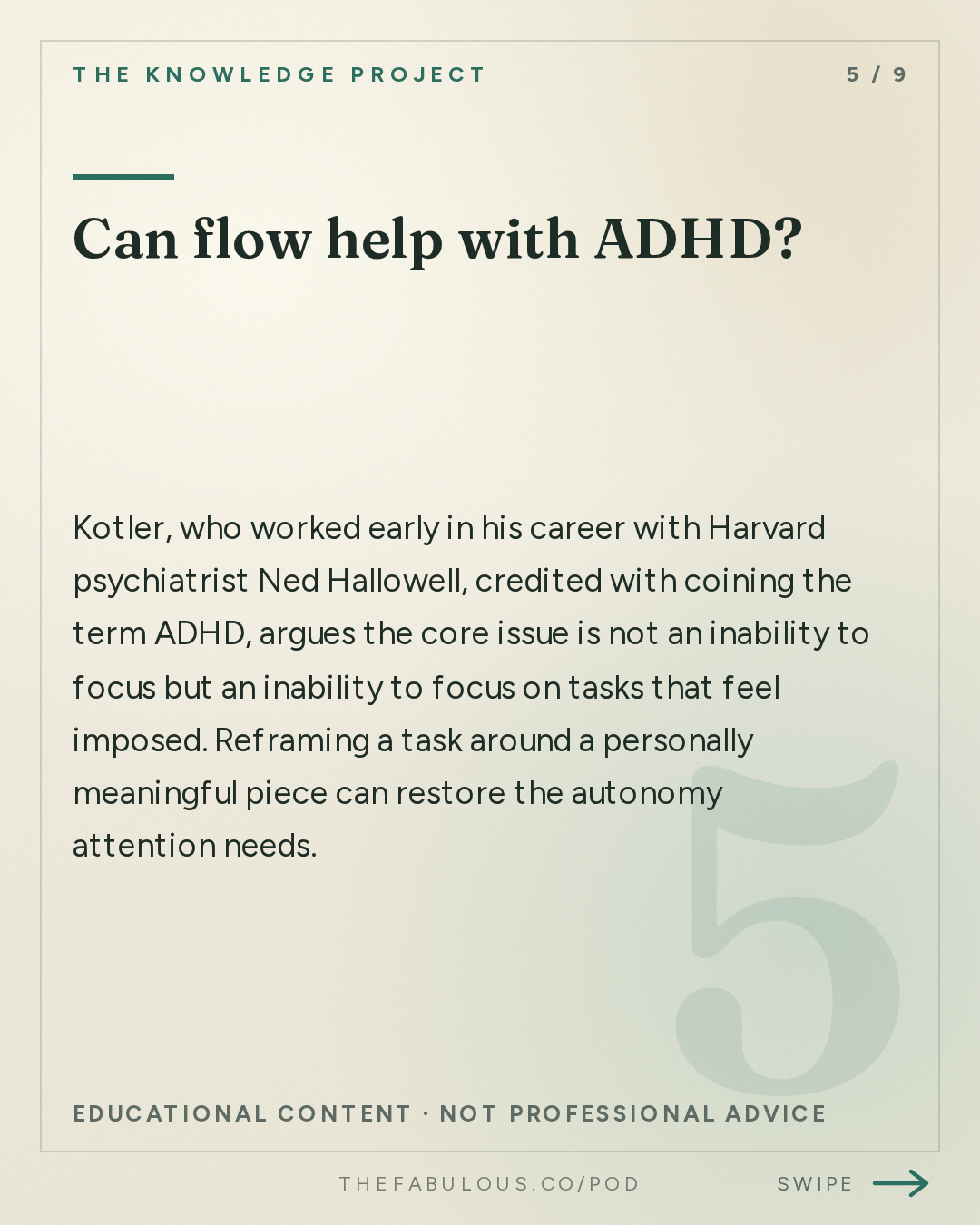
Can flow help with ADHD?
Kotler, who worked early in his career with Harvard psychiatrist Ned Hallowell, credited with coining the term ADHD, argues the core issue is not an inability to focus but an inability to focus on tasks that feel imposed. Reframing a task around a personally meaningful piece can restore the autonomy attention needs (16:08).
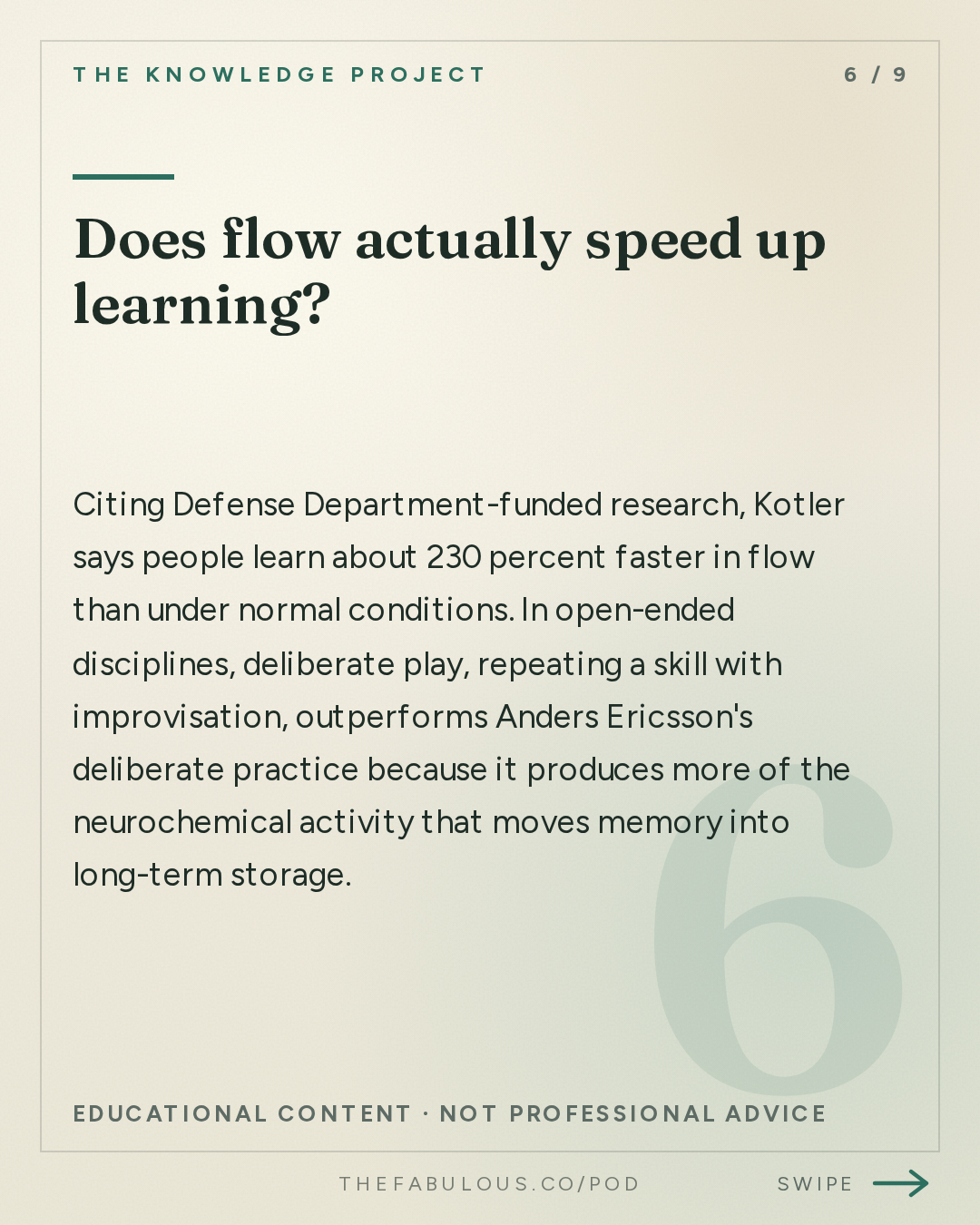
Does flow actually speed up learning?
Citing Defense Department-funded research, Kotler says people learn about 230 percent faster in flow than under normal conditions. In open-ended disciplines, deliberate play, repeating a skill with improvisation, outperforms Anders Ericsson's deliberate practice because it produces more of the neurochemical activity that moves memory into long-term storage (24:06).
Can flow help autoimmune conditions?
Kotler points to Harvard cardiologist Herb Benson's mapping of flow's four-stage neurochemical cycle, arguing that the nitric oxide release triggered by flow pushes out stress hormones and helps reset a nervous system that has lost its sense of baseline, which he describes as a deeper problem in autoimmune disease (58:03).
The full read, in cards

Go deeper
- The Breakout Principle — Herb Benson's book mapping flow's four-stage neurochemical cycle and linking it to spontaneous healing
- Rise of Superman — Kotler's book distilling fifteen years of research into flow and action sports
- West of Jesus — Kotler's memoir covering his Lyme disease recovery through surfing
- Pathfinding: A neurodynamical account of intuition — Research finding that frustration during learning predicts later intuitive breakthroughs
- The Body Doesn't Keep the Score (Frontiers in Neuroscience rebuttal) — Kotler's co-authored article challenging Bessel van der Kolk's trauma framework
Mentioned
Mihaly Csikszentmihalyi · Flow Research Collective · Zero to Dangerous · Anders Ericsson · Ned Hallowell · Cal Newport · Josh Waitzkin · Herb Benson · Colleen Seifert
More from this show and category

Charlie Munger's Todd Combs Interview: Key Lessons
Charlie Munger told Berkshire Hathaway manager Todd Combs in a 2022 interview that temperament, not raw intelligence, decides who wins at investing and leadership. He explains the "fiduciary gene," the Wooden Lesson of concentrating resources behind rare talent, and why positioning, holding cash and options before a crisis hits, beats trying to predict crashes like 1974's.

Ryan Serhant's Sales and Productivity Tactics
Real estate broker Ryan Serhant says willingness to be embarrassed is what separates top earners from everyone else. He built his career on a future-me identity he manifests over 12 to 24 months, a daily budget of 1,000 productive minutes, and follow-ups that sometimes took five years before closing multimillion-dollar deals.
Ryan Serhant's Sales and Productivity Secrets
Ryan Serhant, star of Million Dollar Listing and founder of real estate firm Serhant, says comfort with embarrassment separates top earners from everyone else. He outlines his 1,000 minutes rule for guarding daily time, a hook-help-ask sales framework, and why distribution matters more than product quality.
Charlie Munger's Lessons from Henry Singleton
In a 2022 conversation, Charlie Munger tells Todd Combs that investing success rests on finding rare talent, choosing solvable problems, and smart positioning. The through-line is positioning: arranging affairs so circumstances never force bad decisions, as Munger explains using Rockefeller, Teledyne founder Henry Singleton, and the 1974 market crash.
