
Jon McNeill on How Elon Musk Scales Companies
How Elon Musk Solves Problems | Jon McNeill
▶ Listen to the full episode More from The Knowledge Project
The brief
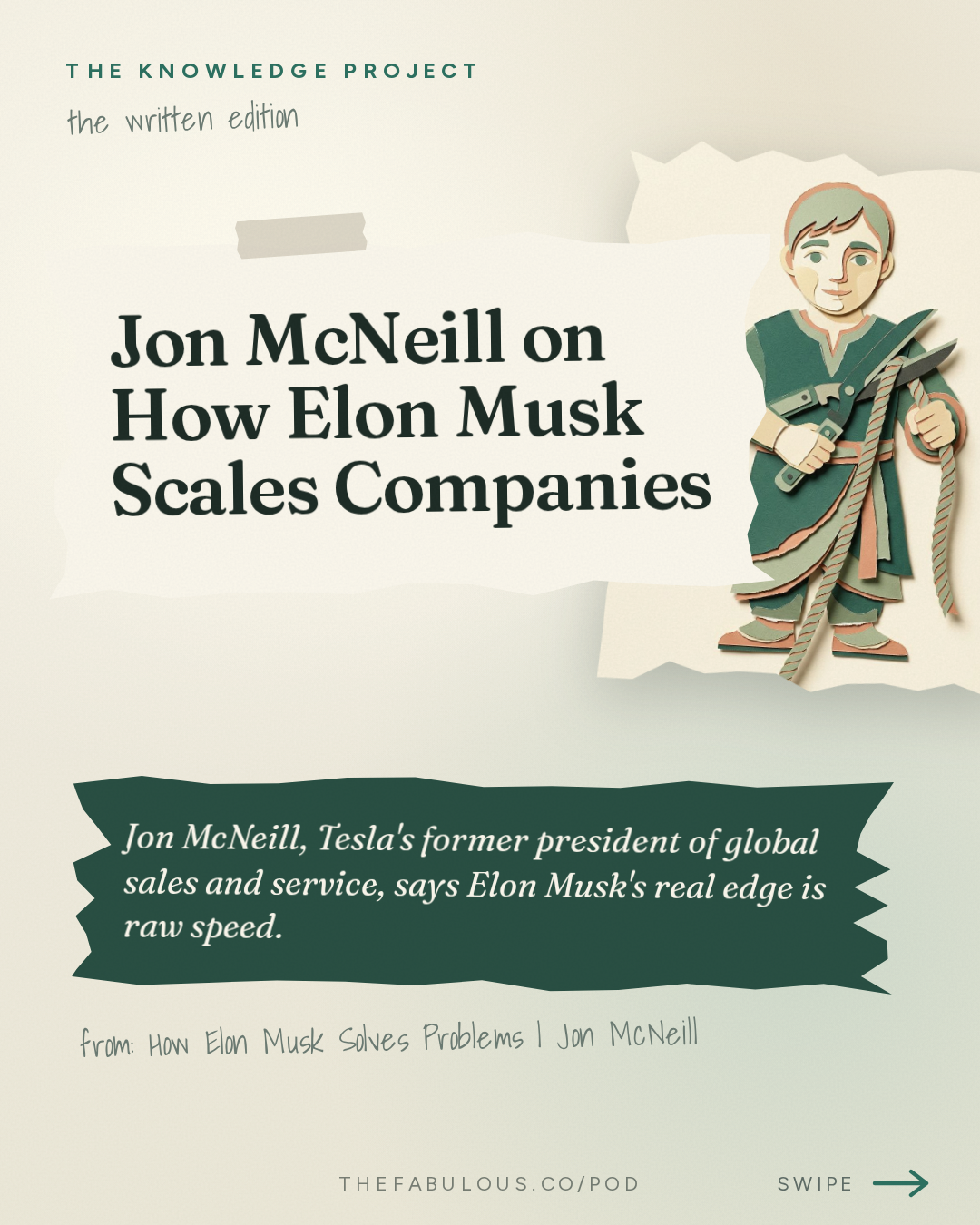
Jon McNeill, Tesla's former president of global sales and service, says Elon Musk's real edge is raw speed. McNeill explains the five-step Algorithm for scaling (question requirements, cut steps, simplify, speed up, automate last), the three-sentence email rule, and how a 10,000-lead sales fix doubled orders almost overnight.
Jon McNeill's first real meeting with Elon Musk was not a job interview. It was a walk. McNeill, who would go on to run global sales and service at Tesla and later serve as Lyft's chief operating officer, met Musk at the SpaceX factory and ended up spending two hours pacing the Model X line with him, trying to solve a manufacturing problem that had stumped engineers for weeks (00:23). Workers bolting on the car's falcon wing doors had to do it blind, reaching underneath and drilling upside down. McNeill asked if anyone had tried a jig, a simple guide that holds parts in place so workers can't misalign them. Musk said no one had. They built one that night (02:07).
That story is the spine of McNeill's new book on how Musk's companies operate, and of this conversation. The lesson is not about jigs. It is about the gap between noticing a problem and acting on it, a gap Musk tries to close to almost nothing. McNeill says Musk told him once that success means two people, given the same information, arrive at the same answer.
"What success looks like is if you and I have the same inputs, we come up with the same answer." - Jon McNeill [00:52]
That sounds like a riddle, but it is really a hiring filter. Musk wasn't looking for someone to defer to him. He wanted someone whose reasoning would converge with his own, so decisions could move at the speed of one mind instead of a committee.
Speed shows up again in the story McNeill tells about his first weeks at Tesla, before he'd technically started. Musk told him the company's biggest problem was demand. Tesla had promised Wall Street 12,000 cars that quarter and had sold only 3,000 a month and a half in (04:04). McNeill went undercover, taking test drives at eight stores under different email addresses, and got no follow-up calls from any of them. He asked the head of sales operations how many test-drive customers in the past 30 days had never been called back. The answer: 10,000 (05:28). Salespeople had plenty of incentive to give test drives, since that counted as activity, but no commission and no real incentive to close. McNeill had sales operations cut off new leads to any rep until they'd called back every one of their old ones. Orders poured in within a day. He hadn't technically started the job yet, and he'd just made a company-wide decision without asking permission. He called Musk to apologize. After a long silence, Musk told him it was a great call and he'd fit in fine (07:07). The incident taught McNeill something Charlie Munger, the investor and longtime Berkshire Hathaway vice chairman, had written about for years: if you want to understand how a system actually works, follow the incentives.
"If you wanna know how a system works, follow the incentives." - Jon McNeill [14:13]
Three Sentences, No Hierarchy
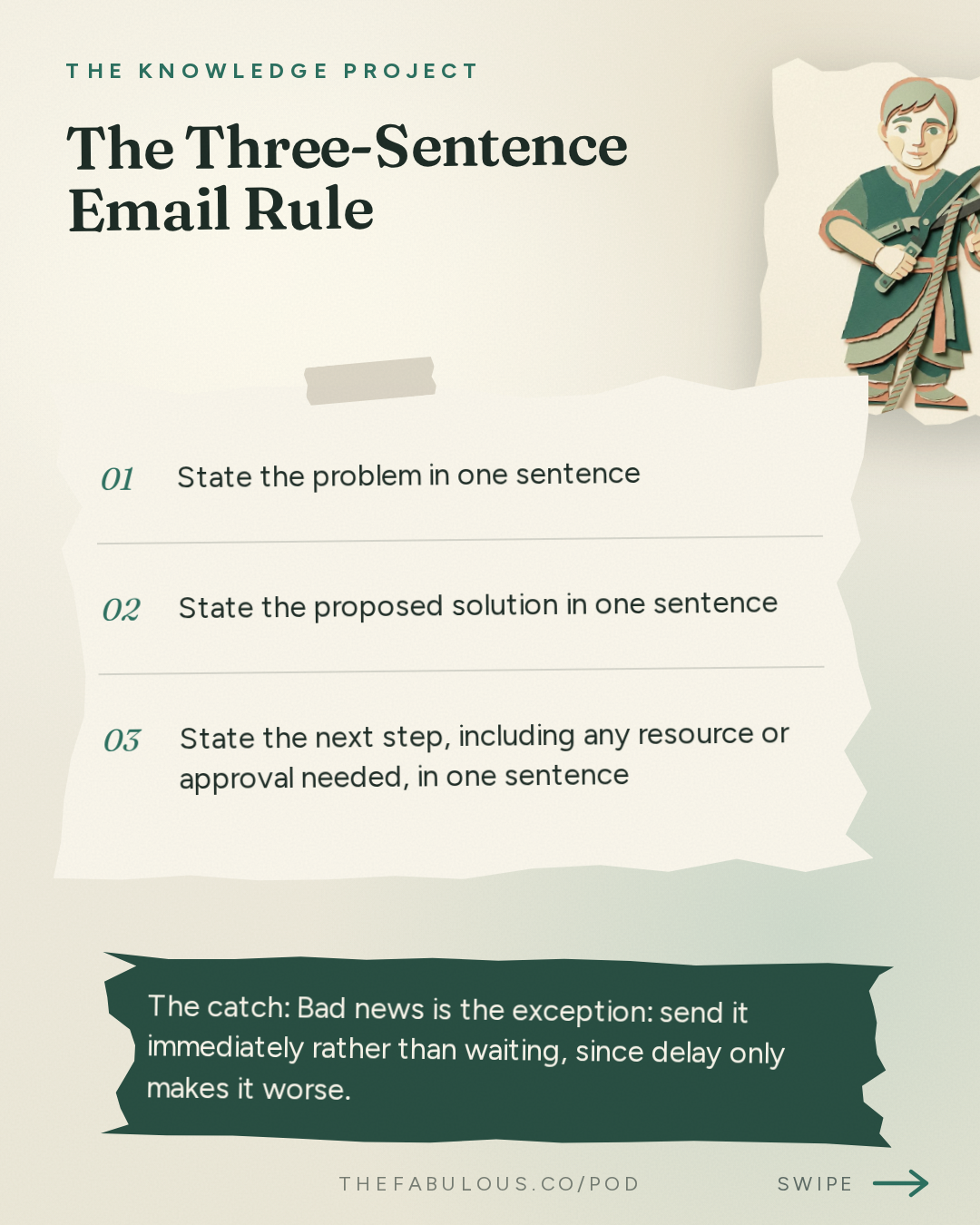
Tesla's internal culture, as McNeill describes it, ran flat on purpose. Instead of questions climbing up a management chain and answers climbing back down, which he compares to the jagged line of an EKG, Musk wanted communication to go straight across the organization, person to person (08:05). To keep that fast, he and McNeill tried running the company on three-sentence emails: state the problem, state the proposed solution, state the next step, and ask for any resource or approval you need in that same sentence (09:31). The other rule was about bad news: send it the moment you know, because it only gets worse with time (10:25).
Underneath the communication style was a theory about risk that McNeill says shaped nearly every major call at Tesla. Musk believed the highest skill in business is allocating capital, because doing it well means assessing risk correctly before you commit money (15:51). McNeill started framing decisions the way a poker player sizes a bet: look for asymmetry. If the downside is much bigger than the upside, don't make the bet unless you can shrink the downside first. If the upside dwarfs the downside, move.
That same bias toward motion over certainty runs through McNeill's cheat sheet for good decisions, laid out in four steps: define the actual outcome you want, figure out what has to be true to get there, estimate what it will cost, then plot impact against effort to decide what's worth doing now versus what goes on the no list (22:45). He credits Meta's former chief operating officer Sheryl Sandberg, who introduced him to Musk, with the idea that your no list should be longer and clearer than your yes list. The same comfort with incomplete information applies outside the office. Waiting for perfect certainty before starting, McNeill argues, just means falling behind people who started anyway and are already learning from their mistakes.
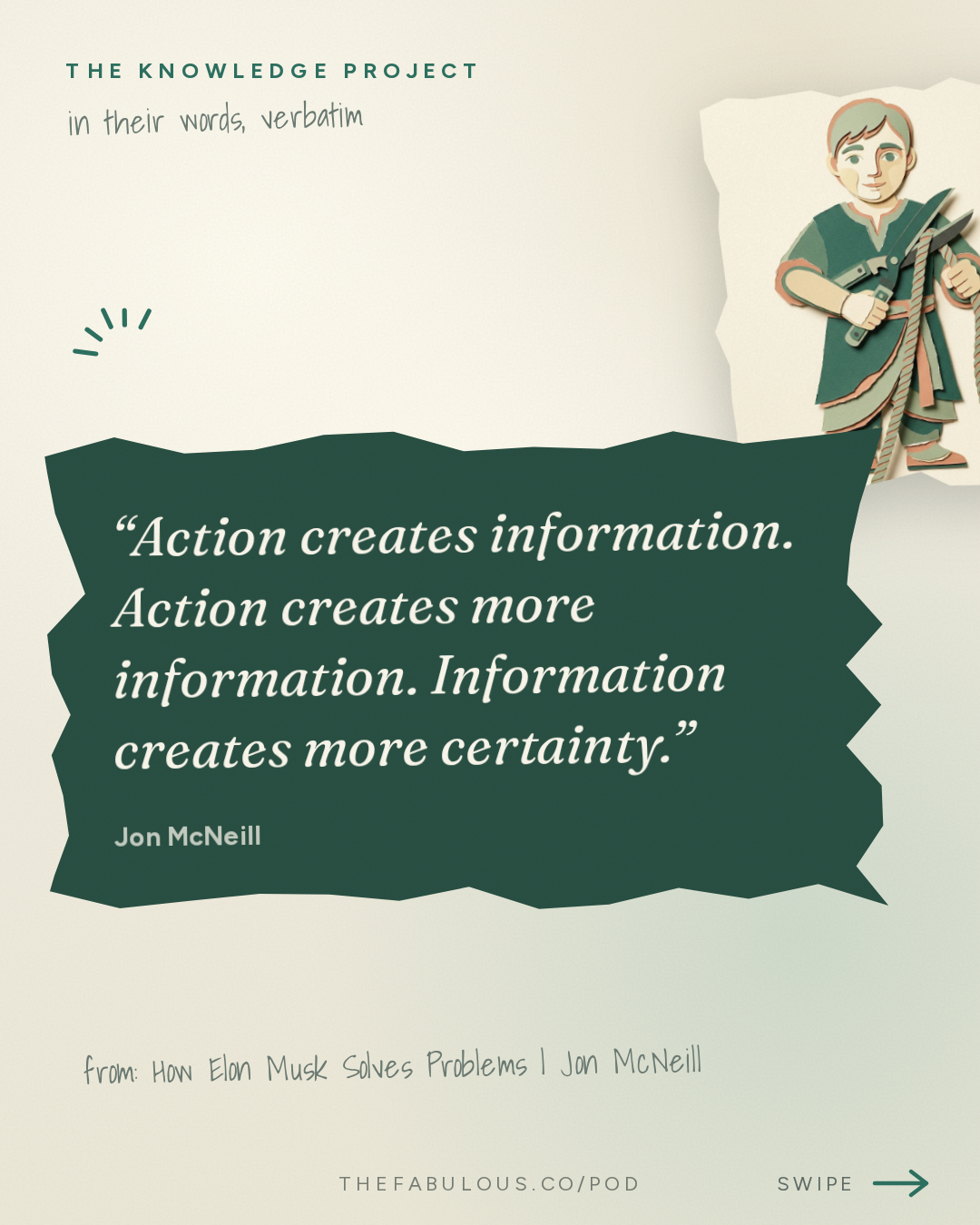
"Action creates information. Action creates more information. Information creates more certainty." - Jon McNeill [27:31]
The Algorithm
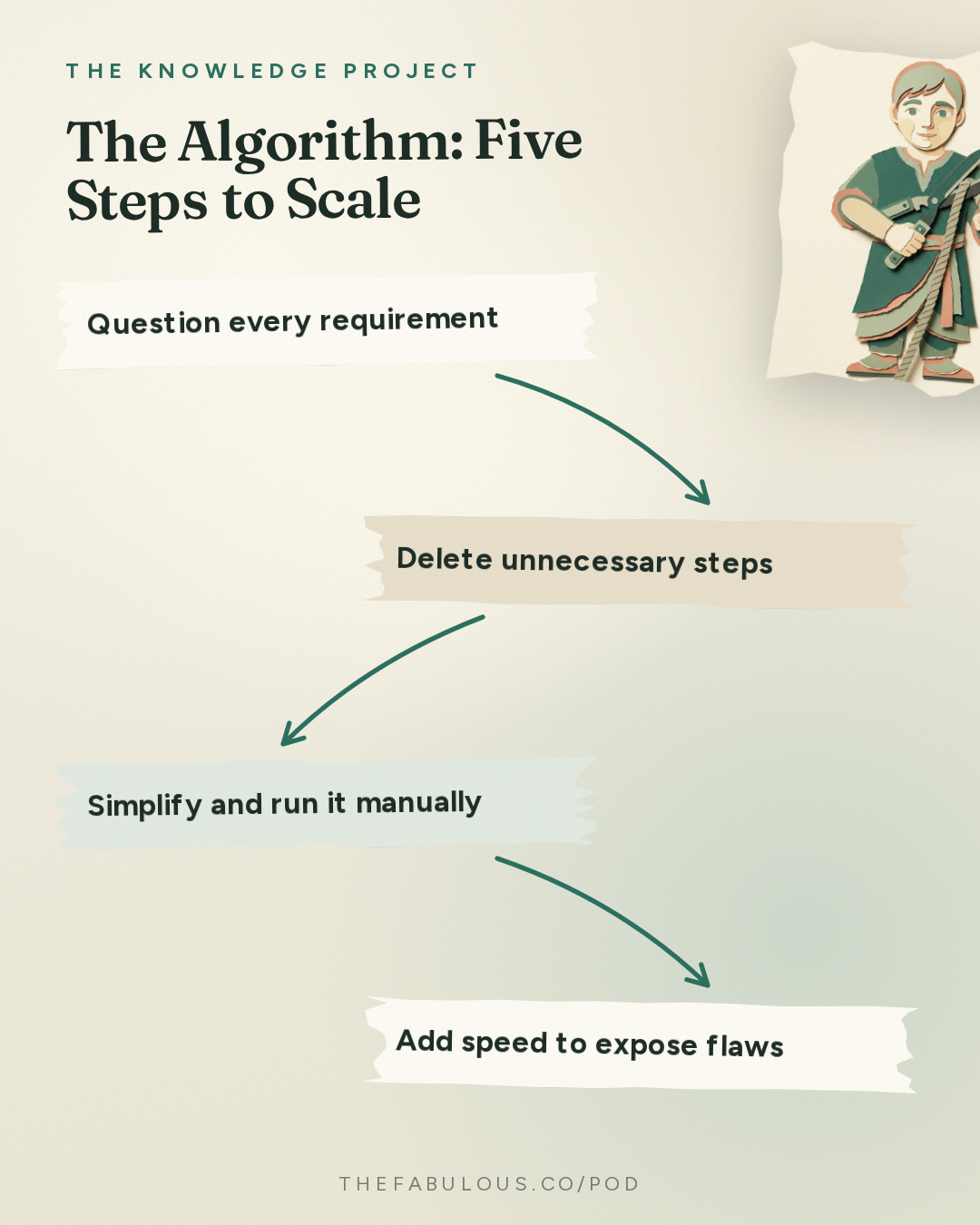
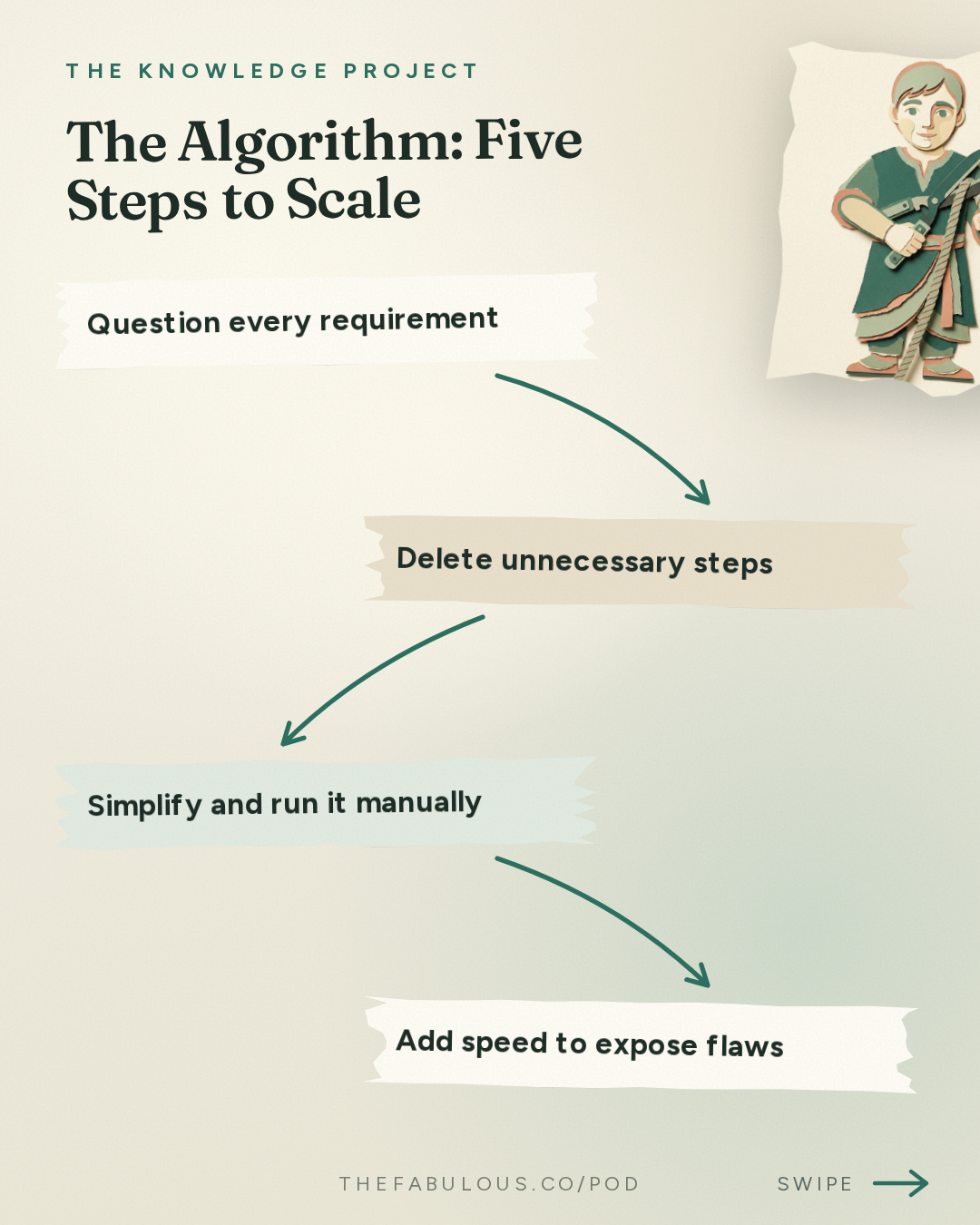
McNeill titled his book The Algorithm, after a five-step framework he says Musk's companies use to scale without drowning in their own complexity (55:48). Step one: question every requirement, and delete the ones that aren't real or don't make sense, even ones nobody remembers the reason for (57:02). Step two: delete unneeded steps from whatever process remains, something McNeill's teams did literally, mapping a workflow on sticky notes and circling only the steps a customer actually pays for (57:26). Step three: run the simplified process by hand and work out its kinks before adding any technology (57:47). Step four: add speed on purpose, because going faster exposes every weak point a slow process can hide (58:12). Step five, and only step five: automate (58:33). Tesla's engineers had learned the hard way that automating a broken process just locks the mistakes in faster.
The clearest illustration McNeill gives of simplifying a requirement down to its studs comes from Steve Jobs, the Apple co-founder, not Musk. McNeill had breakfast with Jobs' former chief of staff, who described how the original iPod got built. Before any engineering began, Jobs and his team spent a week in a room until they agreed on exactly two requirements: the device had to hold 1,000 songs, something no hardware at the time could do, and a user had to be able to find any song in four seconds or less (44:03, 44:37). Everything else, including an FM radio that Samsung's competing player had, got rejected with one question: does that get us to 1,000 songs or four seconds? If not, it didn't belong. Tesla borrowed that discipline directly. Doug Field, the engineering leader who worked for both Jobs and Musk, once demonstrated a plan to replace half of Tesla's factory floor, the half where robots welded a car's skeleton together, by rolling a toy Hot Wheels car across a conference table. His team had found a way to cast half of a car's chassis from liquid aluminum, a process physicists had considered impossible at that scale (52:00). It gave Tesla what McNeill calls an eight-year head start on competitors, because the company could build factories in a fraction of the usual time (53:08).
Not every fix required an engineering breakthrough. McNeill compares an unmanaged business process to an untended garden: weeds grow if nobody goes back with a weed whacker (64:59). Musk would periodically question tools the company had used for years without re-examining them, once asking McNeill point blank whether Tesla even needed its Salesforce subscription, since every new seat was effectively a tax on growth (65:19). McNeill picked up a parallel habit from Calvin McDonald, Lululemon's chief executive at the time: once a year, imagine being hit by a bus or fired, and list the obvious moves your successor would make immediately. Then ask why you aren't already doing them (72:23).
McNeill's current work, a venture studio called DVX Ventures that has launched 17 companies, runs on a similarly blunt filter. Before DVX will build a company around an idea, five things have to be true: a market big enough to matter, confirmed through actual customer calls rather than research reports; gross margins above 50 percent; a genuinely hard technical problem standing in the way, since solving it creates a moat competitors can't easily cross; a competitive field that isn't already crowded; and real buyer interest, meaning someone besides the founders would actually want to own the company (96:38).
What ties all of it together, from the falcon wing door jig to the Algorithm to the yearly bus-test exercise, is a refusal to let a process or a requirement survive on inertia alone. McNeill's closing argument is less about Musk's genius than about a discipline anyone can borrow: ask why a thing is built the way it's built, strip out what isn't earning its place, and then, only then, go fast.
Ask this episode anything
Pod's AI answers from the episode itself, with the minute mark so you can hear it yourself.
Or start with one of these
Ask this episode
Pod's AI listens to the whole episode to answer, and points you to the minute it comes from.
The rest of this answer, and any question after it
Answers come from the episode itself, never from a summary of it.
ContinueKey takeaways
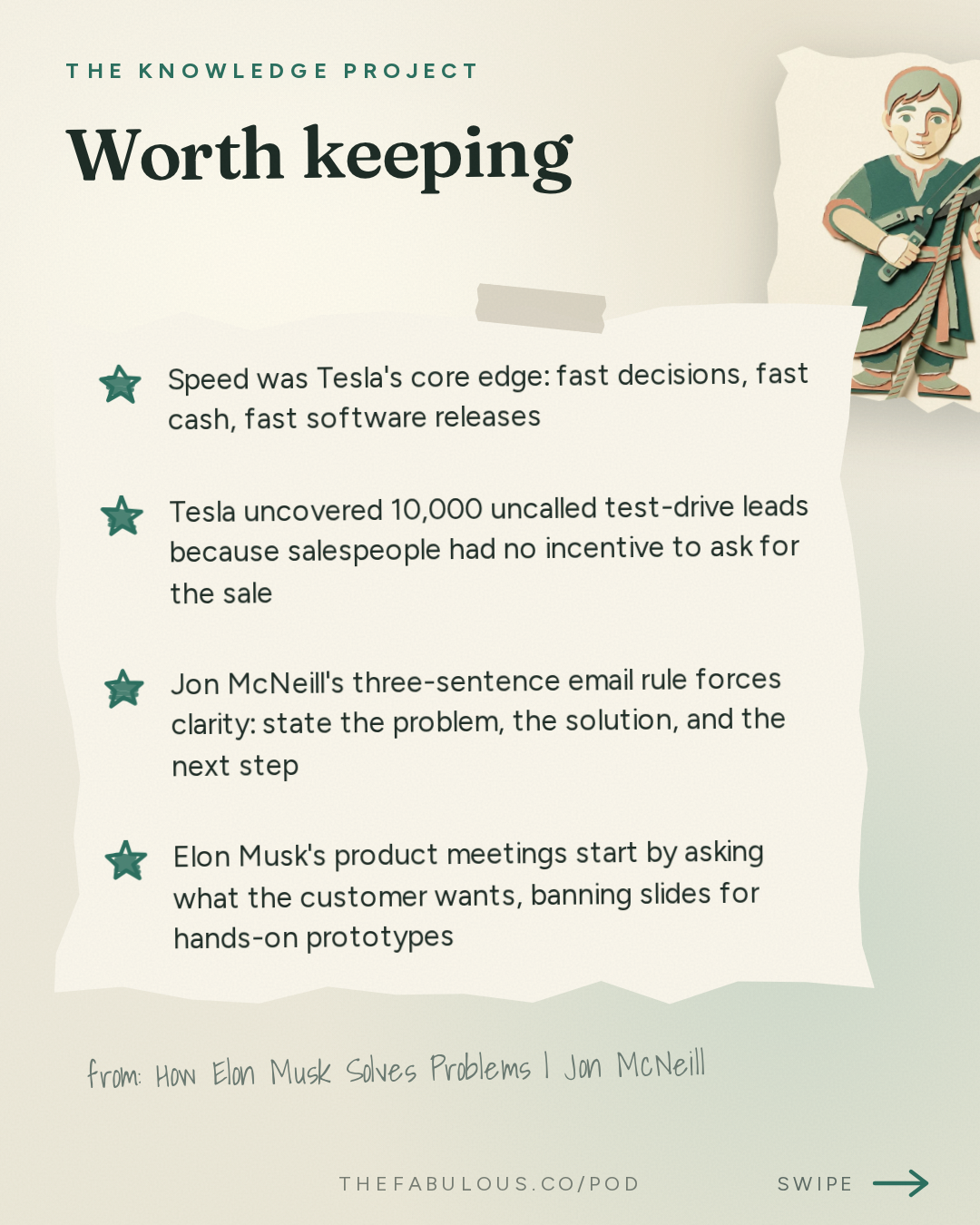
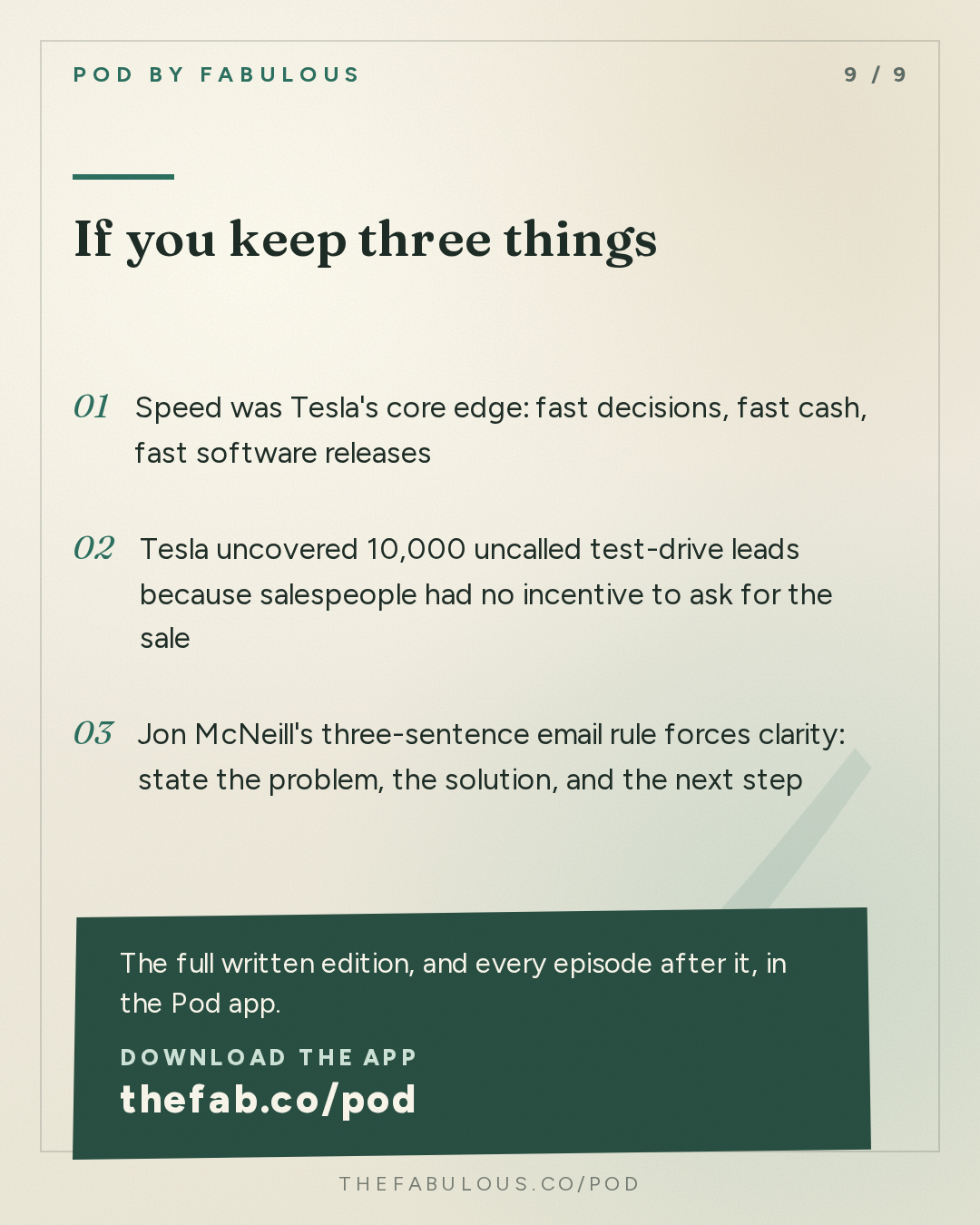
- Speed was Tesla's core edge: fast decisions, fast cash, fast software releases
- Tesla uncovered 10,000 uncalled test-drive leads because salespeople had no incentive to ask for the sale
- Jon McNeill's three-sentence email rule forces clarity: state the problem, the solution, and the next step
- Elon Musk's product meetings start by asking what the customer wants, banning slides for hands-on prototypes
- McNeill's five-step Algorithm says question every requirement first and automate only last
The episode in cards
By the numbers
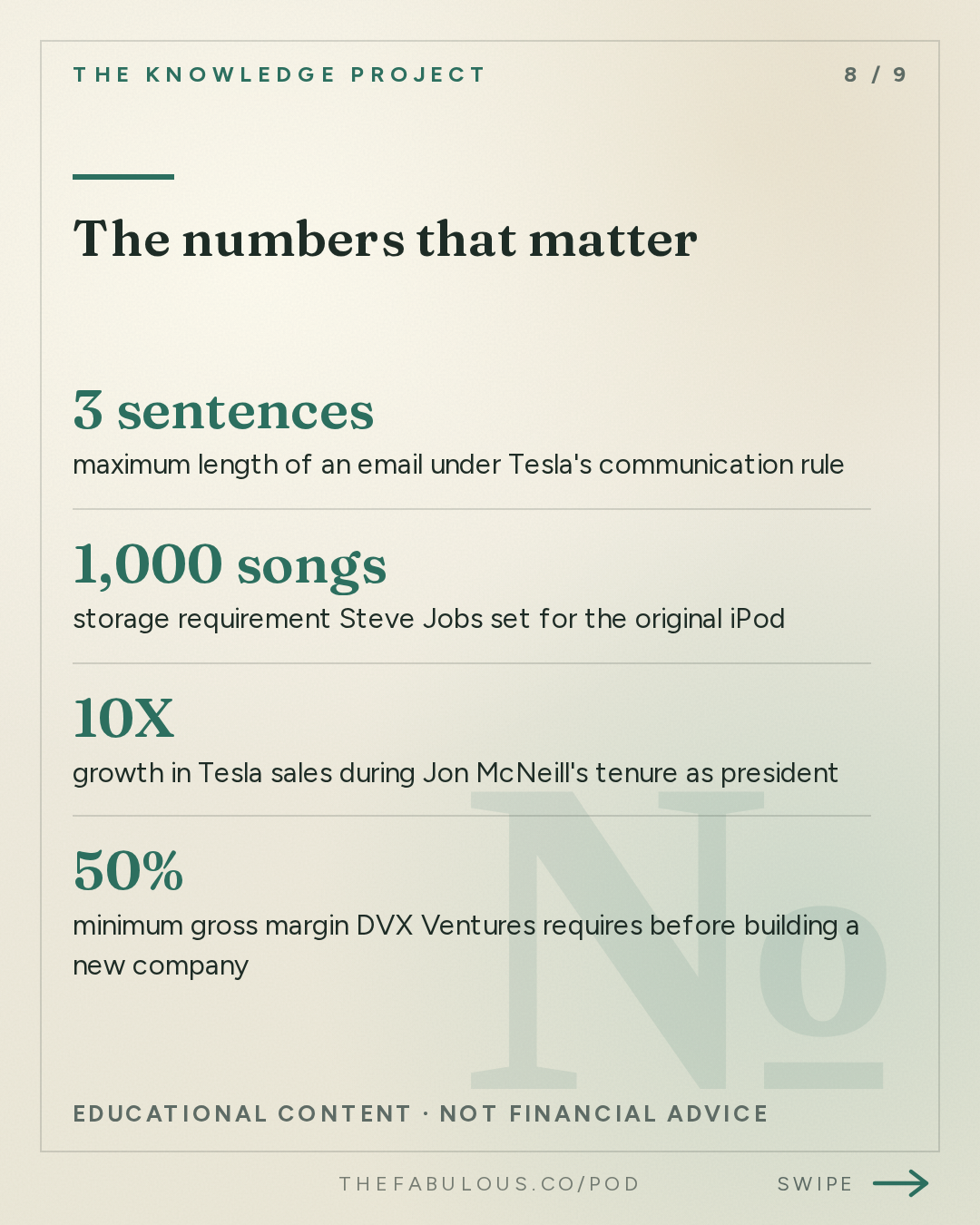
- 3 sentences maximum length of an email under Tesla's communication rule
- 1,000 songs storage requirement Steve Jobs set for the original iPod
- 10X growth in Tesla sales during Jon McNeill's tenure as president
- 50% minimum gross margin DVX Ventures requires before building a new company
In their words
“What success looks like is if you and I have the same inputs, we come up with the same answer.”
“If you wanna know how a system works, follow the incentives.”
“Action creates information. Action creates more information. Information creates more certainty.”
“History is changed by unreasonable men.”
Protocols
-
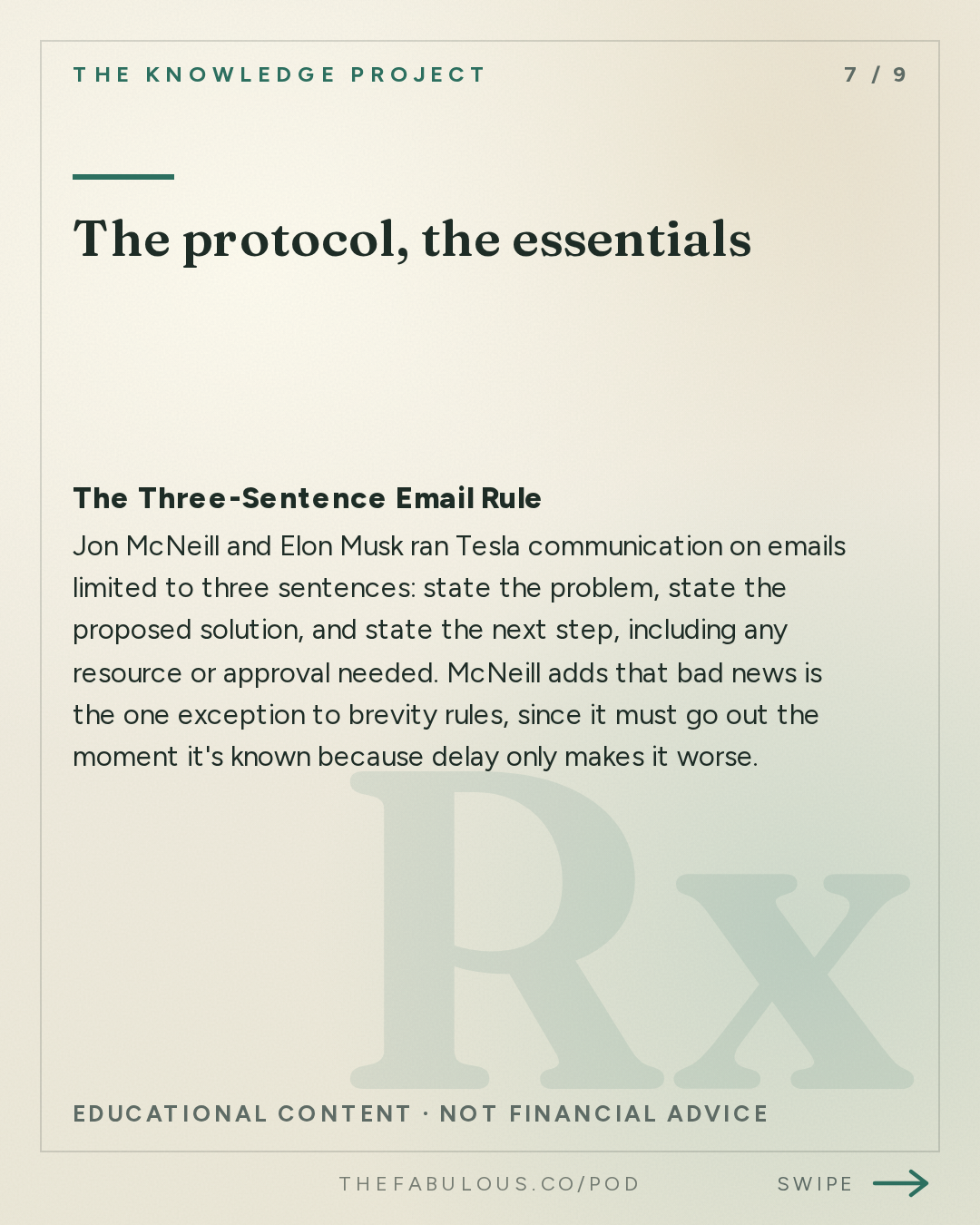
The Three-Sentence Email Rule
Jon McNeill and Elon Musk ran Tesla communication on emails limited to three sentences: state the problem, state the proposed solution, and state the next step, including any resource or approval needed. McNeill adds that bad news is the one exception to brevity rules, since it must go out the moment it's known because delay only makes it worse.
every work email
-
The Four-Step Decision Framework
McNeill starts every major decision by defining the actual outcome wanted, then works backward to what needs to be true to reach it, then estimates the investment required, and finally plots impact against effort to decide what to pursue now versus what goes on the no list. He warns that decisions get flubbed when people never agreed on what they were solving for in the first place.
before any major decision
-
DVX Ventures' Five-Criteria Startup Filter
Jon McNeill's venture studio, DVX Ventures, only builds a new company if five things prove true: a large addressable market confirmed through direct customer calls, gross margins above 50 percent, a hard unsolved technical problem that can become a competitive moat, an uncrowded competitive field, and evidence that buyers would actually want to own the resulting company.
for every new company DVX considers
-
The 'Fire Yourself' Annual Exercise
McNeill borrowed this from Calvin McDonald, Lululemon's chief executive: once a year, imagine being hit by a bus or fired tomorrow and list the obvious moves a successor would make immediately, then ask why those moves aren't already happening.
annually, typically in the first quarter
Questions this episode answers
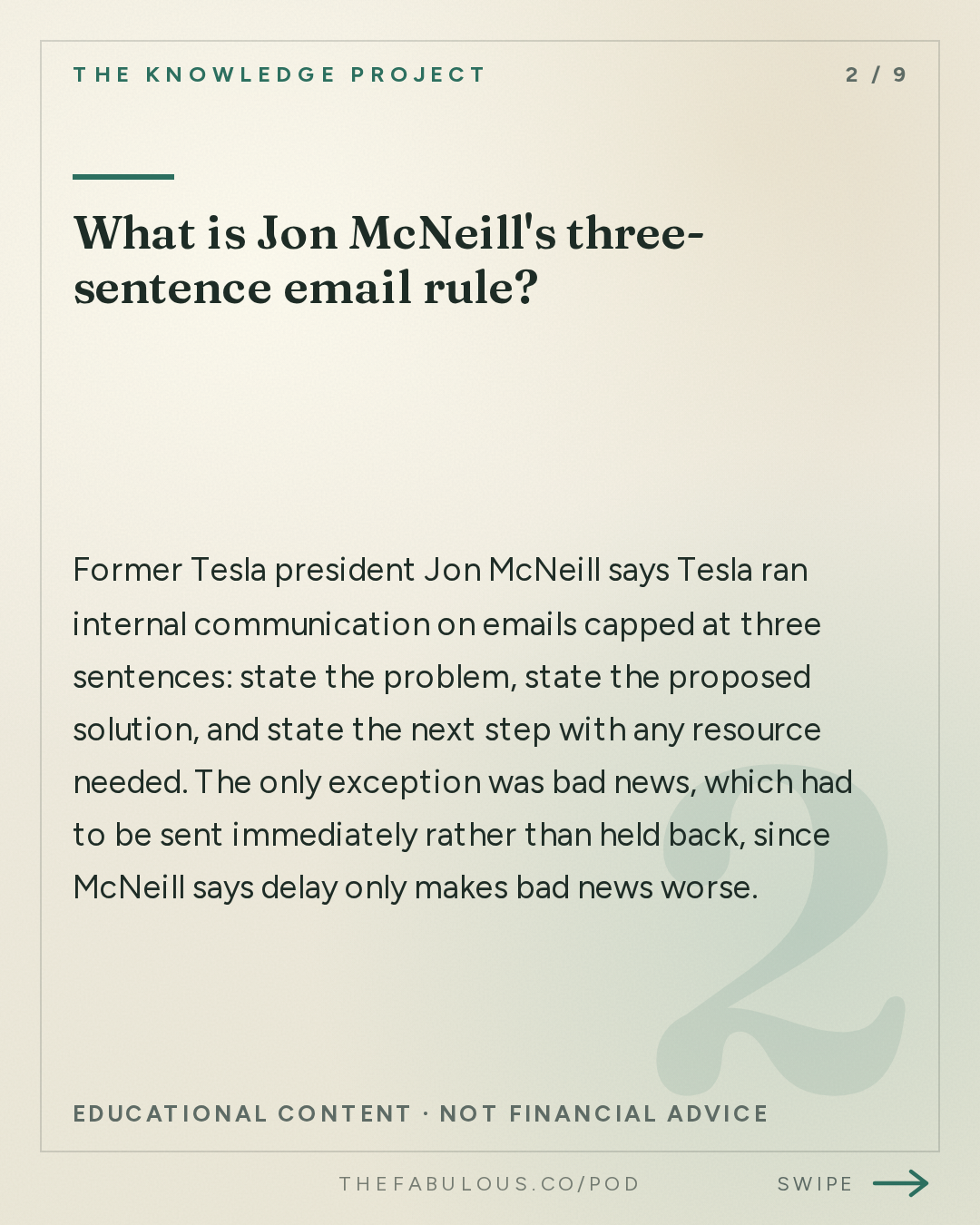
What is Jon McNeill's three-sentence email rule?
Former Tesla president Jon McNeill says Tesla ran internal communication on emails capped at three sentences: state the problem, state the proposed solution, and state the next step with any resource needed (09:31). The only exception was bad news, which had to be sent immediately rather than held back, since McNeill says delay only makes bad news worse (10:25).
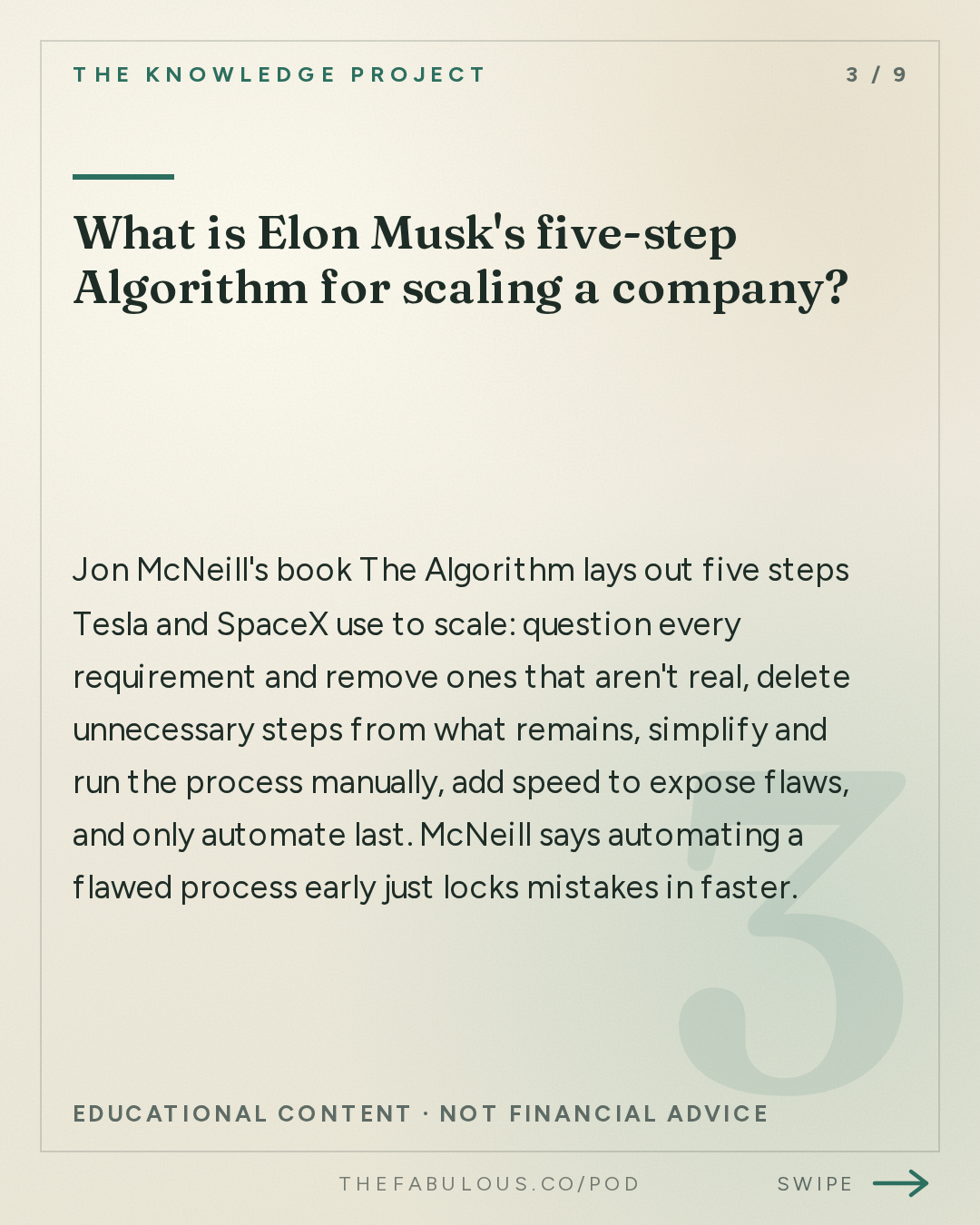
What is Elon Musk's five-step Algorithm for scaling a company?
Jon McNeill's book The Algorithm lays out five steps Tesla and SpaceX use to scale: question every requirement and remove ones that aren't real, delete unnecessary steps from what remains, simplify and run the process manually, add speed to expose flaws, and only automate last (55:48). McNeill says automating a flawed process early just locks mistakes in faster (58:12).
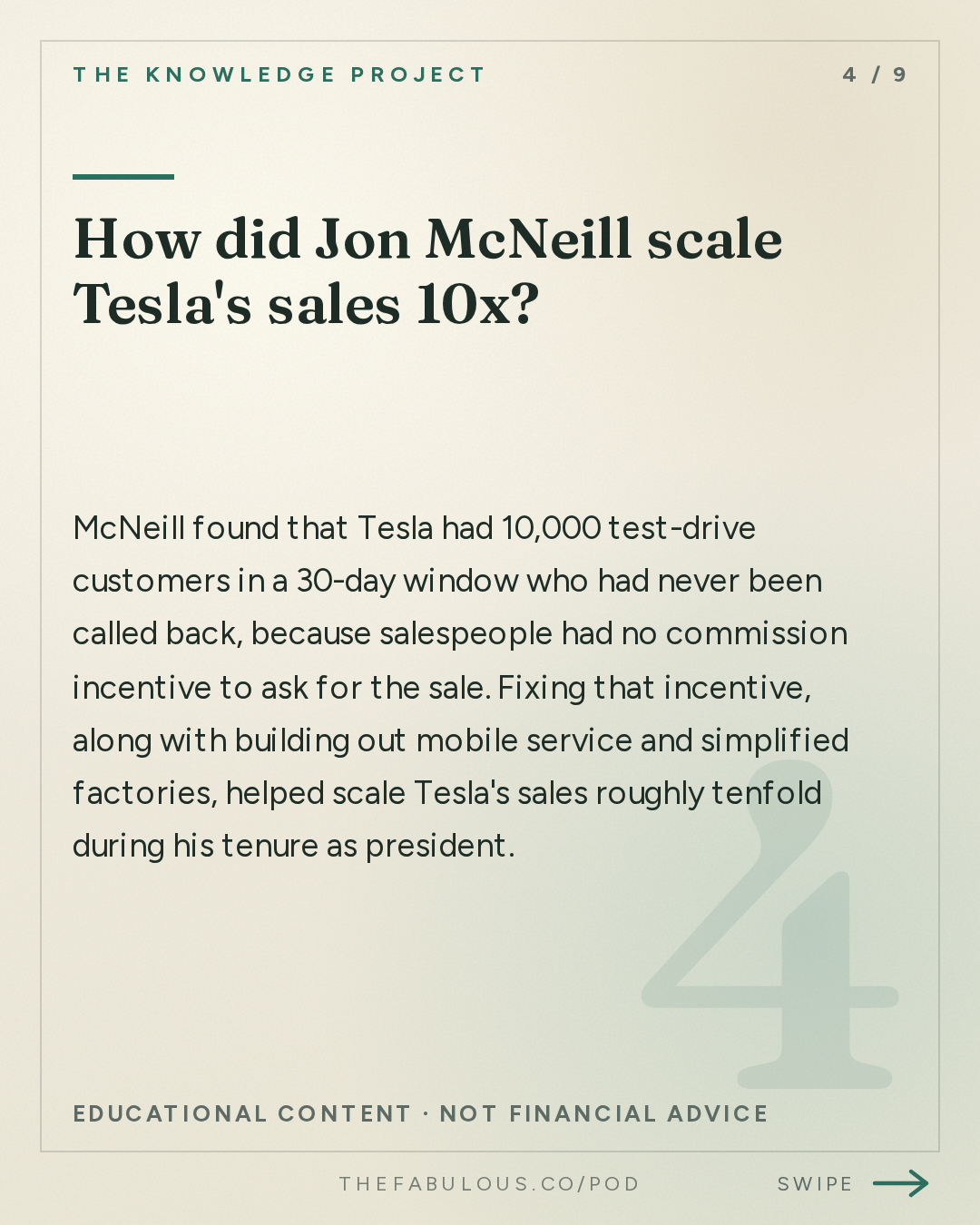
How did Jon McNeill scale Tesla's sales 10x?
McNeill found that Tesla had 10,000 test-drive customers in a 30-day window who had never been called back, because salespeople had no commission incentive to ask for the sale (05:28). Fixing that incentive, along with building out mobile service and simplified factories, helped scale Tesla's sales roughly tenfold during his tenure as president (48:19).
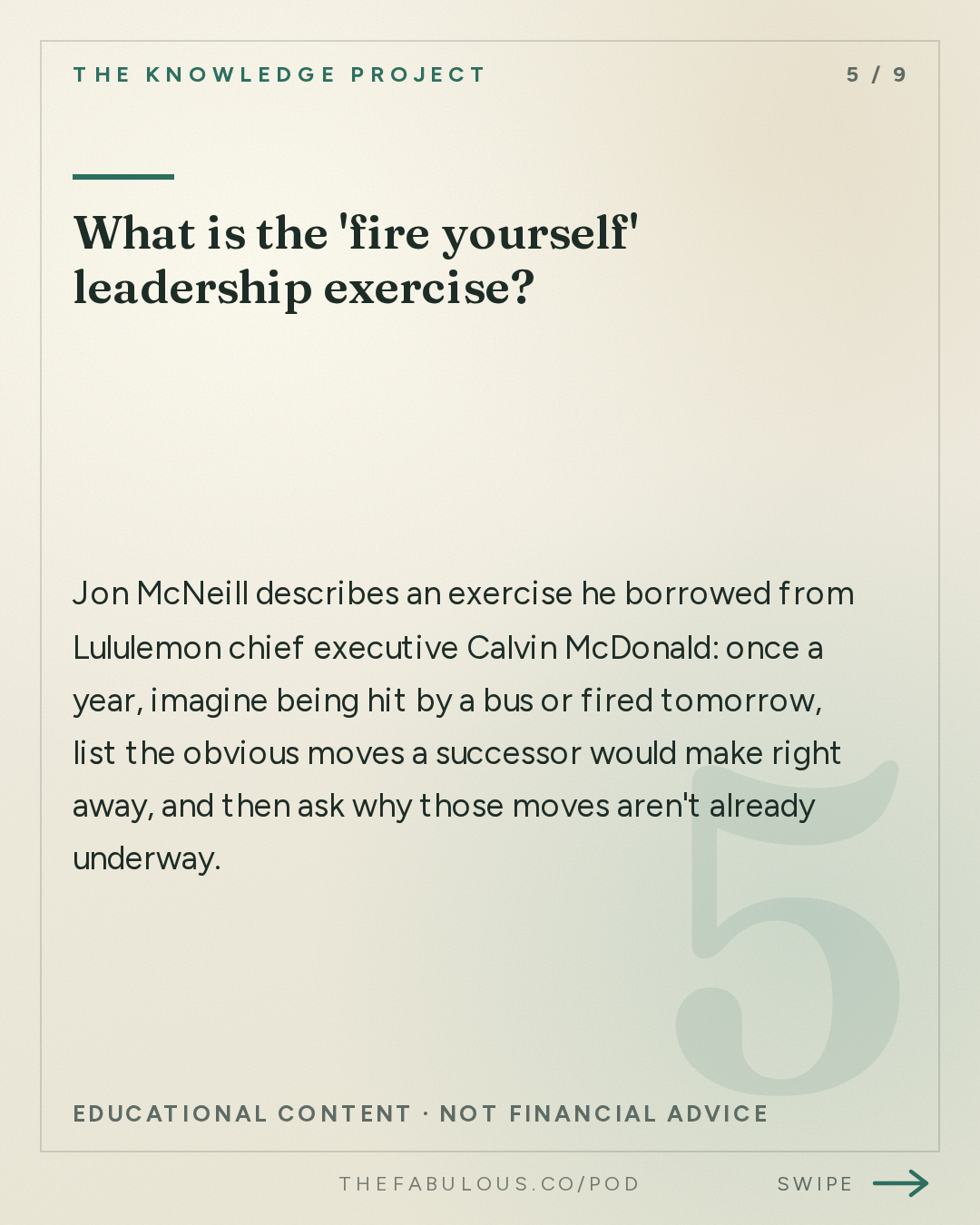
What is the 'fire yourself' leadership exercise?
Jon McNeill describes an exercise he borrowed from Lululemon chief executive Calvin McDonald: once a year, imagine being hit by a bus or fired tomorrow, list the obvious moves a successor would make right away, and then ask why those moves aren't already underway (72:23).
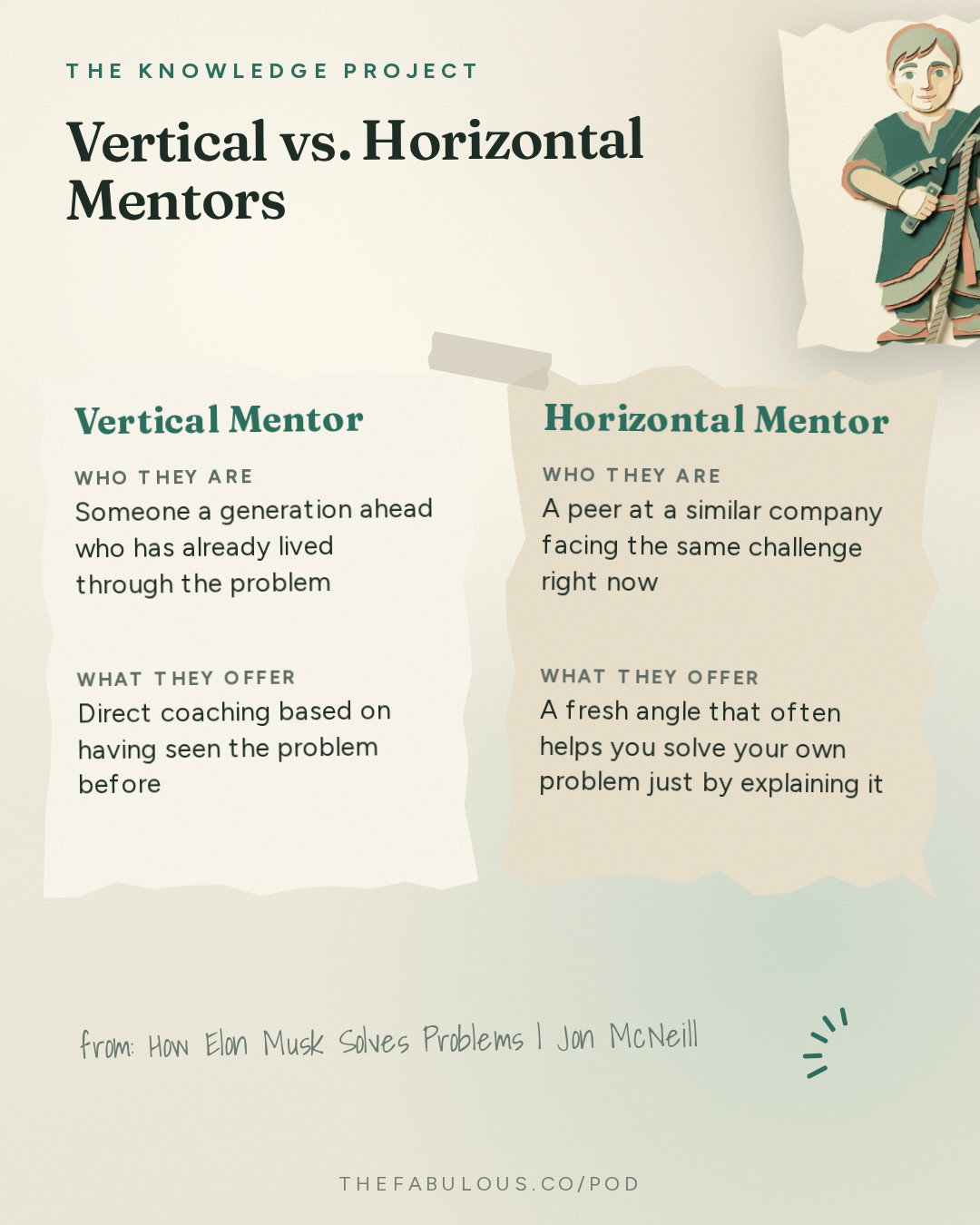
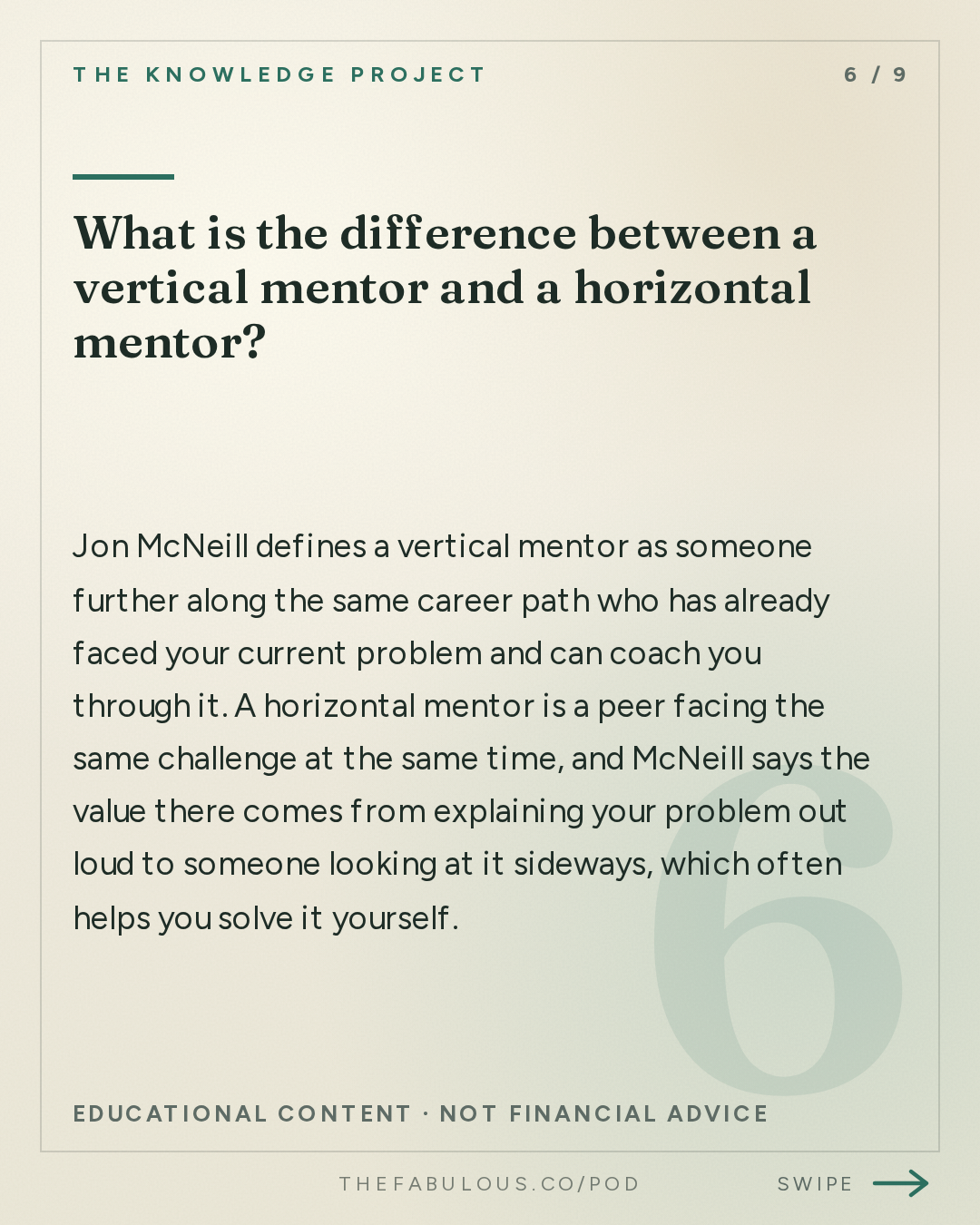
What is the difference between a vertical mentor and a horizontal mentor?
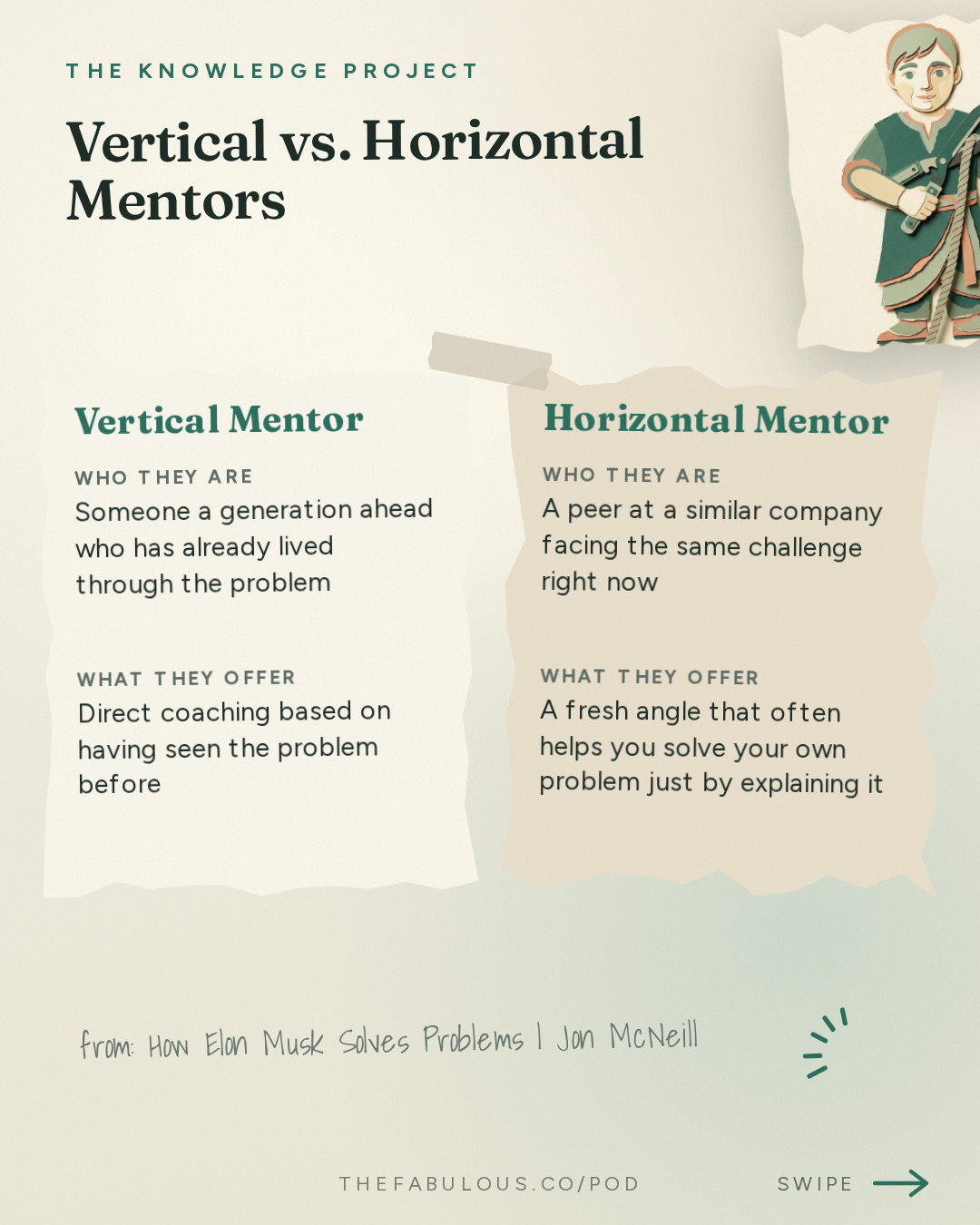
Jon McNeill defines a vertical mentor as someone further along the same career path who has already faced your current problem and can coach you through it (85:49). A horizontal mentor is a peer facing the same challenge at the same time, and McNeill says the value there comes from explaining your problem out loud to someone looking at it sideways, which often helps you solve it yourself (86:42).
The full read, in cards
Go deeper
- The Algorithm — Jon McNeill's book laying out the five-step framework Tesla and SpaceX use to scale without losing quality
- The Goal — Eli Goldratt's operations management book that McNeill says changed how he thinks about running operations
- The Seven Habits of Highly Effective People — Stephen Covey's book, which shaped McNeill's approach to time management and personal effectiveness
- Unreasonable Hospitality — Will Guidara's book on hospitality that McNeill says applies to running any business
- Elon Musk (biography) — Walter Isaacson's biography, which McNeill references on Musk's psychology and his ability to shut off failure
Mentioned
Elon Musk · Jon McNeill · Tesla · SpaceX · Sheryl Sandberg · Charlie Munger · Steve Jobs · Lululemon · Neuralink · Lyft · Doug Field · Calvin McDonald · Scott Cook · Walter Isaacson · DVX Ventures
More from this show and category

K.C. Irving's Business Empire Explained
K.C. Irving turned a single New Brunswick gas station into a 300-company empire by owning every link in his supply chain. He expanded hardest during the Great Depression, fought a government railway by buying his own tanker, and left Canada in 1971 rather than let new taxes break up the business he built for his sons.

Steven Kotler's Guide to Flow State Triggers
Flow, the total-absorption state Mihaly Csikszentmihalyi named decades ago, is trainable biology rather than mood, says flow researcher Steven Kotler. He maps the triggers: a four percent challenge-skill gap, 90 to 110 minute focus cycles, a protected primary flow activity, and reframed tasks that let people learn up to 230 percent faster and recover from burnout.

Charlie Munger's Todd Combs Interview: Key Lessons
Charlie Munger told Berkshire Hathaway manager Todd Combs in a 2022 interview that temperament, not raw intelligence, decides who wins at investing and leadership. He explains the "fiduciary gene," the Wooden Lesson of concentrating resources behind rare talent, and why positioning, holding cash and options before a crisis hits, beats trying to predict crashes like 1974's.

Ryan Serhant's Sales and Productivity Tactics
Real estate broker Ryan Serhant says willingness to be embarrassed is what separates top earners from everyone else. He built his career on a future-me identity he manifests over 12 to 24 months, a daily budget of 1,000 productive minutes, and follow-ups that sometimes took five years before closing multimillion-dollar deals.
