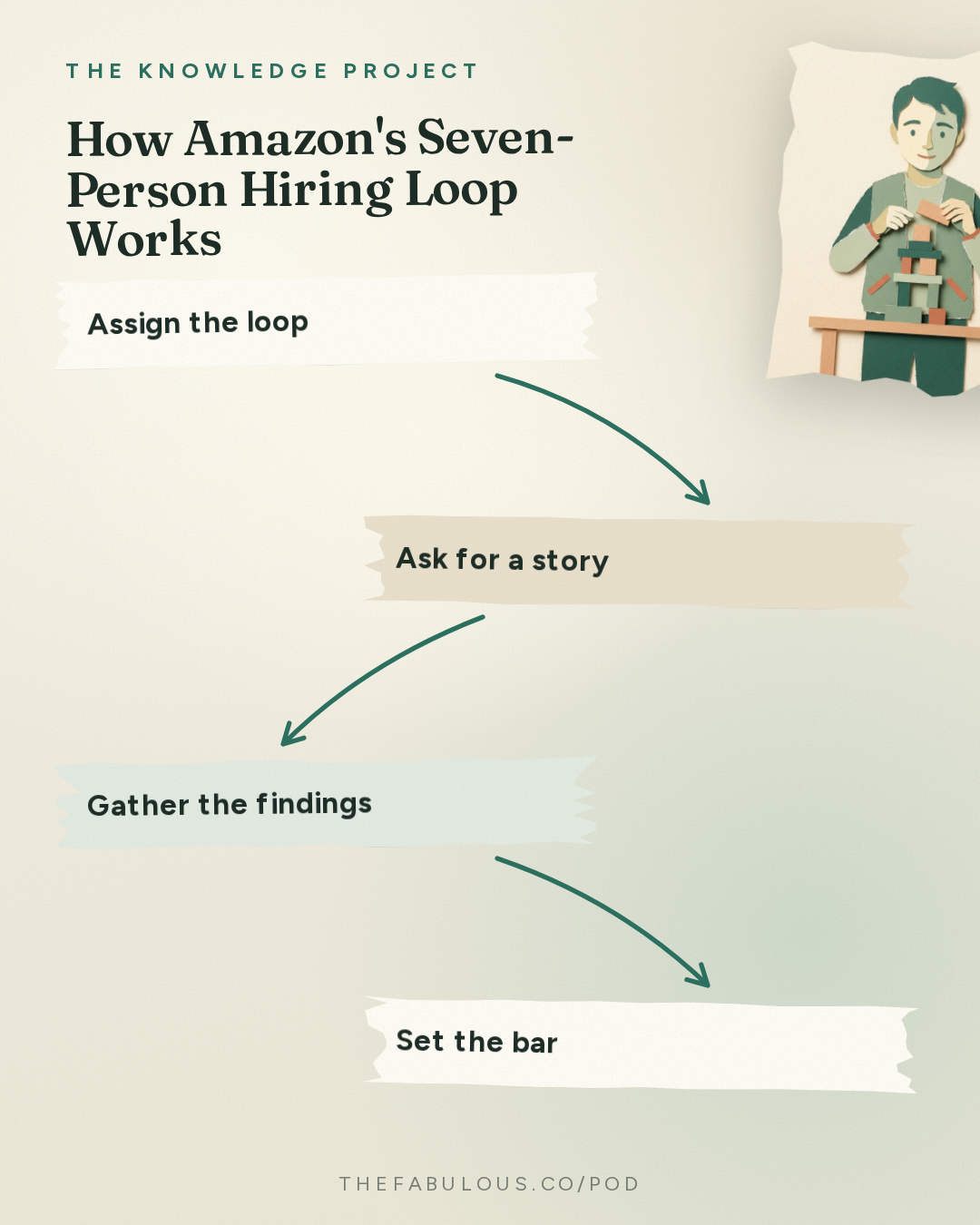
Bing Gordon on Bezos's Amazon Board Playbook
Learning From Bezos, Jobs, and Spielberg | Bing Gordon
▶ Listen to the full episode More from The Knowledge Project
The brief
Bing Gordon, a former Amazon board member and ex-Electronic Arts chief creative officer, explains how Jeff Bezos replaced PowerPoint with six-page memos and built Amazon's culture around "disagree and commit." He also covers why firing a founder before $100M in revenue often kills a company, how to run a board meeting, and what Spielberg, Ogilvy, and Steve Jobs taught him about creative excellence.
John Doerr, the venture investor who sat on Amazon's board for years, once told Bing Gordon he was thinking about quitting. His kids were in high school, he said, and in meeting after meeting he had nothing useful to say. He figured that if he wasn't handing out advice, he wasn't contributing. The same week, a different board member called Gordon with the opposite complaint: Jeff Bezos had called his idea stupid in front of the room, and the man, a former public company CEO, told Gordon he thought he should resign from the board (01:28).
Gordon, who ran marketing and creative at Electronic Arts before spending more than a decade on Amazon's board, noticed that both men were reacting to the same broken machine. Amazon's board meetings looked like every company's board meeting: a presenter, a slide deck, polite nodding. Nobody was asked to think, and nobody was asked to risk anything. So Gordon redesigned the format. Meetings would open with the CEO naming what he was actually wrestling with. The deck would not be presented at all. It would be six pages, read silently, followed by questions (02:17). Optional technical deep dives were added the night before, and every single board member showed up anyway, which told Gordon the group had been starving for real work, not less of it (03:37).
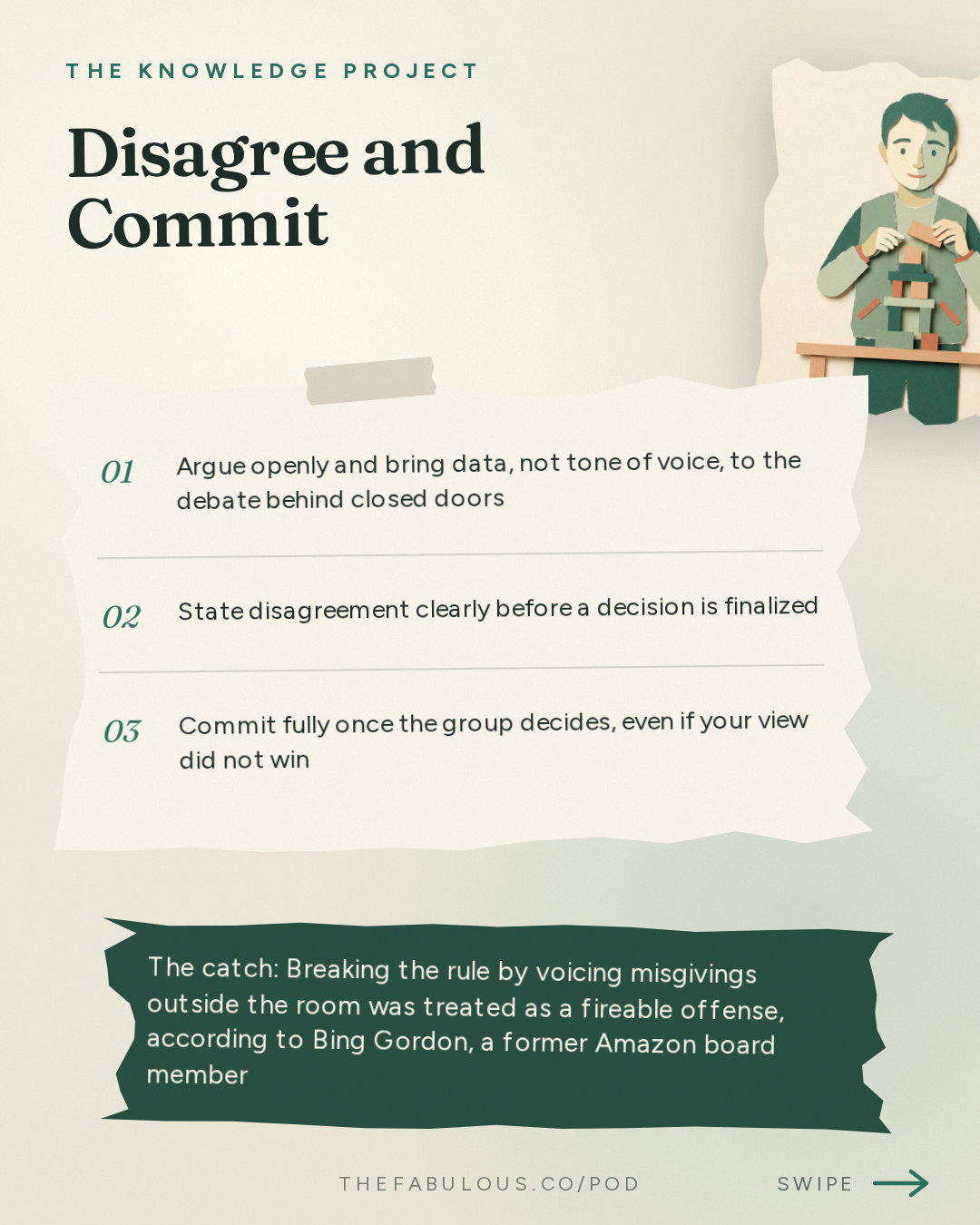
That redesign sits inside a bigger idea Bezos cared about: what he called the institutional no. As a company grows, Bezos told Gordon, layers of people accumulate who can block a decision, while almost nobody is left who can approve one. His fix was to push the authority to say yes as far down the organization as possible (04:29). The mechanism that makes this survivable without chaos is a rule borrowed from the longtime Silicon Valley executive coach Bill Campbell: debate freely behind closed doors, but once the team walks out, nobody second-guesses the decision in public. Breaking that rule, Gordon says, was treated as a fireable offense.
"Behind closed doors, we have a debate. As a management team, when we walk out the door, we never second-guess each other in public." — Bing Gordon, quoting Bill Campbell [06:18]
Architecture, Not Charisma
Years later, Gordon asked Bezos to define one of Amazon's own leadership principles: being "right a lot." How often is a lot? Bezos admitted nobody had ever asked him that directly, but he had a list of behaviors that correlate with it. People who are right a lot are skeptical optimists, able to hold a big idea and its flaws at the same time. They ask sharp questions that pull information out of a room. And they change their minds constantly when new data shows up, which cuts against the usual image of a strong leader as someone who never wavers (08:15).
"People who are right a lot are constantly willing to change their mind." — Bing Gordon, describing Jeff Bezos's view [09:02]
That willingness to flip connects to another Bezos idea: two-way doors versus one-way doors. A two-way door is a reversible decision, so push the power to open it as low in the company as possible. A one-way door is not reversible, and Bezos called himself the company's chief slowdown officer on those (09:24). The organizational unit built around this is the single-threaded leader: one person who owns an initiative end to end, writes the plan, hits the milestones, and cannot be second-guessed as long as those milestones are met (09:48).
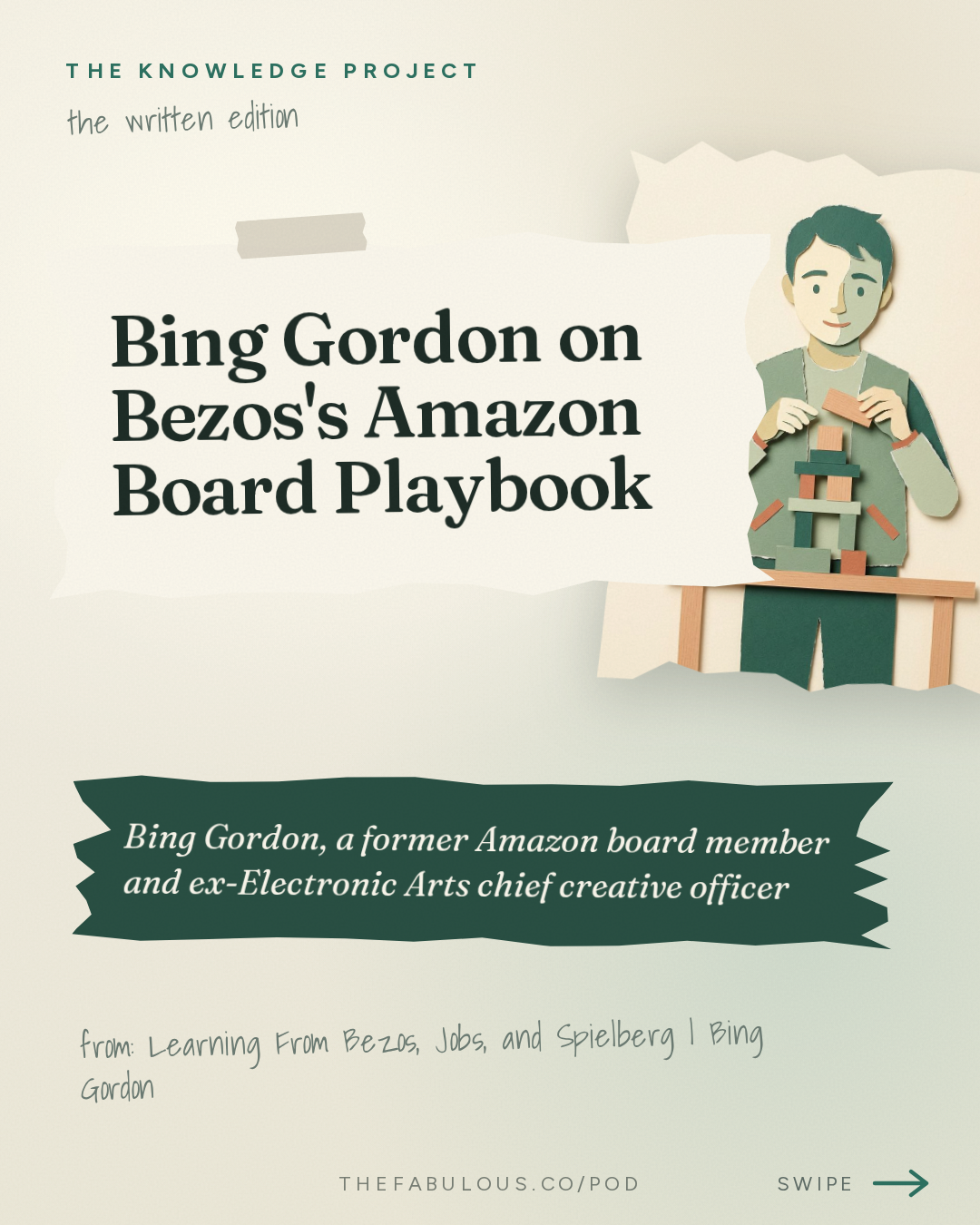
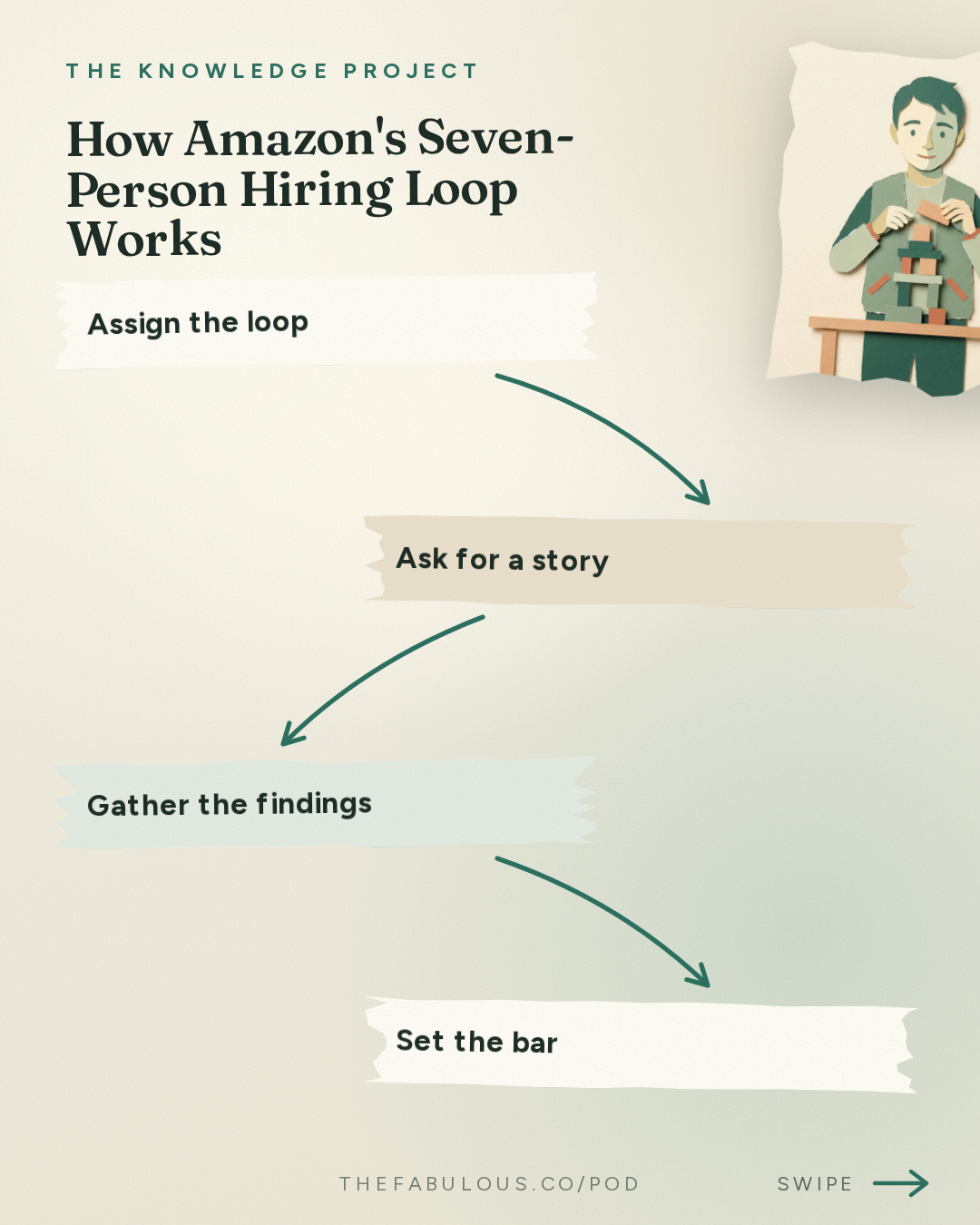
None of this works, Gordon argues, unless values get baked into daily operations rather than stated on a wall. He points to the management researcher Jim Collins and his book Built to Last, which found that the specific values a company claims do not predict success. What predicts success is whether those values are actually built into the company's fabric (14:12). Amazon's version of that is a seven-person hiring loop: six interviewers are each assigned two of the company's twelve leadership principles, and they ask candidates for a specific story that proves it. A seventh person, an HR coordinator, gathers the findings afterward. The goal is a new hire who clearly overachieves on at least two of the twelve (14:43). Run every two to four weeks for years, that loop does double duty: it screens candidates, and it keeps every employee who interviews re-learning the values themselves.
Gordon's sharpest governance opinion concerns firing founders. Boards, he says, tend to think their main job is hiring and firing the CEO. He has found that firing a founder before a company hits $100 million in revenue often kills the company for good, because a hired replacement rarely carries the same moral authority or mission-driven conviction (25:53, 31:38). A board's real job, in his view, is helping a founder keep learning and see around corners, which is a different skill from grading a quarterly scorecard. He measures a good board meeting by a simple yardstick: one big actionable idea per hour of board time, followed by a thank-you note within twenty-four hours summarizing what the CEO plans to do about it (34:26).
The Last Ten Percent
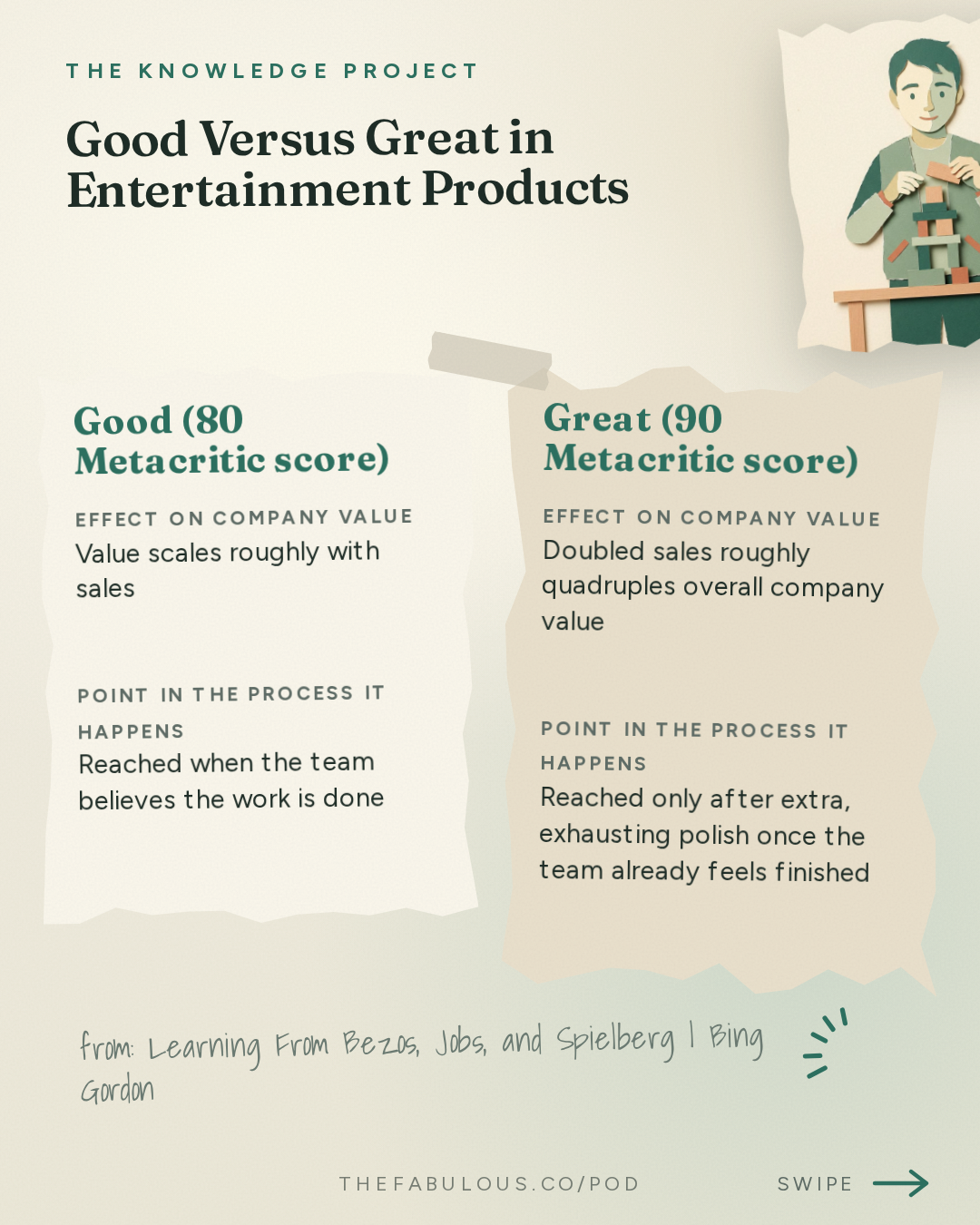
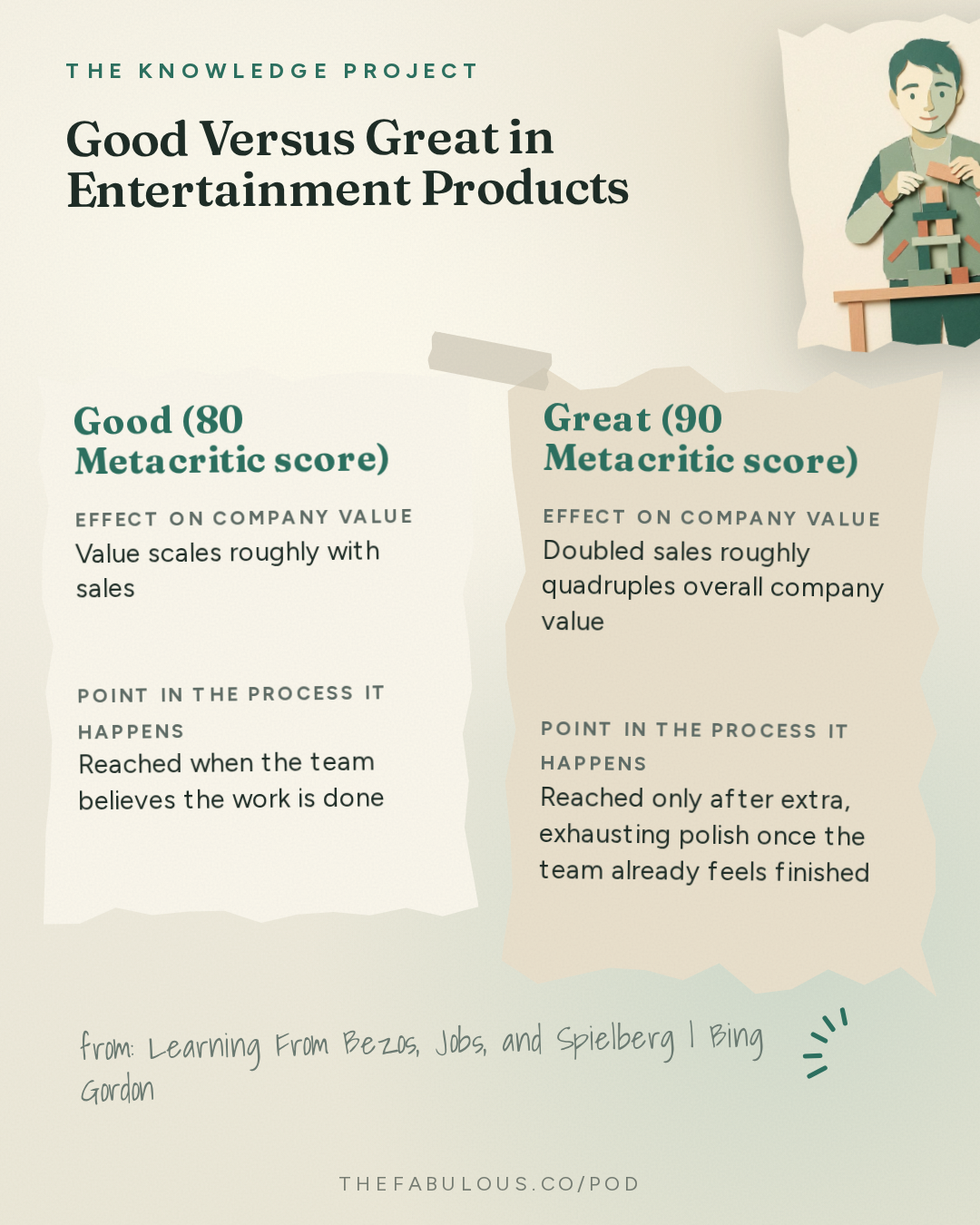
The same obsession with pushing past "good enough" shows up in Gordon's second career, in games and entertainment. He cites a blunt piece of math from the games business: a title rated 80 on Metacritic, a review-aggregation score out of 100 compiled from professional critics, sells roughly 50 to 100 percent more for every five points it climbs past 80 toward 90 (36:59). Because entertainment is a hits business, doubling sales does not just double a company's value, it tends to roughly quadruple it, since a bigger hit buys a longer life and more future opportunities (39:07).
Getting from good to great, Gordon says, almost always happens after the team already believes it is finished. He points to the filmmaker Steven Spielberg, who used to test movies in preview houses where audience members turned a dial to register their reaction, then switched to infrared cameras that track what Gordon calls audience "fidgets." A cluster of bad fidgets in one moment tells Spielberg exactly where to recut (40:54). The playwright Neil Simon described a similar discipline in his book Rewrites: he refused to open a show on Broadway until an out-of-town preview ran perfectly, because once he noticed a flaw from the audience, he could never forgive leaving it in.
Gordon's other model for generating raw material comes from the design firm IDEO, founded by David Kelley. Its brainstorm sessions ban the word no in favor of asking how, keep a scribe logging every idea, and chase a target of 100 ideas an hour, on the theory that any hint of negativity in the room kills the count (44:59). The output does not need to be good. It needs to be plentiful, so that a smaller set of great ideas has a chance to surface and get chosen later.
Gordon closes with advice about recognizing good ideas disguised as bad ones. As an investor, he has watched rooms laugh at pitches that became Airbnb, Uber, Spotify, and AWS. His rule now is to treat laughter and dismissal as a signal to look closer rather than walk away, since a reaction at either extreme of the spectrum of opinion usually means something, and the job is to figure out which end it is (68:52). It is the same instinct, scaled down, that he offers to a parent baffled by a kid's taste in video games: sit down, watch what the kid actually likes about it, and take the thing seriously before deciding it is beneath notice.
Ask this episode anything
Pod's AI answers from the episode itself, with the minute mark so you can hear it yourself.
Or start with one of these
Ask this episode
Pod's AI listens to the whole episode to answer, and points you to the minute it comes from.
The rest of this answer, and any question after it
Answers come from the episode itself, never from a summary of it.
ContinueKey takeaways
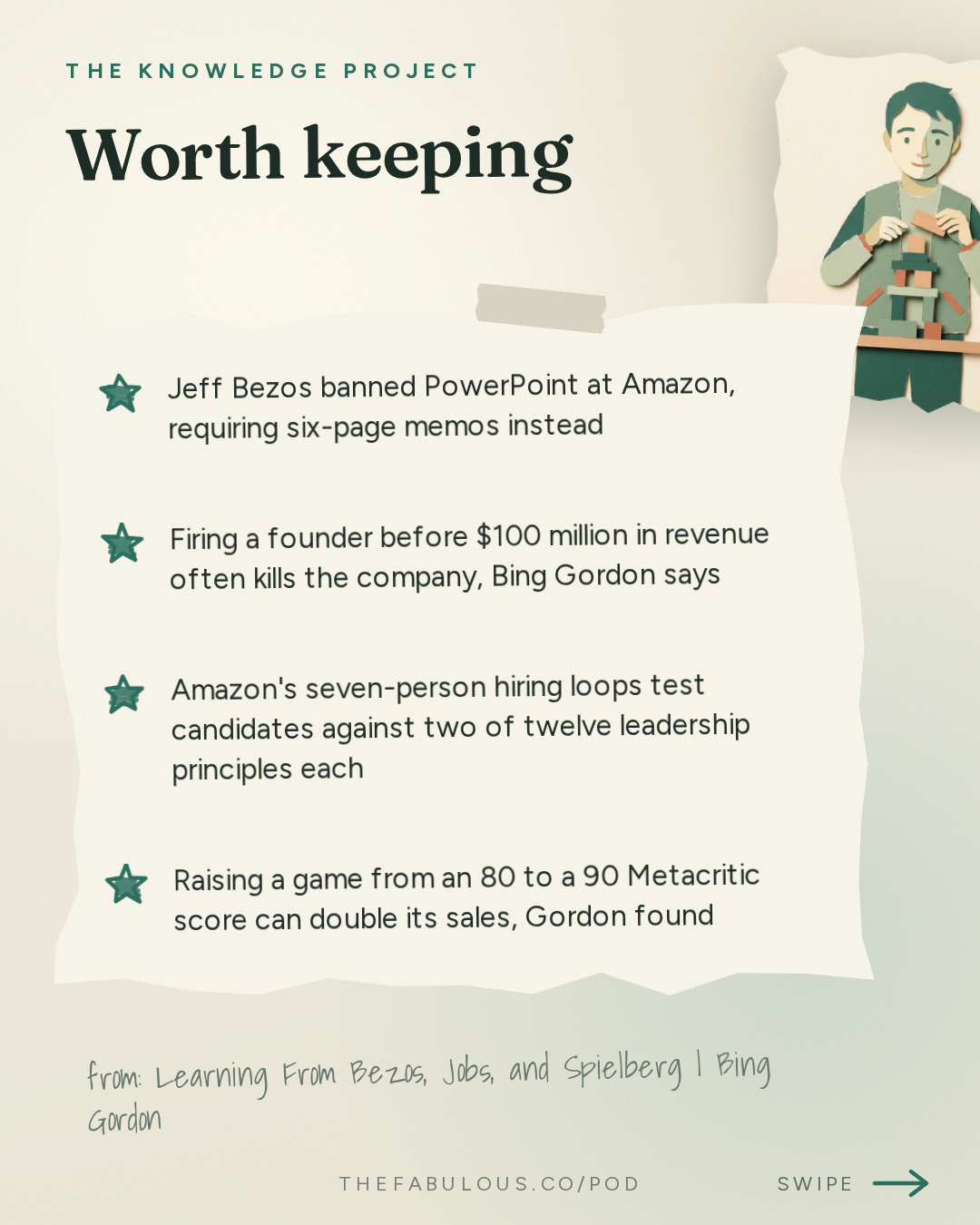
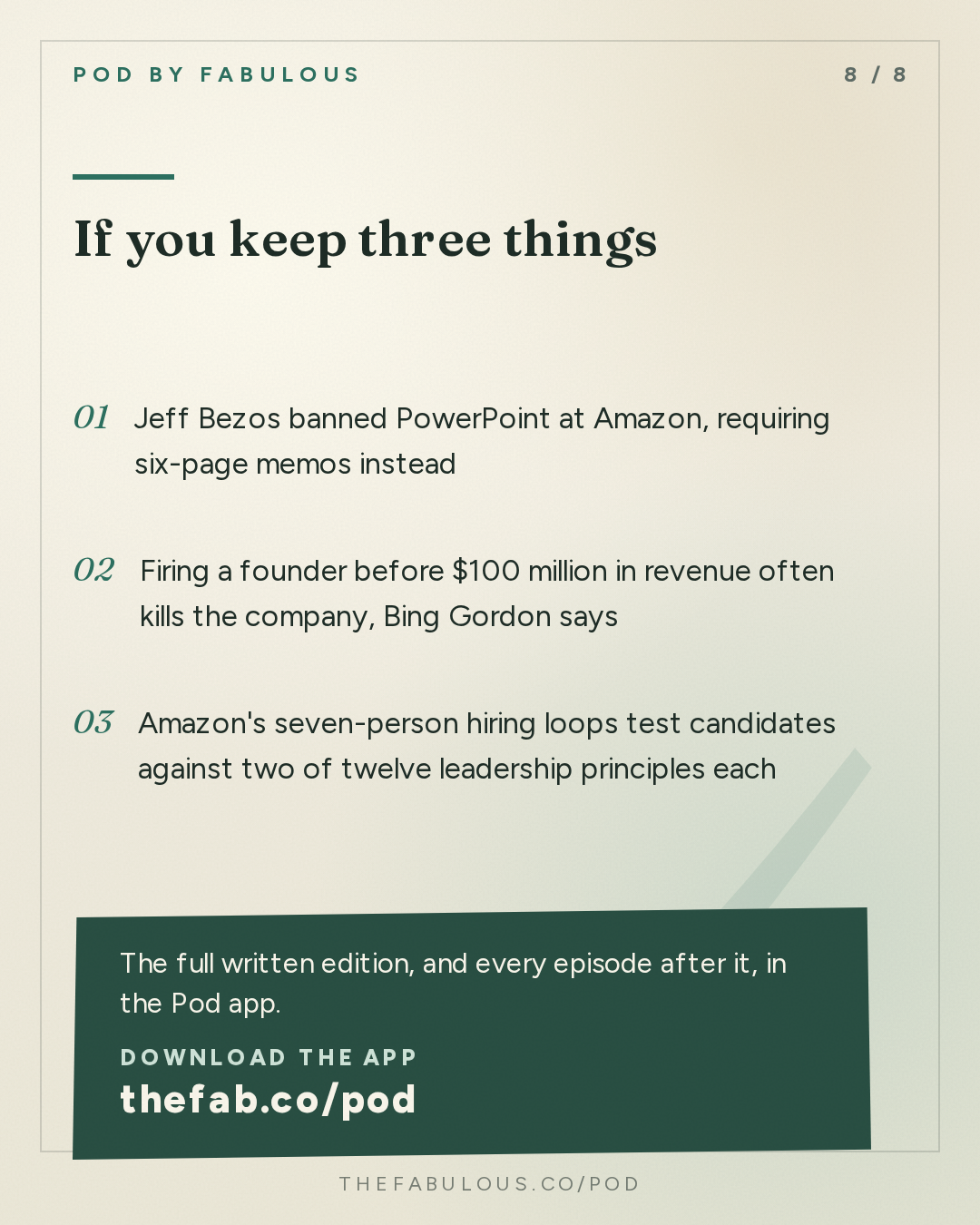
- Jeff Bezos banned PowerPoint at Amazon, requiring six-page memos instead
- Firing a founder before $100 million in revenue often kills the company, Bing Gordon says
- Amazon's seven-person hiring loops test candidates against two of twelve leadership principles each
- Raising a game from an 80 to a 90 Metacritic score can double its sales, Gordon found
- FarmVille players clicked to help friends 30 times more often than to brag about achievements
The episode in cards
By the numbers
- 4x valuation growth Valuation increase within two years that predicts a startup becoming a unicorn
In their words
“People who are right a lot are constantly willing to change their mind.”
“If you fire a founder before a hundred million, you kill the company forever”
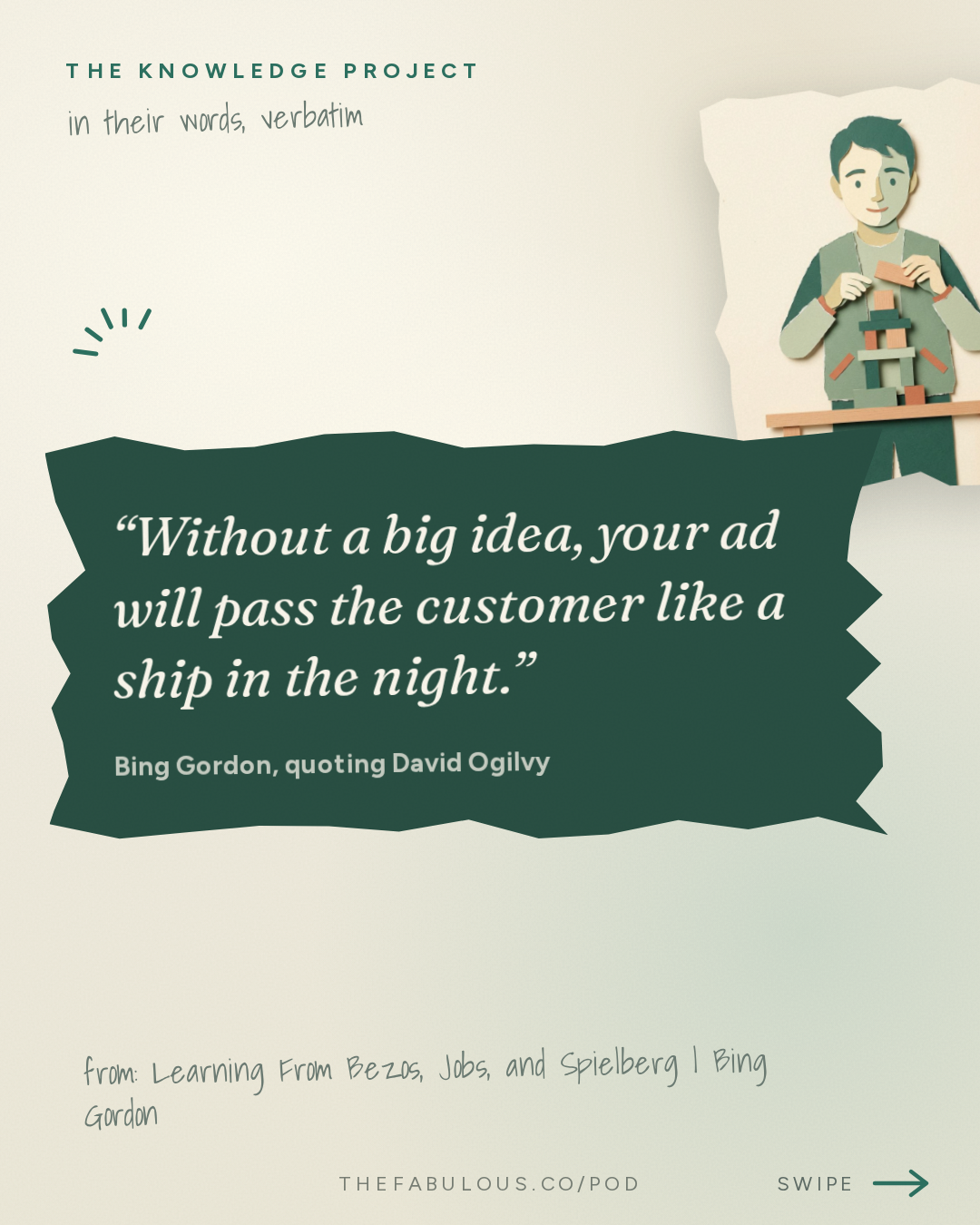
“Without a big idea, your ad will pass the customer like a ship in the night.”
“Your twenties are all about do cool shit.”
Protocols
-
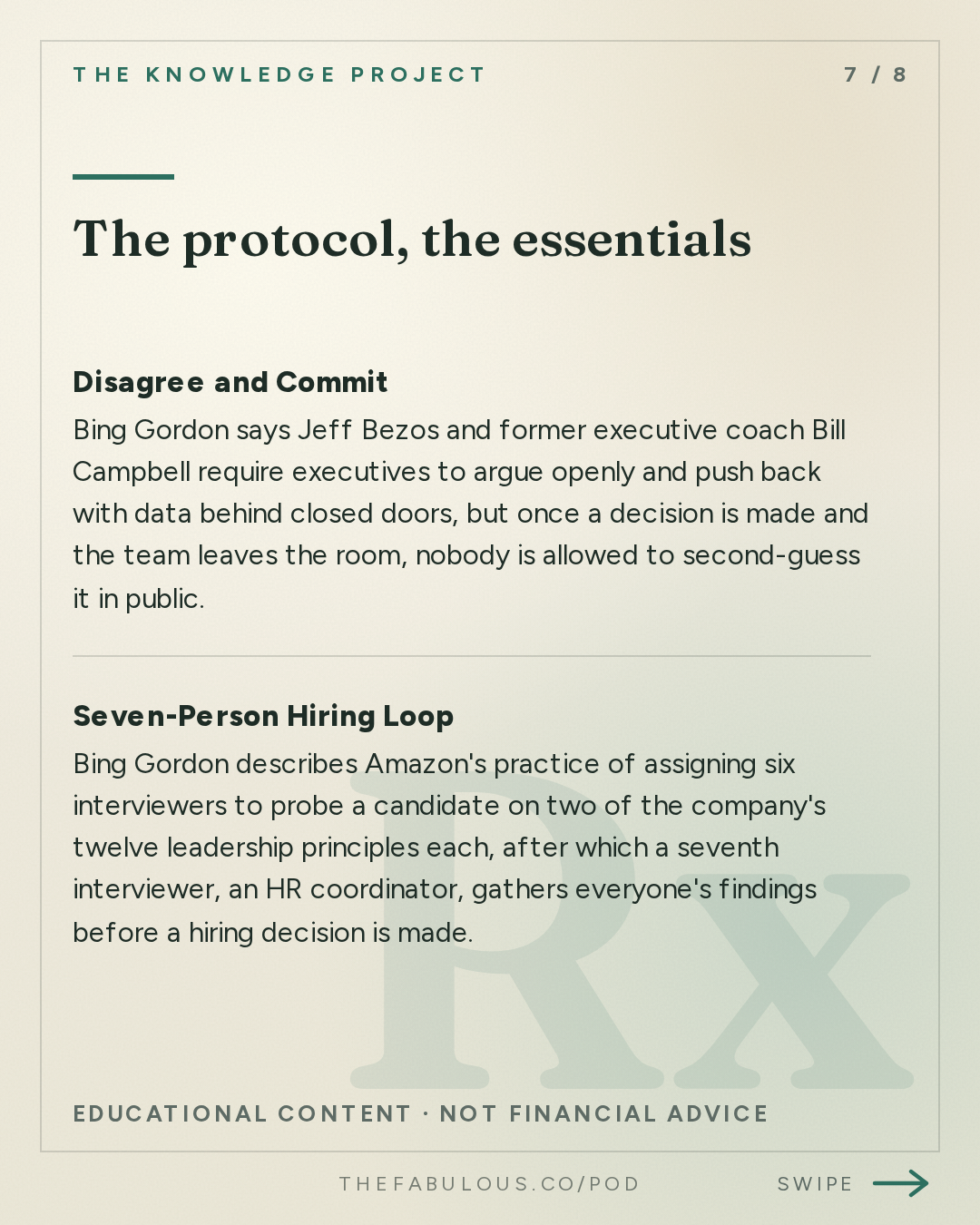
Disagree and Commit
Bing Gordon says Jeff Bezos and former executive coach Bill Campbell require executives to argue openly and push back with data behind closed doors, but once a decision is made and the team leaves the room, nobody is allowed to second-guess it in public.
Before and after every major decision
-
Seven-Person Hiring Loop
Bing Gordon describes Amazon's practice of assigning six interviewers to probe a candidate on two of the company's twelve leadership principles each, after which a seventh interviewer, an HR coordinator, gathers everyone's findings before a hiring decision is made.
Every candidate interview
-
One Big Idea Per Board Hour
Bing Gordon tells founders to send board members a thank-you note within 24 hours of a meeting summarizing what they took away and what they plan to do, then report back at the next meeting on whether they actually did it.
After every board meeting
-
Brainstorm Without No
Design firm IDEO, founded by David Kelley, runs brainstorms with a scribe logging every idea, a target of 100 ideas per hour, and a rule that bans the word no in favor of asking how an idea could work.
Every brainstorm session
Questions this episode answers
What is Amazon's 'disagree and commit' rule?
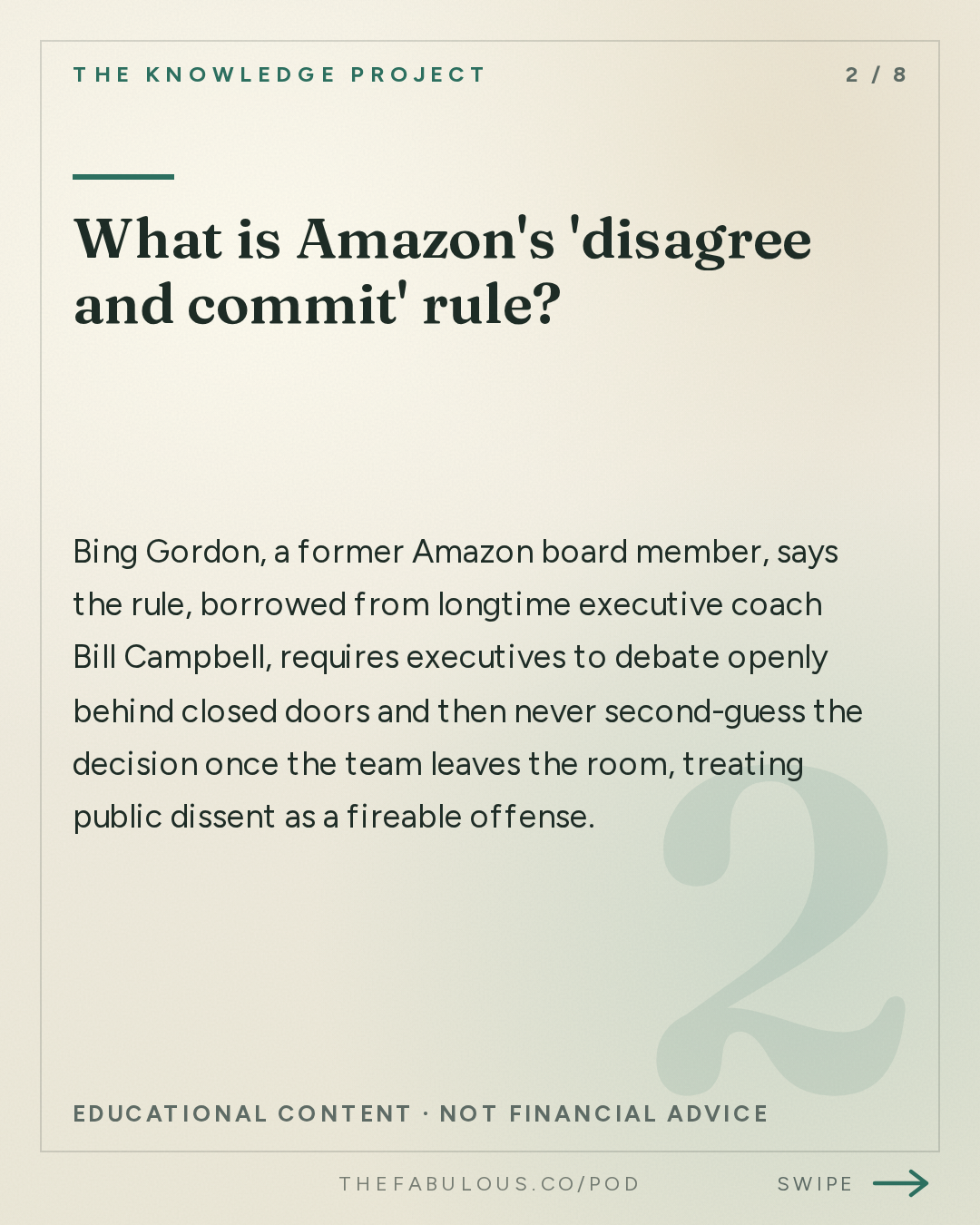
Bing Gordon, a former Amazon board member, says the rule, borrowed from longtime executive coach Bill Campbell, requires executives to debate openly behind closed doors and then never second-guess the decision once the team leaves the room, treating public dissent as a fireable offense (06:18).
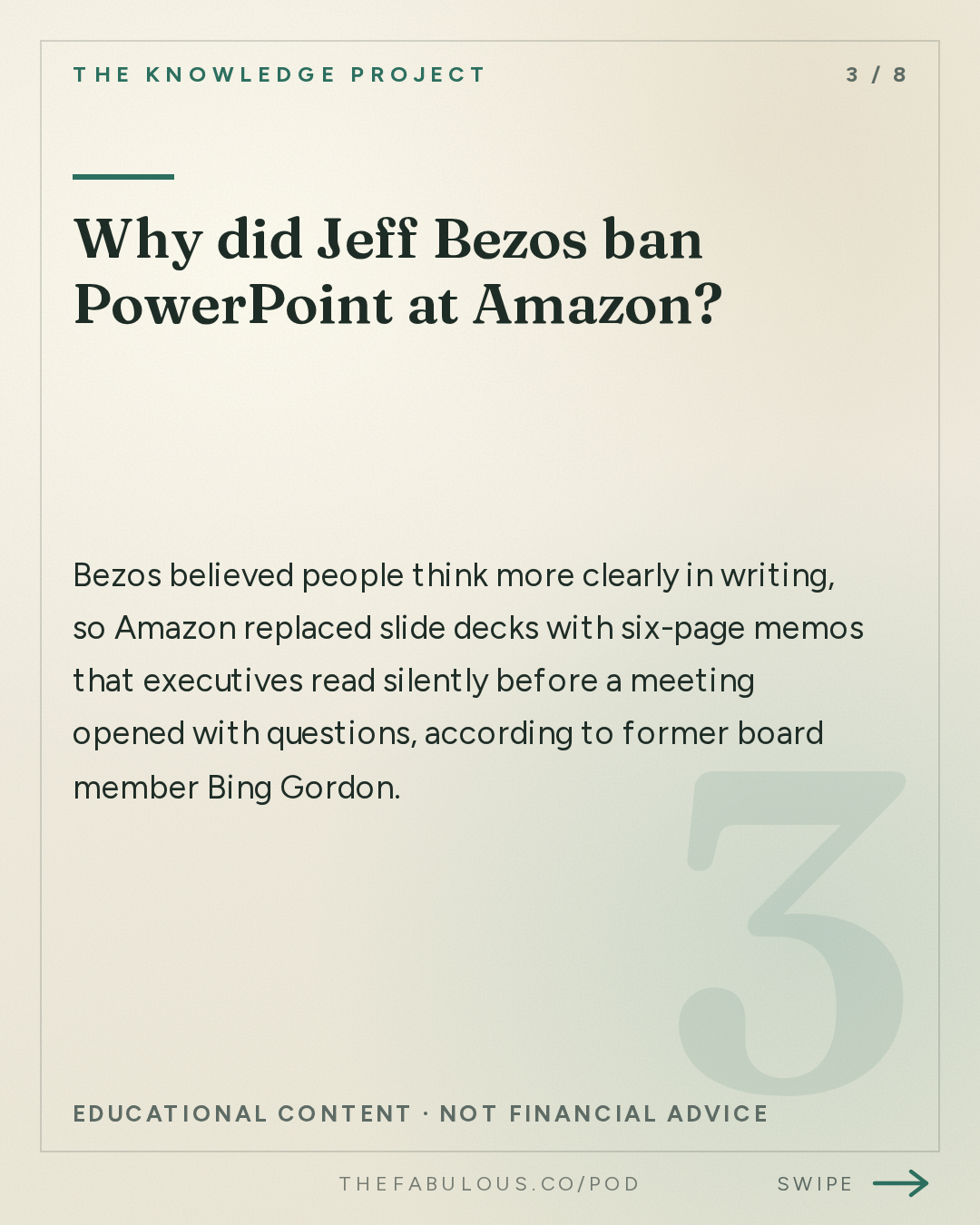
Why did Jeff Bezos ban PowerPoint at Amazon?
Bezos believed people think more clearly in writing, so Amazon replaced slide decks with six-page memos that executives read silently before a meeting opened with questions, according to former board member Bing Gordon (02:17).
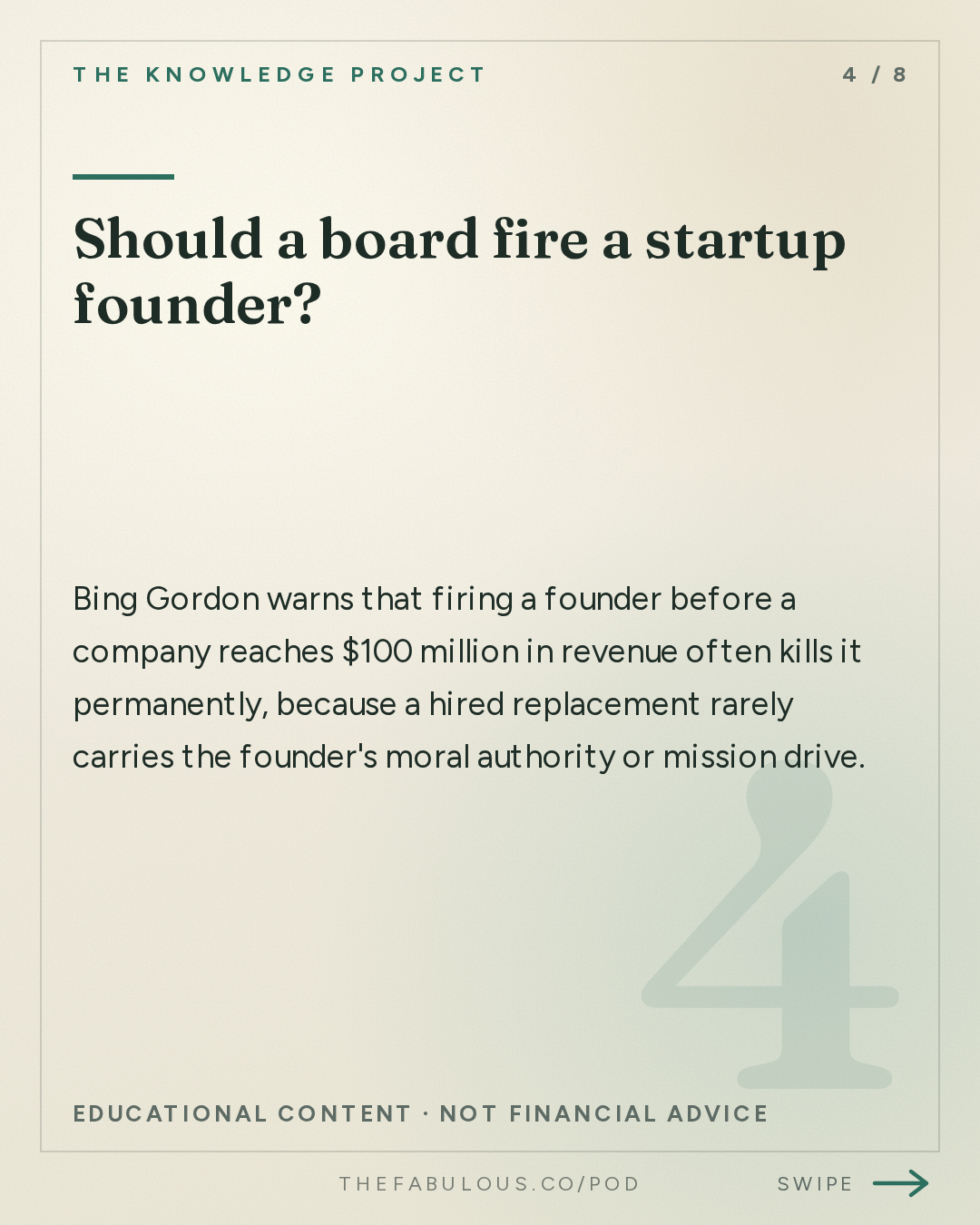
Should a board fire a startup founder?
Bing Gordon warns that firing a founder before a company reaches $100 million in revenue often kills it permanently, because a hired replacement rarely carries the founder's moral authority or mission drive (25:53, 31:38).
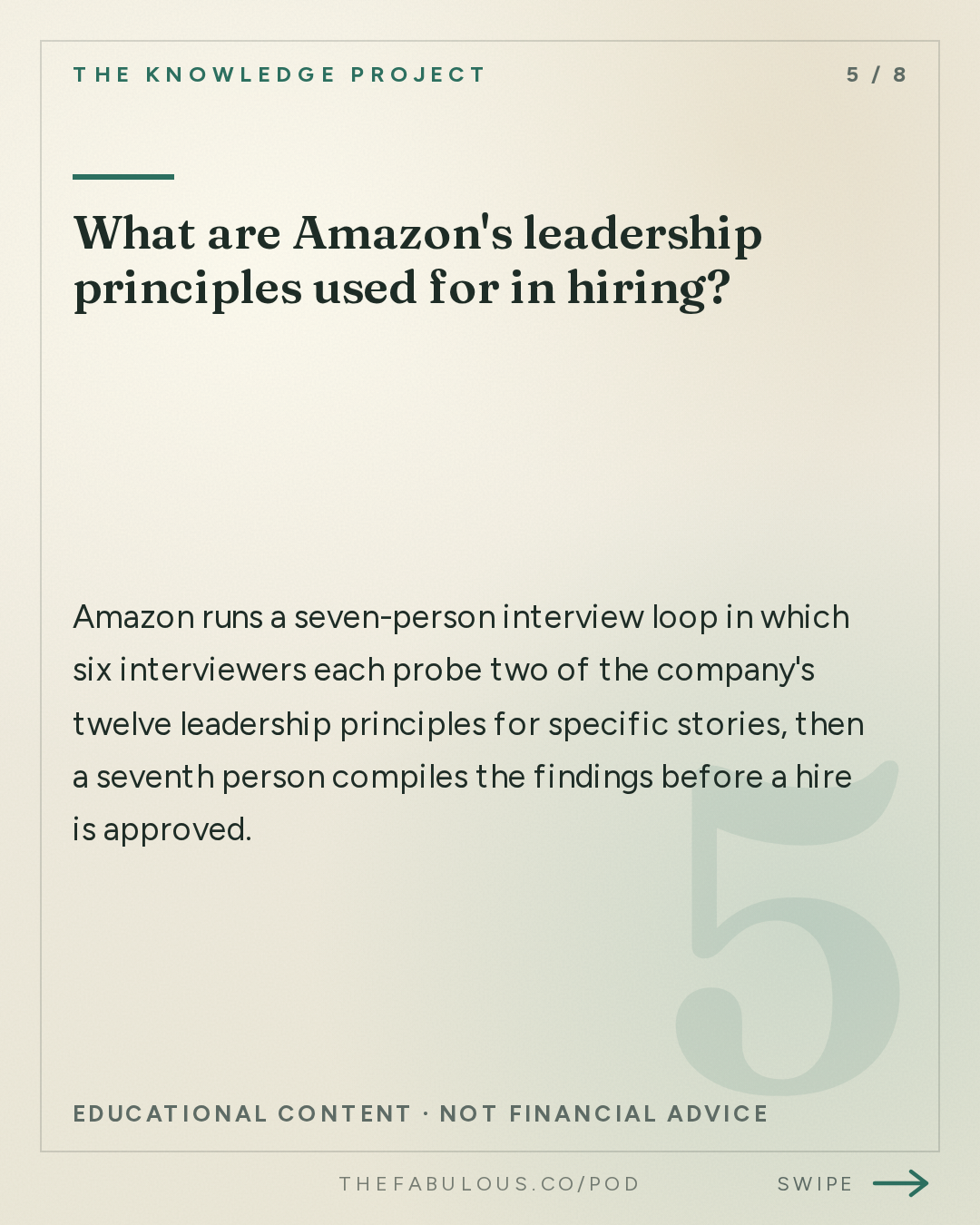
What are Amazon's leadership principles used for in hiring?
Amazon runs a seven-person interview loop in which six interviewers each probe two of the company's twelve leadership principles for specific stories, then a seventh person compiles the findings before a hire is approved (14:43).
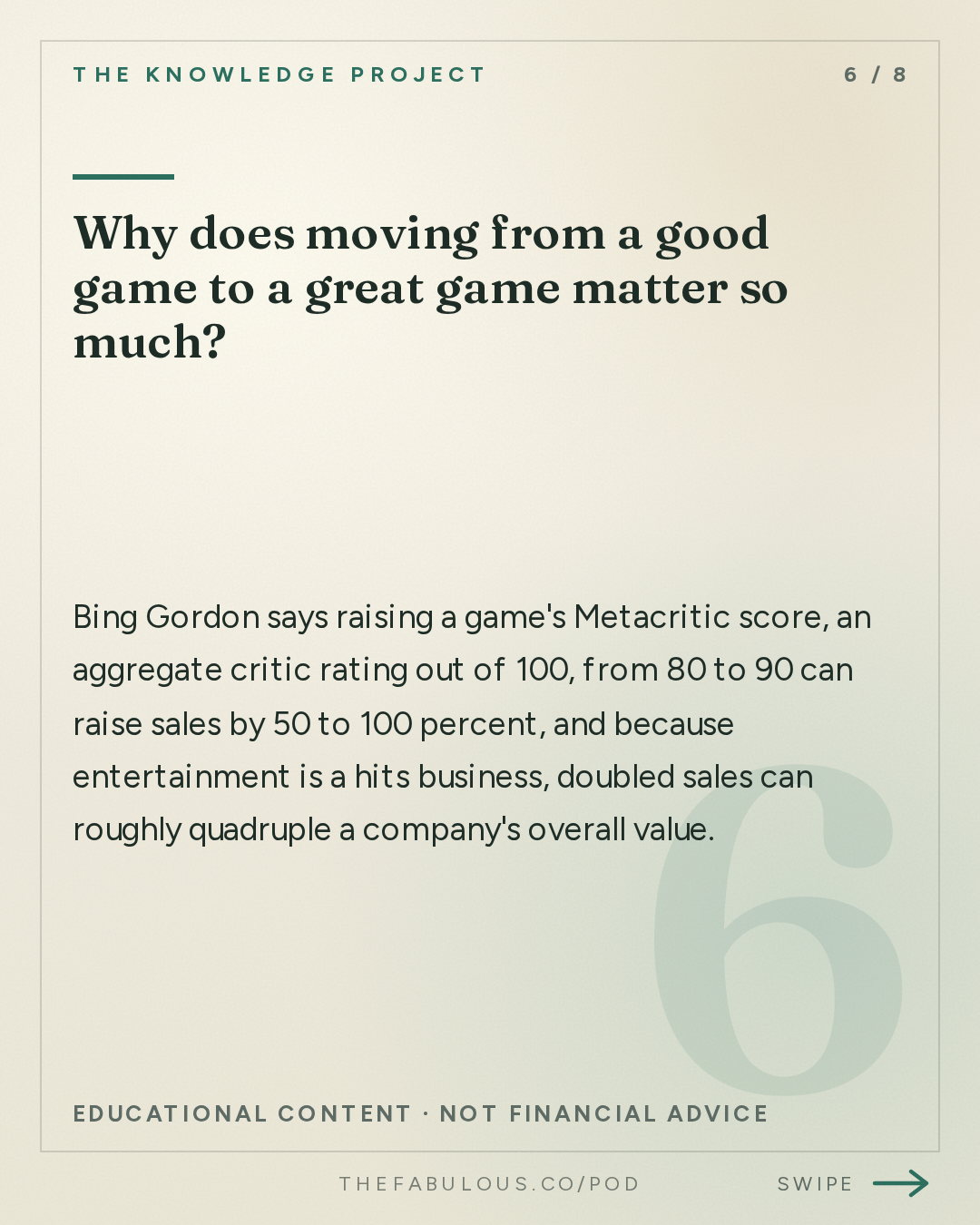
Why does moving from a good game to a great game matter so much?
Bing Gordon says raising a game's Metacritic score, an aggregate critic rating out of 100, from 80 to 90 can raise sales by 50 to 100 percent, and because entertainment is a hits business, doubled sales can roughly quadruple a company's overall value (36:59, 39:07).
The full read, in cards
Go deeper
- Built to Last — Jim Collins's research found that a company's stated values predict success only when built into daily operations, not when merely espoused
- Working Backwards — Colin Bryar's account of serving as Jeff Bezos's chief of staff describes Amazon's shift to a writing culture
- Rewrites — Playwright Neil Simon explains why he refused to open a show on Broadway until a preview ran perfectly
- Competing on Analytics — Describes Harrah's casino loyalty program and the idea of a 'second currency' that offsets the sting of losing money
- Zen and the Art of Motorcycle Maintenance — Robert Pirsig's theory that people perceive quality through sensed intent rather than measured performance
Mentioned
Bing Gordon · Jeff Bezos · John Doerr · Amazon · Electronic Arts · Steve Jobs · Steven Spielberg · David Ogilvy · Kleiner Perkins · Daniel Ek · Bill Campbell · Andy Jassy · Mark Pincus · David Kelley · Jeff Goodby · Wendell Weeks · Neil Simon · Robert Pirsig · Colin Bryar · Jim Collins · IDEO · Working Backwards · Built to Last
More from this show and category

Jon McNeill on How Elon Musk Scales Companies
Jon McNeill, Tesla's former president of global sales and service, says Elon Musk's real edge is raw speed. McNeill explains the five-step Algorithm for scaling (question requirements, cut steps, simplify, speed up, automate last), the three-sentence email rule, and how a 10,000-lead sales fix doubled orders almost overnight.

K.C. Irving's Business Empire Explained
K.C. Irving turned a single New Brunswick gas station into a 300-company empire by owning every link in his supply chain. He expanded hardest during the Great Depression, fought a government railway by buying his own tanker, and left Canada in 1971 rather than let new taxes break up the business he built for his sons.

Steven Kotler's Guide to Flow State Triggers
Flow, the total-absorption state Mihaly Csikszentmihalyi named decades ago, is trainable biology rather than mood, says flow researcher Steven Kotler. He maps the triggers: a four percent challenge-skill gap, 90 to 110 minute focus cycles, a protected primary flow activity, and reframed tasks that let people learn up to 230 percent faster and recover from burnout.

Charlie Munger's Todd Combs Interview: Key Lessons
Charlie Munger told Berkshire Hathaway manager Todd Combs in a 2022 interview that temperament, not raw intelligence, decides who wins at investing and leadership. He explains the "fiduciary gene," the Wooden Lesson of concentrating resources behind rare talent, and why positioning, holding cash and options before a crisis hits, beats trying to predict crashes like 1974's.
