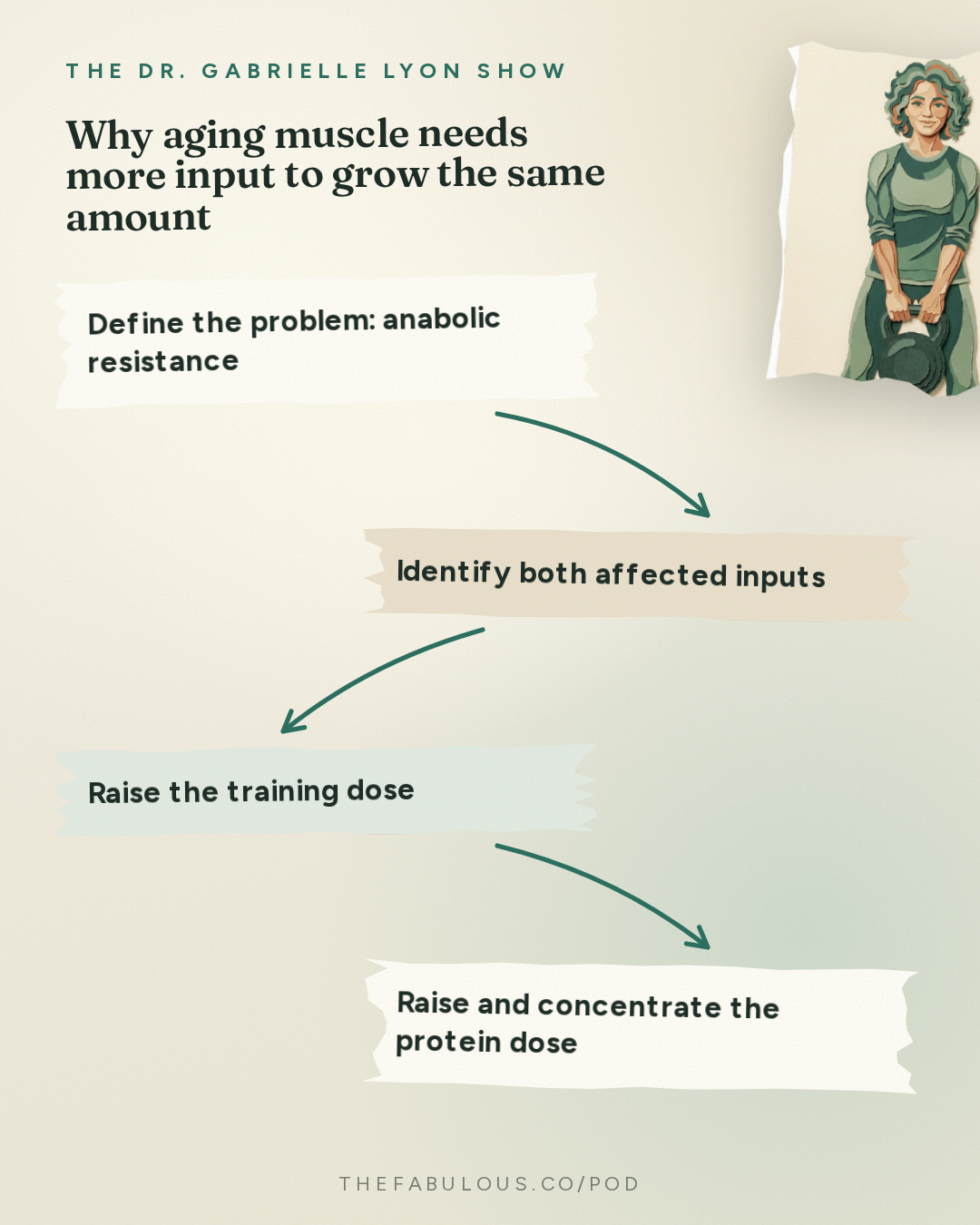
Building Muscle in Menopause: What Studies Show
Is It Too Late to Build Muscle in Menopause? No. Here's What the Studies Show
▶ Listen to the full episode More from The Dr. Gabrielle Lyon Show
The brief
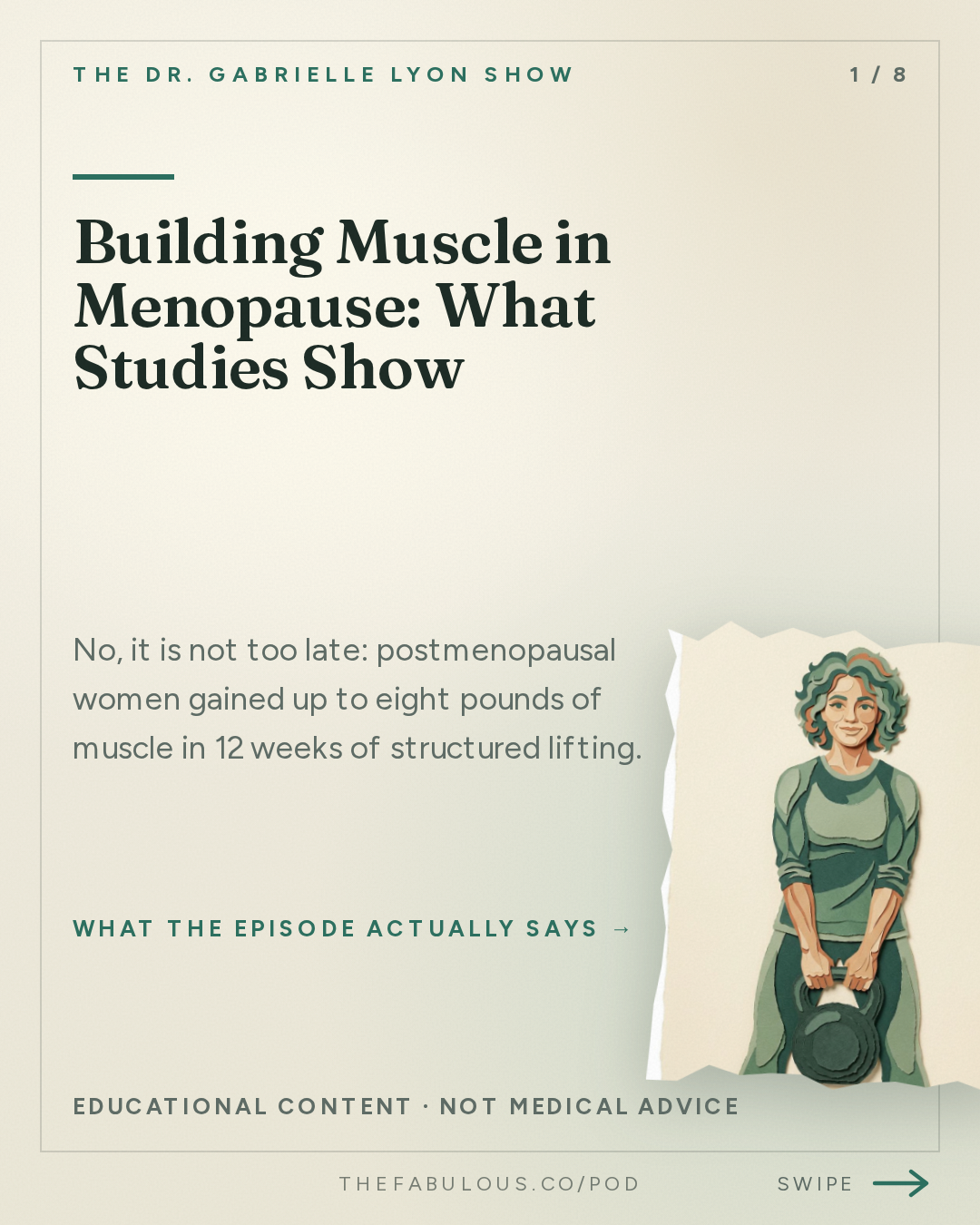
No, it is not too late: postmenopausal women gained up to eight pounds of muscle in 12 weeks of structured lifting. Hormone therapy does not build muscle on its own, but it can amplify gains from resistance training, and the protein target for bone and muscle protection is roughly double the standard RDA.
A funny thing happens when a physician spends a career teaching people how muscle works: she picks up her own myths along the way. Dr. Gabrielle Lyon, a physician who studies skeletal muscle as an organ tied to long-term health, admits she carried one for years. She believed a postmenopausal woman needed hormones on board before resistance training could do much good. She was wrong, and the data that corrected her is now the spine of her case for women well past menopause (04:15).
The correction came from her own mentor, Dr. Donald Layman, a researcher she worked under as an undergraduate collecting urine samples at the University of Illinois for studies on postmenopausal women who received no hormone replacement at all (04:36). Those women still gained strength and muscle. That contradicted what Lyon assumed was mechanistically obvious: that estrogen must be the switch that lets muscle grow. It turned out training was doing the work on its own.
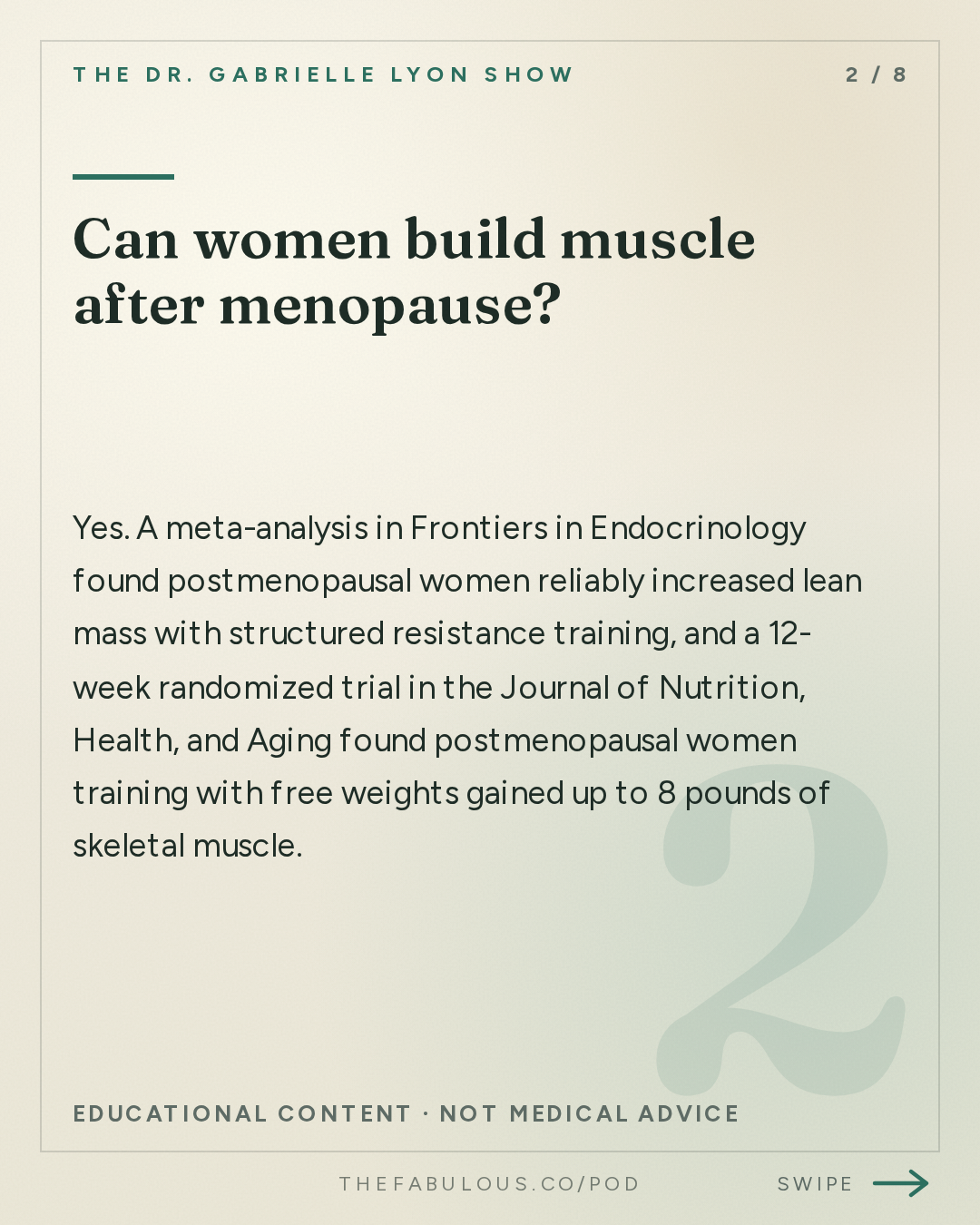
The newer evidence backs this up at a larger scale. A meta-analysis in the journal Frontiers in Endocrinology found that postmenopausal women reliably increased lean mass through structured resistance training, no hormone therapy required (01:06). A 12-week randomized controlled trial published in the Journal of Nutrition, Health, and Aging went further: women training with free weights gained roughly eight pounds of skeletal muscle in three months, with meaningful jumps in squat and deadlift strength (01:38). That is not a subtle effect. It is the kind of change that shows up on a scale and in how heavy a suitcase feels.
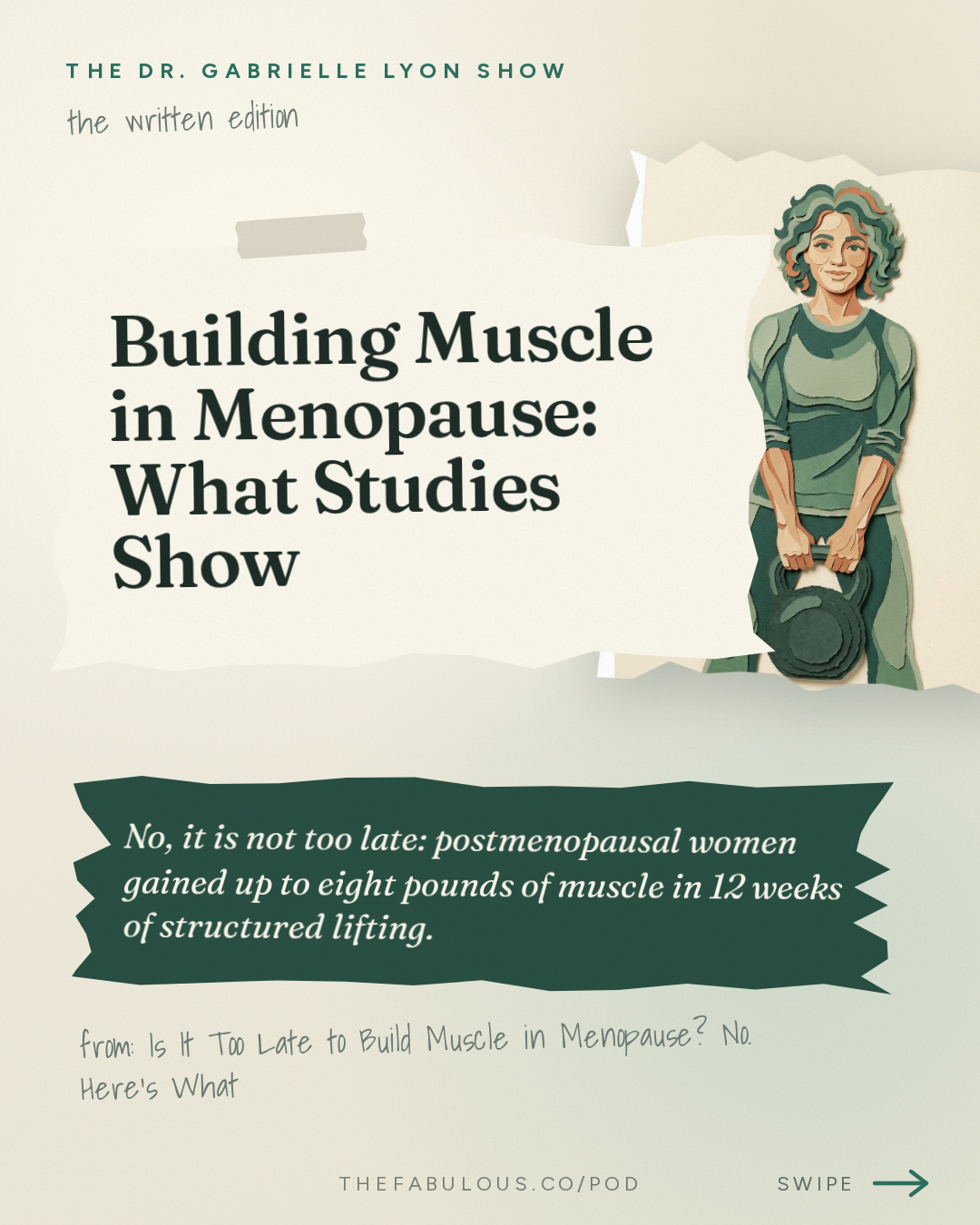
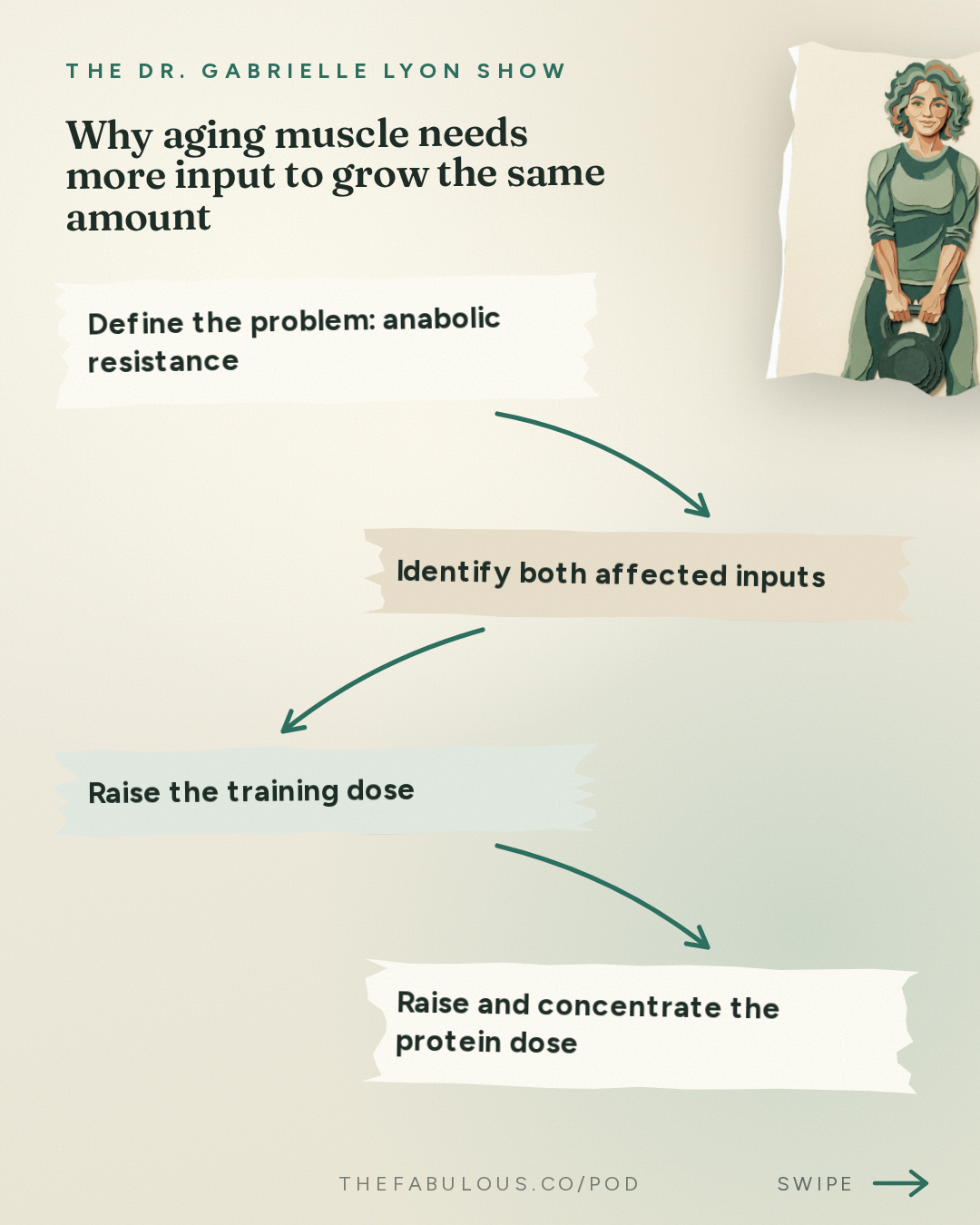
None of this means aging muscle behaves exactly like younger muscle. Lyon points to a real phenomenon called anabolic resistance, which she defines simply: it is the inefficiency of muscle to respond to a building stimulus (02:09). "Anabolic resistance is the inefficiency of your muscle to respond to a stimulus," she says (02:09). That stimulus can be mechanical, the tension created by lifting something heavy, or chemical, the amino acids that arrive after a meal. As muscle ages, it needs more of both to produce the same growth it once got from less. The practical fix, in Lyon's words, is that a well-designed program for anyone past midlife requires higher volume, higher intensity, and a meaningful protein intake, regardless of sex (03:14).
The Hierarchy Nobody Expected
Given anabolic resistance, it seemed reasonable to assume hormone therapy would be the fix, restoring the hormonal environment and letting muscle respond like it used to. Lyon says she wanted to believe exactly that (04:15). But a meta-analysis of 12 randomized controlled trials, published in JAMA Network Open, measured hormone therapy's effect on lean body mass in isolation, without training as a variable, and found essentially nothing. The pooled difference between hormone therapy and no hormone therapy came out to six hundredths of a kilogram, a gap Lyon calls clinically meaningless (05:32). Every individual trial in that pooled analysis clustered near the line of no effect, about as neutral a result as exists in the medical literature on this topic.
"Just because you believe something and you can make it make sense mechanistically, it doesn't mean that it will hold up in the science." — Dr. Gabrielle Lyon [05:04]
That does not make hormone therapy irrelevant. A separate study in Frontiers in Physiology gave postmenopausal women transdermal estradiol, a form of estrogen delivered through the skin, alongside 12 weeks of resistance training, and compared the results against training with a placebo. The estradiol group showed larger gains in quadriceps size and greater fat-free mass, and those gains held up a year later (06:28). The pattern that emerges from both studies together is specific: hormone therapy does not appear to build muscle by itself, but when training is already happening, it seems to amplify what the training produces. Lyon's own summary is blunt: on current evidence, hormone therapy is not a standalone muscle preservation strategy (07:54). Her practical advice follows from that: lift first, and have the hormone therapy conversation with a physician as a separate decision, driven by symptoms like hot flashes, not by an assumption that it is required for muscle.
Protein, Rebuilt
Training is half the equation. The other half is harder to fix than it sounds, because the problem is not just that aging muscle responds less to exercise. It also responds less to protein itself. Lyon describes this as a second, parallel form of resistance: postmenopausal muscle shows a decreased response to protein ingestion on its own, separate from anything happening in the gym (10:01). The average woman eats around 60 grams of protein a day (10:26), and Lyon makes a point of noting that 60 grams eaten in small amounts spread across the day does not produce the same input as 60 grams eaten at a single meal (10:58). Spreading protein thin may be the more common habit, but it appears to blunt the very signal that is already weaker in aging muscle.
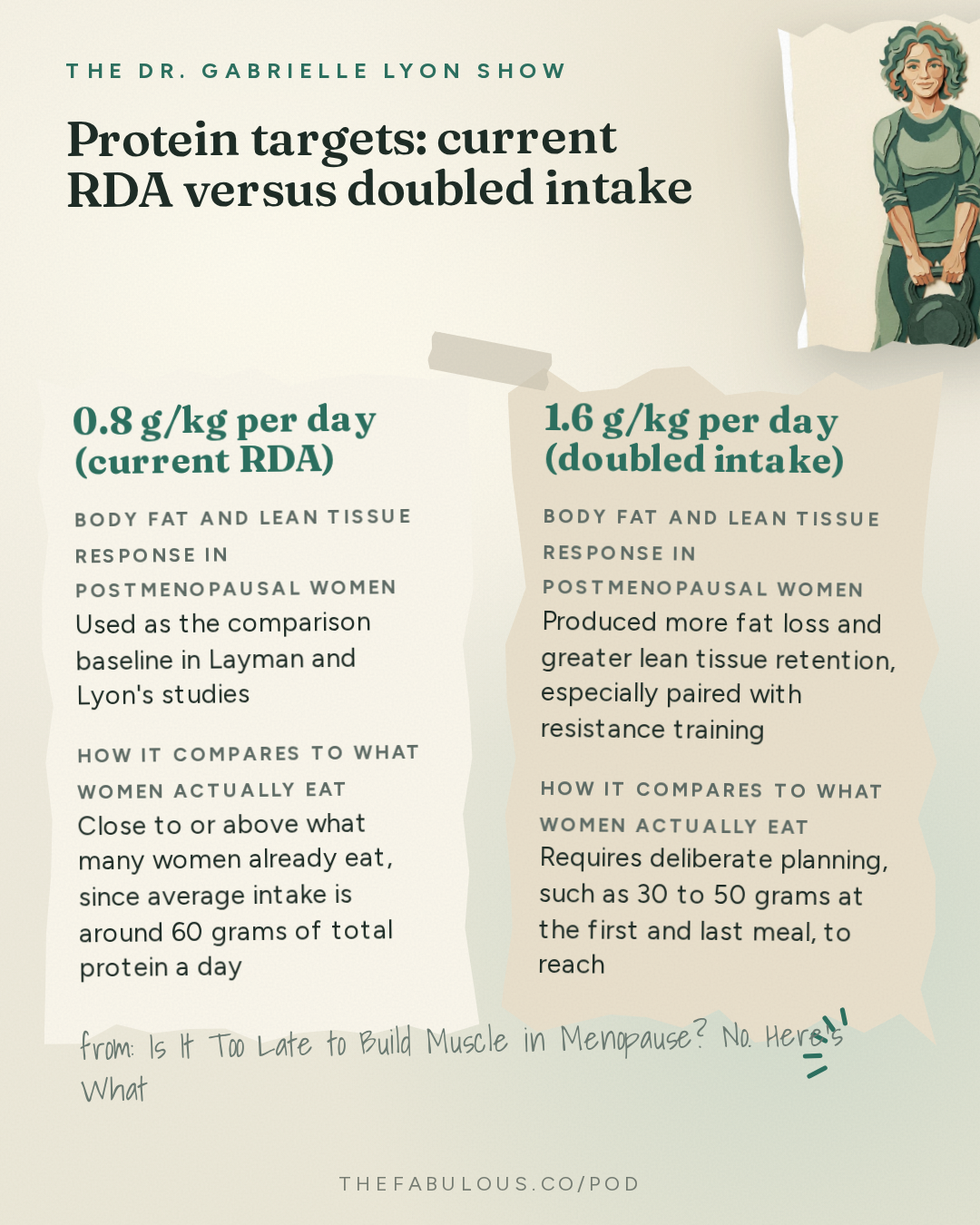
The official numbers make the gap look worse than most people assume. The current Recommended Dietary Allowance, or RDA, sets protein at 0.8 grams per kilogram of body weight per day. A consensus statement from the European Society for Clinical and Economic Aspects of Osteoporosis and Osteoarthritis sets a higher floor, between 1.0 and 1.2 grams per kilogram per day, specifically because bone needs protein too (10:58). Lyon puts the stakes plainly.
"I talk all about muscle, but bone is made from protein." — Dr. Gabrielle Lyon [11:23]
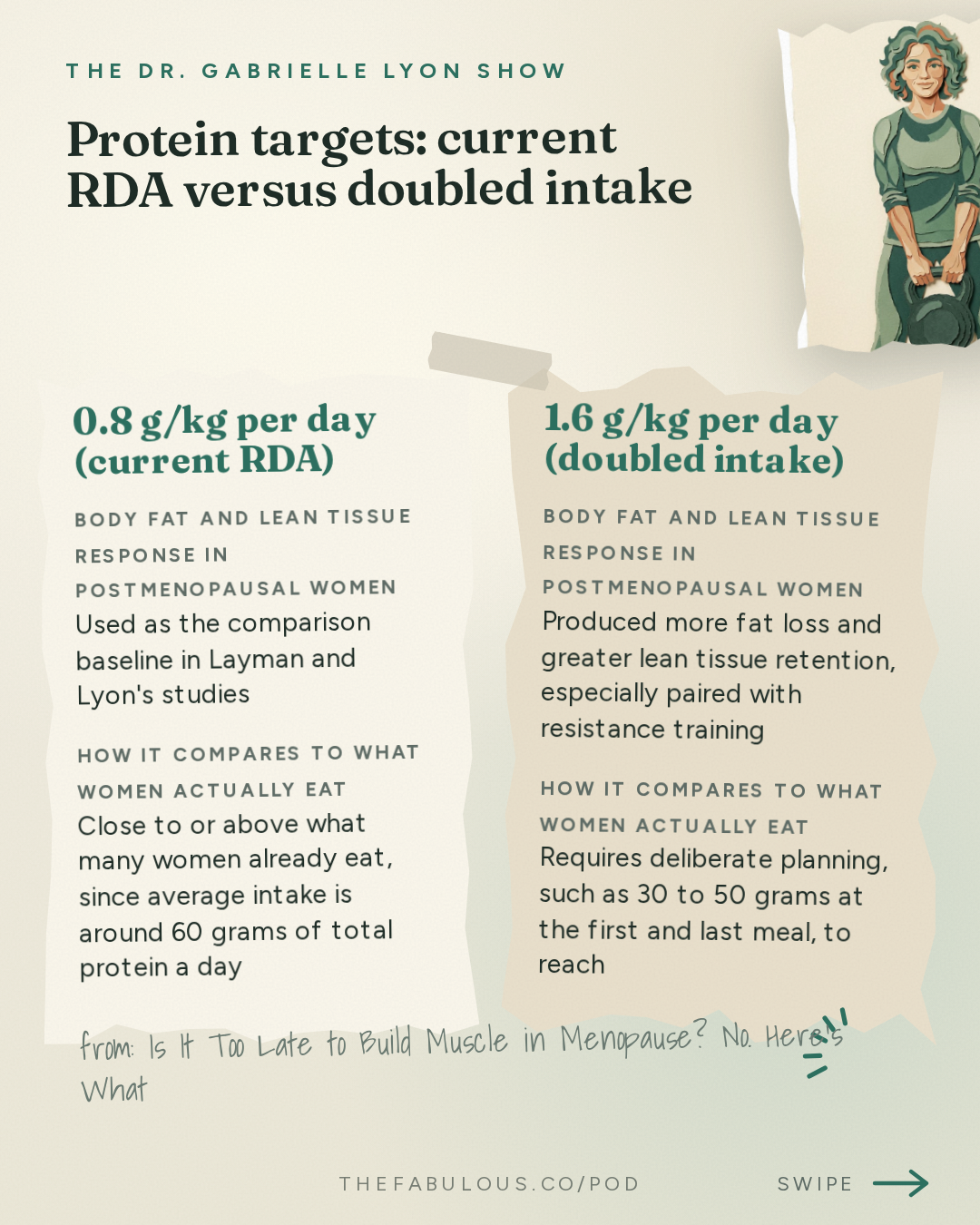
Her own earlier research with Layman in postmenopausal women tested what happens when protein intake is doubled, from the RDA's 0.8 grams per kilogram up to 1.6 grams per kilogram. The women who ate more protein lost more body fat and retained more lean tissue, and the effect was stronger when paired with resistance training (11:57). The average 50-year-old woman currently eats something closer to 60 to 66 grams of total protein a day (12:42), which for most body weights sits well under even the lower 1.0 to 1.2 gram floor, let alone the 1.6 gram target that produced the better outcomes.
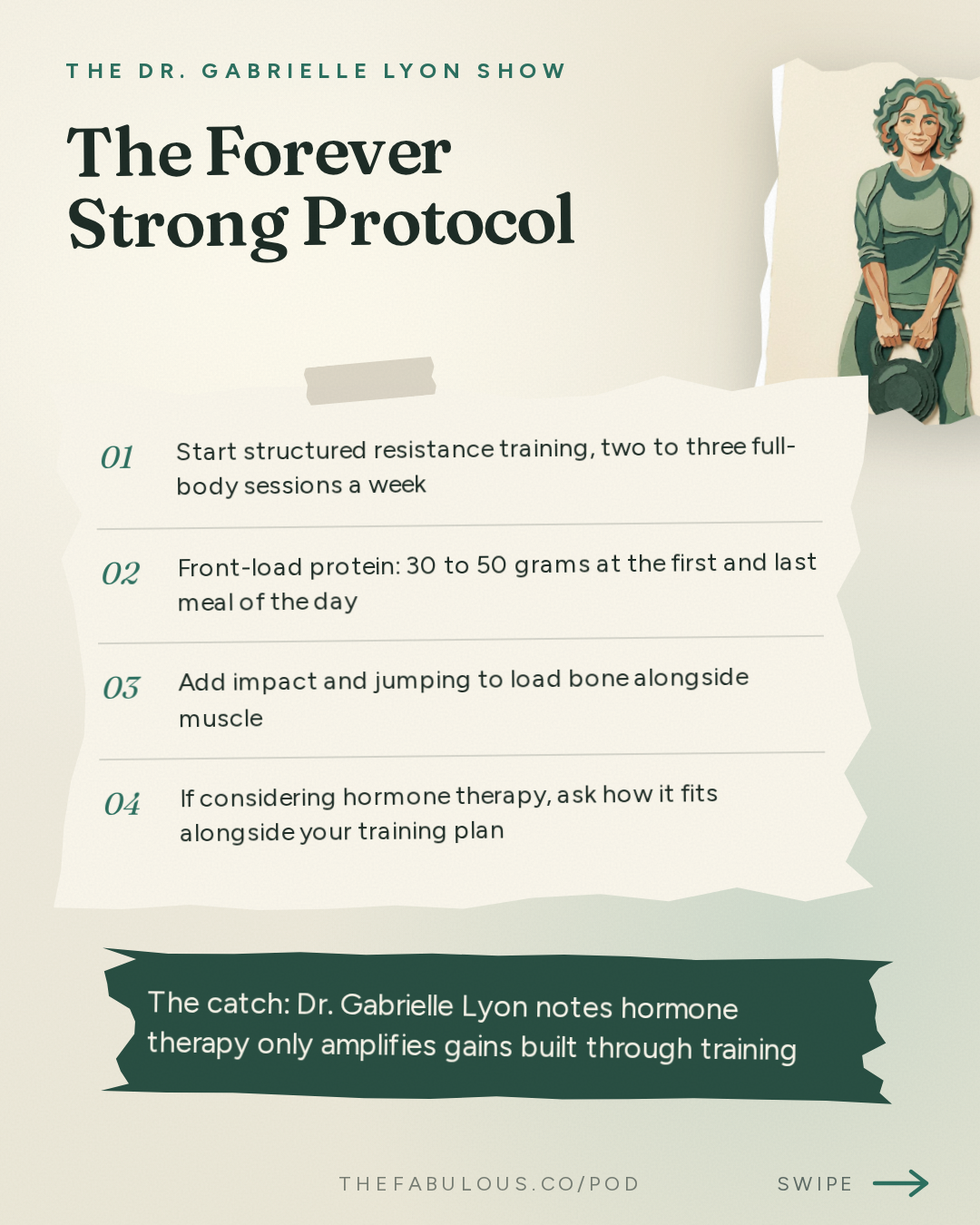
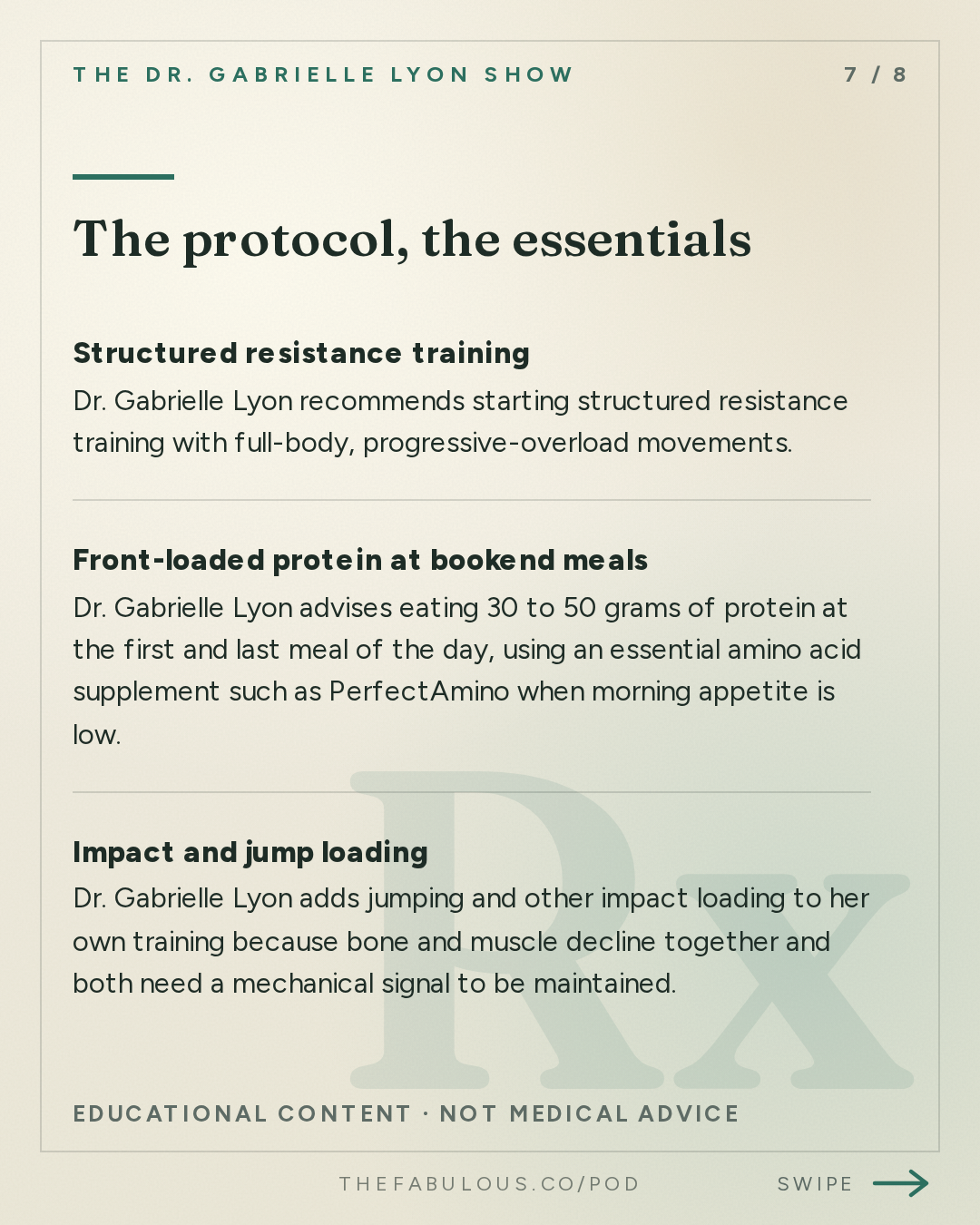
Out of this evidence, Lyon built what she calls the Forever Strong protocol, named after her book, a six-item list she says can be tackled in any order (13:16). The first is structured resistance training, two to three sessions a week built around full-body, progressive movements (13:40). The second is protein concentrated at the first and last meal of the day, 30 to 50 grams each, with an essential amino acid supplement as a backup for anyone without much appetite in the morning (14:02). The third is impact loading, things like jumping, because bone and muscle decline together and both need a mechanical signal to maintain themselves (14:30). The fourth is treating hormone therapy as an add-on to a training plan rather than a substitute for it, a direct echo of the data above (15:24). The fifth is a baseline body composition scan, using a DEXA machine or a comparable tool like InBody, so that change can actually be measured (15:24). The sixth is blood work, checking estrogen, FSH, testosterone, and estradiol, which is the only reliable way to confirm where someone actually stands in the menopause transition rather than guessing from symptoms alone (15:52).
What makes this protocol notable is not any single number in it. It is the order of operations. Lyon spent years assuming hormones came first and training was the variable that depended on them. The evidence pushed her toward the opposite conclusion: training and protein are the levers a woman controls directly, with real trial data behind both, and hormone therapy is a conversation to have alongside that foundation, not instead of it. For a population that has been told for decades that the window for building muscle closes at menopause, the more useful message is narrower and more actionable: the window does not close, it just requires a heavier program and a fuller plate.
Ask this episode anything
Pod's AI answers from the episode itself, with the minute mark so you can hear it yourself.
Or start with one of these
Ask this episode
Pod's AI listens to the whole episode to answer, and points you to the minute it comes from.
The rest of this answer, and any question after it
Answers come from the episode itself, never from a summary of it.
ContinueKey takeaways
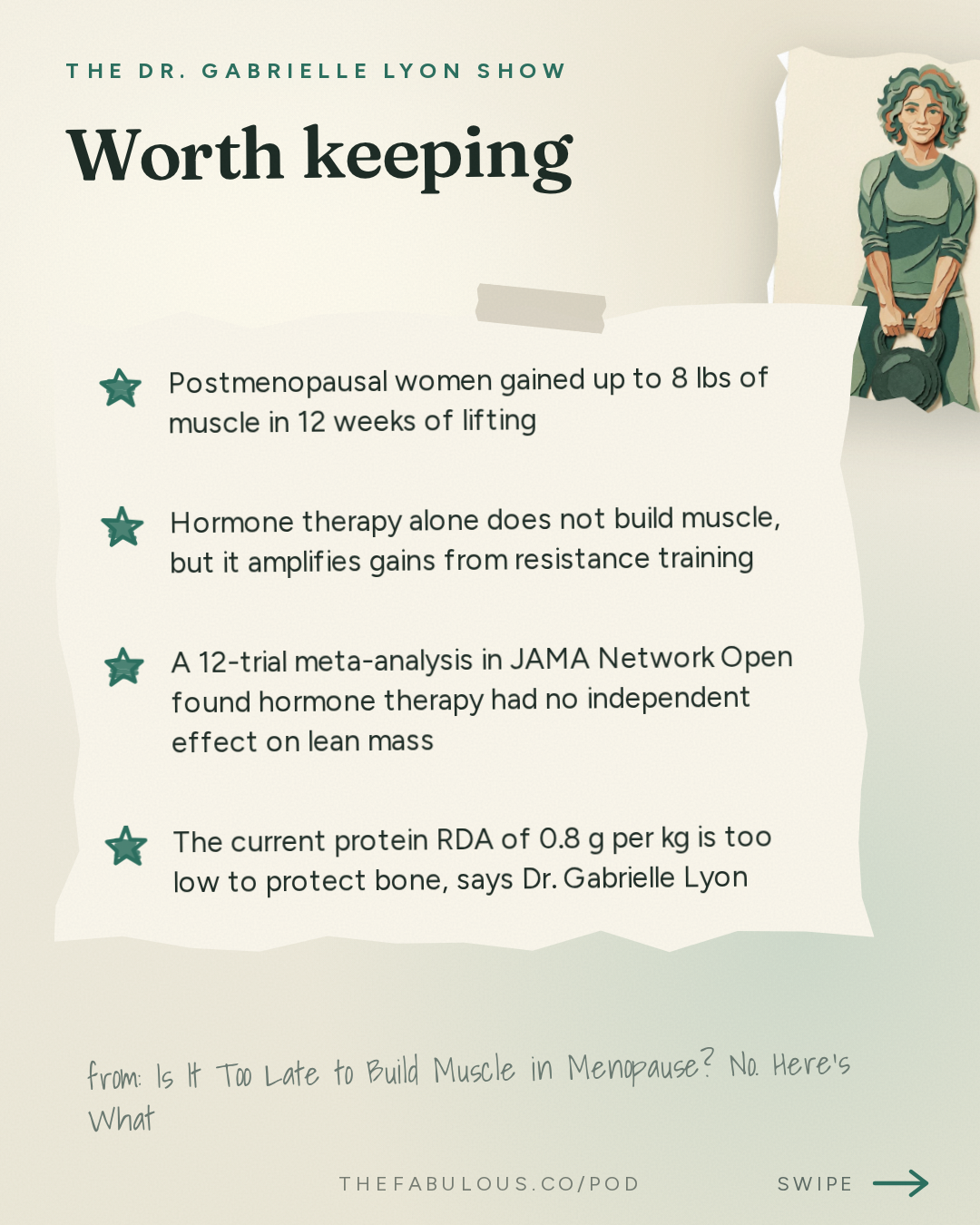
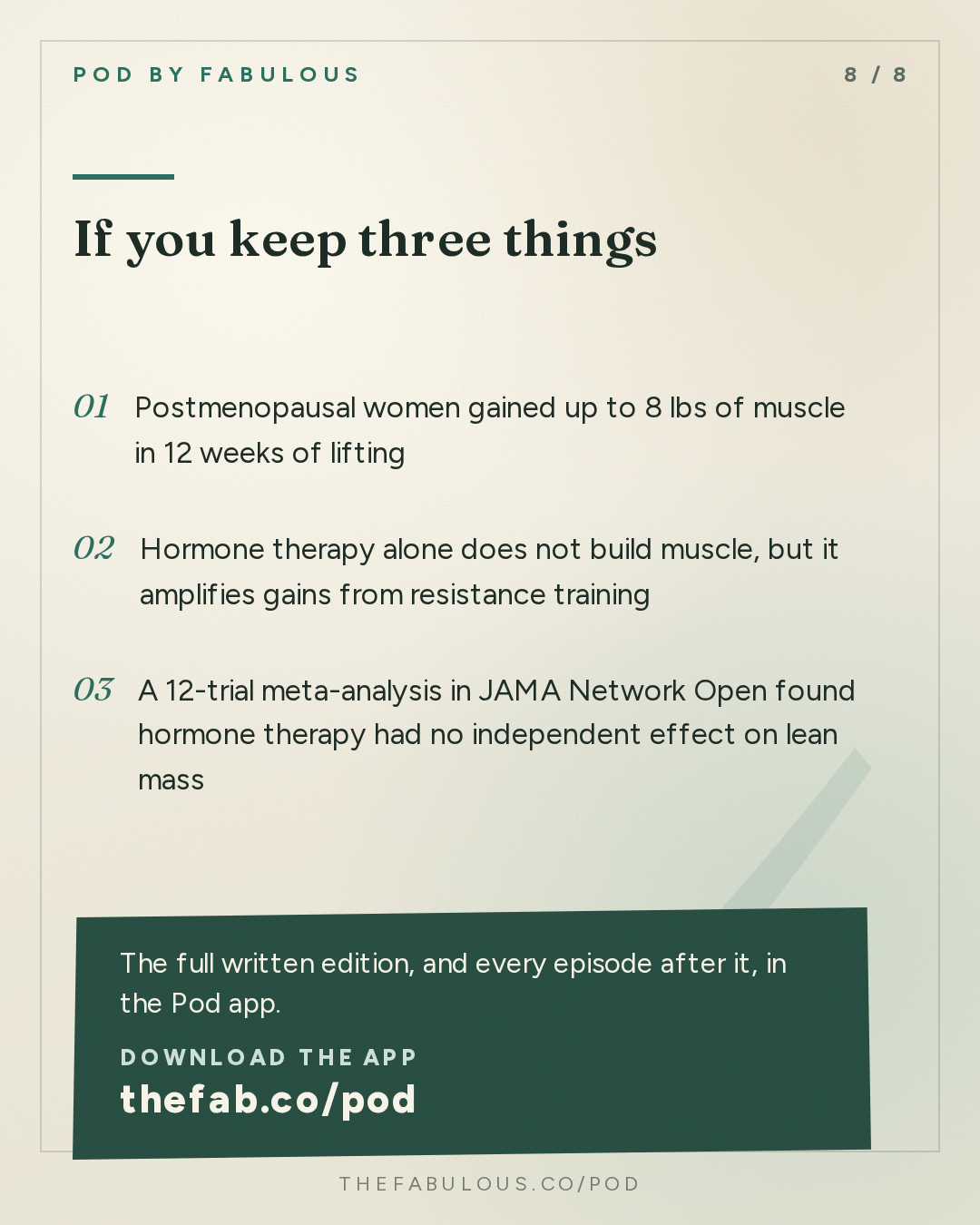
- Postmenopausal women gained up to 8 lbs of muscle in 12 weeks of lifting
- Hormone therapy alone does not build muscle, but it amplifies gains from resistance training
- A 12-trial meta-analysis in JAMA Network Open found hormone therapy had no independent effect on lean mass
- The current protein RDA of 0.8 g per kg is too low to protect bone, says Dr. Gabrielle Lyon
- Doubling protein to 1.6 g per kg a day increased fat loss and preserved lean tissue in women
The episode in cards
By the numbers
- 0.8 g/kg/day current protein RDA, called insufficient to protect bone
- 1.6 g/kg/day protein intake linked to more fat loss and lean tissue retention in postmenopausal women
In their words
“Hormone therapy doesn't really build muscle, but it's amplifying the training effect.”
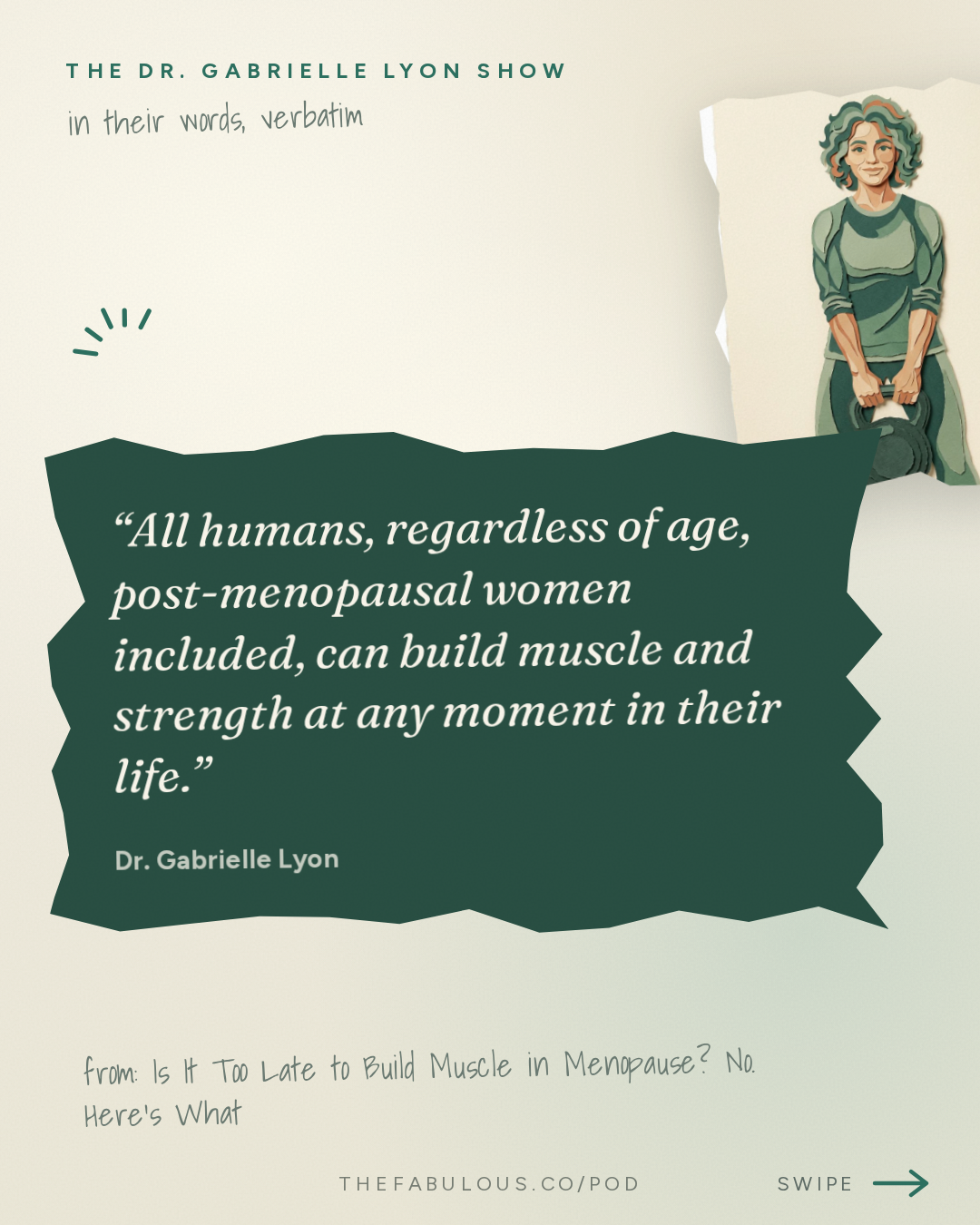
“All humans, regardless of age, post-menopausal women included, can build muscle and strength at any moment in their life.”
“Just because you believe something and you can make it make sense mechanistically, it doesn't mean that it will hold up in the science.”
“I talk all about muscle, but bone is made from protein”
“If you are listening to this podcast, then you or someone you love is likely undereating protein.”
Protocols
-
Structured resistance training
Dr. Gabrielle Lyon recommends starting structured resistance training with full-body, progressive-overload movements.
Two to three sessions per week
-
Front-loaded protein at bookend meals
Dr. Gabrielle Lyon advises eating 30 to 50 grams of protein at the first and last meal of the day, using an essential amino acid supplement such as PerfectAmino when morning appetite is low.
Twice daily, at the first and last meal
-
Impact and jump loading
Dr. Gabrielle Lyon adds jumping and other impact loading to her own training because bone and muscle decline together and both need a mechanical signal to be maintained.
Alongside regular strength sessions
-
Hormone therapy as an adjunct, not a substitute
Dr. Gabrielle Lyon tells women weighing hormone therapy to ask their physician how it fits alongside an existing training plan rather than treating it as a replacement for lifting.
Discuss when hormone therapy is first being considered
-
Baseline tracking
Dr. Gabrielle Lyon recommends getting a baseline body composition scan, such as a DEXA or InBody test, along with blood work checking estrogen, FSH, testosterone, and estradiol to confirm menopausal status.
At the start of the protocol, then periodically to track change
Questions this episode answers
Can women build muscle after menopause?
Yes. A meta-analysis in Frontiers in Endocrinology found postmenopausal women reliably increased lean mass with structured resistance training (01:06), and a 12-week randomized trial in the Journal of Nutrition, Health, and Aging found postmenopausal women training with free weights gained up to 8 pounds of skeletal muscle (01:38).
Does hormone replacement therapy build muscle?
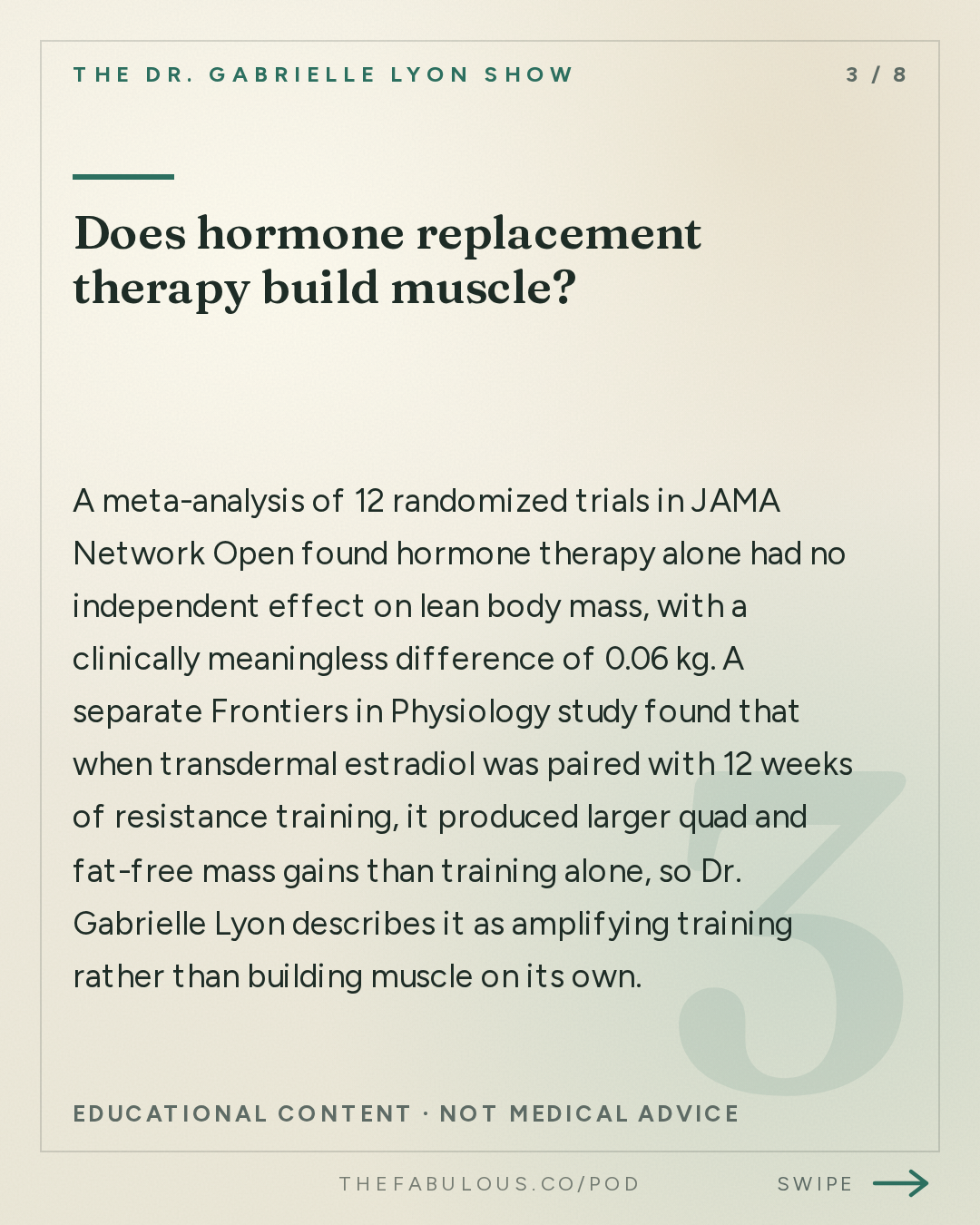
A meta-analysis of 12 randomized trials in JAMA Network Open found hormone therapy alone had no independent effect on lean body mass, with a clinically meaningless difference of 0.06 kg (05:32). A separate Frontiers in Physiology study found that when transdermal estradiol was paired with 12 weeks of resistance training, it produced larger quad and fat-free mass gains than training alone (06:28), so Dr. Gabrielle Lyon describes it as amplifying training rather than building muscle on its own.
How much protein should a postmenopausal woman eat?
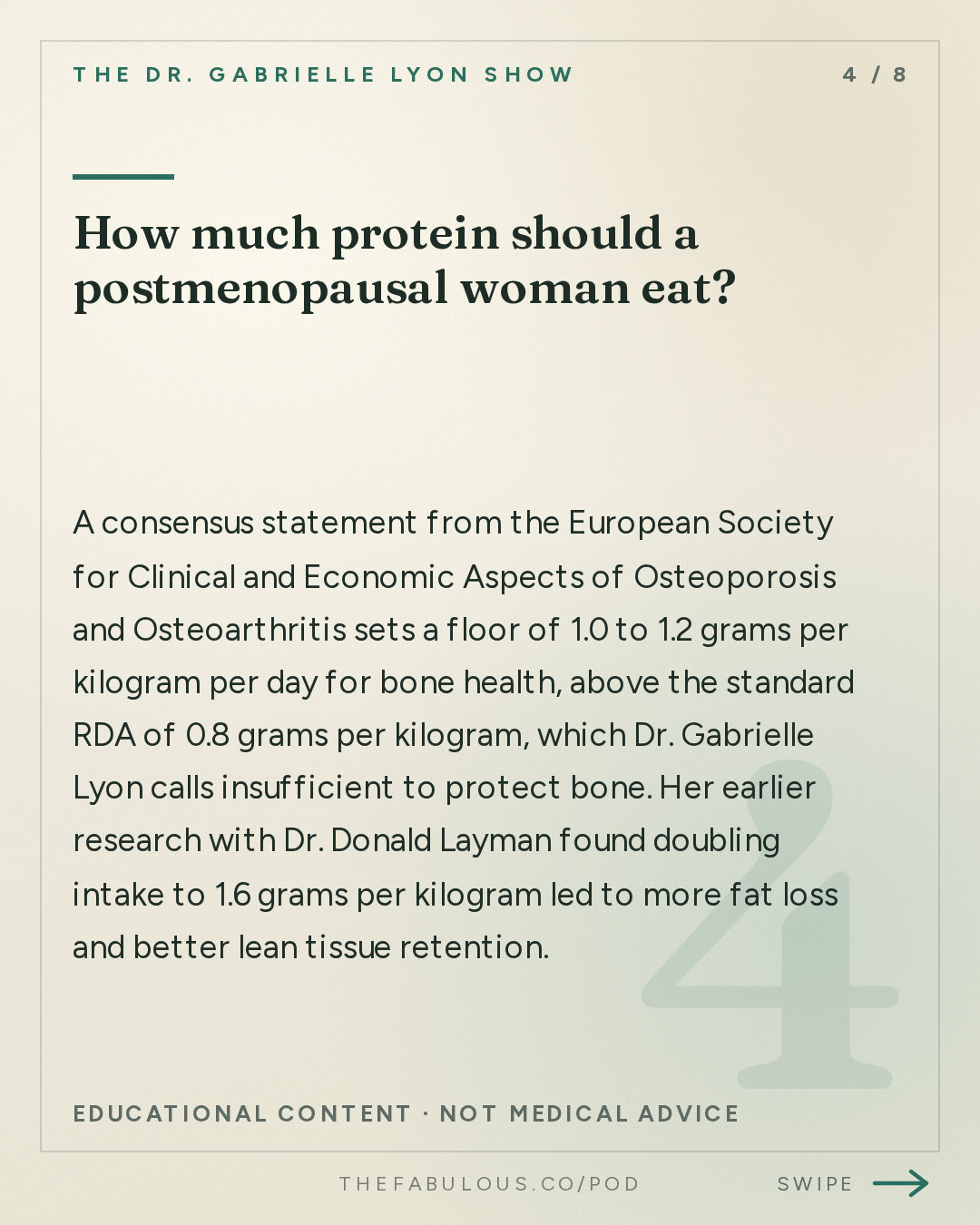
A consensus statement from the European Society for Clinical and Economic Aspects of Osteoporosis and Osteoarthritis sets a floor of 1.0 to 1.2 grams per kilogram per day for bone health (10:58), above the standard RDA of 0.8 grams per kilogram, which Dr. Gabrielle Lyon calls insufficient to protect bone (11:23). Her earlier research with Dr. Donald Layman found doubling intake to 1.6 grams per kilogram led to more fat loss and better lean tissue retention (11:57).
What is anabolic resistance?
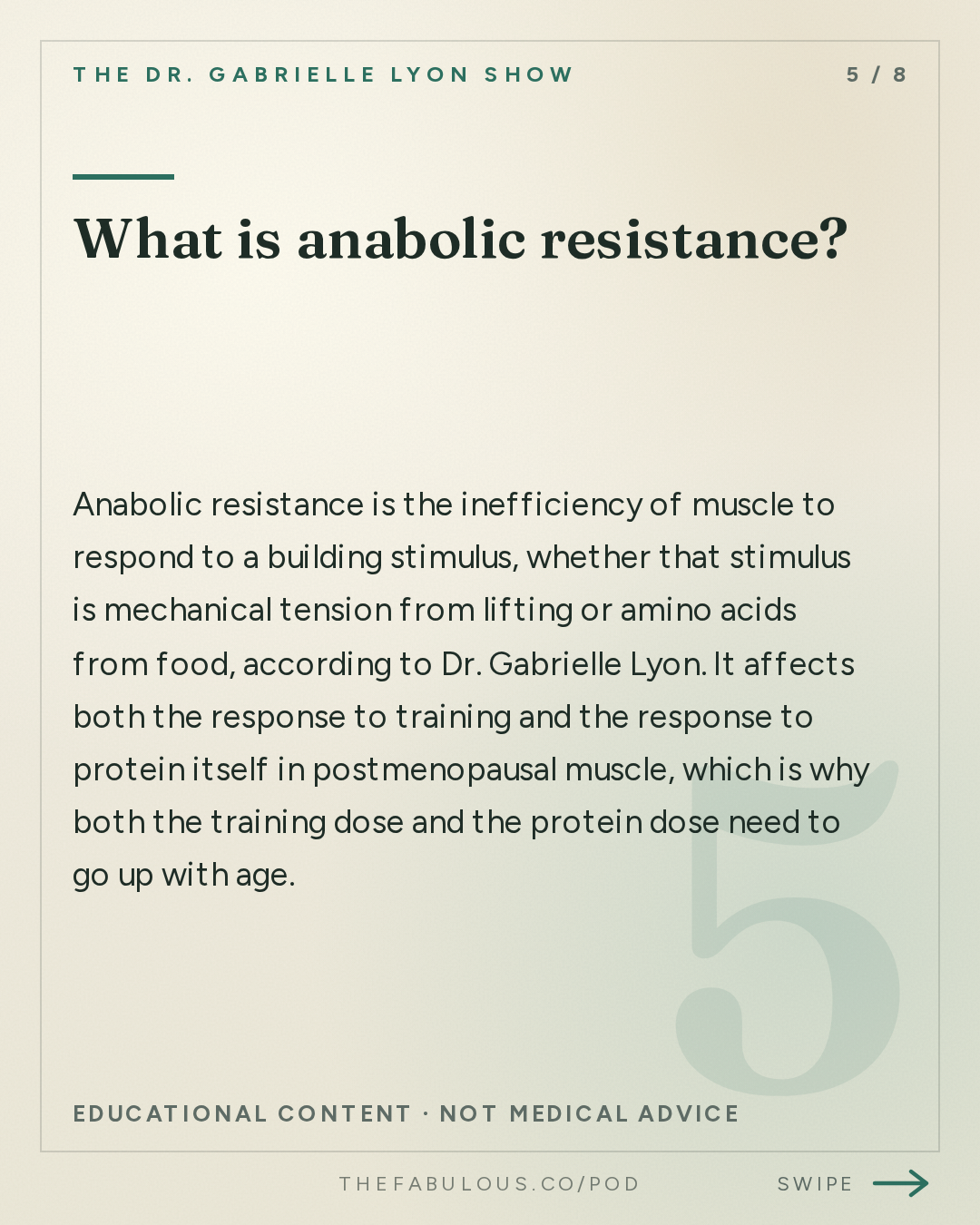
Anabolic resistance is the inefficiency of muscle to respond to a building stimulus, whether that stimulus is mechanical tension from lifting or amino acids from food, according to Dr. Gabrielle Lyon (02:09). It affects both the response to training and the response to protein itself in postmenopausal muscle (10:01), which is why both the training dose and the protein dose need to go up with age.
What is the Forever Strong protocol for menopause?
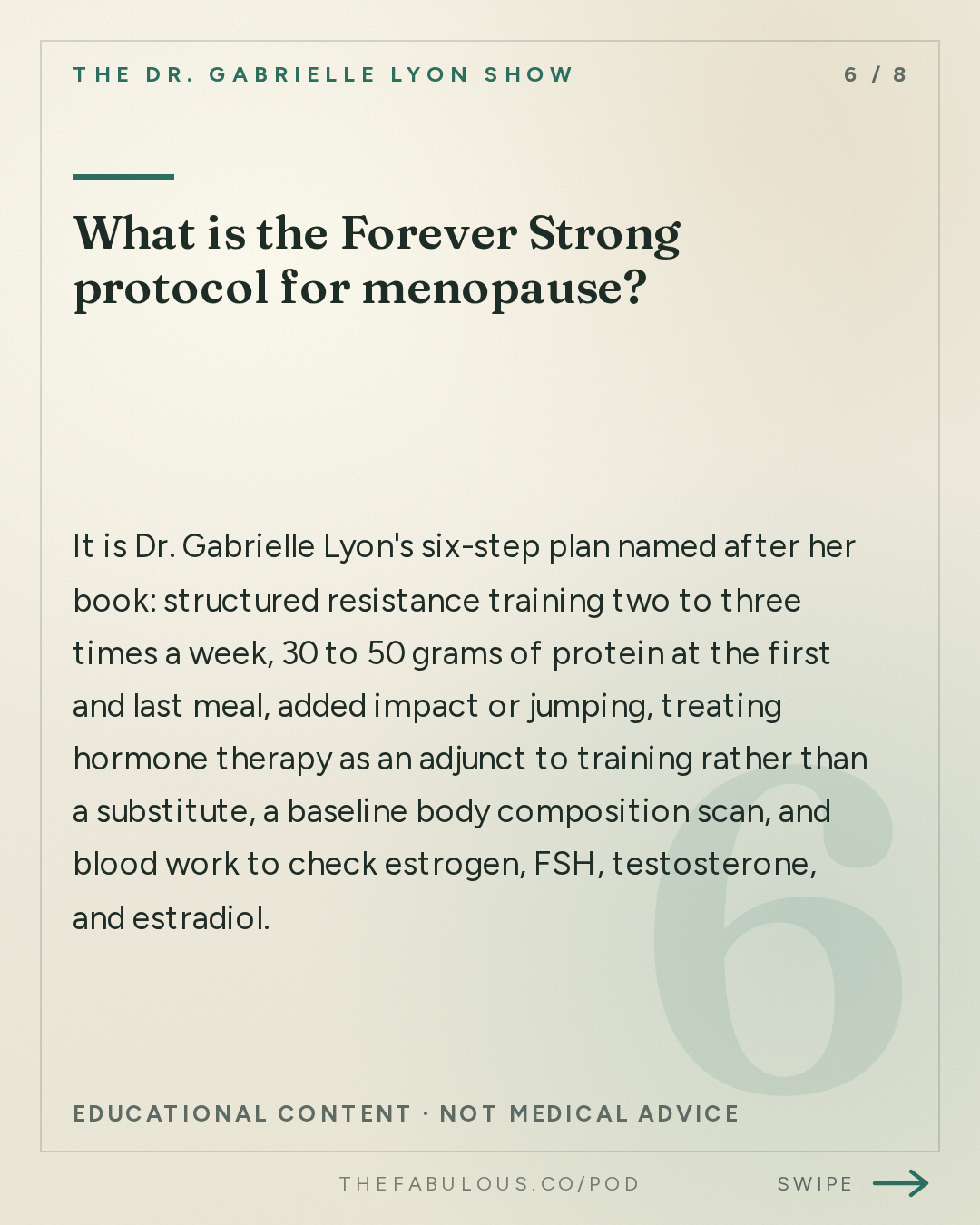
It is Dr. Gabrielle Lyon's six-step plan named after her book: structured resistance training two to three times a week, 30 to 50 grams of protein at the first and last meal, added impact or jumping, treating hormone therapy as an adjunct to training rather than a substitute, a baseline body composition scan, and blood work to check estrogen, FSH, testosterone, and estradiol (13:16).
The full read, in cards
Go deeper
- Frontiers in Endocrinology meta-analysis — found postmenopausal women reliably increased lean mass with structured resistance training
- Journal of Nutrition, Health, and Aging randomized controlled trial — found postmenopausal women training with free weights gained up to 8 pounds of skeletal muscle in 12 weeks
- JAMA Network Open meta-analysis of 12 randomized trials — found no independent effect of hormone therapy alone on lean body mass
- Frontiers in Physiology study — found transdermal estradiol plus resistance training produced larger quad and fat-free mass gains than training with placebo
- European Society for Clinical and Economic Aspects of Osteoporosis and Osteoarthritis consensus statement — set the protein floor for aging adults at 1.0 to 1.2 grams per kilogram per day for bone health
- Forever Strong — Dr. Gabrielle Lyon's book containing the structured training programs referenced in the protocol
Mentioned
Dr. Gabrielle Lyon · Dr. Donald Layman · Frontiers in Endocrinology · Journal of Nutrition, Health, and Aging · JAMA Network Open · Frontiers in Physiology · European Society for Clinical and Economic Aspects of Osteoporosis and Osteoarthritis · Forever Strong · DEXA · InBody · PerfectAmino
More from this show and category

Surgical Prehabilitation Protocol Guide
Prehabilitation, the practice of preparing the body before surgery instead of only recovering after it, can measurably change outcomes. Duke University surgeon Rebecca Knackstedt recommends 2 grams of protein per kilogram of body weight daily (34:26), a vitamin D level near 70 ng/mL (25:47), targeted muscle training, and five days of immunonutrition before major operations (69:01) to cut complications and speed healing.

ED as an Early Predictor of Heart Attack Risk
Erectile dysfunction predicts a future heart attack better than chest pain does, especially in younger men (11:11). Urologist Tobias Kohler describes two cheap early-warning tests, a coronary calcium scan and a Mayo Clinic ceramide blood test, plus the cardiac damage caused by high-dose testosterone abuse (12:49, 44:55).

Menopause, Muscle Loss, and Insulin Resistance
Menopause changes the body mainly by shrinking muscle, not just by crashing hormones. Dr. Gabrielle Lyon argues that muscle loss, which starts speeding up about two years before a woman's final period, drives the insulin resistance, bone loss, and fat gain often blamed on menopause alone, and that resistance training and higher protein intake are the direct countermeasures.

Huberman's Science-Based Focus Tools
Stanford neuroscientist Andrew Huberman lays out a stacked protocol for training focus, from sleep and caffeine to meditation and supplements. He covers 90-minute ultradian work blocks, a 13-minute daily breath meditation, cold exposure for epinephrine, and specific doses for creatine, alpha-GPC, and L-tyrosine, recommending behavioral tools before any supplement or drug.
