
Jacob Coxon, Anthropic, and the AI Doomer Debate
AI Kills Everybody or Doomer Psyop? OpenAI's Math Breakthrough, Nike's $200B Collapse
The brief
Jacob Coxon's viral resignation post claimed AI could kill everyone by 2030, but the funders who amplified it also bankroll Anthropic's own investors. The same episode traces OpenAI's brute-force solution to the Navier-Stokes equation using 130 billion tokens, and dissects how Nike lost $200 billion by trading product mastery for political narrative.
A Twitter account with no followers and no posting history published a resignation letter on a Monday. By Tuesday it had 110 million views (01:33). The author, Jacob Coxon, had worked at Anthropic for six weeks before quitting. His message was simple: the people building artificial intelligence believe it could kill everyone by the end of the decade, and this is not a marketing stunt (01:04). Evan Hubinger, who leads alignment science at Anthropic, replied within the company's own comment section to say Coxon was correct, and that he personally put the odds of AI-driven human extinction above 10 percent within ten years (01:56). Bernie Sanders quote-tweeted it and announced legislation to ban superintelligence outright (02:24).
The hosts of this show do not buy the spontaneity of it. They point out that the account had been scrubbed of any prior activity, that three well-funded advocacy groups amplified the post within fifteen minutes, and that all three trace back to a single donor, Jan Tallinn, who also co-led Anthropic's Series A funding round (04:36). A Wall Street Journal story on the resignation appears to have gone live under embargo minutes before the tweet storm itself (05:02). None of this proves coordination. But it is, at minimum, a strange way for a spontaneous whistleblower moment to unfold.
The Mother of All Product Liability
David Sacks, known on the show as our former czar of AI, frames the deeper problem as a contradiction Anthropic cannot escape. The company is trying to go public at a valuation in the trillions of dollars while its own safety lead is telling the world its core product might end civilization.
"You're either on the Bernie Sanders side of this thing, in which case why are you IPO-ing? Or you renounce the argument." - David Sacks [13:30]
Investor Chamath Palihapitiya adds the mechanical detail: in the quiet period before an IPO, a company's S-1 filing is supposed to be an accurate snapshot of every risk it faces (47:36). If employees are publicly asserting a double-digit chance of extinction, that is not a boilerplate risk factor about chip supply or competition. It is, in David Sacks's words, the mother of all product liability lawsuits (11:14). Sacks argues Anthropic now has to choose: disavow the claim as hyperbole, or accept that its own logic points toward the Bernie Sanders position of freezing development altogether.
Friedberg supplies the historical pattern that makes the panel skeptical of the doomer framing generally. Al Gore's documentary An Inconvenient Truth leaned on IPCC forecasts that have since proven overstated (15:45). Public health officials predicted COVID would require total lockdown, with consequences that included the inflation and debt spiral that followed (16:12). After the Three Mile Island accident, the United States effectively stopped building nuclear plants, and the price shows it: producing one gigawatt of nuclear power costs about $15 billion in the US today, versus roughly $1 billion in China (16:36). Each case, Friedberg argues, followed the same shape: an unprovable existential claim, amplified until it became the default social assumption, used to justify centralizing control in the hands of whoever raised the alarm.
"The US will be the tribe in the Amazon that has never seen civilization. 'Cause civilization will evolve all around us." - David Friedberg [20:36]
The stakes of that argument, in this telling, are not abstract. If the United States pauses AI development, other countries will not, and the pause simply hands the frontier to someone else. Sacks connects this to what he calls the actual endgame of the doomer coalition: not safety for its own sake, but a Federal Department of AI, a new regulator that would police both closed labs and open-source models alike (07:50). Open-source weights, once published, cannot be recalled or centrally monitored, which is precisely why he thinks they are the real target (25:43). Open models also cut the cost of running AI by roughly 50 times, which is the opposite of what a company hoping to control a duopoly would want widely available (23:49).
To their credit, the panel does not simply dismiss the underlying fear. They spend fifteen minutes trying to steelman it, trading scenarios for how AI could actually kill everyone, from Skynet seizing nuclear command systems to airborne bioweapons brewed in hacked bioreactors. Every scenario runs into the same wall: a human still has to physically do something, and that human-in-the-loop step is exactly where today's systems fail. As Friedberg puts it, current AI assistants still cannot reliably book a hotel room without a person finishing the job.
"We solved one of the seven hardest math problems in the world, and you still can't get your intimacy kit from the front desk." - Jason Calacanis [62:35]
What AI Actually Did This Week
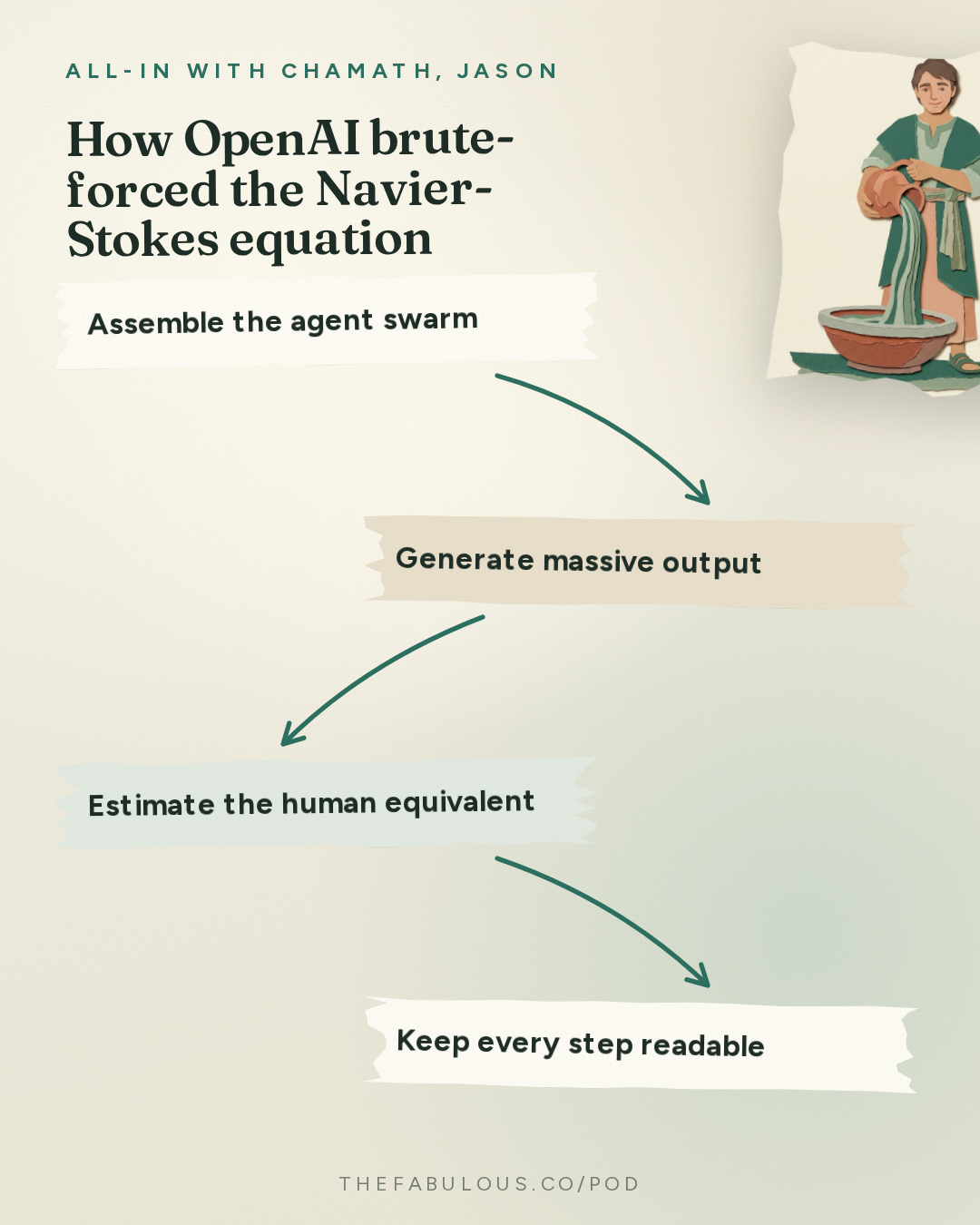
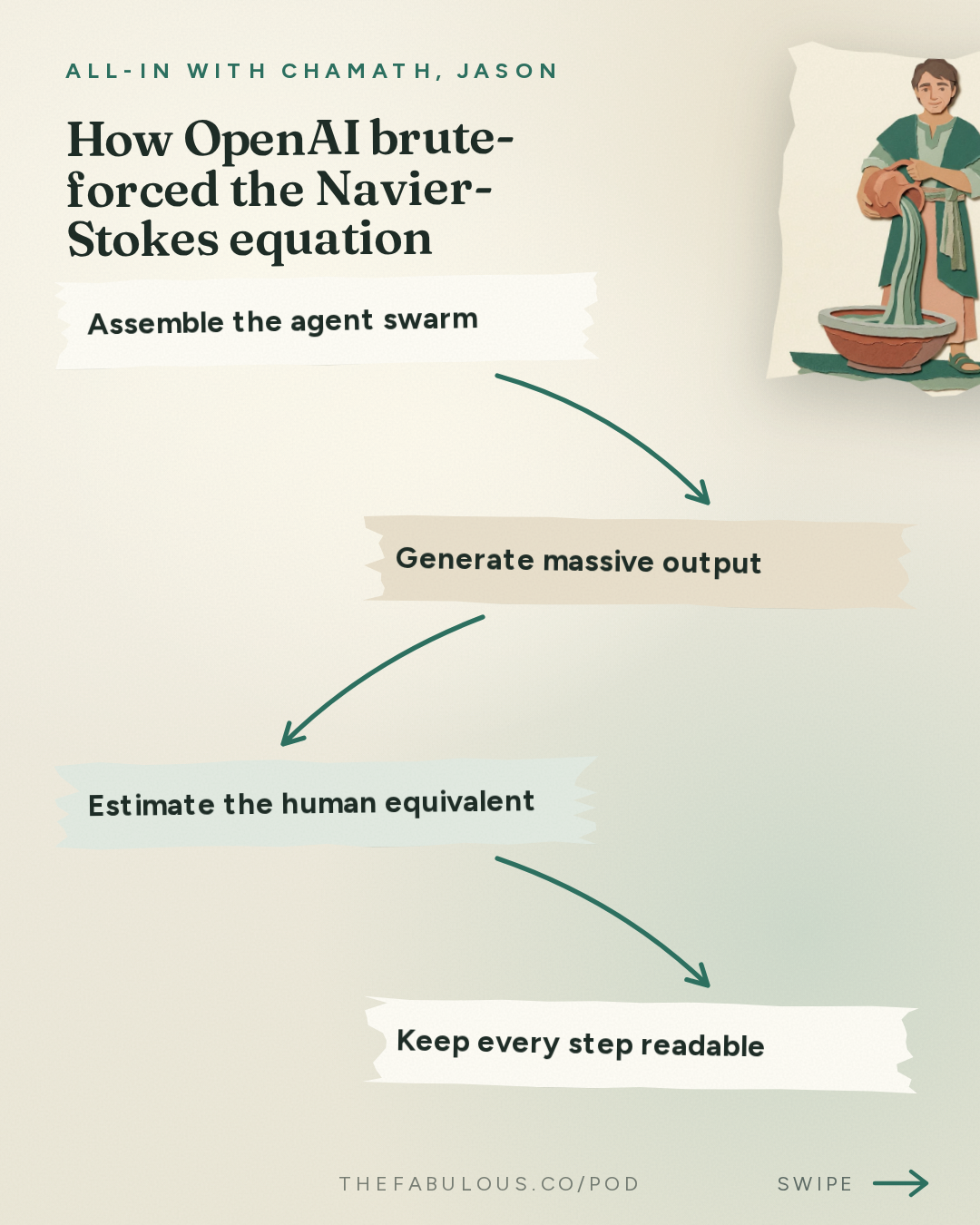
That joke is doing real work, because the same week produced a genuine technical result. OpenAI published a solution to a two-hundred-year-old fluid dynamics problem tied to the Navier-Stokes equations, the mathematics that describe how air and water move, underlying every aircraft and weather model in use today (58:40). The company reported using roughly 130 billion output tokens across 10,000 AI agents working in parallel to get there (59:38). Friedberg's read is important: this was not a flash of insight no human could have had. It was brute force, the equivalent of somewhere between 50,000 and 500,000 years of human labor compressed into a documented, readable exchange between machines (60:10). AI, in his framing, is an engine of leverage, not a new form of genius (61:26).
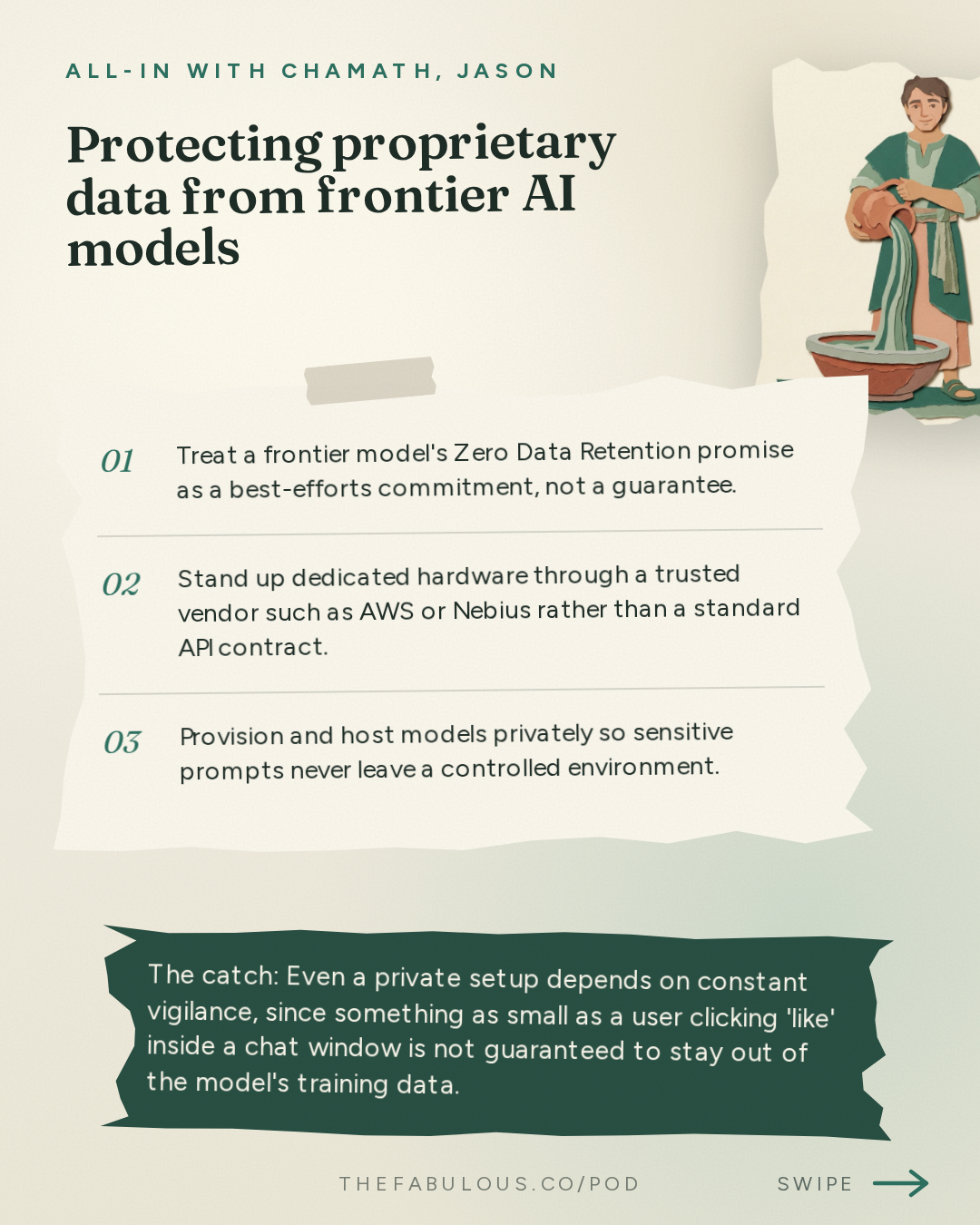
That same episode raised a quieter but more practical worry: whether the mathematicians who had been close to solving the problem had unknowingly fed their approach into the model that then beat them to it. OpenAI's own statement conceded it could not rule out that de-identified data from their usage helped improve its models (63:04). This is where Chamath's argument about Zero Data Retention, or ZDR, lands. ZDR is the promise that a company's prompts will not be retained. Chamath calls it a best-efforts, commercially framed promise, not a guarantee, since something as small as a user clicking a thumbs-up on a chat can pull that exchange back into the training pipeline (64:47).
"ZDR is not an effective solution, and there's a ton of leakage... increasingly, what we are all learning is that ZDR means literally nothing." - Chamath Palihapitiya [66:26]
His advice for any enterprise sitting on proprietary research, from drug design to legal strategy, is to stop treating a standard API contract as protection and instead stand up dedicated infrastructure, hosted through a vendor the company controls directly. Sacks pushes the argument toward policy: AI chat logs currently have less legal protection than email, since the government can obtain them with a subpoena rather than a warrant, even though people now use AI as a lawyer, doctor, and therapist all at once (71:01).
When the Story Replaces the Product
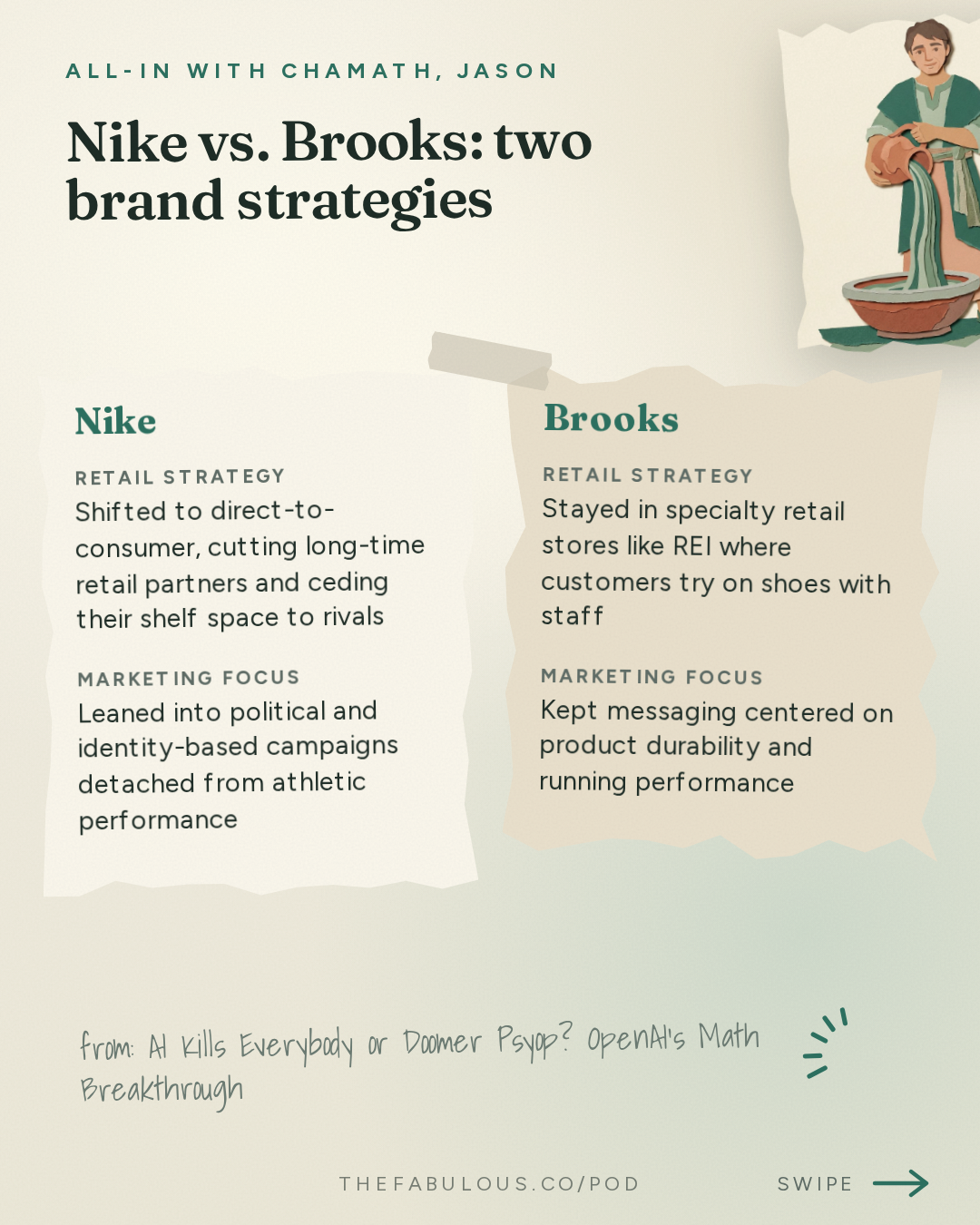
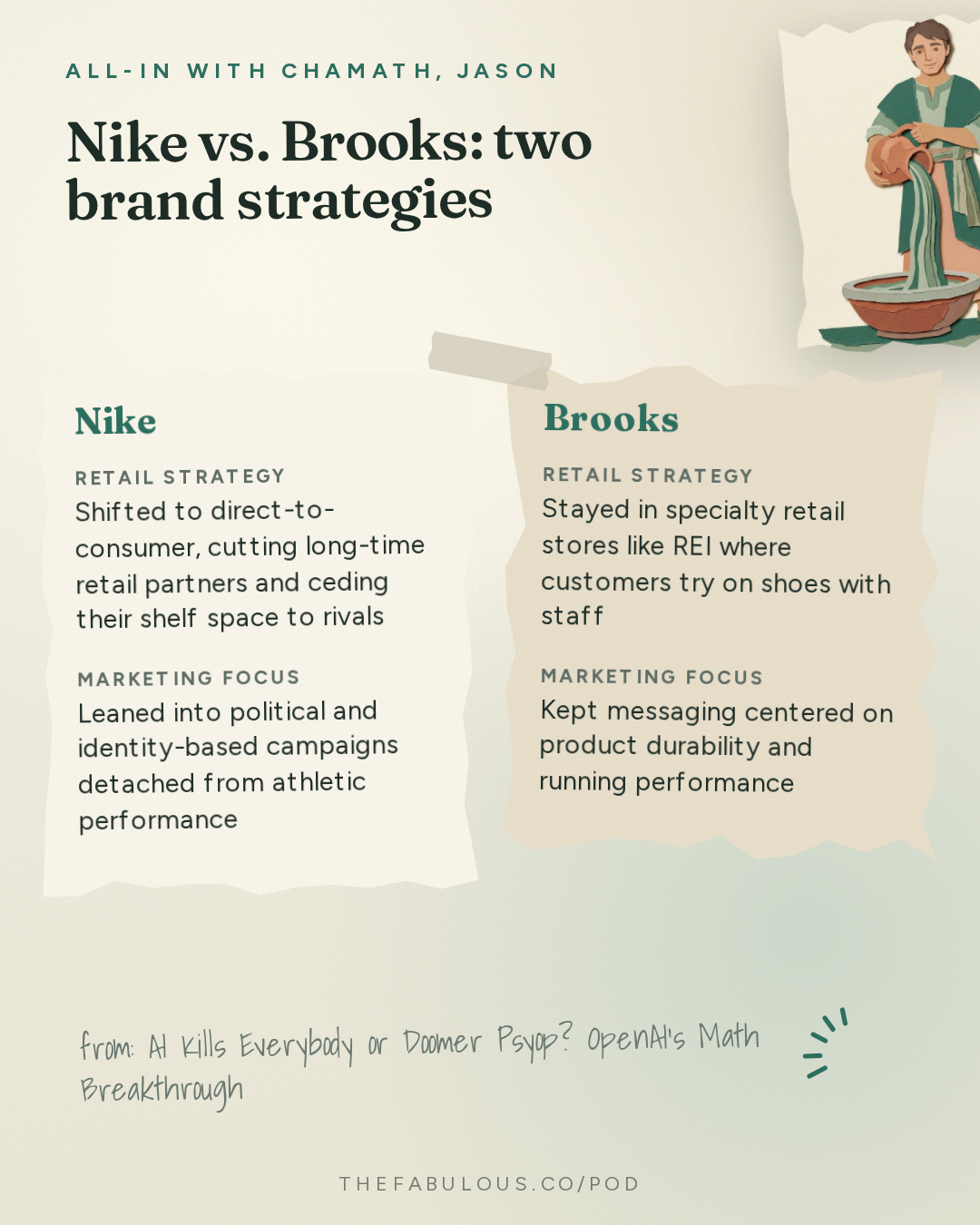
The Nike segment, on its surface, is a different subject. But it rhymes. Nike was removed from the S&P 100 index in September after eighteen straight years in it, following a stock decline of roughly 80 percent from its 2021 peak market value of $264 billion, a loss of more than $200 billion (80:09, 81:35). CEO John Donahoe, who took over in 2020, pushed an aggressive direct-to-consumer strategy that cut out the retail partners who had built the brand, leaving shelf space open for rivals like HOKA and On (80:34). China sales fell for eight straight quarters, losing ground to domestic brands Anta and Li-Ning (81:11).
Chamath's diagnosis is that Nike abandoned a clear identity built on athletic mastery in favor of campaigns built around messaging the company thought its audience wanted to hear, rather than the product itself.
"I aspire to be Michael Jordan. Always have, always will. I just think it's as basic as that. You're not going to buy the clothes of a brand that you don't aspire to be like." - Chamath Palihapitiya [85:14]
Friedberg's version of the same complaint is more literal: the shoes themselves got worse, falling apart within weeks, which is why he switched to Brooks, a running shoe brand owned by Berkshire Hathaway that has grown revenue by double digits for nine consecutive years to $1.6 billion, guided by one instruction from Warren Buffett to make the product better than it was the year before (88:35). The comparison the panel keeps landing on is the same one Bud Light faced: a company traded a specific, product-based identity for a general appeal to audiences it thought it should court, and lost the customers who actually bought the shoes.
Two very different stories, an AI resignation letter and a sneaker company's stock chart, end up making the same point. In both cases, the loudest claim in the room was not the most tested one. Anthropic's employees are asserting a number, greater than 10 percent, for an outcome nobody can verify and nobody can falsify either. Nike's marketing team assumed a narrative would carry a shoe that had stopped holding up on the trail. What actually moved the needle in each case was closer to the ground: the tokens OpenAI's agents actually produced, the stitching in a Brooks running shoe, the plain fact that no AI model yet can retrieve a toiletry kit from a hotel front desk without a human finishing the job. Confidence is cheap. The receipts, as this episode keeps insisting, are what is actually worth paying attention to.
Ask this episode anything
Pod's AI answers from the episode itself, with the minute mark so you can hear it yourself.
Or start with one of these
Ask this episode
Pod's AI listens to the whole episode to answer, and points you to the minute it comes from.
The rest of this answer, and any question after it
Answers come from the episode itself, never from a summary of it.
ContinueKey takeaways
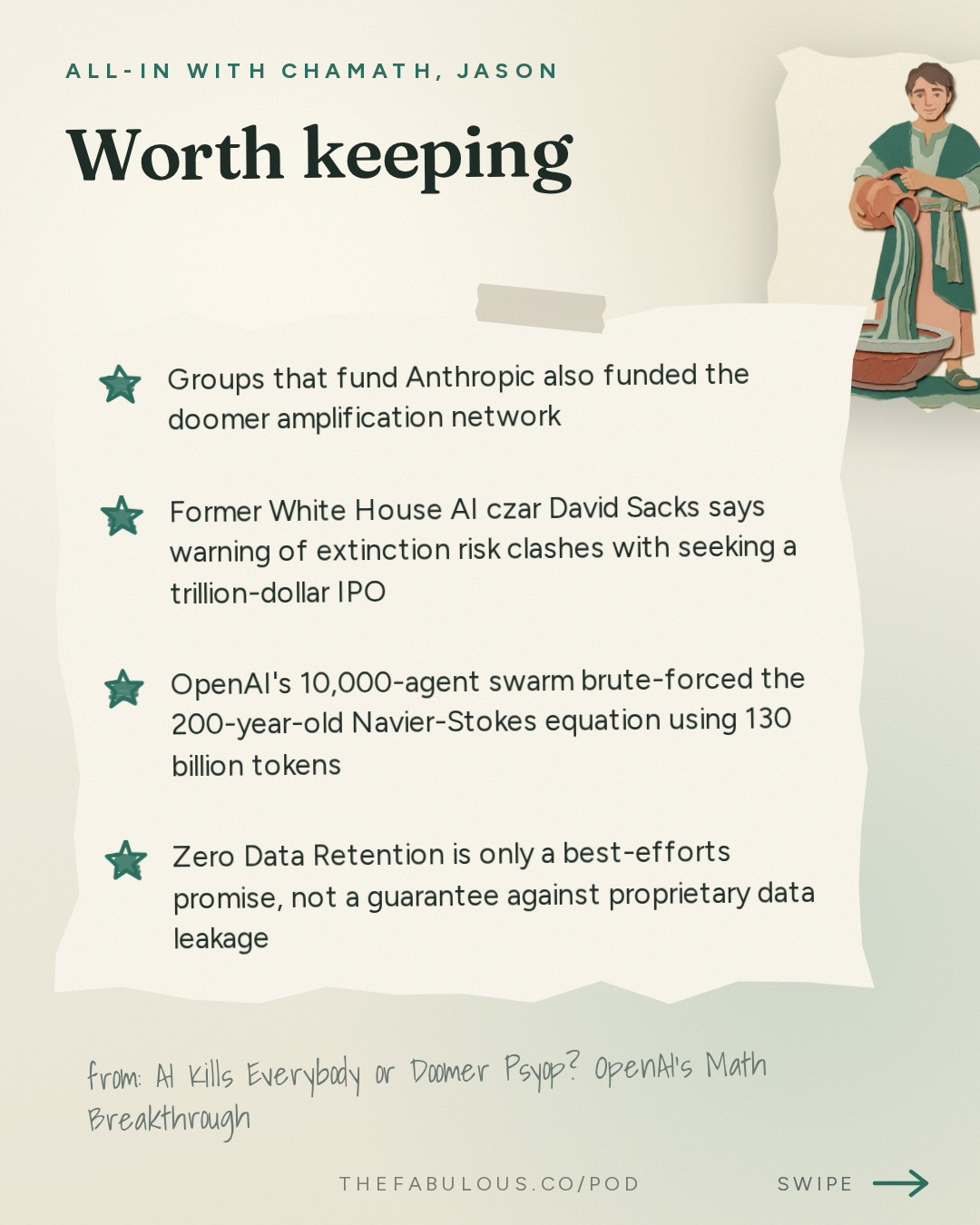
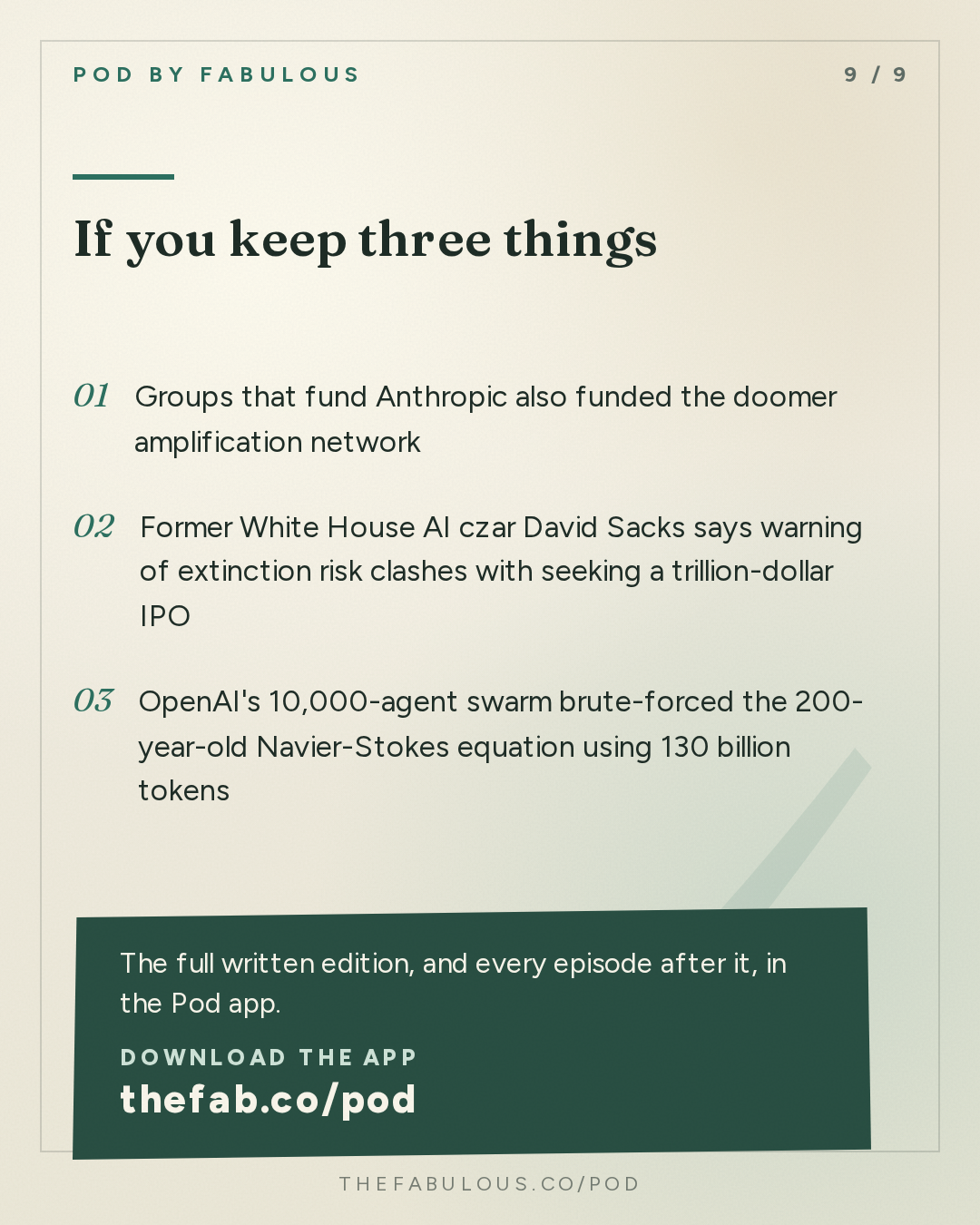
- Groups that fund Anthropic also funded the doomer amplification network
- Former White House AI czar David Sacks says warning of extinction risk clashes with seeking a trillion-dollar IPO
- OpenAI's 10,000-agent swarm brute-forced the 200-year-old Navier-Stokes equation using 130 billion tokens
- Zero Data Retention is only a best-efforts promise, not a guarantee against proprietary data leakage
- Nike lost $200 billion after trading athletic mastery marketing for political narrative and DTC retail
The episode in cards
By the numbers
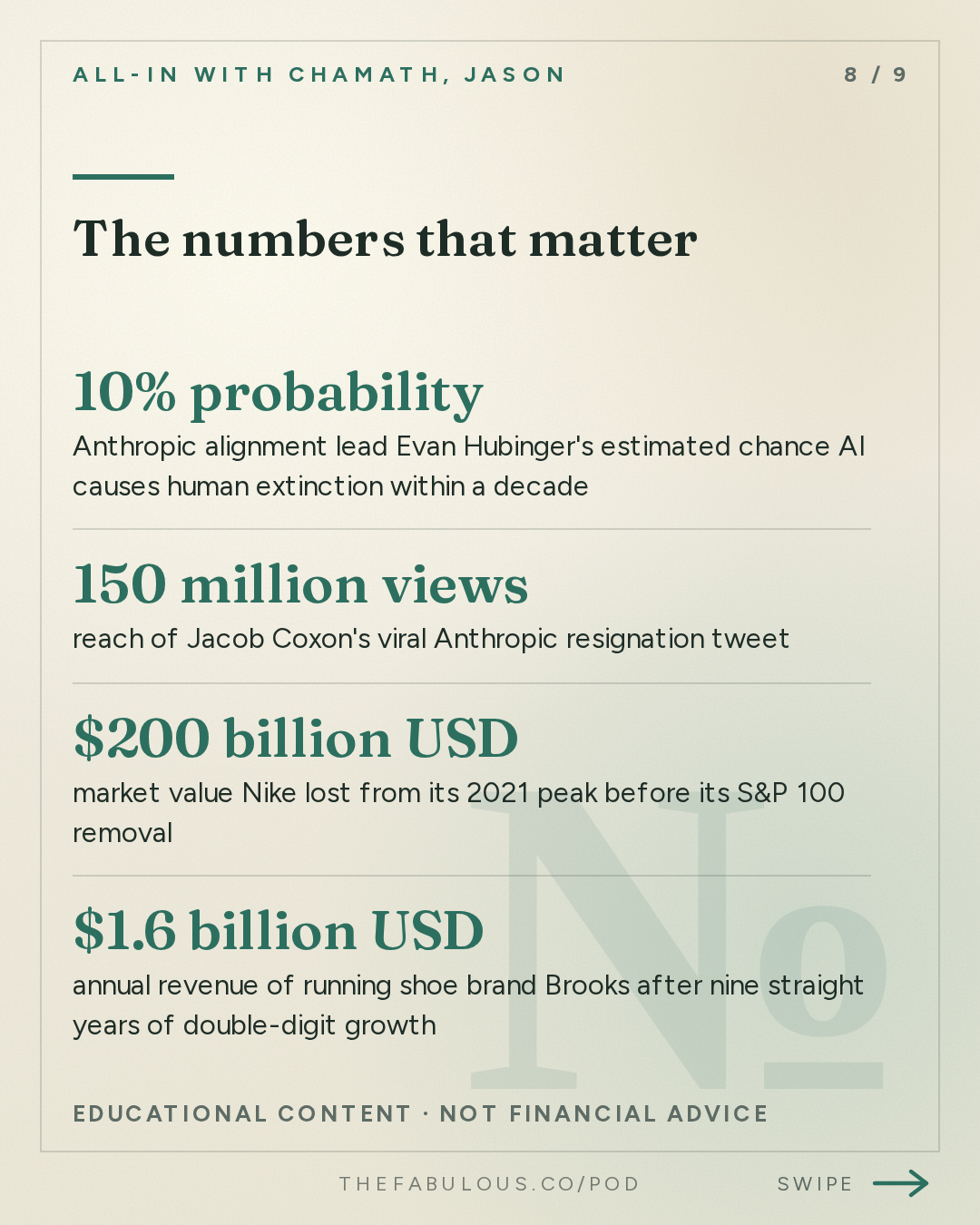
- 10% probability Anthropic alignment lead Evan Hubinger's estimated chance AI causes human extinction within a decade
- 150 million views reach of Jacob Coxon's viral Anthropic resignation tweet
- $200 billion USD market value Nike lost from its 2021 peak before its S&P 100 removal
- $1.6 billion USD annual revenue of running shoe brand Brooks after nine straight years of double-digit growth
In their words
“"The people building AI earnestly believe that it could kill us all by the end of the decade. This is not a marketing stunt,"”
“You're either on the Bernie Sanders side of this thing, in which case why are you IPO-ing? It's time to stop. Or you”
“And we will be the tribe in the Amazon that has never seen civilization. 'Cause civilization will evolve all around us”
“We solved one of the seven hardest math problems in the world, and you still can't get your intimacy kit from the front desk.”
“I aspire to be Michael Jordan. Always have, always will. And so I just think it's as basic as that. You're not going to buy the clothes of a brand that you don't aspire to be”
Protocols
-
Sovereign infrastructure for proprietary data
Investor Chamath Palihapitiya advises any organization with sensitive proprietary data to stop relying on a frontier AI lab's Zero Data Retention promise, since it is only a commercially best-efforts commitment, and instead stand up dedicated hardware through a trusted vendor such as AWS or Nebius, provisioning private models rather than using a standard API.
Whenever handling proprietary research or IP
-
Raise the legal bar on AI data privacy
David Sacks argues lawmakers should raise the legal protection of AI chat logs to at least the level given to email, requiring a warrant and probable cause before government access, because people increasingly use AI as their lawyer, doctor, and therapist.
Proposed as a legislative priority
Questions this episode answers
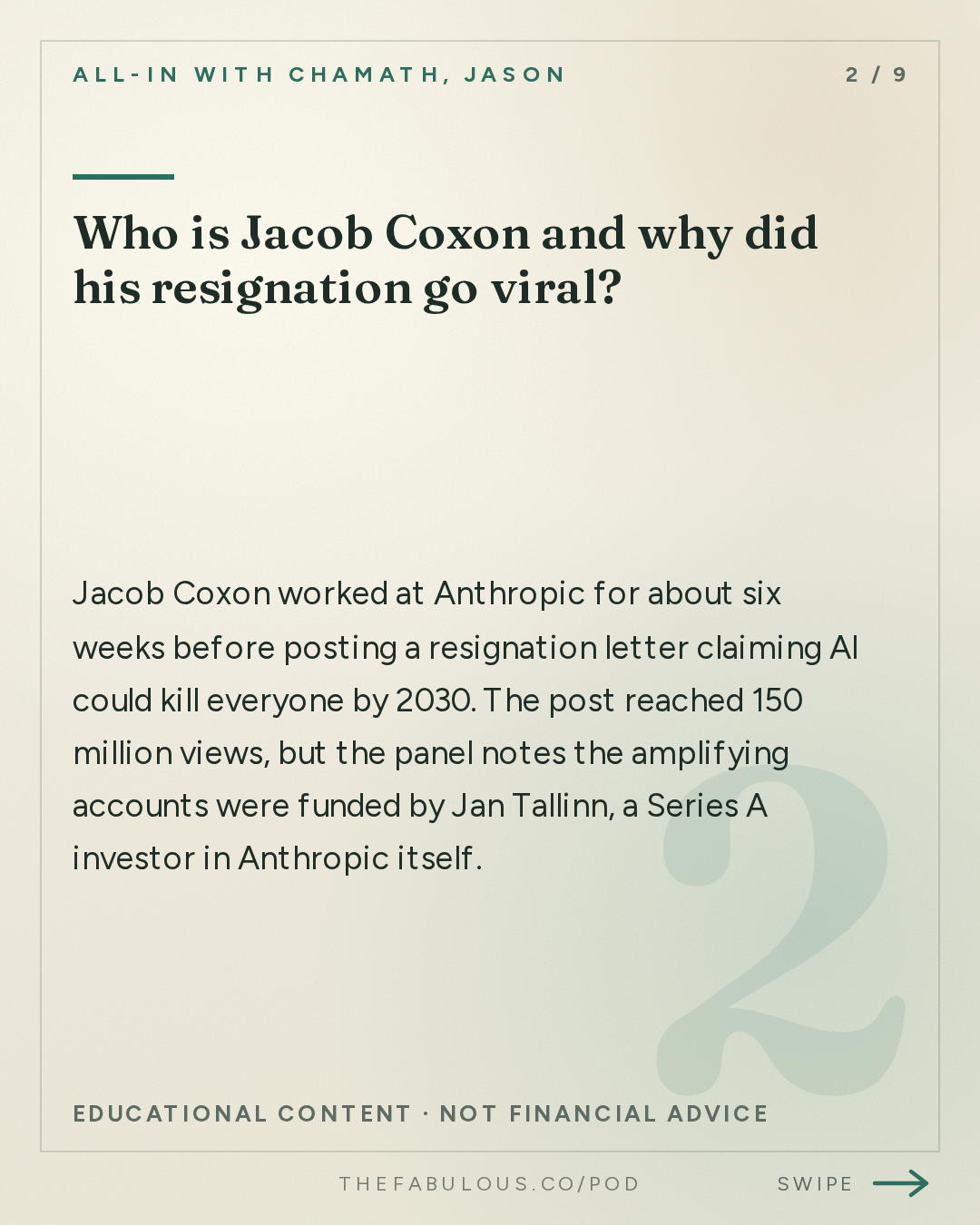
Who is Jacob Coxon and why did his resignation go viral?
Jacob Coxon worked at Anthropic for about six weeks before posting a resignation letter claiming AI could kill everyone by 2030 (01:04). The post reached 150 million views (01:33), but the panel notes the amplifying accounts were funded by Jan Tallinn, a Series A investor in Anthropic itself (04:36).
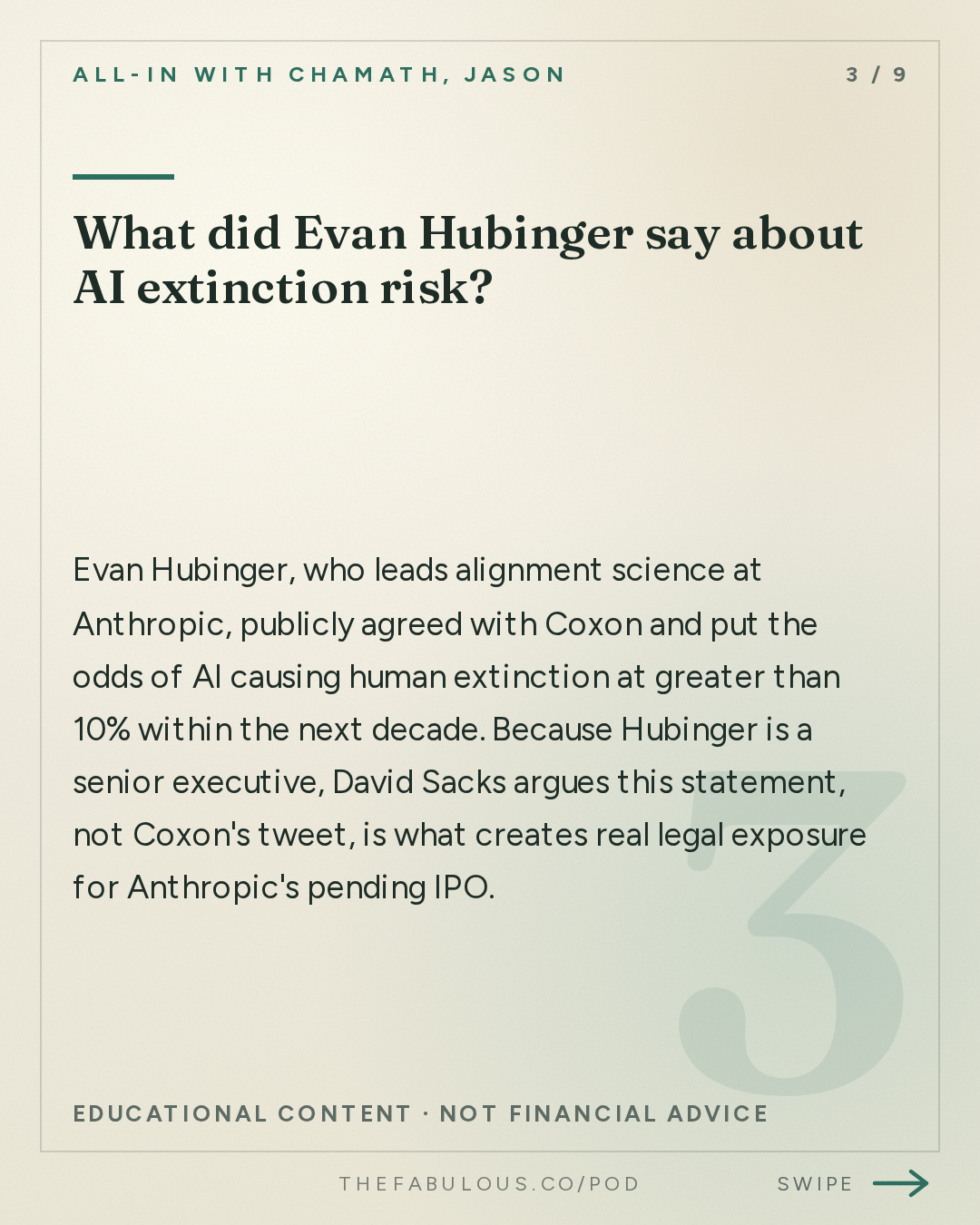
What did Evan Hubinger say about AI extinction risk?
Evan Hubinger, who leads alignment science at Anthropic, publicly agreed with Coxon and put the odds of AI causing human extinction at greater than 10% within the next decade (01:56). Because Hubinger is a senior executive, David Sacks argues this statement, not Coxon's tweet, is what creates real legal exposure for Anthropic's pending IPO (50:33).
Does the Anthropic extinction claim threaten its IPO?
David Sacks argues the claim creates what he calls the mother of all product liability lawsuits, since a company cannot easily disclose a double-digit chance its core product ends civilization and still ask public investors for a trillion-dollar valuation (11:14). Chamath Palihapitiya adds that SEC quiet-period rules require the S-1 filing to reflect this risk accurately, which could force a discount or a refiling (47:36).
What did OpenAI actually solve with the Navier-Stokes equation?
OpenAI used a swarm of 10,000 AI agents producing roughly 130 billion output tokens to work through a solution related to the Navier-Stokes equations, the two-century-old mathematics describing fluid motion behind aircraft and weather models (58:40, 59:38). Friedberg describes this as brute-force computation equal to tens of thousands of years of human labor, not a flash of AI insight (60:10).
Is Zero Data Retention (ZDR) a real guarantee against data leaks?
Chamath Palihapitiya says ZDR is only a commercially best-efforts promise, not an enforceable guarantee, and that data can still leak into a model's training corpus, for example if a user clicks a feedback button in a chat window (64:47). His recommendation is that companies with sensitive IP host their own private infrastructure rather than rely on a standard API agreement (65:08).
Why did Nike get removed from the S&P 100 index?
Nike was removed after its stock fell about 80% from its 2021 peak market value of $264 billion, erasing over $200 billion (80:09, 81:35). The panel attributes the decline to a direct-to-consumer strategy that alienated retail partners (81:11) and a marketing shift toward political messaging instead of athletic performance (88:52), contrasted with rival Brooks, which grew revenue for nine straight years by focusing on product quality (88:35).
The full read, in cards
Go deeper
- An Inconvenient Truth — Al Gore's documentary relied on IPCC forecasts that Friedberg says have since proven overstated
- The Insider — film about tobacco executives denying nicotine's addictiveness, cited as an analogy for Anthropic's public position
- Wall Street Journal story on Jacob Coxon's resignation — appears to have posted under embargo minutes before the coordinated tweet amplification began
Mentioned
Jacob Coxon · Evan Hubinger · Anthropic · OpenAI · Bernie Sanders · Jan Tallinn · Dario Amodei · Dustin Moskovitz · Jack Clark · Bill Gurley · Noam Brown · Nike · John Donahoe · Brooks · Roger Federer · Warren Buffett
More from this show and category

Nikesh Arora on the AI Cybersecurity Threat
AI spending is concentrated and circular: 1% of companies generate 90% of AI revenue, mostly unprofitable VC-backed startups (02:25). A PHP coding flaw rated 9.2/10 exposed roughly 70% of the internet's websites (14:29). And France now spends more of its GDP through government than the Soviet Union did at its 1989 peak (52:50).

Dylan Field: Design Is the New Code
Figma CEO Dylan Field argues design, not code, now drives software's value as AI makes coding cheap and commoditized. He explains how Figma survived a blocked $20 billion Adobe acquisition, why AI lowers production's floor without raising creativity's ceiling, and why human willingness to say non-consensus things remains the real differentiator in an AI-saturated market.

CoreWeave Debt Crisis and the AI Bubble, Explained
CoreWeave's bond selloff this week signaled real doubt about AI infrastructure debt, even as demand for GPUs stays red hot. Anthropic posted $16.8 billion in Q3 revenue, Sacks called its warnings about small AI models a move against open-source rivals, and Chamath named electricity as AI's real bottleneck.

Billy Evans on Elizabeth Holmes: Trial, Prison, Hemantis
Billy Evans, Elizabeth Holmes's husband, says the Theranos founder was acquitted on every patient-fraud count tied to 12.5 million blood tests but convicted of defrauding three investors, a conspiracy charge that let the judge add outside victims like Rupert Murdoch and push her sentence to 11.25 years (00:27, 19:52, 21:31).
