
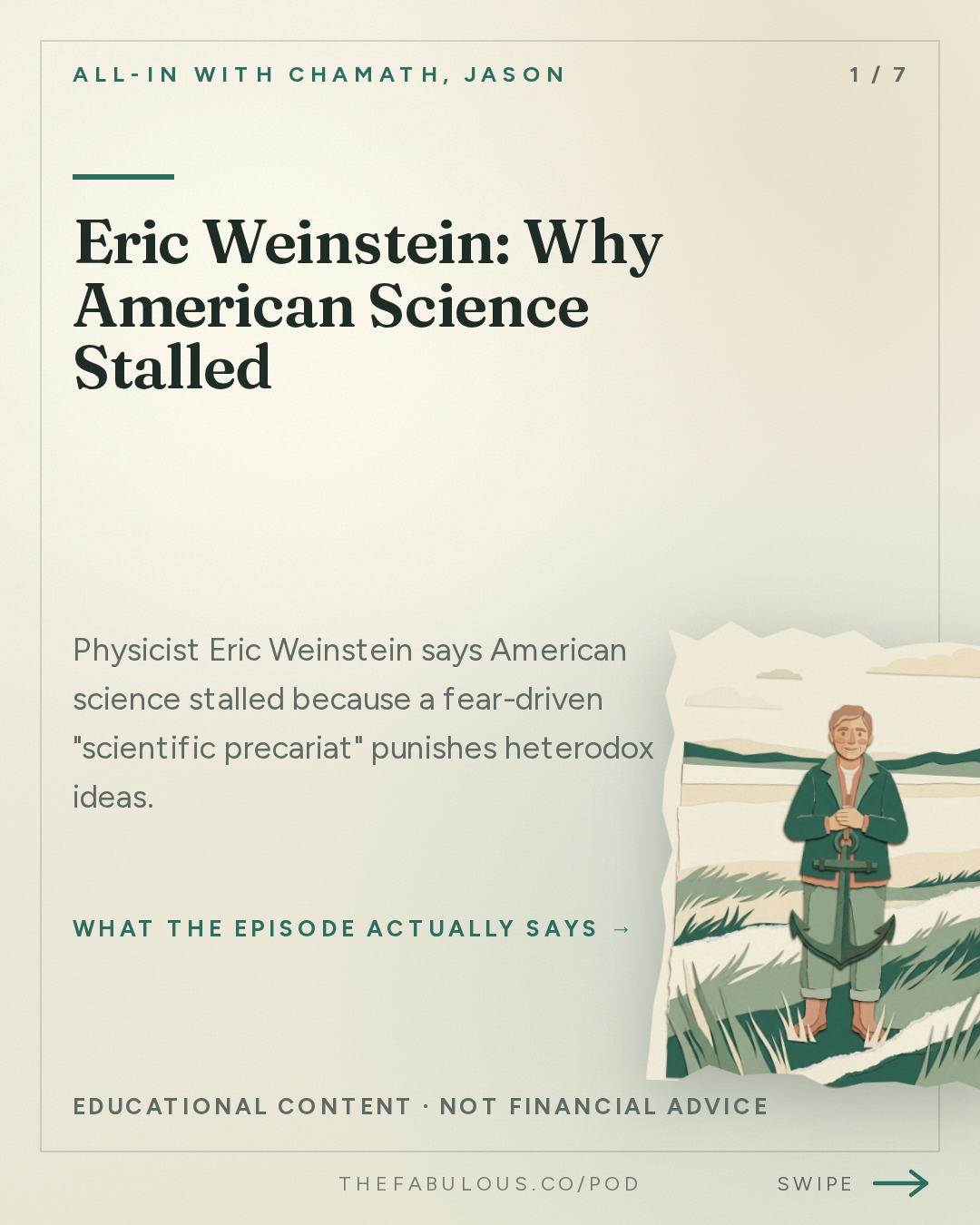
Eric Weinstein: Why American Science Stalled
Eric Weinstein: The Scientific Precariat, China's Brain Drain, Physics Stagnation, String Theory's Collapse & UAPs
The brief
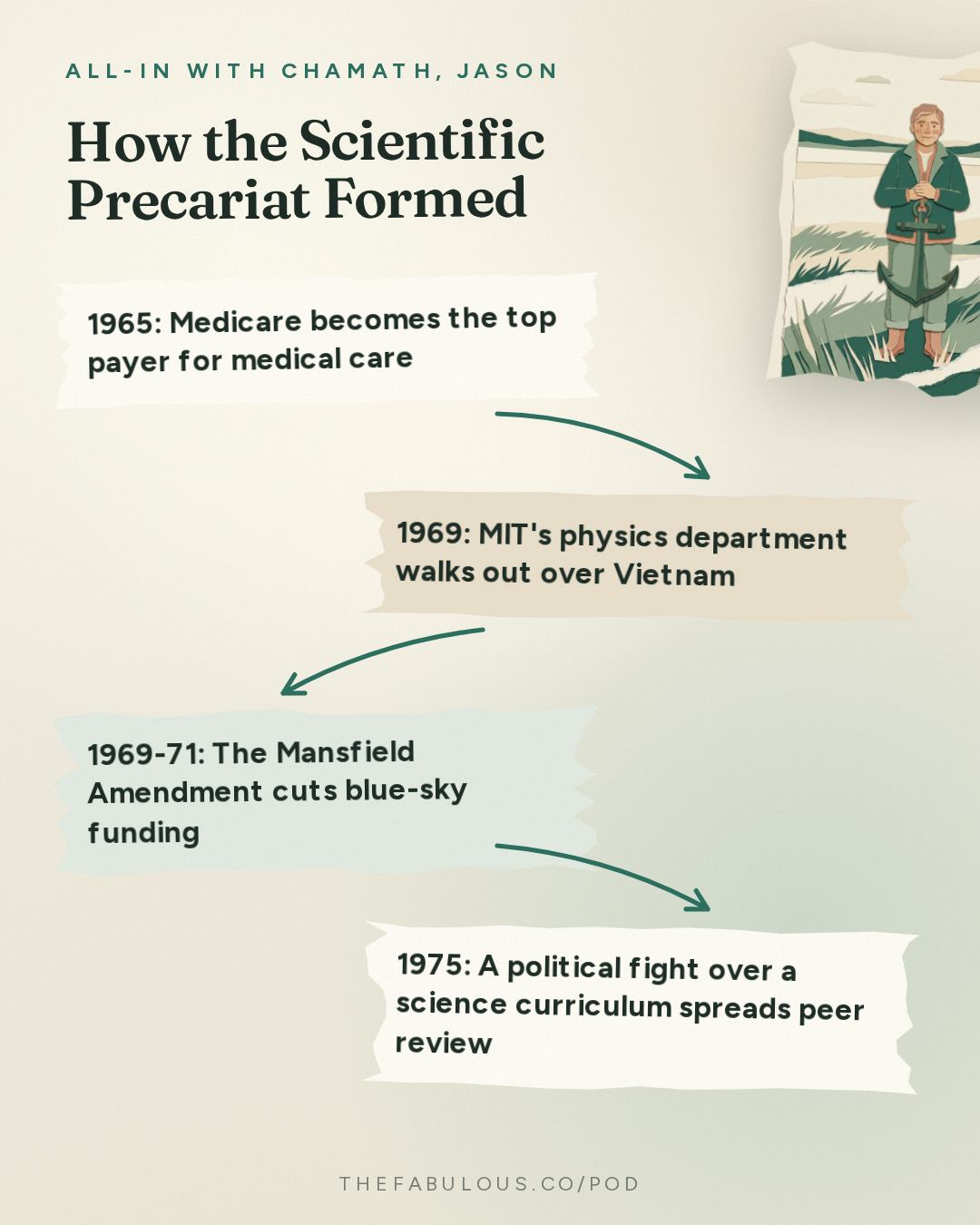
Physicist Eric Weinstein says American science stalled because a fear-driven "scientific precariat" punishes heterodox ideas. He traces peer review to 1965 and argues theoretical physics has made no verified advance in 42 years, since string theory took over in 1983-84, while China now recruits disillusioned Western researchers with money and freedom.
Peer review sounds ancient, like a rule etched into science's foundation. It is not. Run the phrase through a book-search tool and it barely appears before 1965 (24:21). That is the kind of fact mathematician and physicist Eric Weinstein likes to drop into a conversation, because it unravels a story most people never question: that science polices itself through open argument. Weinstein, who holds a PhD in mathematical physics from Harvard and once worked at Thiel Capital, thinks the opposite has happened. Argument has been replaced by enforcement, and the result is what he calls a 'scientific precariat' (06:21).
A precariat is a class of workers without job security, a term borrowed from labor economics. Weinstein applies it to professors who cannot afford to challenge the dominant view in their field, because a grant, a tenure case, or a department chair depends on staying inside the lines. The danger, he says, is not that consensus is usually wrong. It is that a real consensus should not need enforcing at all.
"When I hear the word consensus, I get very, very nervous because a consensus is usually an artificial agreement achieved through pressure." Eric Weinstein, [06:45]
Two plus three equals five without a vote. If a field needs a vote, Weinstein argues, something else is going on.
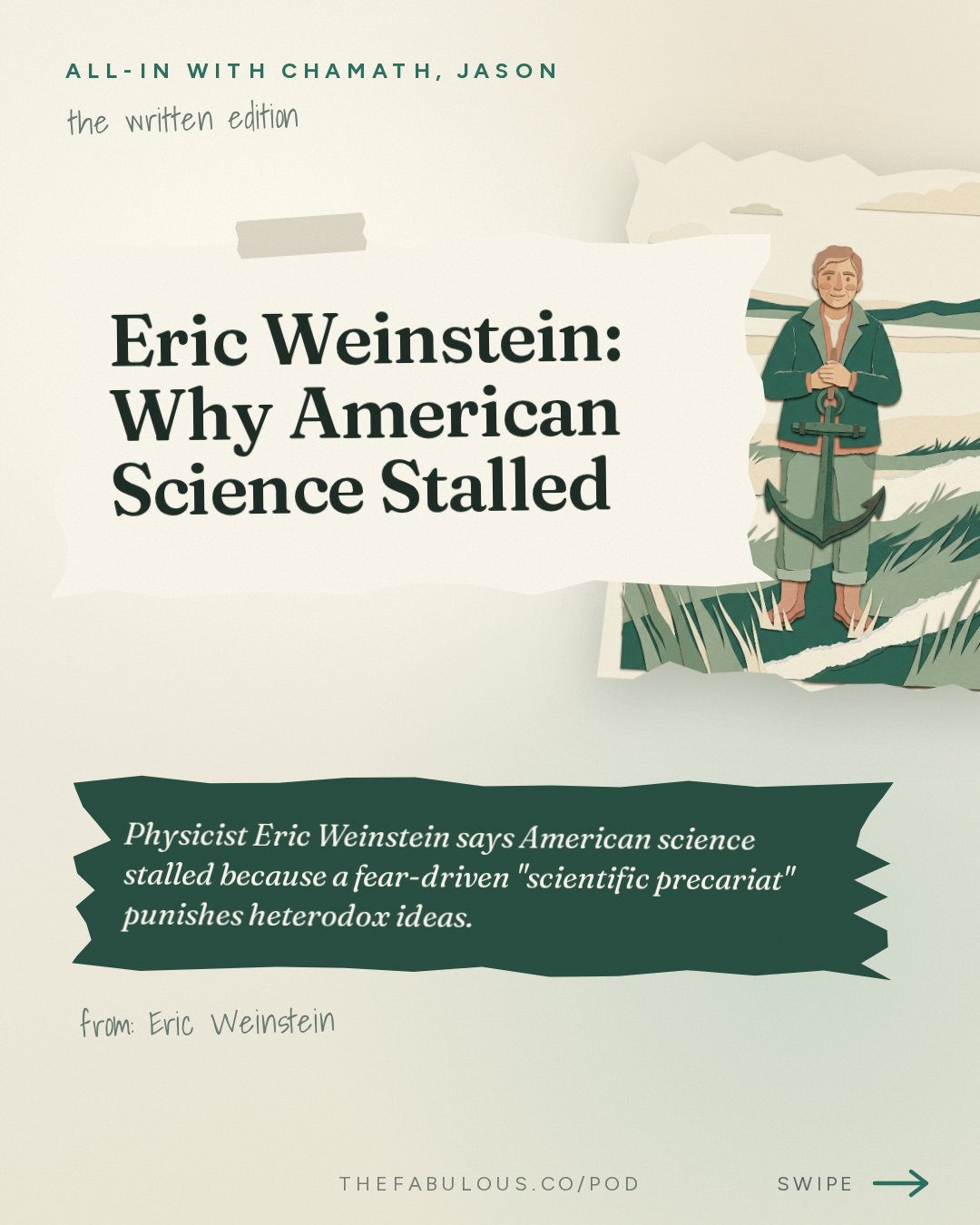
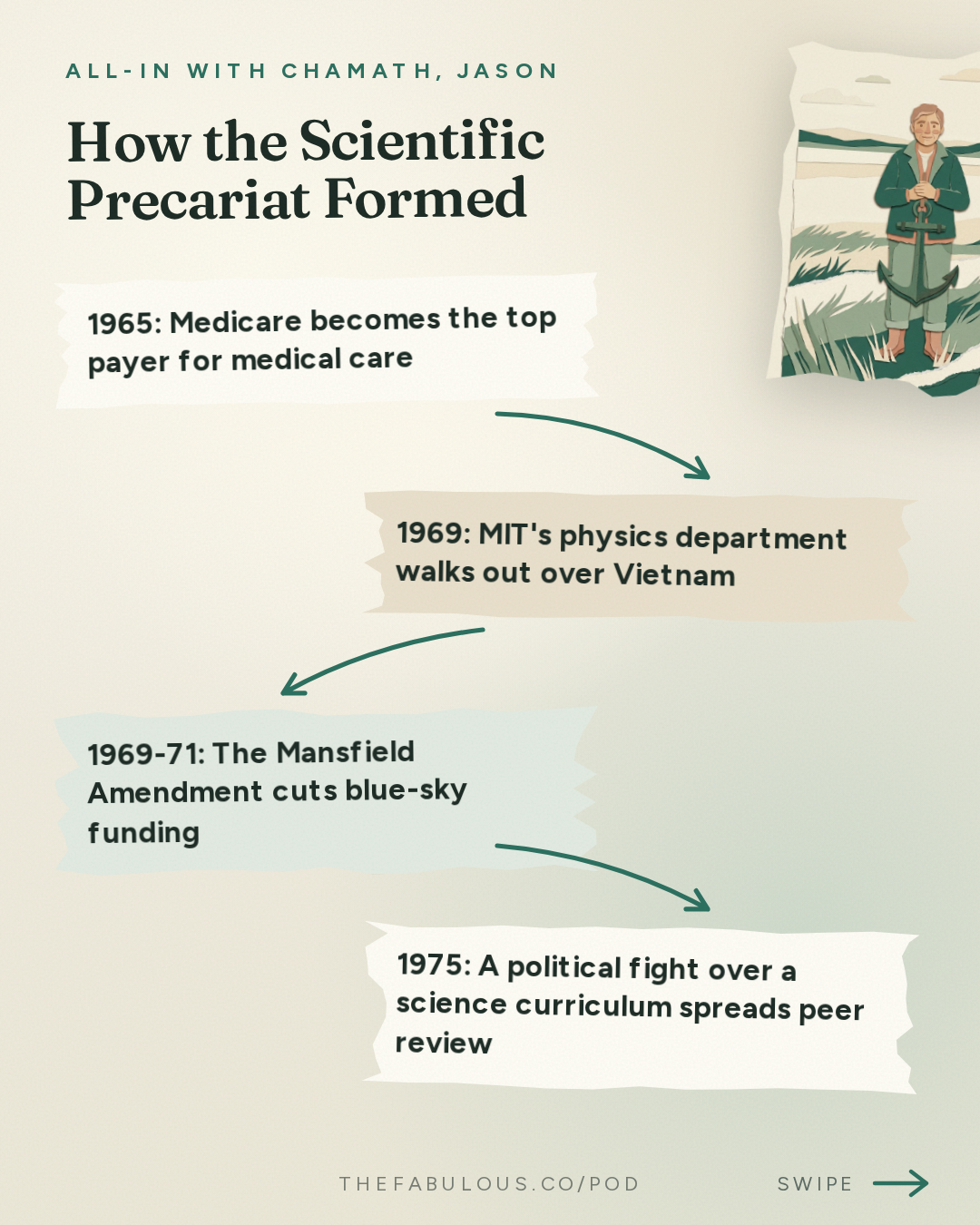
He dates the shift precisely. Between 1965 and 1975, he says, the arrangement between American science and the government that funded it broke down (15:29). In the spring of 1969, physicists at MIT, some of whom had worked on the Manhattan Project, the World War Two effort that built the atomic bomb, walked out to protest the Vietnam War (15:58). The government, in his telling, read that walkout as a loss of control over its most capable people. Congress responded with the Mansfield Amendment of 1969-71, which barred the military from funding open-ended university research unless it served a direct military purpose (16:45). The informal deal that let physicists chase ideas with no obvious use, in exchange for being available when the country needed them, ended. Peer review, invented a few years earlier by doctors trying to keep Medicare from second-guessing their bills, spread into general science after a 1975 political fight over a federally funded classroom curriculum called Man: A Course of Study (25:14).
"If you don't have communists and fascists in the same department having tea together, something has gone wrong." Eric Weinstein, [17:42]
His point is not really about politics. It is that progress needs people who disagree violently about everything except the work.
Weinstein pushes back hard on the idea that markets alone can fund this kind of science. Basic research, he argues, is inexhaustible and inexcludable (26:01), meaning one person using an idea does not use it up, and no one can be stopped from using it once it exists. Economists call that a public good, the same category as national defense, which is why armies are funded through taxes rather than sold on a shelf. David cites a Nature magazine survey in which just 6 percent of polled scientific readers said they backed Donald Trump for president (28:22), evidence, in his view, of a research class so politically uniform it has stopped showing up to argue for its own funding. Meanwhile, David says, the return on every dollar of government research funding has fallen roughly 80-fold over time (30:57), a sign the money is managed by people who do not understand risk.
His preferred fix borrows from venture investing: fund people, not proposals. David points to Stewart Butterfield, who spent years and burned through investor money building a video game that failed, then pivoted the internal chat tool his team had built into Slack, the workplace messaging company later sold for $30 billion (39:23). His investor let him keep the money and make the call himself. Weinstein wants science funded the same way: find the person the establishment will not endorse but also will not bet against, and back them long enough to find out if they are right.
The Physics That Stopped
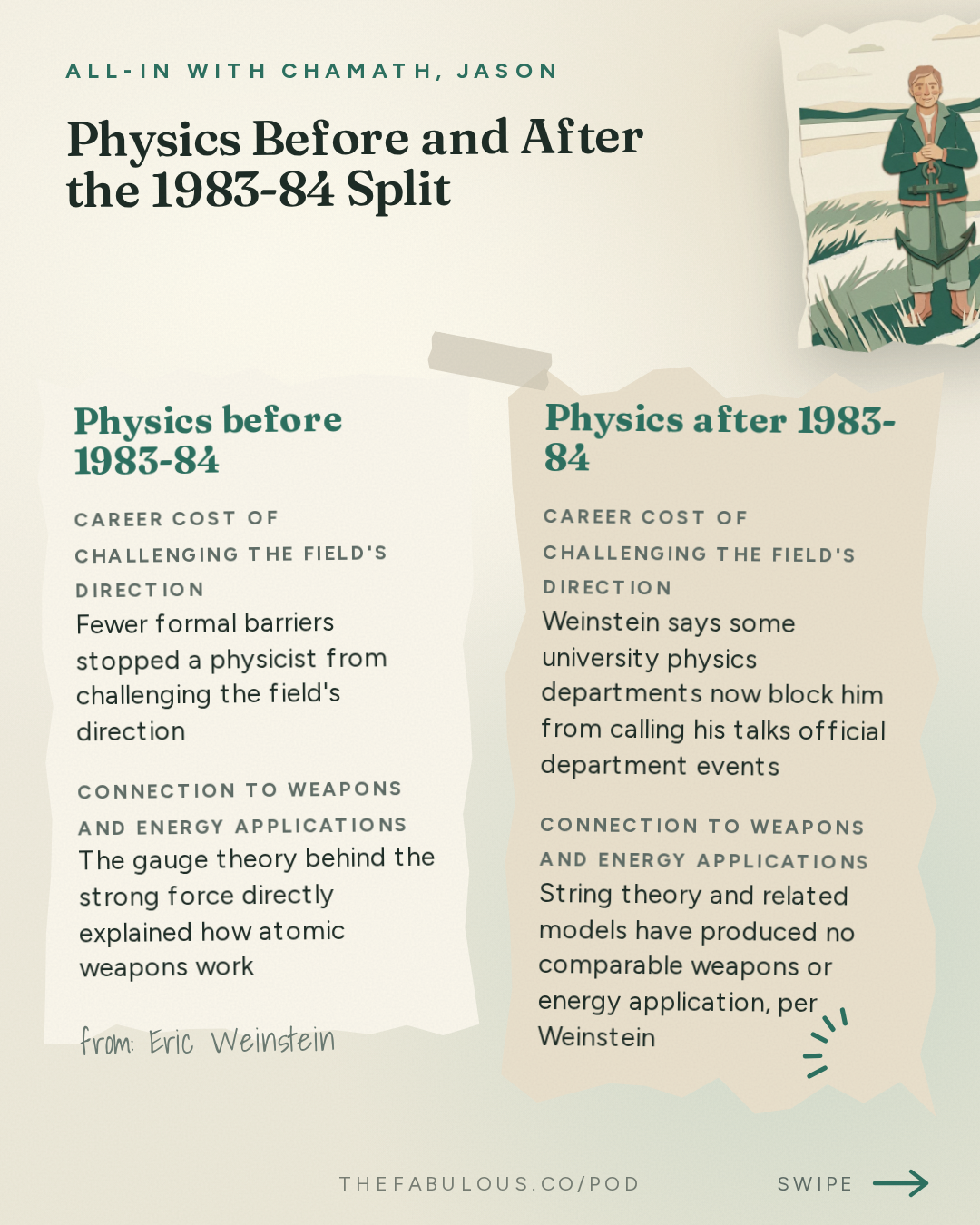
Nowhere does Weinstein apply this more bluntly than to his own field. In 1983, he says, theoretical physics made sense. In 1984 it stopped (44:05). Three physicists, Leonard Susskind, David Gross, and Edward Witten, steered the field toward string theory, an approach to unifying gravity with the other forces of nature that has never been tested against experiment. Weinstein calls Witten the smartest man alive, then delivers the line that makes physicists wince.
"The guy drove theoretical physics off the road, and off a cliff, forty-two years ago." Eric Weinstein, [41:33]
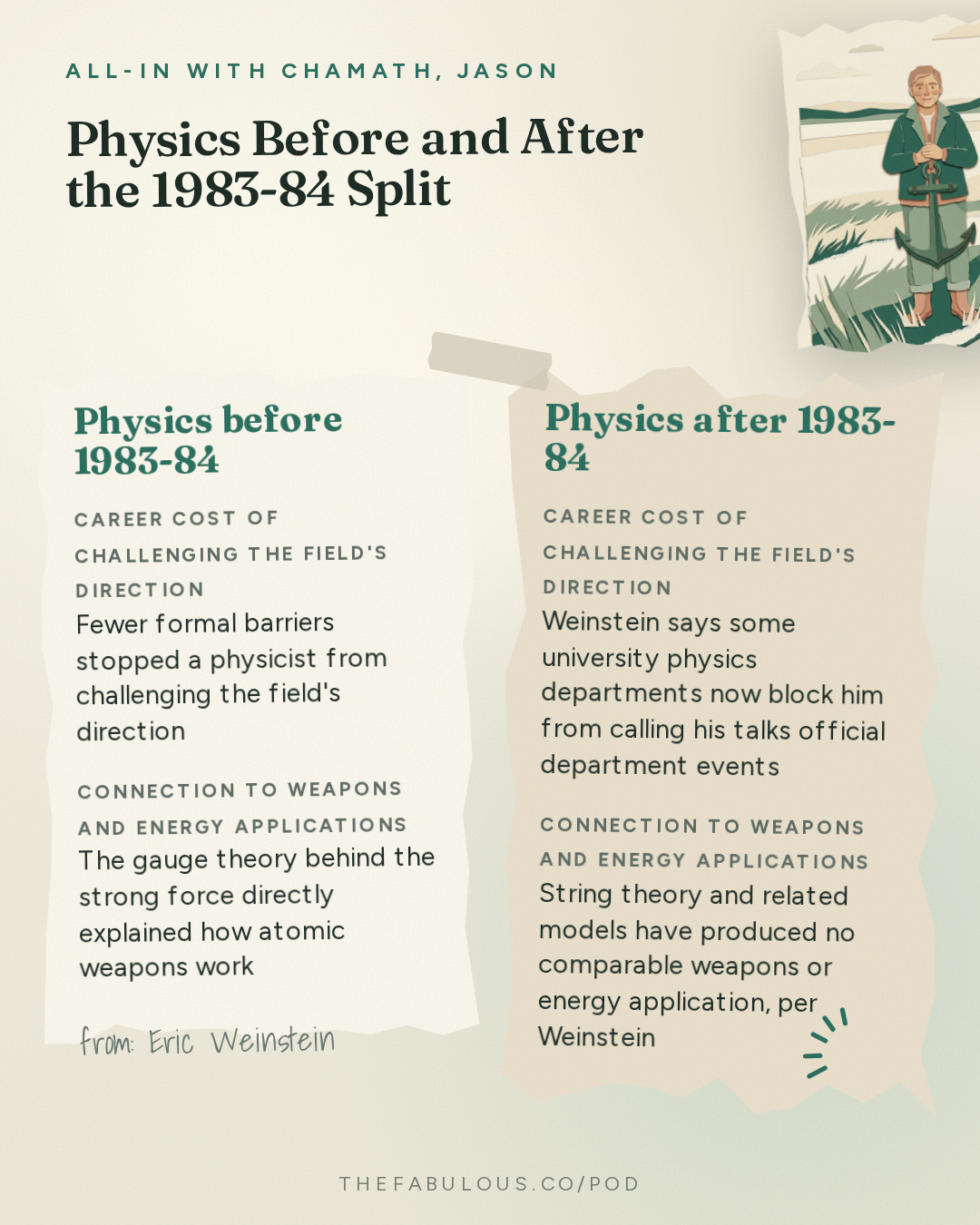
His evidence: search the talk titles from a major 2026 string theory conference for words like electron, hadron, or Higgs, the actual particles that make up matter, and they barely appear (42:31). The standard model, physics' working description of particles and forces, has not been extended by an experimentally confirmed idea in over four decades, he says, even as the field insists to itself that it has never been a better time to be a theorist. He also claims some physics departments now block him from calling his own campus talks official department events (43:38), and notes that the gauge theory behind the strong force once explained, in a very direct sense, how the atomic bomb worked, while string theory has produced no comparable application (44:54).
Weinstein then walks a stranger path. In 1940, a body called the Reference Committee inside the National Research Council quietly rejected any physics paper related to nuclear chain reactions, sending them back to authors with vague revision requests, so outsiders never learned the Manhattan Project's secrets were being pursued at all (46:10). He wonders, without claiming proof, whether something similar might be happening now, and names Renaissance Technologies, the Long Island hedge fund built by mathematician Jim Simons, as his best guess for where advanced, undisclosed physics work could be hiding, citing its close ties to Stony Brook University and Brookhaven National Laboratory (48:01). He goes further still, arguing that the stall in physics might have accidentally saved the species. Neutrinos, particles that pass through the Earth almost without interacting, can in theory be converted into other particles using force carriers called W bosons (58:53). Weinstein suggests that if physics had kept advancing, humanity might already have built weapons capable of destabilizing matter itself, and that the 40-year plateau, whatever caused it, may be the only thing standing between the species and that kind of power (60:09).
On the constructive side, Weinstein is watching an instrument in Arizona called DESI, the Dark Energy Spectroscopic Instrument at Kitt Peak, which maps the universe's expansion by tracking how galaxies move. He predicts it will show that the cosmological constant, the number physicists use to represent dark energy's push on space, is not actually constant (71:27). If true, that breaks a piece of general relativity, Einstein's century-old theory of gravity, at its foundation. He also floats the idea that time might not be one-dimensional, comparing the limitation to a gun bolted to a train track before someone thinks to mount it on a tank, then a plane (68:12). An adversary who could maneuver through additional dimensions of time, he says, would have an advantage no current weapon could counter.
China, AI, and the Uncontacted Island
Weinstein sees China moving into the space the United States is vacating, offering Western scientists money, prestige, and freedom from the ideological conformity he says now governs American departments (76:50). He is also betting on artificial intelligence to do what human gatekeepers will not: read what he calls the trash can corpus, the ideas that prestige journals have rejected and laughed off, and find the ones that were actually right (78:47). On UAPs, unidentified aerial phenomena, he stops short of aliens but not far short. He cites a 1971 Australian intelligence document reporting sightings clustered around nuclear tests (86:36), and offers an analogy: humanity may be like the residents of North Sentinel Island, a real island in the Indian Ocean whose inhabitants are legally Indian citizens but do not know India exists.
"They're an uncontacted people who don't know that they're part of something larger that watches them." Eric Weinstein, [85:51]
Weinstein's tour through physics, policy, and geopolitics has one hinge: the belief that institutions built to reward safety have quietly made heresy the only trustworthy signal left. Whether or not Renaissance Technologies is hiding a physics breakthrough, or a nuclear test really is a rite of passage before interstellar travel, is beside his real point. He wants tenure, grants, and prestige to go back to protecting people who might be wrong in interesting ways. Near the end of the conversation, he says the fix starts small, with scientists willing to show up in Washington and ask an unfashionable question: how can I help.
Ask this episode anything
Pod's AI answers from the episode itself, with the minute mark so you can hear it yourself.
Or start with one of these
Ask this episode
Pod's AI listens to the whole episode to answer, and points you to the minute it comes from.
The rest of this answer, and any question after it
Answers come from the episode itself, never from a summary of it.
ContinueKey takeaways
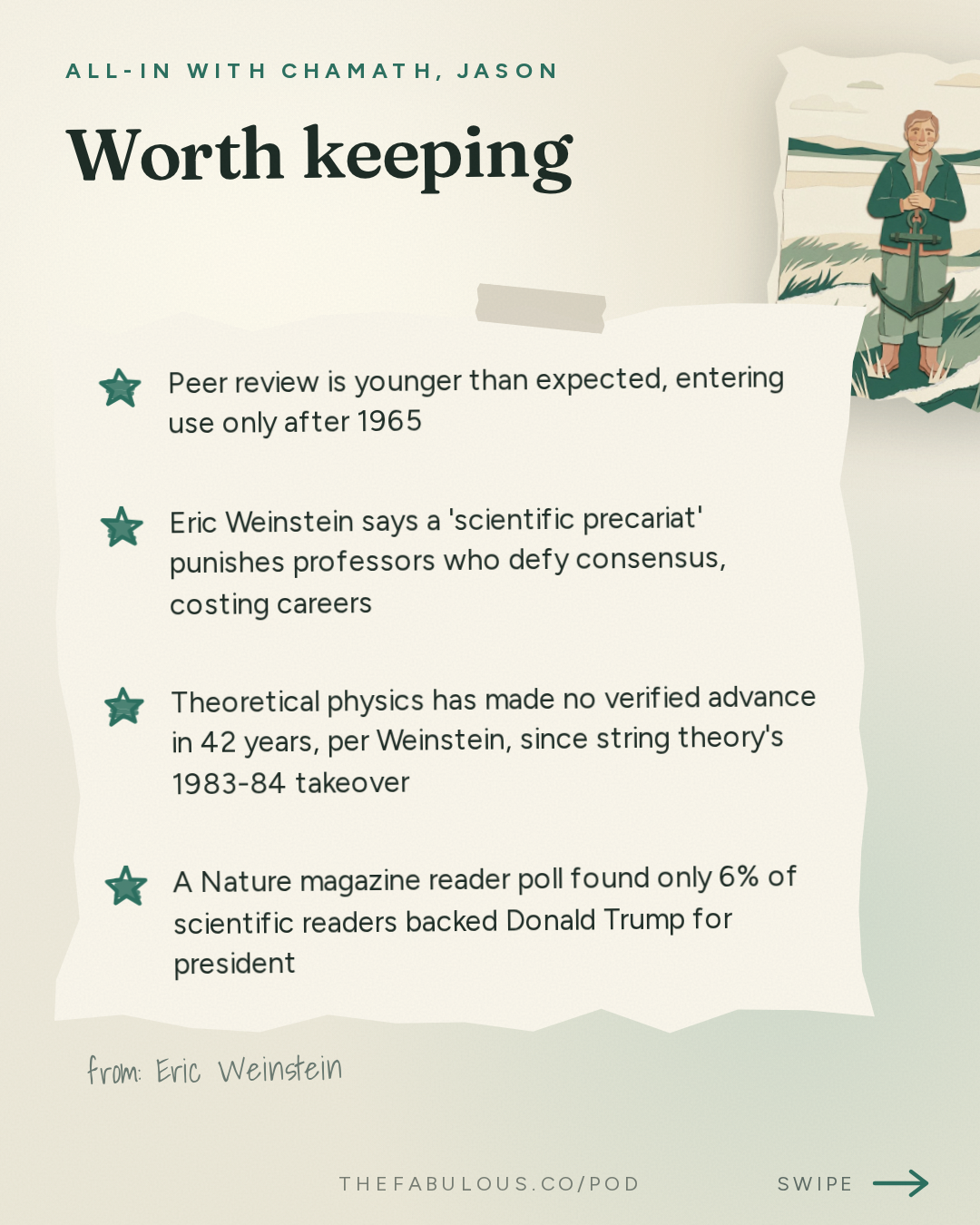
- Peer review is younger than expected, entering use only after 1965
- Eric Weinstein says a 'scientific precariat' punishes professors who defy consensus, costing careers
- Theoretical physics has made no verified advance in 42 years, per Weinstein, since string theory's 1983-84 takeover
- A Nature magazine reader poll found only 6% of scientific readers backed Donald Trump for president
- China is recruiting Western scientists with money and freedom that Weinstein says US institutions no longer offer
The episode in cards

By the numbers
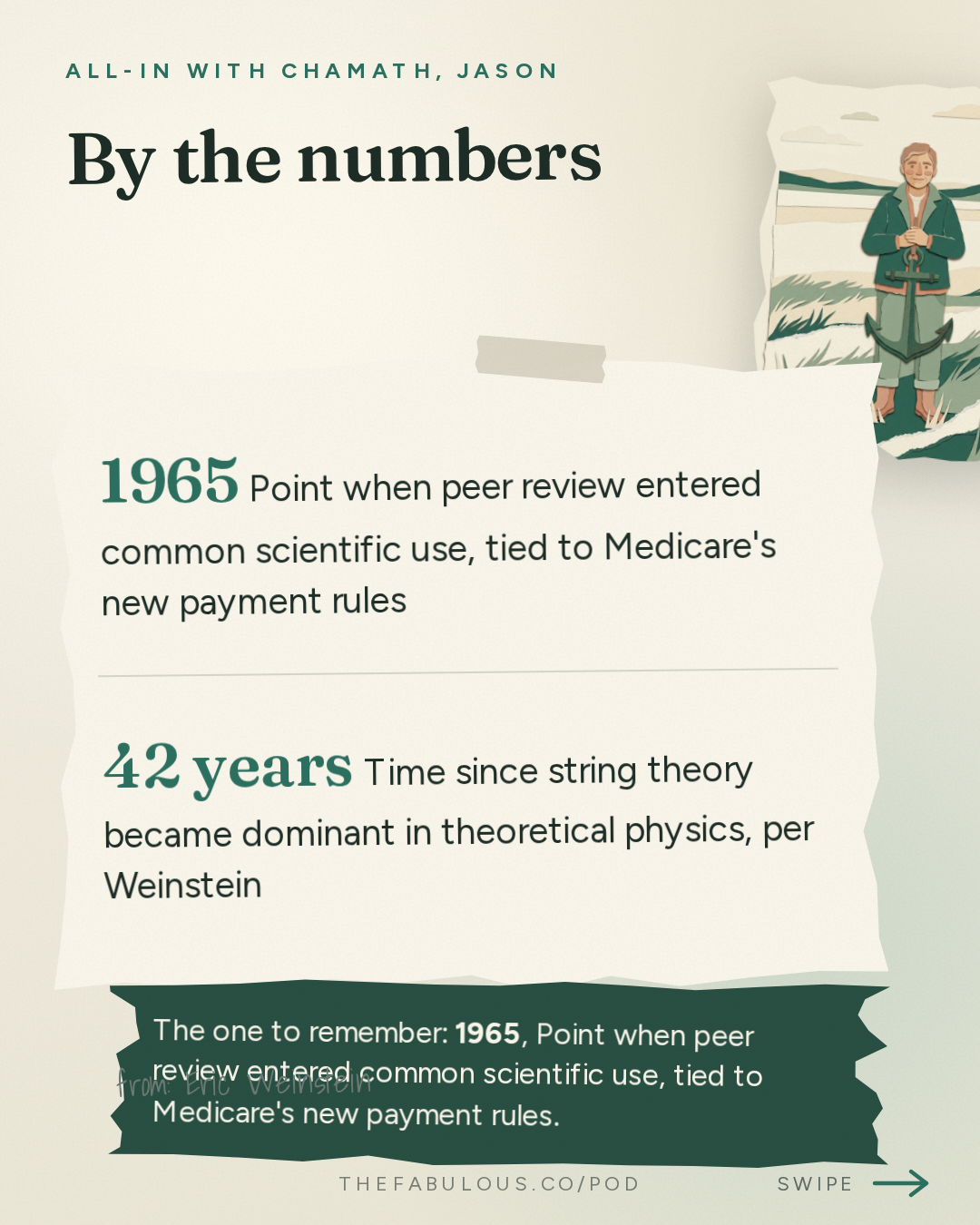
- 1965 Point when peer review entered common scientific use, tied to Medicare's new payment rules
- 42 years Time since string theory became dominant in theoretical physics, per Weinstein
In their words
“When I hear the word consensus, I get very, very nervous because a consensus is usually an artificial agreement achieved through pressure.”
“If you don't have communists and fascists in the same department having tea together, something has gone wrong.”
“The guy drove theoretical physics off the road, uh, and off a cliff forty-two years ago.”
“They're an uncontacted people who don't know that they're part of something larger that watches them.”
Questions this episode answers
What is the 'scientific precariat' that Eric Weinstein describes?
Mathematician and physicist Eric Weinstein uses the term to describe professors who cannot afford to challenge their field's dominant view because a grant, tenure case, or department chair depends on staying inside the lines (06:21). He argues this fear, not genuine agreement, is what enforces most scientific consensus today.
When did peer review become standard in science?
A search of the published record shows the phrase 'peer review' barely appears before 1965, the year Medicare made the US government the primary payer for medical procedures. Doctors reportedly began reviewing each other's decisions to keep government regulators from having direct oversight (24:21), and the practice spread into general science after a 1975 political fight over a federal science curriculum (25:14).
Has theoretical physics actually stalled since the 1980s?
Physicist Eric Weinstein argues theoretical physics has produced no experimentally verified advance in 42 years, since Leonard Susskind, David Gross, and Edward Witten steered the field toward untested string theory in 1983-84 (41:33). This is his personal assessment, not a mainstream consensus finding, and many physicists would dispute the framing.
Why does Eric Weinstein suspect Renaissance Technologies of hiding physics research?
Weinstein speculates, without offering proof, that the hedge fund Renaissance Technologies, founded by mathematician Jim Simons, could be a private site for undisclosed physics work, based on its unmatched trading returns and its close, unexplained ties to Stony Brook University and Brookhaven National Laboratory (48:01).
Are UAP sightings connected to nuclear weapons sites?
Weinstein cites a 1971 Australian intelligence document reporting that unidentified aerial phenomena clustered near nuclear tests, a pattern he says resembles sightings near US nuclear test and deployment sites (86:36). He treats this as evidence that UAPs may be advanced, technologically capable actors rather than proof of extraterrestrial visitors.
Is China recruiting American scientists?
Weinstein says China is offering Western scientists money, prestige, and intellectual freedom that American institutions increasingly withhold, and that scientists are responding by leaving (76:50). He frames this as a brain drain driven by ideological conformity inside US science departments, though he does not cite specific recruitment numbers.
The full read, in cards
Go deeper
- Science: A New Golden Age — Report/book published by White House science advisor Michael Kratsios arguing American science has stalled and needs reform
- Great Barrington Declaration — 2020 declaration against COVID lockdowns co-authored by Jay Bhattacharya, later named NIH director
- Nature reader survey on the 2024 US election — Found roughly 6% of polled scientific readers supported Trump versus a large majority for Kamala Harris
- 1971 Australian intelligence document on UAP sightings — Reportedly linked UAP sightings to nuclear test sites and framed general relativity research as a cover story for anti-gravity work
Mentioned
Eric Weinstein · Edward Witten · Jim Simons · Geometric Unity · Renaissance Technologies · National Science Foundation · Michael Kratsios · Jay Bhattacharya · String Theory · Manhattan Project · EcoHealth Alliance · Nima Arkani-Hamed · Stewart Butterfield · Pati-Salam model · DESI (Dark Energy Spectroscopic Instrument)
More from this show and category

CoreWeave Debt Crisis and the AI Bubble, Explained
CoreWeave's bond selloff this week signaled real doubt about AI infrastructure debt, even as demand for GPUs stays red hot. Anthropic posted $16.8 billion in Q3 revenue, Sacks called its warnings about small AI models a move against open-source rivals, and Chamath named electricity as AI's real bottleneck.

Billy Evans on Elizabeth Holmes: Trial, Prison, Hemantis
Billy Evans, Elizabeth Holmes's husband, says the Theranos founder was acquitted on every patient-fraud count tied to 12.5 million blood tests but convicted of defrauding three investors, a conspiracy charge that let the judge add outside victims like Rupert Murdoch and push her sentence to 11.25 years (00:27, 19:52, 21:31).

Martin Shkreli: Quantum Computing Fraud, Pharma Deals
Martin Shkreli argues quantum computing is mostly a business mirage because today's machines run at only hundreds of hertz. He says photonic chips, which multiply matrices with light, could make Nvidia's GPUs obsolete within twenty years, and he describes turning a $2 million drug deal into a $6 billion pharmaceutical company.

Anthropic Lobbied the Pope on AI Consciousness
Anthropic lobbied religious leaders, including the Pope, on whether Claude is conscious, then coded that belief into the model's training itself. The same episode covers OpenAI's single-day release of 700 math papers, France's debt-fueled riots, and why headless AI agents are erasing the value of software intellectual property.
