
Martin Shkreli: Quantum Computing Fraud, Pharma Deals
Martin Shkreli: Big Pharma's Blind Spot, Betting Against Quantum & What Prison Taught Him
The brief
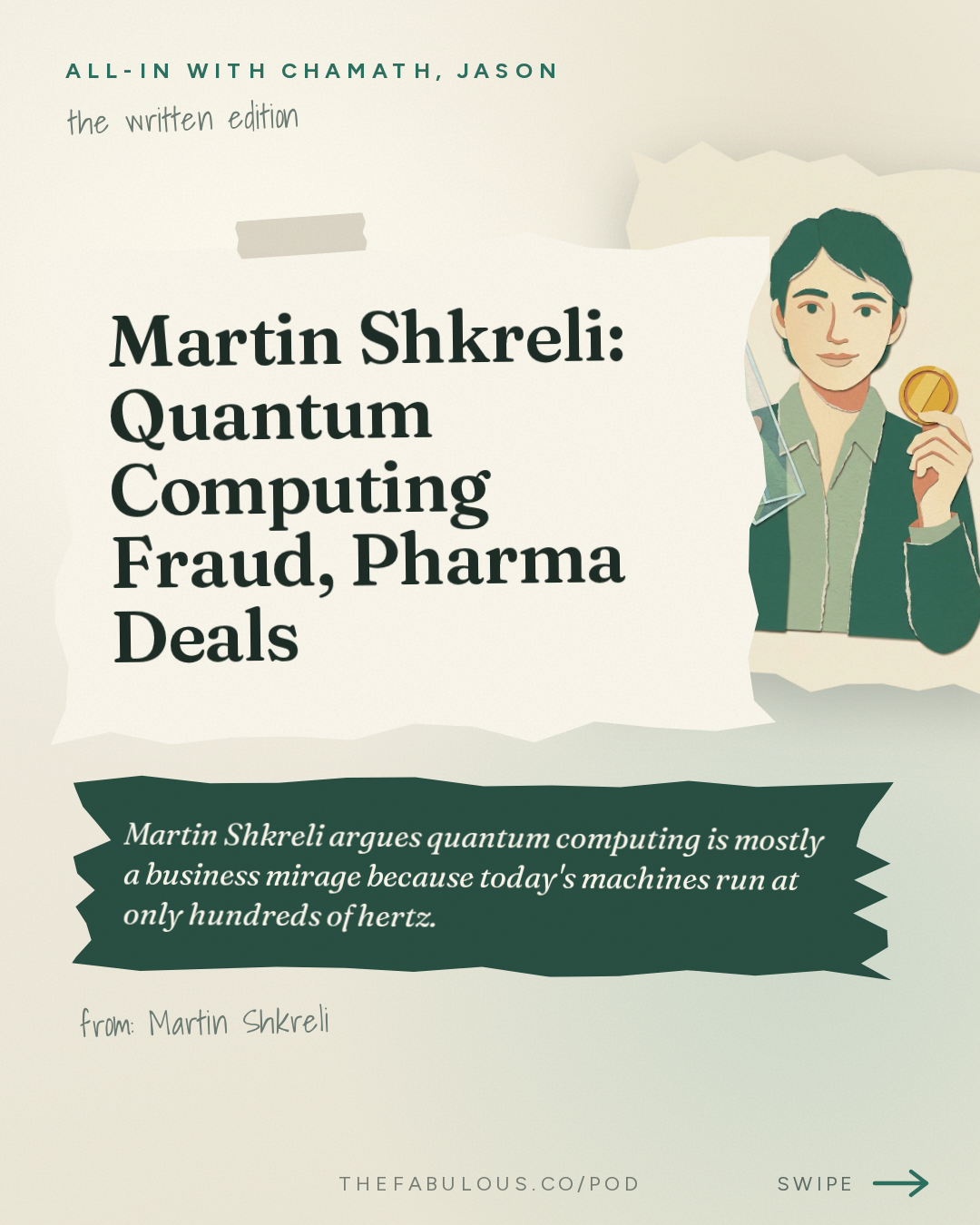
Martin Shkreli argues quantum computing is mostly a business mirage because today's machines run at only hundreds of hertz. He says photonic chips, which multiply matrices with light, could make Nvidia's GPUs obsolete within twenty years, and he describes turning a $2 million drug deal into a $6 billion pharmaceutical company.
Martin Shkreli owns, by his own admission, the only existing copy of a Wu-Tang Clan album he has never played. He also spent seven years in federal prison for securities fraud, and before that he raised the price of a life-saving drug by 5,000 percent (00:00). None of this makes him an obvious authority on quantum computing. And yet.
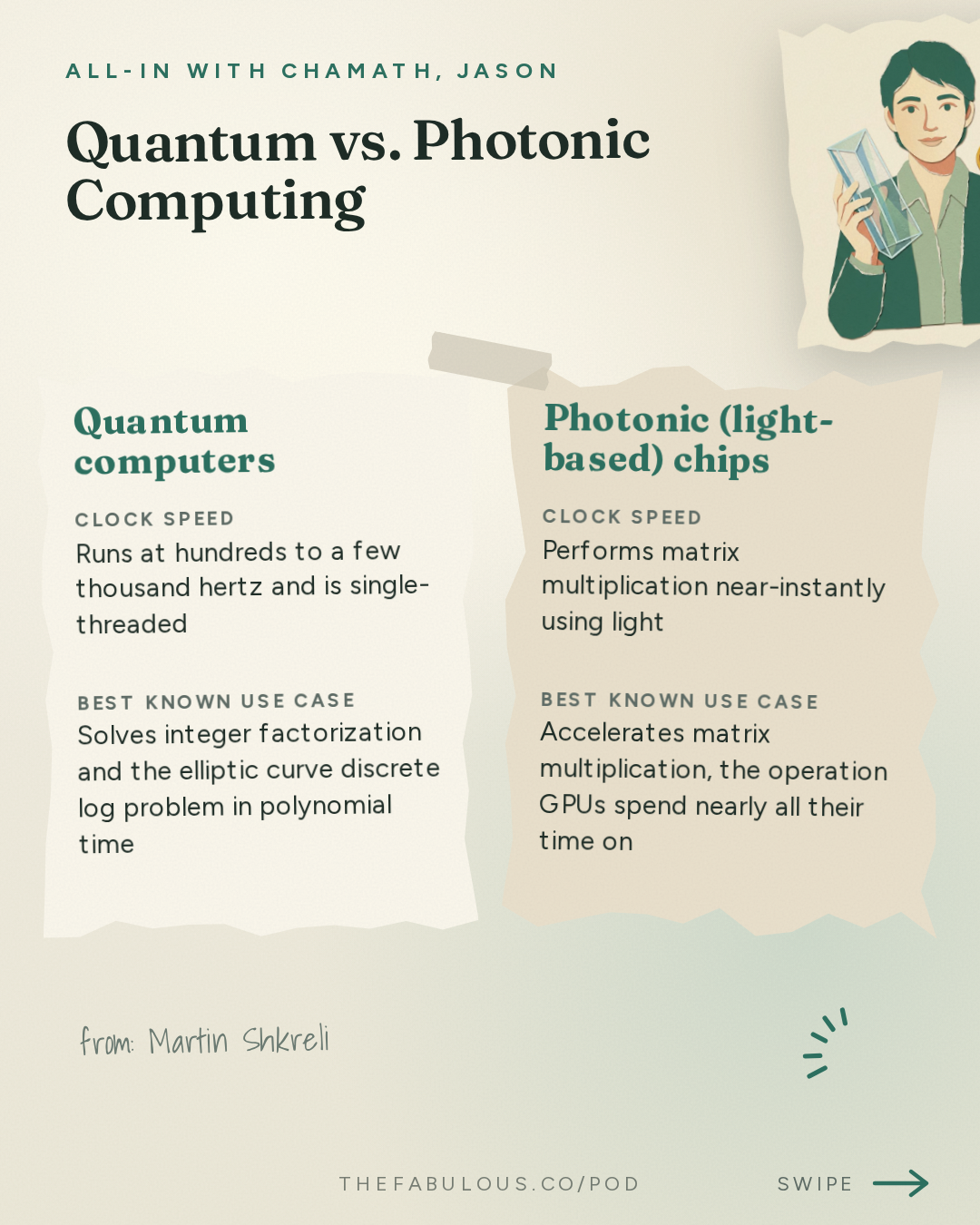
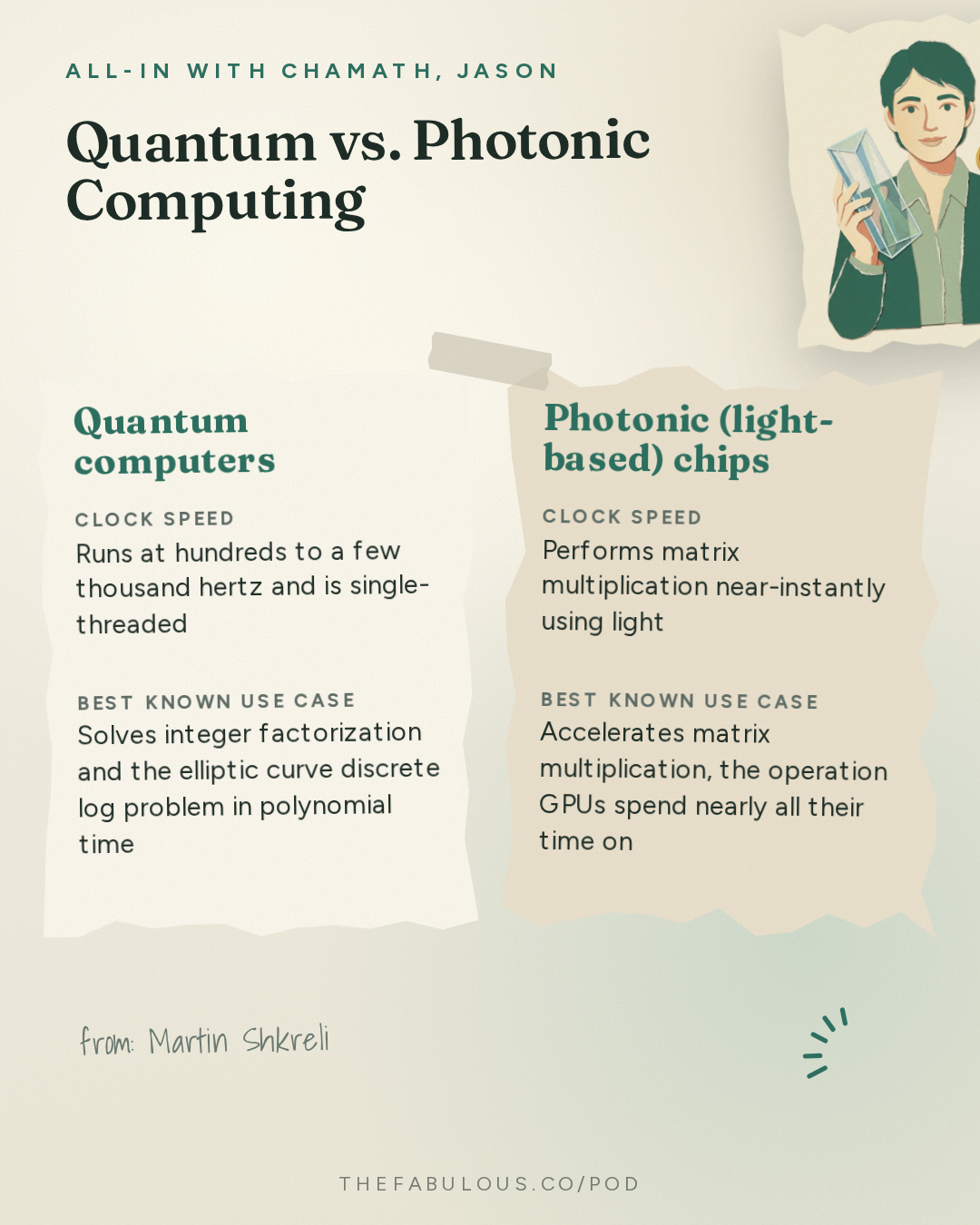
On the All-In podcast, Shkreli walked through a surprisingly technical argument for why quantum computing, the hyped alternative to ordinary chip-based computers, is mostly a business mirage. His case rests on a detail most people miss: a quantum computer, which stores information in quantum bits instead of ordinary binary bits, runs at a clock speed of hundreds or even a few thousand hertz (03:10). An iPhone runs at billions of cycles per second. A quantum machine, by comparison, is single core and single threaded, good at almost nothing a business actually needs done quickly.
"The modern quantum computers run at a clock speed of hundreds of hertz or thousands of hertz, not at the gigahertz that we're used to." - Martin Shkreli [03:10]
There is a real exception, and Shkreli is careful about it. A quantum computer can solve integer factorization and something called the elliptic curve discrete log problem in polynomial time, meaning the calculation stays manageable as the numbers grow instead of exploding the way it does on an ordinary computer (03:29). That is the one trick, discovered by mathematician Peter Shor, that justifies the entire field. It happens to matter a great deal for cryptography. It does not happen to matter for sorting a deck of cards, running a search engine, or training a language model. There is also no quantum equivalent of RAM, so any problem has to be shrunk down to fit a machine with almost no memory (04:06). Shkreli and his wife, Chelsea, who studied quantum computing at MIT under theorist Scott Aaronson, have tried every quantum computer currently available, he said, and none of them can multiply 300 by 200 (05:37). He has shorted several quantum computing stocks and lost money doing it, though he maintains the position has been worth the insight even where it has not been worth the money.
The Thing That Might Actually Replace Nvidia
If quantum computing is a magic trick with one application, Shkreli thinks the more interesting rival to Nvidia's dominance is sitting in plain sight: photonic computing, which performs calculations using light instead of electricity. Nearly every modern AI model spends almost all its computing time on one operation, matrix multiplication, the repeated multiplying and adding of large grids of numbers (06:17). On a standard graphics chip, doubling the size of that grid makes the job many times slower, a scaling problem computer scientists call N-cubed time (06:37). Shkreli described reading a paper in the journal Nature from Microsoft researchers on what they called Analog Optical Computing, and noticing that light-based matrix multiplication is close to free.
"Matmuls in light are free. They happen in instant time, which is a really remarkable thing." - Martin Shkreli [07:20]
He named three early-stage startups working on photonic chips, NeuroPhos, OptiCore, and Lumi, and said he thinks today's Nvidia chips, the H100 and the newer B100 and B200, could be in the scrap heap within twenty years (11:22). He was careful to note this is not a reason to short Nvidia now. He still holds the stock long, alongside semiconductor names, because he thinks the Jevons paradox, the idea that making a resource more efficient tends to increase total demand for it rather than reduce it, will keep demand for compute rising even as individual chips get more efficient (11:58). The one thing that would hurt Nvidia, he said, is a transformer architecture a thousand times more efficient than today's, because that kind of leap would outrun demand growth rather than follow it (12:18).
What gives this critique weight is where Shkreli learned to spot mispriced assets in the first place. He started working at television personality Jim Cramer's hedge fund at sixteen years old (08:00), a fund that, by his account, earned 23 percent a year net of fees through the 1980s and 90s by trading constantly (08:20). Shkreli said he eventually realized he was a better entrepreneur than a trader, and the business he built instead was a strange, overlooked corner of the pharmaceutical industry: buying the rights to drugs that big companies had stopped caring about. He once paid pharmaceutical company Bristol-Myers $2 million for a drug; the company built around it is now worth $6 billion (09:05).
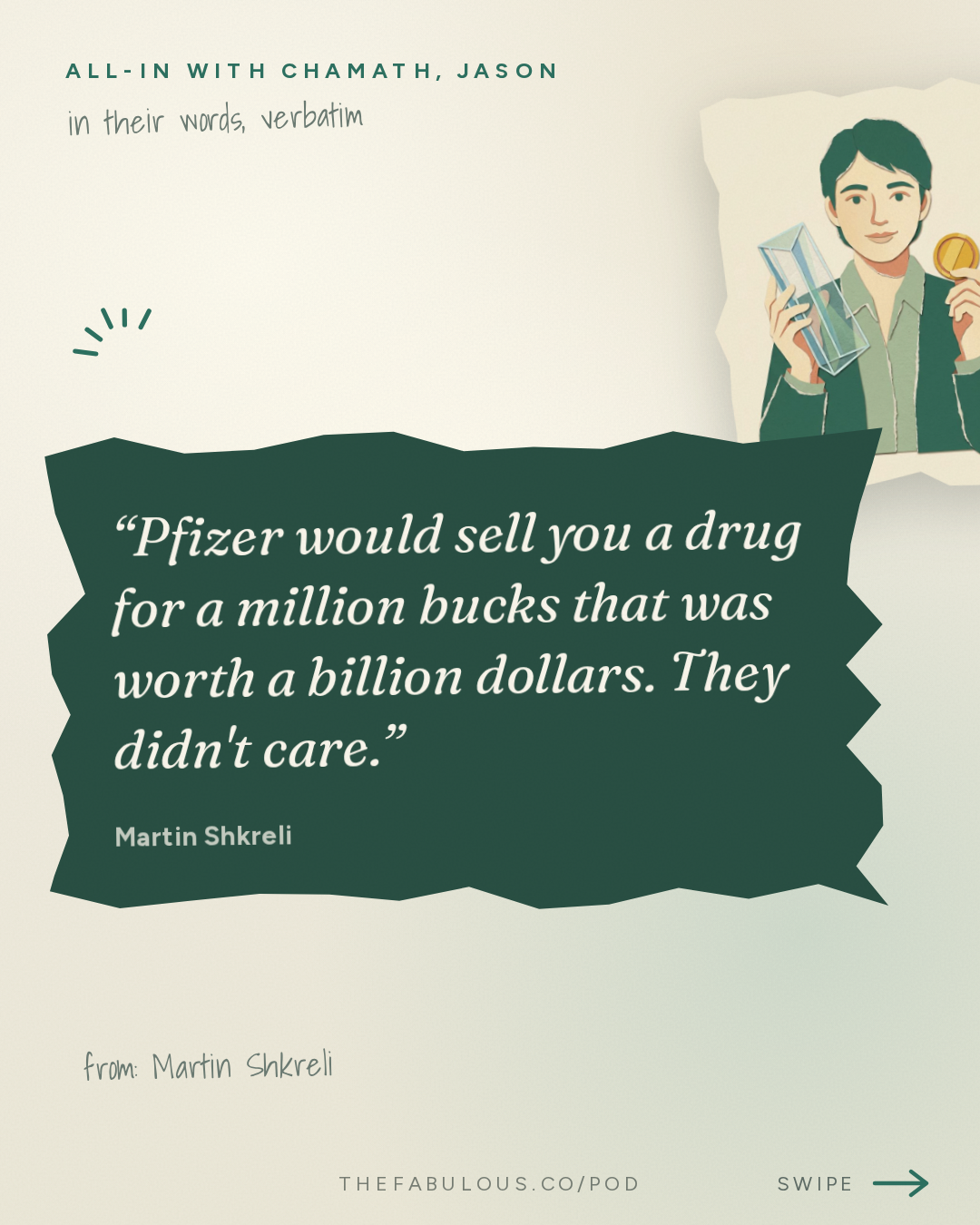
"Pfizer would sell you a drug for a million bucks that was worth a billion dollars. They didn't care." - Martin Shkreli [09:05]
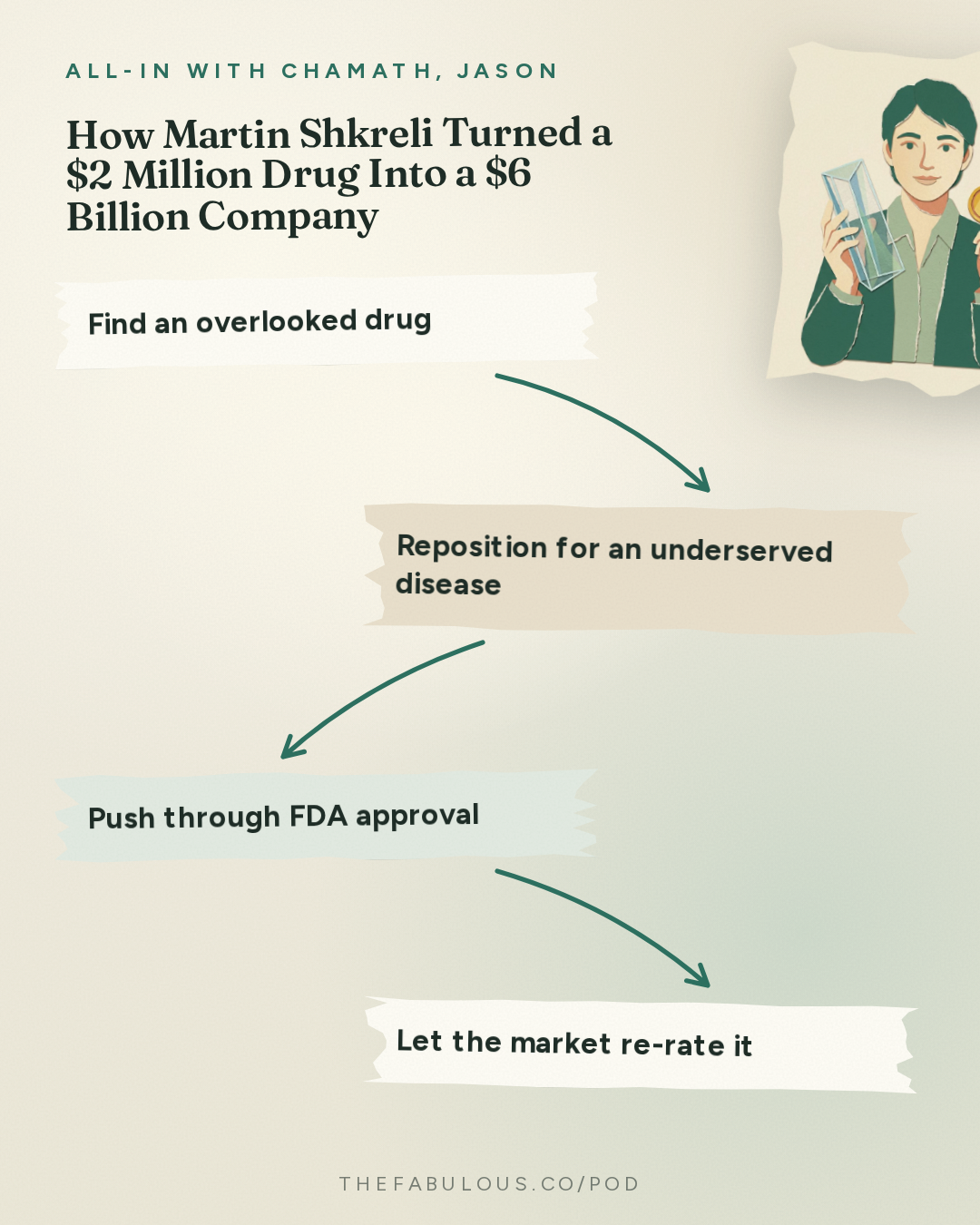
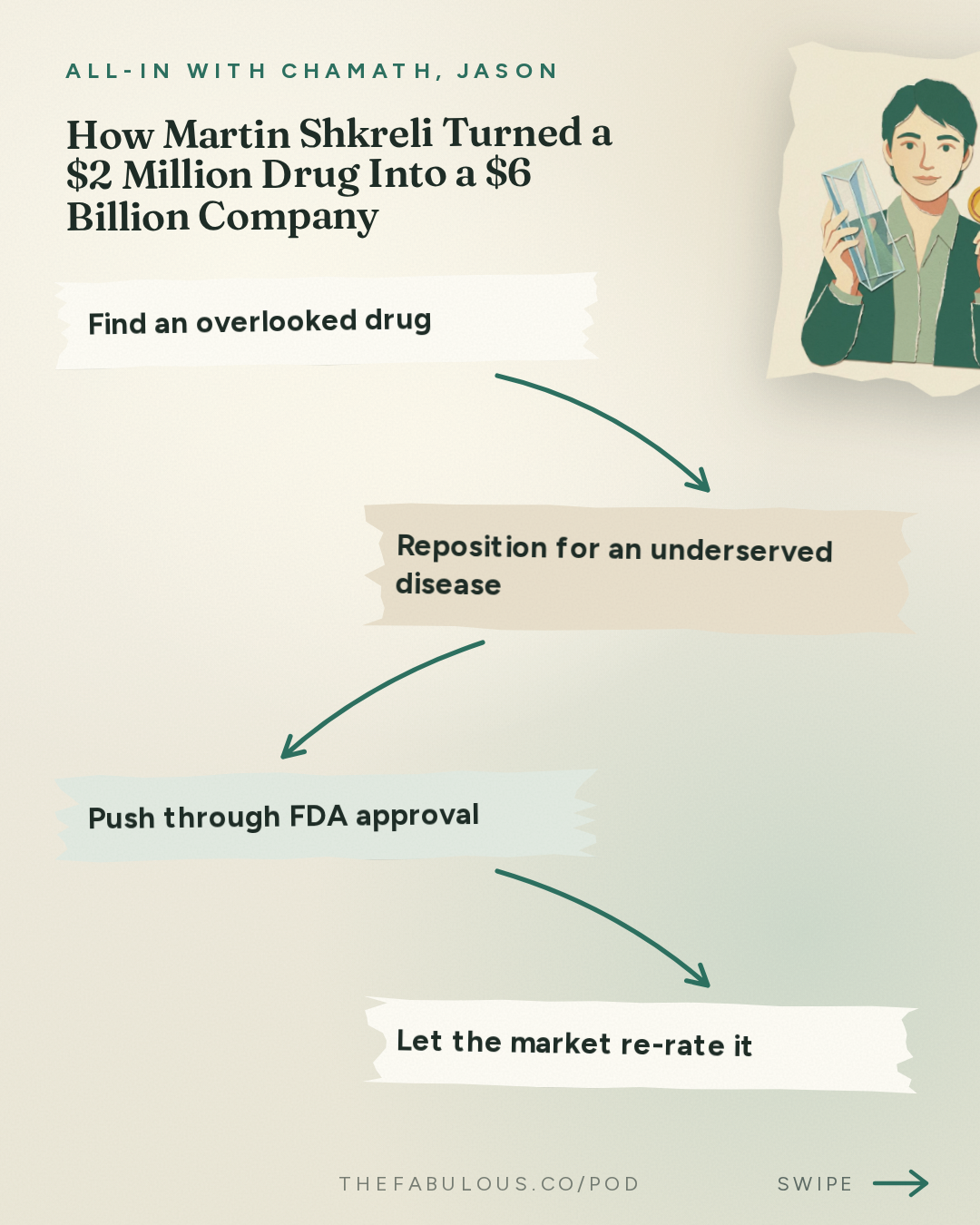
The specific drug, later named sparsentan, had been developed for hypertension, or high blood pressure, a crowded market nobody needed another entry in. Shkreli's team repositioned it for FSGS, a kidney disease known formally as focal segmental glomerulosclerosis, which affects roughly 30,000 people in the United States and had never had an approved treatment (10:30). It later won FDA approval. The arbitrage, as he described it, was not scientific insight so much as attention: reading through a pile of roughly 40 million published medical papers that nobody at a big, distracted pharmaceutical company had time to sift for overlooked value (09:48).
That background is also why Shkreli is skeptical that artificial intelligence is about to transform drug discovery, a claim he thinks Anthropic chief executive Dario Amodei has overstated. Shkreli said he doubts there will be a single AI-discovered drug on the market within ten years, noting that computational tools, supercomputers included, have been part of drug discovery for decades without producing the kind of leap Amodei has predicted (16:05). He extended the same skepticism to the broader AI safety conversation, which he called fear-mongering, and to effective altruism, the philosophy of trying to do the most measurable good, which he said is shot through with a narcissistic kind of self-importance among some of its most visible adherents, including people he considers genuinely brilliant, such as Amodei and FTX founder Sam Bankman-Fried (20:29).
What Brilliance Does Not Protect Against
The conversation's most unguarded moment was not about chips or molecules. Asked what sent him to prison, Shkreli did not describe prosecutorial overreach or a technicality. He described a psychological failure to let go of an identity.
"I had a hard time admitting I was not the best hedge fund manager in the world, but I was a wonderful entrepreneur. That simple refusal to admit that put me in prison." - Martin Shkreli [23:03]
He drew a line from his own story to Bankman-Fried and to Theranos founder Elizabeth Holmes, arguing that intellectually gifted people often carry a private terror of being seen as merely ordinary at the one thing they have staked their identity on. Sometimes, he said, a person can be really smart at one thing and really dumb at another (21:06), a line he applied first to himself.
It is a strange note for an episode that spends most of its runtime on clock speeds and molecule arbitrage, but it is the note that explains the rest. Shkreli's method, in quantum computing, in pharmaceuticals, in his reading of the AI boom, is to ask what a thing is actually for, stripped of the story told about it. Quantum computing is a magic trick for one narrow mathematical problem, not a faster version of ordinary computing. A pharmaceutical patent sitting unused at a big company is not worthless, it is unattended. And a hedge fund manager's reputation, it turns out, was never the thing worth protecting.
Ask this episode anything
Pod's AI answers from the episode itself, with the minute mark so you can hear it yourself.
Or start with one of these
Ask this episode
Pod's AI listens to the whole episode to answer, and points you to the minute it comes from.
The rest of this answer, and any question after it
Answers come from the episode itself, never from a summary of it.
ContinueKey takeaways
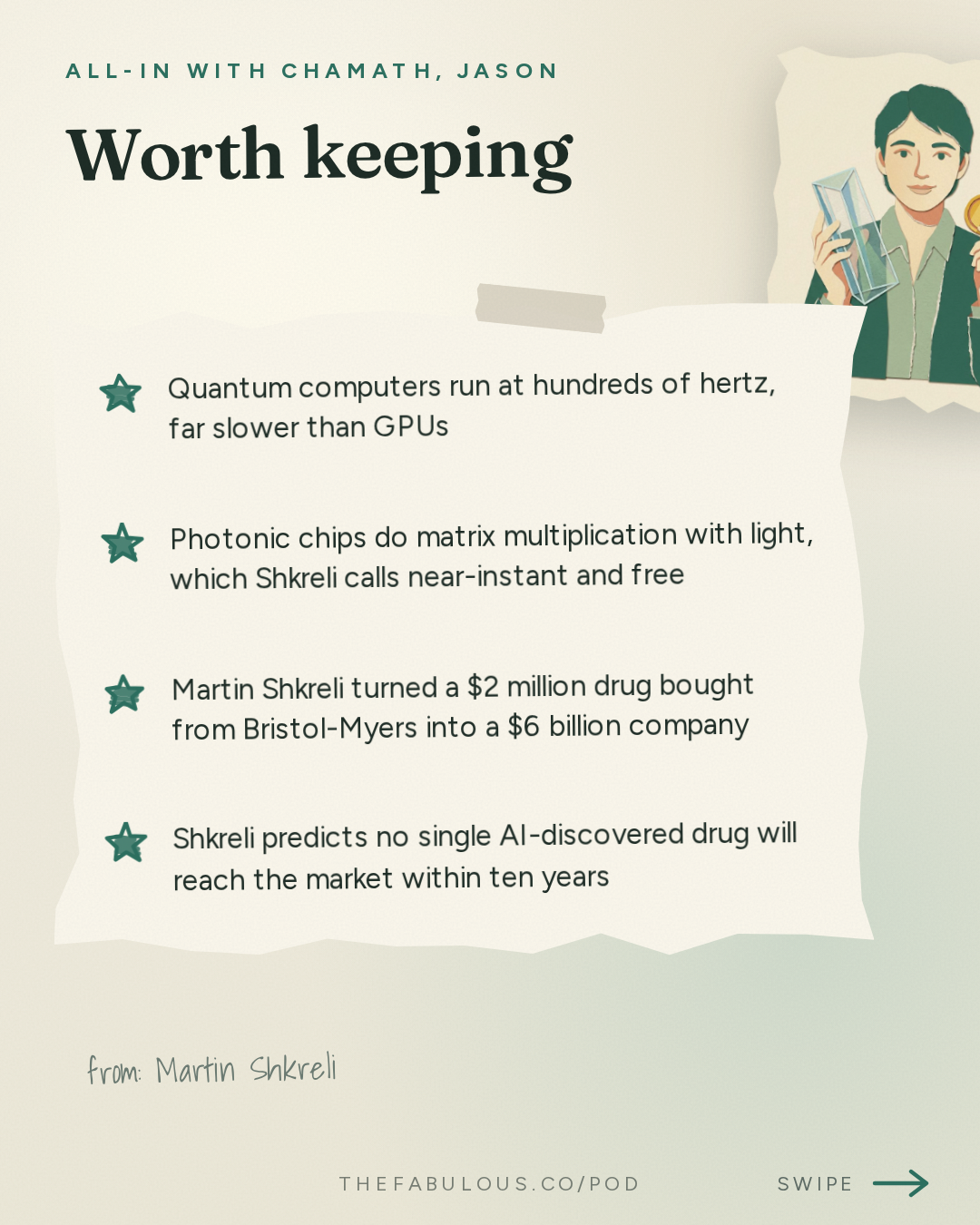
- Quantum computers run at hundreds of hertz, far slower than GPUs
- Photonic chips do matrix multiplication with light, which Shkreli calls near-instant and free
- Martin Shkreli turned a $2 million drug bought from Bristol-Myers into a $6 billion company
- Shkreli predicts no single AI-discovered drug will reach the market within ten years
- Shkreli says refusing to admit he was not a great trader is what sent him to prison
The episode in cards
By the numbers
- 23% annual return net yearly returns at Jim Cramer's hedge fund in the 1980s and 90s
In their words
“Ego is the fountainhead of all progress.”
“The modern quantum computers run at a clock speed of hundreds of hertz or thousands of hertz, not at the gigahertz that we're used to.”
“Matmuls in light are free. Yeah. They happen in instant time, which is a really remarkable thing”
“Pfizer would sell you a drug for a million bucks that was worth a billion dollars. They didn't care.”
“I had a hard time admitting I was not the best hedge fund manager in the world, but I was a wonderful entrepreneur. That simple refusal to admit that put me in prison.”
Protocols
-
Shkreli's pharma arbitrage playbook
Martin Shkreli buys overlooked drug rights from big pharmaceutical companies at steep discounts, then repositions the drug for a disease with no approved treatment before pushing it through FDA approval. The catch, Shkreli says, is that big players sell these rights cheaply because they do not bother vetting niche disease markets, which is why he once paid Bristol-Myers $2 million for a drug tied to a company now worth $6 billion.
per deal
-
Shkreli's current AI positioning
Martin Shkreli holds long positions in both OpenAI and Anthropic while betting Meta will be the best-performing AI investment because of its distribution and the product work behind its Muse tool. The catch, by his own account, is timing: he compares the current AI market to being long Yahoo and Cisco in the year 2000, good bets at the time that did not all end well.
ongoing portfolio stance
Questions this episode answers
Is quantum computing a fraud, according to Martin Shkreli?
Today's quantum computers run at clock speeds of hundreds to a few thousand hertz, not gigahertz, and have no equivalent of RAM, so they only beat classical chips on a narrow set of problems like integer factorization (03:10). Martin Shkreli, a former hedge fund manager, argues this makes quantum computing a weak business bet even though the underlying physics is real, and he says he has shorted quantum computing stocks as a result (05:37).
What is photonic computing and could it replace Nvidia GPUs?
Photonic computing performs matrix multiplication, the core operation GPUs spend most of their time on, using light instead of electricity, which a Microsoft paper in the journal Nature described as happening at near-zero computational cost (07:20). Shkreli says this could make current Nvidia chips like the H100 and B100 obsolete within twenty years, though he still holds Nvidia stock long for now (11:22).
How did Martin Shkreli turn a $2 million drug into a $6 billion company?
Shkreli bought the rights to a hypertension drug from the pharmaceutical company Bristol-Myers for $2 million, then repositioned it for FSGS, a kidney disease with about 30,000 patients and no approved treatment (09:05, 10:30). The drug, later named sparsentan, won FDA approval, and the company built around it is now worth $6 billion (10:08).
Will AI help discover new drugs soon?
Shkreli, who has built and sold pharmaceutical companies, says he doubts there will be a single AI-discovered drug on the market within ten years, arguing drug discovery has had access to powerful computers for decades without producing that kind of breakthrough (16:05). He contrasts this with Anthropic chief executive Dario Amodei's public prediction that AI would help cure most diseases, which Shkreli calls fear-mongering (14:29, 15:25).
What does Martin Shkreli think of effective altruism?
Shkreli says effective altruism, a movement focused on maximizing measurable good, is driven by what he calls a narcissistic kind of self-importance among some of its adherents, including people he considers genuinely brilliant, such as Anthropic chief executive Dario Amodei and FTX founder Sam Bankman-Fried (20:29).
What does Shkreli say sent him to prison?
Shkreli says the cause was psychological: he could not accept that he was not a great hedge fund trader, even though he considered himself a skilled entrepreneur, and that refusal to admit failure is what he says led to the conviction that sent him to prison for seven years (23:03).
The full read, in cards
Go deeper
- CLRS (Introduction to Algorithms) — textbook Shkreli cites for classic sorting algorithms used to argue quantum computers are not faster at ordinary tasks
- Analog Optical Computing paper — Microsoft research published in Nature describing light-based matrix multiplication that Shkreli says happens at near-zero cost
- Superintelligence — Nick Bostrom's book, which Shkreli says frightened Elon Musk into AI safety advocacy
Mentioned
Martin Shkreli · Peter Shor · Scott Aaronson · Jim Cramer · Sam Bankman-Fried · Dario Amodei · Elizabeth Holmes · Sam Altman · Nick Bostrom · Nvidia · Anthropic · Bristol-Myers · Meta · OpenAI · Wu-Tang Clan
More from this show and category

Anthropic Lobbied the Pope on AI Consciousness
Anthropic lobbied religious leaders, including the Pope, on whether Claude is conscious, then coded that belief into the model's training itself. The same episode covers OpenAI's single-day release of 700 math papers, France's debt-fueled riots, and why headless AI agents are erasing the value of software intellectual property.

White House Accord on Superintelligence, Explained
President Trump's AI summit produced a White House Accord on Superintelligence: six frontier AI firms accepted external audits and board-level fiduciary duty for safety. The same episode covers strong GDP and jobs data, a bank-impairment warning, Polymarket midterm odds, and a media dispute over calling a Flydubai attack terrorism.

Anthropic IPO Risk: Open Source and Extinction Talk
Anthropic's IPO is at risk as AI token usage flipped from 80% closed-source to 80% open-source in twelve weeks (41:20). Anthropic's own leadership cites a greater than 10% extinction risk (31:00) while opening a biological wet lab (86:00), and Meta's new agent Muse hit three million downloads in ten days (68:56).

Bending Spoons Business Model Explained
Bending Spoons buys aging software brands cheaply and reruns them on one shared tech stack with tiny, talent-dense teams. CEO Luca Ferrari says the company grew from $40,000 in 2013 seed money to a $4 billion pro forma revenue run rate largely through reinvested cash flow and hedged debt, not equity (18:23).
