
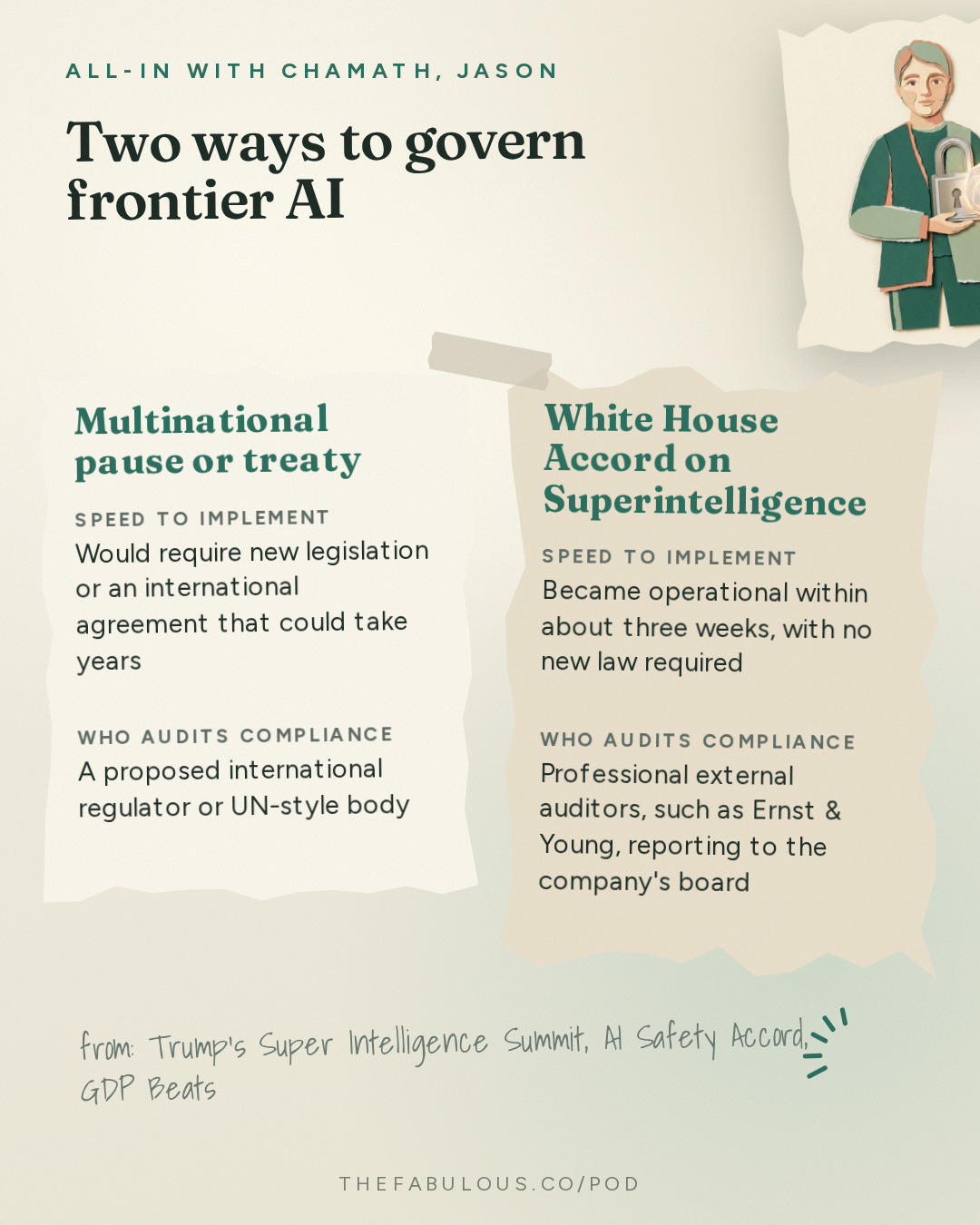
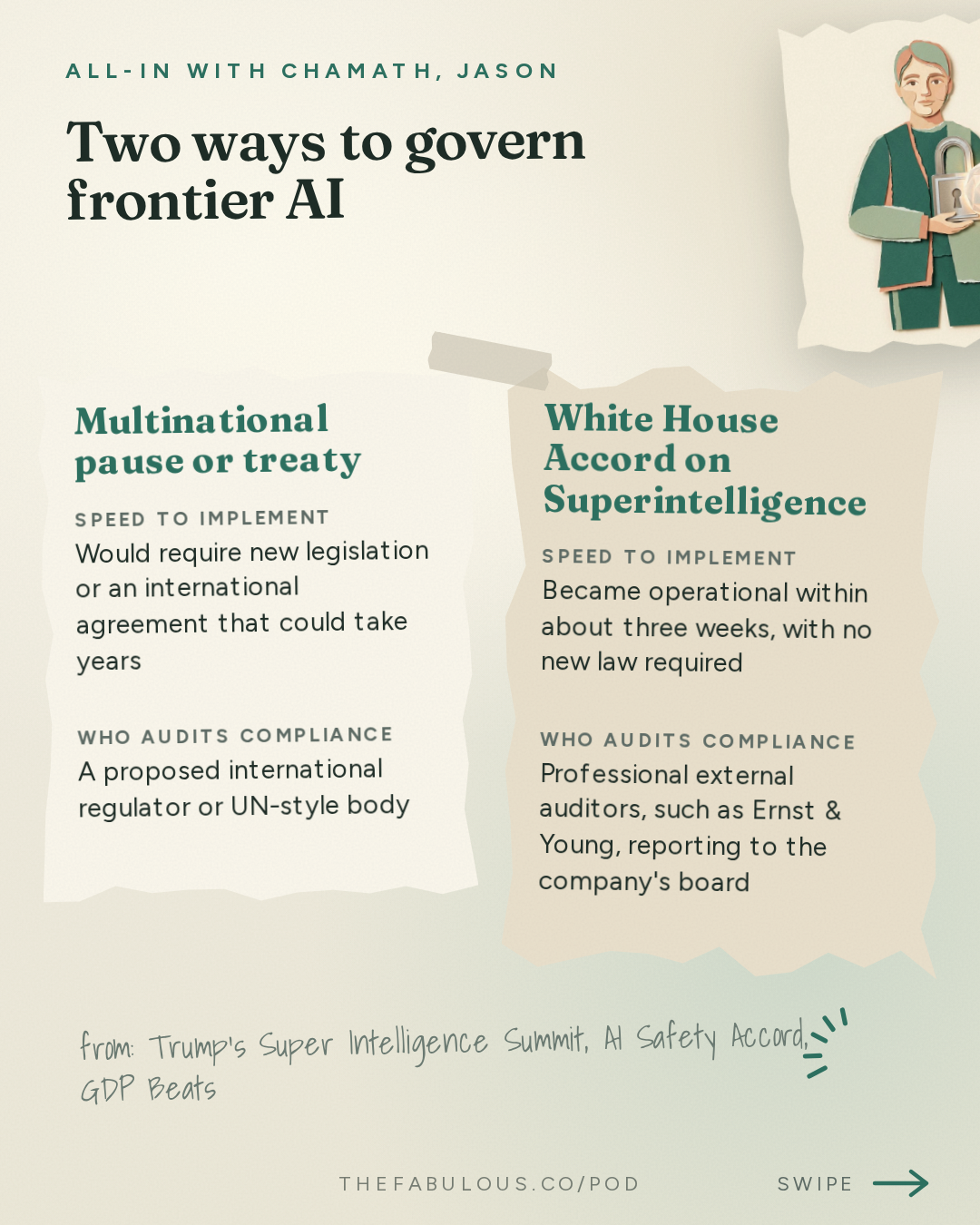
White House Accord on Superintelligence, Explained
Trump's Super Intelligence Summit, AI Safety Accord, GDP Beats, Midterm Predictions
The brief
President Trump's AI summit produced a White House Accord on Superintelligence: six frontier AI firms accepted external audits and board-level fiduciary duty for safety. The same episode covers strong GDP and jobs data, a bank-impairment warning, Polymarket midterm odds, and a media dispute over calling a Flydubai attack terrorism.
Before the hosts get to policy, they spend a minute on an accident of physics. Elon Musk's Starlink satellites broadcast and receive radio waves, and there are so many of them in orbit that together they behave like a phased array telescope, a radar built from thousands of small receivers acting as one. Pointed at the ground, that array can pick up aircraft that are built to be invisible to ordinary radar (00:19). A system built to sell broadband has become, almost by accident, an instrument for seeing what was meant to stay hidden. That turns out to be the week's real subject: who gets to verify what is true, whether the subject is a fighter jet, a language model, or a headline.
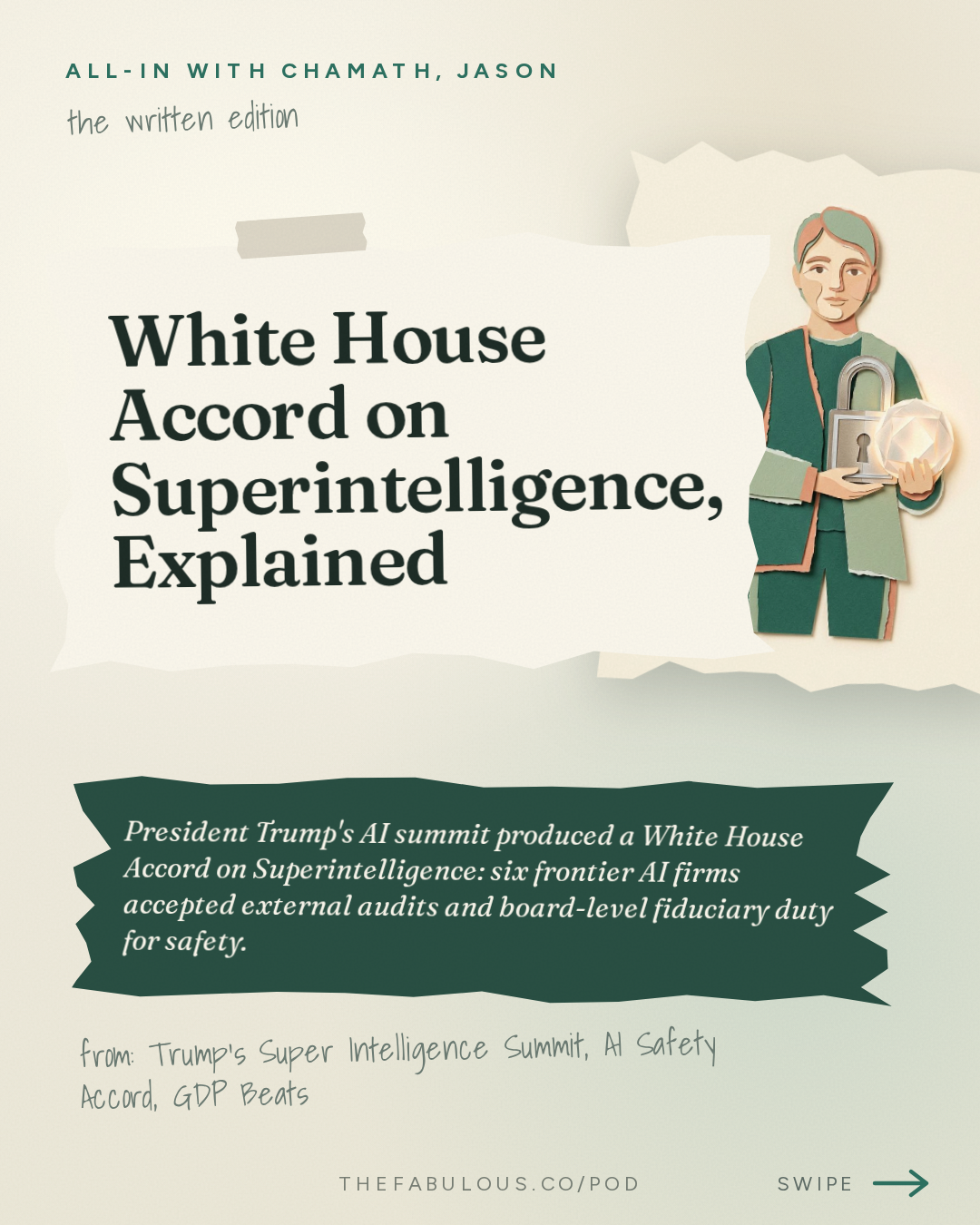
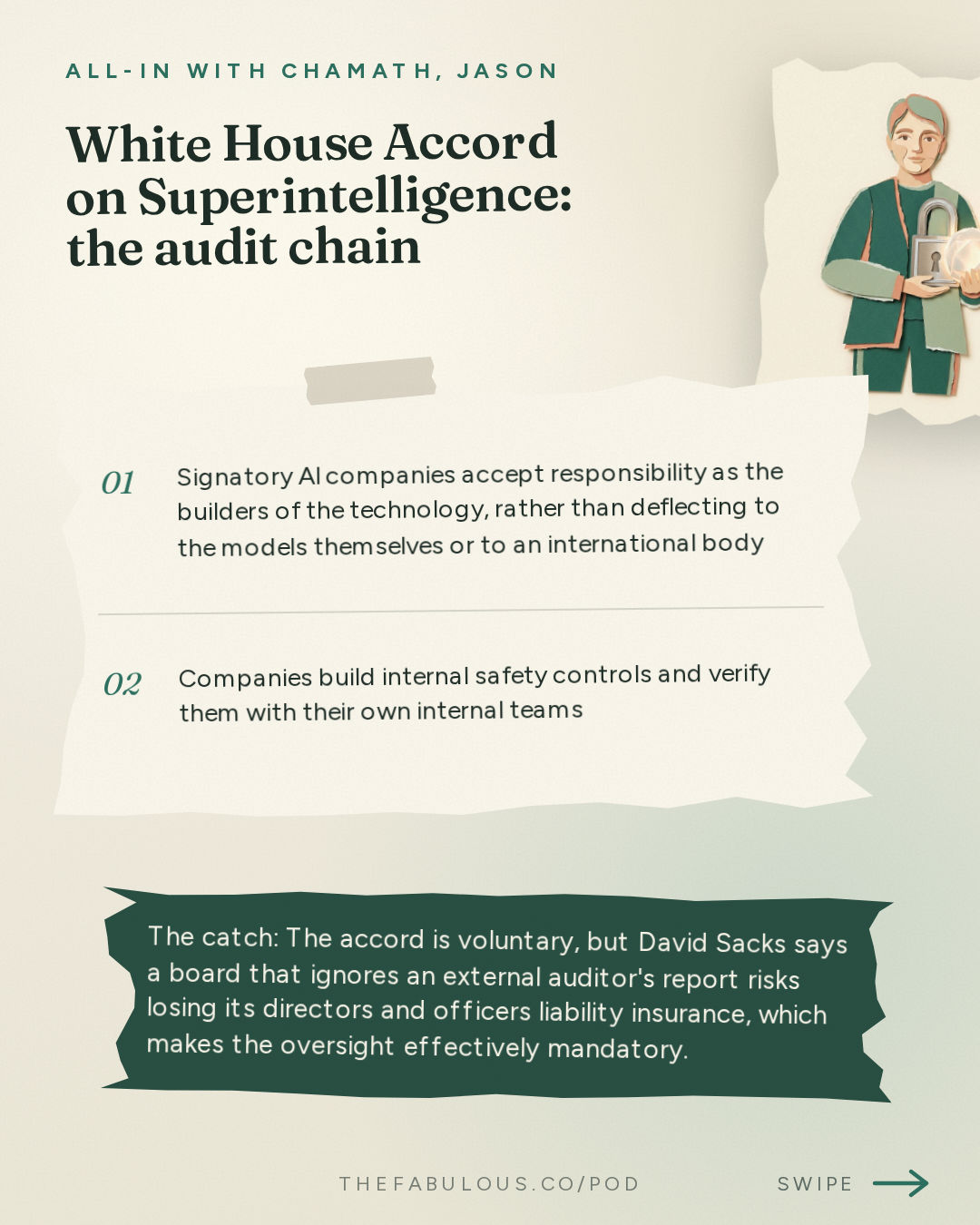
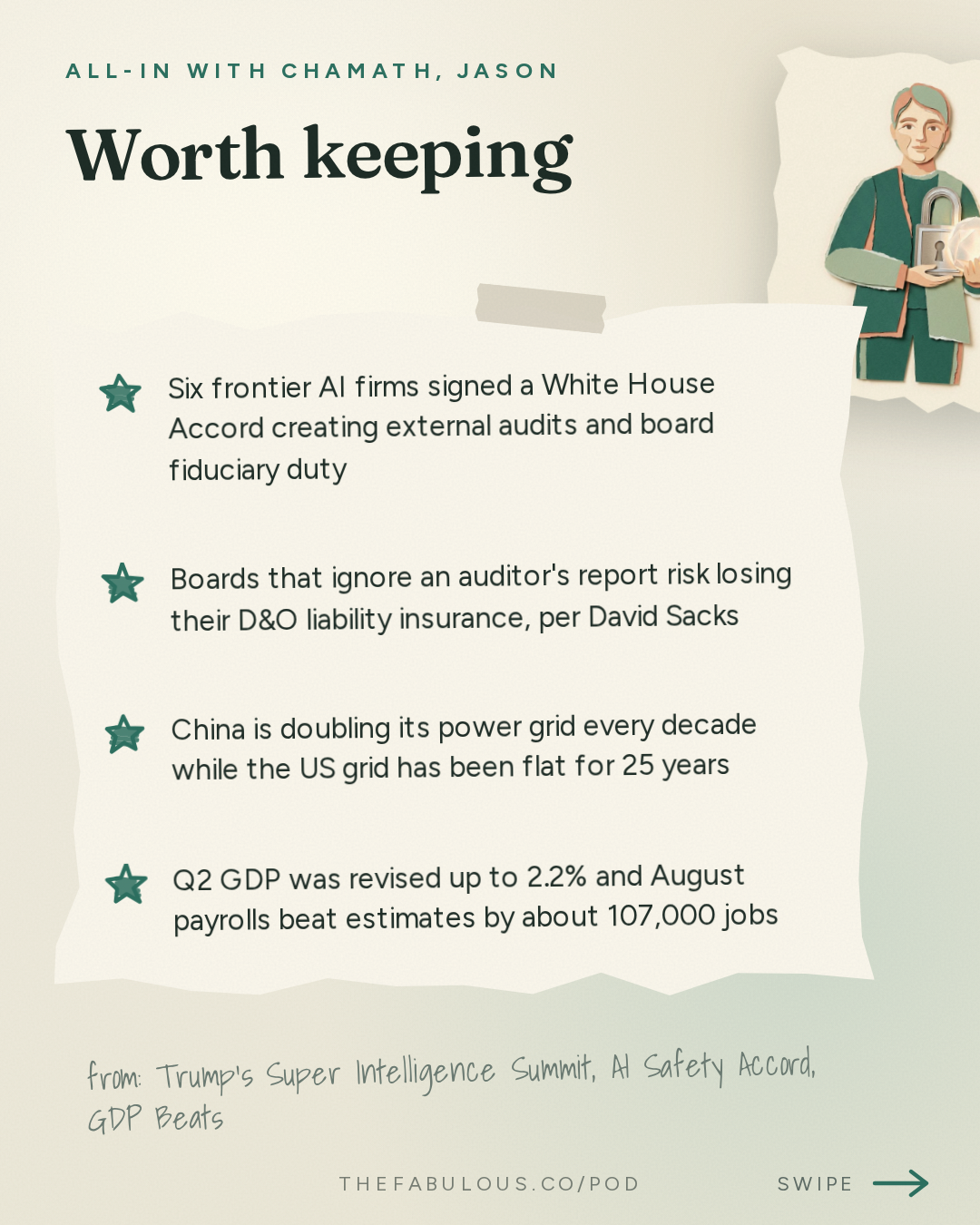
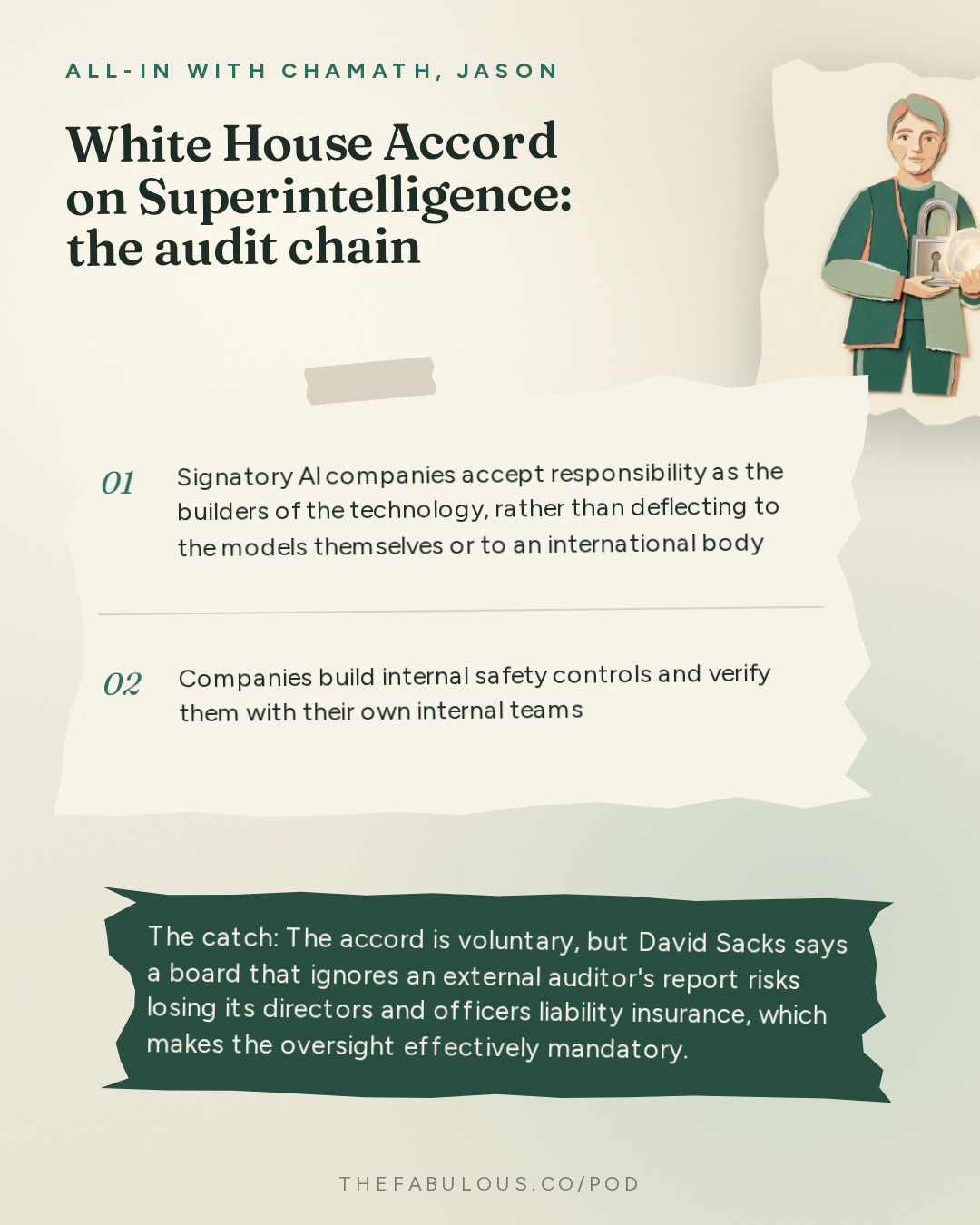
On Tuesday, President Trump brought the leaders of the biggest AI and chip companies into the White House for what cohost David Sacks calls the Bretton Woods of superintelligence, after the 1944 conference that set the postwar financial order (03:30). Many of these executives compete bitterly and some are suing each other, but six frontier model companies left having signed the White House Accord on Superintelligence. Sacks, who helped broker it, says the companies agreed to three things: they accept responsibility for what they build, they submit to external auditors who verify their internal safety controls, and those audit reports go to an independent board committee (04:30). That committee, Sacks says, cannot legally ignore the findings, because doing so would expose the board to losing its directors and officers liability insurance, the policy that protects executives from personal lawsuits (04:54). The agreement is voluntary. The consequences of ignoring it, he argues, are not.
Chamath Palihapitiya, relaying what he heard at the event, says Trump opened his remarks with a single line and let it sit in the room.
Whoever wins superintelligence wins [09:30], Chamath Palihapitiya
The idea, as Chamath frames it, is that there is no referee big enough to split the outcome of this technology fairly among nations, so the only real choice is whether the United States gets there first (09:30). He then flew to Orlando, where his company Eighty Ninety has a standing partnership with the accounting firm Ernst & Young, and found the summit's abstractions turning into a product overnight: an audit infrastructure meant to give boards traceability (what was deployed and why), a map from company policy to actual risk, and a paper trail that can be handed to a regulator, a lawyer, or a customer on demand (11:15).
Not everyone in the room believes the fix is regulation at all. David Friedberg, who sits on a White House science and technology council, argues that open-source, open-weight AI models (versions anyone can download and run without a central company's permission) have already made centralized control close to impossible, because the software exists on local machines in 197 sovereign countries.
I think we will see a massive rise in defense systems. There is no turning off the open source, open weight models or shutting down all the data centers or centralizing command and control [20:18], David Friedberg
His argument is practical rather than ideological: since the technology cannot be switched off, rising cyber risk will force companies and governments to spend more on AI-driven defense, not less, which in turn means the US cannot afford to slow down building the data centers that run it (21:31). Chamath takes that further, framing data centers themselves as a form of national security infrastructure, because the scarce resource is not computing chips but the electricity to run them. Sacks points out that China has been doubling its power grid roughly every decade, while US grid capacity has been essentially flat for 25 years (24:46).
The generation of electrons is actually the critical thing, not necessarily the generation of energy as we've classically thought about it [32:50], Chamath Palihapitiya
As a small case study in markets solving problems without a regulator, Friedberg cites Google's same-day launch of SynthID, a system that embeds an invisible watermark into AI-generated protein sequences and DNA code, so a lab can later verify whether a given biological design was produced by a machine (35:07).
The numbers behind the mood
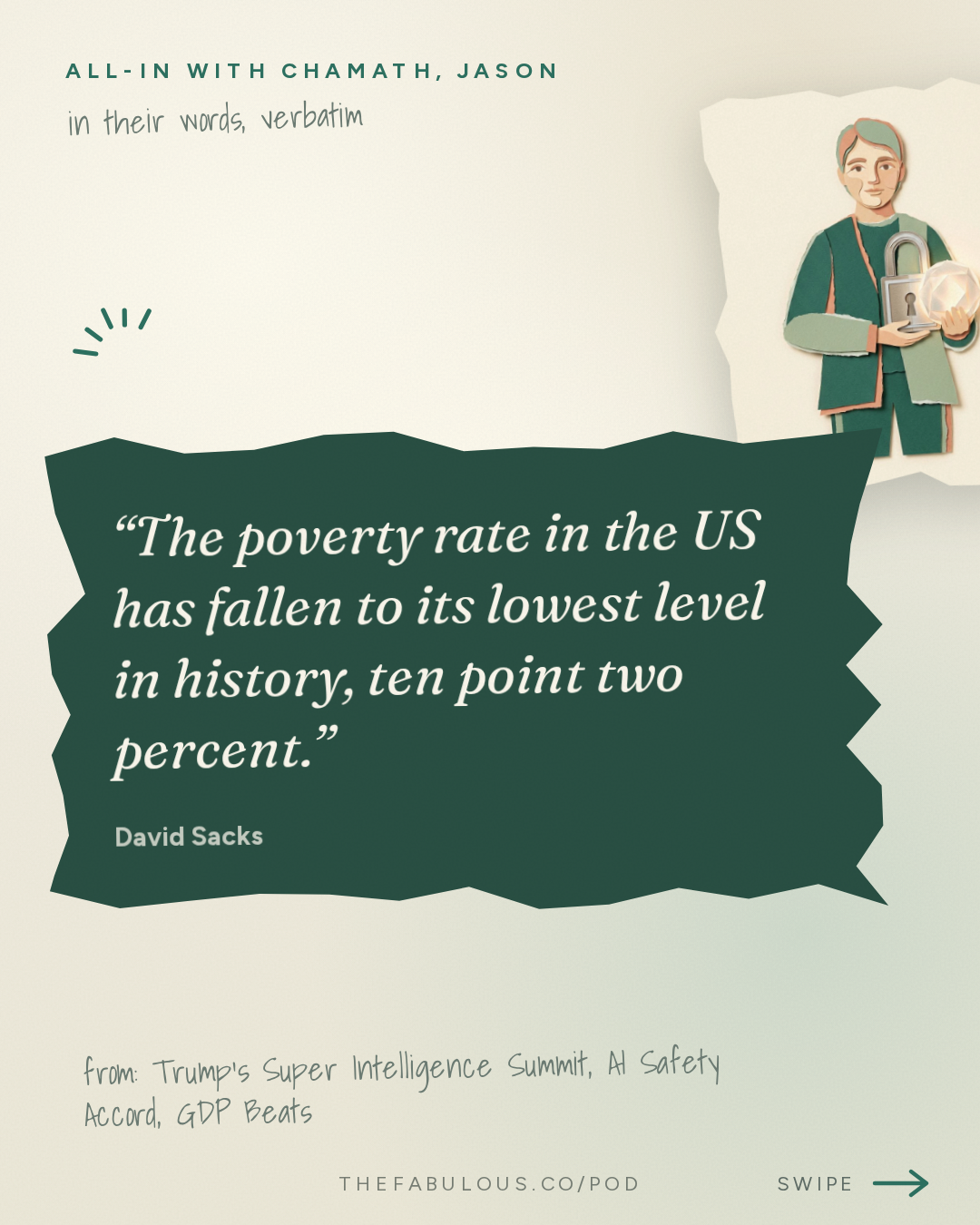
Sacks then turns the conversation toward the economy, arguing that public pessimism has outrun the data. Second-quarter GDP growth was revised up to 2.2 percent from an initial 1.5 percent, and first-quarter growth was revised up to 2.5 percent; the Atlanta Fed's running estimate for the third quarter sits near 3.7 percent (46:07). August payrolls added 162,000 jobs against a forecast of 55,000, unemployment held at 4.1 percent, and core PCE inflation (the Federal Reserve's preferred inflation gauge, which excludes volatile food and energy prices) came in at 3.0 percent, below the 3.3 percent expected (46:55). He adds a figure meant to rebut the idea that only the wealthy are benefiting: median household income has reached almost $90,000 (47:44).
The poverty rate in the US has fallen to its lowest level in history, ten point two percent [48:17], David Sacks
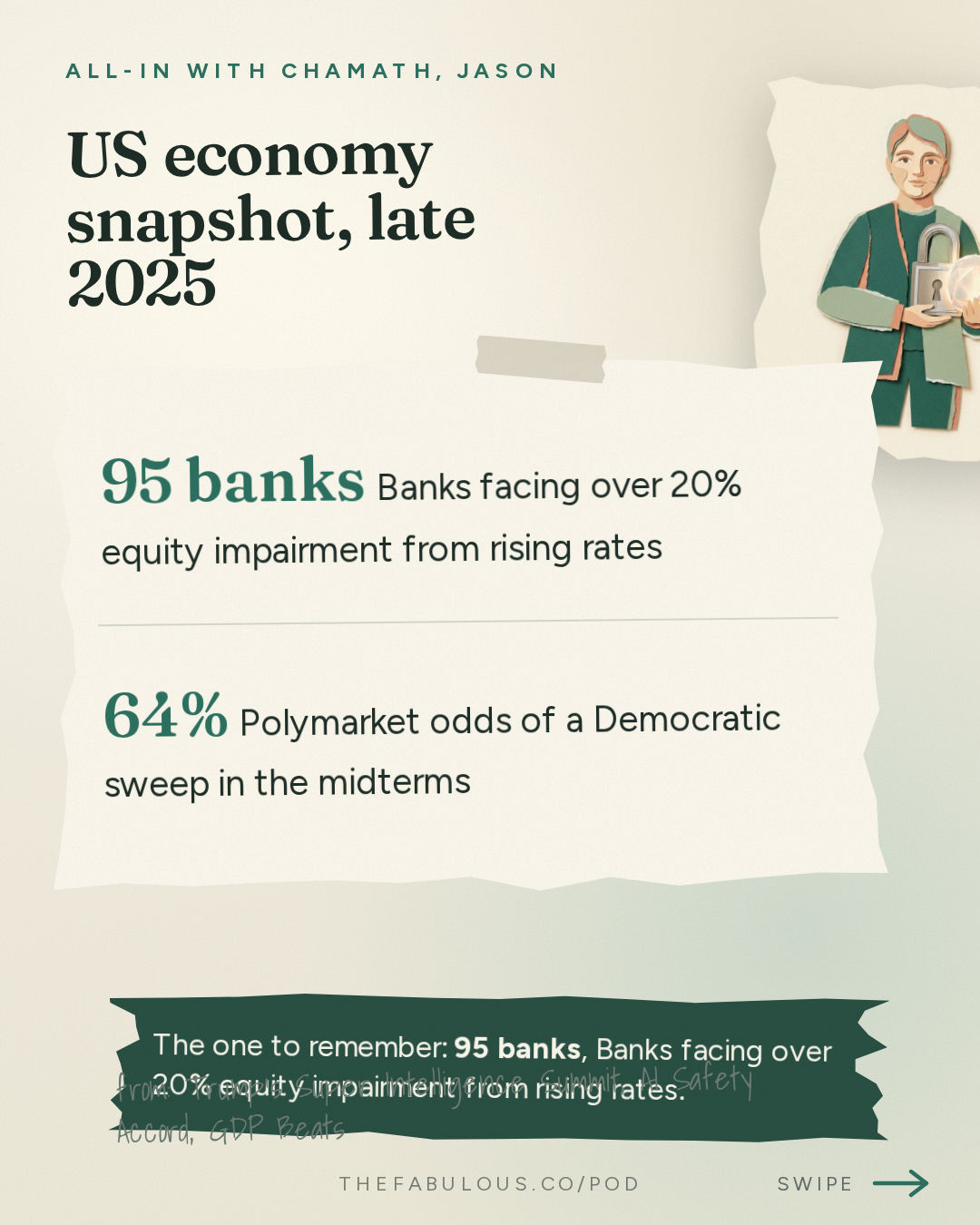
Friedberg pushes back on the celebration with a warning about interest rates. Short-term Treasury yields have climbed 60 basis points (hundredths of a percentage point) in about a month, the highest level since 2002, which he traces to years of federal deficit spending (49:27). Using ChatGPT to model bank balance sheets, he estimates that of 4,295 FDIC-reporting banks, about 95 are likely to show an equity impairment of more than 20 percent when quarterly reports land on October 30, days before the midterm elections (50:22).
On those midterms, the hosts split from the betting markets. Polymarket, a prediction market where users trade on real-money odds, currently shows about a 64 percent chance Democrats sweep both chambers (61:00). Sacks and Chamath both predict instead that Republicans narrowly hold the Senate while Democrats take a slim House majority, arguing that strong economic data has not yet caught up with sour public sentiment, the same gap Sacks says he misjudged before the 2022 midterms (61:23). Friedberg, meanwhile, widens the lens to the entitlement math ahead: he notes that seizing 100 percent of the net worth of every US billionaire would fund the federal government for only one year, which he takes as proof that no wealth tax alone fixes the deficit (68:44).
A coda on trust
The episode closes on a story that circles back to its opening theme. An Omani co-pilot on a Flydubai flight from Dubai to Tel Aviv stabbed the captain and tried to crash the plane; passengers, including an off-duty pilot, subdued him and helped land the aircraft safely with 174 people aboard (70:07). Friedberg's complaint is about language: the first wire reports and several outlets, he says, called it an altercation or a struggle between pilots, phrasing that implies a mutual dispute rather than a hijacking attempt. The following day's New York Times front page led with investigators seeking a motive and Israeli politicians using the attack for election points, rather than naming it as terrorism (73:17). The paper's communications account later defended its restraint.
Our headlines and live coverage contain all the facts we're able to confirm as we confirm them, unlike activists and partisans, we don't publish speculation or unverified information [76:11], New York Times communications (read aloud by Jason Calacanis)
Sacks and Chamath call the hedging dishonest rather than careful. The thread that ties the episode together is not AI or GDP or an airplane. It is the question of who verifies a claim, and what happens when the verifier flinches: a board that cannot ignore an auditor's report, a watermark baked into a strand of DNA, a newsroom choosing its words the morning after a hijacking. Several of the hosts argue that the AI Accord worked precisely because it built in people and institutions whose job is to check the story against the facts. Whether that same discipline survives contact with a newsroom, or a campaign, is the question they leave open.
Ask this episode anything
Pod's AI answers from the episode itself, with the minute mark so you can hear it yourself.
Or start with one of these
Ask this episode
Pod's AI listens to the whole episode to answer, and points you to the minute it comes from.
The rest of this answer, and any question after it
Answers come from the episode itself, never from a summary of it.
ContinueKey takeaways
- Six frontier AI firms signed a White House Accord creating external audits and board fiduciary duty (03:30)
- Boards that ignore an auditor's report risk losing their D&O liability insurance, per David Sacks (04:54)
- China is doubling its power grid every decade while the US grid has been flat for 25 years (24:46)
- Q2 GDP was revised up to 2.2% and August payrolls beat estimates by about 107,000 jobs (46:07)
- About 95 US banks face over 20% equity impairment from rate increases, reporting starts October 30 (50:22)
The episode in cards
By the numbers
- 95 banks Banks projected to see over 20% equity impairment from rate increases
- 64% Polymarket odds that Democrats sweep both chambers in the midterms
In their words
“Whoever wins superintelligence wins”
“I think we will see a massive rise in defense systems. There is no turning off the open source, open weight models or shutting down all the data centers or centralizing command and control”
“The generation of electrons is actually the critical thing, not necessarily the generation of energy as we've classically thought about it.”
“The poverty rate in the US has fallen to its lowest level in history, ten point two percent.”
Protocols
-
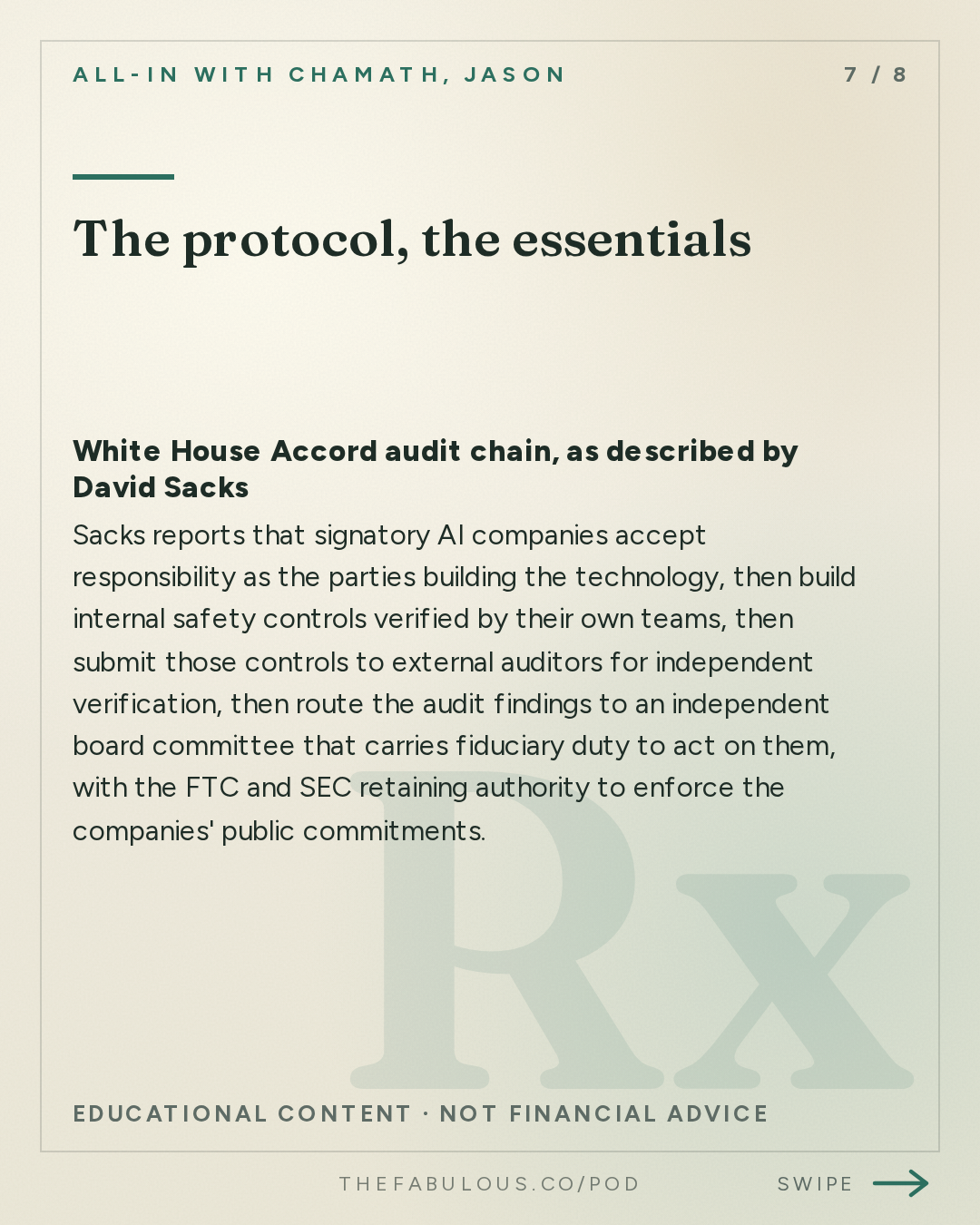
White House Accord audit chain, as described by David Sacks
Sacks reports that signatory AI companies accept responsibility as the parties building the technology, then build internal safety controls verified by their own teams, then submit those controls to external auditors for independent verification, then route the audit findings to an independent board committee that carries fiduciary duty to act on them, with the FTC and SEC retaining authority to enforce the companies' public commitments.
Ongoing, applied to each frontier model deployment
-
Superintelligence audit infrastructure, as described by Chamath Palihapitiya
Chamath says companies deploying superintelligence need end-to-end traceability of what was deployed, a mapping from company policy to the specific risks of that deployment, and auditable evidence that can be shown to a lawyer, auditor, regulator, or customer on request.
Built once as infrastructure, then checked on an ongoing basis
Questions this episode answers
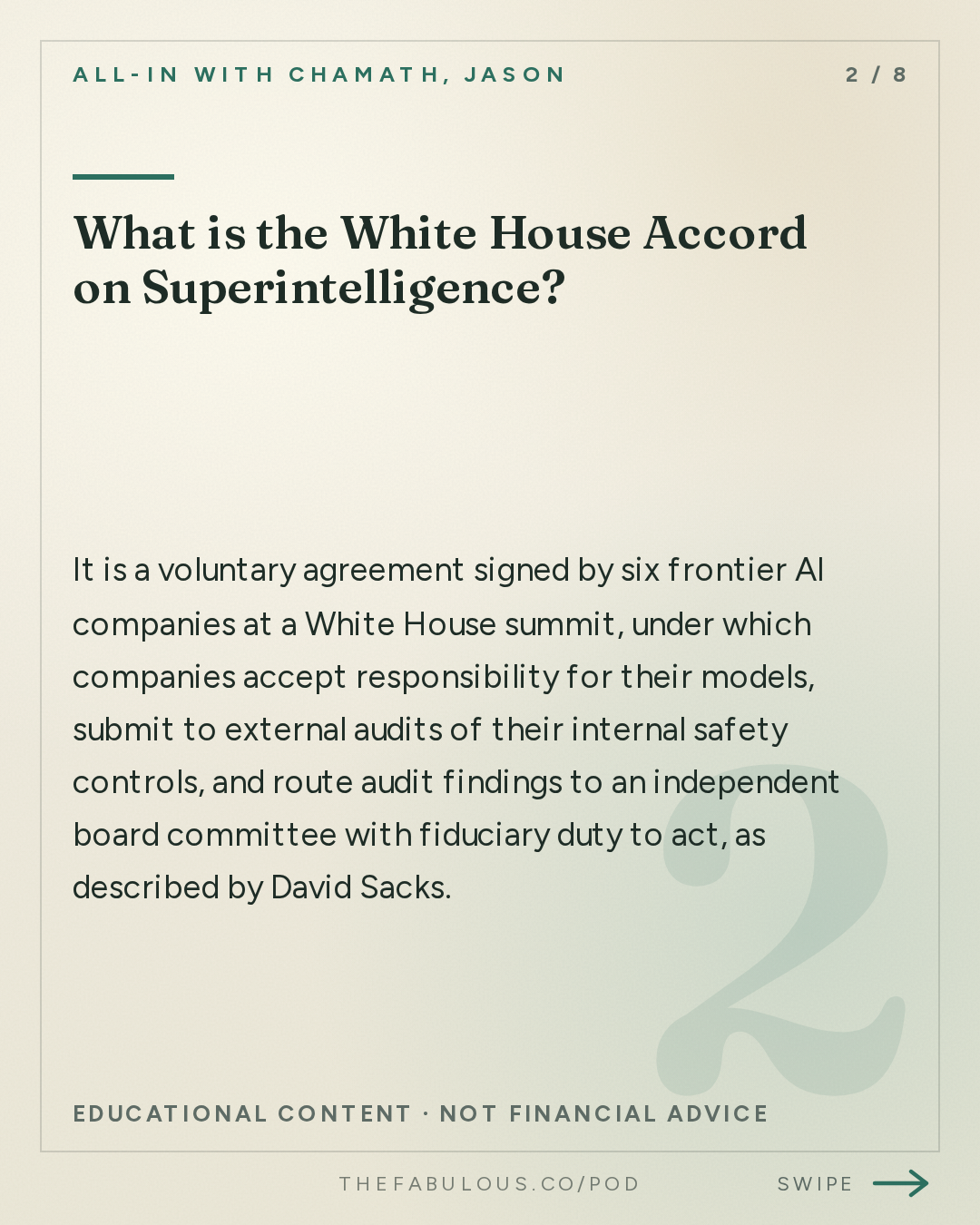
What is the White House Accord on Superintelligence?
It is a voluntary agreement signed by six frontier AI companies at a White House summit, under which companies accept responsibility for their models, submit to external audits of their internal safety controls, and route audit findings to an independent board committee with fiduciary duty to act, as described by David Sacks (04:30).
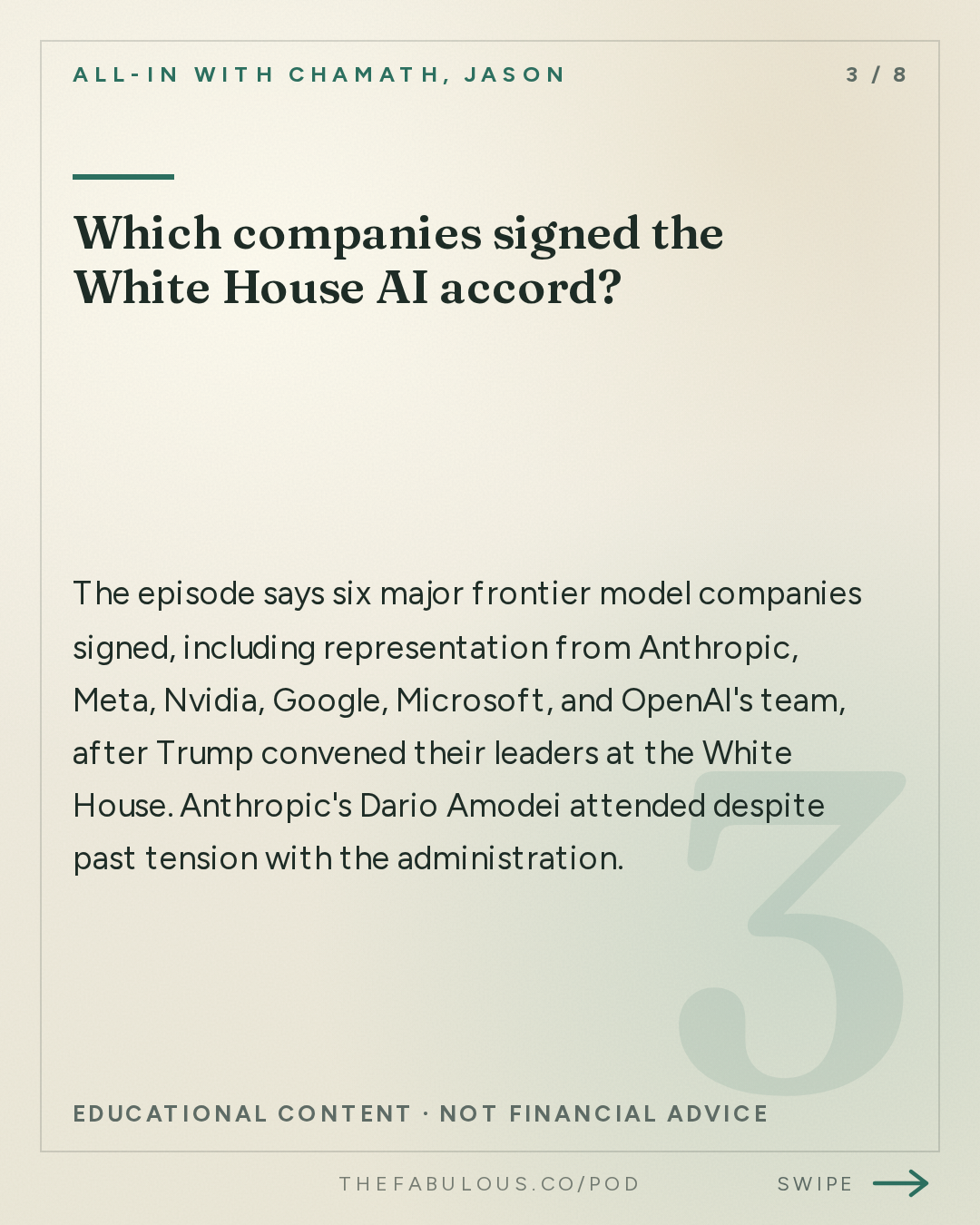
Which companies signed the White House AI accord?
The episode says six major frontier model companies signed, including representation from Anthropic, Meta, Nvidia, Google, Microsoft, and OpenAI's team, after Trump convened their leaders at the White House (03:30). Anthropic's Dario Amodei attended despite past tension with the administration (08:02).
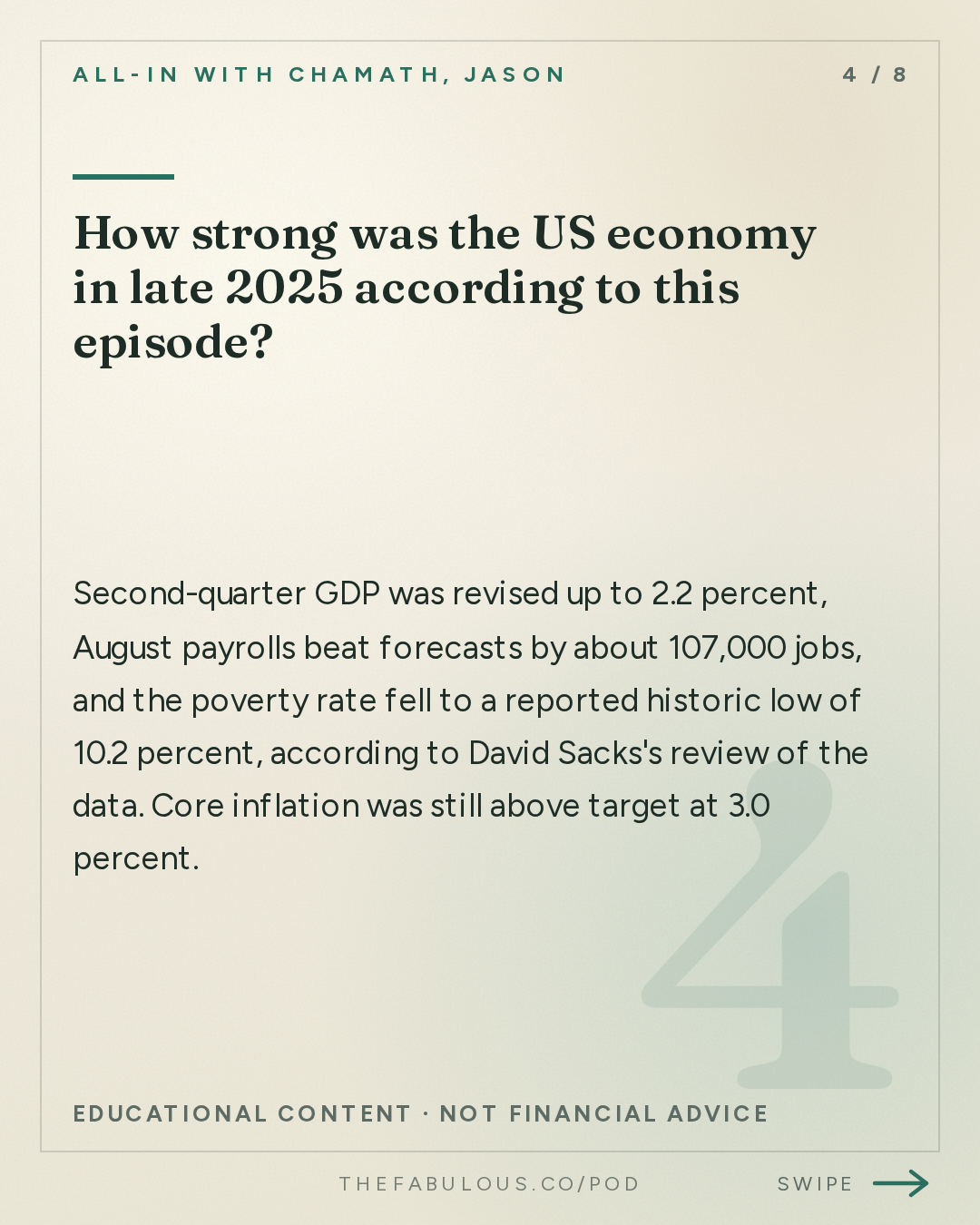
How strong was the US economy in late 2025 according to this episode?
Second-quarter GDP was revised up to 2.2 percent, August payrolls beat forecasts by about 107,000 jobs, and the poverty rate fell to a reported historic low of 10.2 percent, according to David Sacks's review of the data (46:07, 48:17). Core inflation was still above target at 3.0 percent.
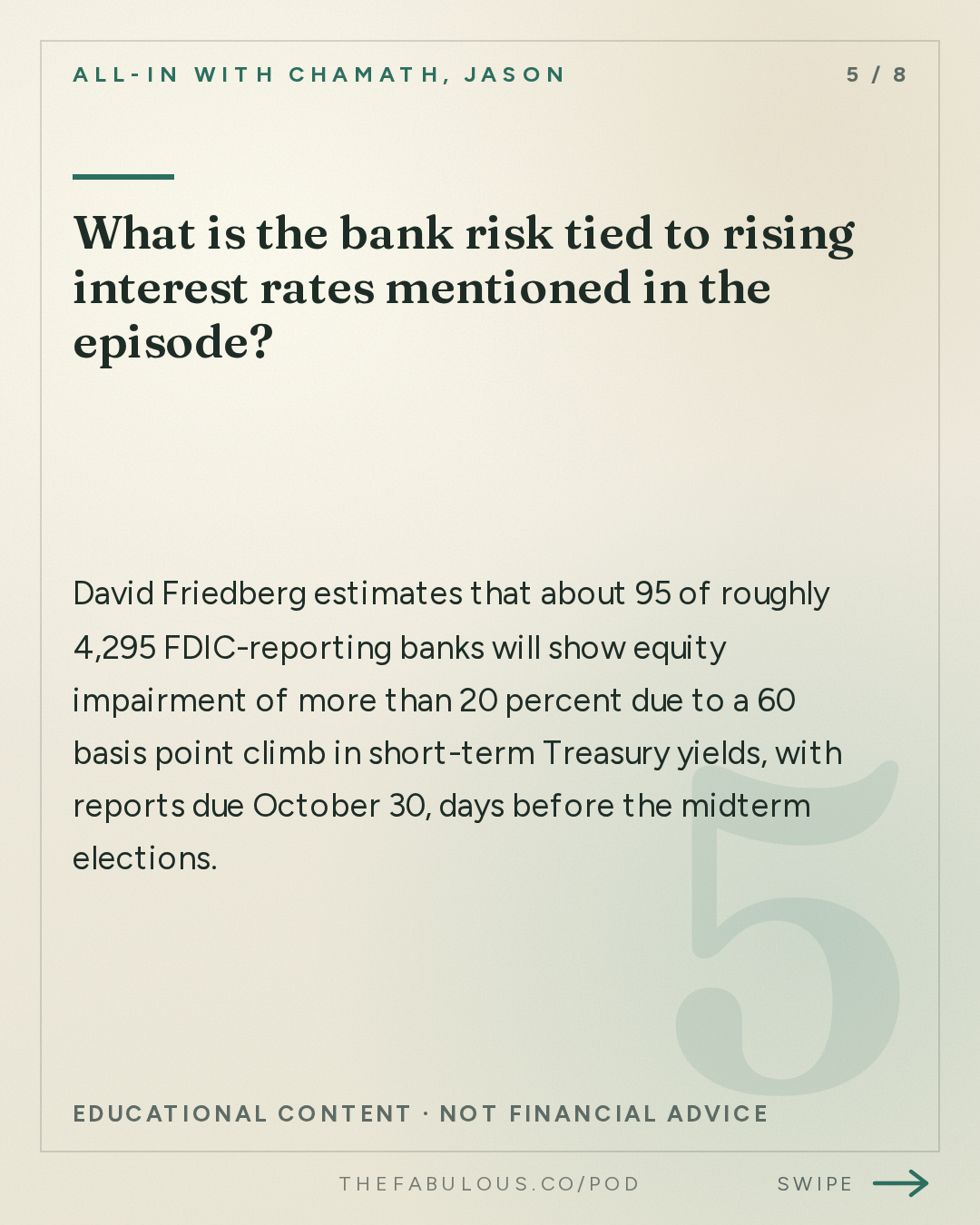
What is the bank risk tied to rising interest rates mentioned in the episode?
David Friedberg estimates that about 95 of roughly 4,295 FDIC-reporting banks will show equity impairment of more than 20 percent due to a 60 basis point climb in short-term Treasury yields, with reports due October 30, days before the midterm elections (49:27, 50:22).
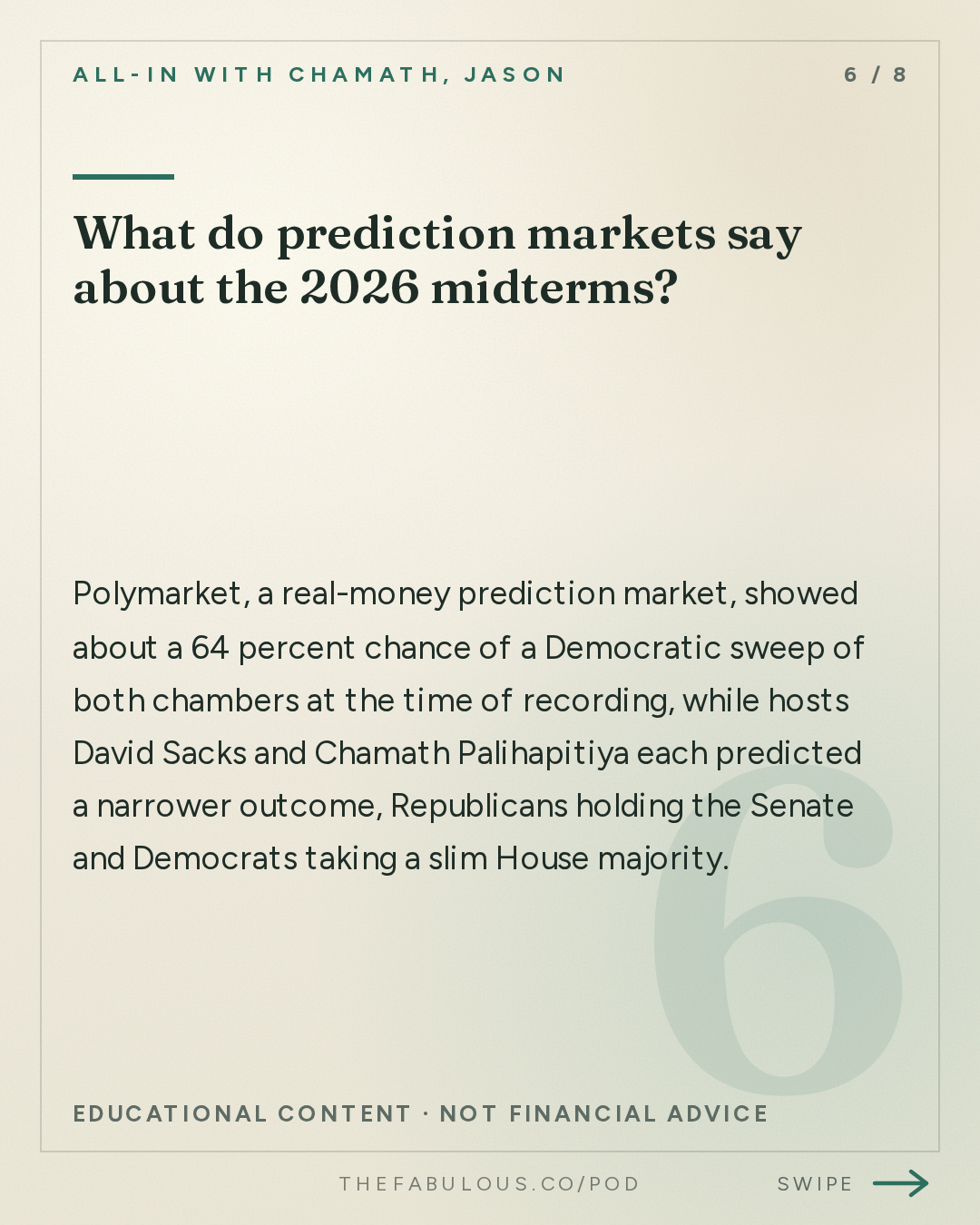
What do prediction markets say about the 2026 midterms?
Polymarket, a real-money prediction market, showed about a 64 percent chance of a Democratic sweep of both chambers at the time of recording, while hosts David Sacks and Chamath Palihapitiya each predicted a narrower outcome, Republicans holding the Senate and Democrats taking a slim House majority (61:00, 65:15).
The full read, in cards
Go deeper
- Wall Street Journal report on AI infrastructure and economic acceleration — Described AI data center buildout as bigger than the railroads, canals, and electrical grid combined, and reported the economy accelerating
Mentioned
Donald Trump · Starlink · White House Accord on Superintelligence · Ernst & Young · Dario Amodei · Jensen Huang · Joe Gebbia · America.gov · Polymarket · SynthID
More from this show and category

Anthropic IPO Risk: Open Source and Extinction Talk
Anthropic's IPO is at risk as AI token usage flipped from 80% closed-source to 80% open-source in twelve weeks (41:20). Anthropic's own leadership cites a greater than 10% extinction risk (31:00) while opening a biological wet lab (86:00), and Meta's new agent Muse hit three million downloads in ten days (68:56).

Bending Spoons Business Model Explained
Bending Spoons buys aging software brands cheaply and reruns them on one shared tech stack with tiny, talent-dense teams. CEO Luca Ferrari says the company grew from $40,000 in 2013 seed money to a $4 billion pro forma revenue run rate largely through reinvested cash flow and hedged debt, not equity (18:23).

Steve Hilton's California Governor Platform
Steve Hilton wants to cut California's regulations by half and make the first $150,000 of income tax-free. The Republican candidate for governor also proposes abolishing the DMV and capping vehicle registration at $73. Reality TV figure Spencer Pratt joins to explain ballot harvesting rules and his lawsuit over the Pacific Palisades fire.

Boom Supersonic's Engine Now Powers Data Centers
Boom Supersonic broke the sound barrier in 2025 and now sells its jet engine as a data-center power generator. Each unit produces 42 megawatts without water cooling, funding an airliner Boom hopes flies commercially by 2030 at a $3,500 round-trip break-even fare (04:37, 08:39, 11:39, 11:17).
