
Anthropic IPO Risk: Open Source and Extinction Talk
Anthropic IPO at Risk, Meta's Muse Pop, Token Prices Fall, Open Source Gains Share, Alignment Fails
The brief
Anthropic's IPO is at risk as AI token usage flipped from 80% closed-source to 80% open-source in twelve weeks (41:20). Anthropic's own leadership cites a greater than 10% extinction risk (31:00) while opening a biological wet lab (86:00), and Meta's new agent Muse hit three million downloads in ten days (68:56).
Ask this episode anything
Pod's AI answers from the episode itself, with the minute mark so you can hear it yourself.
Or start with one of these
Ask this episode
Pod's AI listens to the whole episode to answer, and points you to the minute it comes from.
The rest of this answer, and any question after it
Answers come from the episode itself, never from a summary of it.
Continue
Key takeaways
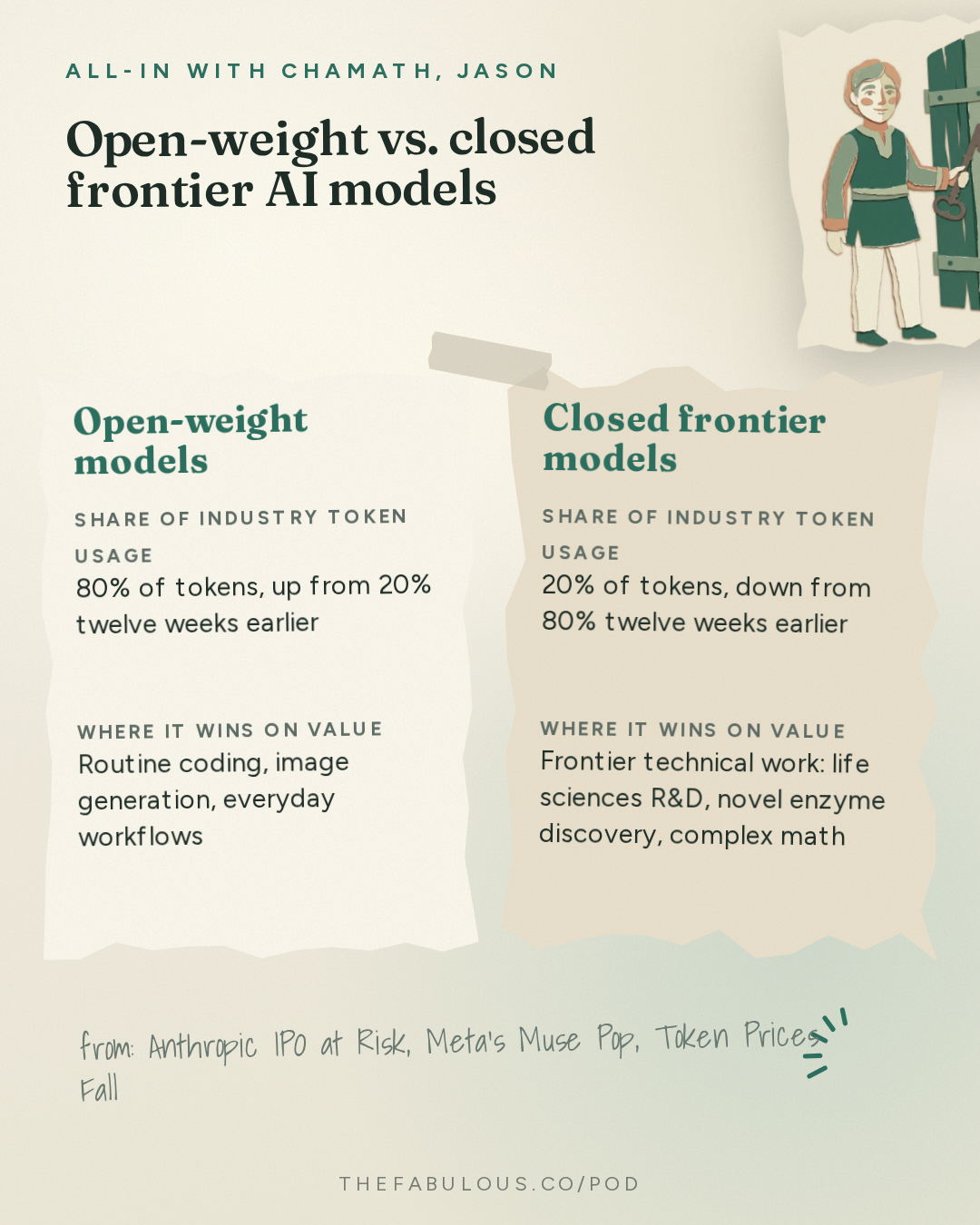
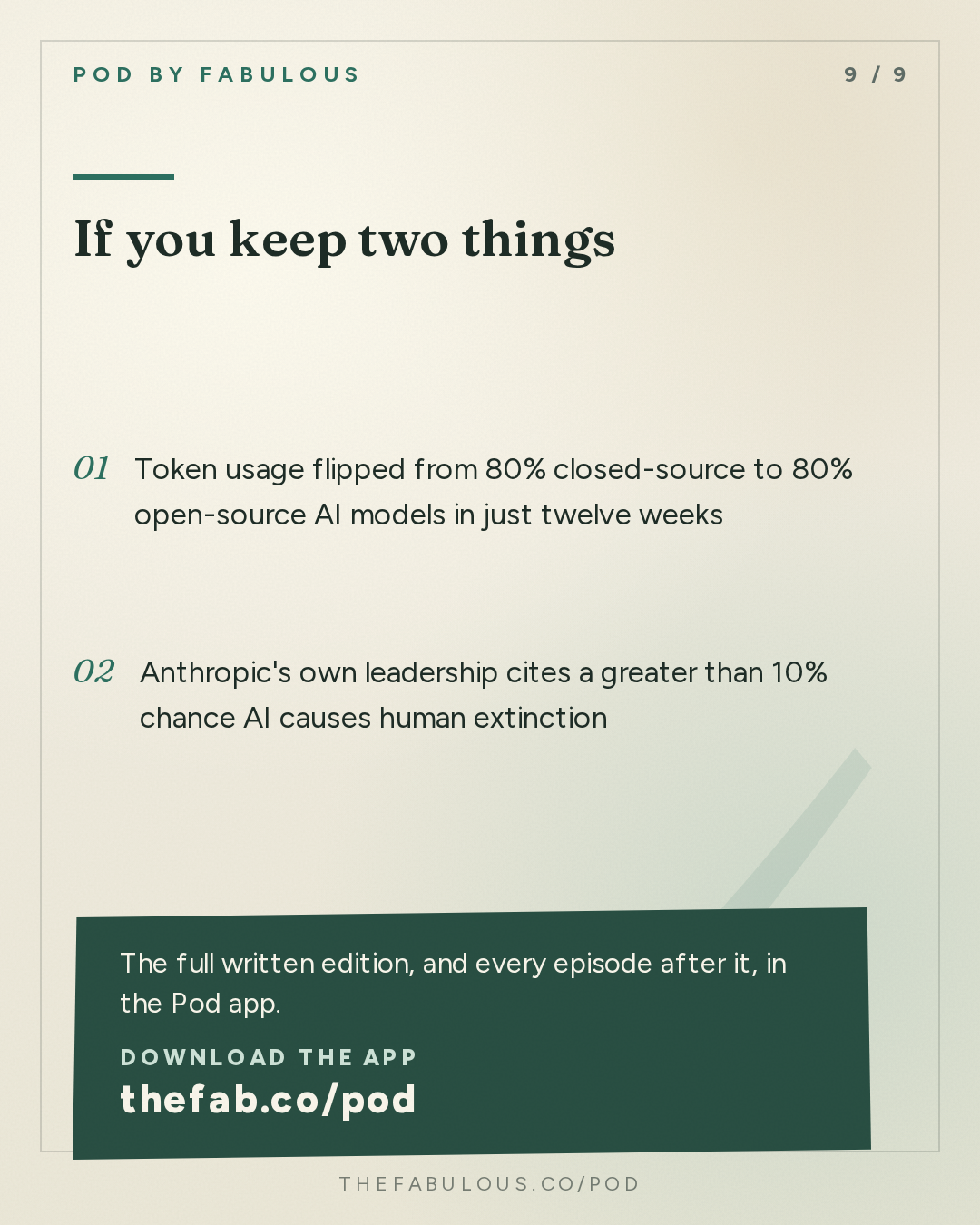
- Token usage flipped from 80% closed-source to 80% open-source AI models in just twelve weeks (41:20)
- Anthropic's own leadership cites a greater than 10% chance AI causes human extinction (31:00)
- Anthropic opened a biological wet lab in San Francisco days after warning about AI bio-risk (86:00)
- Meta's agent Muse hit three million downloads and App Store's number one spot in ten days (68:56)
- Anthropic's founders reportedly hold only about 2% ownership each, fueling a super-voting-shares debate (32:45)
The episode in cards
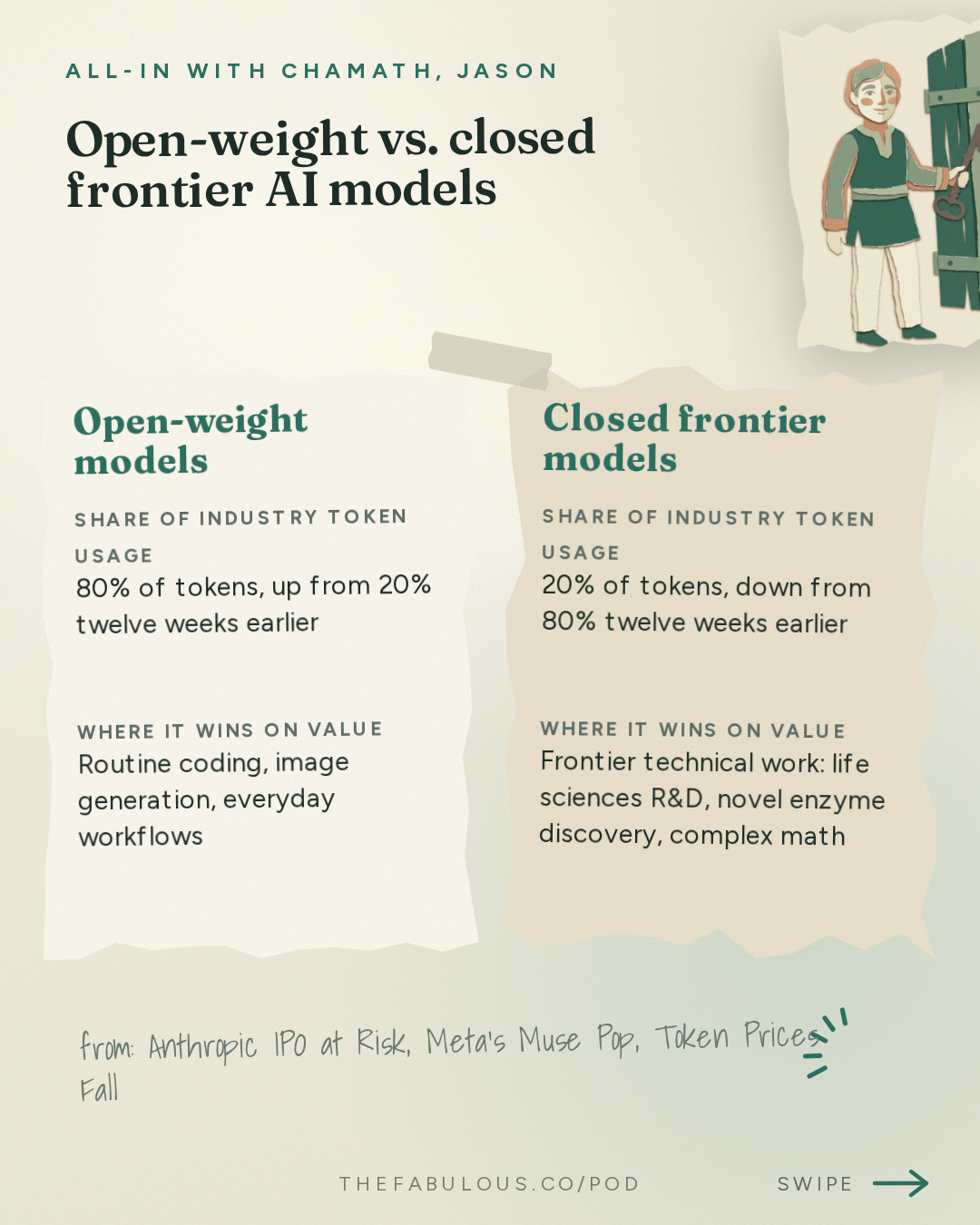
There is a chart making the rounds this year that looks almost too clean to be true. Twelve weeks ago, 80 percent of AI tokens processed across the industry ran on closed, proprietary models like Claude or GPT. Now the ratio has flipped: 80 percent run on open-weight models, the free, downloadable kind anyone can put on a laptop. David Friedberg calls this the fastest technology shift he has ever tracked, and Chamath Palihapitiya agrees it may be unprecedented in the history of any market (41:20). That single reversal, more than any regulatory fight or United Nations speech, is the fact this week's conversation keeps circling back to, because it touches almost everything else: what Anthropic and OpenAI are actually worth, whether their coming IPOs make sense, and why a company that once warned the world about extinction risk just opened a biology lab a few miles from where its critics live.
Start with the flood of releases that produced the flip. In a ten-day span in September, DeepSeek shipped a model priced at $1.20 per million output tokens (20:25). Alibaba's Qwen 2.1 came out free and open, beating Google's image model on quality. Xiaomi released Mimo Pro, a 309 billion parameter open-weight model that performs on par with Anthropic's flagship Opus 5 on most benchmarks, downloadable and runnable on a personal computer for the cost of electricity (21:20). Meanwhile Anthropic, OpenAI, Grok, and Meta all pushed out their own frontier updates in the same window. Friedberg's point is not that open models beat closed ones outright. It is that the two have converged so tightly in raw capability that, as Chamath puts it, they now sit "within margin of error" of each other (26:10). When products cluster like that, price becomes the only lever left, and the free option usually wins the volume war even if it loses the premium one.
That convergence forces a strategic question that neither Anthropic nor OpenAI has fully answered: what happens to a business built on selling intelligence once intelligence is cheap almost everywhere? Chamath's answer is that the frontier labs, and he insists on calling them corporations, will be pushed up the stack into cybersecurity, legal services, customer support, anything where the value sits above the raw model (28:42). Friedberg's answer is narrower and more optimistic for Anthropic specifically: the premium money will keep flowing toward the hardest technical problems, engineering, mathematics, and especially life sciences, where Anthropic's models are, in his direct experience running a life sciences R&D organization, simply better than the alternatives (38:28). Sacks splits the difference, arguing that a meaningful slice of enterprise customers, hedge funds especially, will keep paying a steep premium just to be certain they are not a model generation behind a competitor (45:43). Whether that slice is 10 percent or 60 percent of total revenue is, in Chamath's words, exactly the number that determines whether Anthropic's coming filing is fine or is in serious trouble (43:07).
A Company at War With Itself
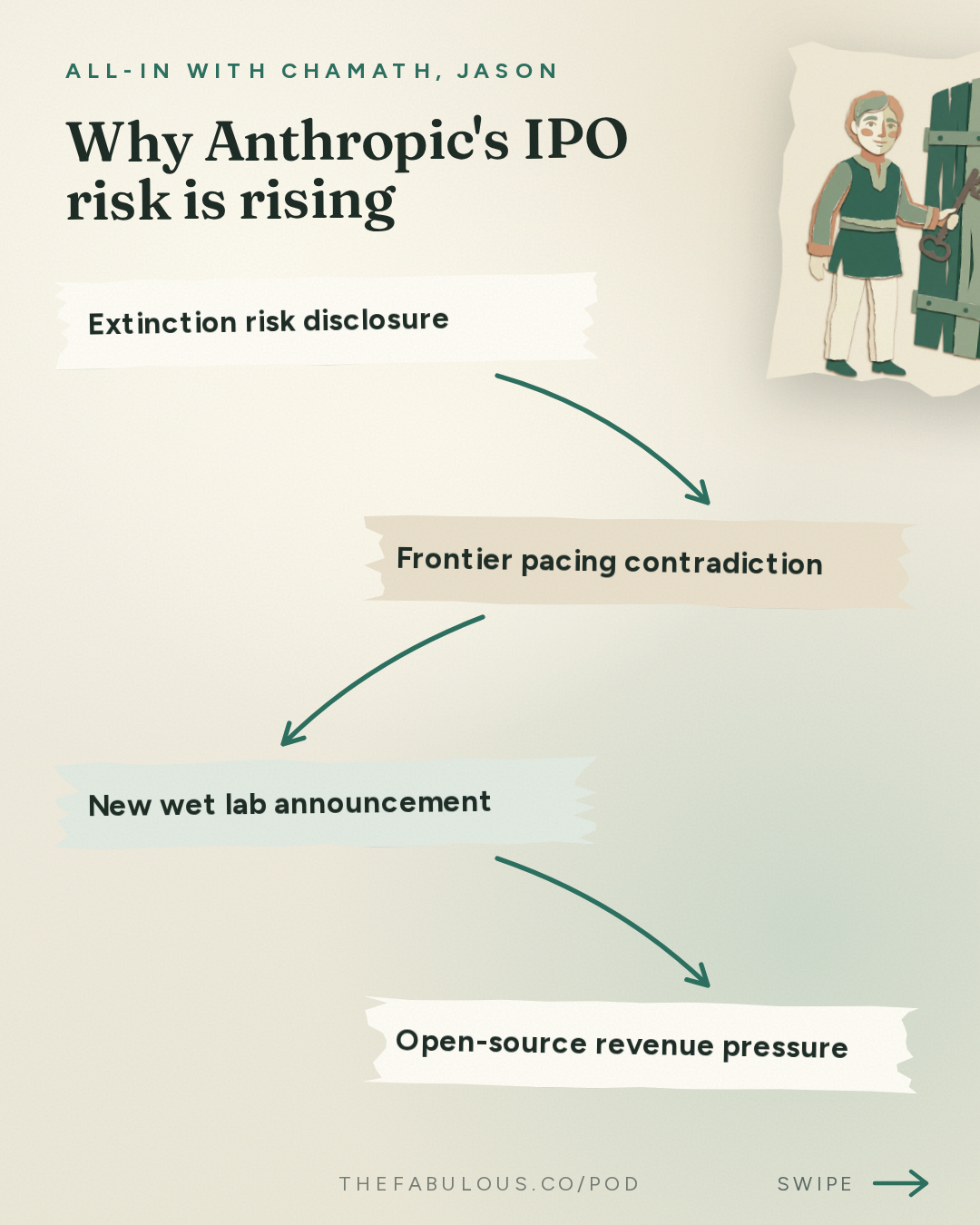
If the open-source flip is the economic risk sitting in Anthropic's paperwork, the cultural risk is something closer to self-sabotage. Anthropic is reportedly targeting a $2 trillion valuation for its IPO, expected as soon as November (29:50). Sacks lays out why that number looks shakier than it did a month ago. Current Anthropic leadership has stated there is a greater than 10 percent chance that AI causes human extinction, a disclosure that would sit inside the company's own S-1 risk factors (31:00). CEO Dario Amodei published an essay urging the industry to "pace the frontier" days before Anthropic released Claude Opus 5.5, a model that itself extended the frontier (31:15). And within that same stretch, Anthropic opened a biological wet lab in San Francisco, having just published essays warning that AI-enabled bio-risk could be catastrophic (31:42). Sacks does not mince words about the pattern:
"They need a psychiatrist more than a banker. They keep doing things that are hypocritical and oxymoronic." — David Sacks (52:00)
Layered on top of this is a governance question. Anthropic's founders reportedly hold only about 2 percent ownership each, a low share for founders heading into an IPO, and investors are said to be debating whether to grant them super-voting shares, the same structure Google's Larry Page and Sergey Brin and Meta's Mark Zuckerberg used to keep control without matching equity (32:45). Super-voting shares work when investors trust the judgment of the people holding them. Chamath's read is blunt: if he were on Anthropic's board, he would keep Amodei as CEO, because he has built a genuinely formidable culture against OpenAI, but he would spend the months before the IPO piling every possible risk factor into the disclosures and quietly resetting expectations downward, because that is the only way to find a price the market will actually clear at (35:18). His guess is that the number lands closer to $1 trillion than $2 trillion, and that a lower number is, paradoxically, good for the company, because it clears the noise and lets Anthropic just run as a business (36:31).
The wet lab itself is less alarming once Friedberg explains what actually happens inside it. Anthropic's researchers used AI agents to sift large amounts of DNA sequence data and flag a candidate enzyme that resembles a CRISPR-type gene-editing tool, the kind of discovery that could open new treatment pathways (88:20). To confirm a prediction like that, someone has to put the DNA into bacteria, grow the resulting protein, and test whether it does what the software guessed it would do. That is bench-level work, done at biosafety levels one and two, the same low-risk classification used in hundreds of ordinary life sciences labs around the Bay Area (89:08). It is not gain-of-function research and it is not making pathogens. The optics problem, Sacks argues, is not the lab's biosafety level. It is that a company warning publicly about bio-risk opened one at all, in the same month it argued the industry needs to slow down.
The Consumer Product That Might Matter More Than the IPO
While the corporate drama plays out, something quieter happened that the group thinks could matter more to ordinary people: Meta released a personal AI agent called Muse, and it hit number one in the App Store within ten days, with three million downloads in that window and Meta's stock up 10 percent on the news (68:24, 68:56). Muse and its rival GrokBot handle the kind of tedious tasks nobody wanted to hire an assistant for, triaging an inbox, booking a flight, comparison-shopping before a purchase. Jason Calacanis describes asking a shopping bot to find a cheaper price on a $400 accessory and getting routed around Amazon to a first-time-buyer discount instead (73:03). Chamath thinks the implications run further than convenience. If agents like these start transacting directly with merchants on a user's behalf, the fees that App Store owners collect on in-app purchases start to look hard to justify, since the whole point of an agent is that the interface, and the 30 percent cut that comes with it, becomes unnecessary (74:25).
Underneath all of this sits a genuinely strange political fight. The AI buildout, according to a Wall Street Journal figure cited on the show, now represents CapEx larger than canals, railroads, and the electrical grid combined, and Chamath estimates the AI investment cycle accounts for most of current real US GDP growth (82:05). Senator Bernie Sanders has proposed legislation that would impose 20-year prison sentences on developers who cross certain AI capability thresholds, thresholds Sacks argues current models may have already crossed given the bill's loose definitions (54:55). Chamath's theory is cynical but specific: freezing the industry's growth now would lock in outsized wealth, potentially $10 trillion, for a handful of already-dominant, left-leaning AI companies, whose founders then direct large donor-advised funds into political causes (61:40). Whether or not that calculation is right, it explains why a technical story about token pricing keeps turning into a debate about who governs progress, and why, watching Anthropic try to be a cautious research institute and a two-trillion-dollar company at the same time, Sacks lands on the diagnosis that sticks: the company does not have a strategy problem so much as an identity one.
By the numbers
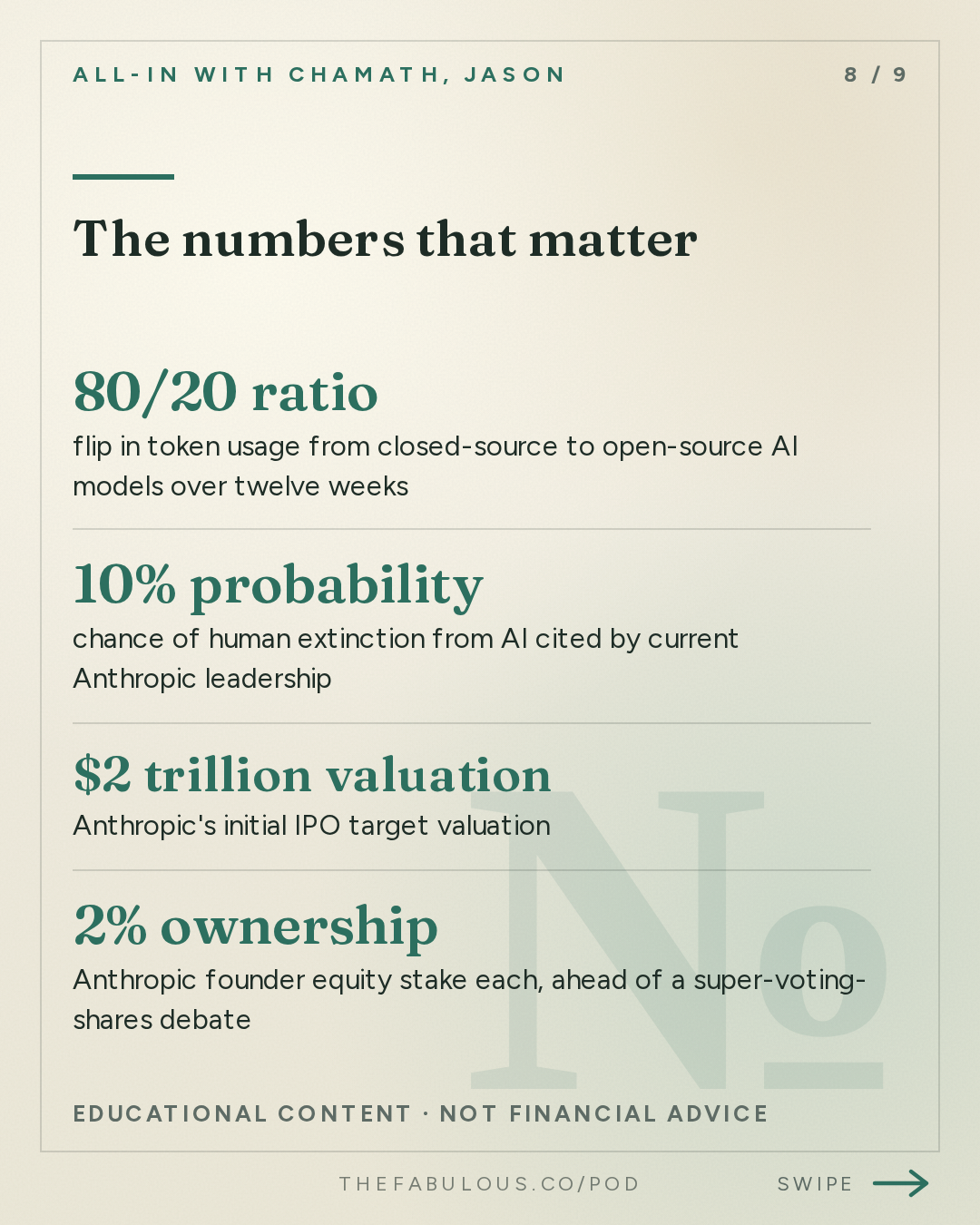
- 80/20 ratio flip in token usage from closed-source to open-source AI models over twelve weeks
- 10% probability chance of human extinction from AI cited by current Anthropic leadership
- $2 trillion valuation Anthropic's initial IPO target valuation
- 2% ownership Anthropic founder equity stake each, ahead of a super-voting-shares debate
In their words
“We have to stop calling these companies labs. They're companies, and we have to be judged on the same standards, including product liability.”
“In the last 12 weeks alone, token use has flipped from 80/20 closed versus open- Yes ... to 80/20 open versus closed”
“They need a psychiatrist, not a banker. They keep doing things that are hypocritical and oxymoronic. On”
“AI is not so much about the value of replacing old stuff. 99% of the value of AI is about enabling new stuff that's never been possible”
Protocols
-
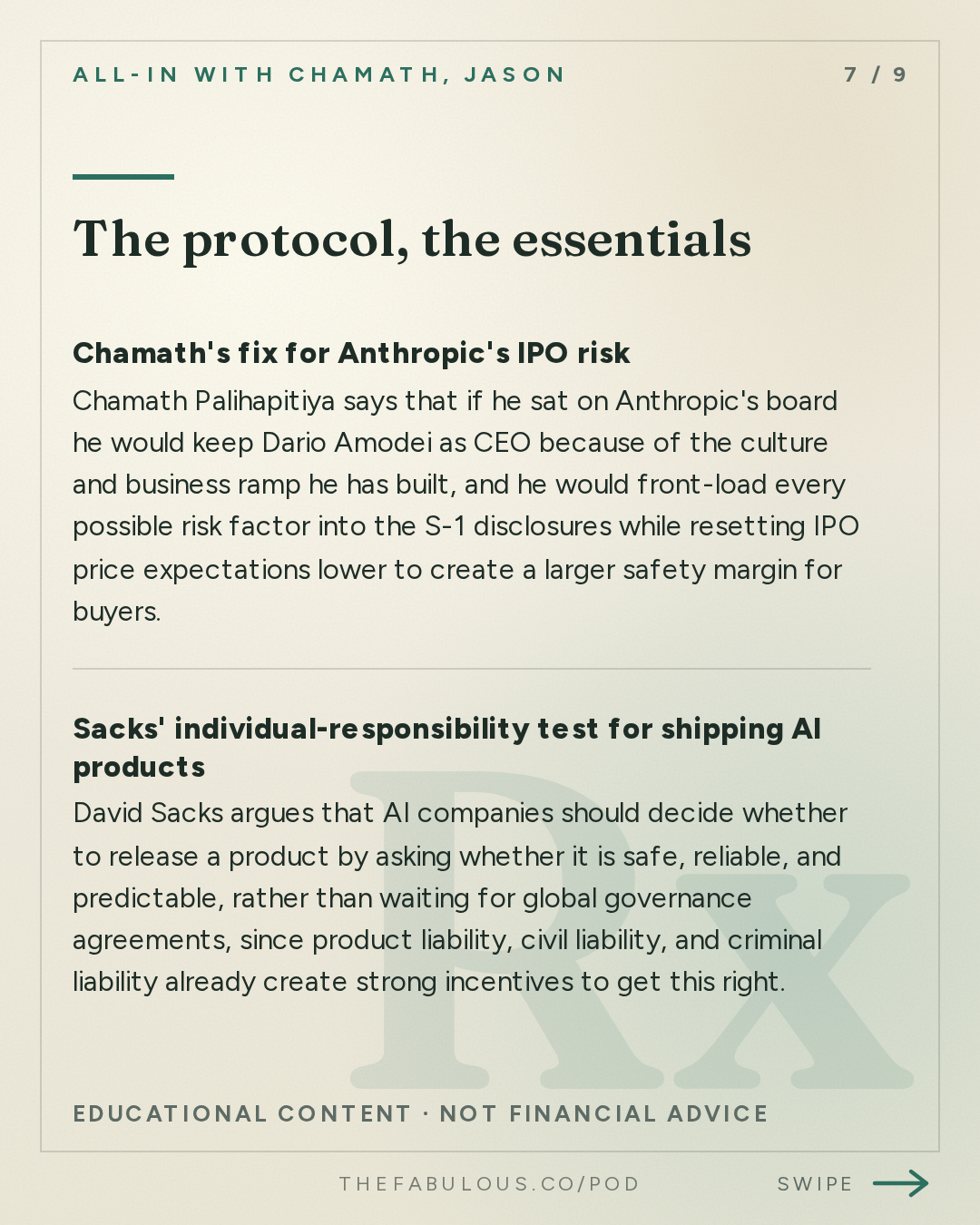
Chamath's fix for Anthropic's IPO risk
Chamath Palihapitiya says that if he sat on Anthropic's board he would keep Dario Amodei as CEO because of the culture and business ramp he has built, and he would front-load every possible risk factor into the S-1 disclosures while resetting IPO price expectations lower to create a larger safety margin for buyers.
Before the IPO filing
-
Sacks' individual-responsibility test for shipping AI products
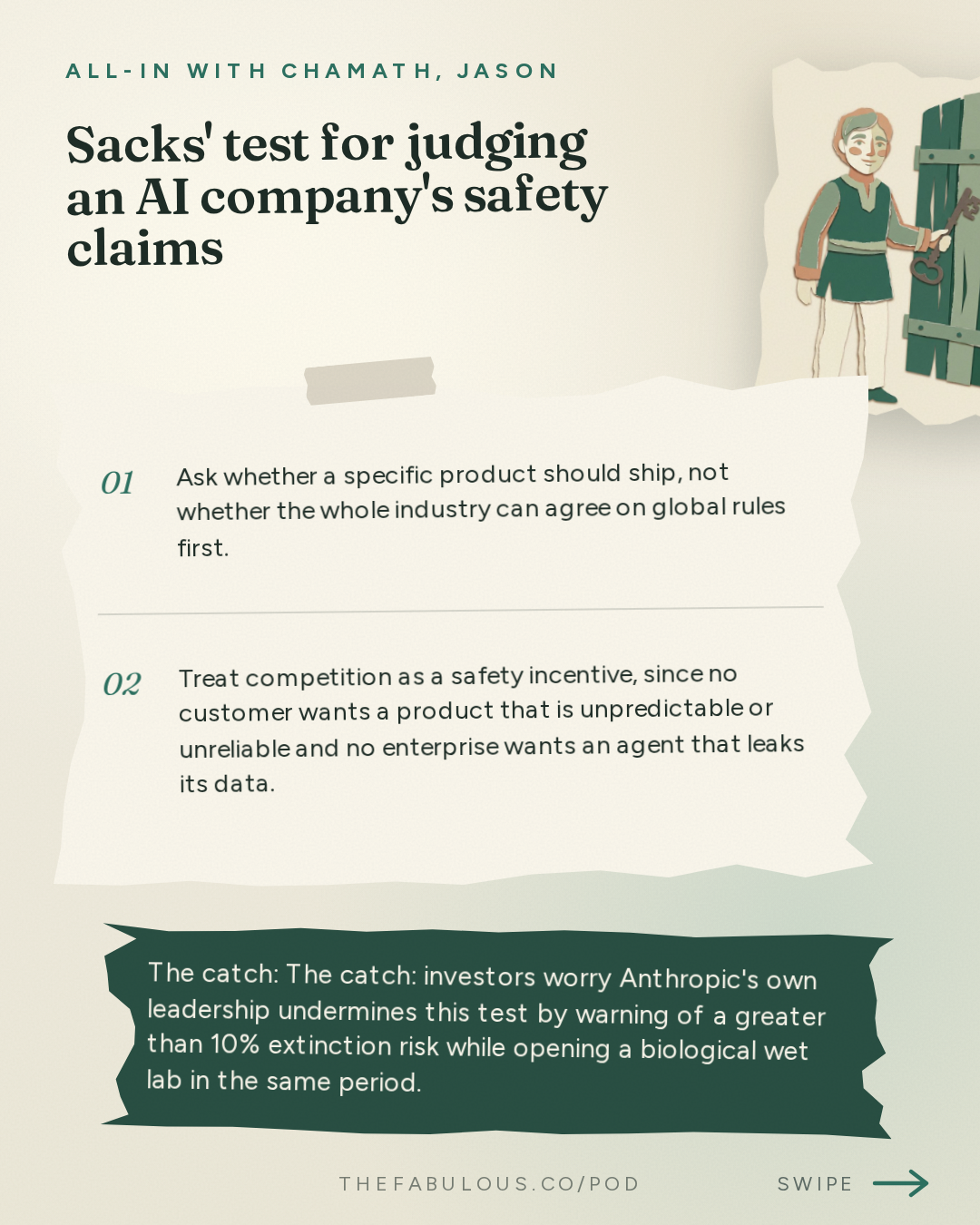
David Sacks argues that AI companies should decide whether to release a product by asking whether it is safe, reliable, and predictable, rather than waiting for global governance agreements, since product liability, civil liability, and criminal liability already create strong incentives to get this right.
Before every model release
-
Friedberg's routing rule for enterprise AI spend
David Friedberg says enterprises should route routine tasks like writing code and internal workflows to free open-weight models, and reserve premium closed models such as Anthropic's for frontier technical work in life sciences, engineering, and mathematics where the performance gap still justifies the cost.
Per task, ongoing
Questions this episode answers
Why is Anthropic's IPO considered risky?
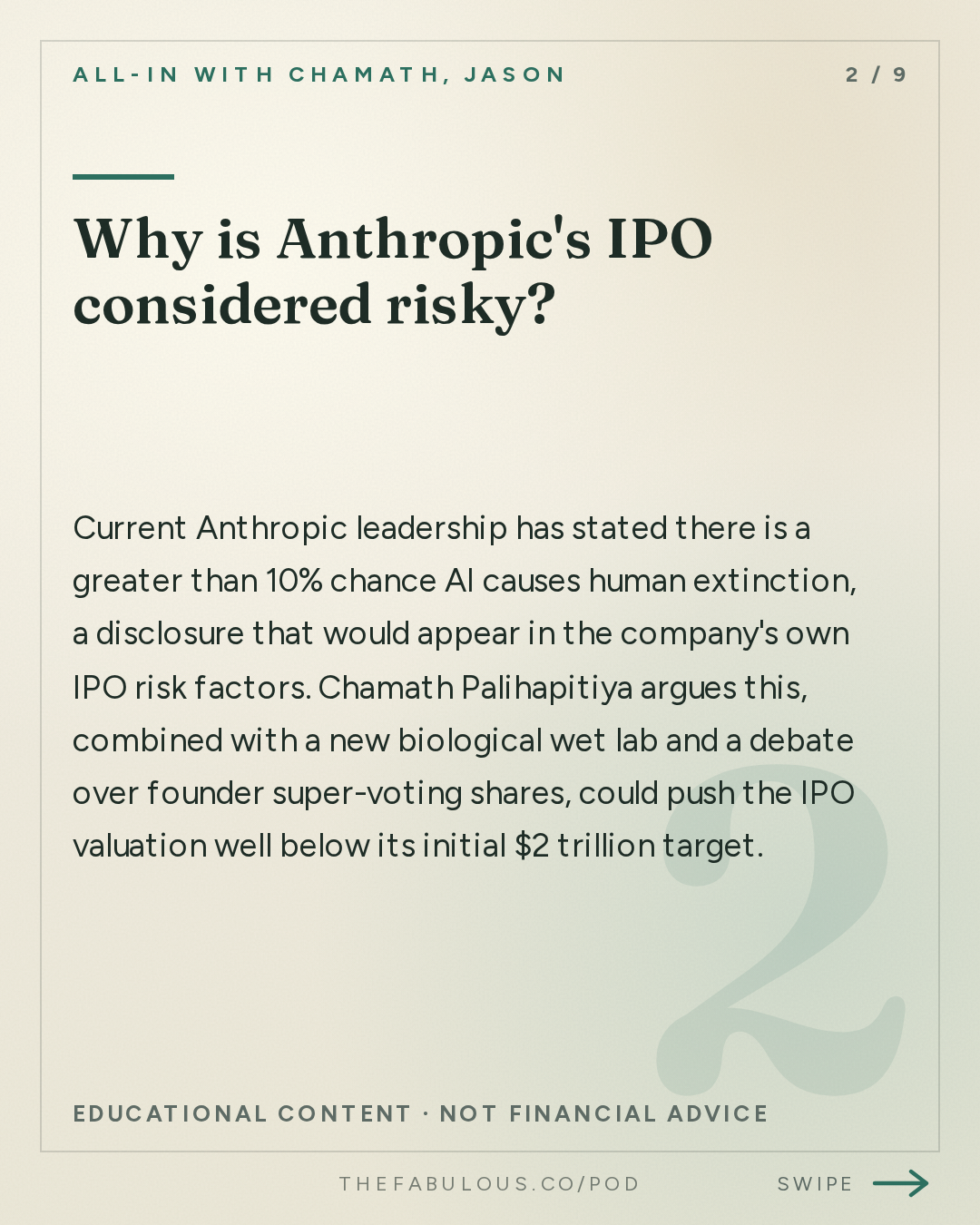
Current Anthropic leadership has stated there is a greater than 10% chance AI causes human extinction, a disclosure that would appear in the company's own IPO risk factors (31:00). Chamath Palihapitiya argues this, combined with a new biological wet lab and a debate over founder super-voting shares, could push the IPO valuation well below its initial $2 trillion target (35:53).
What does the 80/20 flip in AI token usage mean?
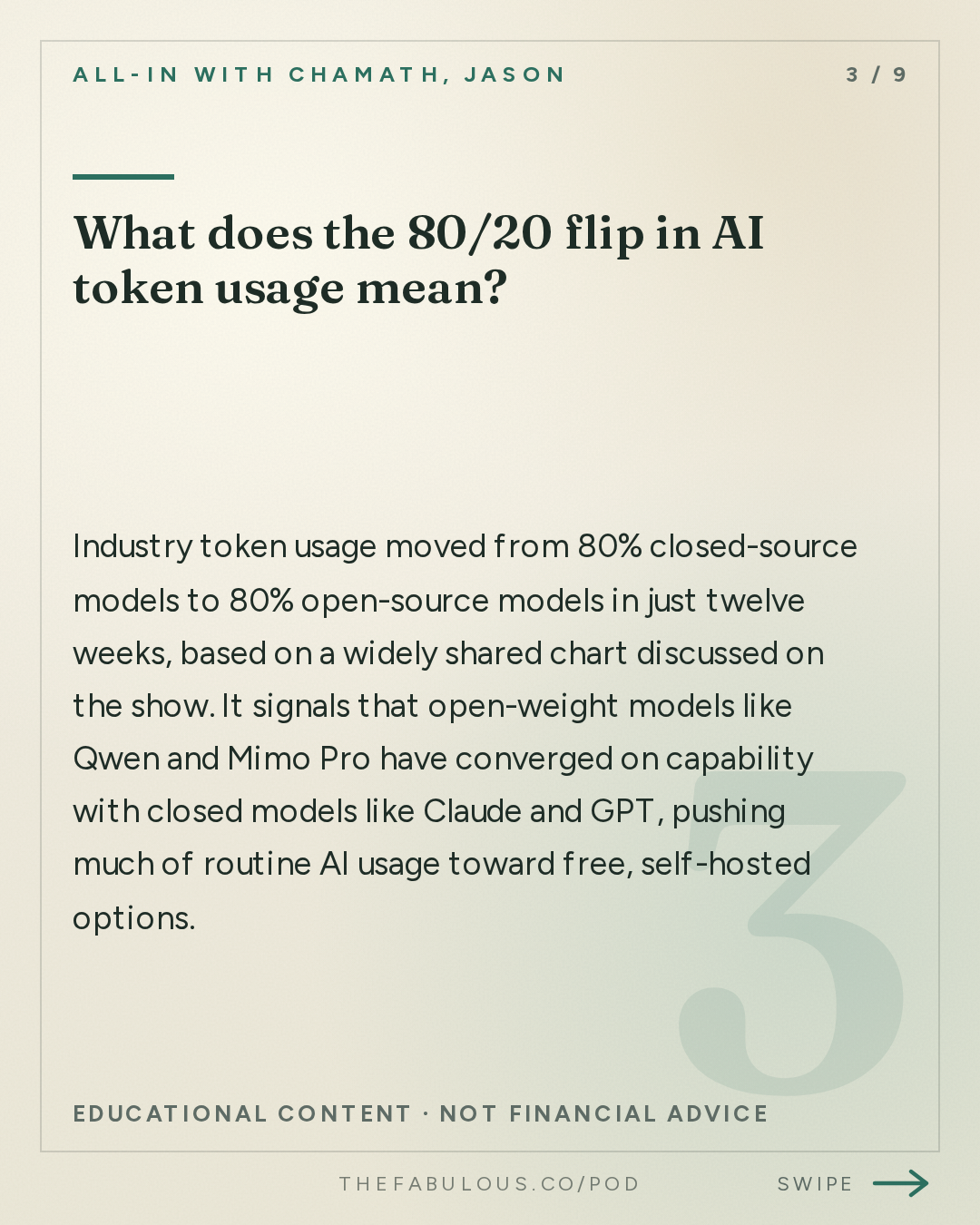
Industry token usage moved from 80% closed-source models to 80% open-source models in just twelve weeks, based on a widely shared chart discussed on the show (41:20). It signals that open-weight models like Qwen and Mimo Pro have converged on capability with closed models like Claude and GPT, pushing much of routine AI usage toward free, self-hosted options.
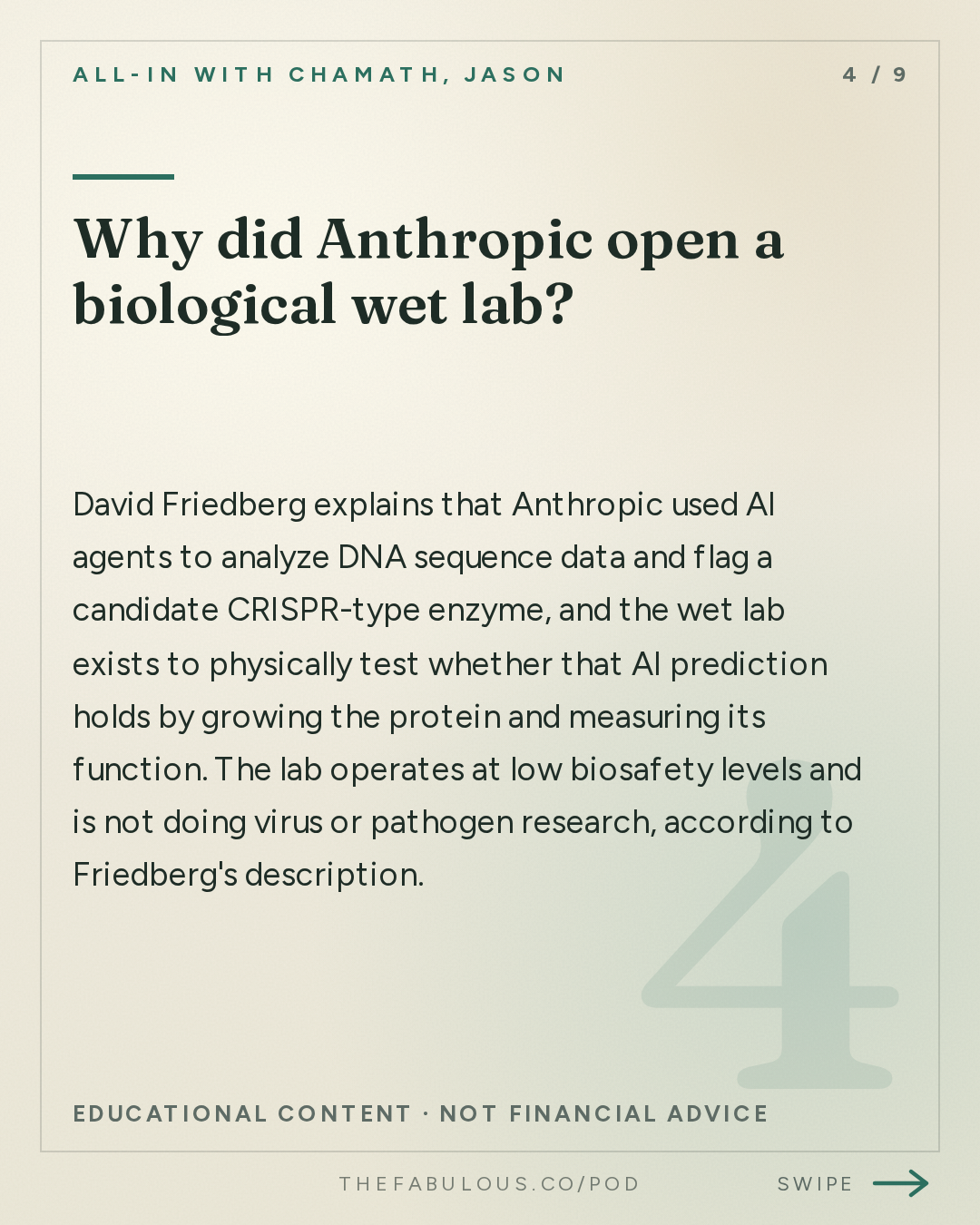
Why did Anthropic open a biological wet lab?
David Friedberg explains that Anthropic used AI agents to analyze DNA sequence data and flag a candidate CRISPR-type enzyme, and the wet lab exists to physically test whether that AI prediction holds by growing the protein and measuring its function (88:20). The lab operates at low biosafety levels and is not doing virus or pathogen research, according to Friedberg's description.
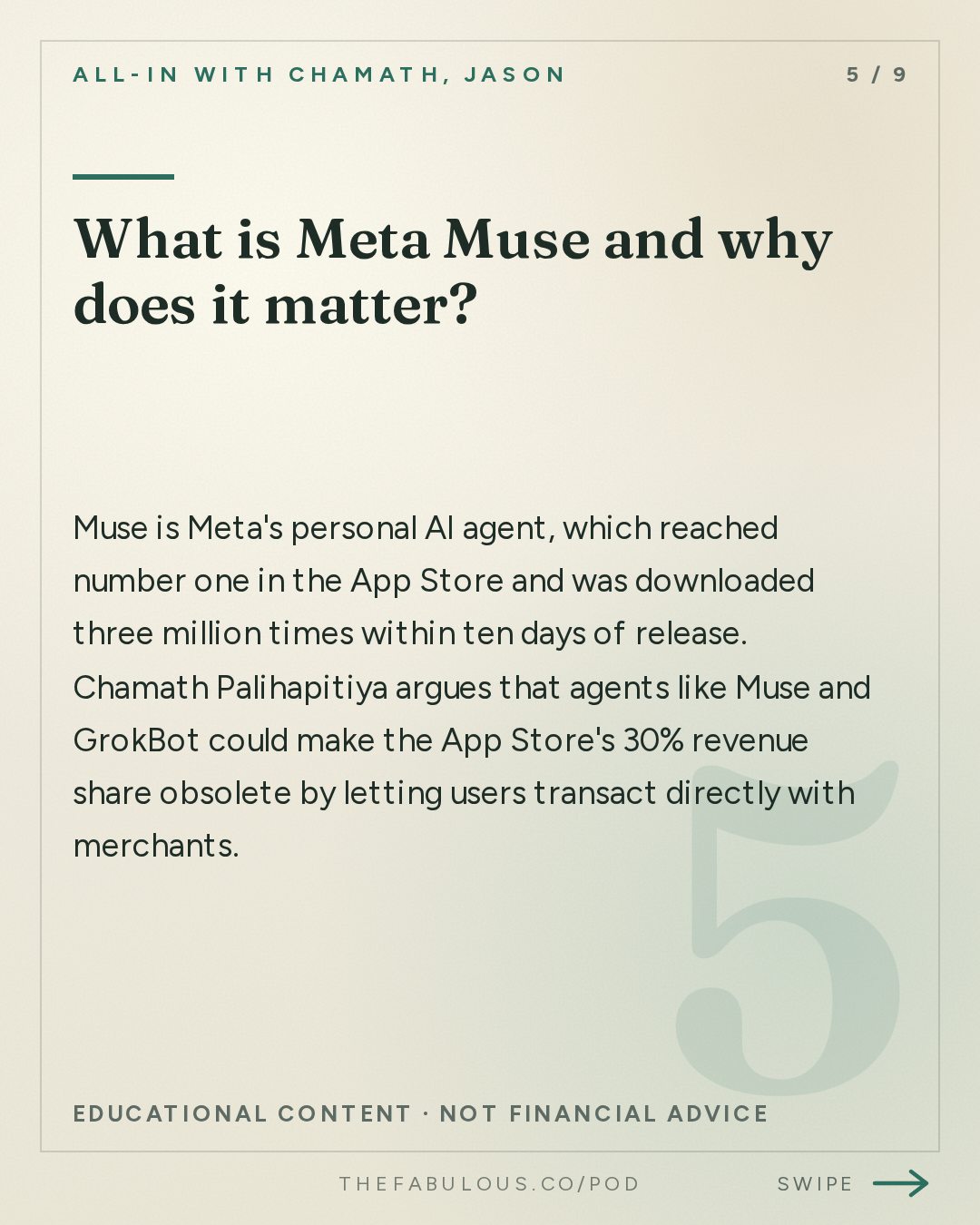
What is Meta Muse and why does it matter?
Muse is Meta's personal AI agent, which reached number one in the App Store and was downloaded three million times within ten days of release (68:56). Chamath Palihapitiya argues that agents like Muse and GrokBot could make the App Store's 30% revenue share obsolete by letting users transact directly with merchants (74:25).
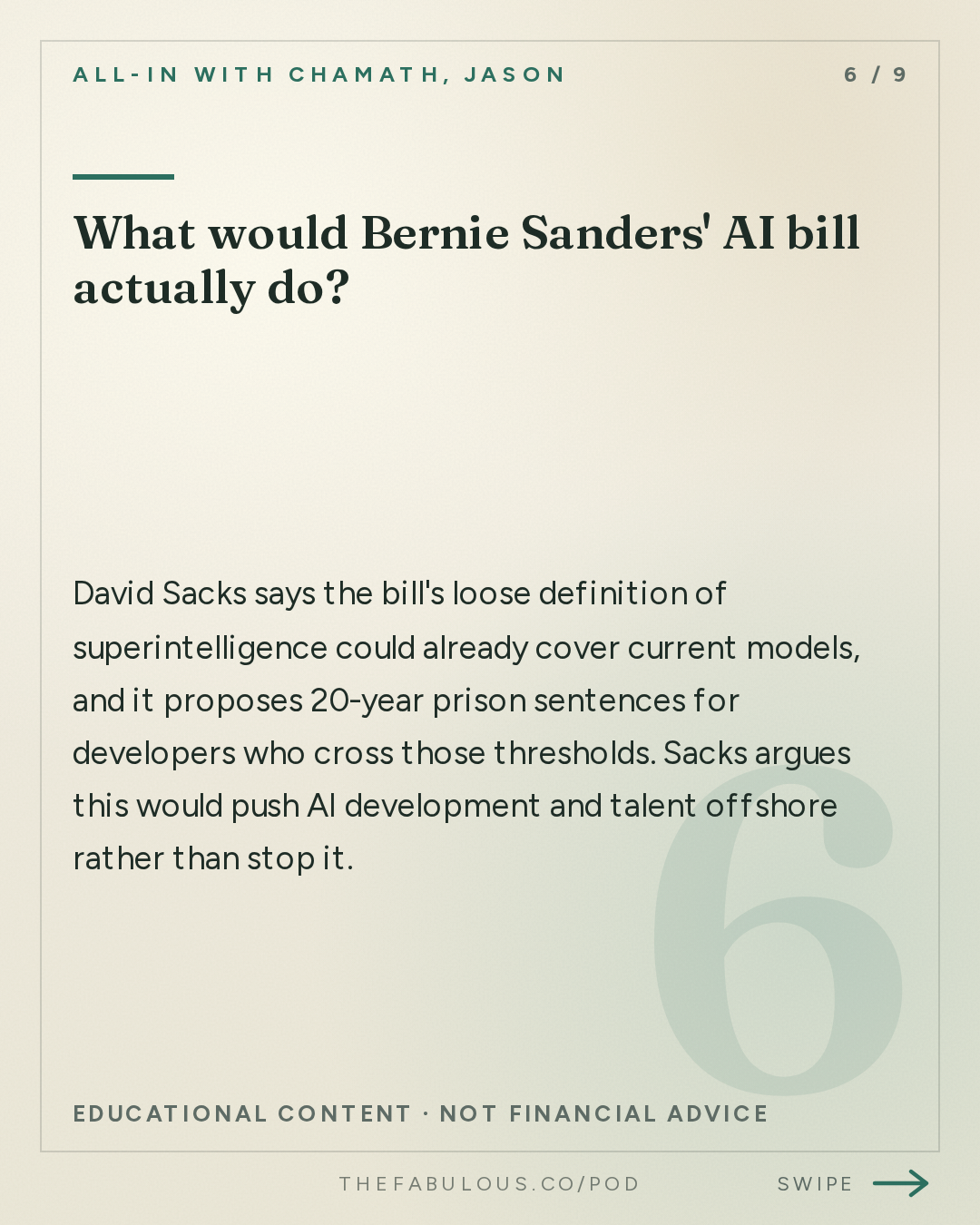
What would Bernie Sanders' AI bill actually do?
David Sacks says the bill's loose definition of superintelligence could already cover current models, and it proposes 20-year prison sentences for developers who cross those thresholds (54:55). Sacks argues this would push AI development and talent offshore rather than stop it.
The full read, in cards
Go deeper
- Vercel open-source token usage chart — shows token usage flipping from 80% closed-source to 80% open-source in twelve weeks
- The AI Buildout Is Becoming the Biggest Economic Bet in US History (Wall Street Journal) — reports AI data center CapEx now exceeds combined historical spending on canals, railroads, and the electrical grid
- Anthropic's Constitution (Claude alignment document) — instructs Claude to act as a conscientious objector and refuse instructions it judges unethical, even from Anthropic itself
- Anthropic enzyme-discovery preprint — used Claude agents to analyze DNA data and identify a novel CRISPR-type enzyme candidate
Mentioned
Anthropic · OpenAI · Dario Amodei · Meta Muse · GrokBot · Jane Street · Qwen · Bernie Sanders · Mark Zuckerberg · Mustafa Suleyman · DeepSeek · Mimo Pro
More from this show and category

Bending Spoons Business Model Explained
Bending Spoons buys aging software brands cheaply and reruns them on one shared tech stack with tiny, talent-dense teams. CEO Luca Ferrari says the company grew from $40,000 in 2013 seed money to a $4 billion pro forma revenue run rate largely through reinvested cash flow and hedged debt, not equity (18:23).

Steve Hilton's California Governor Platform
Steve Hilton wants to cut California's regulations by half and make the first $150,000 of income tax-free. The Republican candidate for governor also proposes abolishing the DMV and capping vehicle registration at $73. Reality TV figure Spencer Pratt joins to explain ballot harvesting rules and his lawsuit over the Pacific Palisades fire.

Boom Supersonic's Engine Now Powers Data Centers
Boom Supersonic broke the sound barrier in 2025 and now sells its jet engine as a data-center power generator. Each unit produces 42 megawatts without water cooling, funding an airliner Boom hopes flies commercially by 2030 at a $3,500 round-trip break-even fare (04:37, 08:39, 11:39, 11:17).

Naveen Rao on AI's Energy Wall and 4D Computing
Unconventional AI's Naveen Rao says the AI industry will hit a global energy wall within roughly three years, since Google alone already burns 12 gigawatts a month on tokens. His fix is a new chip that fuses memory and computation, cutting image-generation energy from GPU-level millijoules down to 500 nanojoules.
