
Billy Evans on Elizabeth Holmes: Trial, Prison, Hemantis
Elizabeth Holmes' Husband Billy Evans: The Trial, Prison & Nathan Fielder's Documentary
The brief
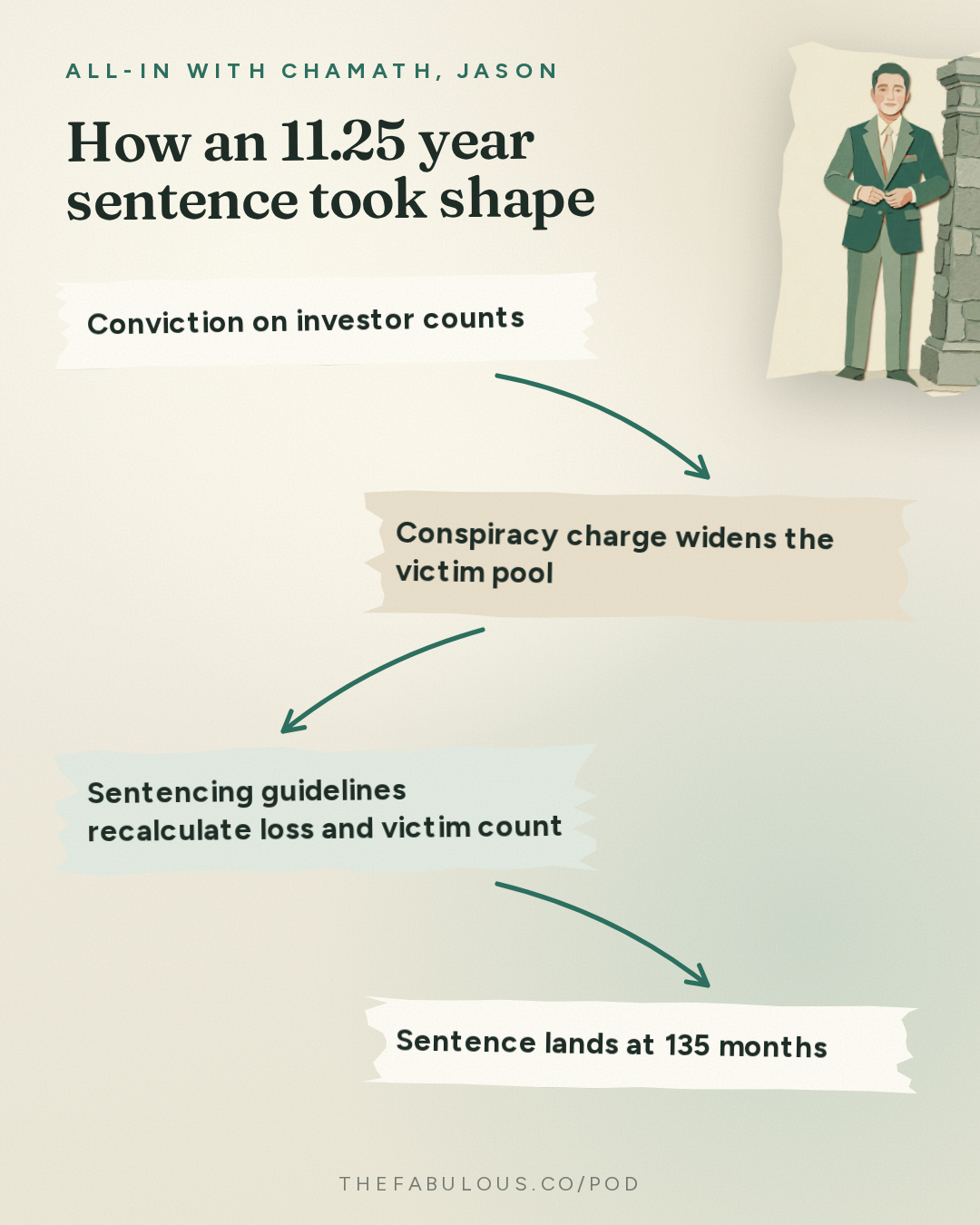
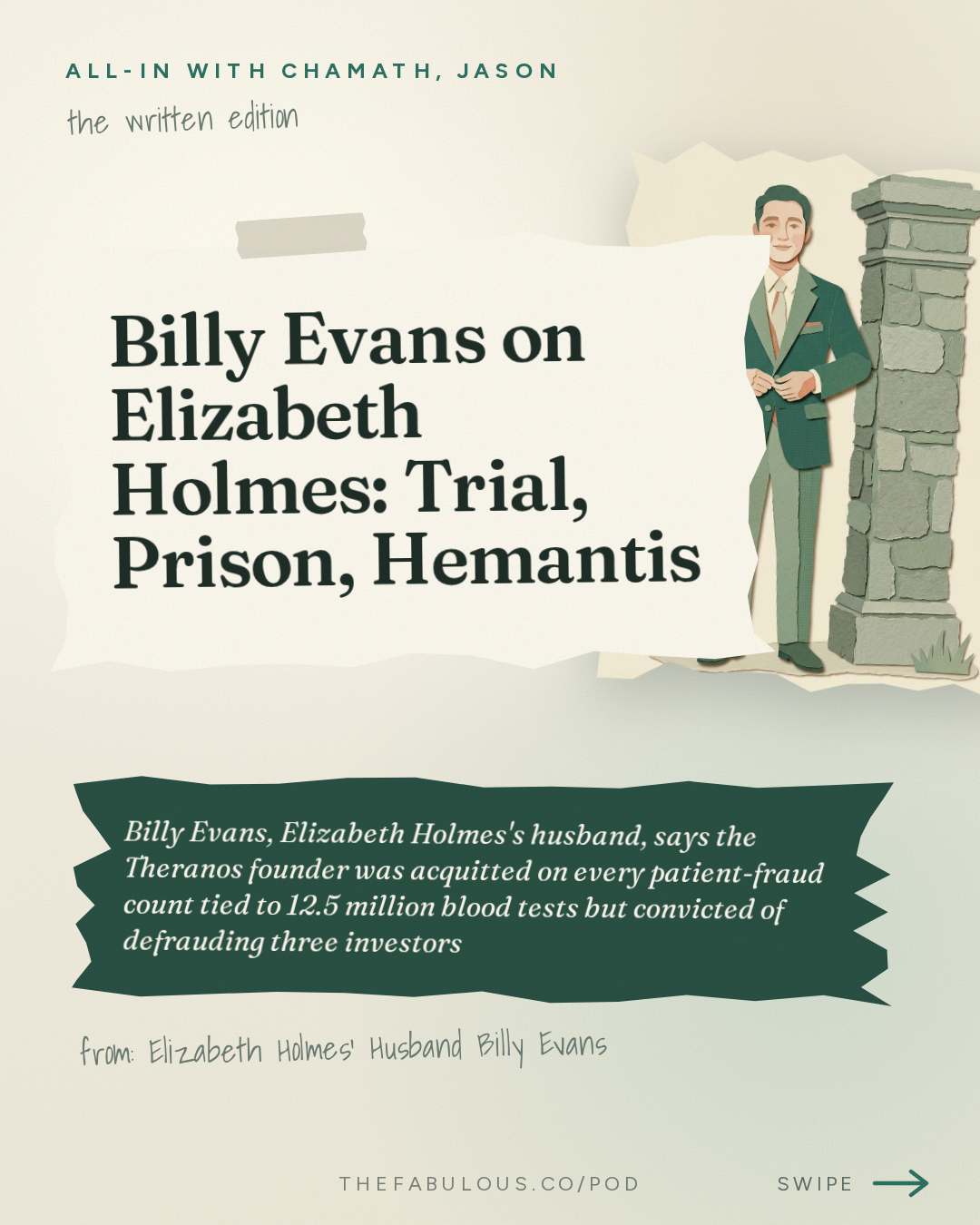
Billy Evans, Elizabeth Holmes's husband, says the Theranos founder was acquitted on every patient-fraud count tied to 12.5 million blood tests but convicted of defrauding three investors, a conspiracy charge that let the judge add outside victims like Rupert Murdoch and push her sentence to 11.25 years (00:27, 19:52, 21:31).
A woman in a floppy hat and dark sunglasses, with a Band-Aid on her cheek from a husky scratch, strikes up a conversation at a Fleet Week party on a San Francisco rooftop. She asks about everything, the way a child asks about everything, and she watches the Blue Angels overhead with what her future husband later calls childlike wonder. He has no idea who she is. That is the opening scene Billy Evans gives for how he met Elizabeth Holmes, the founder convicted of defrauding investors in the blood-testing startup Theranos, and it is the frame for the whole conversation: a man asking a stadium of strangers to separate the person he knows from the story everyone else has already finished writing.
The timeline matters here, because it is the spine of Evans's case for sympathy. He and Holmes met on October 7, 2017 (05:14), after journalist John Carreyrou's investigative articles had already run but before Holmes was indicted. They spent six months as platonic dog-walking friends, Evans using his roommate's husky as a prop, before the relationship turned romantic (07:40). Three weeks later, she was indicted (08:40). "It's one hell of an experience to fall in love with somebody so quickly and then immediately come to terms with, like, I didn't even know what an indictment was," he says. What followed was not a glamorous countdown to trial but eight months living off-grid in an RV with their husky, Balto, parking in national forests for the maximum 14 days allowed, hiking by day and working by firelight, specifically to escape a press corps that photographed them at friends' birthday dinners and turned it into a story about a fraudster gallivanting around San Francisco (11:38).
The Case Against the Narrative
Evans's central argument is that the public settled on a verdict about Holmes's character before the jury settled on one about her conduct, and that the character verdict was built on language nobody would use for a man. "If you look back, like with as much clarity as you can muster, some of it's pretty crazy," he says. "That she would manipulate people with her big blue eyes, and that her deep voice would immediately have people give her a hundred million dollars. I mean, it's incredibly sexist" (13:44). He does not deny Theranos missed revenue targets; he argues the missed numbers came from Walgreens defaulting on a contractual rollout across roughly 800 stores after bad press broke, not from invented projections (15:56).
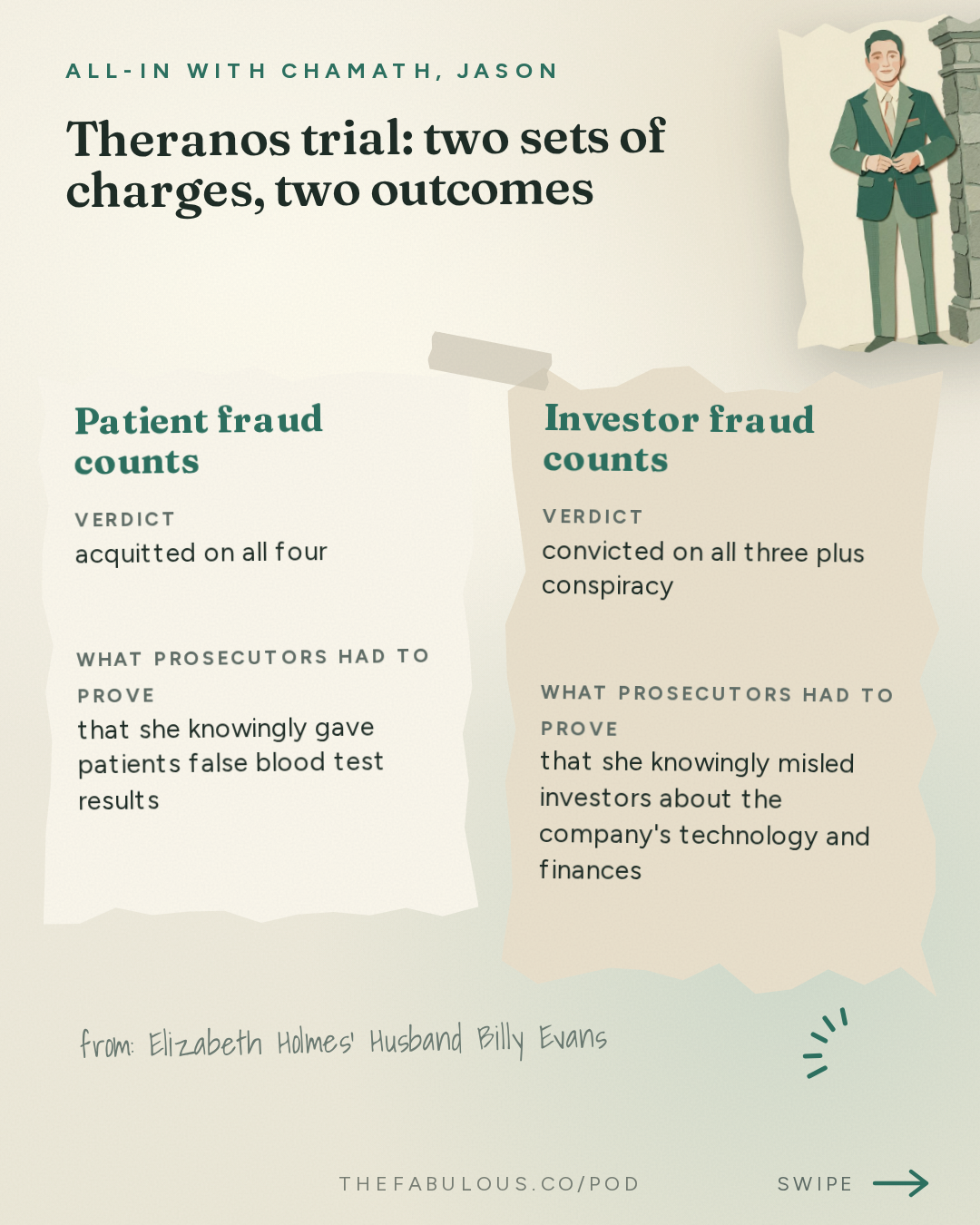
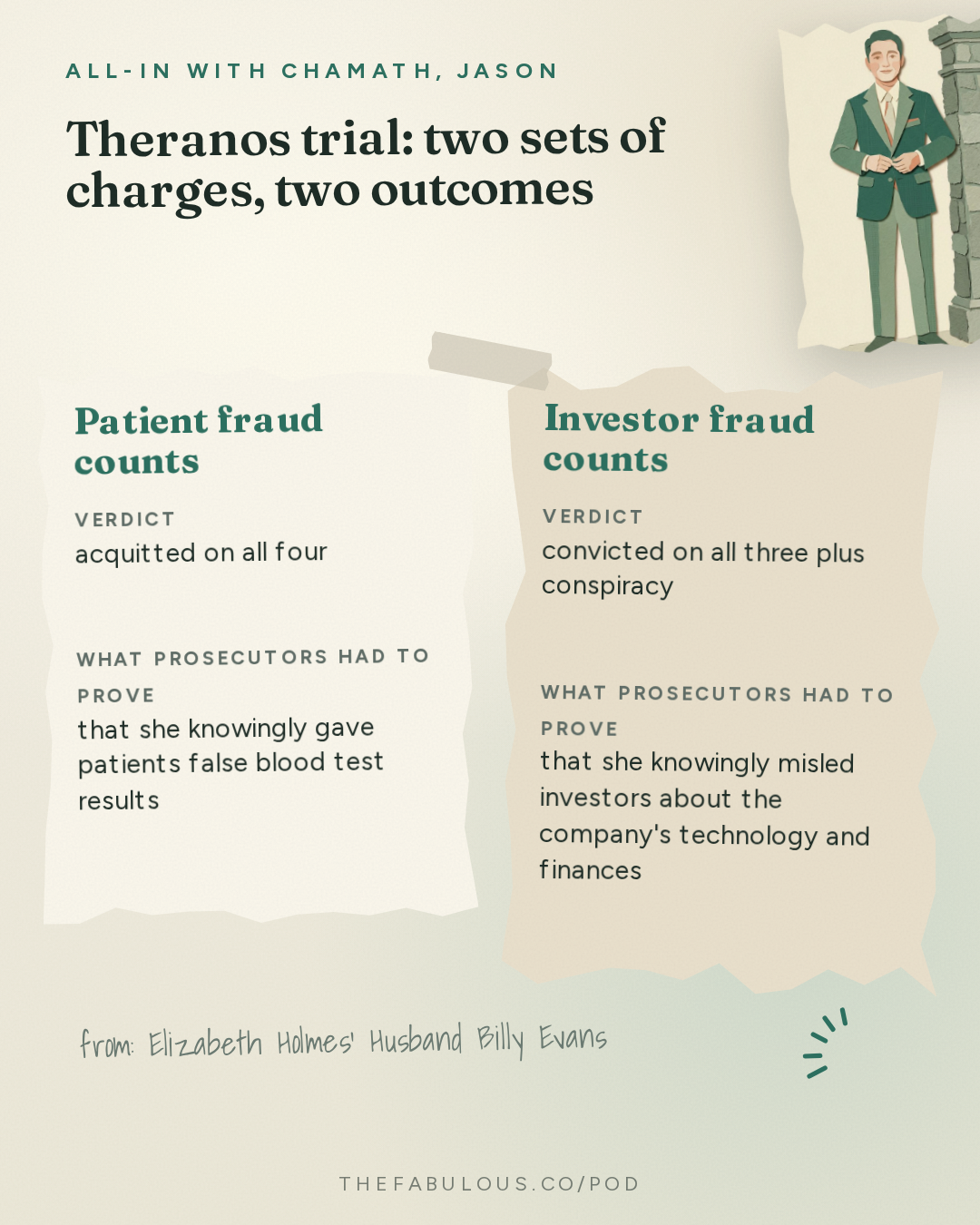
The trial itself is where Evans tries to do real work with numbers. The government charged 13 counts total. Theranos ran about 12.5 million blood tests on patients over an 18-month stretch, and prosecutors built four of those counts around four specific patients they said received knowingly false results (19:31, 19:52). Holmes was acquitted on all of them (20:27). Evans frames this as a statistics problem as much as a legal one: "Diagnostics is, like, an inherently inaccurate space. Ninety percent accuracy for some tests is good, and for other really inaccurate tests, seventy percent is really good," he says, arguing that four disputed results out of 12.5 million tests is not evidence of systemic fraud (21:00). Whatever the merits of that framing, the acquittal is a matter of record, and it is the part of the case least discussed in the popular retellings Evans is pushing back against.
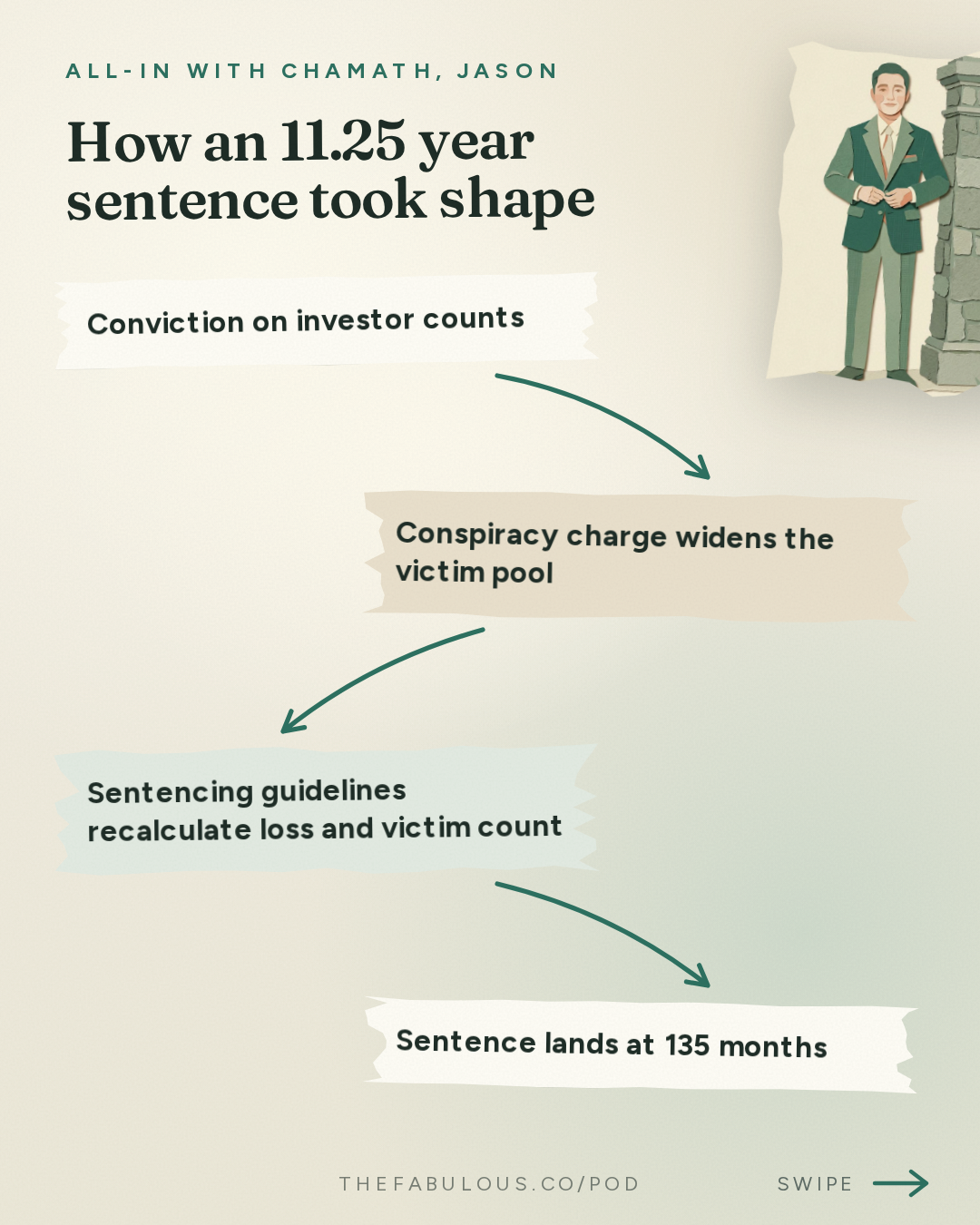
What she was convicted of is a narrower, more technical thing: conspiracy to commit wire fraud against three investors, plus substantive fraud counts tied to them. That conspiracy charge did heavier lifting than its name suggests. Under federal sentencing rules, a conspiracy conviction let the judge widen the pool of people counted as victims, which is how media mogul Rupert Murdoch, who was never part of the original counts Holmes was convicted on, got added at sentencing (21:31, 21:41). Evans says that single mechanism is what moved her exposure from something like four and a half or five years up to 135 months, 11.25 years (37:52, 00:27). The $435 million in restitution she now owes is built from claims by ten investors, even though, Evans says, the government itself argued at a later hearing that none of those investors suffered actual financial hardship from the loss (37:00, 38:08).
The Arithmetic of Getting Out
The back half of the conversation turns into something closer to a tutorial on how a federal sentence actually gets served, and it is the most concrete, least contested material in the whole hour. Holmes is housed at Bryan Federal Prison Camp in College Station, Texas, alongside roughly 800 other women; she has been there more than 1,200 days, and on a typical weekend only about 30 of those 800 women get a visitor (28:05, 28:42). Evans situates his own circumstance inside a much larger one: 130 million Americans have a family member who has been or will be incarcerated, he says, a figure meant to puncture the uniqueness of his own grief (28:42).
"I recognize that I'm not unique in that. There's 130 million Americans who have a family member that will be incarcerated." — Billy Evans (28:42)
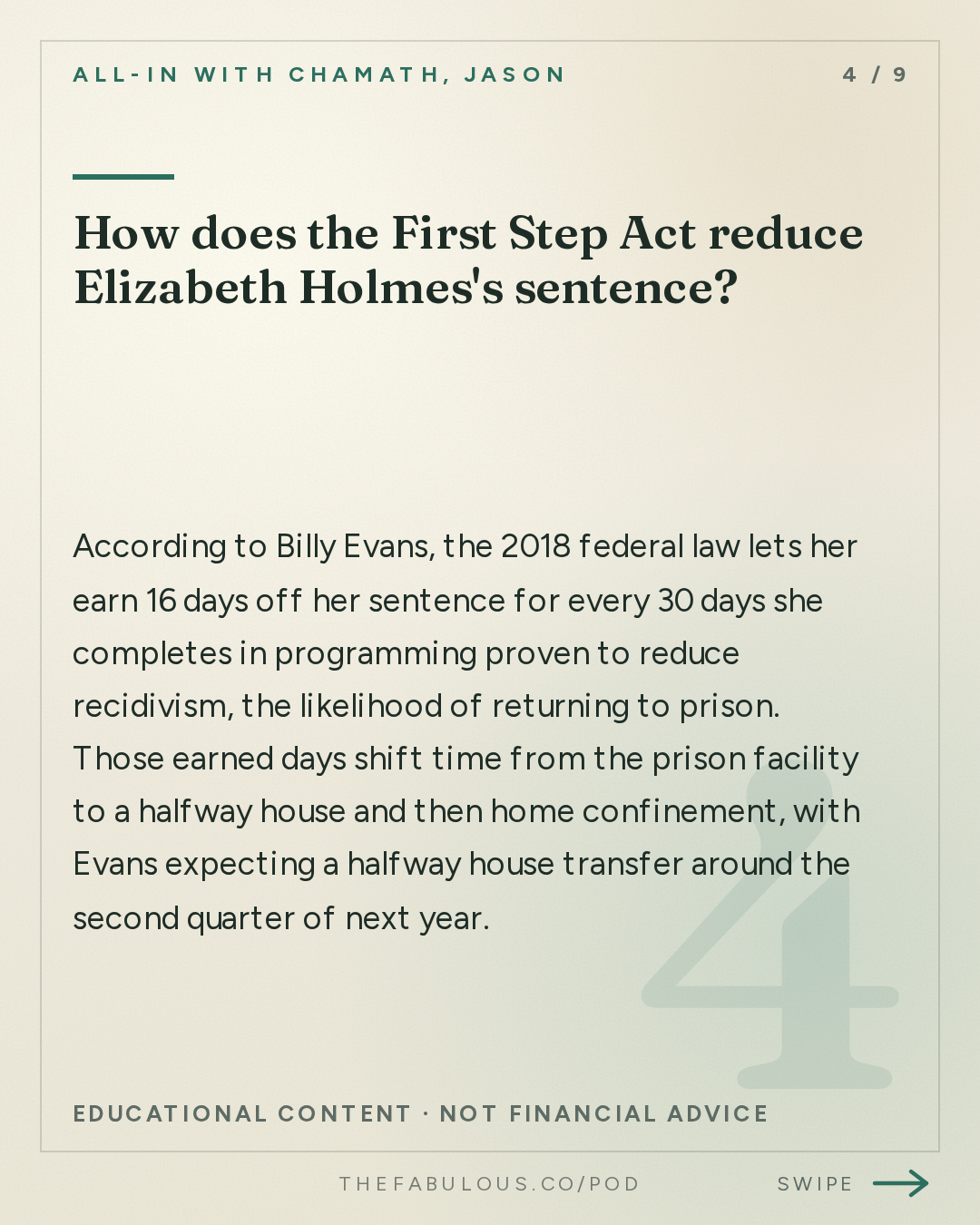
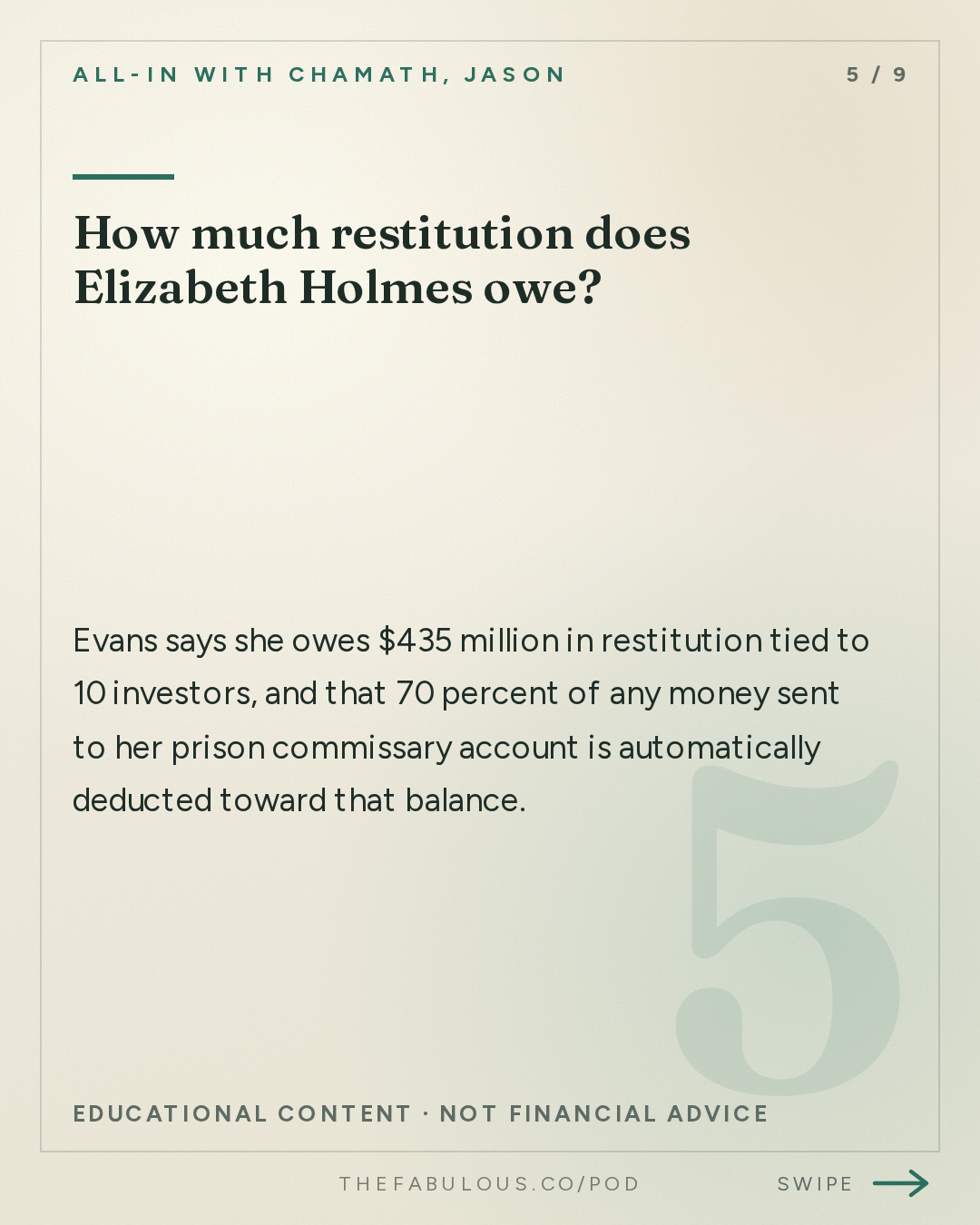
The mechanism that is actually shortening Holmes's sentence is the First Step Act, a 2018 federal law passed during President Trump's first term. Evans explains it as a kind of point system: an inmate can earn 16 days off her sentence for every 30 days spent in programming proven to reduce recidivism, which is the likelihood of returning to prison after release (36:36). Those earned days move a sentence through three stages, time inside the facility itself, time at a halfway house, and time on home confinement. By Evans's account, Holmes is now expected to reach a halfway house around the second quarter of next year. He also describes a detail that functions almost as a tax: 70 percent of any money sent to her prison commissary account is automatically deducted toward the restitution balance, which is why, he says, their last visit together consisted largely of buying trail mix from vending machines (36:56, 37:12).
The emotional centerpiece of the hour is the morning Holmes reported to prison. Evans describes driving her there, the ill-fitting New Balance sneakers a prison consultant had assured them were standard issue, and a final hug outside the facility. "I just hugged her and I said, 'I love you more than everything.' And she looked at me and she said, 'Now we are free,'" he says (31:08). It is a strange sentence to put in a prison parking lot, and Evans does not unpack it, but the context he has just spent half an hour building, years of being recognized in restaurants, photographed at private dinners, narrated by strangers, makes the line legible: incarceration, in his telling, ended a different kind of confinement.
A Documentary and a New Company
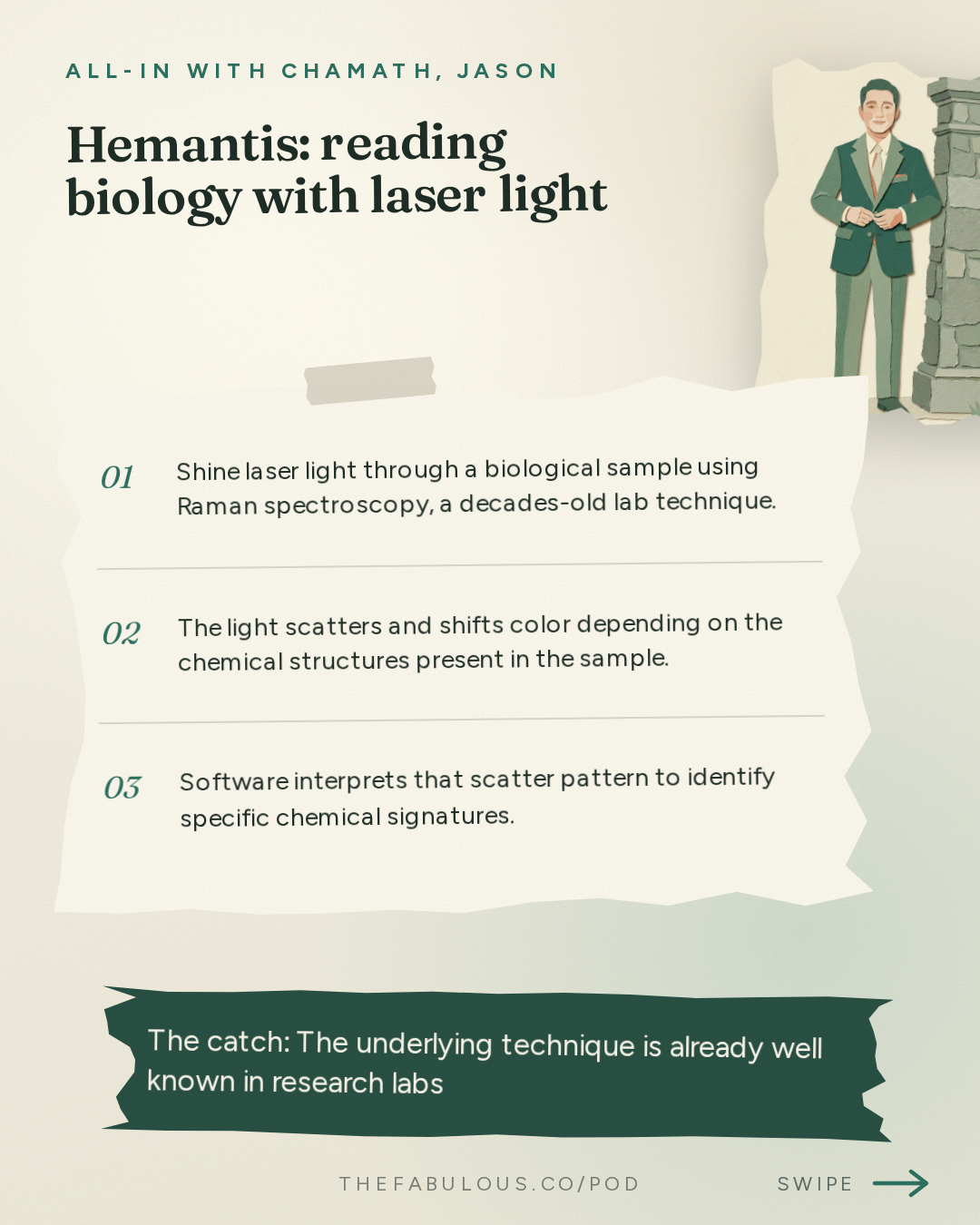
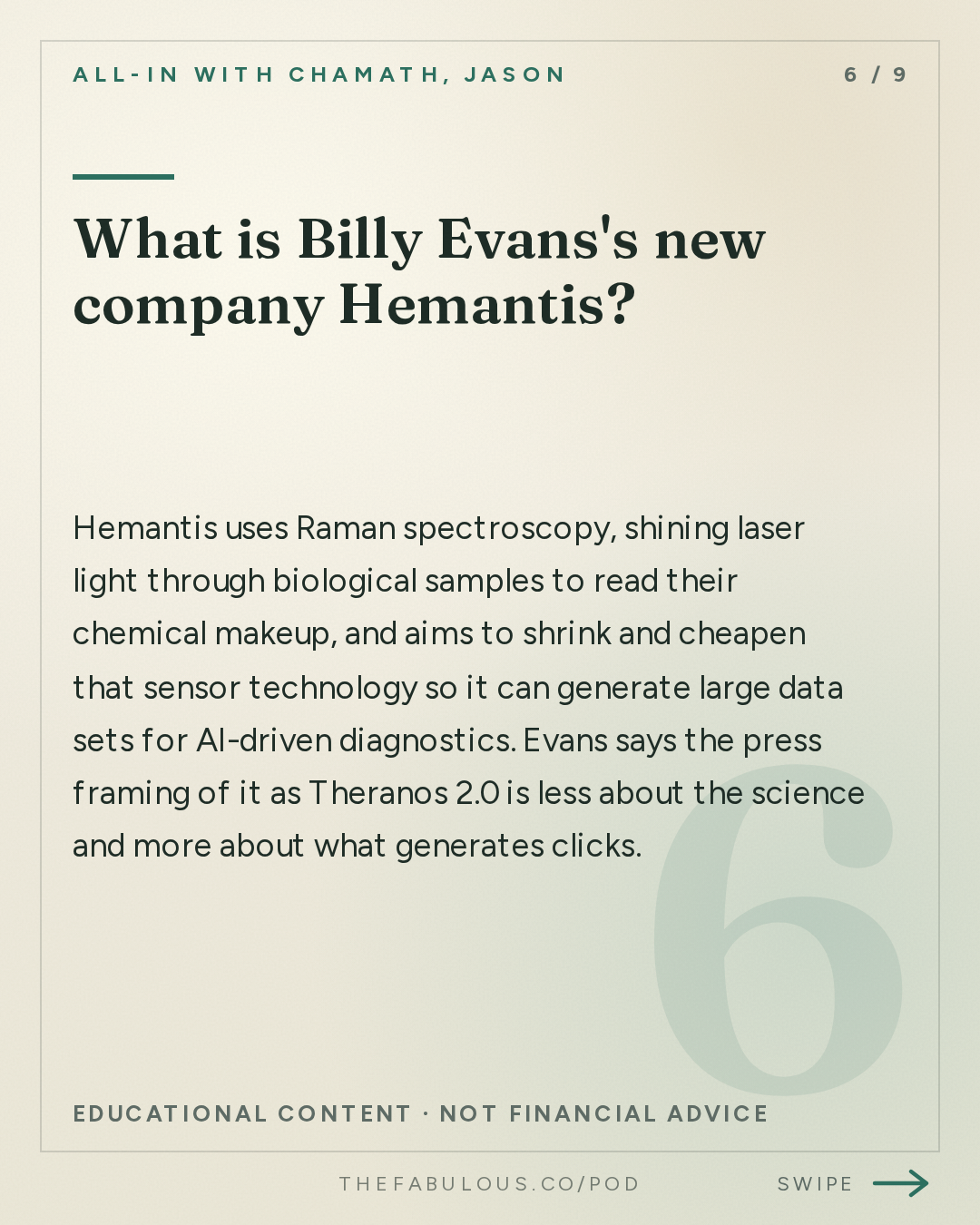
Two things exist now because of this period: a documentary called You Can See Everything, filmed over three years and timed to release only after Holmes's gag order and appeals process ended, and a startup called Hemantis that Evans is building without her. He is candid about why the press keeps calling it Theranos 2.0. "It's a lot easier to make it seem like Elizabeth Holmes is El Chapo running a diagnostics cartel from prison than it is to say Billy's building a nerdy company," he says (41:02). The actual company, by his description, uses Raman spectroscopy, a decades-old lab technique where laser light shone through a biological sample scatters and changes color in ways that reveal its chemical makeup. Existing Raman machines cost millions of dollars and take up entire rooms; Evans, who previously built lidar sensors for self-driving cars at a company called Luminar, says his contribution is shrinking and cheapening that sensor so it can feed large, messy data sets to artificial intelligence models looking for correlations human doctors were never built to see (39:57, 40:19).
What makes the interview worth sitting with is not whether it resolves the Theranos case, it explicitly does not try to, but how plainly it shows the gap between a legal record and a public verdict. The jury acquitted on every patient count and convicted on a narrower financial one. The sentence that followed was shaped less by the number of tests Theranos ran than by a conspiracy statute's reach into who counts as a victim. Evans is not asking anyone to forget the conviction. He is asking them to notice how much of the story that made the conviction feel inevitable was built on an interpretation of her voice, her eyes, her turtleneck, rather than on the counts a jury actually returned.
Ask this episode anything
Pod's AI answers from the episode itself, with the minute mark so you can hear it yourself.
Or start with one of these
Ask this episode
Pod's AI listens to the whole episode to answer, and points you to the minute it comes from.
The rest of this answer, and any question after it
Answers come from the episode itself, never from a summary of it.
ContinueKey takeaways
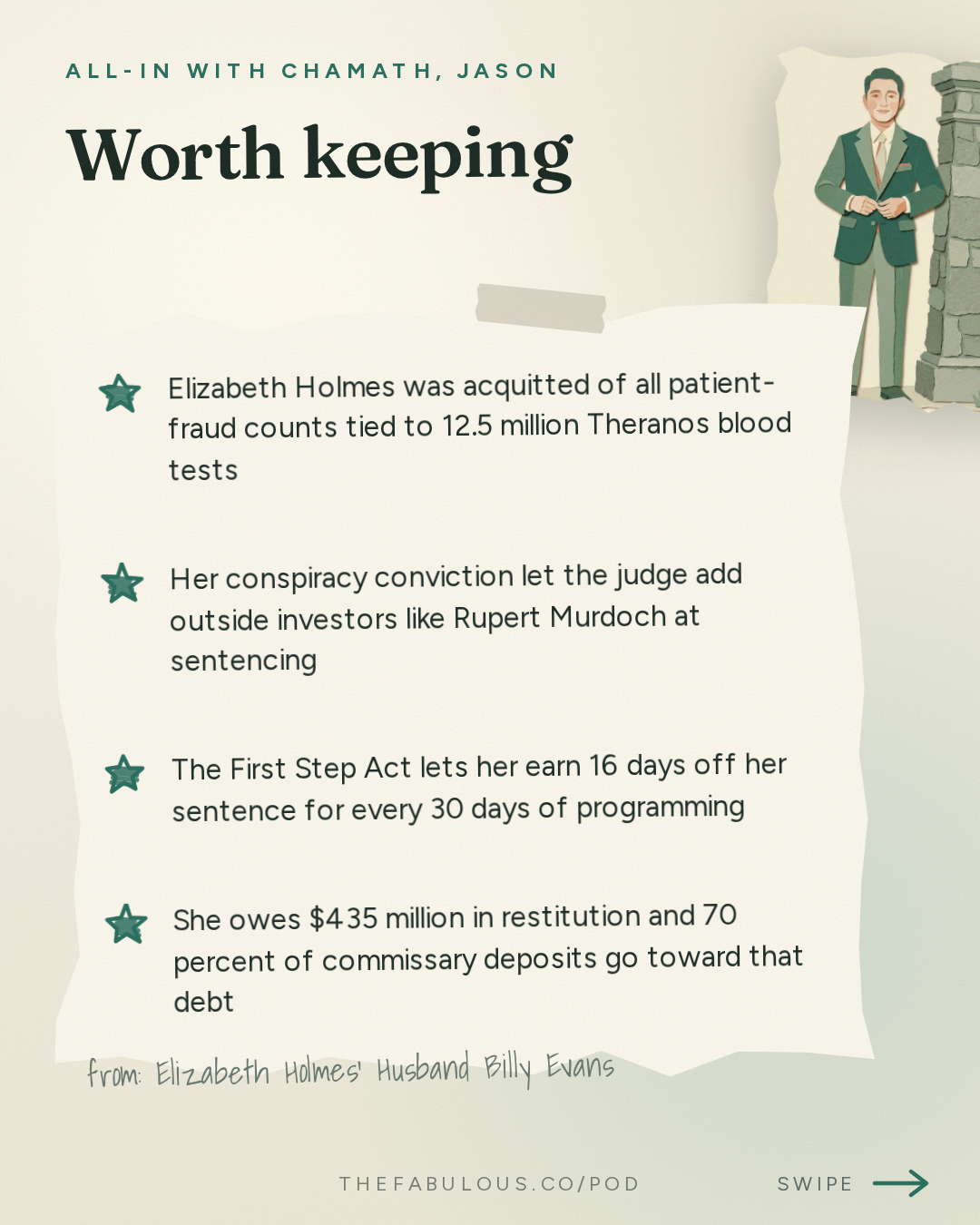
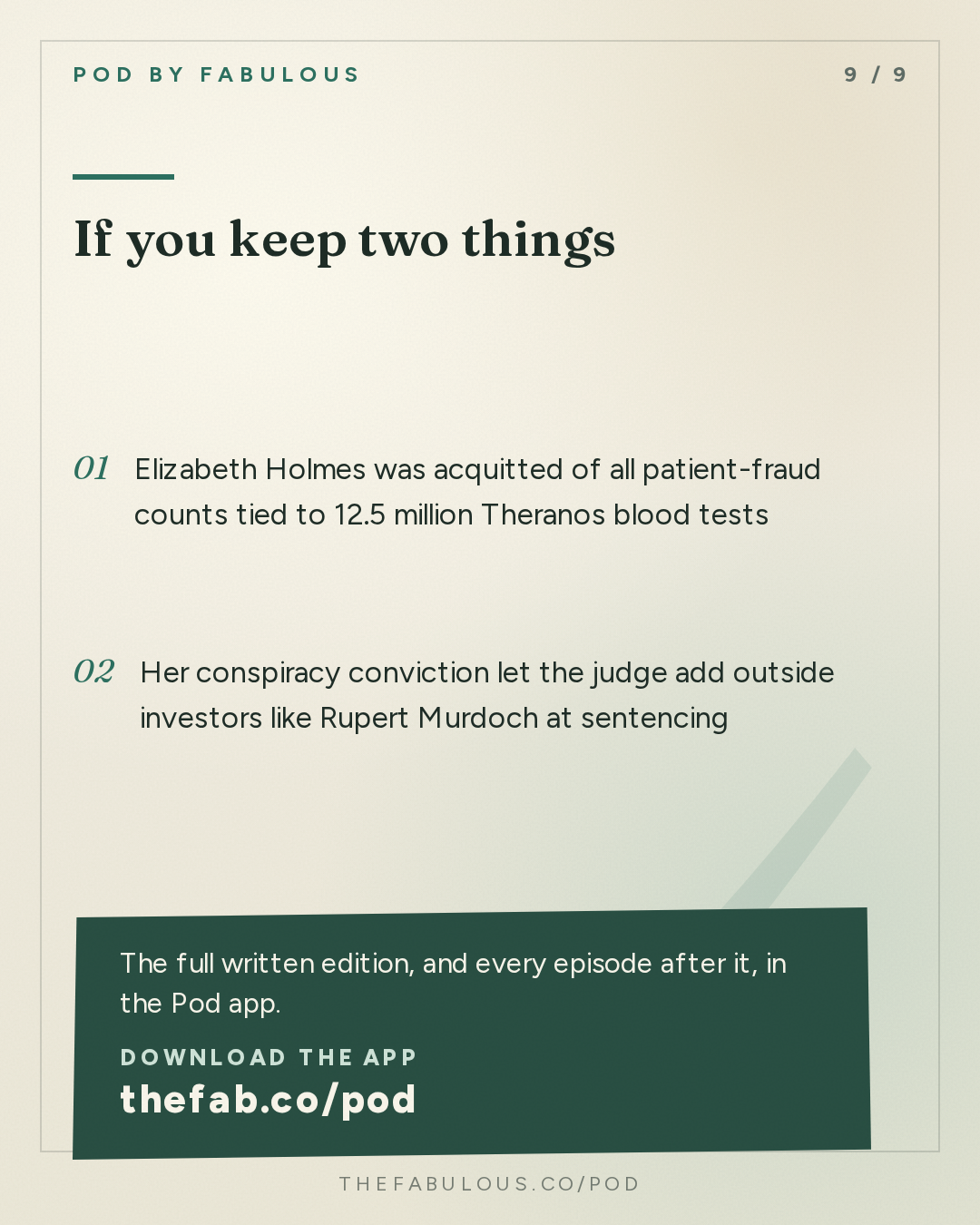
- Elizabeth Holmes was acquitted of all patient-fraud counts tied to 12.5 million Theranos blood tests
- Her conspiracy conviction let the judge add outside investors like Rupert Murdoch at sentencing
- The First Step Act lets her earn 16 days off her sentence for every 30 days of programming
- She owes $435 million in restitution and 70 percent of commissary deposits go toward that debt
- Husband Billy Evans is now building Hemantis, a Raman spectroscopy diagnostics company, separately from her
The episode in cards
By the numbers
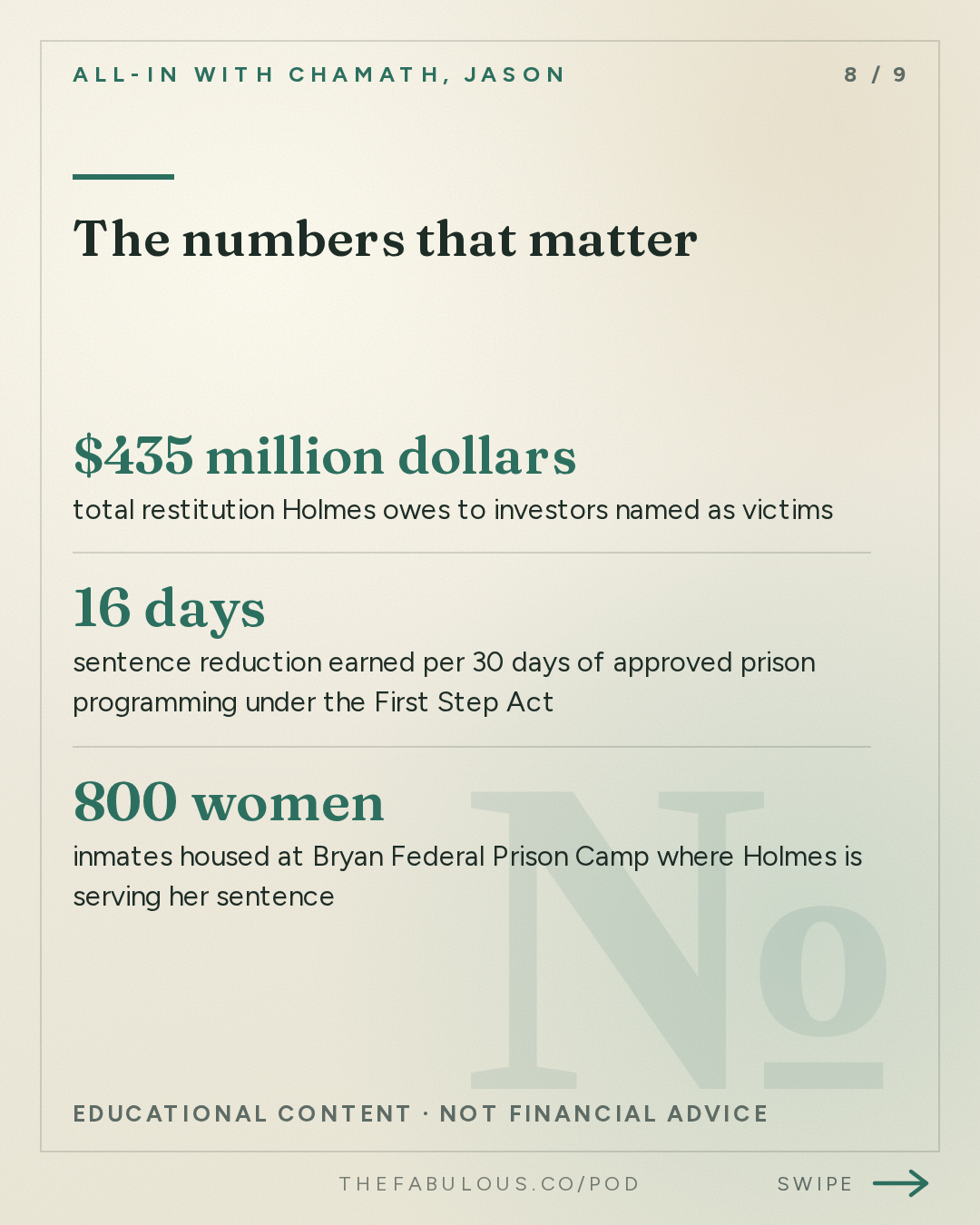
- $435 million dollars total restitution Holmes owes to investors named as victims
- 16 days sentence reduction earned per 30 days of approved prison programming under the First Step Act
- 800 women inmates housed at Bryan Federal Prison Camp where Holmes is serving her sentence
In their words
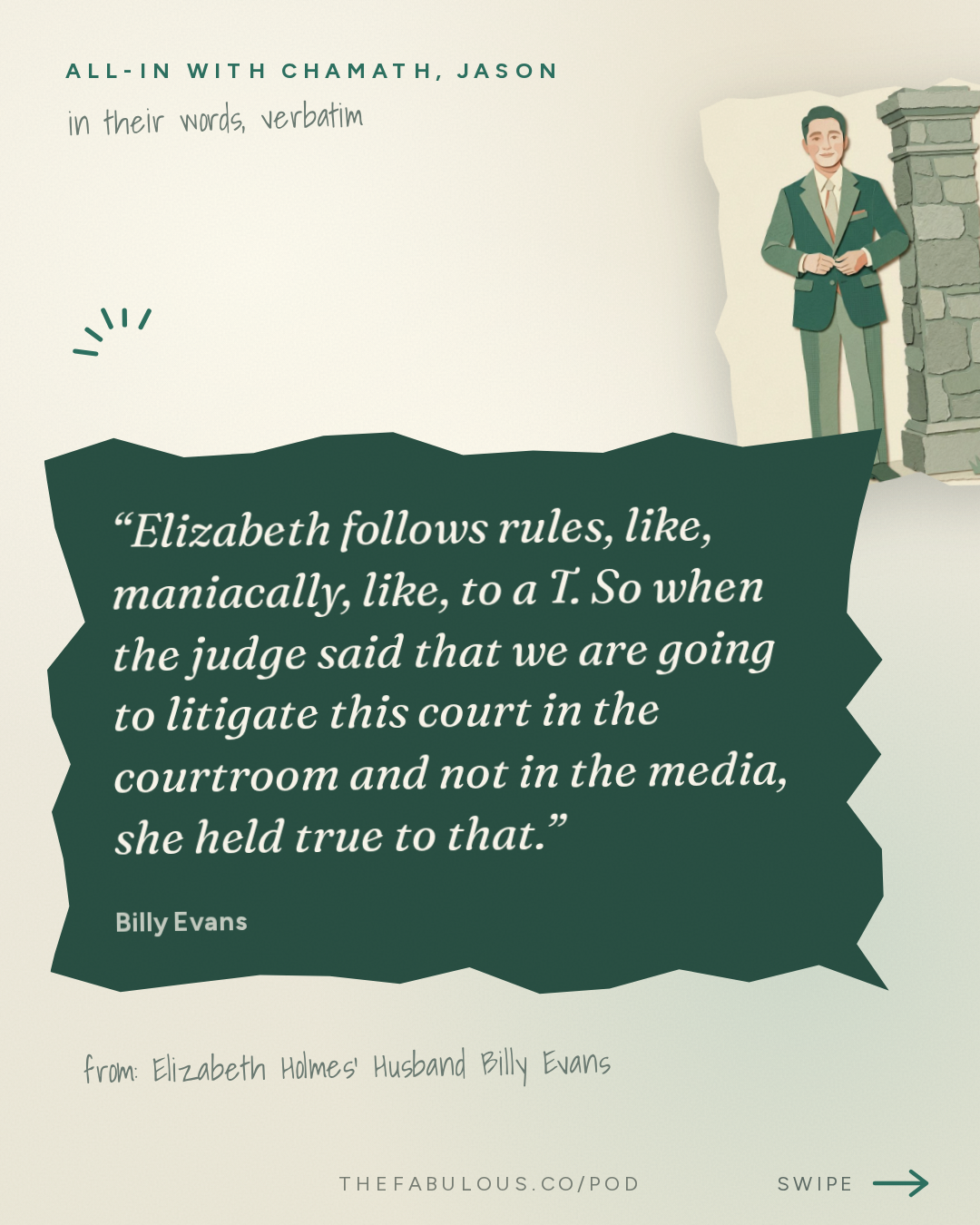
“Elizabeth follows rules, like, maniacally, like, to a T. So when the judge said that we are going to litigate this court in the courtroom and not in the media, she held true to that.”
“I just hugged her and I said, "I love you more than everything." And, uh, she looked at me and she said, "Now we are free."”
“It's a lot easier to make it seem like Elizabeth Holmes is El Chapo running, you know, a diagnostics cartel from prison- Okay ... than it is to say Billy's building a”
Protocols
-
How Billy Evans describes Holmes earning early release
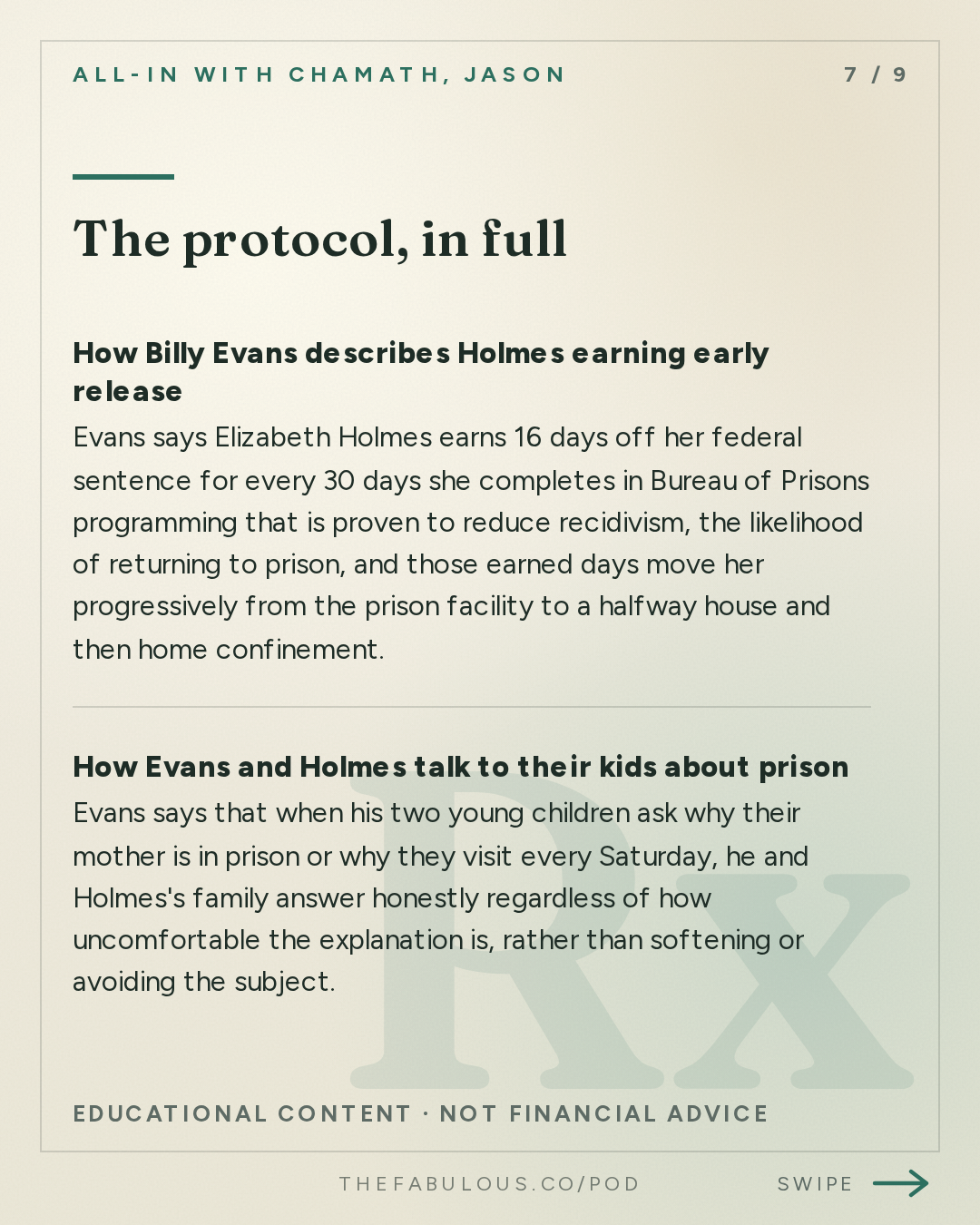
Evans says Elizabeth Holmes earns 16 days off her federal sentence for every 30 days she completes in Bureau of Prisons programming that is proven to reduce recidivism, the likelihood of returning to prison, and those earned days move her progressively from the prison facility to a halfway house and then home confinement.
every 30 days of qualifying programming
-
How Evans and Holmes talk to their kids about prison
Evans says that when his two young children ask why their mother is in prison or why they visit every Saturday, he and Holmes's family answer honestly regardless of how uncomfortable the explanation is, rather than softening or avoiding the subject.
whenever the children ask
Questions this episode answers
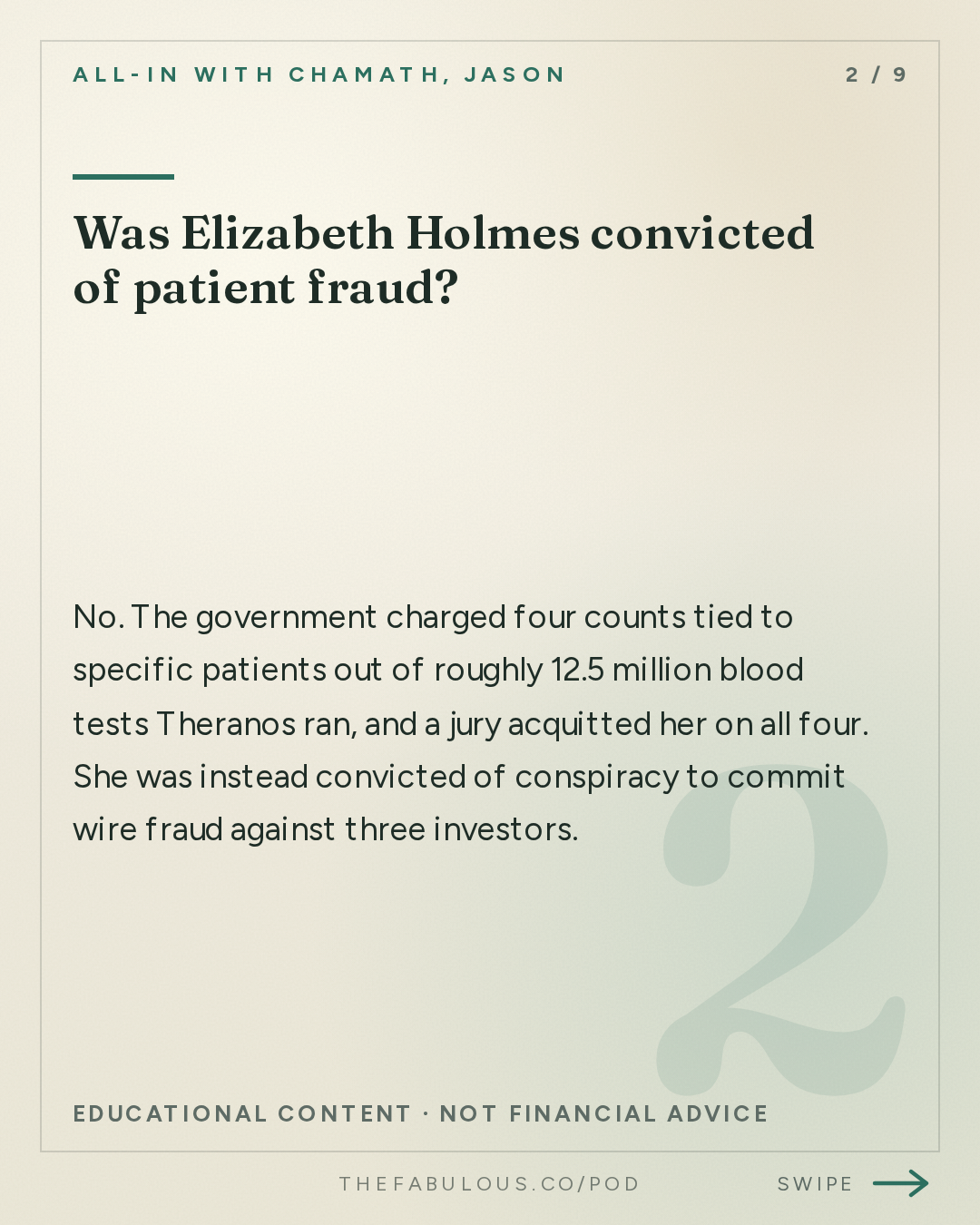
Was Elizabeth Holmes convicted of patient fraud?
No. The government charged four counts tied to specific patients out of roughly 12.5 million blood tests Theranos ran, and a jury acquitted her on all four (20:27, 19:52). She was instead convicted of conspiracy to commit wire fraud against three investors (21:19).
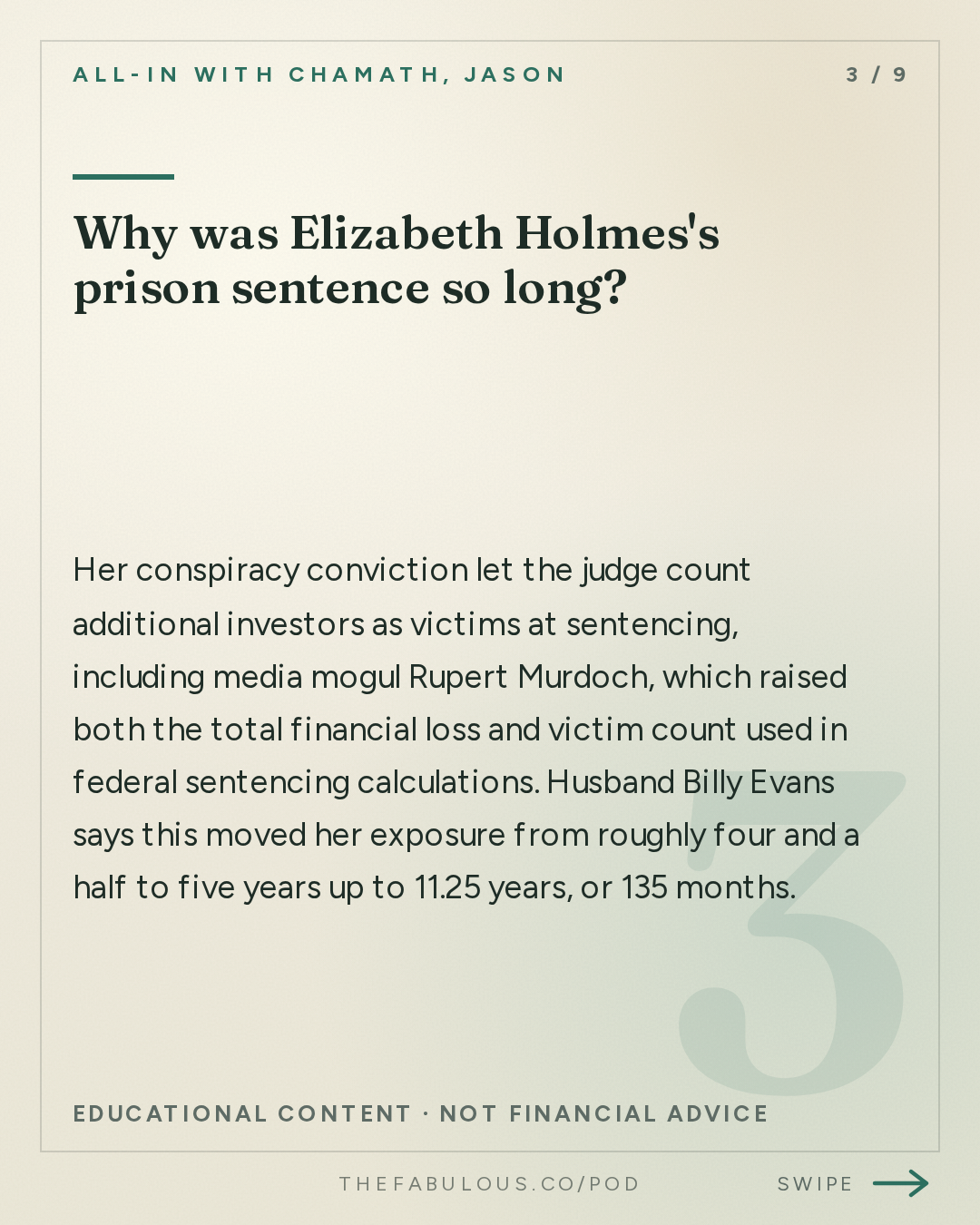
Why was Elizabeth Holmes's prison sentence so long?
Her conspiracy conviction let the judge count additional investors as victims at sentencing, including media mogul Rupert Murdoch, which raised both the total financial loss and victim count used in federal sentencing calculations (21:31). Husband Billy Evans says this moved her exposure from roughly four and a half to five years up to 11.25 years, or 135 months (37:52, 00:27).
How does the First Step Act reduce Elizabeth Holmes's sentence?
According to Billy Evans, the 2018 federal law lets her earn 16 days off her sentence for every 30 days she completes in programming proven to reduce recidivism, the likelihood of returning to prison (36:36). Those earned days shift time from the prison facility to a halfway house and then home confinement, with Evans expecting a halfway house transfer around the second quarter of next year (36:56).
How much restitution does Elizabeth Holmes owe?
Evans says she owes $435 million in restitution tied to 10 investors, and that 70 percent of any money sent to her prison commissary account is automatically deducted toward that balance (37:00, 36:56).
What is Billy Evans's new company Hemantis?
Hemantis uses Raman spectroscopy, shining laser light through biological samples to read their chemical makeup, and aims to shrink and cheapen that sensor technology so it can generate large data sets for AI-driven diagnostics (39:57, 40:19). Evans says the press framing of it as Theranos 2.0 is less about the science and more about what generates clicks (41:02).
The full read, in cards
Go deeper
- Bad Blood — John Carreyrou's reporting on Theranos, which Evans says he only skimmed on his lawyers' advice
- You Can See Everything — documentary following Holmes's life after Theranos, filmed over three years with Nathan Fielder's team and released after her gag order ended
- First Step Act — 2018 federal law allowing inmates to earn time off for programming that reduces recidivism
Mentioned
Billy Evans · Elizabeth Holmes · Theranos · John Carreyrou · Walgreens · Bryan Federal Prison Camp · First Step Act · Hemantis · Raman spectroscopy · Nathan Fielder · Rupert Murdoch · Luminar
More from this show and category

Martin Shkreli: Quantum Computing Fraud, Pharma Deals
Martin Shkreli argues quantum computing is mostly a business mirage because today's machines run at only hundreds of hertz. He says photonic chips, which multiply matrices with light, could make Nvidia's GPUs obsolete within twenty years, and he describes turning a $2 million drug deal into a $6 billion pharmaceutical company.

Anthropic Lobbied the Pope on AI Consciousness
Anthropic lobbied religious leaders, including the Pope, on whether Claude is conscious, then coded that belief into the model's training itself. The same episode covers OpenAI's single-day release of 700 math papers, France's debt-fueled riots, and why headless AI agents are erasing the value of software intellectual property.

White House Accord on Superintelligence, Explained
President Trump's AI summit produced a White House Accord on Superintelligence: six frontier AI firms accepted external audits and board-level fiduciary duty for safety. The same episode covers strong GDP and jobs data, a bank-impairment warning, Polymarket midterm odds, and a media dispute over calling a Flydubai attack terrorism.

Anthropic IPO Risk: Open Source and Extinction Talk
Anthropic's IPO is at risk as AI token usage flipped from 80% closed-source to 80% open-source in twelve weeks (41:20). Anthropic's own leadership cites a greater than 10% extinction risk (31:00) while opening a biological wet lab (86:00), and Meta's new agent Muse hit three million downloads in ten days (68:56).
