
US-China AI Relations: The Pax Machina Plan
Nathan Goes to China #3: US-China Relations, the Art of the AI Deal & the Road to Pax Robotica
▶ Listen to the full episode More from The Cognitive Revolution
The brief
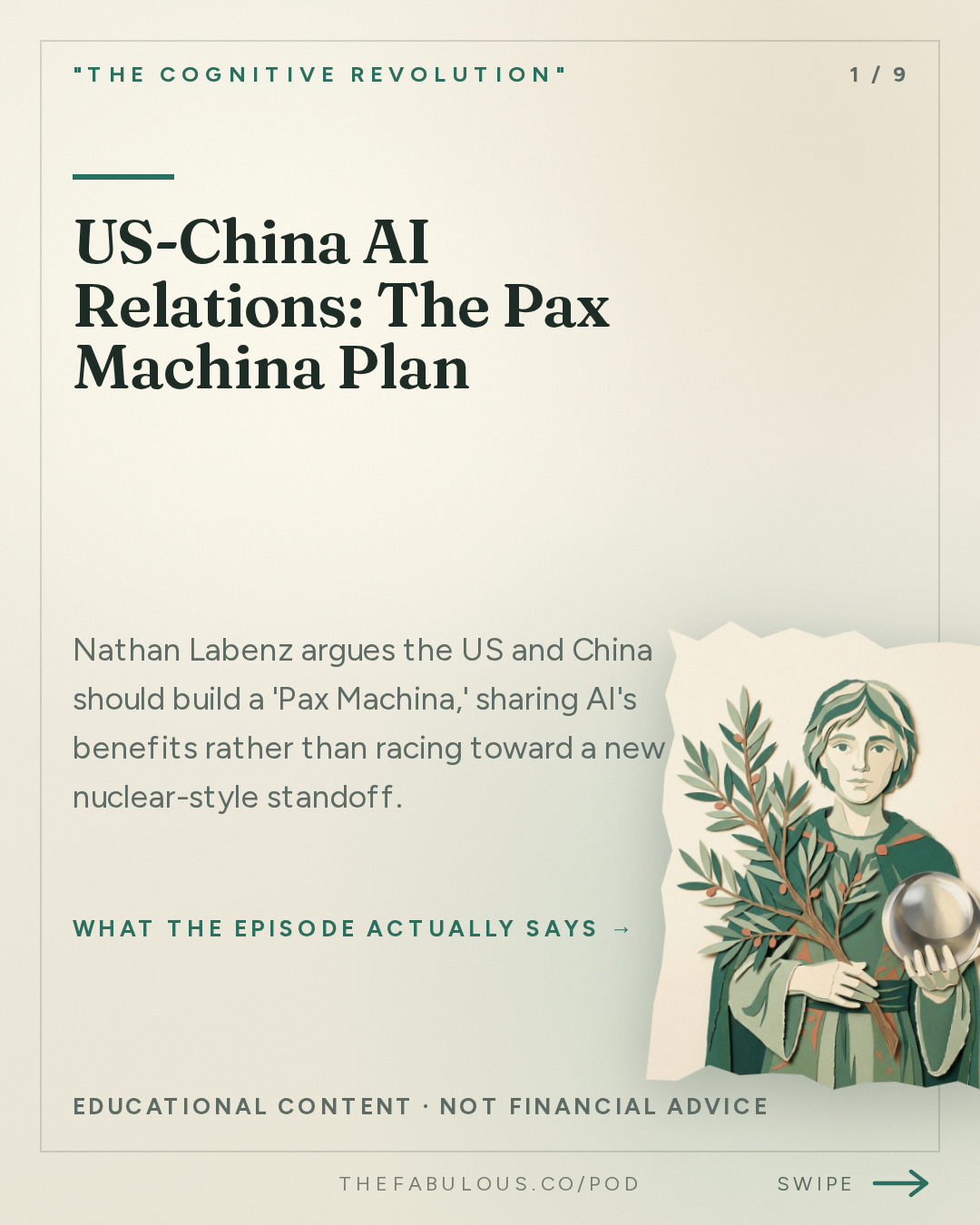
Nathan Labenz argues the US and China should build a 'Pax Machina,' sharing AI's benefits rather than racing toward a new nuclear-style standoff. He says China's rise in AI is a return to historical norm, not an aberration, and proposes chip-for-expertise trades, confidential-computing audits, and a joint refusal to build autonomous military AI.
For most of the last two thousand years, China was the richest and most technically advanced society on earth. The brief span in which it was not, roughly from the Opium Wars through the late twentieth century, is the exception that a whole generation of Americans mistook for the rule. Podcast host Nathan Labenz spent two weeks traveling through China this year, and he returns with a blunt correction: the country's return to the technological frontier is not a plot twist. It is a reversion to the mean.
This is the third installment of Labenz's China series, and it is the argumentative one. The first two episodes described what he saw on the ground and the safety culture inside Chinese AI labs. This one asks a question he says almost never gets asked out loud in Washington: what, exactly, is the goal of the US-China relationship? Not slogans about winning, but an actual end state. His answer is what he calls a Pax Machina, or Pax Robotica: a world in which both countries, and everyone else, get to enjoy cheap energy, cured diseases, and robot labor without also inheriting a new nuclear-style sword hanging over humanity (00:27, 10:51).
Labenz is careful to note that this puts him at odds with Anthropic, the company that sponsors his podcast. He admires Dario Amodei's essay Machines of Loving Grace, and he separately admires Amodei's own 2017 warning that races raise the odds of safety catastrophes.
"Technology races can raise the risk of safety catastrophes." — Nathan Labenz, quoting Dario Amodei (14:11)
Labenz's complaint is that Anthropic's China policy contradicts Anthropic's own founder. If racing is dangerous, then a strategy built on outracing China toward decisive advantage is a strategy built on the very dynamic Amodei once warned against.
The Mandate of Heaven, Not the End of History
Much of the episode is an exercise in what Labenz calls cognitive empathy: trying to see the relationship the way Beijing sees it. The starting point is the "century of humiliation," the period from Western and Japanese incursions through the chaos of the Cultural Revolution, which ended only in 1976 (67:31). People who are seventy years old today lived through the tail of it. The lesson Chinese leadership drew, in Labenz's telling, is simple: falling behind on technology is an existential risk, and dependence on foreign powers for a critical technology is a standing invitation for those powers to dictate terms again.
That history reframes things Americans tend to read as pure aggression, like the chip export ban and the pressure campaign against Huawei. Chinese officials, Labenz says, read Snowden-era revelations about American surveillance of allies, including the German chancellor's phone, and conclude that accusations of Huawei spying are hypocrisy dressed up as security policy (76:22). He does not fully endorse that reading, but he thinks Washington badly underestimates how corrosive it is to trust.
He also thinks Americans misjudge the legitimacy of China's government. Borrowing the old Confucian idea of the Mandate of Heaven, the notion that a government earns its right to rule by delivering for its people, Labenz argues the Chinese Communist Party currently has it in spades, because two generations of rising living standards have made this, for ordinary Chinese citizens, an unusually good time to be alive.
"In China, I think they are living their eternal 1991 right now. Times have never been better in any living memory than they are right now." — Nathan Labenz (39:02)
The reference is to 1991, the fall of the Soviet Union, when Americans of Labenz's generation briefly believed history had ended in their favor. He thinks Beijing is having that moment now, which is one reason he doubts any American appeal to democracy or dissent would land the way policymakers imagine.
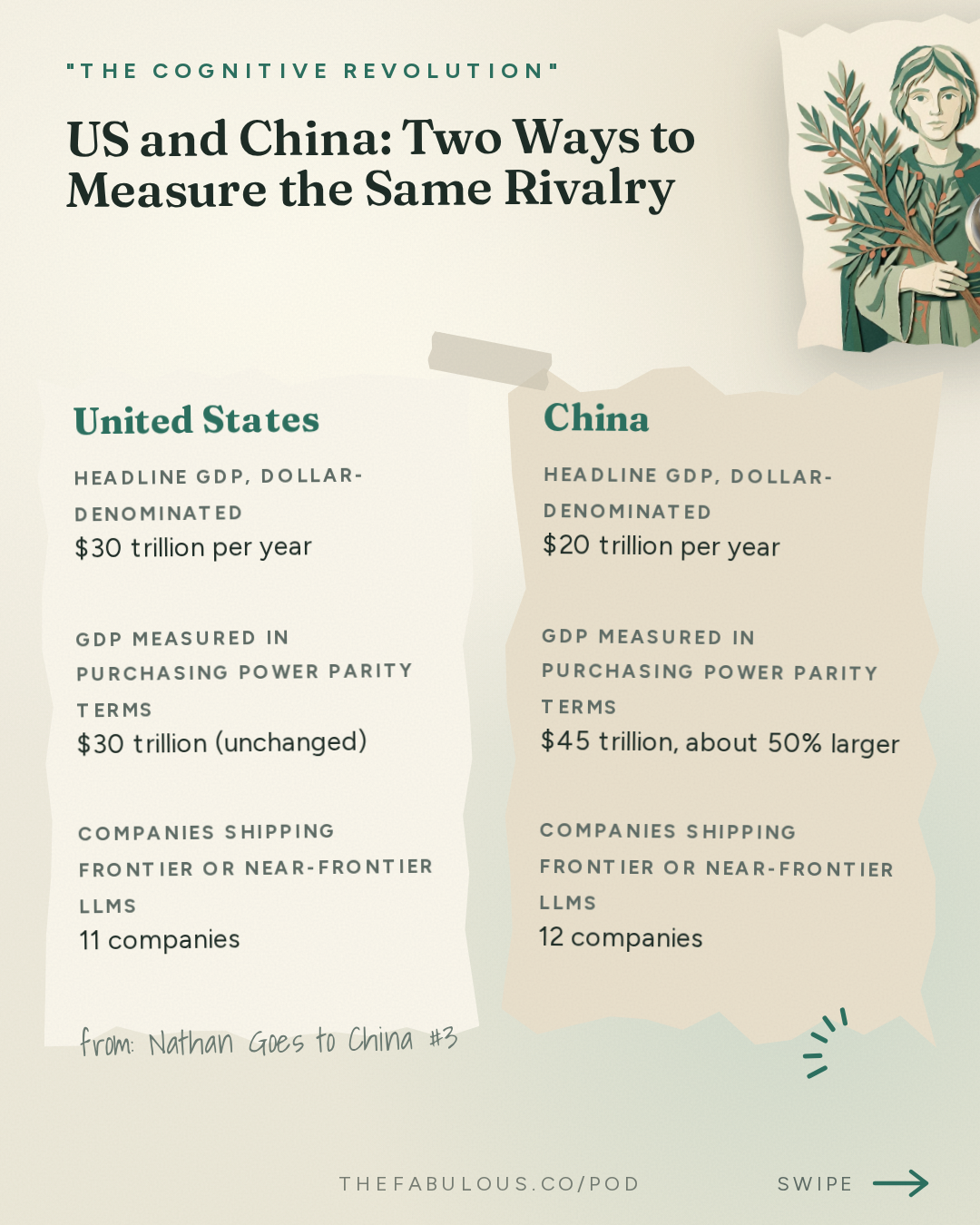
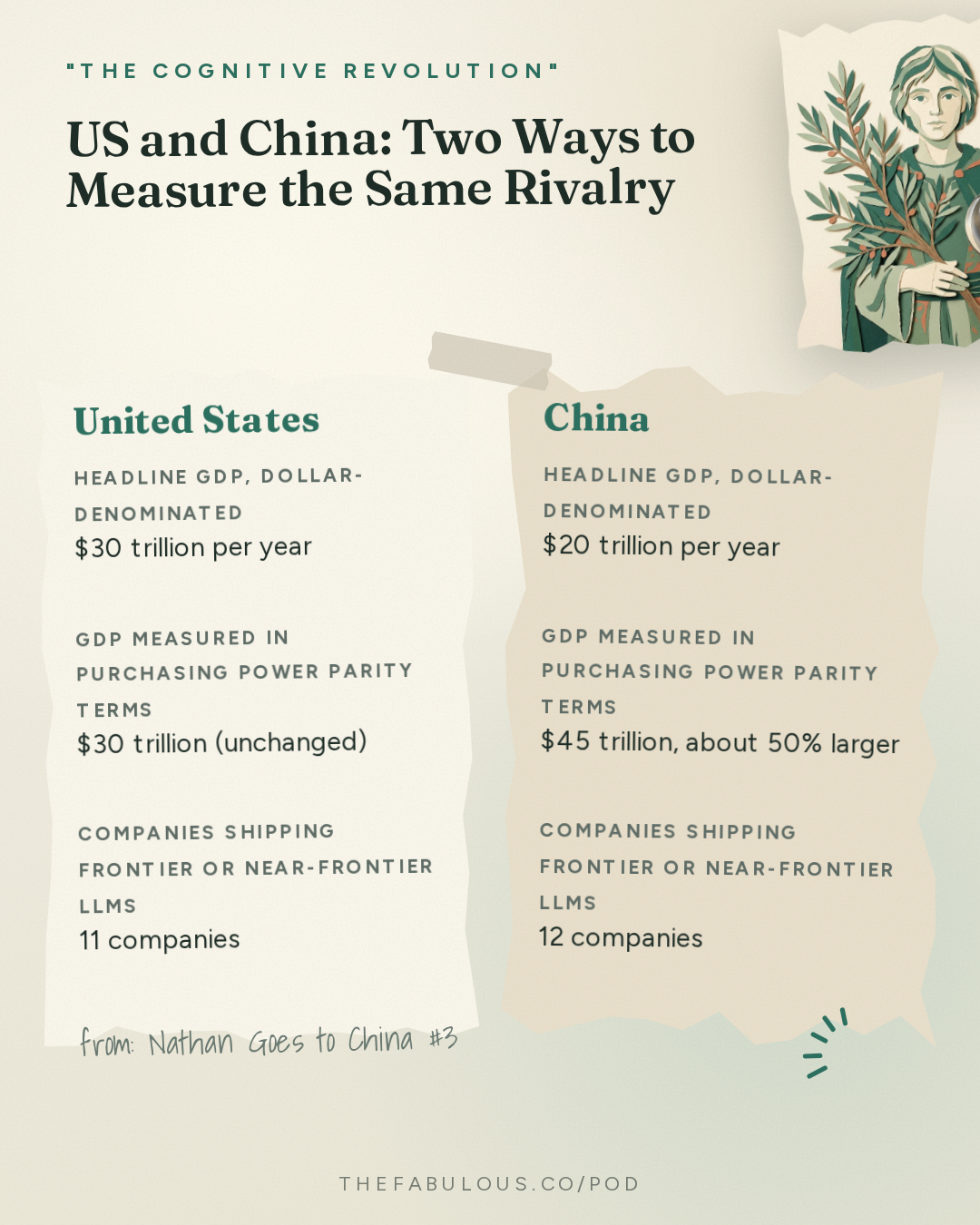
The economic evidence backs some of this up. Headline dollar GDP puts the US ahead, at $30 trillion against China's $20 trillion (28:37). But converted into purchasing power parity, a method that measures what money actually buys inside a country rather than what it converts to at the exchange rate, the picture flips: China's economy measures at $45 trillion, about 50 percent larger than the American figure (29:05). Labenz points to cheap dinners, $12 pedicures, and 200-mile-per-hour trains that run on schedule as everyday confirmation that the PPP story is the more honest one (25:57, 30:39).
China's AI buildup follows the same long-arc pattern. Its first five-year plan to mention artificial intelligence was adopted in 2016, the same year Google declared itself an AI-first company (46:28). By Labenz's count, roughly 11 American companies and 12 Chinese companies are currently shipping frontier or near-frontier large language models (47:25), a rough parity that undercuts the idea that China is merely fast-following a purely American invention.
Trading Chips for Trust
None of this makes Labenz an uncritical China booster. He flags real vulnerabilities: an aging population projected to shrink from 1.4 billion to 800 million (106:03), no visible succession plan behind the 73-year-old President Xi, and a military that, like Russia's before Ukraine, has not been tested in decades and may not know its own strength.
His policy proposals, though, are aimed almost entirely at the American side of the ledger. He is skeptical of export controls, not because they fail to slow China, but because the rationale keeps shrinking, from denying military applications, to denying frontier models, to now limiting how many AI agents Chinese firms can run (127:06). He also argues the controls have a chilling effect nobody talks about: American AI safety researchers, worried about violating rules they do not fully understand, are quietly avoiding collaborations with Chinese counterparts who would otherwise welcome them (132:45).
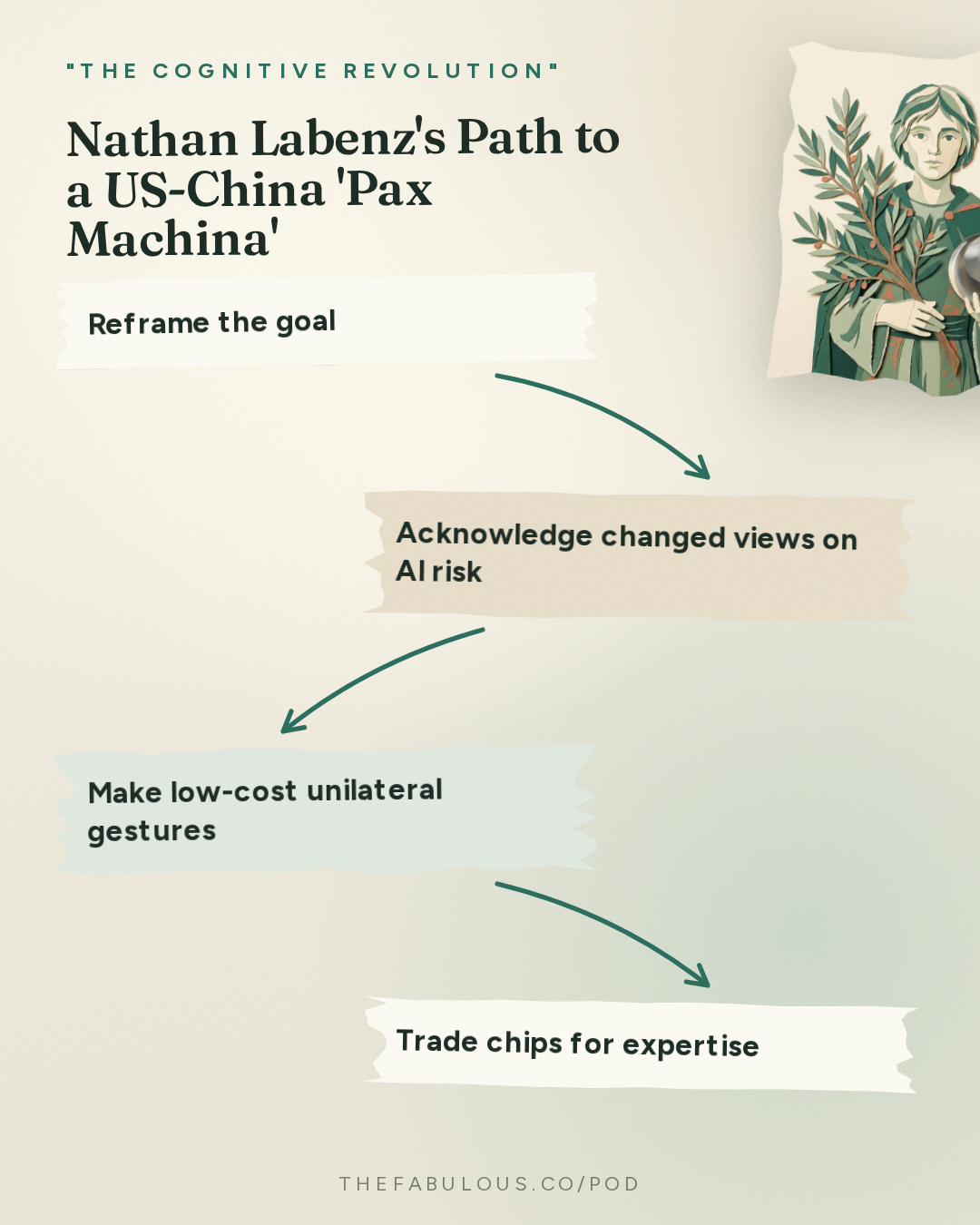
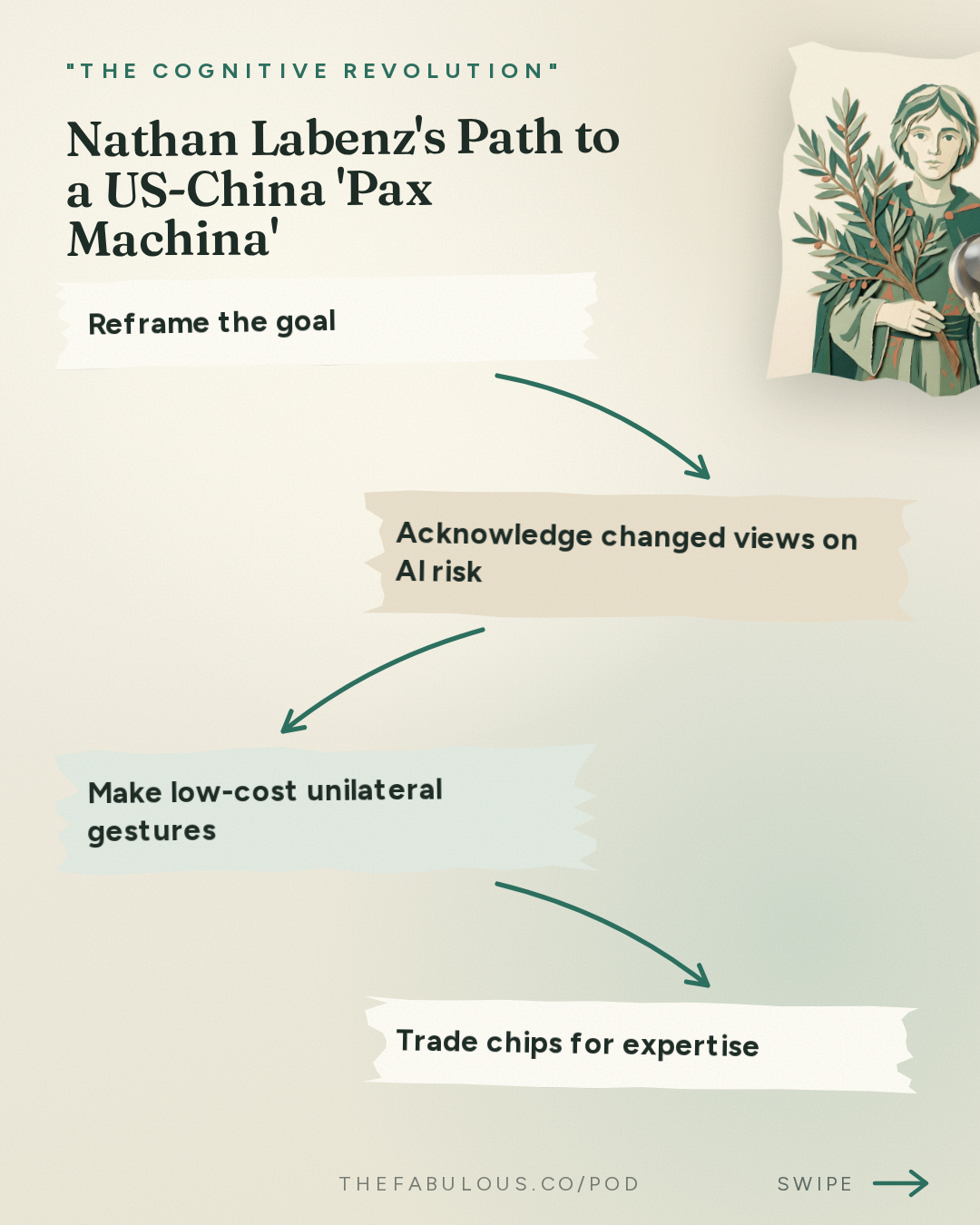
His alternative is a series of trust-building trades. Sell chips in exchange for Chinese expertise in batteries, solar, and robotics, with manufacturing located in the US. Let Huawei back into Western markets once formal verification methods, mathematical techniques for proving what software will and will not do, can certify its equipment does not phone home. Most strikingly, use confidential computing, a technique that lets one party run a program over another party's data without ever seeing the data itself, so each government's AI systems could review the other's sensitive communications and simply certify that no attack is being planned, without either side reading the other's transcripts (177:05).
The unifying worry behind all of this is what Labenz calls legibility. Right now, American and Chinese AI run on roughly the same paradigm, are trained on similar hardware assumptions, and are published, in China's case, in English. That mutual visibility, he argues, is what prevents catastrophic miscalculation. If the chip ban pushes China entirely onto its own silicon and its own closed research culture, both countries lose the ability to know what the other has, and that unknown is far more dangerous than any near-term capability gap.
The essay closes on a case for optimism that Labenz calls hyperstition, the idea that a boldly stated belief about the future can help bring that future into being.
"If you believe it's possible, then it might become possible. But if you don't believe it's possible, then by definition, you've already closed off the possibility." — Nathan Labenz (151:35)
He wants the upcoming Trump-Xi summit treated as a genuine opening rather than a photo op, and he wants both governments to agree, at minimum, never to train general-purpose AI systems to pursue military objectives "by any means necessary," the same instinct that makes commercial AI systems unpredictable when let loose in competitive markets. Whether any of this survives contact with actual diplomacy is an open question. But Labenz's real argument is smaller and harder to dismiss: the two countries are not choosing whether China becomes a technological power. That happened. The only choice left is whether the two powers stay legible to each other, or drift into separate, unreadable futures.
Ask this episode anything
Pod's AI answers from the episode itself, with the minute mark so you can hear it yourself.
Or start with one of these
Ask this episode
Pod's AI listens to the whole episode to answer, and points you to the minute it comes from.
The rest of this answer, and any question after it
Answers come from the episode itself, never from a summary of it.
ContinueKey takeaways
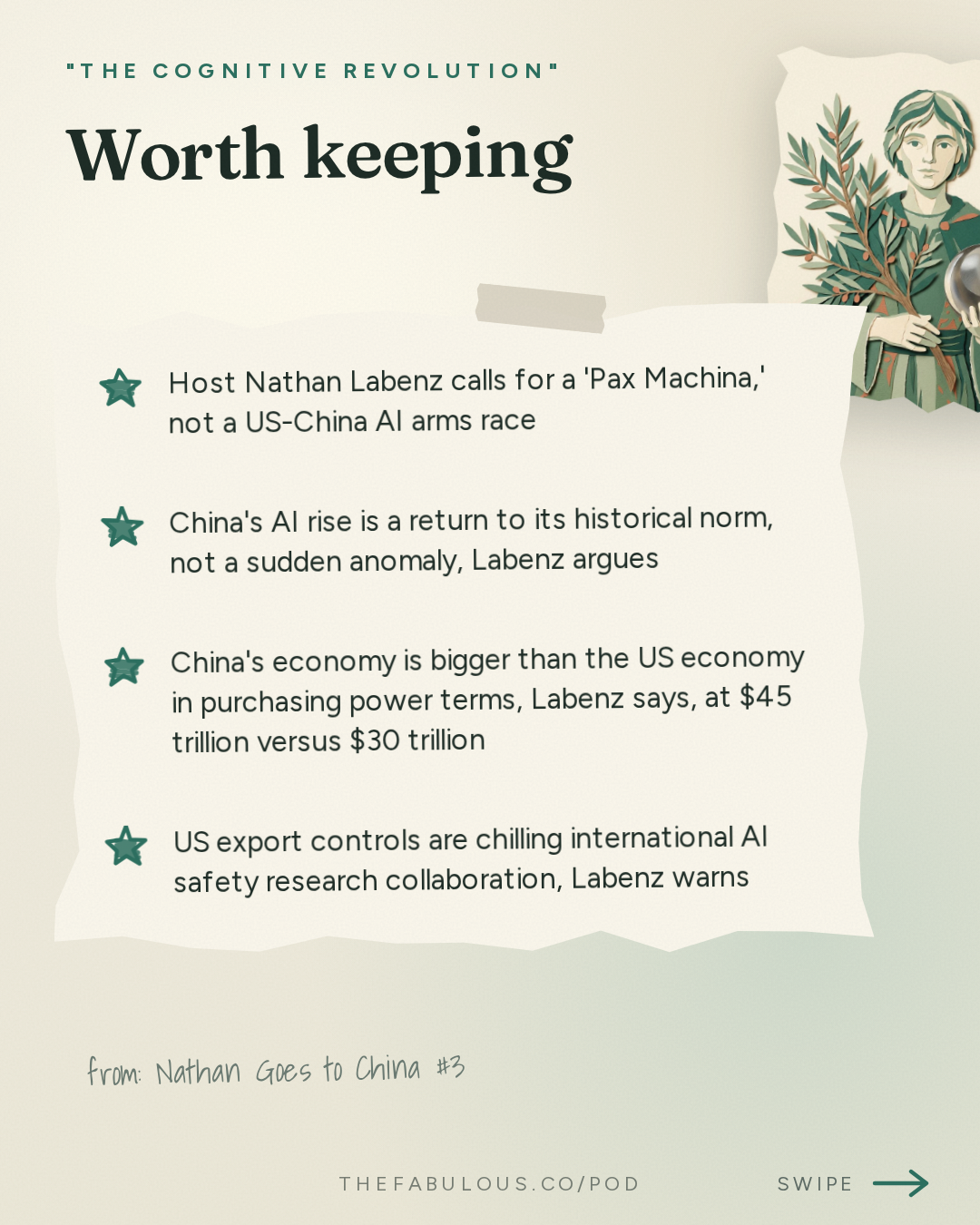
- Host Nathan Labenz calls for a 'Pax Machina,' not a US-China AI arms race
- China's AI rise is a return to its historical norm, not a sudden anomaly, Labenz argues
- China's economy is bigger than the US economy in purchasing power terms, Labenz says, at $45 trillion versus $30 trillion
- US export controls are chilling international AI safety research collaboration, Labenz warns
- Labenz proposes confidential computing so the US and China can verify each other's AI safety claims without exposing secrets
The episode in cards
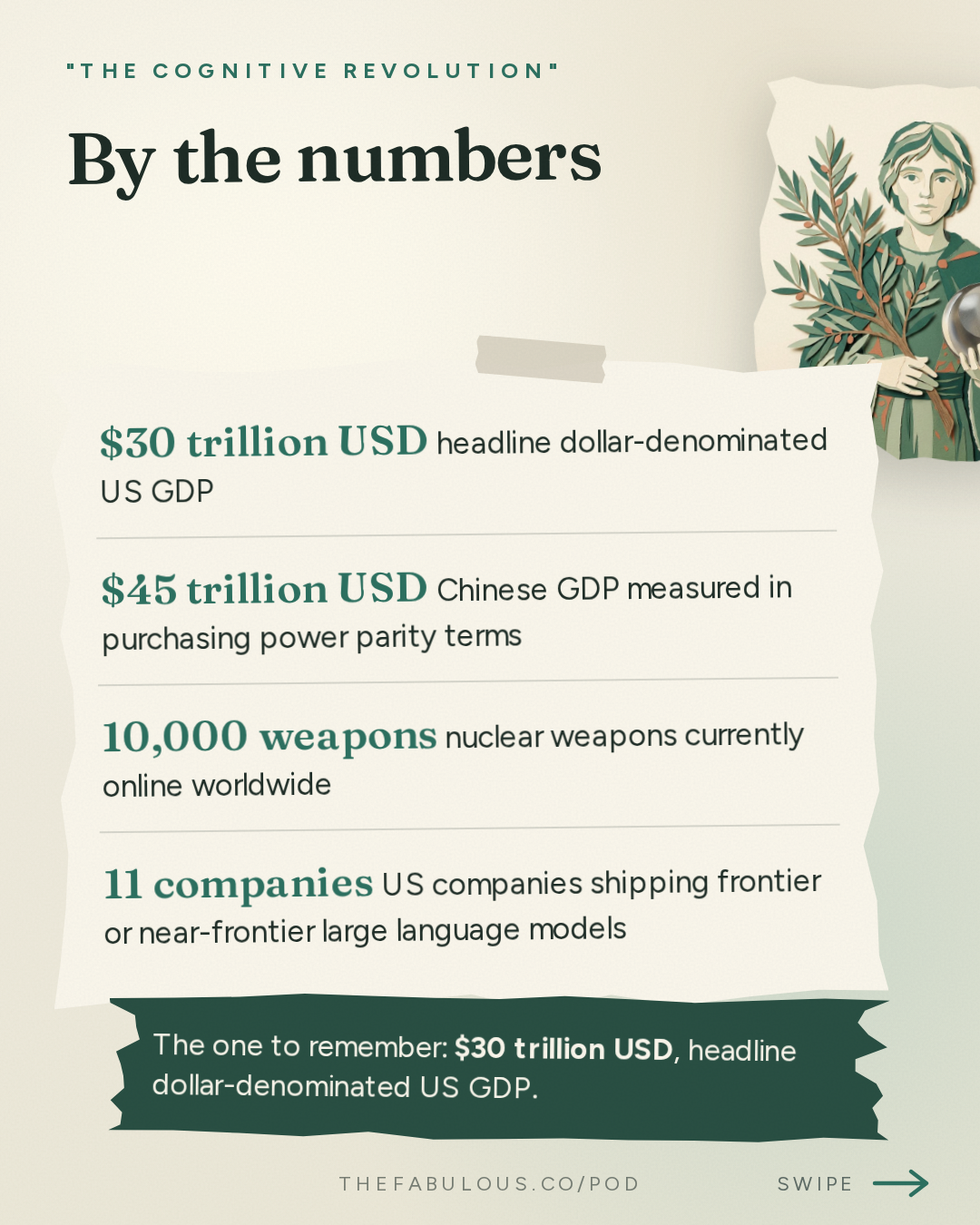


By the numbers
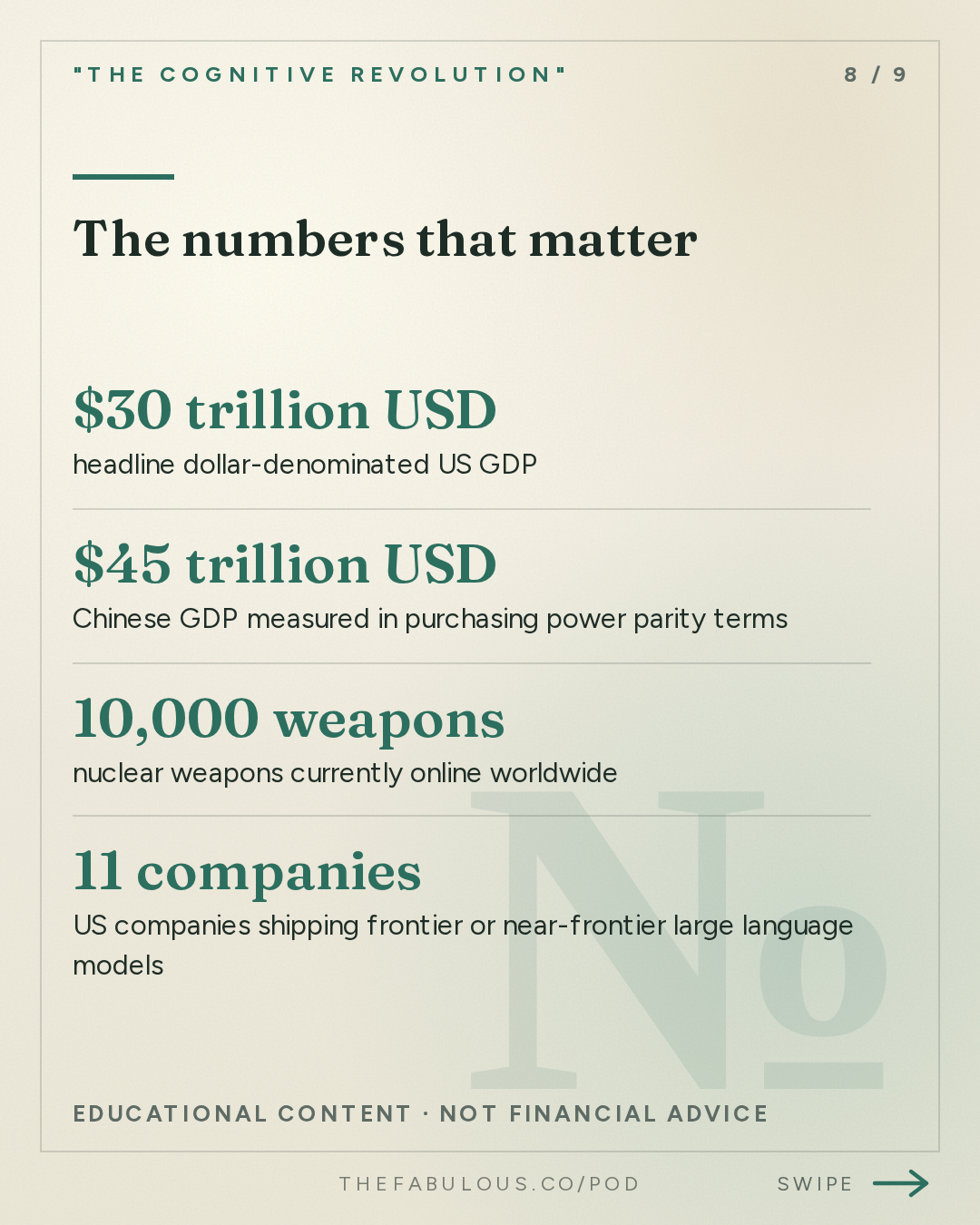
- $30 trillion USD headline dollar-denominated US GDP
- $45 trillion USD Chinese GDP measured in purchasing power parity terms
- 10,000 weapons nuclear weapons currently online worldwide
- 11 companies US companies shipping frontier or near-frontier large language models
- 12 companies Chinese companies shipping frontier or near-frontier large language models
- $7 trillion USD funding OpenAI CEO Sam Altman requested for a global AI chip build-out
In their words
“And the goal that I have in everything that I'm gonna articulate today is achieving what I'll call a pax machina between the United States and China.”
“In China, I think they are living their eternal 1991 right now. Times have never been better in any living memory than they are right now.”
“We should jointly oppose overstretching the national security concept in the field of AI and placing one country's security over that of others.”
“If you believe it's possible, then it might become possible. But if you don't believe it's possible, then by definition, you've already closed off the possibility.”
Protocols
-
Trade chips for green-tech know-how
Nathan Labenz proposes that the US allow chip sales into China in exchange for Chinese expertise in solar energy, batteries, and robotics, paired with Chinese manufacturing located inside the United States.
one-time trade framework proposed ahead of the Trump-Xi summit
-
Exempt AI safety collaboration from export controls
Nathan Labenz recommends that the US government state clearly that chip export controls are not meant to block AI safety and control research collaborations with Chinese researchers.
immediate policy clarification, ideally before the summit
-
Audit AI systems through confidential computing
Nathan Labenz suggests that frontier AI companies give outside auditors access to log data, usage data, and test results through a confidential computing environment rather than raw data, so trade secrets stay protected while auditors gain real visibility.
ongoing auditing arrangement
-
Let Huawei re-enter the US market once formally verified
Nathan Labenz proposes that the US develop a formal-methods security standard so that Huawei can prove its software never sends data back to China, and that Huawei be allowed to compete freely in the US market once it meets that standard.
future one-time policy standard, not immediate
Questions this episode answers
What does 'Pax Machina' mean in US-China AI relations?
Podcast host Nathan Labenz uses the term to describe a proposed goal for US-China relations in which both countries share the economic and health benefits of AI without triggering an arms race or a new nuclear-style standoff (00:27). He frames it as an alternative to policy debates that assume the only options are total victory or total loss.
Is China's rise in AI a recent surge or a long-term trend?
China's first five-year plan to mention artificial intelligence was adopted in 2016, the same year Google declared itself an AI-first company, showing systematic investment predating the ChatGPT moment by years (46:28). By 2022, a Chinese company topped the SuperGLUE leaderboard, evidence that competition was already close before ChatGPT's public debut (48:47).
How does China's economy compare to the US economy?
In headline dollar terms, US GDP is about $30 trillion against China's $20 trillion, making the US appear 50% larger (28:37). But measured in purchasing power parity, a method reflecting what money actually buys locally, China's economy is about $45 trillion, roughly 50% larger than the US figure (29:05).
Do US chip export controls actually slow down Chinese AI development?
Nathan Labenz says the controls are having some effect but their stated purpose keeps narrowing, from blocking military uses to now limiting the number of AI agents Chinese firms can run (127:06). He also notes Chinese company Meituan trained its Longcat model entirely on Huawei Ascend chips, showing frontier-adjacent training without Nvidia hardware is already possible (128:17).
What is the DeepSeek RL Zero paper and why does it matter?
Released in January 2025, the paper showed that reasoning and metacognitive behavior can emerge from pure reinforcement learning without supervised fine-tuning (83:18). Nathan Labenz calls it one of the most important AI papers he has read because it demonstrated a path to better chain-of-thought reasoning shared openly in English by a Chinese lab.
How could the US and China verify each other's AI safety claims without spying?
Nathan Labenz proposes confidential computing, a method that lets one party run analysis over another party's data without ever viewing the raw data itself (177:05). He suggests this could extend to reviewing government communications so each side can confirm the other is not planning an attack without exposing the actual transcripts.
The full read, in cards
Go deeper
- Machines of Loving Grace — Dario Amodei's essay imagining an AI-driven age of abundance, which Labenz endorses in part while rejecting its 'coalition of democracies' framing of China
- DeepSeek RL Zero paper — showed that reasoning and metacognitive behavior can emerge from pure reinforcement learning without supervised fine-tuning
- AI 2027 / AI 2040 — scenario forecasts by Daniel Kokotajlo and co-authors proposing ideas like mutually placed, mutually destructible data centers to build strategic trust
- Liquid Rain — proposed weakly encrypting surveillance footage so it can be decoded case-by-case rather than analyzed in bulk, balancing safety and privacy
Mentioned
President Xi · Donald Trump · Dario Amodei · Anthropic · Huawei · DeepSeek · Tsinghua University · Machines of Loving Grace · OpenAI · Tesla · Meituan · He Jiankui · Sam Altman · Elon Musk · Daniel Kokotajlo
More from this show and category

AI's Real Bottleneck: Credit, Not Chips
AI's current bottleneck isn't power or chips, it's credit: lenders can't value a GPU cluster as collateral, so only cash-rich labs can build. The episode also covers a rosy interpretability essay that Zvi Moskowitz says oversells itself, a thesis that chip supply chains will outearn AI software, and Anthropic's leaked federal AI bill.

Biohub's $1.8B Virtual Biology Initiative Explained
Biohub's $1.8 billion Virtual Biology Initiative bets that AI can't model cells until scientists can see inside them better. Head of science Alex Rives argues measurement, not model architecture, is the real bottleneck, pointing to new tools like the laser phase plate and transparent zebrafish imaging, with an information theoretic model of the cell possible within five years (17:39).

How AI Models Actually Decide: Critical Tokens
Goodfire researcher Eric Bigelow finds that an AI model's final answer can hinge on one random token, not step-by-step logic. He also warns that reinforcement learning erodes chain of thought reliability, pushing models toward compressed shorthand that is hard to monitor, even as interpretability funding lags far behind capability spending.

AI Token Spend Now Beats Human Salaries
A frontier lab executive told podcast host Nathan Labenz that humanity probably shouldn't exceed some future level of AI intelligence. He said he'd accept a flop cap on the next pretraining run, and the episode also covers a 4.5x jump in AI memory prices, Positron's new inference chip, and why Latent Space's Shawn Wang says most SaaS software is 'cooked.'
