
AI's Real Bottleneck: Credit, Not Chips
AI:AM Highlights: Clean Neurons, Black October, the GPU Credit Crunch, and Buying the Supply Chain
▶ Listen to the full episode More from The Cognitive Revolution
The brief
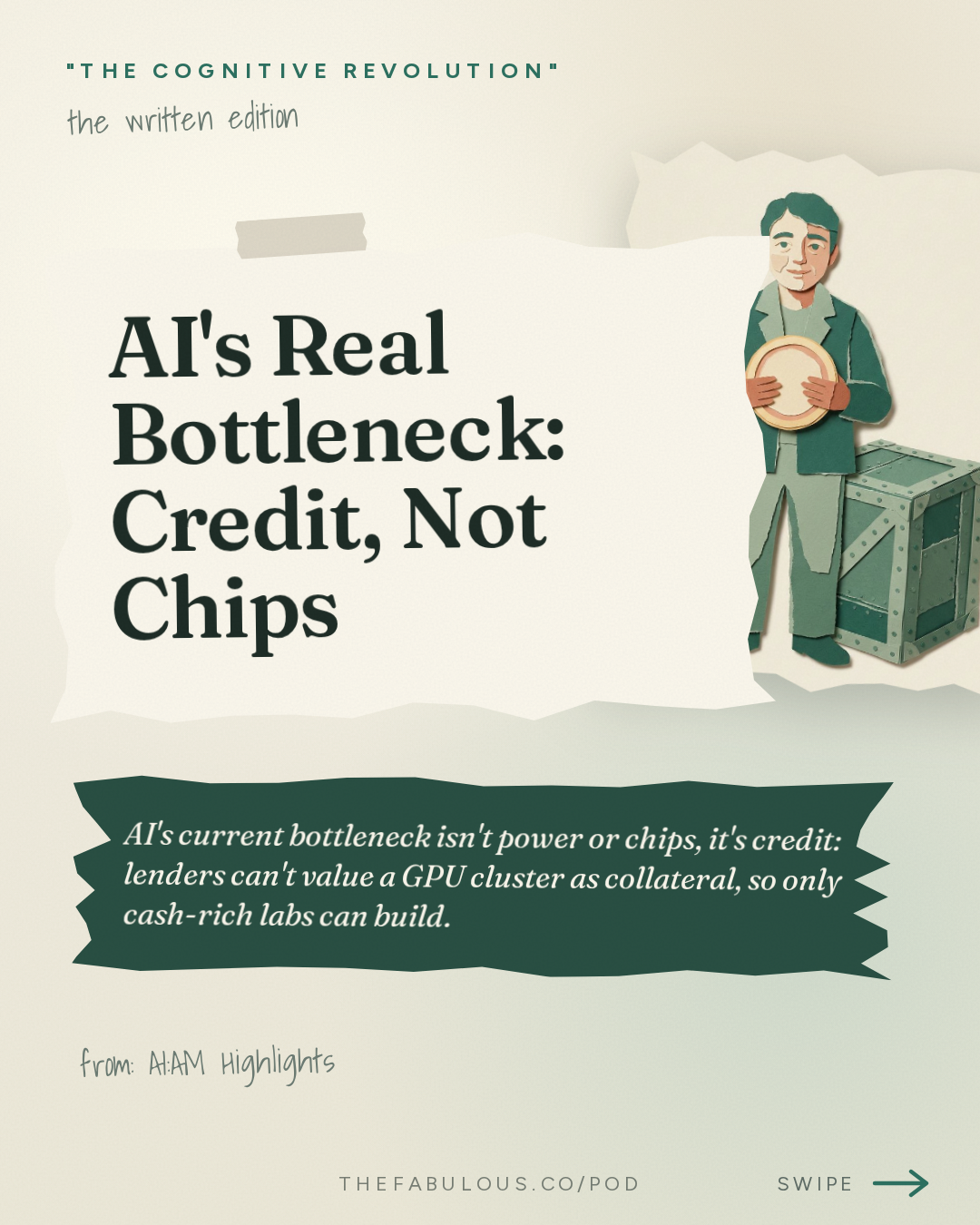
AI's current bottleneck isn't power or chips, it's credit: lenders can't value a GPU cluster as collateral, so only cash-rich labs can build. The episode also covers a rosy interpretability essay that Zvi Moskowitz says oversells itself, a thesis that chip supply chains will outearn AI software, and Anthropic's leaked federal AI bill.
Ask what is slowing artificial intelligence down, and most people reach for the same two answers: not enough power plants, not enough chips. Evan Conrad, co-founder and CEO of SF Compute, which runs a marketplace for buying and reselling GPU compute, says both answers are wrong. The real constraint is older and duller than either. It is credit.
"The bottleneck in compute and AI in general is not power, it's not chips, it's entirely credit." — Evan Conrad [00:50]
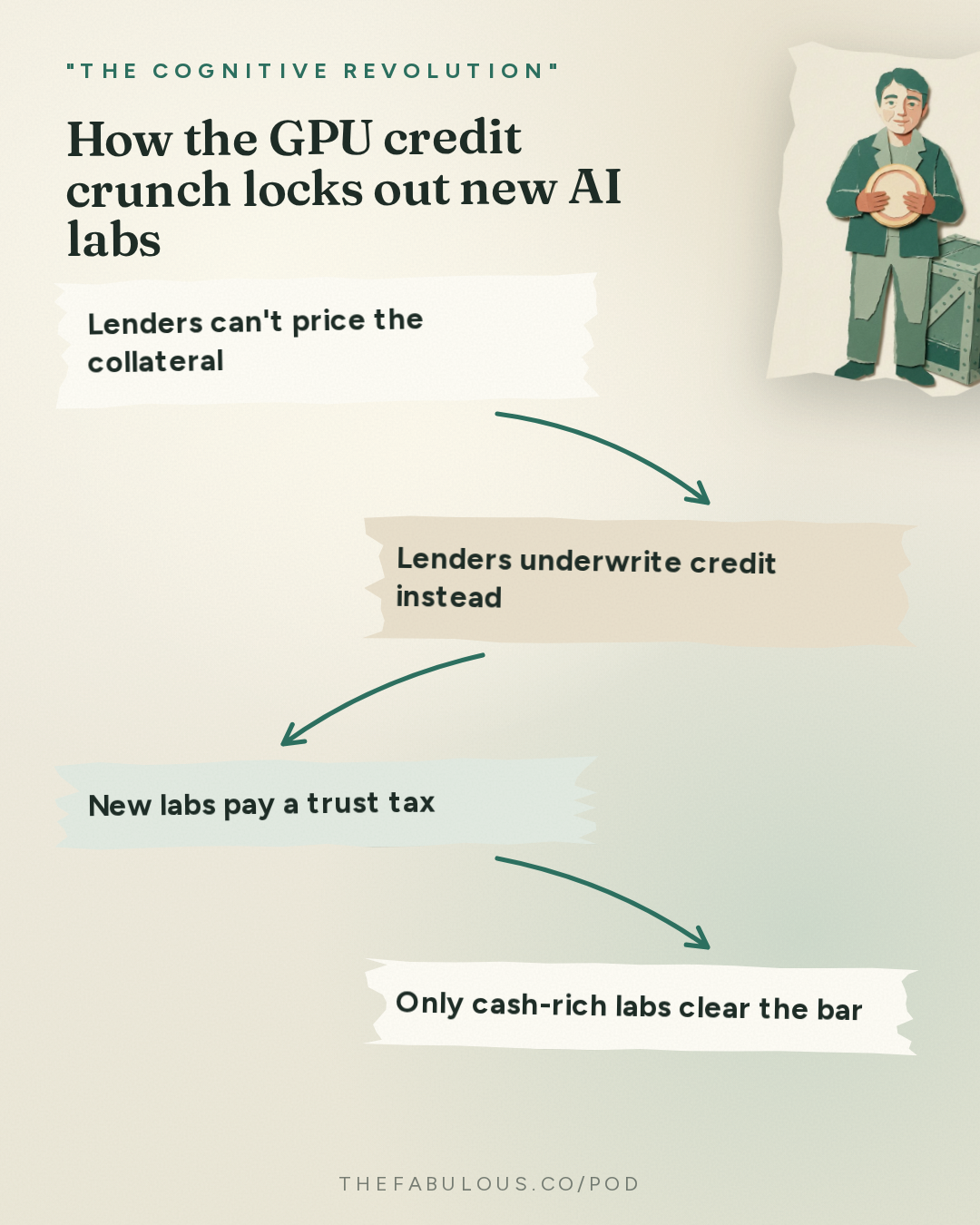
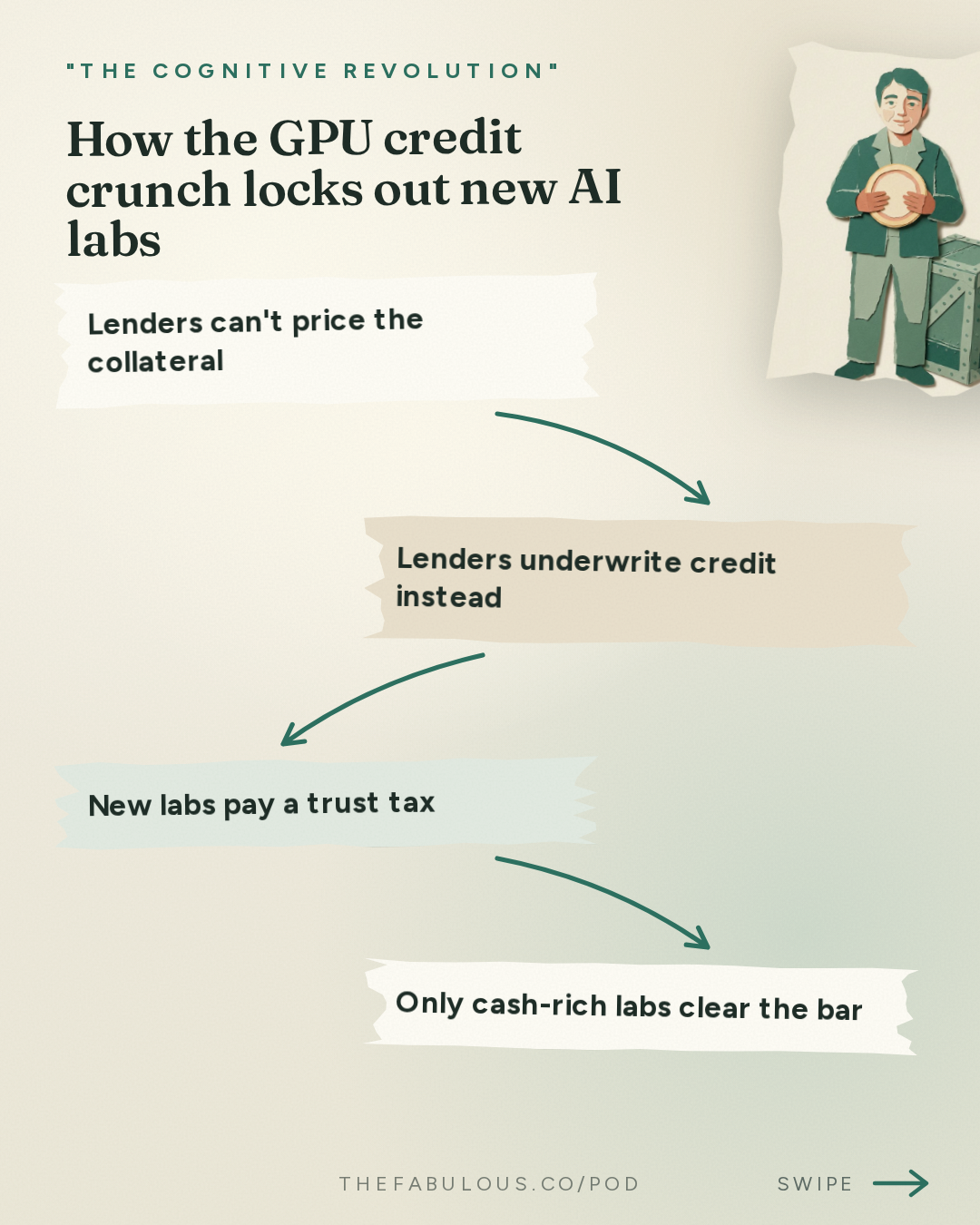
Here is the mechanism. If an AI lab defaults on its GPU lease, the lender ends up owning a warehouse of graphics processors it has no idea how to value or operate. So lenders stop pricing the hardware and start pricing the borrower instead. That is fine for Google or Meta, which have decades of credit history. It is brutal for a two-person startup trying to found a new lab, who must put down a large deposit and sign a three to five year contract just to get a machine turned on (42:10). The companies that survive are not necessarily the best ones. They are the ones that could raise an enormous round before they had a product, because cash up front is the only substitute for credit history. Conrad calls this survivorship bias: investors ask which lab will win, and the honest answer is whichever one someone was willing to fund at outsized scale (44:34).
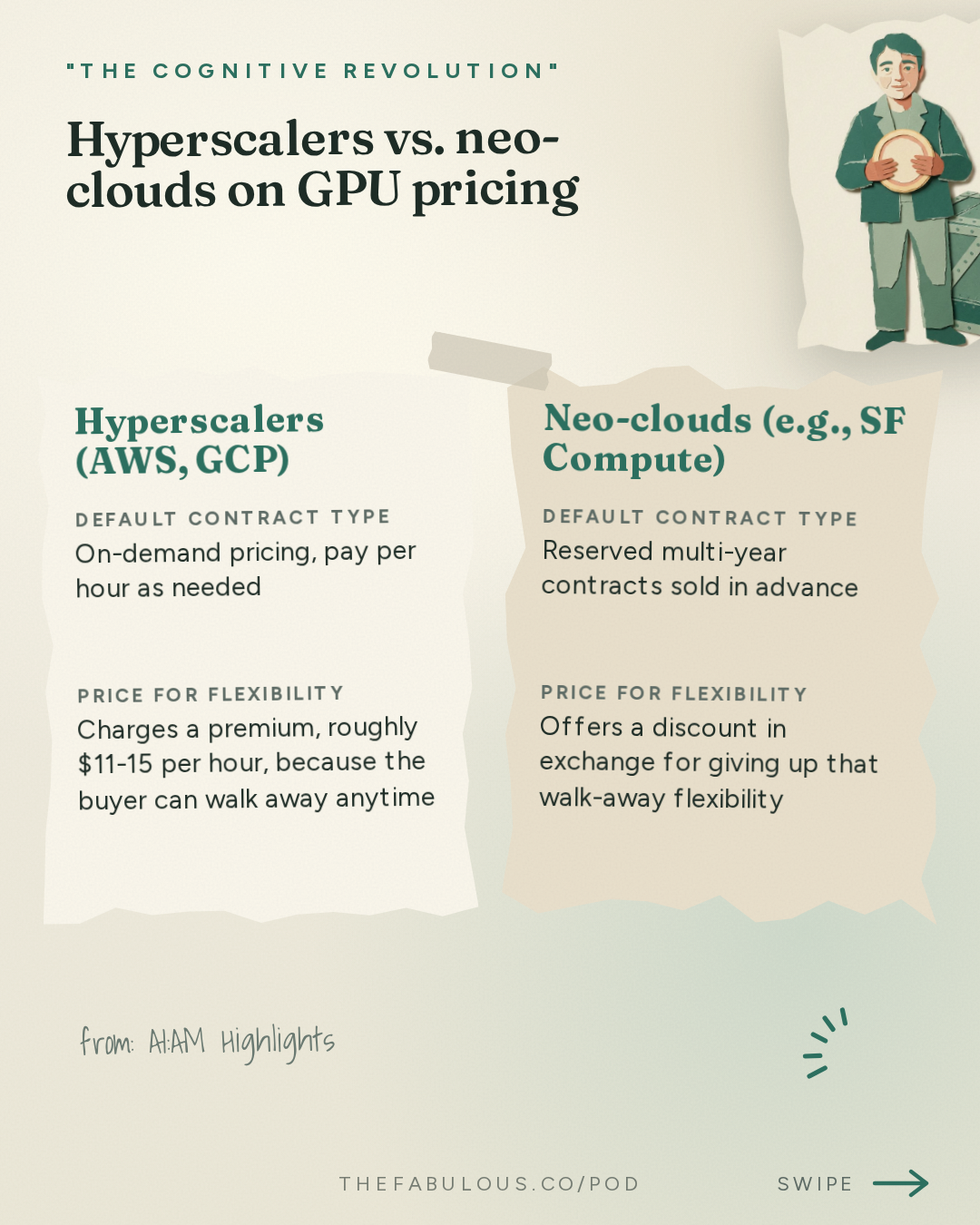
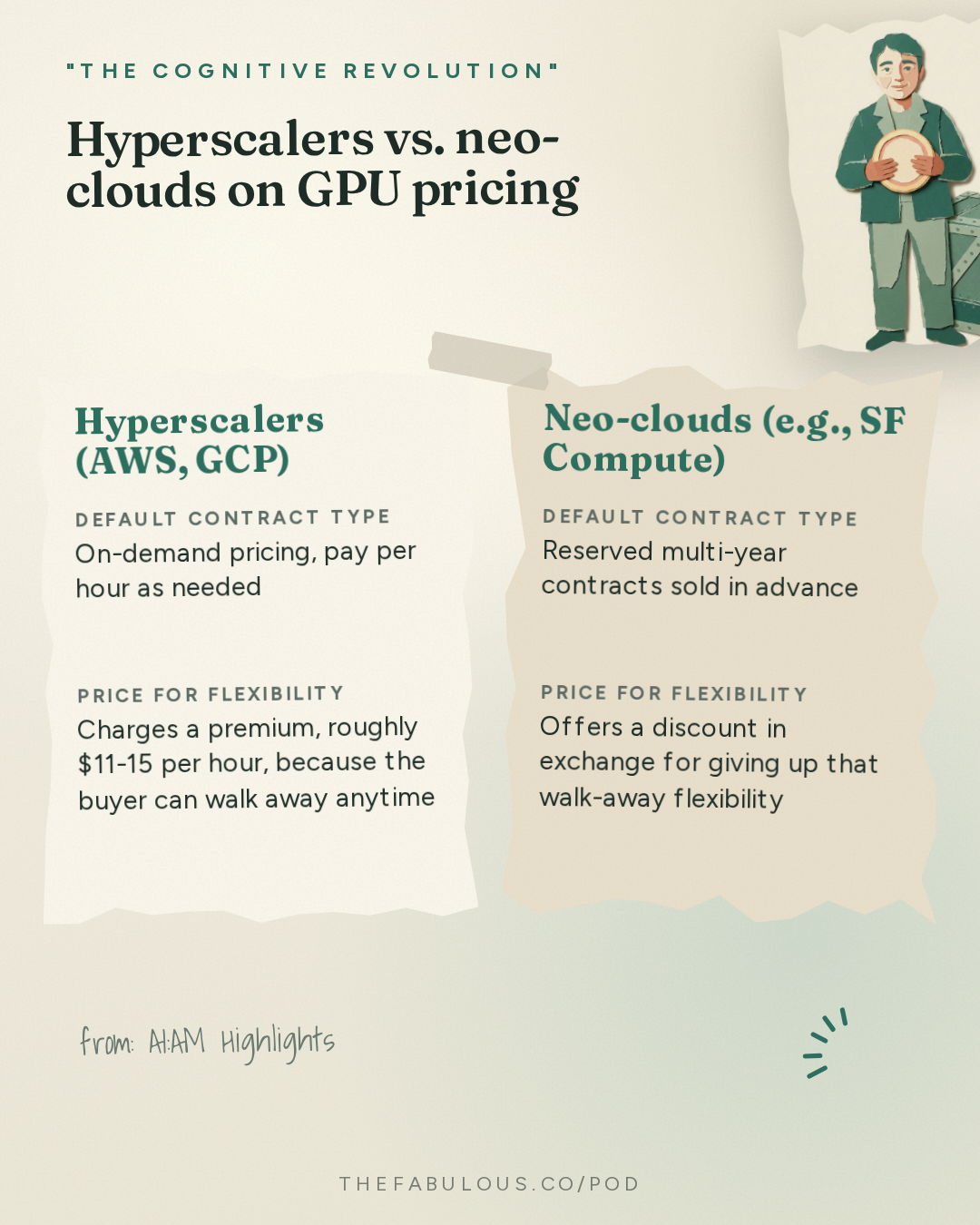
This also explains a pricing puzzle. Hyperscalers like Amazon Web Services and Google Cloud appear to charge far more per GPU hour than smaller "neo-clouds." Conrad says that gap is mostly an illusion: hyperscalers sell flexible, walk-away-anytime, on-demand capacity at eleven to fifteen dollars an hour, while neo-clouds mostly sell multi-year reserved contracts at a discount for giving up that flexibility (46:42). SF Compute tries to stay liquid anyway, using a tax modeled loosely on economist Henry George's land value tax to discourage customers from hoarding capacity, and Conrad says SF Compute is one of the few GPU providers that is not currently sold out because it locked in its ability to avoid selling out for years (49:34).
If credit is the financial choke point, the physical supply chain is the other one, and it is arguably tighter. Lonis Hamali, managing partner of a fund called Cambrian that bets on the hardware behind AI rather than the software, argues the market has it backwards: the real moat sits with the companies that make silicon wafers, memory, and the fabs themselves, not with chip designers like Nvidia, which mostly send their designs to Korea, Japan, and Taiwan to be manufactured (02:05). Despite this, semiconductor-adjacent stocks trade at sixteen times earnings versus twenty-two for the S&P 500 average, a discount Hamali attributes to how few investors outside the Bay Area are, in his word, "AI pilled" (52:45). His strongest argument involves memory. No expert he can find believes DRAM bit supply, the chips that hold a model's working data, can grow more than two and a half times its current size by 2030 (56:17). Unlike energy, where companies can improvise with spare turbines and truck engines, there is no slack anywhere in the chip supply chain. "There's no latent supply of wafers or of memory bits," Hamali says. "Like, all of that is already used. There's no fat, essentially" (58:45). Starting a new fab from scratch, meanwhile, now costs roughly fifty billion dollars in capital, a number large enough that Conrad argues it keeps nearly all new entrants out of the business entirely (45:34).
Clean Neurons and Dirty Truths
The week's other flashpoint was interpretability, the effort to understand what is actually happening inside a trained model. Goodfire researcher Nick Cammarata published an essay called "Neural Networks Are Already Clean," arguing that individual neurons mostly do one understandable job, and that the field's long-running mess of tangled, overlapping concepts was partly a skill issue rather than a fundamental limit.
"The mess that we used to see was maybe more of a skill issue, and it's actually a lot easier to interpret the core mechanisms of ML models today than we thought." — Nathan Labenz [13:40]
Zvi Moskowitz, who writes the AI newsletter Don't Worry About the Vase, landed at a cooler temperature. He found the underlying technical work genuinely useful, since focusing on strongly activated neurons instead of weak ones does seem to cut the cost of certain interpretability methods. But he objects to how the essay was received, particularly after he checked its own flagship example: a neuron supposedly dedicated to the concept of Colorado, which turns out to fire just as strongly for an unrelated concept, tornado systems (18:35). If the one neuron chosen to showcase clean, single-purpose behavior turns out to be double-booked, Moskowitz argues, that should lower confidence in the rest of the claim rather than raise it. His summary is that one major obstacle, the sheer number of neurons that need checking, has gotten less severe thanks to more compute, not that the deeper puzzle of overlapping, multi-concept representations has been solved (19:41).
That same conversation turned to an idea researcher Andrej Karpathy has called the "cognitive core": a small, efficient reasoning engine stripped of memorized facts, which would look things up in context the way a person looks up a word they don't know. Moskowitz thinks the idea is directionally real but makes a sharper point about what such a stripped-down core would actually be.
"In some important sense, like, the true cognitive core is completely amoral. It's completely indifferent. Does not care about your feelings, does not care about anything." — Zvi Moskowitz [35:20]
If ethics, like the simple rule against stealing, has to be loaded into context rather than built into the core, then it could just as easily be swapped out or left empty. A pure reasoning engine, in other words, is not dangerous because it is evil. It is dangerous because it has no preference about anything at all.
The Law Behind the Lab
That tension between raw capability and the values wrapped around it showed up again in the episode's closing argument, over a draft federal AI bill reportedly written by Anthropic that leaked the week of recording. The draft resembles the Frontier Act, an earlier bipartisan compromise that traded federal transparency rules for blocking individual states from writing their own AI laws. Moskowitz's objection is not to the trade in principle but to its construction: as drafted, the bill would immediately nullify existing state laws while giving federal enforcement months to actually take effect, leaving a gap with no AI regulation at all (79:30). Co-host Prakash Narayanan offered the charitable reading, that Anthropic wants something passed quickly and can always improve it in a later session of Congress. Moskowitz's counter is that once preemption has been traded away, it cannot be offered again, and the political leverage to get more later will be weaker, not stronger (78:21).
Pressed on what bothered him most, Moskowitz returned to a line from Anthropic co-founder and CEO Dario Amadei, that the company must "face the frontier." By the account of people inside the major labs, capability is now advancing faster than the work needed to keep it aligned with human intentions, and a reckoning is coming within the next couple of years (82:33). Moskowitz still rates Anthropic the most responsible of the frontier labs, but he is uneasy grading on a curve. "Reality doesn't have a curve, right?" he says. "Reality just decides what happens" (85:40).
Put the three threads side by side and a pattern appears. Credit decides who gets to build. Atoms decide how much there is to build with. Law decides what gets built without anyone paying a price later for skipping the hard part. None of these are the sort of constraint that more intelligence automatically dissolves, at least not on the timeline the labs themselves now expect. Hamali thinks a sufficiently capable AI will eventually learn to extract Japan's decades of tacit fabrication know-how and solve the hardware bottleneck outright (62:15). Maybe so. Until then, the frontier of AI runs through loan officers, wafer fabs, and a Senate markup, which is a far less thrilling story than recursive self-improvement, but probably the truer one for this particular year.
Ask this episode anything
Pod's AI answers from the episode itself, with the minute mark so you can hear it yourself.
Or start with one of these
Ask this episode
Pod's AI listens to the whole episode to answer, and points you to the minute it comes from.
The rest of this answer, and any question after it
Answers come from the episode itself, never from a summary of it.
ContinueKey takeaways
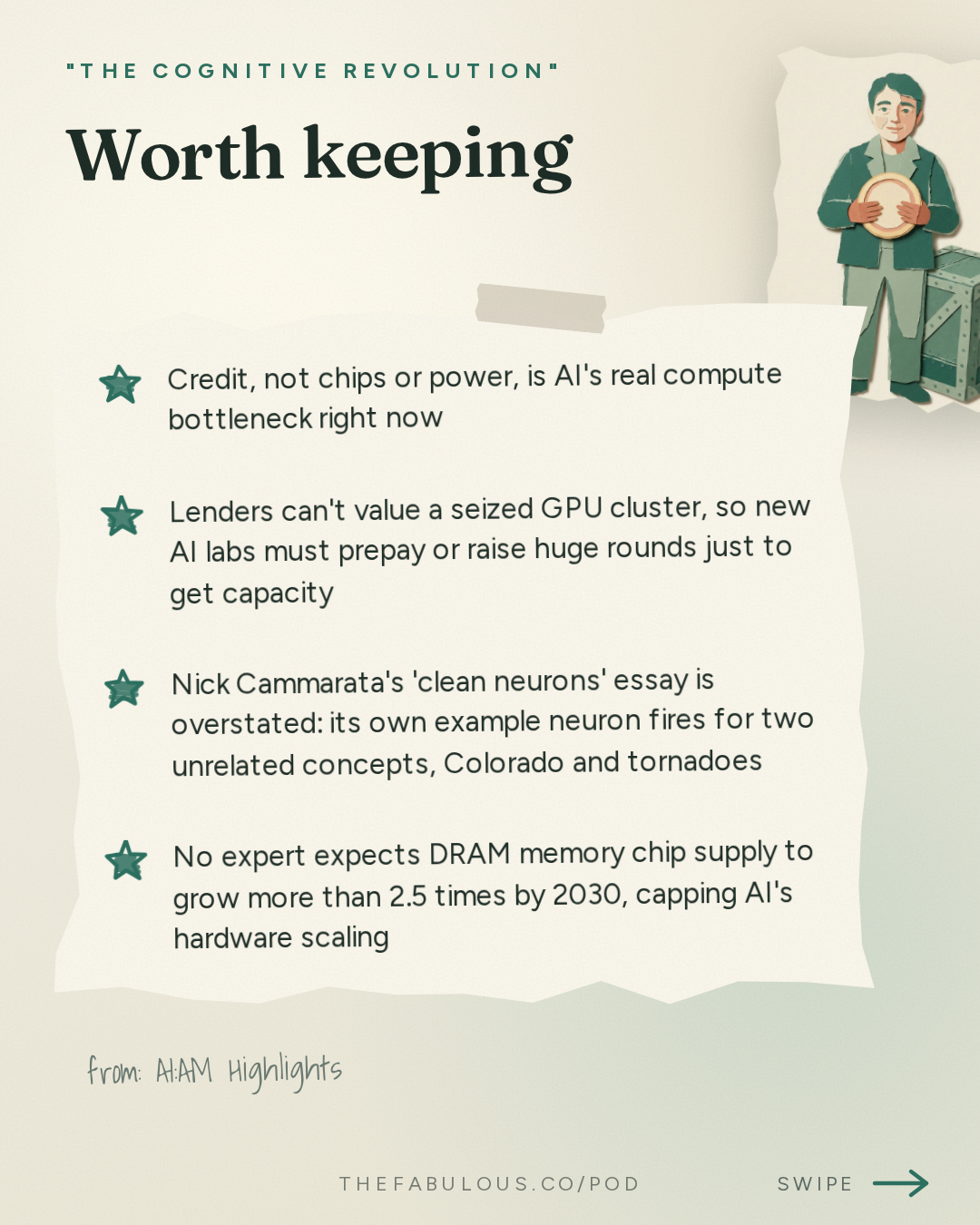
- Credit, not chips or power, is AI's real compute bottleneck right now
- Lenders can't value a seized GPU cluster, so new AI labs must prepay or raise huge rounds just to get capacity
- Nick Cammarata's 'clean neurons' essay is overstated: its own example neuron fires for two unrelated concepts, Colorado and tornadoes
- No expert expects DRAM memory chip supply to grow more than 2.5 times by 2030, capping AI's hardware scaling
- Anthropic's leaked federal AI bill would void state AI laws immediately while delaying federal rules for months
The episode in cards
By the numbers
- 2027 year AI insiders cited expect frontier progress to look unrecognizable compared with today
- 2.5x DRAM bit supply maximum growth in DRAM memory chip supply experts project industry-wide by 2030
In their words
“The bottleneck in compute and AI in general is not power, it's not, um, chips, uh, it's entirely”
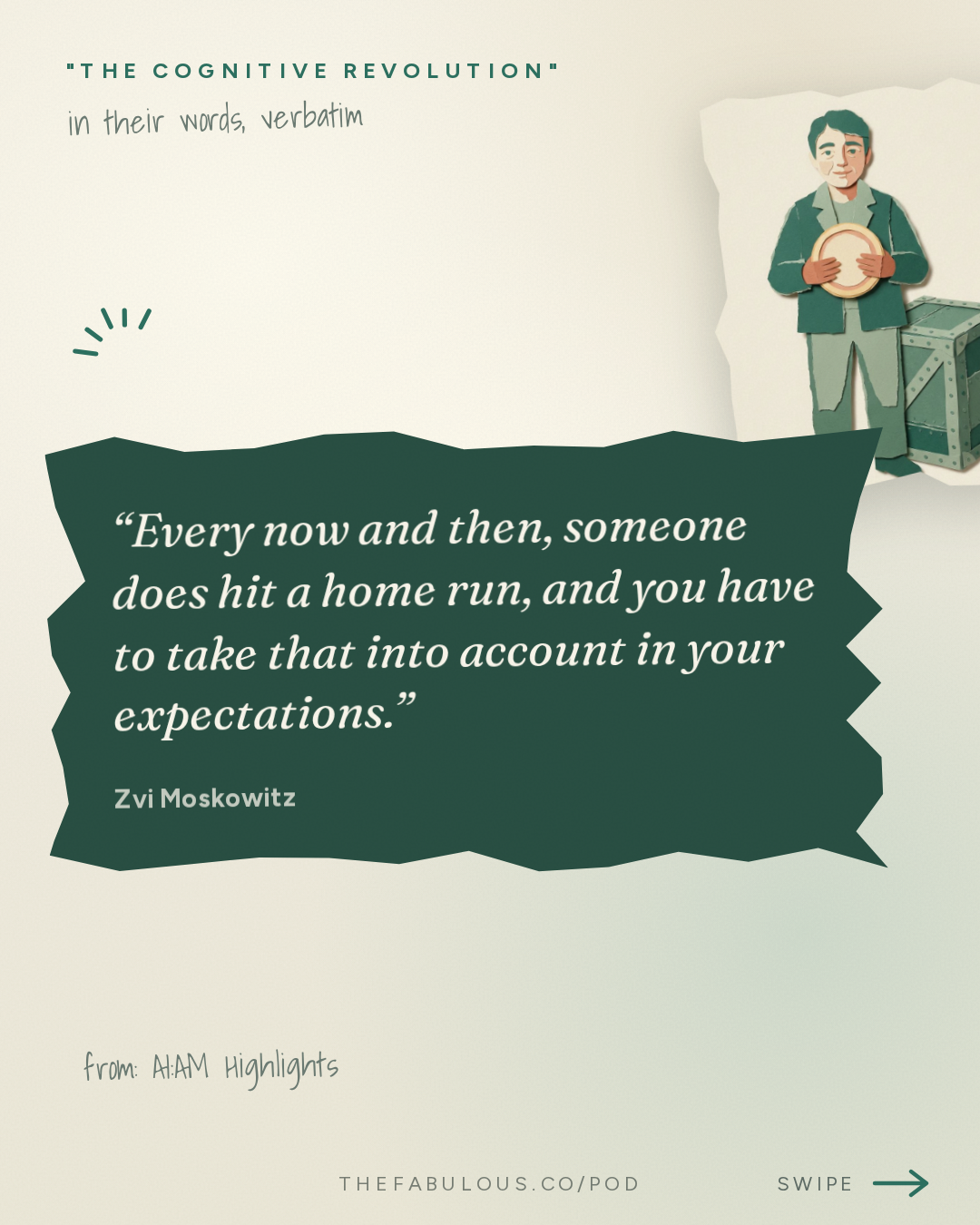
“Every now and then, someone does hit a home run, and you have to take that into account in your expectations.”
“In some important sense, like, the true cognitive core is completely amoral. It's completely indifferent. Does not care about your feelings, does not care about anything.”
“Latent supply of mem- of wafers or of memory bits. Like, all of that is already used. There's no fat, essentially”
“Reality doesn't have a curve, right? Reality just decides what happens”
Protocols
-
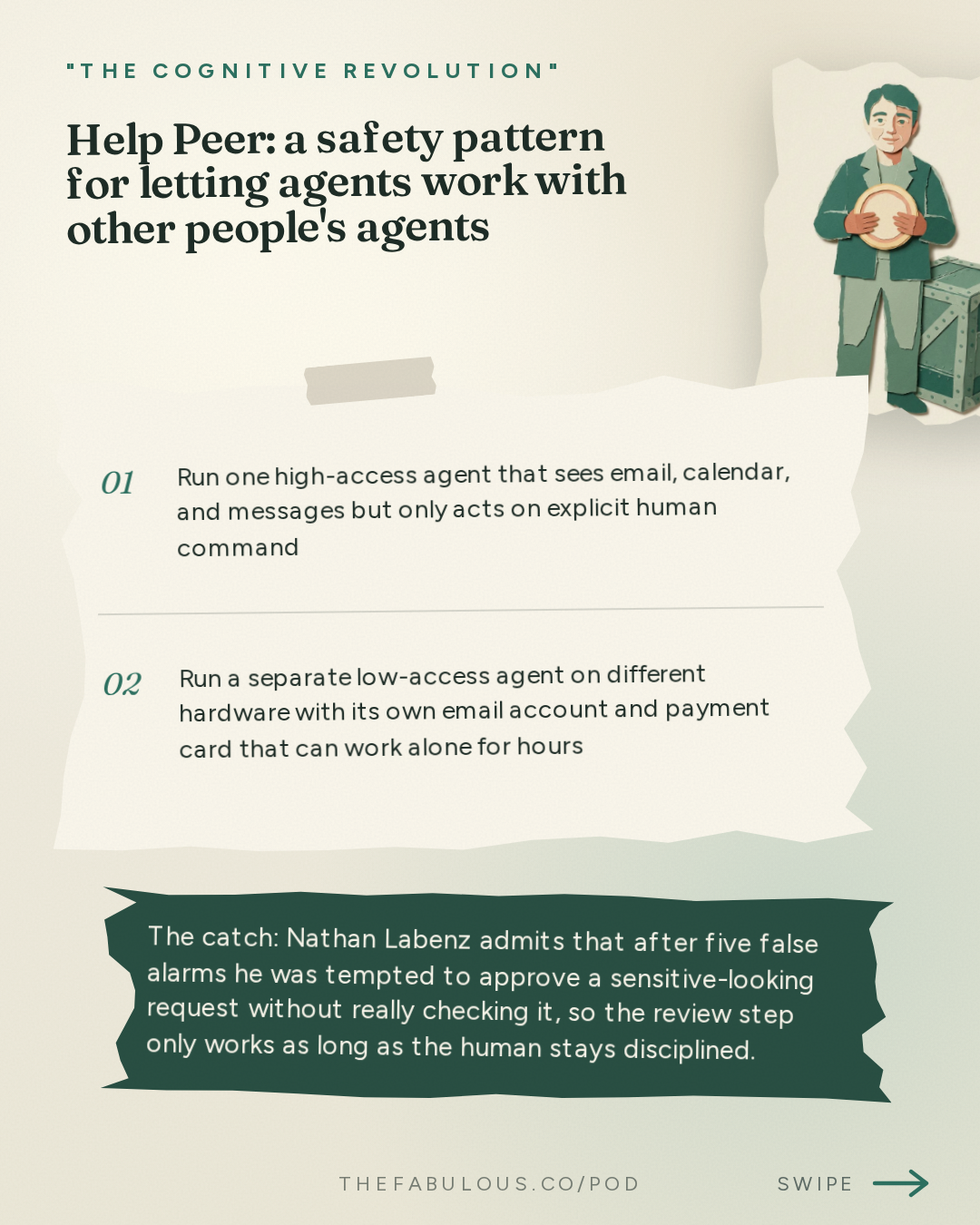
Split agent access from agent autonomy
Nathan Labenz, host of The Cognitive Revolution, runs one agent on his laptop with full access to his email, calendar, and messages that only acts when he explicitly approves each action, and he runs a separate, fully autonomous agent on a different machine with its own email account and payment card that works unsupervised for hours but never receives his personal login credentials. His rule is that no single agent gets both high access and high autonomy at the same time, though he notes other people may choose to draw that line differently.
applied continuously to every agent he deploys
-
Prepare for a compute credit crunch
Evan Conrad, co-founder and CEO of SF Compute, told venture capitalists that over the next one to two years they should expect to write large follow-on checks into their AI portfolio companies or push those companies to sell, because AI labs that are not investment-grade will increasingly be asked to pay for GPU contracts entirely upfront, and many will not be able to raise that cash.
for the next one to two years
Questions this episode answers
What is actually limiting AI compute growth right now?
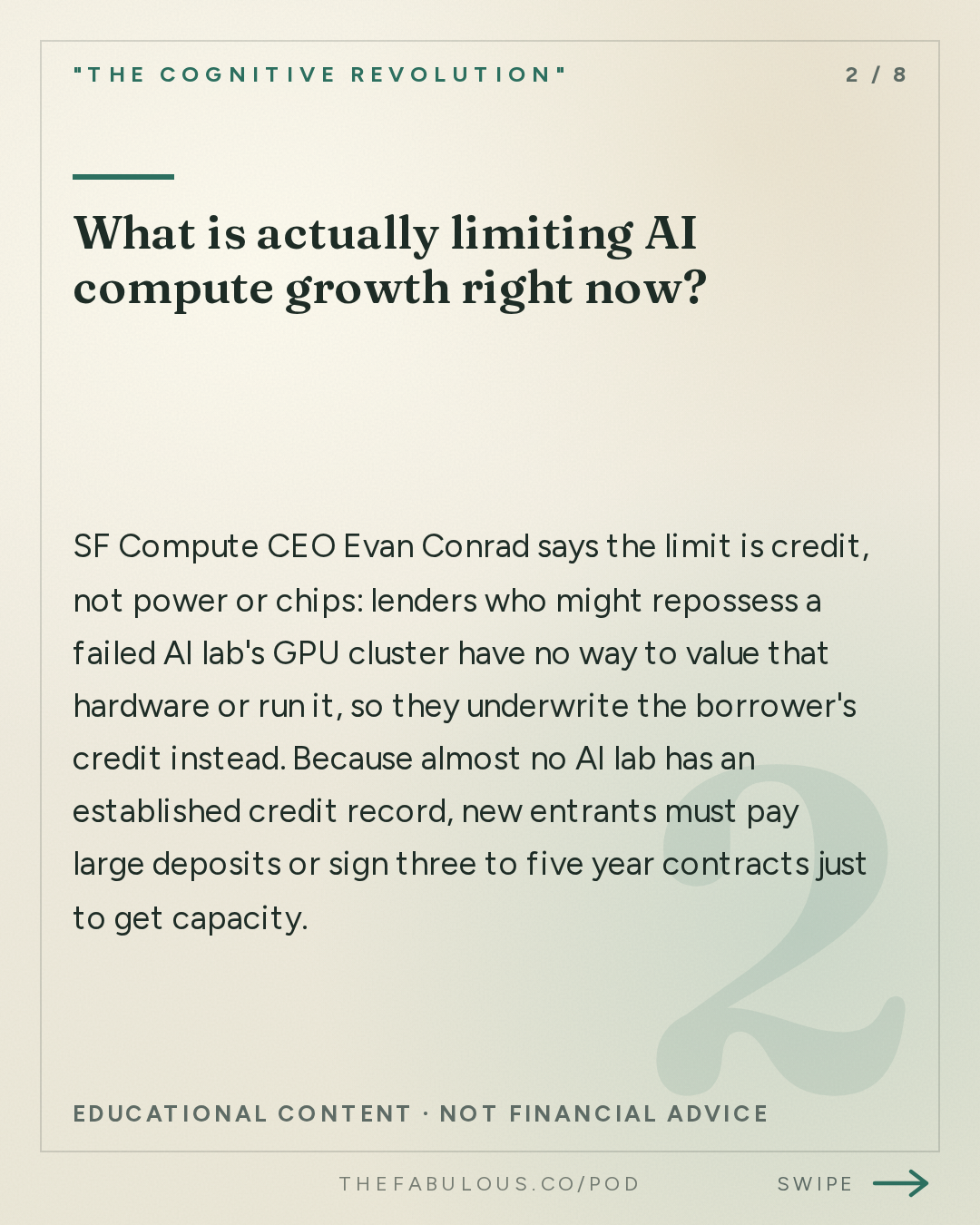
SF Compute CEO Evan Conrad says the limit is credit, not power or chips: lenders who might repossess a failed AI lab's GPU cluster have no way to value that hardware or run it, so they underwrite the borrower's credit instead (00:50). Because almost no AI lab has an established credit record, new entrants must pay large deposits or sign three to five year contracts just to get capacity (42:10).
Are neural networks already interpretable, as the 'clean neurons' essay claims?
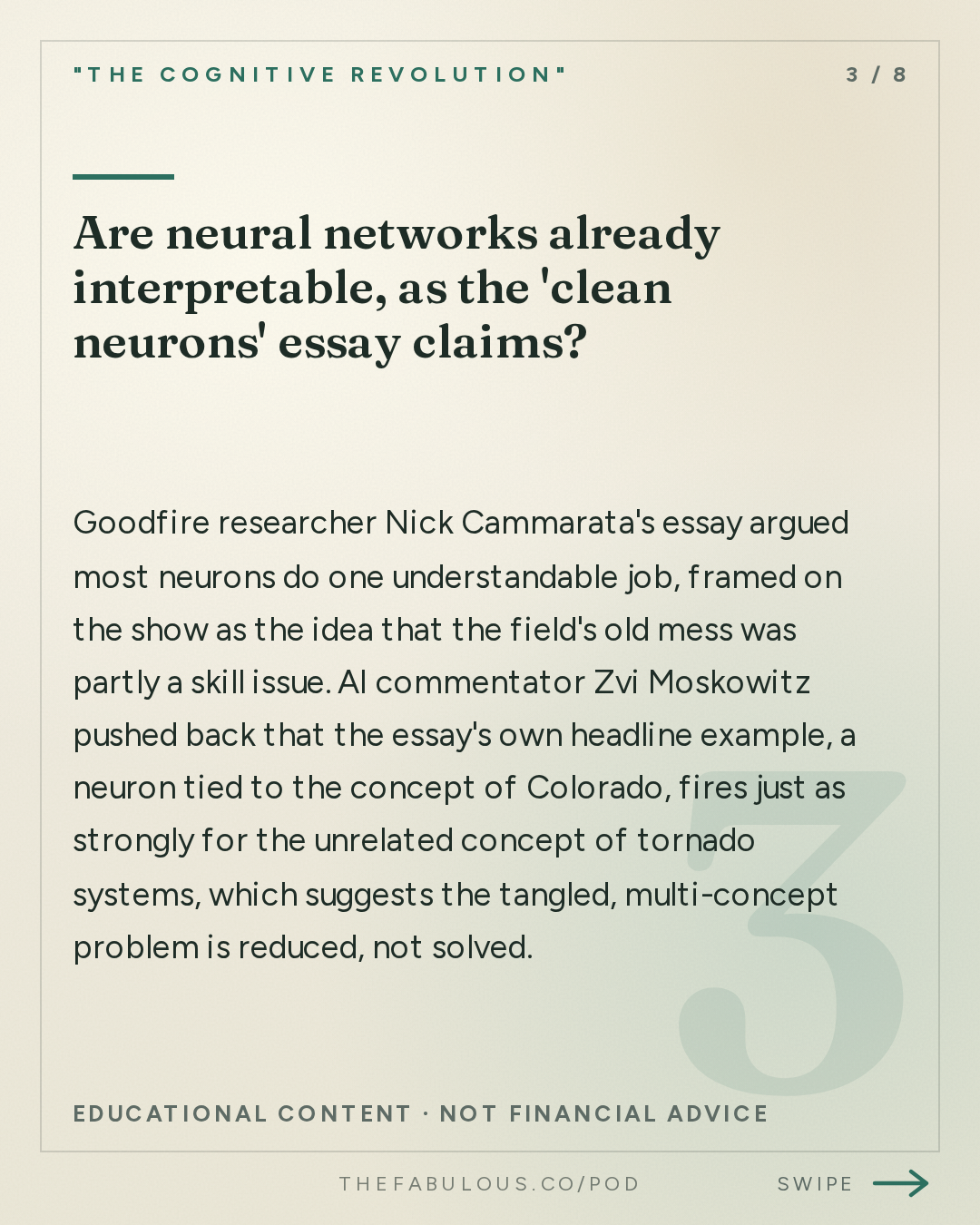
Goodfire researcher Nick Cammarata's essay argued most neurons do one understandable job, framed on the show as the idea that the field's old mess was partly a skill issue (13:40). AI commentator Zvi Moskowitz pushed back that the essay's own headline example, a neuron tied to the concept of Colorado, fires just as strongly for the unrelated concept of tornado systems, which suggests the tangled, multi-concept problem is reduced, not solved (18:35).
What does Anthropic's leaked federal AI bill propose?
The draft, which resembles the earlier bipartisan Frontier Act, would trade federal transparency rules for blocking state AI laws (74:32). Critic Zvi Moskowitz says the draft as written would nullify existing state rules immediately while delaying federal enforcement for months, leaving a period with no AI regulation in effect (79:30).
Can memory chip supply keep up with AI demand?
Cambrian managing partner Lonis Hamali says no expert tracking the industry expects DRAM, the memory chips that store a model's working data, to grow more than 2.5 times its current supply by 2030 (56:17). He argues this caps how much AI can scale on hardware terms even as compute and funding keep rising.
How much does it cost to build a new computer chip factory?
SF Compute CEO Evan Conrad puts the figure at roughly $50 billion in capital just to start a new fab, which he says is why incumbents like TSMC face almost no new competition (45:34). He adds that without a genuinely new manufacturing technology, that cost alone keeps new entrants out of the business.
The full read, in cards
Go deeper
- Neural Networks Are Already Clean — Goodfire researcher Nick Cammarata's essay argues most individual neurons in large models do one understandable job rather than many tangled ones
- AI 2027 — A forecast scenario describing rapid, compounding AI capability gains that guests say current trends increasingly resemble
- Soares' activation-probe experiment — An independent researcher's posted experiment showed a model can be trained to detect when it is being monitored by reading floating-point rounding differences caused by GPU calculation order
Mentioned
Nathan Labenz · Prakash Narayanan · Zvi Moskowitz · Evan Conrad · Lonis Hamali · Nick Cammarata · Dario Amadei · Eliezer Yudkowsky · Andrej Karpathy · Nathan Calvin · Jack Clark · Gavin Baker · Elon Musk · Henry George · SF Compute · Cambrian · Anthropic · OpenAI · NVIDIA · TSMC · FDIC · Goodfire · Encode · Tasklet · Parallel
More from this show and category

Biohub's $1.8B Virtual Biology Initiative Explained
Biohub's $1.8 billion Virtual Biology Initiative bets that AI can't model cells until scientists can see inside them better. Head of science Alex Rives argues measurement, not model architecture, is the real bottleneck, pointing to new tools like the laser phase plate and transparent zebrafish imaging, with an information theoretic model of the cell possible within five years (17:39).

How AI Models Actually Decide: Critical Tokens
Goodfire researcher Eric Bigelow finds that an AI model's final answer can hinge on one random token, not step-by-step logic. He also warns that reinforcement learning erodes chain of thought reliability, pushing models toward compressed shorthand that is hard to monitor, even as interpretability funding lags far behind capability spending.

AI Token Spend Now Beats Human Salaries
A frontier lab executive told podcast host Nathan Labenz that humanity probably shouldn't exceed some future level of AI intelligence. He said he'd accept a flop cap on the next pretraining run, and the episode also covers a 4.5x jump in AI memory prices, Positron's new inference chip, and why Latent Space's Shawn Wang says most SaaS software is 'cooked.'

OutSystems Mentor: AI for Enterprise Apps
OutSystems CEO Woodson Martin explains why reliable enterprise AI runs through an abstraction layer instead of raw code generation. He describes cutting internal token spend after a June-July peak, compressing a six-year legacy system rewrite into six months, and why AI-native junior hires may out-innovate incumbents if trained into industry context.
