
Biohub's $1.8B Virtual Biology Initiative Explained
A World Model of Life: Biohub's Alex Rives on Virtual Cells, Measurement, & the $1.8B Data Push
▶ Listen to the full episode More from The Cognitive Revolution
The brief
Biohub's $1.8 billion Virtual Biology Initiative bets that AI can't model cells until scientists can see inside them better. Head of science Alex Rives argues measurement, not model architecture, is the real bottleneck, pointing to new tools like the laser phase plate and transparent zebrafish imaging, with an information theoretic model of the cell possible within five years (17:39).
A zebrafish embryo starts as a single cell and grows into a fish you can see through. At Biohub, the nonprofit research institute backed by the Chan Zuckerberg Initiative, scientists point microscopes at these transparent embryos and track every one of their cells as the animal assembles itself, from one cell to a fully formed body (34:51). That small, patient experiment and the headline Biohub made this week, a $1.8 billion expansion of something called the Virtual Biology Initiative, built with the Department of Energy, the NIH, Google DeepMind, Isomorphic, and Meta, are the same project at two different scales (00:00). Both are attempts to fix what Alex Rives, Biohub's head of science and a co-founder of the protein-modeling company EvolutionaryScale, argues is the actual obstacle between artificial intelligence and medicine. It isn't the models. It's what we can see.
Rives spent years building ESM, a family of language models trained not on sentences but on protein sequences, the strings of amino acids that fold into the molecular machines of life. That work taught him a lesson he now applies to something harder: the cell. Virtual cell models, built to predict how a cell responds to a drug or a mutation, have existed for a while and have mostly disappointed. The common explanation is that the models aren't smart enough. Rives disagrees. The problem, he says, is that so much about the cell simply cannot be measured or even seen with today's tools (12:25). Good data is not just scarce, it is the wrong kind of scarce: thin on the fine grained, moment to moment detail that would let a model learn the actual rules a cell follows. A language model can read billions of sentences because text is cheap to collect. A cell's internal life, proteins bumping into each other, molecules switching a gene on or off, mostly happens somewhere no instrument has ever pointed a lens.
Measurement first, modeling second
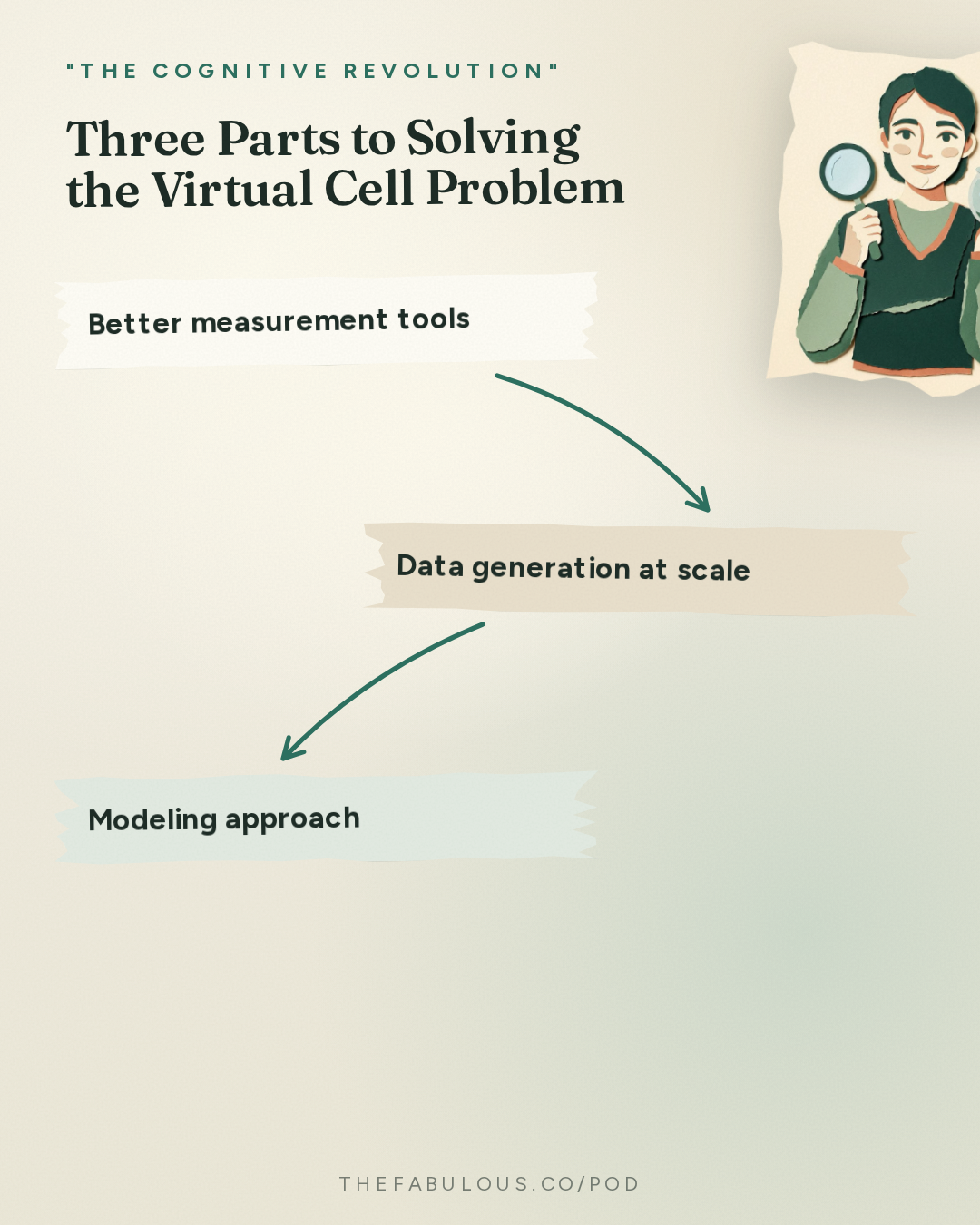
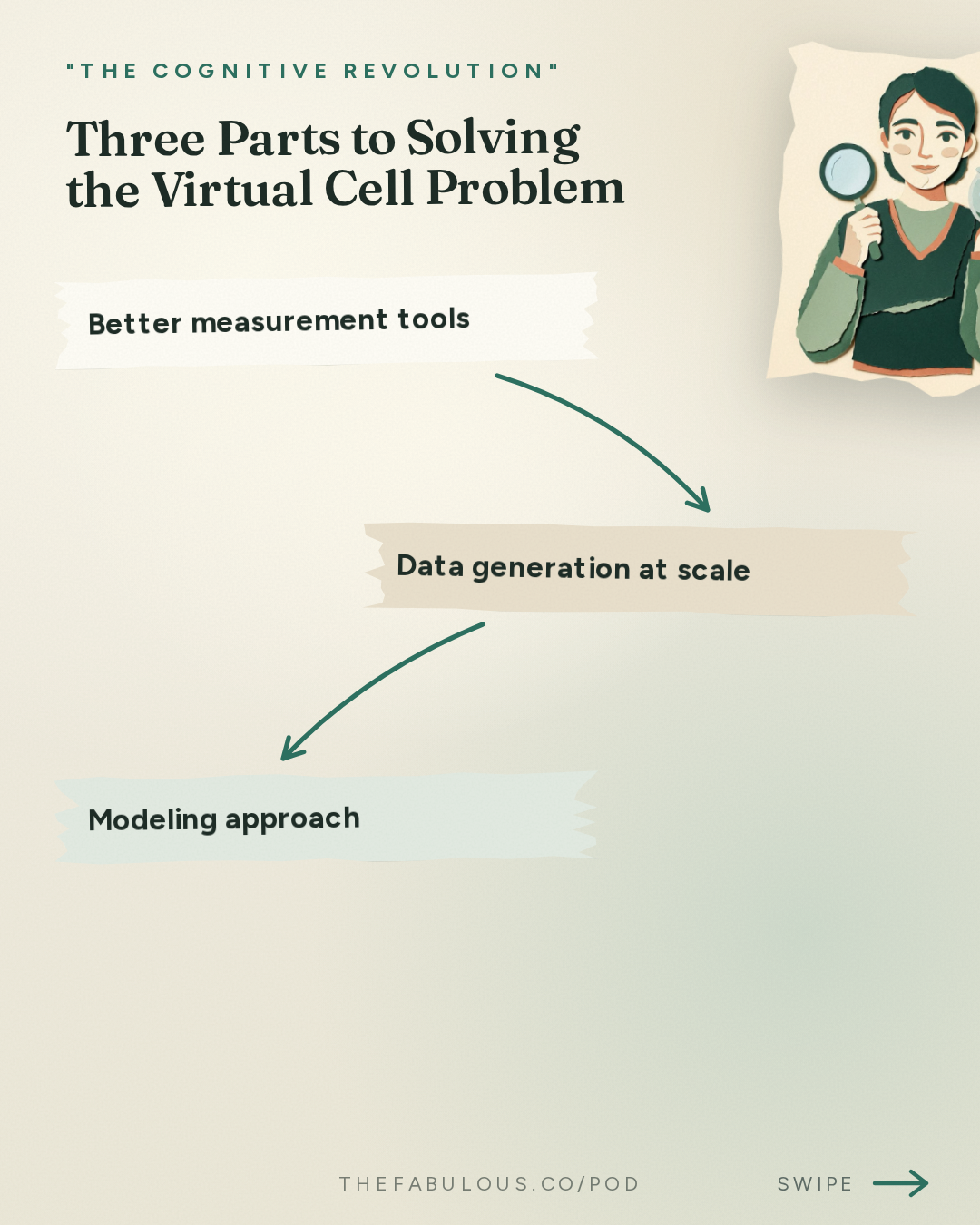
This is why Biohub organizes its research, and now this new coalition's money, around three linked problems: better measurement tools, data generated at the scale needed to reveal statistical structure, and modeling approaches suited to how little clean data biology actually offers (12:45). One concrete example of the first problem is the laser phase plate, a piece of hardware decades in the making, first imagined by Berkeley physicist Holger Muller and developed with Biohub funding. It adds phase contrast, extra visual clarity, to electron microscopy by using an extremely powerful standing wave laser to bend an electron beam (26:28, 26:49). The payoff is that scientists doing cryo electron tomography, a technique for imaging thin frozen slices of cells, can begin to make out individual proteins inside a cell's actual architecture rather than inferring shapes in a test tube. New instruments like this, Rives argues, have been behind most of the real turning points in biology's history, more so than any particular theory (27:46).
The ambition behind all this hardware and data collection is what Rives calls an information theoretic model of the cell: a model built not from physics and chemistry working upward, but from treating the cell as a program running on a genome, with observable states that shift from one to the next in response to inputs.
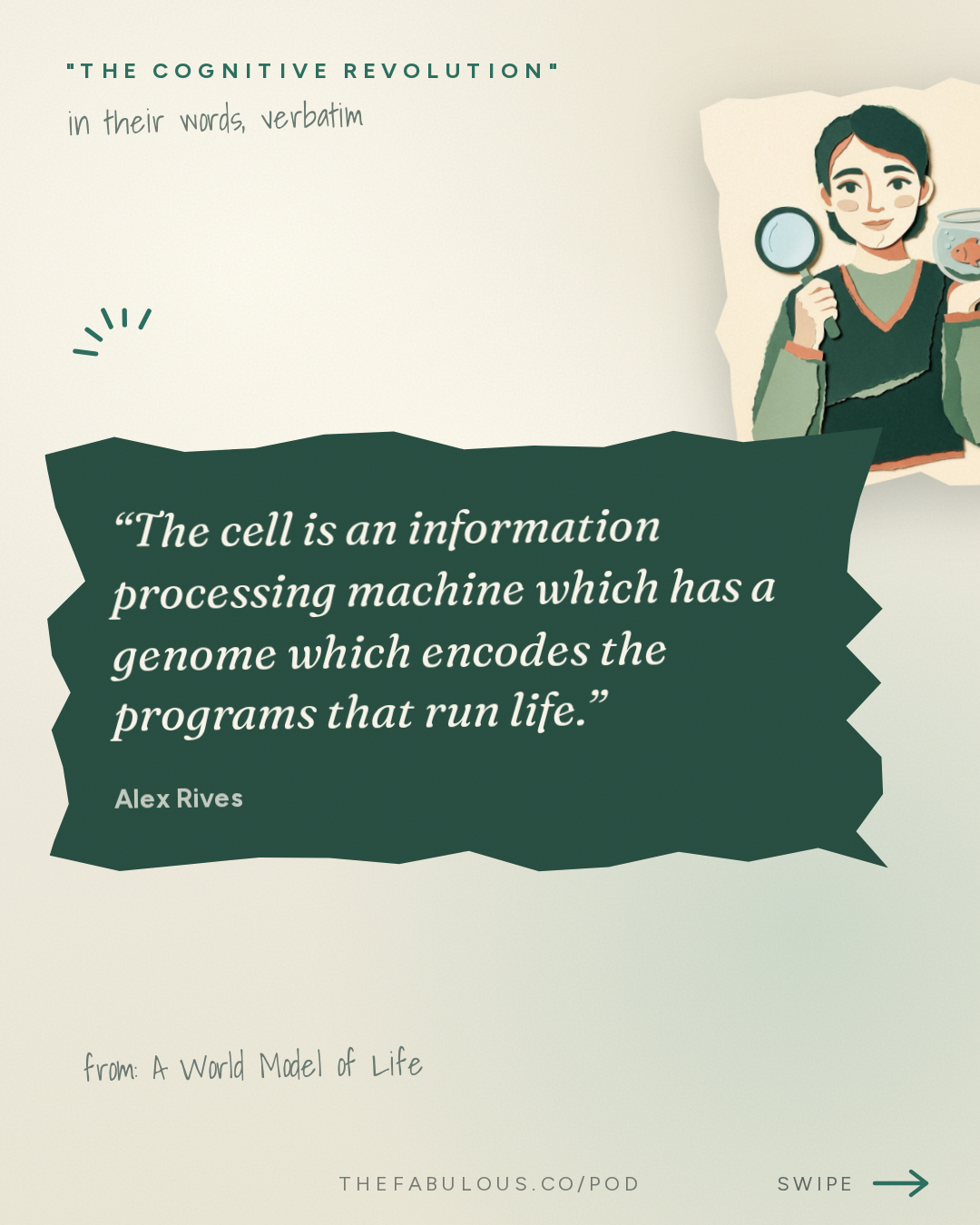
"The cell is an information processing machine which has a genome which encodes the programs that run life." — Alex Rives [17:39]
He argues this kind of model, a precursor to what he calls a full world model of life, is realistic within five years given the current trajectory of AI and data generation (17:39). The near term version is a transition function: feed it a cell's current state and some perturbation, a drug, a mutation, a signal, and it predicts the distribution of states the cell might land in next (18:54). That word distribution matters. Biology is not deterministic. A cell does not do one thing in response to a stimulus; it does one of several things, with different odds.
Scaling that idea from a single cell to a living organism is its own problem, because a point mutation in one gene can ripple up to cause disease in an entire body, and no one is building a model that tracks every molecule in a person (30:59). Rives's answer is a layered approach: learn what is possible from cells in a dish, learn more from cells imaged inside tissue, and learn still more from whole organism imaging, like the zebrafish work, then build a model that integrates across those layers rather than pretending any one of them is the whole truth (31:34, 33:06). That stitching also runs sideways, across species, not just up through scales. Rives points to his own prior work on ESM and to AlphaFold, Google DeepMind's protein structure prediction model, as proof that narrow training data produces worse models, not just smaller ones.
"If you train a model just on the human proteins, you know, you wouldn't get an accurate predictive model." — Alex Rives [41:09]
The reason, he says, is that evolution reuses the same molecular parts, transcription factors, the switches that turn genes on, and the control regions they bind, across enormous stretches of life, even when the programs those parts run have been completely rewired from one species to the next (41:42). That is also the best argument for why mouse studies, so often mocked for not translating into human treatments, still matter: the raw materials are shared even when the wiring diagram is not.
A biology without the right words yet
The final piece of Rives's picture turns the relationship between AI and biology almost inside out. Large language models are powerful partly because they absorb centuries of accumulated human knowledge, written down in text. Rives thinks that advantage runs out fast in biology, because the facts that matter most have never been written down by anyone. "The things we most want to know about biology today are novel concepts for which we don't yet have words and names," he says (03:02). Billions of proteins have been sequenced across every branch of life, and most of them still have no known function (55:44). When a protein language model is trained on those sequences anyway, it develops internal features that correspond to real biological concepts with no English name attached, something closer to discovering a pattern no one has described before than to looking something up (56:13).
That is also why Rives thinks the fashionable move in AI, reinforcement learning from verifiable rewards, known as RLVR, where a model improves by checking its own answers against an automatic grader, will look different in biology than it does in code or math.
"We're going to have to build the systems that actually allow verification in the laboratory." — Alex Rives [46:08]
A coding model can test whether a program compiles in milliseconds. A biology model has to wait for an actual experiment, grown in an actual dish, to come back with an actual result. That is slower by orders of magnitude, but Rives thinks it is buildable: a loop where a model proposes a question, a lab runs the experiment, the result updates the model, and the model proposes a better question (45:24). He expects first drafts of atlases mapping cell states in health and disease within one to two years, and something close to comprehensive within five, assuming a coordinated, well funded effort (47:51).
There is a small, almost funny coda to all this ambition. Asked how he personally tracks his own health in preparation for whatever Biohub eventually builds, Rives admitted he barely thinks about it. He has a watch that tracks his sleep. That is it (59:07). It is tempting to read that as a researcher too consumed by the work to practice what he is building toward, but it also captures something true about where the field stands. The tools that would make personal, continuous, molecular level monitoring useful, the kind that could link a wearable's data to the deep causal biology underneath it, mostly do not exist yet (57:57). Rives is betting that building those tools, patiently, instrument by instrument, atlas by atlas, is a better use of five years than wearing more sensors today.
Ask this episode anything
Pod's AI answers from the episode itself, with the minute mark so you can hear it yourself.
Or start with one of these
Ask this episode
Pod's AI listens to the whole episode to answer, and points you to the minute it comes from.
The rest of this answer, and any question after it
Answers come from the episode itself, never from a summary of it.
ContinueKey takeaways
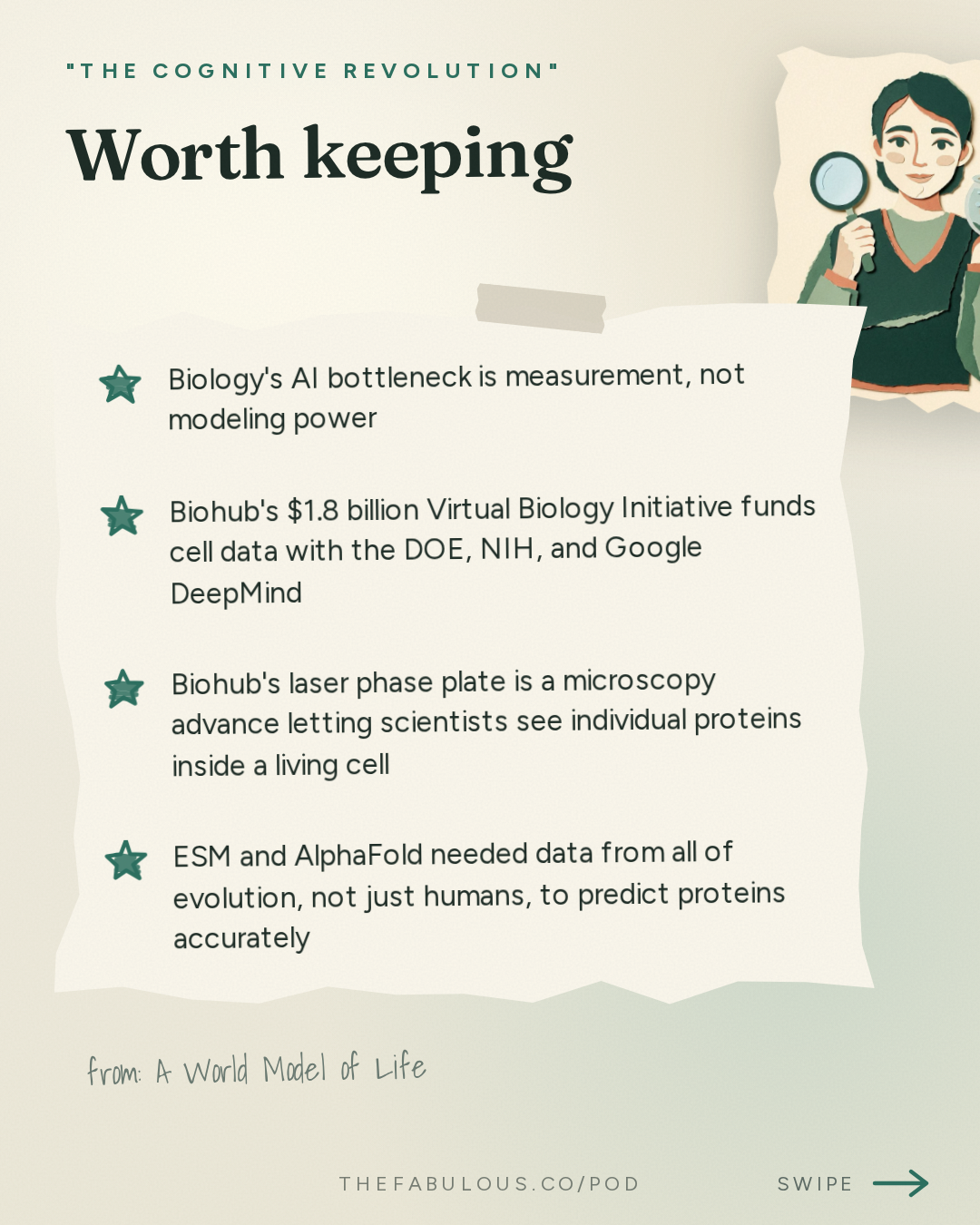
- Biology's AI bottleneck is measurement, not modeling power
- Biohub's $1.8 billion Virtual Biology Initiative funds cell data with the DOE, NIH, and Google DeepMind
- Biohub's laser phase plate is a microscopy advance letting scientists see individual proteins inside a living cell
- ESM and AlphaFold needed data from all of evolution, not just humans, to predict proteins accurately
- Alex Rives expects an information theoretic model of the cell, encoding life's programs, within five years
The episode in cards
In their words
“The cell is an information processing machine which has a genome which encodes the programs that run life.”
“The things we most want to know about biology today are novel concepts for which we don't yet have words and names.”
Protocols
-
Build RLVR loops for biology with lab verification
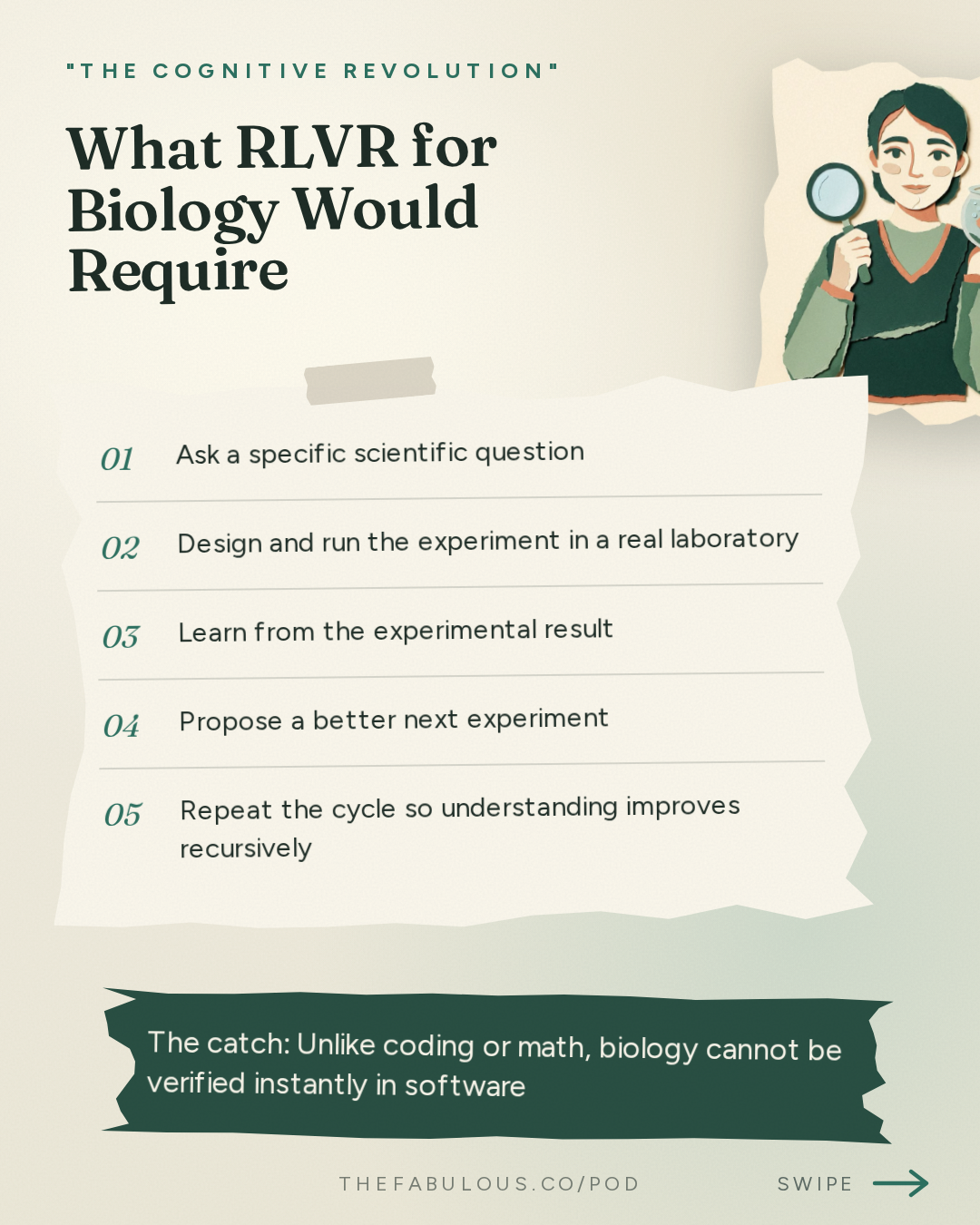
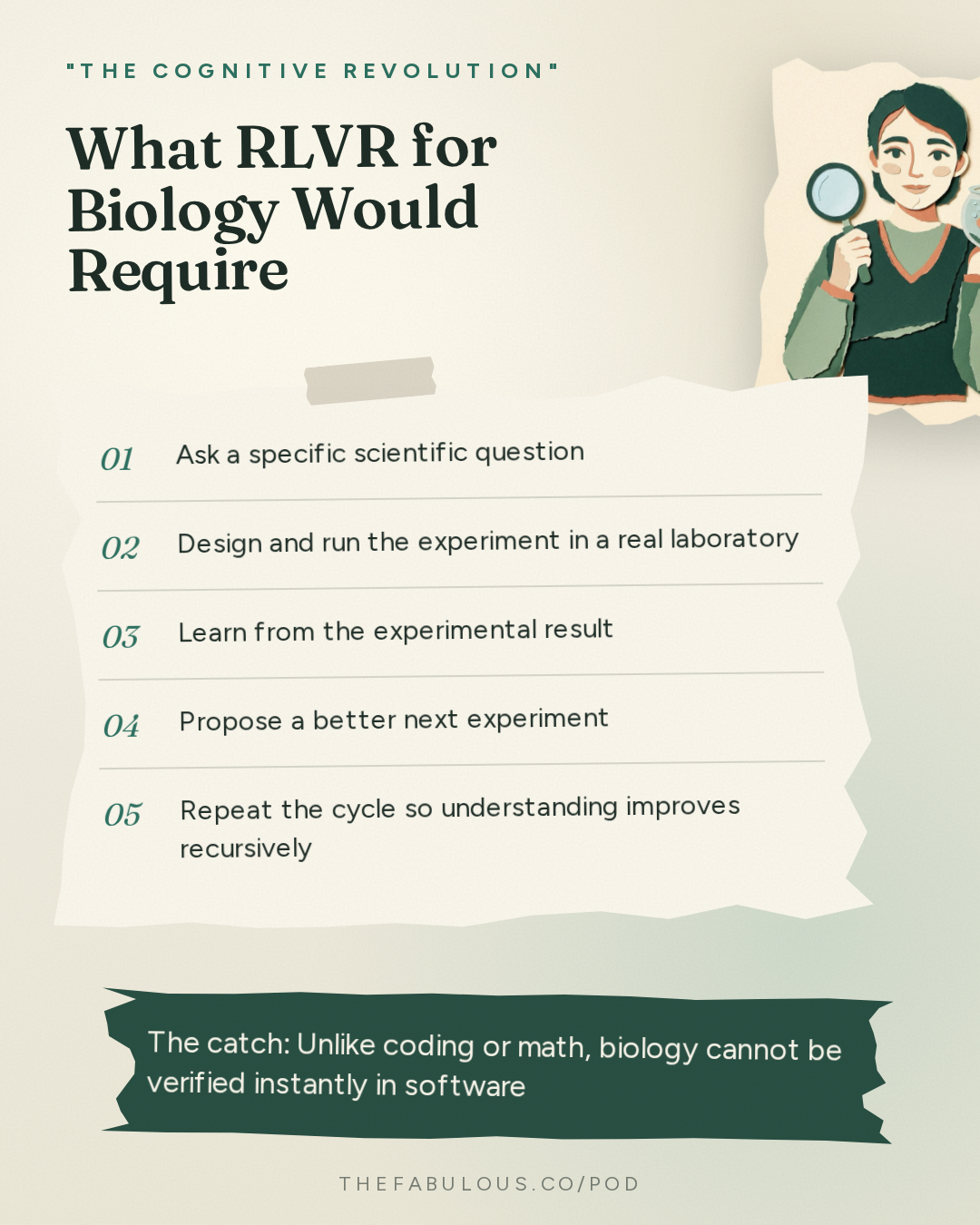
Rives says AI systems for biology need to ask a question, design and run the experiment in an actual laboratory, learn from the result, and propose a better next experiment, repeating that cycle so understanding improves recursively. He notes the catch is that unlike code or math, biology cannot be verified instantly in software, so every reward signal depends on a real wet lab experiment, which caps how fast the loop can run.
ongoing, cycle repeated per experiment
-
Link continuous molecular monitoring to health records
Rives says continuous monitoring technologies need to measure more molecular level parameters over time so that top down views of a person's health can be connected to bottom up cellular biology. He adds that this kind of convergence is likely to happen over time but is not yet the near term focus of his own research.
continuous, over time
Questions this episode answers
What is Biohub's Virtual Biology Initiative?
It is a $1.8 billion data generation partnership between Biohub, the Department of Energy, the NIH, Google DeepMind, Isomorphic, and Meta, announced to build the large scale cell data needed for general models of cellular biology (00:00, 23:41). The money goes mainly toward new measurement technology and cell atlases rather than toward model training itself (24:41).
Why don't virtual cell models work well yet?
Biohub head of science Alex Rives argues the bottleneck is not modeling technique but measurement: much of what happens inside a cell cannot currently be observed or measured at all (12:25). Without data that captures the cell's fine grained causal structure, even well designed models have nothing accurate to learn from (01:03).
What is a laser phase plate and why does it matter for biology?
The laser phase plate is a microscopy advance that adds phase contrast to electron microscopy by using an extremely powerful standing wave laser to shift an electron beam, conceived decades ago by Berkeley physicist Holger Muller (26:28, 26:49). It lets scientists doing cryo electron tomography see individual proteins and macromolecules inside a cell section in much sharper detail than before (27:22).
What is an information theoretic model of the cell?
It is Alex Rives's term for a model that treats the cell as a program running on its genome, predicting how a cell's state shifts into a new distribution of possible states given some input, rather than simulating every atom from physics upward (17:39, 18:54). Rives says this kind of model, a step toward what he calls a world model of life, is achievable within five years given current AI and data generation trends (17:39).
Why do protein AI models like ESM and AlphaFold need data from more than just humans?
Alex Rives says training a protein model only on human proteins produces an inaccurate predictive model, because the molecular building blocks of life, such as transcription factors, are conserved across evolution even when the programs built from them are rewired between species (41:09, 41:42). Both ESM, the protein language model Rives co-created at EvolutionaryScale, and Google DeepMind's AlphaFold were trained across broad evolutionary data rather than human proteins alone (40:42).
Can reinforcement learning from verifiable rewards (RLVR) work for biology the way it does for coding?
Rives says RLVR is possible in biology but cannot be checked instantly the way code compiling or a math proof can be; it requires building systems that allow verification through real laboratory experiments (46:08). He describes the target as a recursive loop where a model proposes a question, a lab runs the experiment, and the result feeds back to improve the next proposed experiment (45:24).
The full read, in cards
Go deeper
- Virtual Biology Initiative partnership announcement — A $1.8 billion data generation partnership between Biohub, the Department of Energy, the NIH, Google DeepMind, Isomorphic, and Meta to build data for virtual cell models
- Laser phase plate project — A Biohub funded microscopy advance, conceived decades ago by Berkeley physicist Holger Muller, that adds phase contrast to electron microscopy so individual proteins inside cells become visible
Mentioned
Alex Rives · Biohub · Chan Zuckerberg Initiative · EvolutionaryScale · Department of Energy · NIH · Google DeepMind · Isomorphic · Meta · AlphaFold · ESM · laser phase plate · zebrafish · Holger Muller
More from this show and category

How AI Models Actually Decide: Critical Tokens
Goodfire researcher Eric Bigelow finds that an AI model's final answer can hinge on one random token, not step-by-step logic. He also warns that reinforcement learning erodes chain of thought reliability, pushing models toward compressed shorthand that is hard to monitor, even as interpretability funding lags far behind capability spending.

AI Token Spend Now Beats Human Salaries
A frontier lab executive told podcast host Nathan Labenz that humanity probably shouldn't exceed some future level of AI intelligence. He said he'd accept a flop cap on the next pretraining run, and the episode also covers a 4.5x jump in AI memory prices, Positron's new inference chip, and why Latent Space's Shawn Wang says most SaaS software is 'cooked.'

OutSystems Mentor: AI for Enterprise Apps
OutSystems CEO Woodson Martin explains why reliable enterprise AI runs through an abstraction layer instead of raw code generation. He describes cutting internal token spend after a June-July peak, compressing a six-year legacy system rewrite into six months, and why AI-native junior hires may out-innovate incumbents if trained into industry context.
Gemini Robotics 2.0: DeepMind's New Robot Brain
Google DeepMind's Keerthana Gopalakrishnan says robotics is still in its GPT-2 era despite Gemini Robotics 2.0 driving humanoid hands and grippers alike. The new architecture splits reasoning (ER2) from action (the VLA), needs just 200 examples to adapt to a new robot body, and treats safety as a capability rather than a constraint.
