
Nvidia's $60B Quarter and What It Means
Nvidia's Historic Quarter, SaaS Comeback, Bessent vs Druck, America's Debt Crisis, Cancer Vaccine
The brief
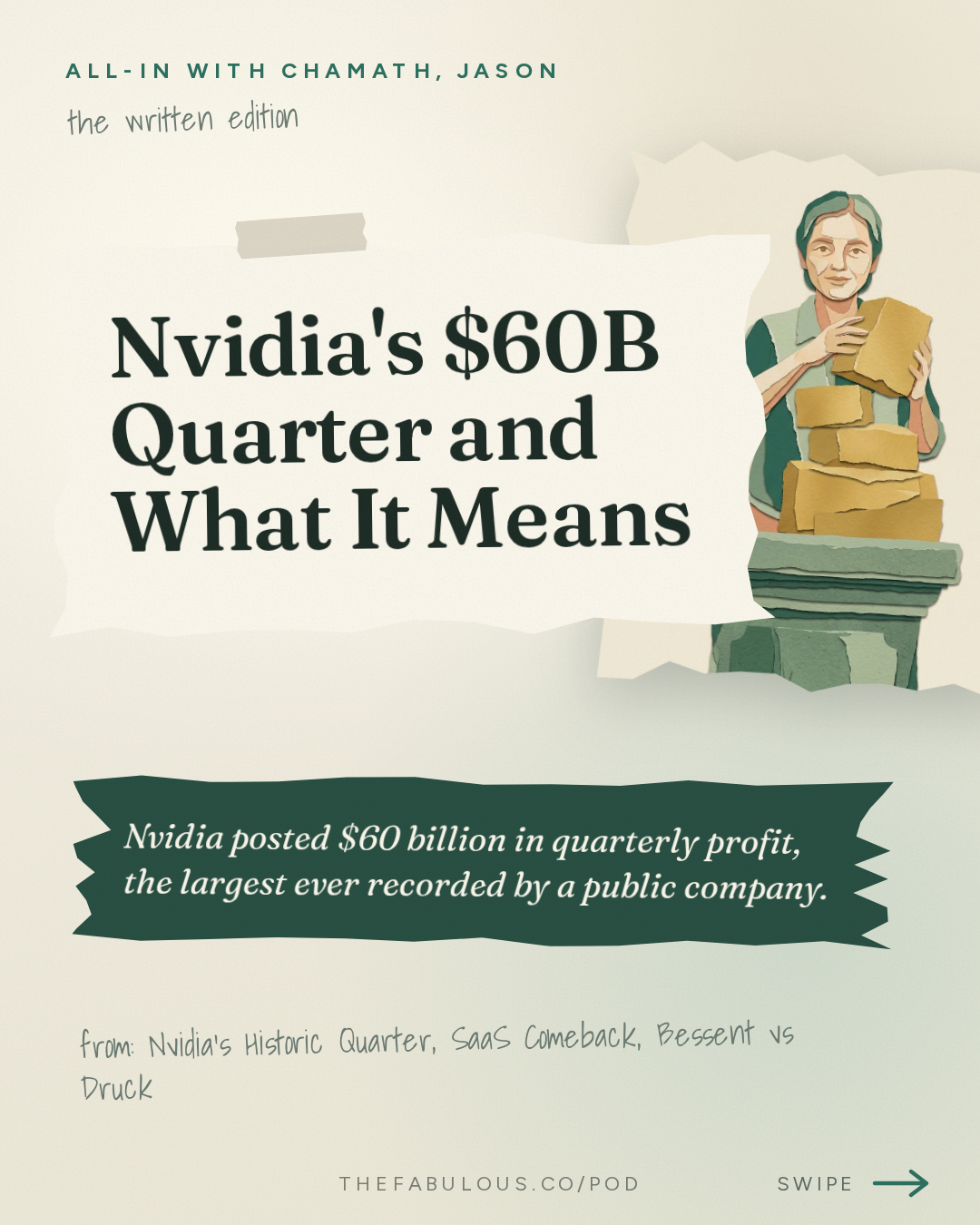
Nvidia posted $60 billion in quarterly profit, the largest ever recorded by a public company (09:38). Salesforce rallied on its Anthropic deal, US Treasury yields near 5.3% point to a fiscal squeeze requiring $10 trillion in refinancing (38:48), and Moderna's mRNA cancer therapy, built on decades of public research, now costs $500,000 per patient (88:56).
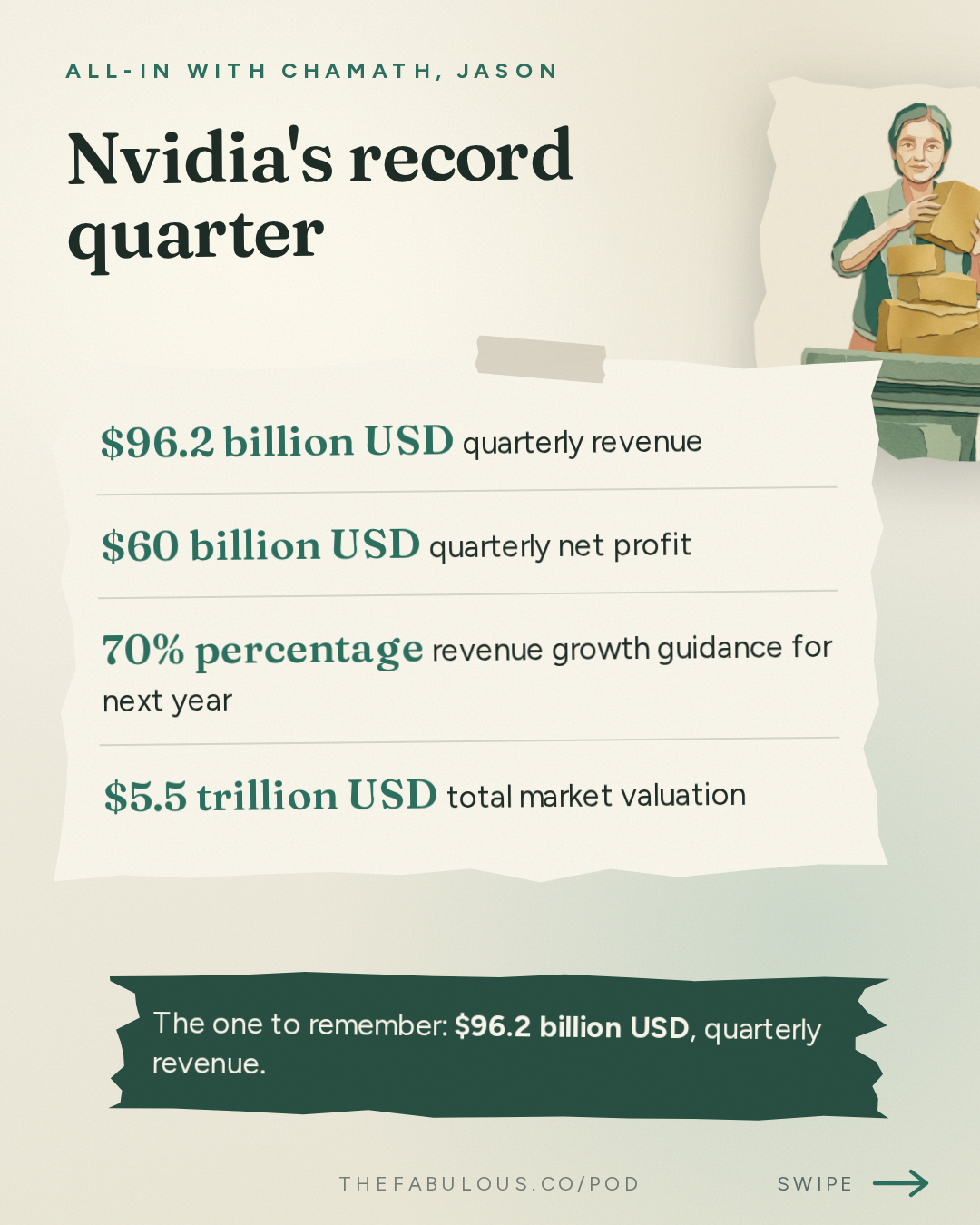
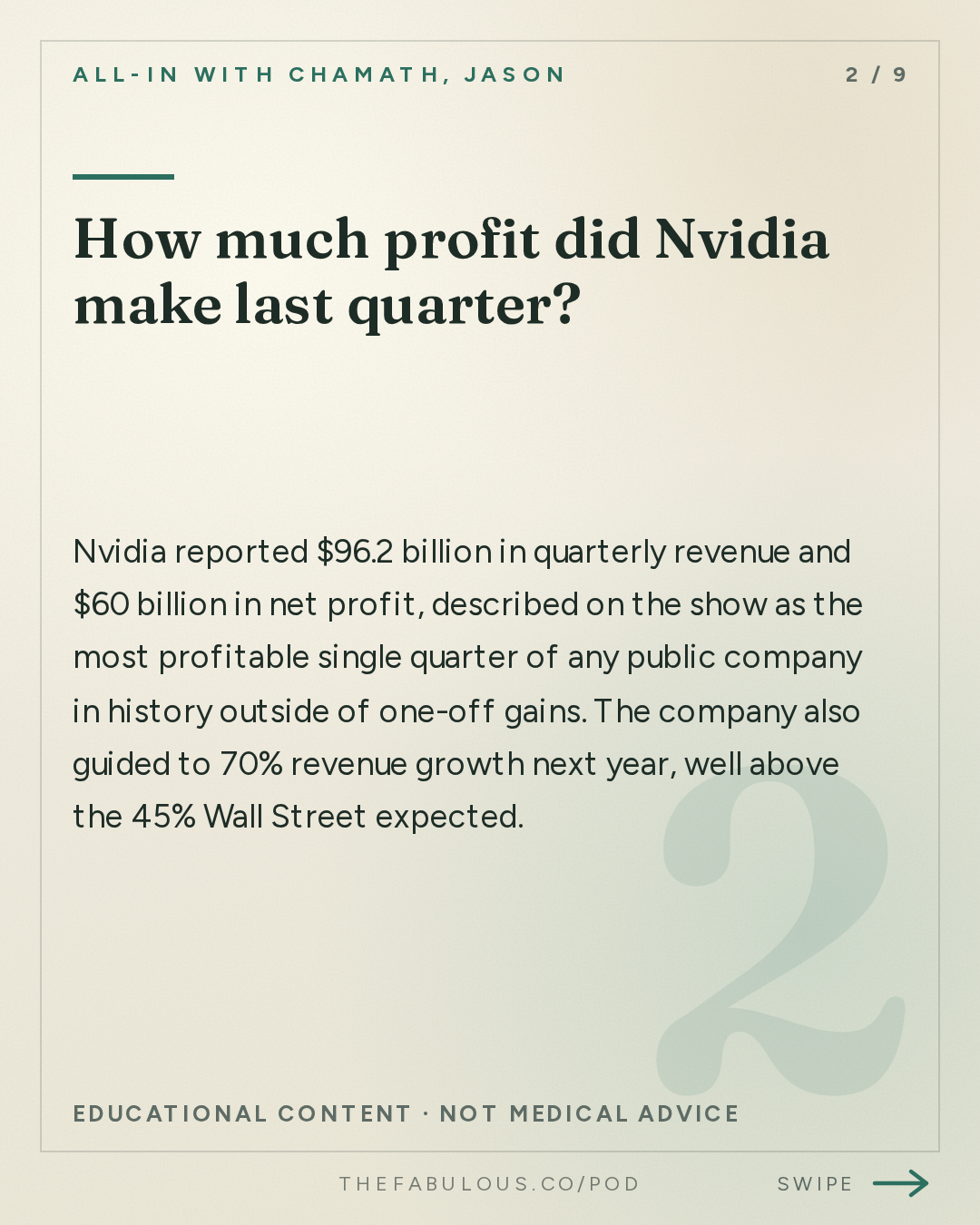
Ninety-six billion dollars passed through Nvidia's books in a single quarter this fall, and sixty billion of it stuck as pure profit (09:38). That is not simply a strong result. Host Jason Calacanis calls it the most profitable quarter any public company has ever posted, once one-time gains like asset sales are set aside (09:38). Nvidia also told investors to expect 70 percent revenue growth next year, far above the 45 percent Wall Street had modeled (09:44). For months, a slice of Wall Street had bet that AI spending, or capex, meaning capital expenditure on chips, data centers, and infrastructure, was a bubble about to pop. These numbers did not just answer that bet. They buried it, and even after an 8 percent stock jump, Nvidia still trades at only 12 times earnings, cheap by the standards of a company this dominant (30:45).
"This AI CapEx is gonna continue well into the future. It's got real legs." — David Sacks [30:33]
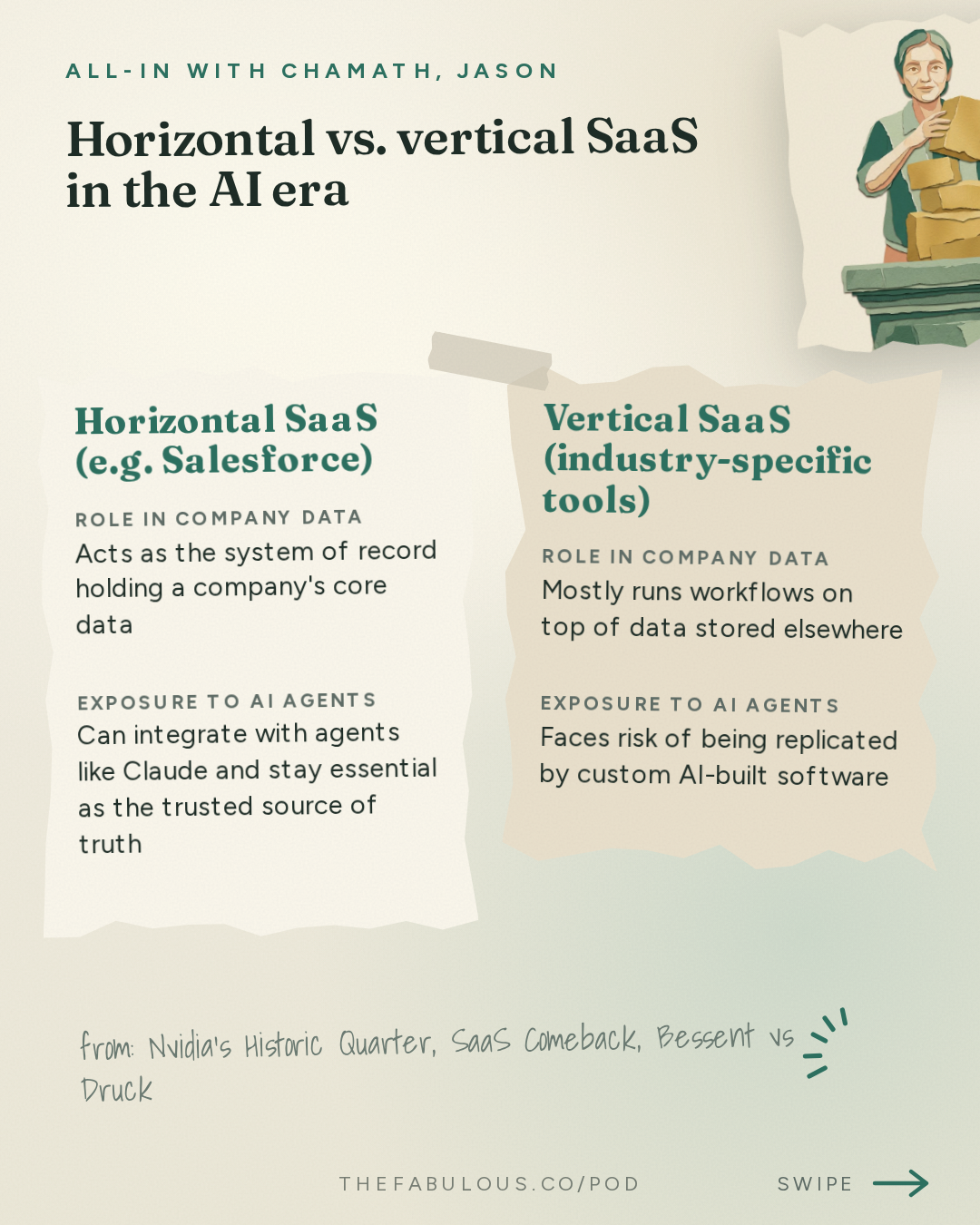
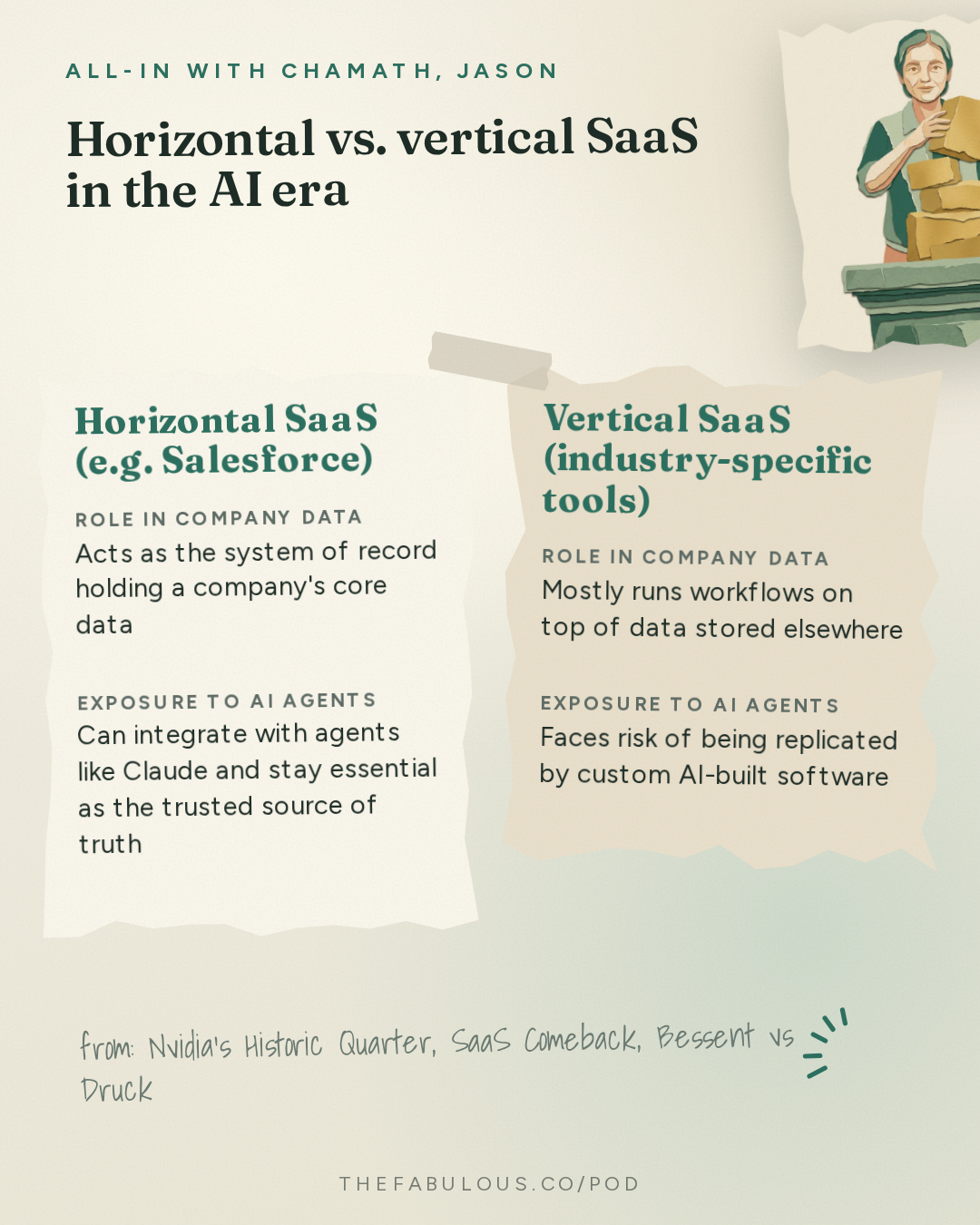
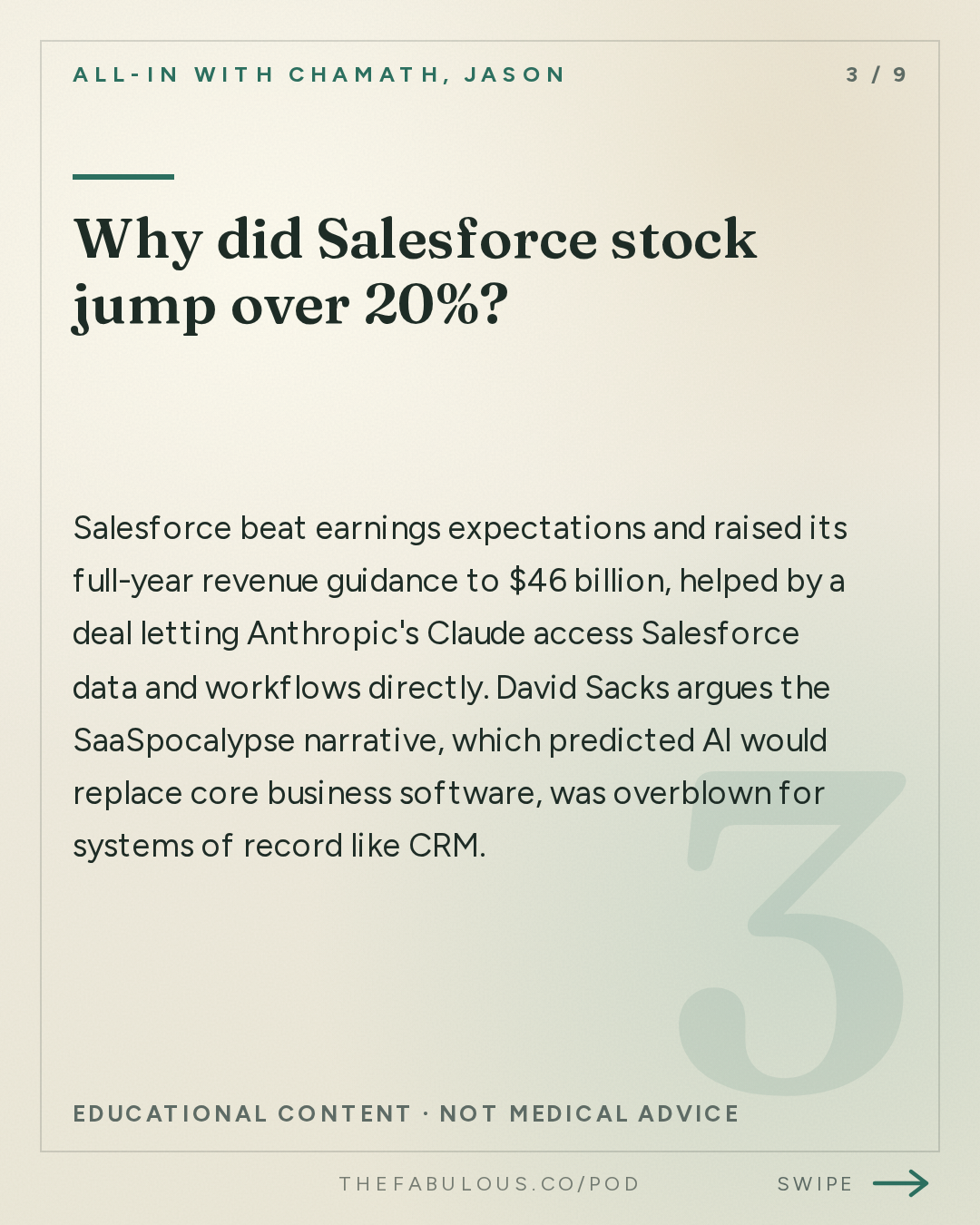
Salesforce told a related story. Its stock jumped more than 20 percent after an earnings beat and a raised full-year guidance of $46 billion (10:52). The company had been the poster child of what the hosts call the SaaSpocalypse, a fear that AI coding tools would let anyone rebuild their own business software and make traditional SaaS, or software as a service, obsolete. David Sacks argues that fear was overblown for one specific kind of software: the system of record, meaning the canonical database a company trusts as its single source of truth. Enterprises do not want to gamble their compliance and data integrity on something vibe-coded over a weekend, he says (18:11). What changed the picture is Salesforce's deal with Anthropic: Salesforce is letting Anthropic's AI assistant, Claude, act as the front-end interface, with full access to Salesforce's data and workflows (19:20). Sacks calls this a bet that pays off precisely because Salesforce still owns the underlying system agents have to query. David Friedberg, another host, draws the line differently: horizontal platforms like Salesforce, Workday, or Excel are hard to replace because they hold real data across a whole company, while vertical, industry-specific software mostly just manages workflow on top of data stored somewhere else, which makes it the more exposed target (25:08).
But the same week Nvidia and Salesforce delivered good news, a much less cheerful number was quietly getting worse: the price the United States government pays to borrow money.
The bill comes due
The 30-year Treasury yield hit 5.3 percent last week, a 19-year high (33:43). In response, Treasury Secretary Scott Bessent doubled the government's long-bond buyback program, essentially using public money to buy up Treasury bonds and push their prices up, which pushes yields down (34:07). His former mentor, investor Stan Druckenmiller, published a Wall Street Journal op-ed calling this the wrong fix: the real problem, Druckenmiller argued, is not the bond market's pricing but Congress's spending (34:07). Friedberg walks through why the arithmetic is unforgiving.
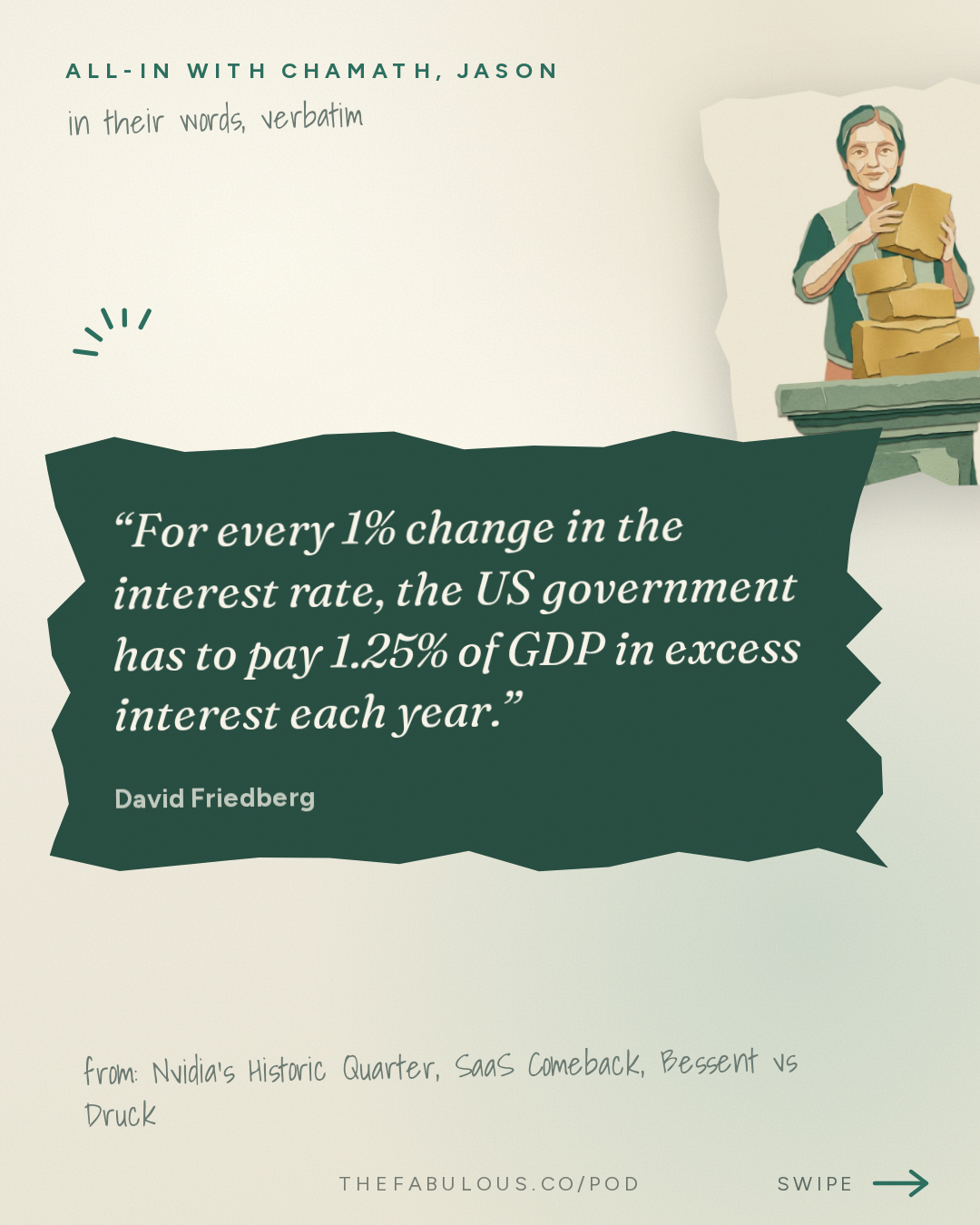
"For every 1% change in the interest rate, the US government has to pay 1.25% of GDP in excess interest each year." — David Friedberg [38:18]
The government's average cost of debt is currently 3.4 percent, well below the 5.2 percent now being charged on new 30-year bonds (37:54). That gap matters because roughly $10 trillion of existing federal debt has to be refinanced, meaning rolled over into new bonds, in the next twelve months (38:48). Every dollar of that debt that gets refinanced at today's higher rates raises the government's annual interest bill, which raises the deficit, which is already running at roughly $2 trillion a year and adding a trillion dollars in new debt roughly every five months (34:30). Friedberg's read is that Druckenmiller's op-ed functions as cover for Bessent: it tells markets that the yield problem is Congress's to solve, not the Treasury's, because no amount of bond buying can offset $10 trillion in refinancing at higher rates (39:15). Chamath frames the stakes starkly: if the 30-year yield reaches 6 percent, he calls that the start of a slow-moving crisis that could take years to play out, solvable only through a congressional deal to cut spending (44:32).
The hosts point to one place where different choices produced a visibly different outcome: housing. Home prices in Austin, Texas are down 27 percent from their 2022 peak, largely because the state allowed more building (59:46). Jason Calacanis, who moved from New York, Los Angeles, and San Francisco to Texas, argues that affordability followed directly from a policy choice to let supply grow, in contrast to cities that restrict new construction (59:12).
Who owns the cure
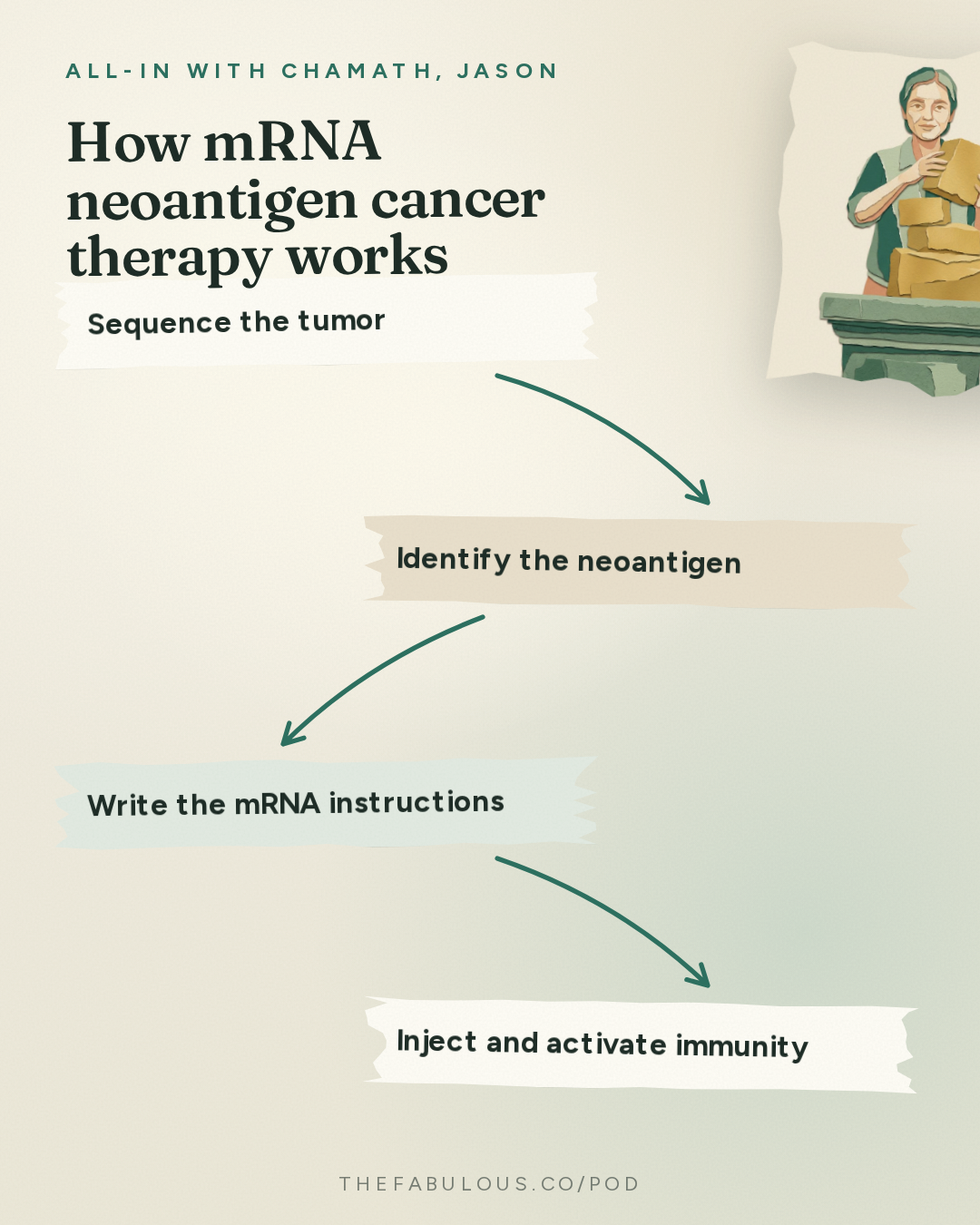
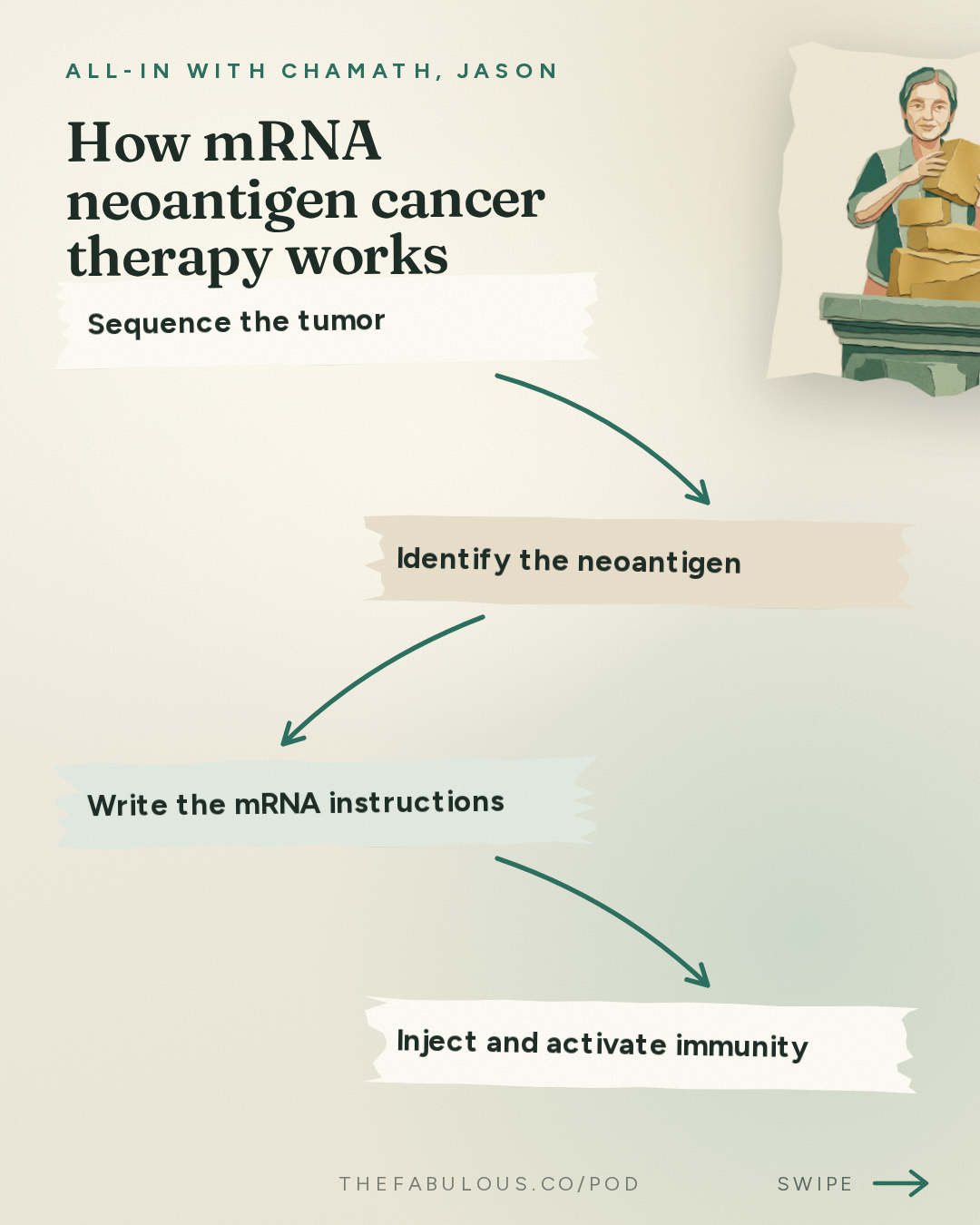
The most detailed segment of the episode has nothing to do with markets. Moderna's market value roughly tripled in two weeks, from about $20 billion to $60 billion, after positive results from what is being called a cancer vaccine (83:02). Friedberg, whose company works in DNA sequencing, walks through why that label is misleading and how the underlying science actually works. The idea, dating to the 1990s, is to find a neoantigen: a small protein unique to a specific patient's cancer, one the immune system will recognize as foreign (83:26). Doctors take a sample of a tumor, sequence its DNA to find the mutation that makes it unique, and use that sequence to build a matching protein (83:59, 85:16). In Moderna's version, instead of manufacturing the protein outside the body, doctors inject mRNA, the molecular instructions that tell a cell what protein to build, so the patient's own cells manufacture the neoantigen and the immune system learns to attack matching cancer cells throughout the body (86:04, 86:49). It is the same basic mechanism used in the COVID-19 vaccine, but aimed at cancer cells instead of a virus.
Friedberg's objection is not to the science, which he calls well understood after decades of trials largely funded by NIH and other public research dollars. It is to the price. Moderna is reportedly planning to charge around $500,000 for the treatment (88:56), while CAR T therapy, a related but distinct approach that reprograms a patient's own immune cells to hunt down cancer, already runs up to $1 million per treatment (94:23). Friedberg says clinics already offer a version of the neoantigen approach for a small fraction of that cost.
"It's a process... Why is Moderna saying that they're gonna charge $500,000 for this?" — David Friedberg [88:56]
His argument is that a therapeutic process built on public science should not become the exclusive property of one company through patents and FDA approval, especially when the core technique, sequence the tumor, build a matching protein, provoke the immune system, is neither secret nor new (89:00). He expects the approach to spread overseas at far lower cost as more providers adopt it (93:26).
Laid side by side, the three stories share a question the hosts never quite state outright: who gets to charge for a process that mostly already exists. Nvidia and Salesforce are charging premiums for owning the pipes that AI agents now have to run through. The federal government is discovering that trust, priced daily in the bond market, is not free either. And Moderna is charging half a million dollars for a delivery method wrapped around science the public already paid to develop. The specifics differ. The pattern, watching who ends up holding the toll booth, does not.
Ask this episode anything
Pod's AI answers from the episode itself, with the minute mark so you can hear it yourself.
Or start with one of these
Ask this episode
Pod's AI listens to the whole episode to answer, and points you to the minute it comes from.
The rest of this answer, and any question after it
Answers come from the episode itself, never from a summary of it.
ContinueKey takeaways
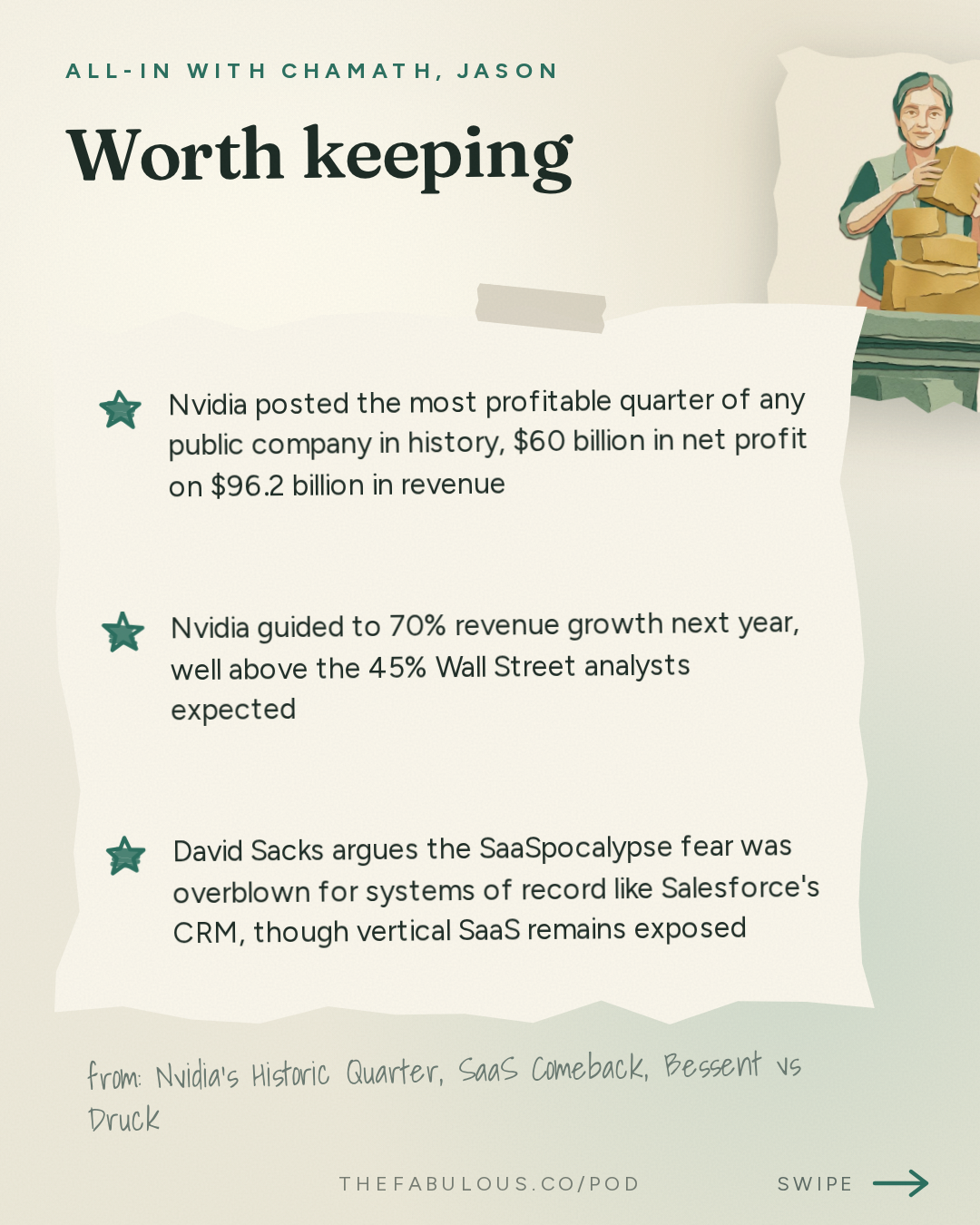
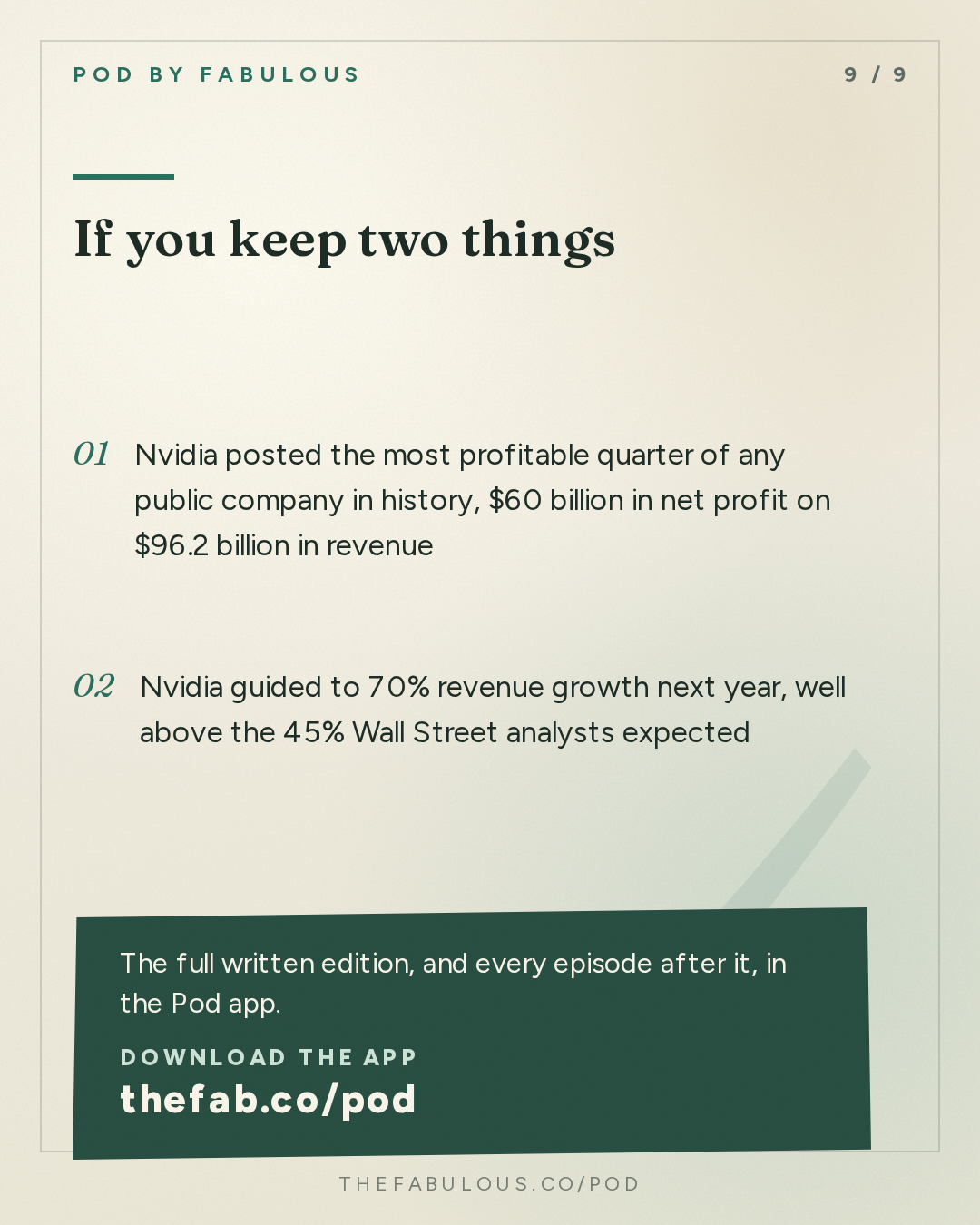
- Nvidia posted the most profitable quarter of any public company in history, $60 billion in net profit on $96.2 billion in revenue
- Nvidia guided to 70% revenue growth next year, well above the 45% Wall Street analysts expected
- David Sacks argues the SaaSpocalypse fear was overblown for systems of record like Salesforce's CRM, though vertical SaaS remains exposed
- The US must refinance $10 trillion of federal debt in the next 12 months at yields near 5.3%, raising the government's interest burden
- Moderna's mRNA cancer therapy builds on publicly funded neoantigen research from the 1990s but is priced at roughly $500,000 per patient
The episode in cards
By the numbers
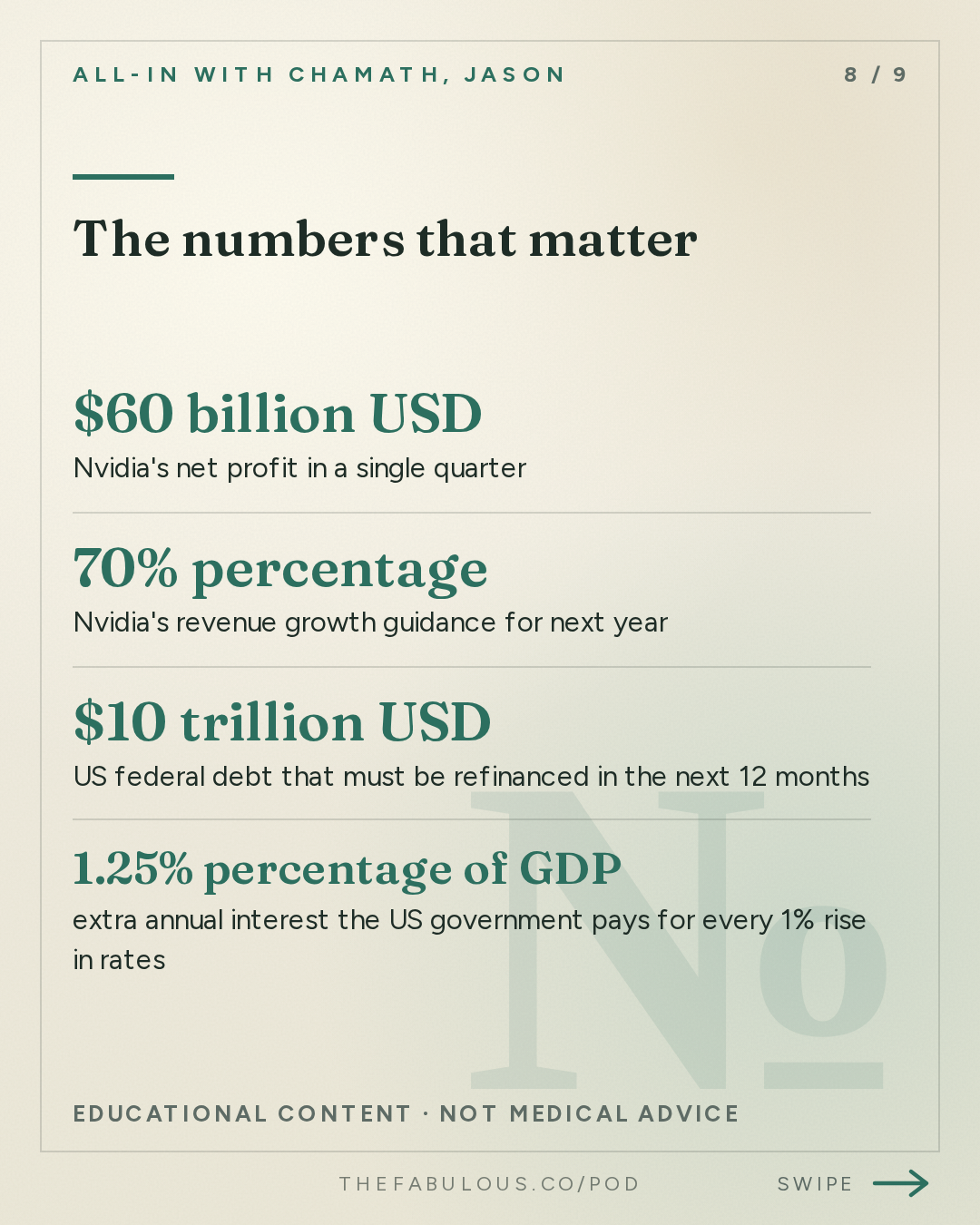
- $60 billion USD Nvidia's net profit in a single quarter
- 70% percentage Nvidia's revenue growth guidance for next year
- $10 trillion USD US federal debt that must be refinanced in the next 12 months
- 1.25% percentage of GDP extra annual interest the US government pays for every 1% rise in rates
- 27% percentage decline in Austin, Texas home prices from their 2022 peak
- $500,000 USD estimated price of Moderna's mRNA cancer immunotherapy per patient
In their words
“This AI CapEx is gonna continue well into the future. It's got real legs”
“For every 1% change in the interest rate, the US government has to pay 1.25% of GDP in excess interest each year.”
“The core root of inflation in this country, the core root of it is government spending.”
Protocols
-
Screen early for cancer with blood-based tests
Jason Calacanis recommends getting tested early and often for cancer using blood-based screening tools such as the Galleri test made by Grail, which is designed to catch cancer before symptoms appear.
As part of routine, ongoing health screening
-
Build software for AI agents, not just human users
David Sacks advises software companies to build strong APIs and command line interfaces so AI agents can read and act on their data, and to accept that a chat assistant like Claude may become the primary user interface instead of the company's own dashboard.
Ongoing product strategy
Questions this episode answers
How much profit did Nvidia make last quarter?
Nvidia reported $96.2 billion in quarterly revenue and $60 billion in net profit, described on the show as the most profitable single quarter of any public company in history outside of one-off gains (09:38). The company also guided to 70% revenue growth next year, well above the 45% Wall Street expected (09:44).
Why did Salesforce stock jump over 20%?
Salesforce beat earnings expectations and raised its full-year revenue guidance to $46 billion, helped by a deal letting Anthropic's Claude access Salesforce data and workflows directly (10:52, 19:20). David Sacks argues the SaaSpocalypse narrative, which predicted AI would replace core business software, was overblown for systems of record like CRM (18:11).
Why are US Treasury yields so high, and what does it mean for the national debt?
The 30-year Treasury yield hit a 19-year high of 5.3%, and David Friedberg explains that for every 1% rise in interest rates, the government pays an extra 1.25% of GDP in interest annually (38:18). The federal government must also refinance $10 trillion of existing debt in the next 12 months at these higher rates (38:48).
What is Moderna's mRNA cancer vaccine and how does it work?
It is technically an immunotherapy rather than a preventive vaccine: doctors sequence a patient's tumor DNA to find a unique protein called a neoantigen, then use mRNA to instruct the patient's own cells to produce that protein so the immune system attacks matching cancer cells (83:59, 86:22). David Friedberg notes the underlying technique was developed largely with public research funding and criticizes Moderna's roughly $500,000 price for the treatment (88:56).
Is vertical SaaS at risk from AI, or just horizontal platforms like Salesforce?
The discussion suggests horizontal platforms that hold a company's core data, like Salesforce or Workday, are more protected because AI agents still need a trusted system of record to pull from (25:08). Industry-specific vertical software that mostly runs workflows rather than storing canonical data is described as more exposed to replacement by custom AI-built tools (17:18).
The full read, in cards
Go deeper
- Wall Street Journal op-ed by Stan Druckenmiller — argued that rising Treasury yields reflect a congressional spending problem the Treasury cannot fix by buying bonds
- NIH-funded neoantigen immunotherapy research — decades of publicly funded research established the sequence-and-target technique now used in mRNA cancer immunotherapy
Mentioned
Nvidia · Salesforce · Mark Benioff · Jensen Huang · Stan Druckenmiller · Scott Bessent · Kevin Warsh · Moderna · Eric Weinstein · Anthropic · Hugging Face · Poolside · Grail
More from this show and category

Dylan Field: Design Is the New Code
Figma CEO Dylan Field argues design, not code, now drives software's value as AI makes coding cheap and commoditized. He explains how Figma survived a blocked $20 billion Adobe acquisition, why AI lowers production's floor without raising creativity's ceiling, and why human willingness to say non-consensus things remains the real differentiator in an AI-saturated market.

CoreWeave Debt Crisis and the AI Bubble, Explained
CoreWeave's bond selloff this week signaled real doubt about AI infrastructure debt, even as demand for GPUs stays red hot. Anthropic posted $16.8 billion in Q3 revenue, Sacks called its warnings about small AI models a move against open-source rivals, and Chamath named electricity as AI's real bottleneck.

Billy Evans on Elizabeth Holmes: Trial, Prison, Hemantis
Billy Evans, Elizabeth Holmes's husband, says the Theranos founder was acquitted on every patient-fraud count tied to 12.5 million blood tests but convicted of defrauding three investors, a conspiracy charge that let the judge add outside victims like Rupert Murdoch and push her sentence to 11.25 years (00:27, 19:52, 21:31).

Martin Shkreli: Quantum Computing Fraud, Pharma Deals
Martin Shkreli argues quantum computing is mostly a business mirage because today's machines run at only hundreds of hertz. He says photonic chips, which multiply matrices with light, could make Nvidia's GPUs obsolete within twenty years, and he describes turning a $2 million drug deal into a $6 billion pharmaceutical company.
