
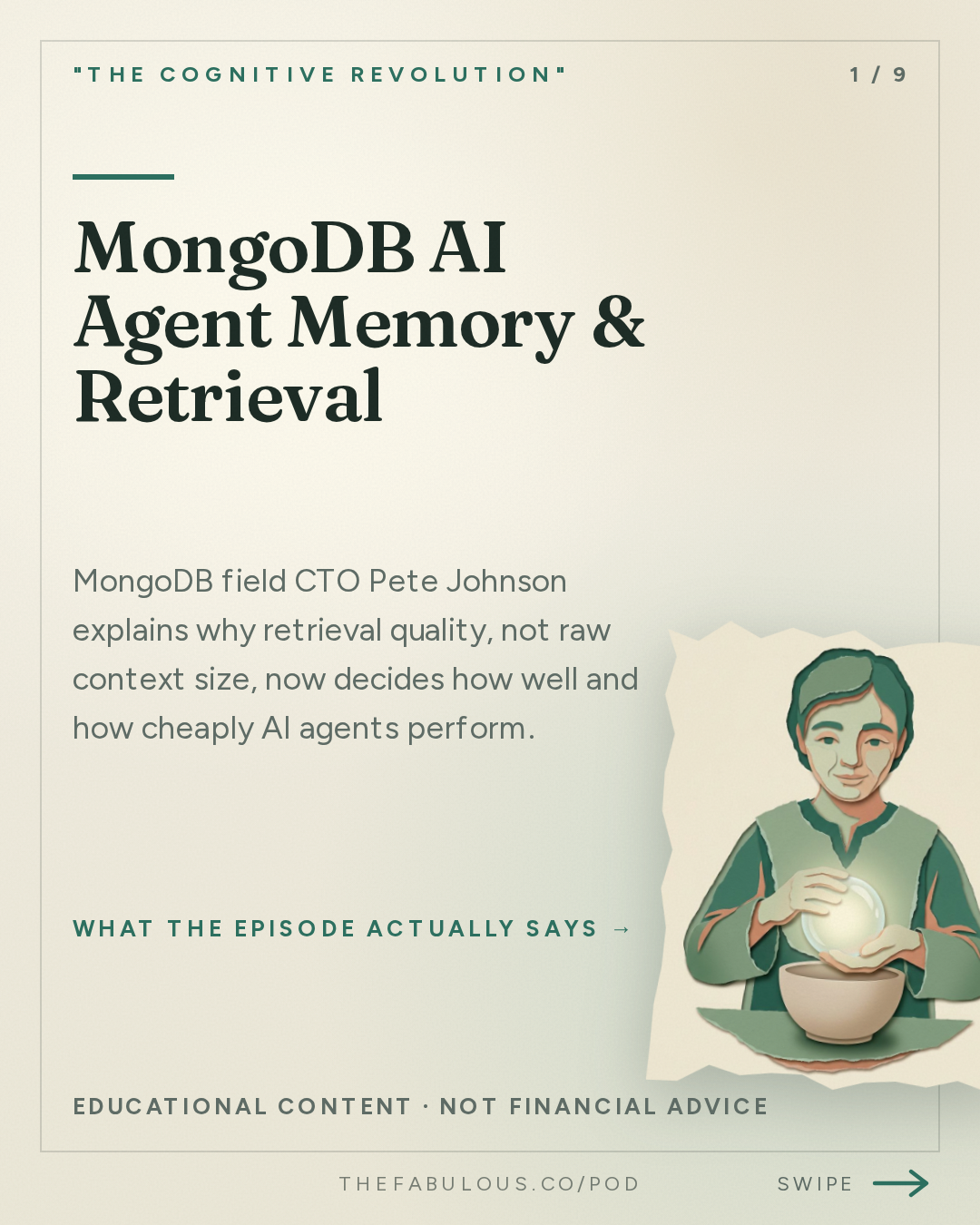
MongoDB AI Agent Memory & Retrieval
Write, Change, Recall, Forget: MongoDB's Pete Johnson on How Retrieval Drives Agent Performance
▶ Listen to the full episode More from The Cognitive Revolution
The brief
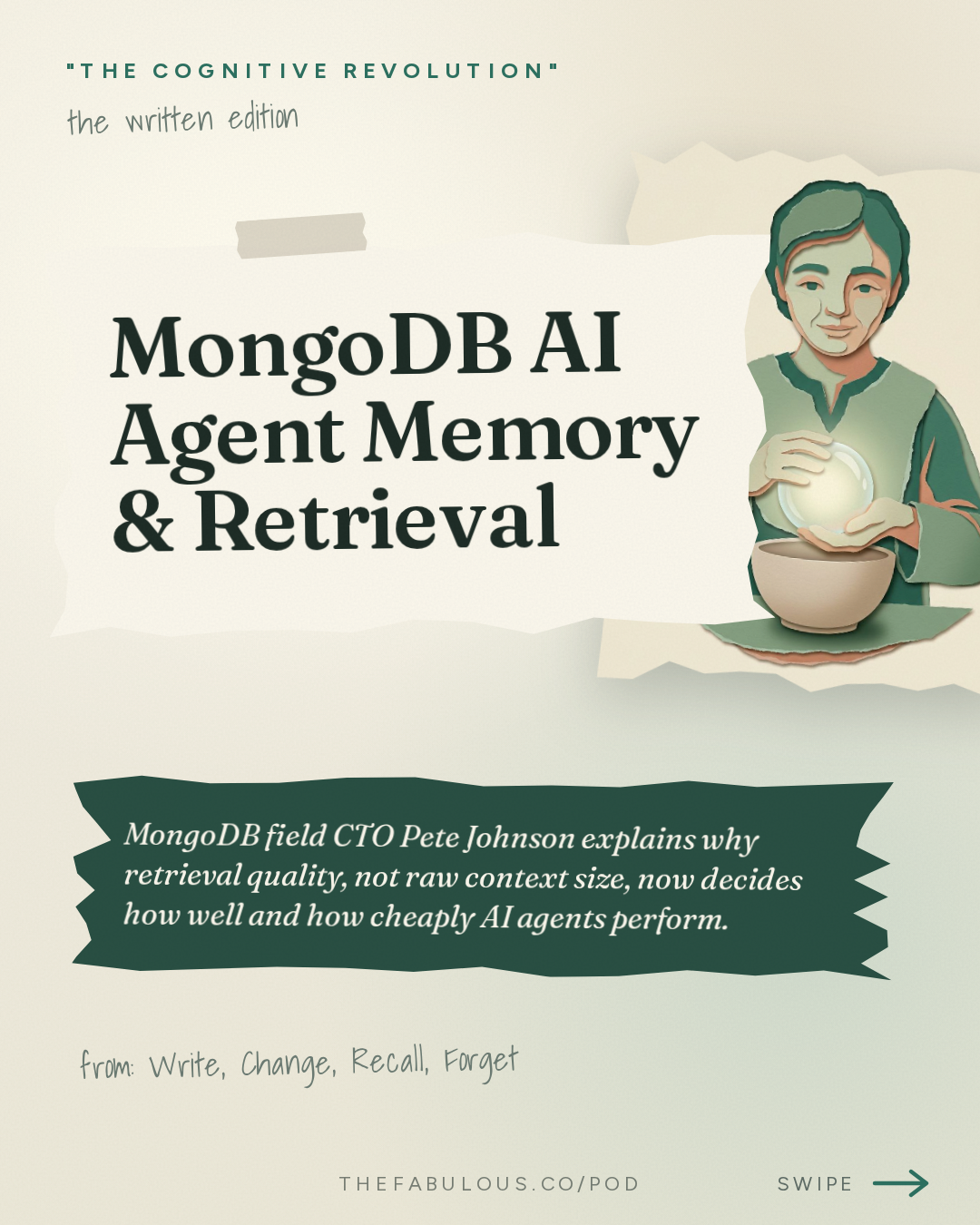
MongoDB field CTO Pete Johnson explains why retrieval quality, not raw context size, now decides how well and how cheaply AI agents perform. He traces database design from 1970s SQL normalization through MongoDB's 2007 launch to today's vector search, and argues agent memory needs deliberate write, change, recall, and forget steps rather than dumping everything into context.
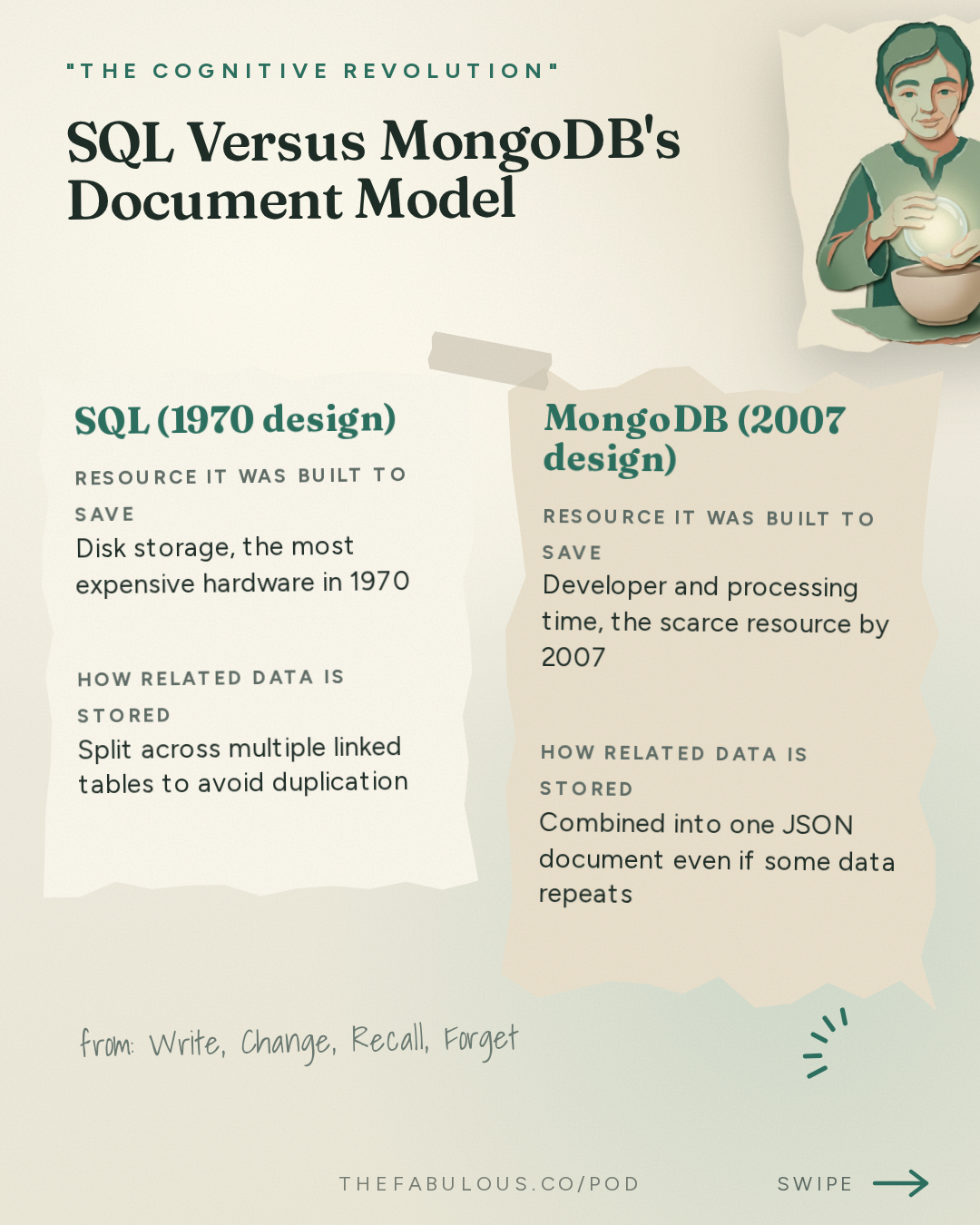
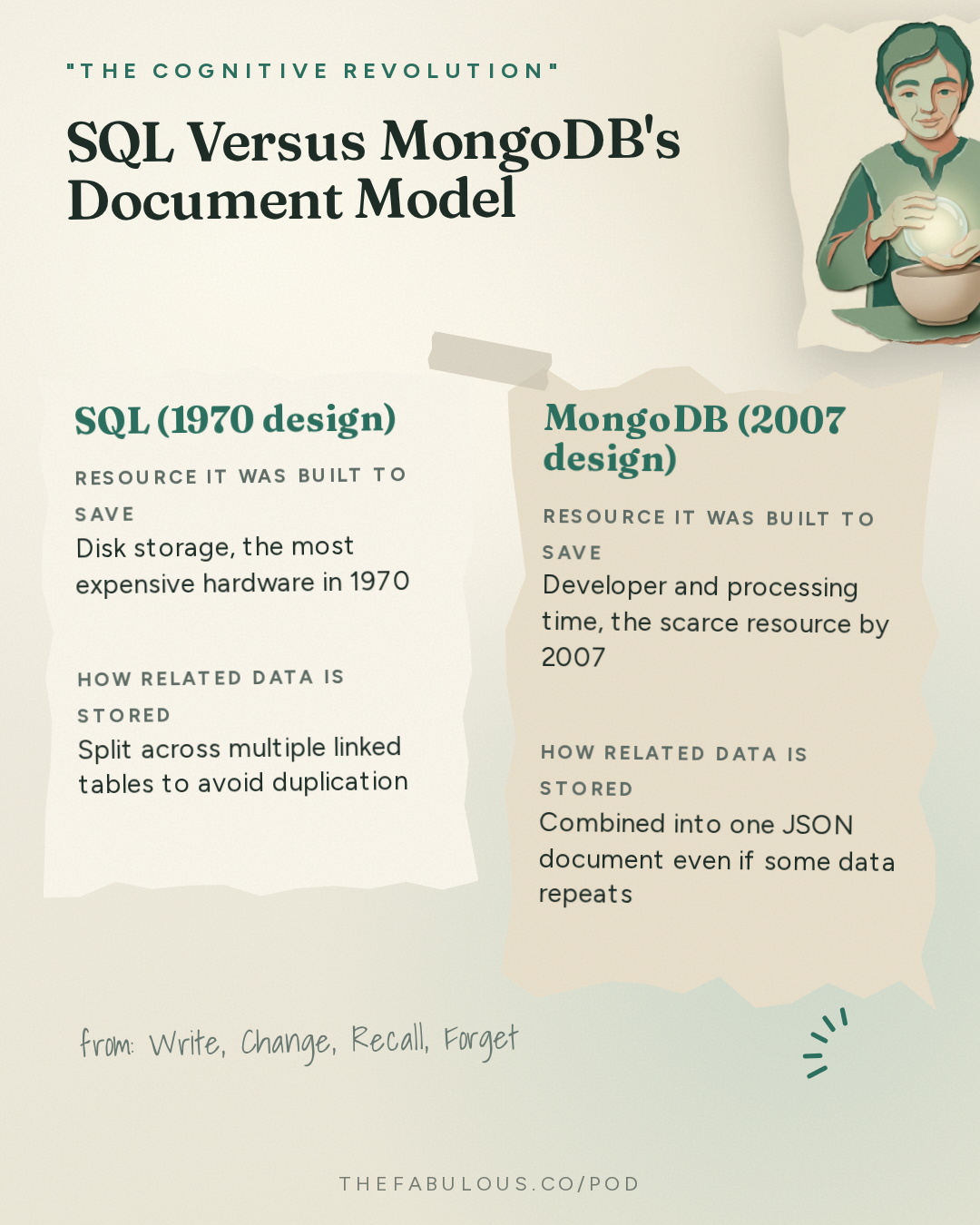
In June of 1970, an IBM researcher named E.F. Codd wrote a paper that would define how computers stored information for the next three decades. At the time, storage was the most expensive part of any computer system, more costly than memory or processing power. So Codd's design, which became SQL, split data into many small tables to avoid ever storing the same fact twice. A customer's address might live in one table, the customer's name in another, and a third table would link them, purely to save disk space (07:25). That single constraint, expensive storage, shaped software architecture for a generation.
Pete Johnson, MongoDB's field CTO of AI and a 30-year veteran of enterprise software, opens his account of database history there because he thinks the pattern still applies. By 2007, when the first commit to MongoDB was written, storage was cheap and disk was no longer the bottleneck. The internet, cloud computing, and the first iPhone had changed what applications needed to do. Suddenly they had to run continuously, not on a nine-to-five schedule, and developers had far less patience for wrestling with rigid table structures. As Johnson puts it, the scarce resource had moved.
"The scarce resource in that ecosystem became time." — Pete Johnson [08:49]
MongoDB's answer was to store data as JSON, a text format that mirrors how programming languages already represent objects, saved on disk in a binary form called BSON. Instead of splitting a customer's name and address across three tables, you keep them together in one document. You duplicate a bit of data, but you get it back in a single disk read instead of three (10:40). Johnson is careful to correct a common misunderstanding here: MongoDB is not schemaless. It is schema-flexible, meaning different documents in the same collection can have different shapes, and you can add new fields without the cascading rewrites that a SQL migration usually requires (21:36).
"It's not that we're schemaless, it's that we're schema-flexible, that you can change the schema more easily over time." — Pete Johnson [21:36]
Retrieval Is the Real Cost Center
That history matters now because AI has revived an old argument in a new form. When GPT-4-class models had tiny context windows, the space where a language model reads the text it is given, developers were forced to retrieve only the most relevant snippets of company data and feed them in, a technique called RAG, short for retrieval-augmented generation. When million-token context windows arrived, plenty of people declared RAG dead: why bother selecting anything if you can just paste in everything? Johnson says that phase ended badly. Uber reportedly burned through its entire 2026 token budget in just thirteen weeks (16:38), an outcome that became a cautionary tale across the industry. Feeding a model a million tokens every time is not just slow, it is expensive, and Johnson argues it does not even produce better answers, because the middle of a long context window tends to get ignored while the first and last roughly seven thousand tokens do the real work (56:54).
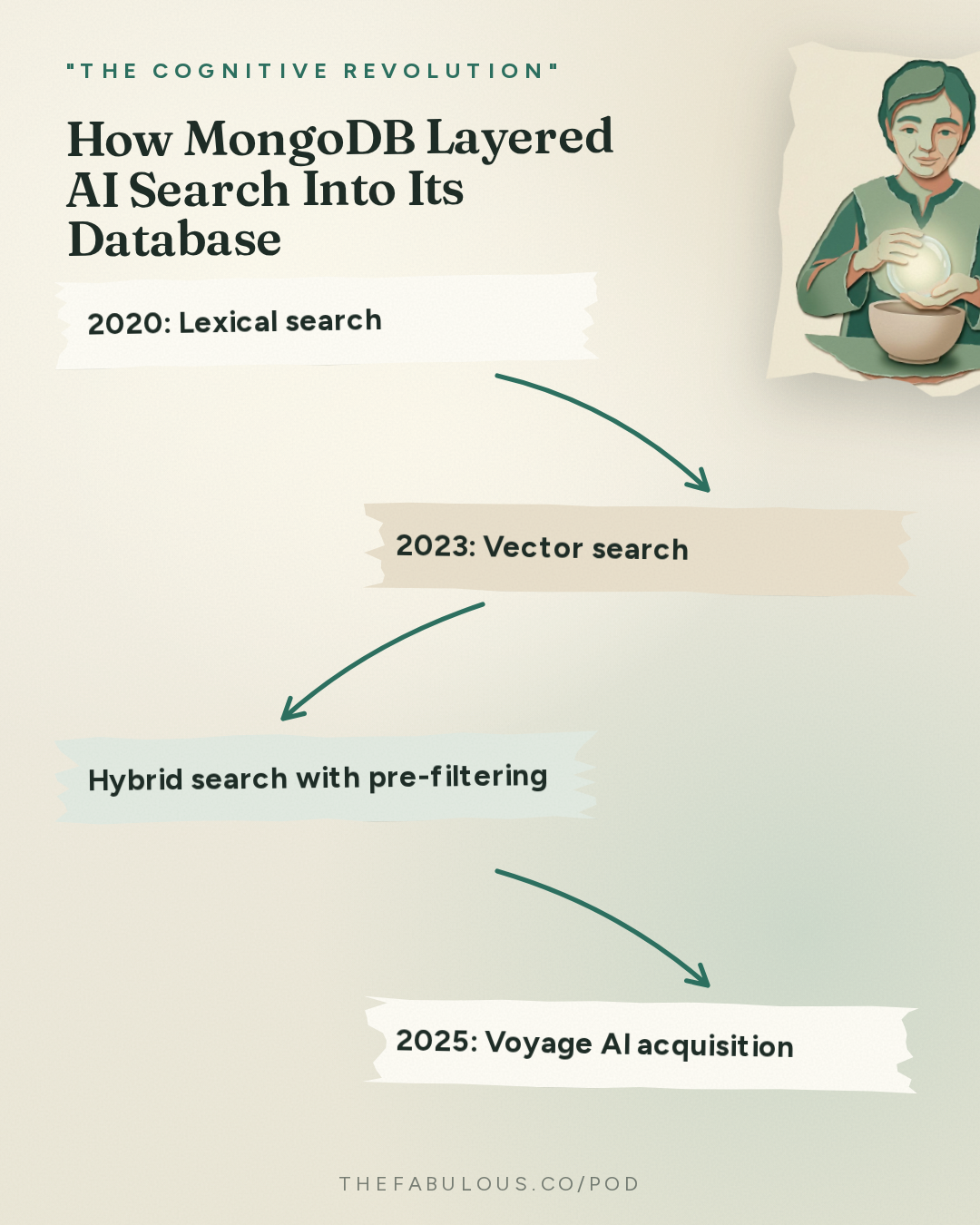
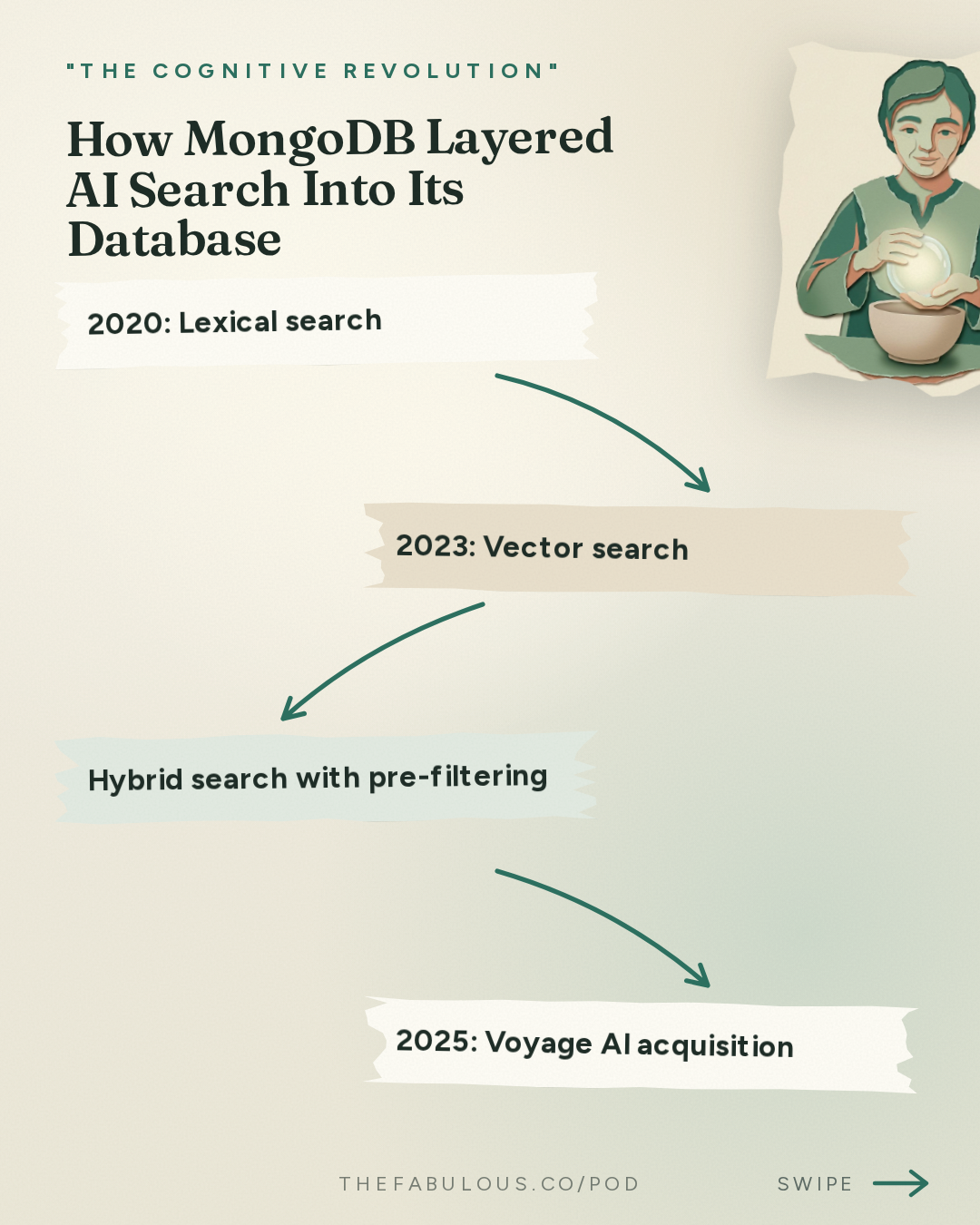
So retrieval quality, not sheer context size, is what Johnson calls the biggest lever on cost-adjusted agent performance (13:15). MongoDB's own vector search product grew in stages that trace this shift. In 2020 the company added lexical search, essentially keyword matching, because customers were already running separate search servers next to their databases (23:27). In 2023 it added vector search: an embedding model converts text, images, or audio into an array of numbers called a vector, and MongoDB simply stores that array as another attribute on the same document (25:33). Because the schema is flexible, developers can combine keyword search, vector search, and traditional filters, such as "only books published after 2000," in one query (27:17). This year MongoDB shipped Rank Fusion and Score Fusion, aggregation stages that let a single API call run both lexical and vector search and merge the results automatically, instead of requiring developers to make two calls and stitch the results together themselves (30:42).
Underneath all of this sits a genuinely hard engineering problem: chunking, the process of breaking a long document into pieces small enough to embed and search individually. Chunk too small, like a single sentence, and you lose the surrounding context. Chunk too large, like a whole chapter, and storage costs rise while retrieval precision falls, because the vector now represents too many different ideas at once (39:19). MongoDB's 2025 acquisition of embedding company Voyage AI, reportedly valued around 220 million dollars (77:03), was aimed partly at this problem. Voyage's contextualized chunking sends both a small target chunk and a second string carrying its surrounding context, and returns one vector that balances the two, which Johnson says lets developers get better retrieval quality even with smaller chunks, without running the usual trial-and-error cycle of testing chunk sizes by hand (41:23). A related feature, Matryoshka reasoning, named for Russian nesting dolls, lets developers cut a large embedding down to fewer dimensions, the individual numbers in the vector, without re-processing the entire dataset, because the values are ordered so the extra ones can simply be trimmed off the end (44:04).
These tools matter mostly at scale. Johnson pegs the point where vector database performance starts to require real engineering attention at around 100,000 vectors (49:01). Below that, most setups work fine regardless of vendor choice. He also pushes back on the idea that embedding models are interchangeable commodities: on the Hugging Face retrieval benchmark called RTab, Voyage AI's models reportedly outperform competitors by up to 14 percent (49:30), a gap he says is large enough in some cases to be the difference between a hallucination and a correct answer.
Memory Needs a Loop, and Forgetting Is the Hard Part
Retrieval solves the problem of injecting outside data into a model that was never trained on it. Memory solves a different problem: giving an agent continuity across many separate calls, since every call to a language model still starts with a technically blank context window. Early memory systems, Johnson says, simply crammed every message from a session, and then every session from the last few days, into that window. This produced the token-maxing costs already described, plus a quieter failure mode: useful information buried in the middle of a huge context window gets effectively ignored by the model (56:54). More advanced systems now practice what Johnson calls taxonomic memory, selectively injecting only the five or so vertical-specific terms relevant to the current task instead of a full glossary of a hundred (57:39).
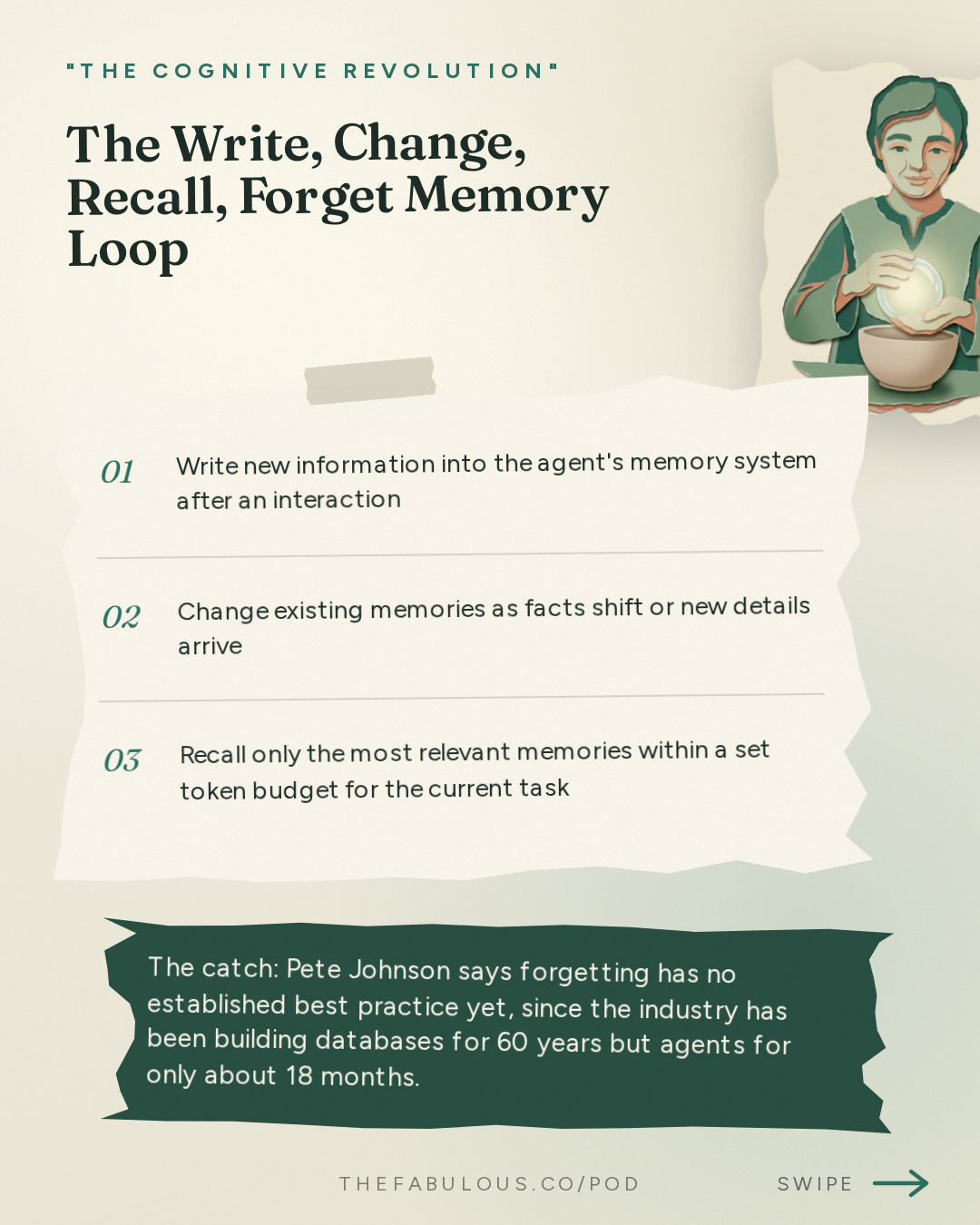
Johnson frames the overall discipline as a four-step loop: write, change, recall, and forget (62:50). Writing and recalling are relatively well understood. Changing a memory as facts shift is harder. Forgetting, deciding what should decay or disappear, is the part nobody has solved yet, partly because so little time has passed to figure it out.
"We've been building databases for 60 years. We've been building agents for, like, 18 months, man." — Pete Johnson [60:07]
That humility carries into his advice on enterprise strategy. Johnson has visited seven countries this year talking to roughly a hundred companies about their AI plans, and he says the ones stuck in what he calls proof-of-concept purgatory usually picked the wrong problem, not the wrong tool. His filter: choose use cases where the company already has clean data and existing performance metrics, because a bad foundation gets worse, not better, once AI is layered on top.
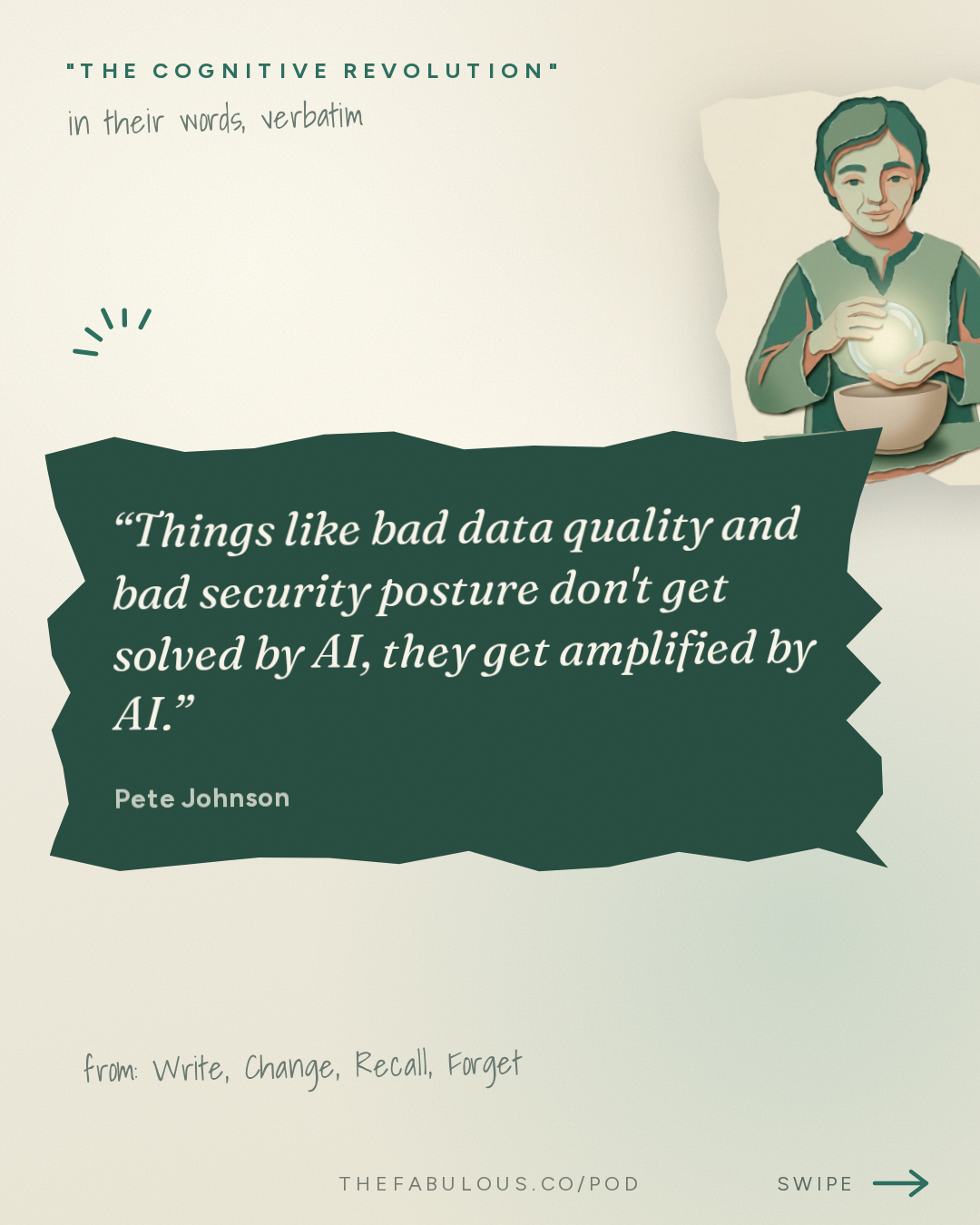
"Things like bad data quality and bad security posture don't get solved by AI, they get amplified by AI." — Pete Johnson [68:54]
He also notes there is no equivalent yet of the LAMP stack, the standard set of tools that once made web development predictable, for building AI agents (71:12), which is why most Fortune 500 companies are still deploying AI on internal, employee-facing tasks with a human checking the output, rather than trusting it directly with customers.
Perhaps the most surprising finding from Johnson's travels has nothing to do with technology at all. He expected the United States to be furthest ahead. Instead, the two most sophisticated deployments he saw this year were in Mexico City and Sao Paulo (85:16), a reversal he attributes to infrastructure access spreading faster this cycle than in the cloud or mobile eras, when a missing data center or cell tower could leave an entire country behind. Fittingly, MongoDB's newest cost-saving trick works the same way, in miniature: its shared embedding spaces let a developer embed their full dataset with a large, paid Voyage model, then run all their development-time queries against a free, open-weight "Nano" version that shares the same embedding space, cutting token costs during the build phase to nearly zero (87:47). Access, in other words, keeps getting cheaper. What is expensive now, and worth arguing about, is judgment: which data to keep, which to trim, and when to let something go.
Ask this episode anything
Pod's AI answers from the episode itself, with the minute mark so you can hear it yourself.
Or start with one of these
Ask this episode
Pod's AI listens to the whole episode to answer, and points you to the minute it comes from.
The rest of this answer, and any question after it
Answers come from the episode itself, never from a summary of it.
ContinueKey takeaways
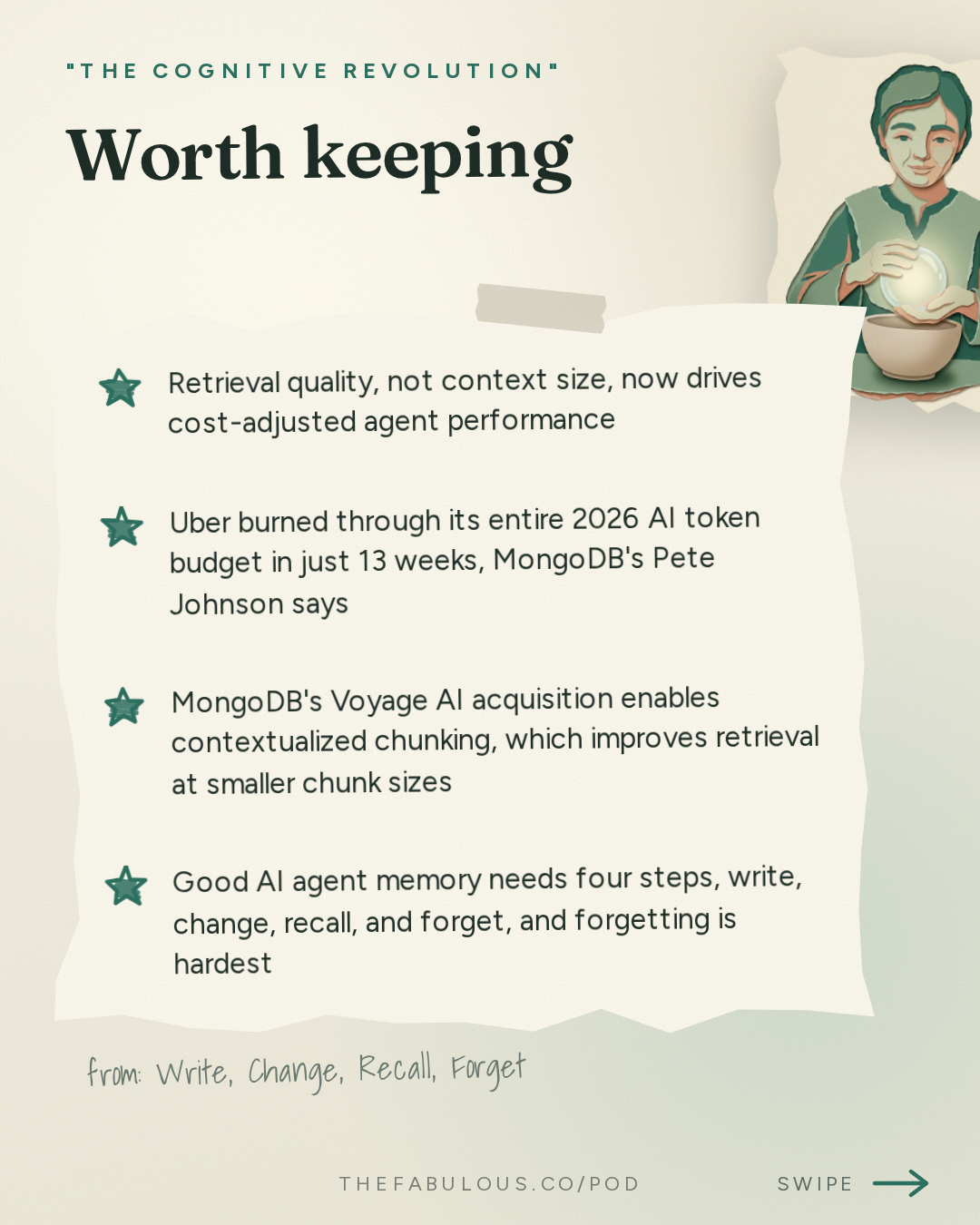
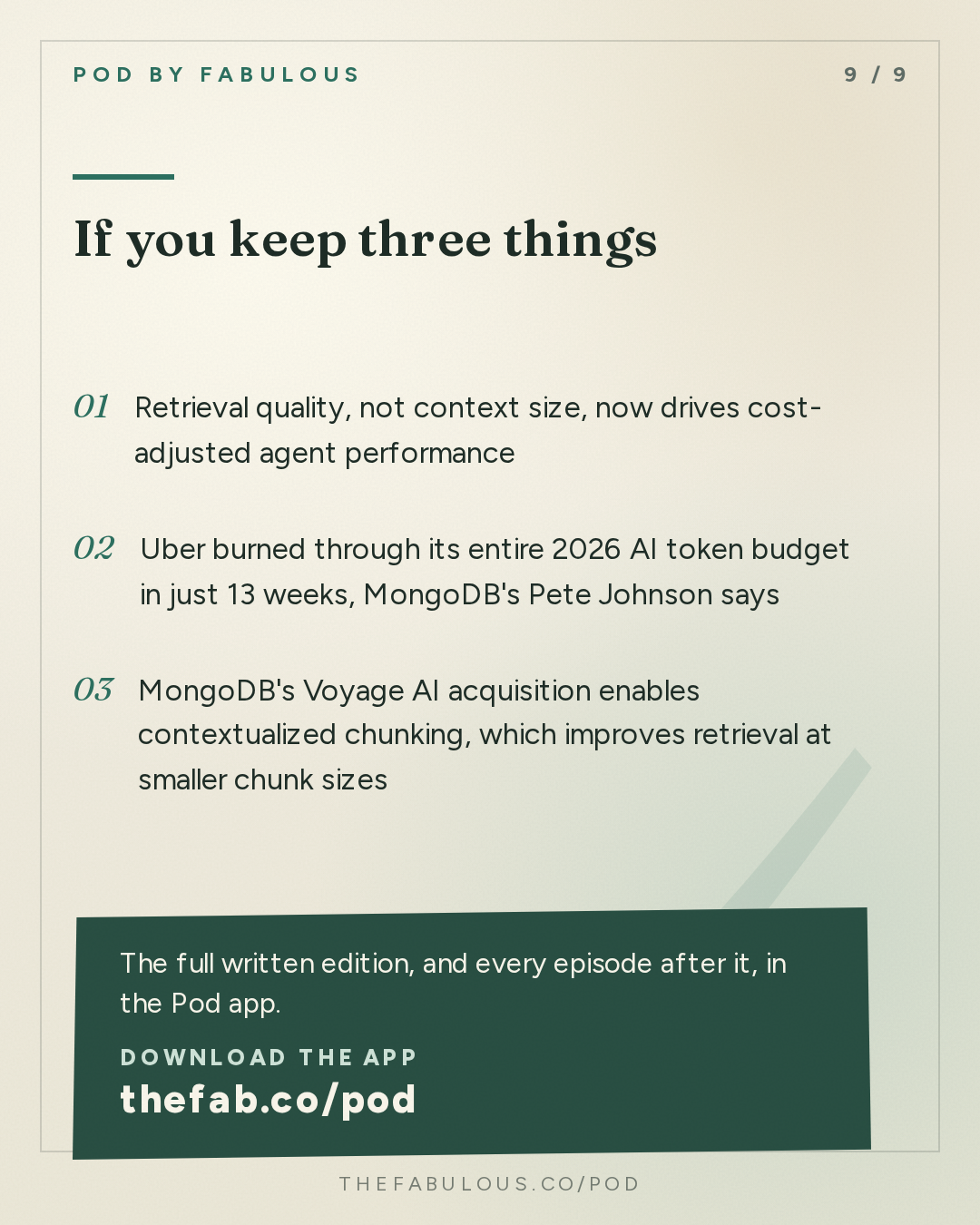
- Retrieval quality, not context size, now drives cost-adjusted agent performance
- Uber burned through its entire 2026 AI token budget in just 13 weeks, MongoDB's Pete Johnson says
- MongoDB's Voyage AI acquisition enables contextualized chunking, which improves retrieval at smaller chunk sizes
- Good AI agent memory needs four steps, write, change, recall, and forget, and forgetting is hardest
- The most advanced AI deployments Pete Johnson saw in 2026 were in Mexico City and Sao Paulo, not the US
The episode in cards

By the numbers
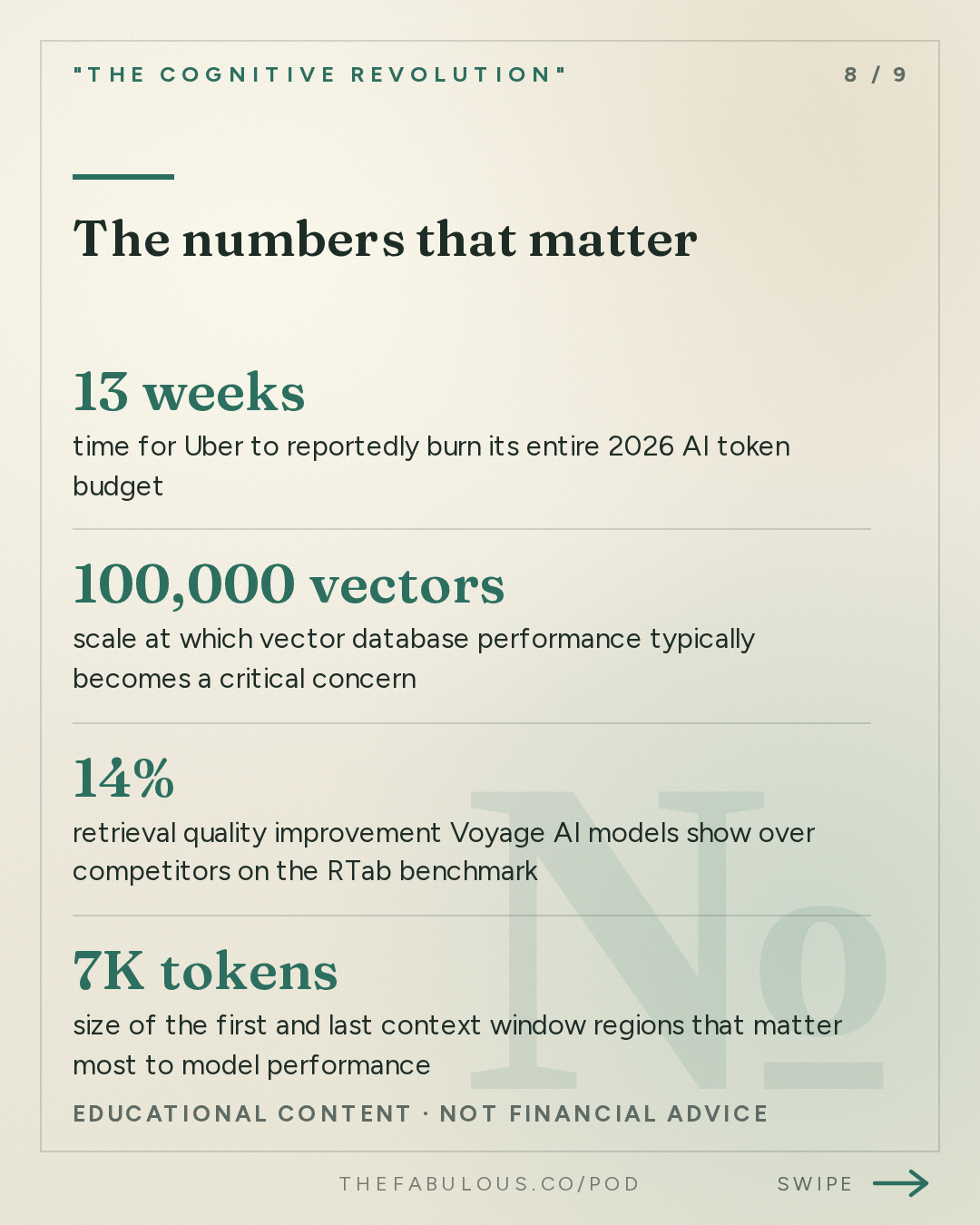
- 13 weeks time for Uber to reportedly burn its entire 2026 AI token budget
- 100,000 vectors scale at which vector database performance typically becomes a critical concern
- 14% percent retrieval quality improvement Voyage AI models show over competitors on the RTab benchmark
- 7K tokens size of the first and last context window regions that matter most to model performance
In their words
“The scarce resource in that ecosystem became time.”
“It's not that we're schemaless, it's that we're schema-flexible, that you can change the schema more easily over time.”
“Most people think embedding models are commoditized, and that is not true.”
“We've been building databases for 60 years. We've been building agents for, like, 18 months, man.”
“Things like bad data quality and bad security posture don't get solved by AI, they get amplified by AI.”
Protocols
-
Combine lexical and vector search in one call
Pete Johnson recommends using MongoDB's Rank Fusion or Score Fusion aggregation stages to run keyword search and vector search together in a single API call instead of making two calls and merging the results manually. The catch is that developers still have to choose whether to combine results by rank or by score, since the two fusion methods are not interchangeable.
Per query
-
Use contextualized chunking instead of manual tuning
Pete Johnson recommends using Voyage AI's contextualized chunking, which sends a small text chunk plus its surrounding context as two strings so the retrieval model balances chunk size automatically. The catch is that some use cases still require manual control over chunk size, so this does not replace testing entirely.
Set once per data pipeline
-
Pick AI problems with clean data and existing metrics
Pete Johnson advises enterprises to choose AI use cases where they already have good data quality and existing performance metrics, such as cost per call in a call center, so any change can be credited to the AI. The catch is that AI amplifies bad data quality and weak security posture rather than fixing them, so a poorly chosen problem tends to get worse.
Before starting any AI project
-
Give agent memory a token budget instead of full history
Pete Johnson recommends querying agent memory with a fixed token budget, for example the best 50,000 tokens, rather than loading an entire session or multiple days of history into the context window. The catch is that the first and last roughly 7,000 tokens of a context window matter most, so tokens placed in the middle can end up confusing the model instead of helping it.
Every agent loop
Questions this episode answers
What is contextualized chunking and how does it improve AI retrieval?
Contextualized chunking, developed by Voyage AI and used in MongoDB, sends a small target text chunk plus a separate string carrying its surrounding context, returning one balanced vector instead of forcing developers to manually test chunk sizes. MongoDB field CTO Pete Johnson says this can produce better retrieval quality even with smaller chunks, which traditional embedding approaches cannot achieve (41:23).
How many vectors before a vector database needs to worry about scale?
Pete Johnson, MongoDB's field CTO of AI, puts the threshold at around 100,000 vectors, the point where speed and scale start to require deliberate engineering rather than working fine by default (49:01).
What is the write, change, recall, forget loop for AI agent memory?
It is a four-step pattern Pete Johnson describes for managing AI agent memory: writing new information after each interaction, changing memories as facts shift, recalling only the most relevant memories within a token budget, and forgetting outdated ones. Johnson says forgetting is currently the hardest step to build well, since the industry has only been building agents for about 18 months compared to 60 years of database experience (62:50).
Are embedding models commoditized?
No. On the Hugging Face RTab benchmark, Voyage AI's embedding models reportedly beat competitors by up to 14 percent in retrieval quality (49:30). MongoDB's Pete Johnson notes that Anthropic, which has no embedding model of its own, recommends Voyage rather than treating embeddings as interchangeable (50:00).
Why did Uber's AI costs spike in 2026?
Uber reportedly burned through its entire 2026 AI token budget in just 13 weeks by maxing out large context windows on every call, a strategy that became a cautionary example across the industry for treating million-token context as free (16:38).
Where is enterprise AI adoption most advanced right now?
Pete Johnson, who visited seven countries in 2026 talking to about 100 companies, says the two most sophisticated AI deployments he saw this year were in Mexico City and Sao Paulo, not the United States, which he attributes to AI infrastructure access spreading faster and more evenly than in previous technology waves (85:16).
The full read, in cards
Go deeper
- E.F. Codd's original relational database paper — IBM researcher's 1970 white paper that gave rise to SQL and table normalization
- RTab embedding benchmark (Hugging Face) — shows Voyage AI embedding models near the top for retrieval quality, up to 14 percent above competitors
- Voyage AI contextualized chunking research — found that sending a chunk plus separate context string improves retrieval quality at smaller chunk sizes
- Academic studies on context window token position — found the first and last roughly 7,000 tokens of a context window matter most while middle tokens can confuse the model
Mentioned
Pete Johnson · MongoDB · E.F. Codd · Guillermo Rauch · Voyage AI · Anthropic · ElevenLabs · Uber · Apache Lucene · MCP · Hugging Face · Matryoshka reasoning
More from this show and category

How AI Models Actually Decide: Critical Tokens
Goodfire researcher Eric Bigelow finds that an AI model's final answer can hinge on one random token, not step-by-step logic. He also warns that reinforcement learning erodes chain of thought reliability, pushing models toward compressed shorthand that is hard to monitor, even as interpretability funding lags far behind capability spending.

AI Token Spend Now Beats Human Salaries
A frontier lab executive told podcast host Nathan Labenz that humanity probably shouldn't exceed some future level of AI intelligence. He said he'd accept a flop cap on the next pretraining run, and the episode also covers a 4.5x jump in AI memory prices, Positron's new inference chip, and why Latent Space's Shawn Wang says most SaaS software is 'cooked.'

OutSystems Mentor: AI for Enterprise Apps
OutSystems CEO Woodson Martin explains why reliable enterprise AI runs through an abstraction layer instead of raw code generation. He describes cutting internal token spend after a June-July peak, compressing a six-year legacy system rewrite into six months, and why AI-native junior hires may out-innovate incumbents if trained into industry context.
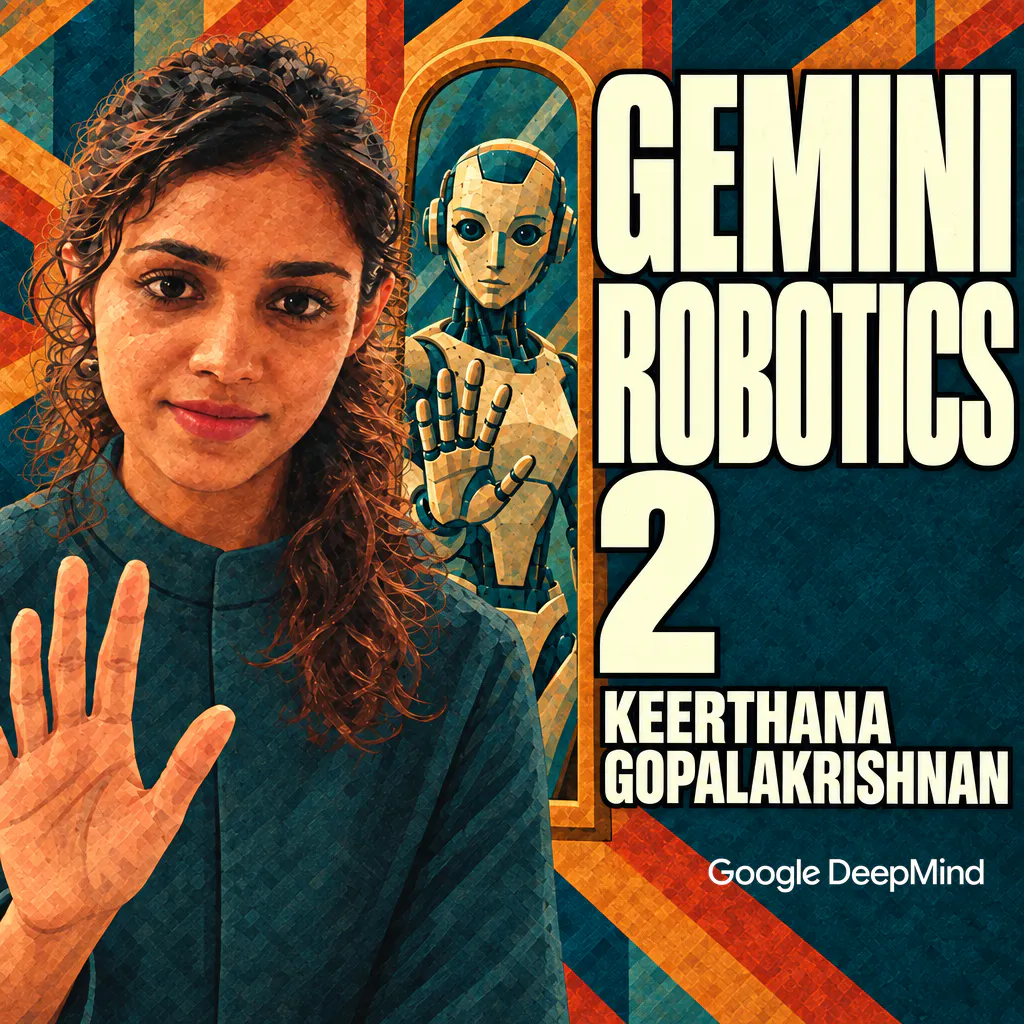
Gemini Robotics 2.0: DeepMind's New Robot Brain
Google DeepMind's Keerthana Gopalakrishnan says robotics is still in its GPT-2 era despite Gemini Robotics 2.0 driving humanoid hands and grippers alike. The new architecture splits reasoning (ER2) from action (the VLA), needs just 200 examples to adapt to a new robot body, and treats safety as a capability rather than a constraint.
