
Khabib Nurmagomedov on Hardship, Discipline, and Faith
#500 – Khabib Nurmagomedov: Dagestan, MMA, UFC, Islam, Conor, Fedor & Football
The brief
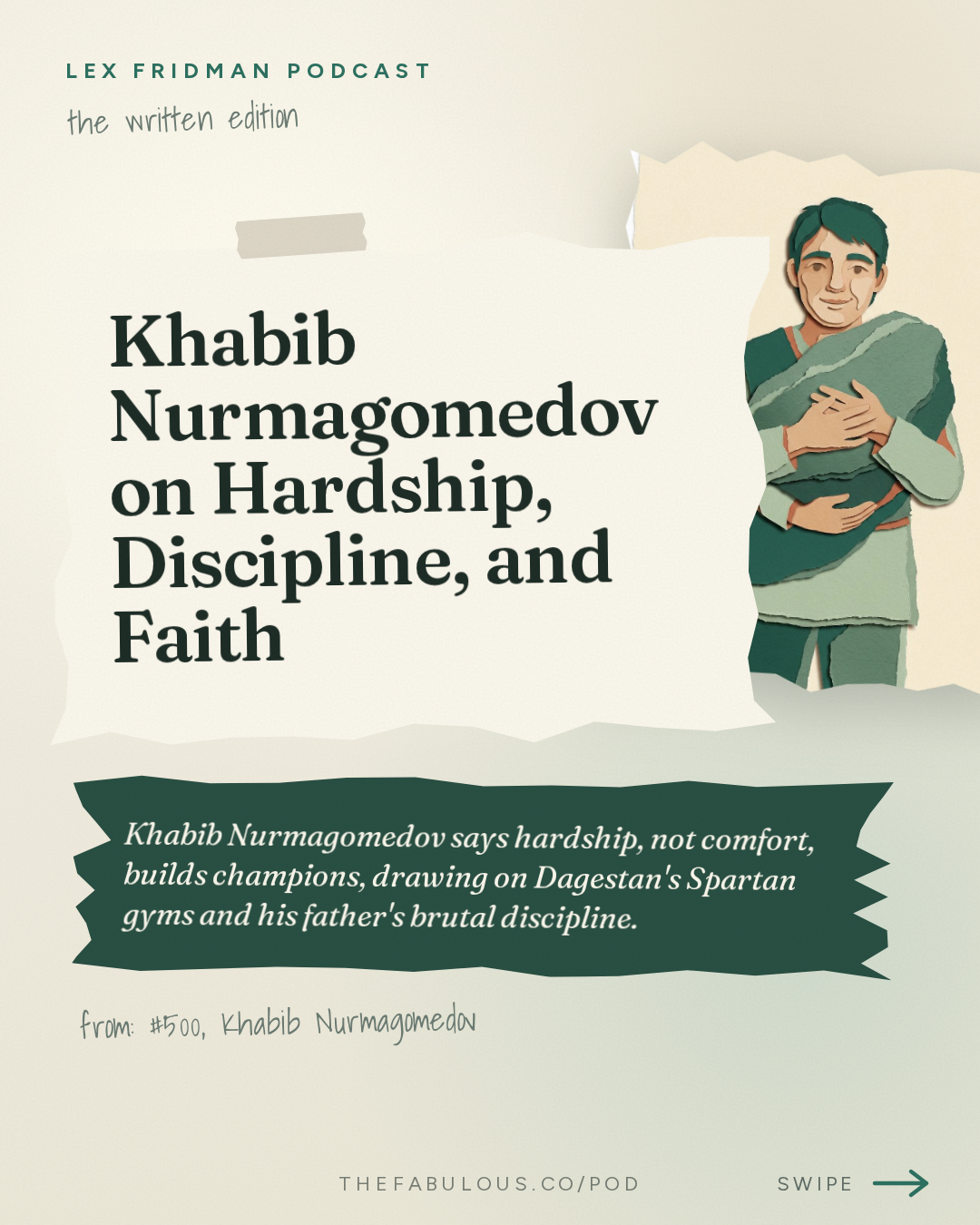
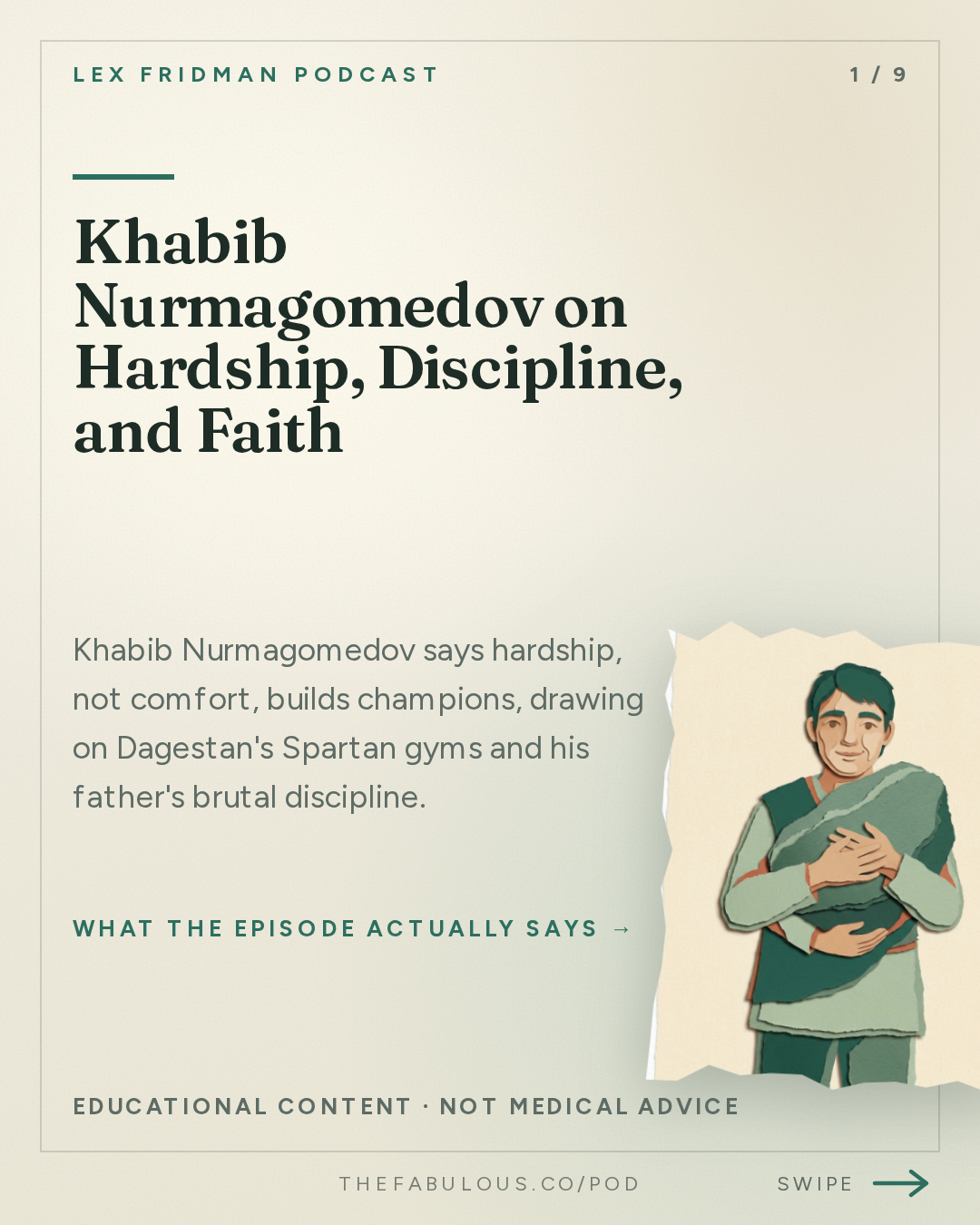
Khabib Nurmagomedov says hardship, not comfort, builds champions, drawing on Dagestan's Spartan gyms and his father's brutal discipline. The retired UFC lightweight champion, undefeated at 29-0, tells Lex Fridman that staying a champion is harder than becoming one, and that faith keeps wealth in the hand rather than the heart.
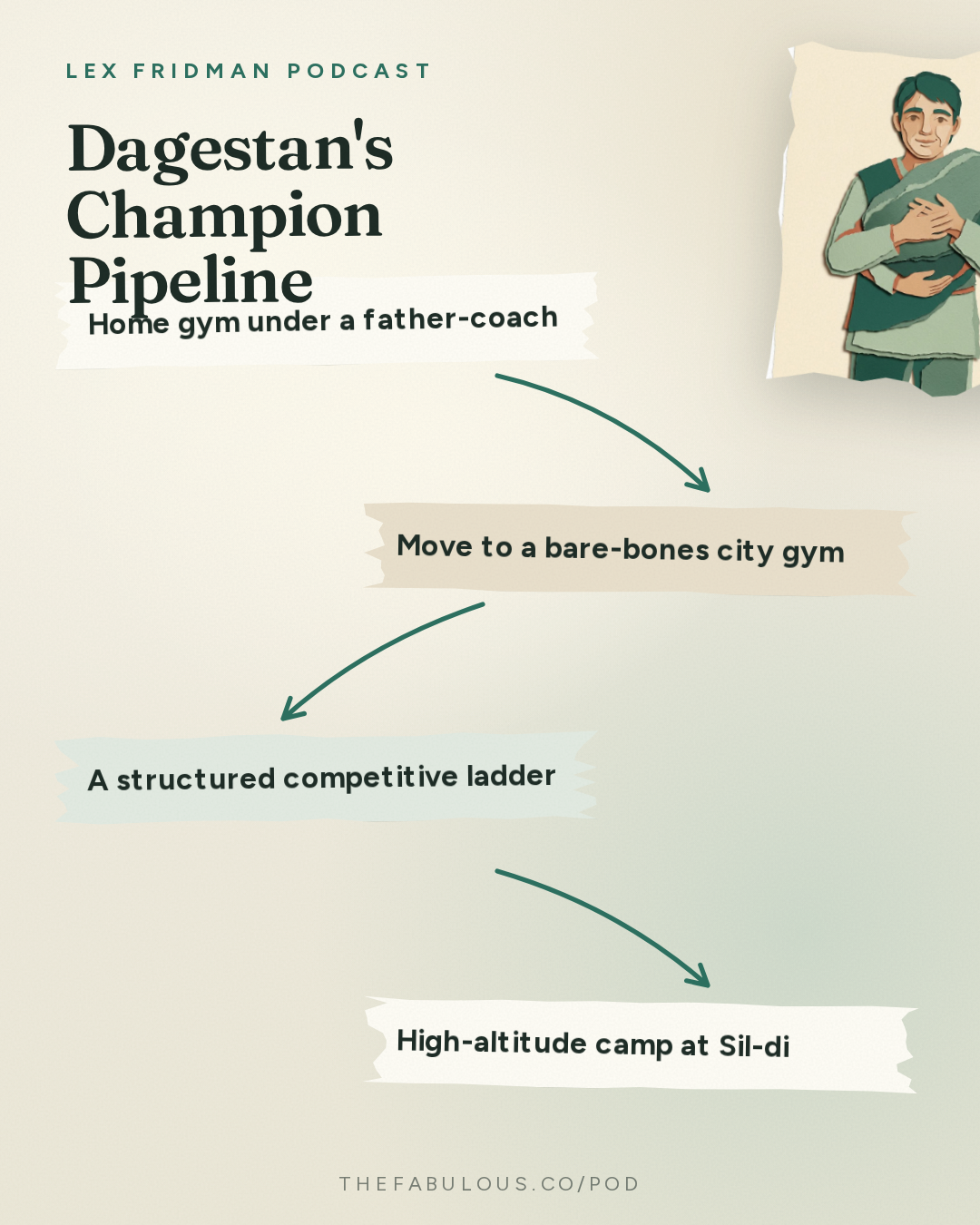
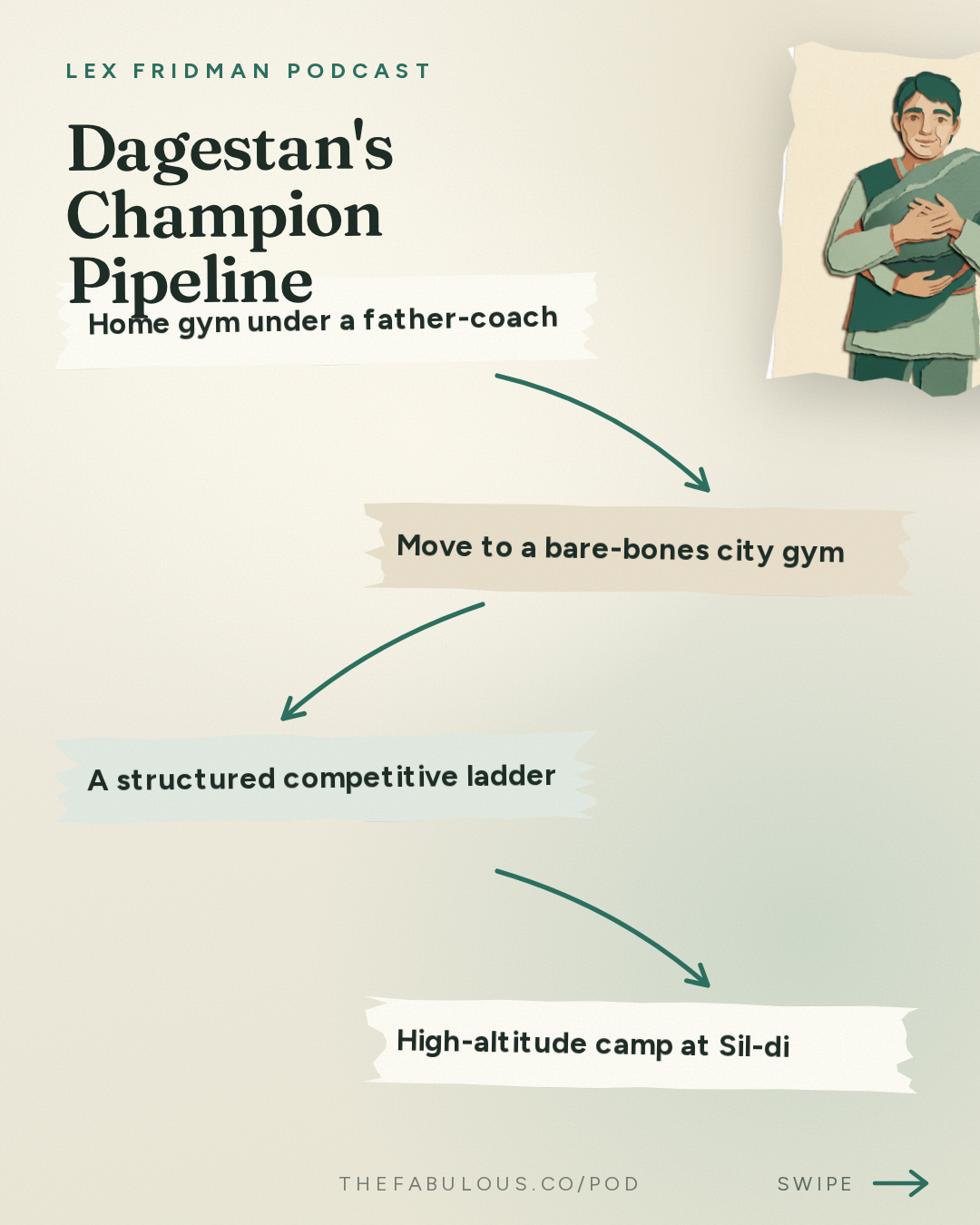
For years, the gym that produced more than twenty world champions in Makhachkala, the capital of Dagestan, had one shower. Seventy men used it, and the water was always cold. There was a single punching bag, one climbing rope, and a basketball court that doubled as a mat room (08:52). Khabib Nurmagomedov trained there as a teenager, and he returns to it, in a long conversation with Lex Fridman conducted entirely in Russian, as proof of something he believes down to his bones: comfort does not make champions, hardship does (11:37).
His father, Abdulmanap Nurmagomedov, built the family's first gym inside their house in a mountain village. Khabib's earliest memory is the sound of it, judo throws landing on a mat before sunrise, heard through a child's half sleep (09:43). Years later, asked whether a wealthy father would ever push a child into a sport that comes home bruised every night, Khabib answers his own question. Statistically, he says, the answer is no. A person needs to be in real need to accept that kind of pain (12:53).
"The best results are born out of the worst conditions." — Khabib Nurmagomedov [12:02]
He extends the idea outward, into the land itself. Dagestan sits where the Caucasus mountains meet the Caspian lowlands, a corridor that the Khazars, the Arab Caliphate, the Persian Empire, the Mongols, and the Russian Empire all passed through over roughly fifteen hundred years (19:59). More than thirty languages survive there today, often mutually unintelligible even between neighboring villages (20:58). Armies could conquer the flat coastal strip, Khabib says, but they rarely climbed into the mountains, because moving thousands of troops and horses up terrain with no roads was not worth the trouble. That is how highland villages like his own, Sil-di, kept a measure of independence for centuries (21:54). Imam Shamil, the nineteenth-century resistance leader Khabib writes about, held off the Russian Empire for thirty-five years with a fraction of its manpower, and Khabib says that endurance, not any single victory, is what made him a legend (24:39).
All of this, in Khabib's telling, seeped into the people. Summers were for growing food on narrow mountain terraces in more accessible spots like Marghit, while the villages themselves were built in rugged terrain an army could not easily reach; winters were for surviving heavy snow that cut villages off completely (26:08). "You just can't be born in these conditions, live here, stay here, and be mentally weak," he says. There is no other way to survive.
His father's final project was building that logic back into stone. Sil-di now has a training complex at 1,500 to 1,600 meters above sea level, big enough to house 100 people at once (28:52). Athletes who spend three or four weeks there, Khabib says, gain oxygen capacity and testosterone along with stamina (28:21). Abdulmanap started the build around 2016, working with little money. He died in 2020, and Khabib finished the project at a larger scale, partly, he says, because it brings him a kind of happiness that has nothing to do with profit (29:58).
Becoming a champion, staying a champion
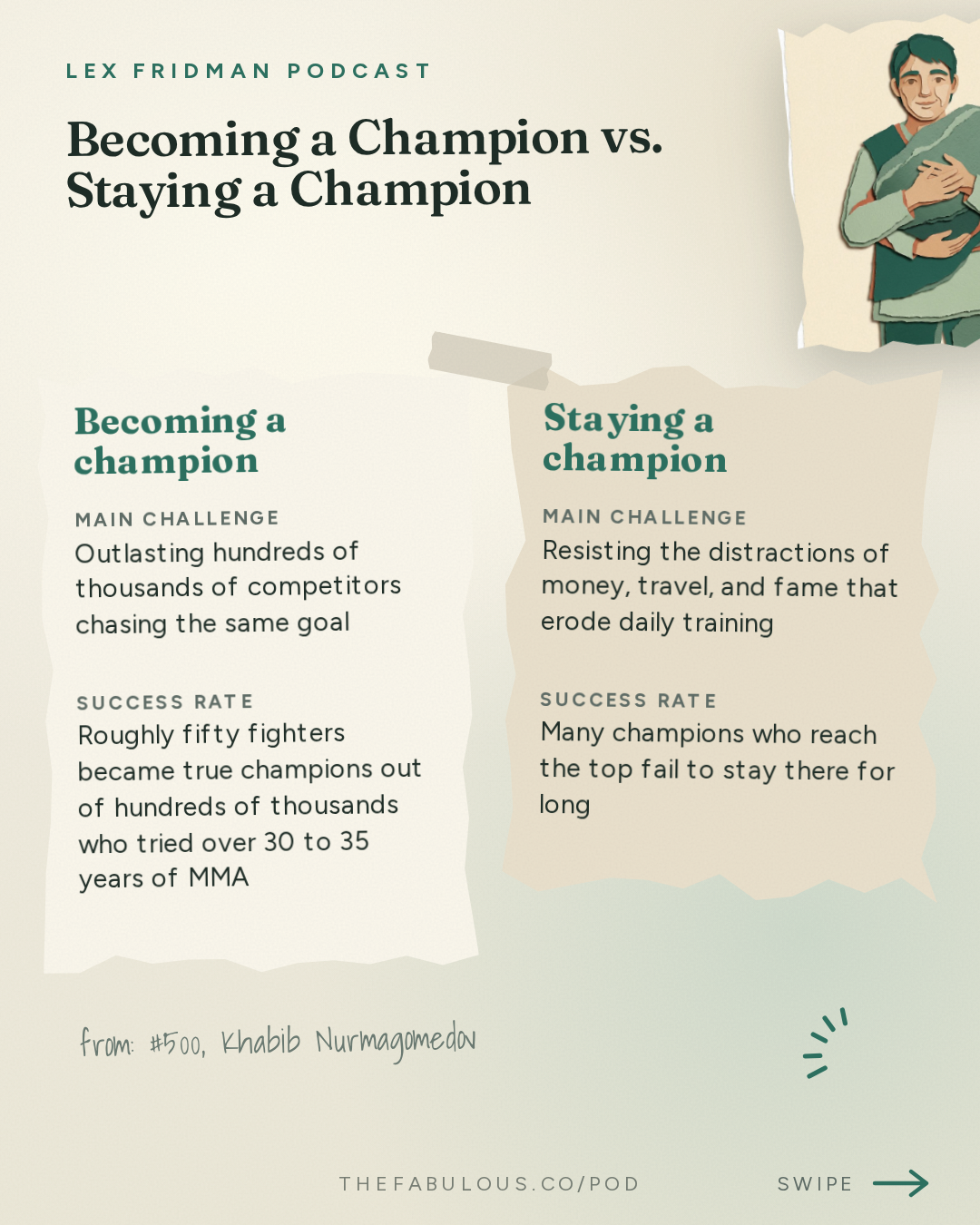
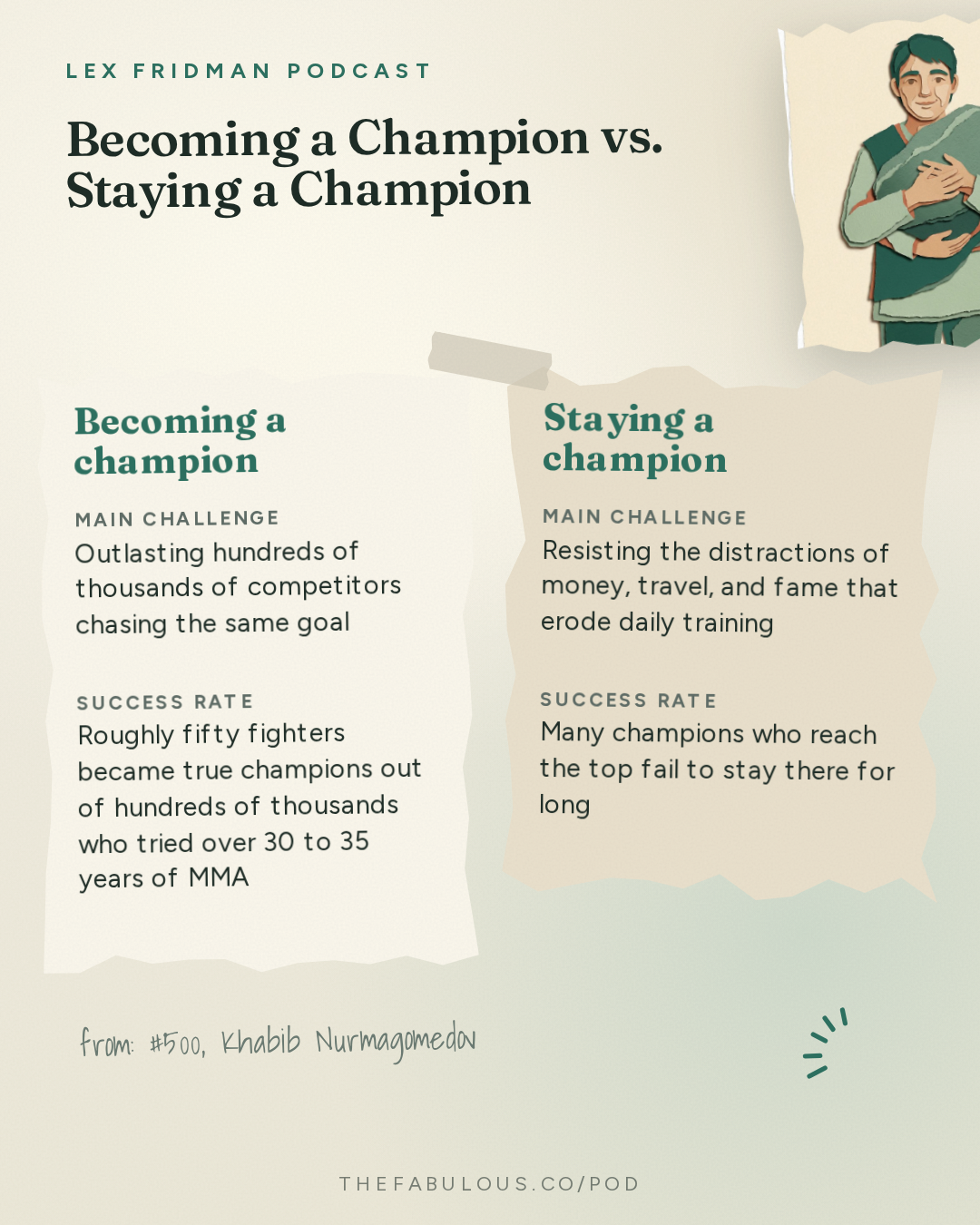
The most striking part of the conversation is not about winning. It is about what happens after. Khabib estimates that across thirty to thirty-five years of MMA, roughly fifty fighters have actually reached the level of true champion, out of hundreds of thousands who tried (35:31). Getting there requires hunger. Staying there requires something harder: resisting the money, the contracts, the flights, and the attention that quietly replace training sessions, one missed workout at a time (32:05). "Reaching the championship and staying there, reaching it is one thing, but staying a champion, that's totally different," he says. "It's incredibly tough" (33:36).
Part of what kept him from losing himself, Khabib argues, is a simple, almost blunt piece of self-assessment.
"If we can't control even this, so what can we actually control in this life?" — Khabib Nurmagomedov [38:52]
He is talking, half-embarrassed, about the body's most basic functions. If a person cannot even control that, he reasons, there is no basis for crowning oneself king after a title win. Everyone eventually ends up in the same size grave, he notes, regardless of fame or wealth (39:26).
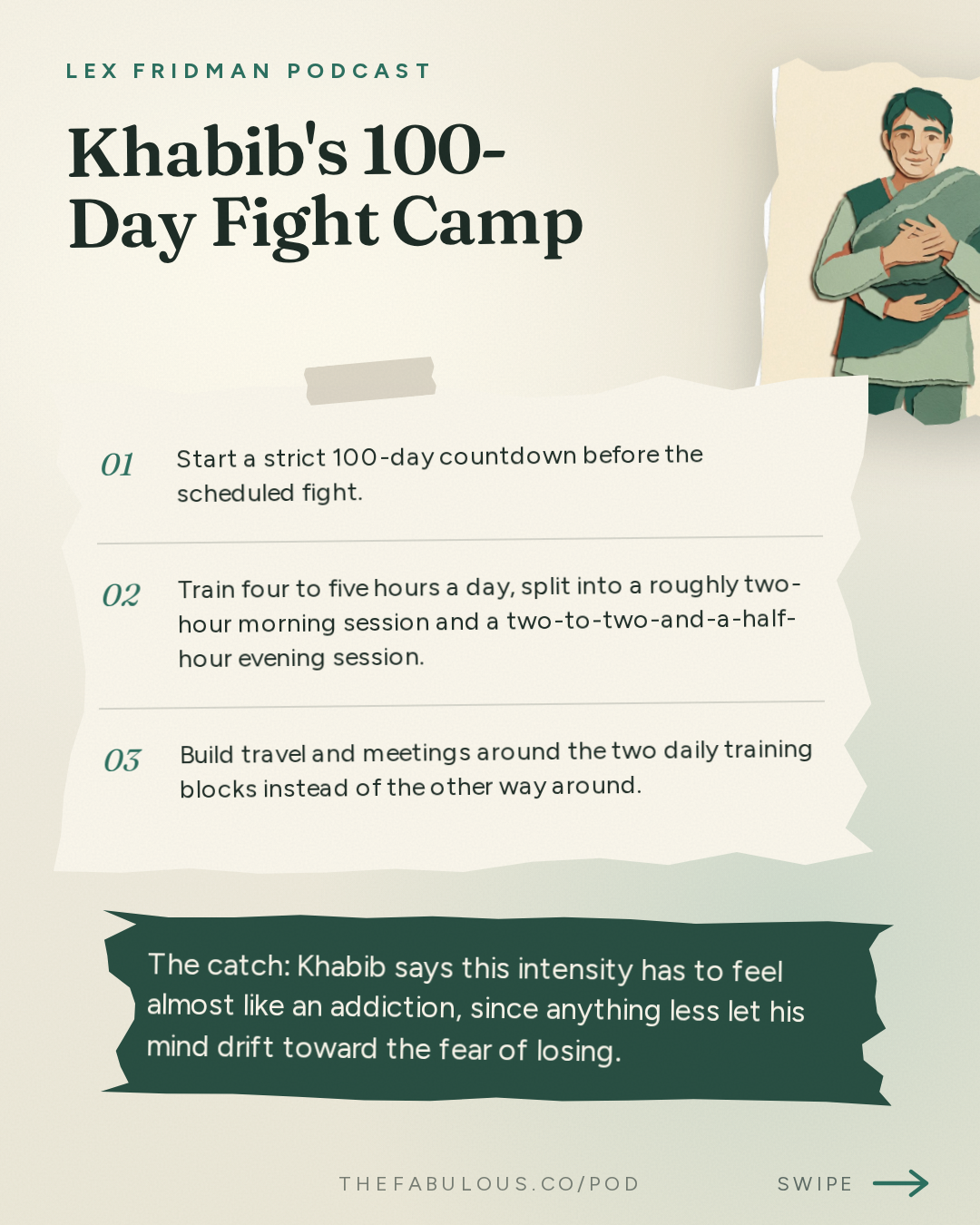
That humility coexisted with an almost clinical intensity in fight preparation. Khabib describes fixing on every professional fight exactly 100 days out, structuring flights, meetings, and sparring partners around two daily training blocks of two hours in the morning and two to two and a half hours in the evening, four to five hours total (42:47, 43:38). He compares it to an addiction he could not turn off. "I didn't want to lose rather than I wanted to win," he says, describing the fear that drove him more than any pleasure in victory (44:22).
His father shaped that mind early, and not only through wrestling. Someone gave Abdulmanap a book called Countries and Peoples, covering the geography and history of 193 countries, and he used it as currency: Khabib had to read a section, then recite it back, then copy it out by hand, to earn small amounts of money (57:06, 59:26). Khabib now recommends the same method to parents, arguing that copying text by hand improves handwriting, reading, and focus in children whose minds are still, as he puts it, an empty table waiting to be set (61:30). During slow afternoons at a childhood training camp, Abdulmanap sometimes had the boys dig deep, pointless-seeming holes, explaining afterward that people once used them as makeshift refrigerators. The real point, Khabib says, was to never let idle time sit around unfilled (65:01).
What the McGregor fight cost, and what faith gave back
The rivalry with Conor McGregor, Khabib argues, went beyond sport the way Muhammad Ali and Joe Frazier's fights did, or Joe Louis against Max Schmeling did, because politics, religion, and national pride all attached themselves to it (89:13). Through the entire build-up, press conferences included, Khabib says he kept himself deliberately calm, because losing control of emotion during preparation is, in his words, a very dangerous place to be (91:06). The one voice he needed during that period belonged to his father, watching from across an ocean without a visa to attend. Abdulmanap told him a version of an old idea: diamonds form under pressure, and a person under pressure can either break or come through it with dignity (96:17). Only after the fight ended, Khabib says, did his own emotions finally come out (92:05).
Two years later, preparing for what he already privately knew would be his last fight, against Justin Gaethje, Khabib was training without his father, who had just died, and through a string of injuries. He says he knew, standing in the cage that night, that he was already starting to miss something he had not yet lost (101:26). He has not felt anything like it since.
Underneath all of it sits his faith, organized around five daily prayers that structure everything else, including, he notes, the timing of this very conversation (181:36). Grief over his father's death, he says, would have been unbearable without believing it was fated, that no one belongs to anyone but God, and that everyone eventually returns to Him (184:28). That same framework shapes how he thinks about money and legacy. Success, he argues, is a test, not a personal achievement to take credit for, and the real measure of a life, in his account, is not applause but whether people are inspired rather than merely impressed (104:33).
"Money and fame can stay in your hand, but not in your heart." — Khabib Nurmagomedov [194:39]
Wealth held loosely, used for family and people in need, is fine, he says; wealth that settles into the heart corrupts, and becomes something a person can no longer bring themselves to share (195:08). It is a strange, almost circular return to the shower in Makhachkala with the cold water and the line for seventy men. The condition that built him, in his telling, was never really the poverty of the room. It was the discipline of not needing more than it offered.
Ask this episode anything
Pod's AI answers from the episode itself, with the minute mark so you can hear it yourself.
Or start with one of these
Ask this episode
Pod's AI listens to the whole episode to answer, and points you to the minute it comes from.
The rest of this answer, and any question after it
Answers come from the episode itself, never from a summary of it.
ContinueKey takeaways
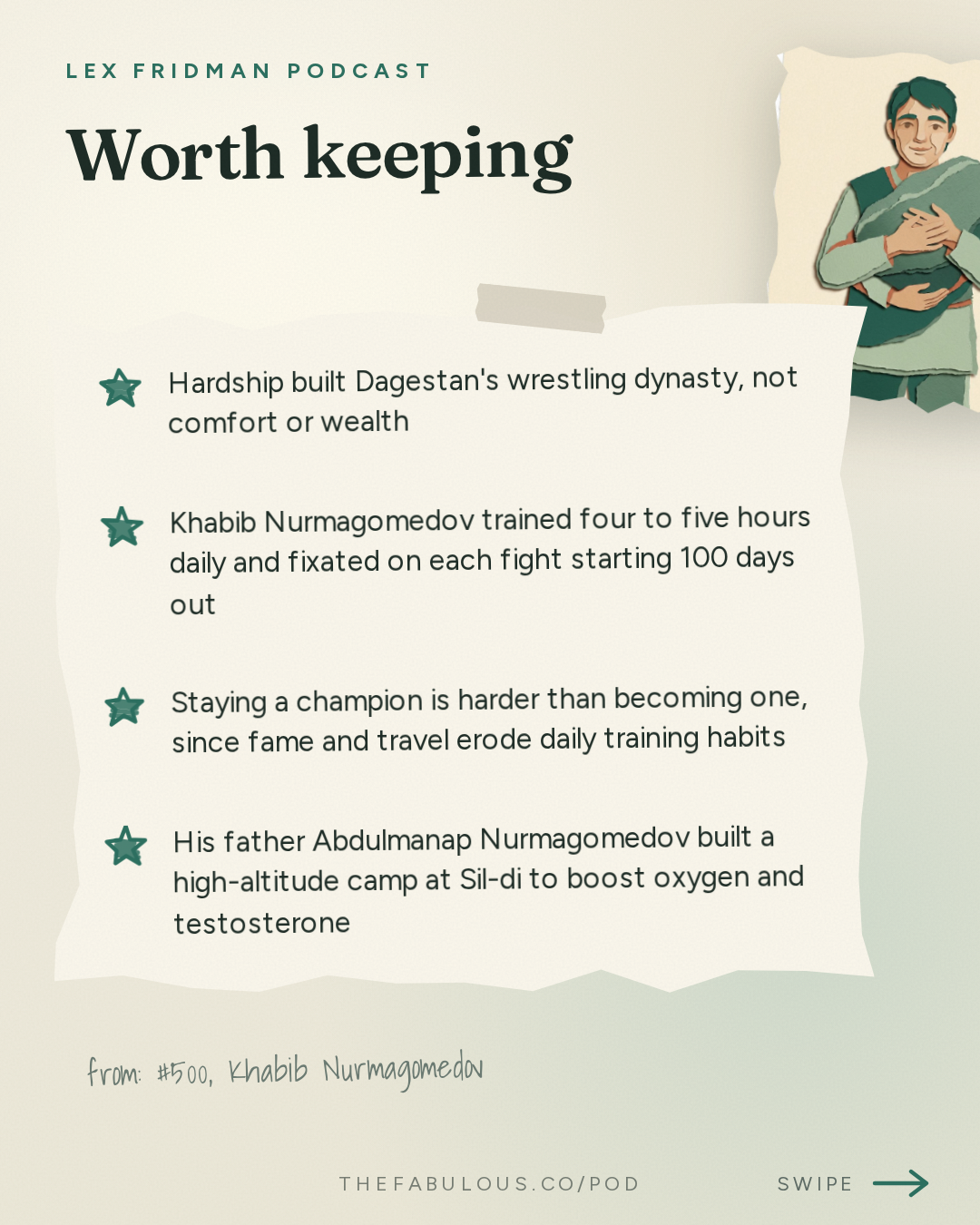
- Hardship built Dagestan's wrestling dynasty, not comfort or wealth
- Khabib Nurmagomedov trained four to five hours daily and fixated on each fight starting 100 days out
- Staying a champion is harder than becoming one, since fame and travel erode daily training habits
- His father Abdulmanap Nurmagomedov built a high-altitude camp at Sil-di to boost oxygen and testosterone
- Khabib Nurmagomedov says wealth is fine in the hand but corrupts once it enters the heart
The episode in cards

By the numbers
- 1,500 meters Altitude of the Sil-di training complex built to raise oxygen and testosterone
- 100 days Length of Khabib Nurmagomedov's fixation period before each professional fight
- 5 km Distance of the morning run in Khabib's training camps
- 200 minutes Live grappling Khabib did in one week even after retirement
- 20 world champions Champions produced by the original bare-bones Makhachkala gym
In their words
“The best results are born out of the worst conditions.”
“If we can't control even this, so what can we actually control in this life?”
“I didn't want to lose rather than I wanted to win.”
“Money and fame to stay in your hand, but not in your heart”
Protocols
-
100-Day Fight Fixation
Khabib Nurmagomedov begins strict fight preparation exactly 100 days before a professional bout and treats the countdown like an addiction he refuses to break.
100 days before each professional fight
-
Two-a-Day Training Blocks
Khabib trains four to five hours a day during fight camp, splitting the load into a roughly two-hour morning session and a two-to-two-and-a-half-hour evening session, and he schedules travel and meetings around those two blocks rather than the other way around.
daily during fight camp
-
Copy Books by Hand
Khabib advises parents to have children copy books out by hand, saying it sharpens handwriting, reading, and focus, and to reward children with a small payment for completing sections, the way his father Abdulmanap Nurmagomedov did with him.
as a regular childhood habit over several years
-
Compete Constantly as an Amateur
Khabib's father Abdulmanap Nurmagomedov sent him to compete across judo, sambo, freestyle wrestling, and pankration even in disciplines where he was not skilled, arguing that frequent competition builds the relaxed confidence a fighter needs under pressure later.
continuous through the teenage years
Questions this episode answers
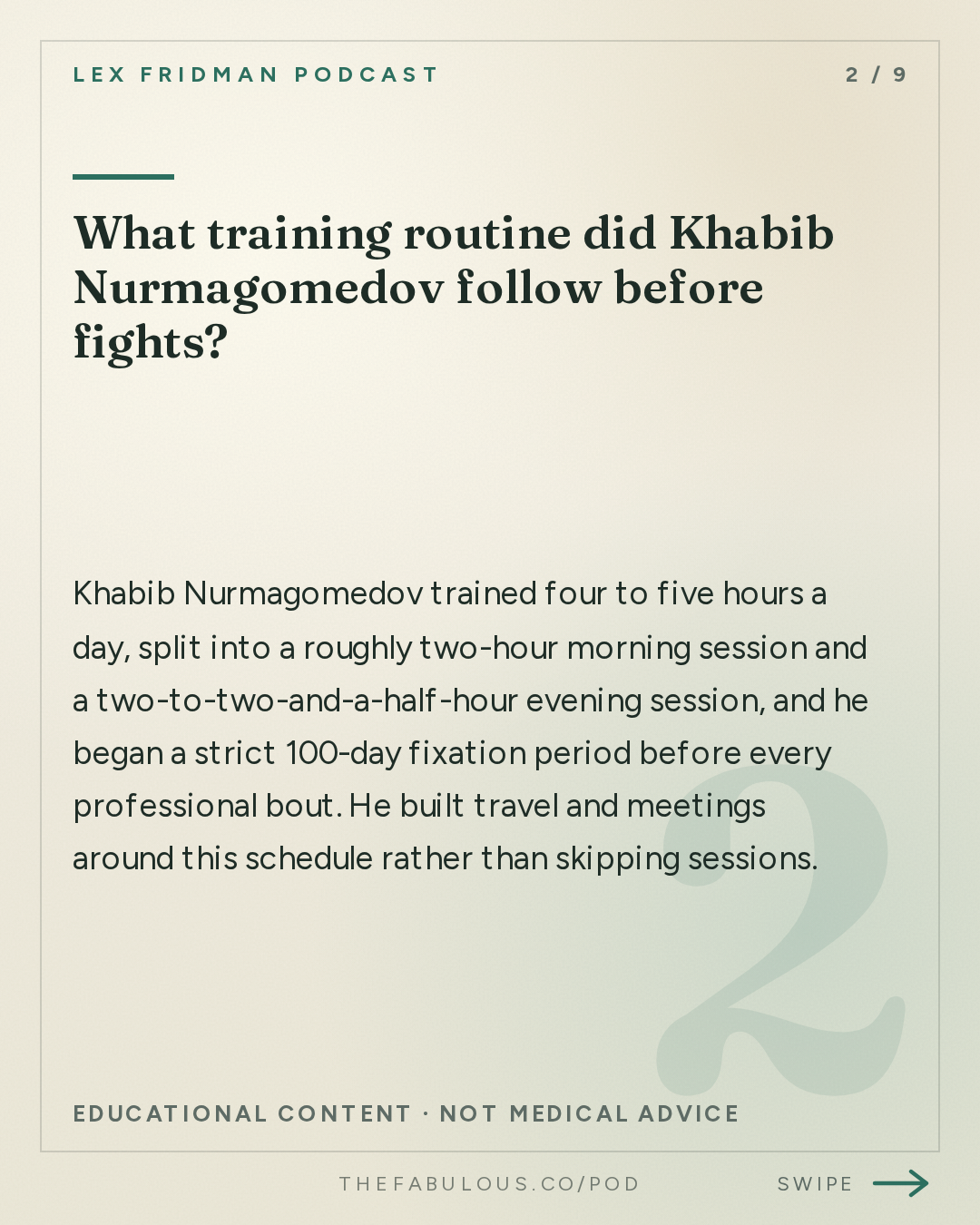
What training routine did Khabib Nurmagomedov follow before fights?
Khabib Nurmagomedov trained four to five hours a day, split into a roughly two-hour morning session and a two-to-two-and-a-half-hour evening session, and he began a strict 100-day fixation period before every professional bout (43:38). He built travel and meetings around this schedule rather than skipping sessions (42:47).
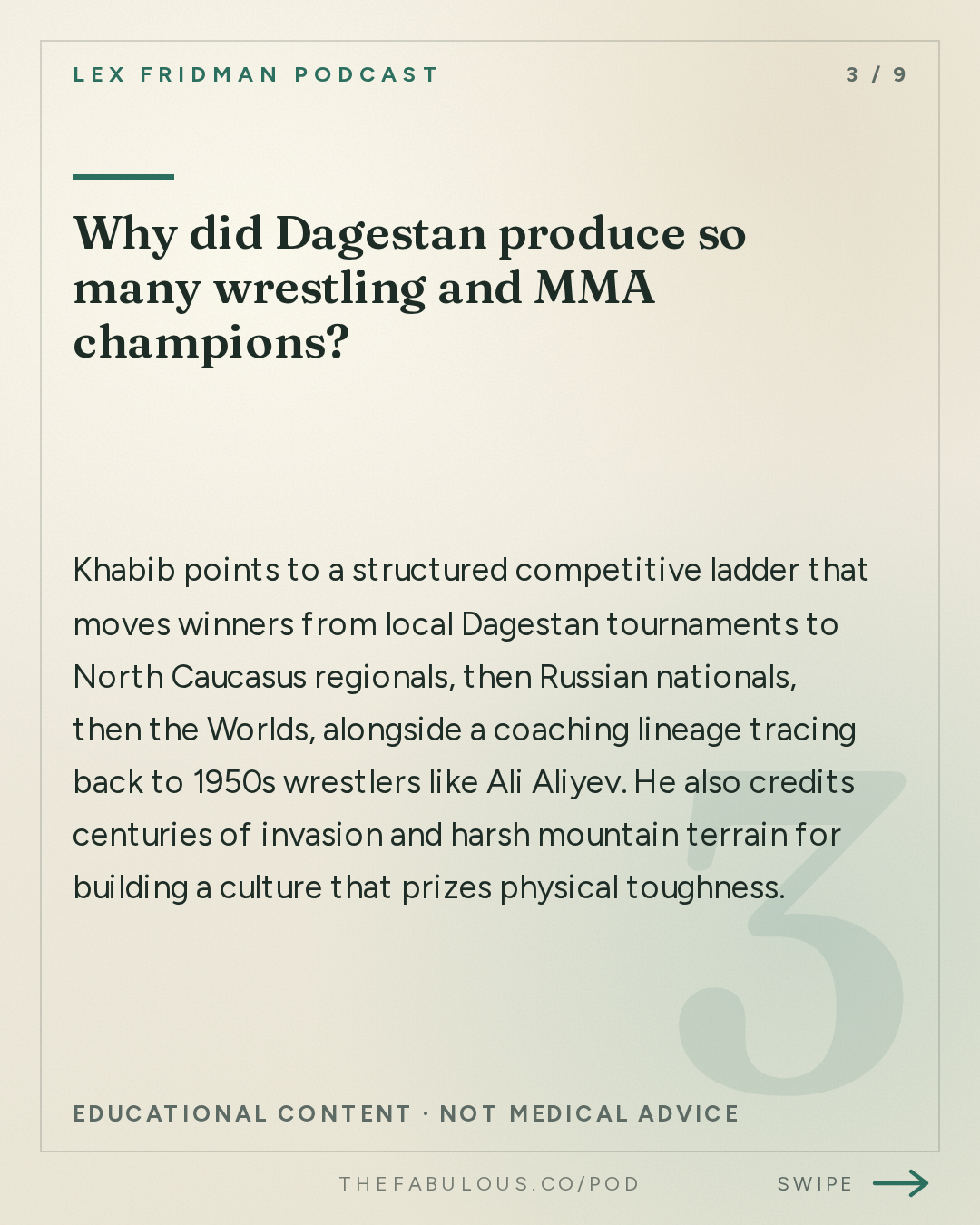
Why did Dagestan produce so many wrestling and MMA champions?
Khabib points to a structured competitive ladder that moves winners from local Dagestan tournaments to North Caucasus regionals, then Russian nationals, then the Worlds, alongside a coaching lineage tracing back to 1950s wrestlers like Ali Aliyev (17:23). He also credits centuries of invasion and harsh mountain terrain for building a culture that prizes physical toughness (19:59).
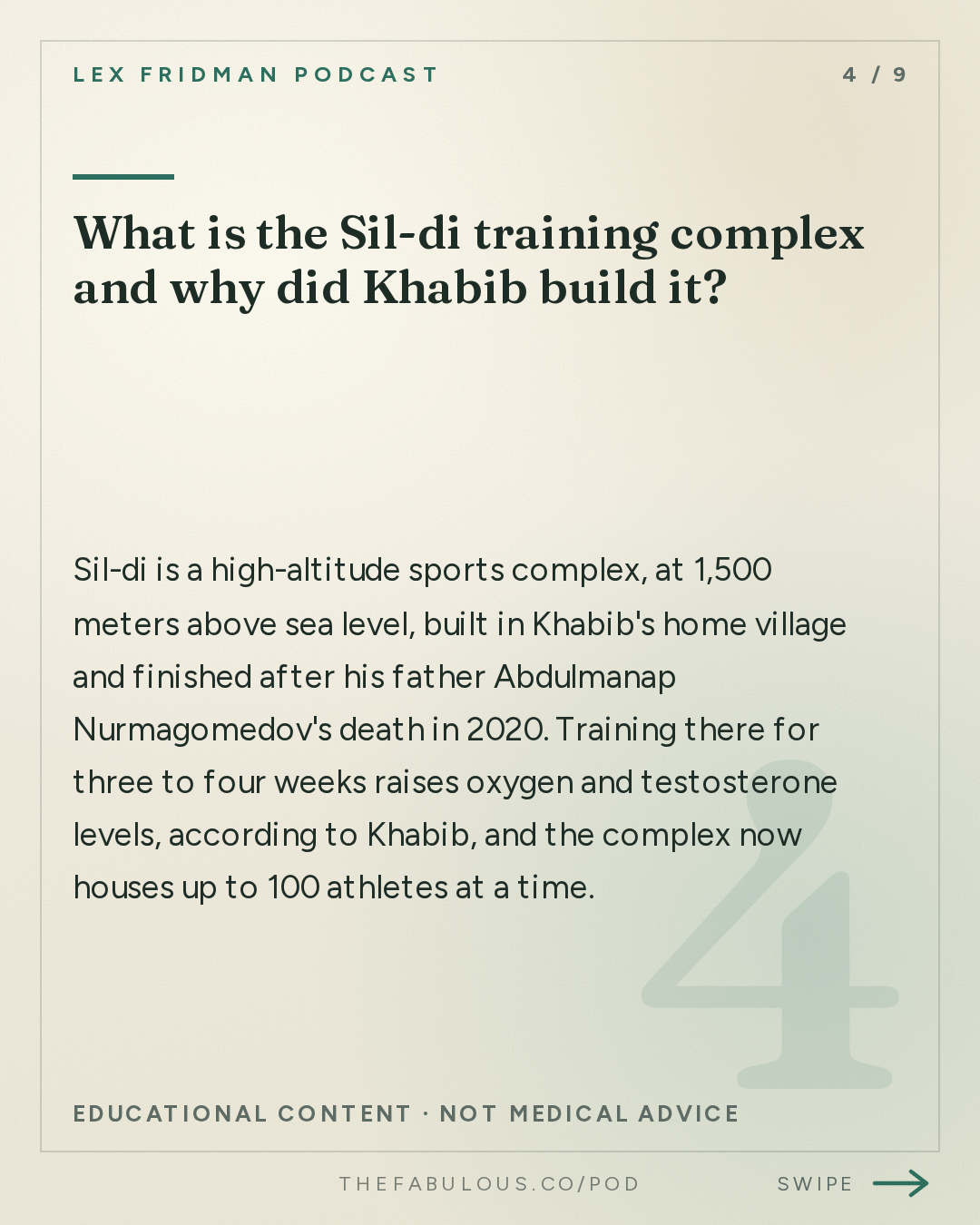
What is the Sil-di training complex and why did Khabib build it?
Sil-di is a high-altitude sports complex, at 1,500 meters above sea level, built in Khabib's home village and finished after his father Abdulmanap Nurmagomedov's death in 2020 (28:52). Training there for three to four weeks raises oxygen and testosterone levels, according to Khabib, and the complex now houses up to 100 athletes at a time (28:21).
Is it harder to become a champion or stay one, according to Khabib Nurmagomedov?
Khabib says staying a champion is harder, because fame, contracts, and travel create distractions that erode the daily training habits that built the champion in the first place (32:05). He estimates roughly fifty fighters became true champions out of hundreds of thousands who tried over thirty to thirty-five years of MMA (35:31).
What did Khabib Nurmagomedov say about money and faith?
Khabib says wealth is fine to hold in the hand but dangerous once it enters the heart, since it becomes hard to share and can corrupt a person's judgment (195:08). He credits his Muslim faith, and daily prayer built around his schedule, with keeping him grounded through fame and grief, including the loss of his father (183:17).
The full read, in cards
Go deeper
- Countries and Peoples — Childhood geography book covering 193 countries that Khabib's father used to test him for small cash rewards
- Messi vs. Ronaldo: One Rivalry, Almost Twenty-Year Era — Book Khabib recommends that traces two decades of the Messi-Ronaldo rivalry and its effect on modern football
- The Quran — Referenced for its first revealed word, Iqra or Read, which Khabib treats as core life advice
Mentioned
Makhachkala · Abdulmanap Nurmagomedov · Imam Shamil · Sil-di · Islam Makhachev · Conor McGregor · Fedor Emelianenko · Javier Mendez · Dana White · Joe Rogan · Cristiano Ronaldo · Lionel Messi · Real Madrid · UFC · John Danaher · Daniel Cormier · Zinedine Zidane · Zlatan Ibrahimović · Diego Maradona · Ali Abdelaziz
More from this show and category
DHH on Omachi Linux and AI Coding Agents
David Heinemeier Hansson, the Ruby on Rails creator, says he wrote zero lines of code by hand for his Linux distribution Omachi's latest release, Quatro, letting AI agents do it instead. He argues Linux, not Mac or Windows, is now the ideal home for AI coding agents, and that installing an OS in under a minute is possible with the same tools (21:41, 126:07).

Dylan Field: Design Is the New Code
Figma CEO Dylan Field argues design, not code, now drives software's value as AI makes coding cheap and commoditized. He explains how Figma survived a blocked $20 billion Adobe acquisition, why AI lowers production's floor without raising creativity's ceiling, and why human willingness to say non-consensus things remains the real differentiator in an AI-saturated market.

CoreWeave Debt Crisis and the AI Bubble, Explained
CoreWeave's bond selloff this week signaled real doubt about AI infrastructure debt, even as demand for GPUs stays red hot. Anthropic posted $16.8 billion in Q3 revenue, Sacks called its warnings about small AI models a move against open-source rivals, and Chamath named electricity as AI's real bottleneck.

Billy Evans on Elizabeth Holmes: Trial, Prison, Hemantis
Billy Evans, Elizabeth Holmes's husband, says the Theranos founder was acquitted on every patient-fraud count tied to 12.5 million blood tests but convicted of defrauding three investors, a conspiracy charge that let the judge add outside victims like Rupert Murdoch and push her sentence to 11.25 years (00:27, 19:52, 21:31).
