
DHH on Omachi Linux and AI Coding Agents
#501 – DHH: Future of Programming, AI, Agentic Engineering, Vibe Coding & Linux
The brief
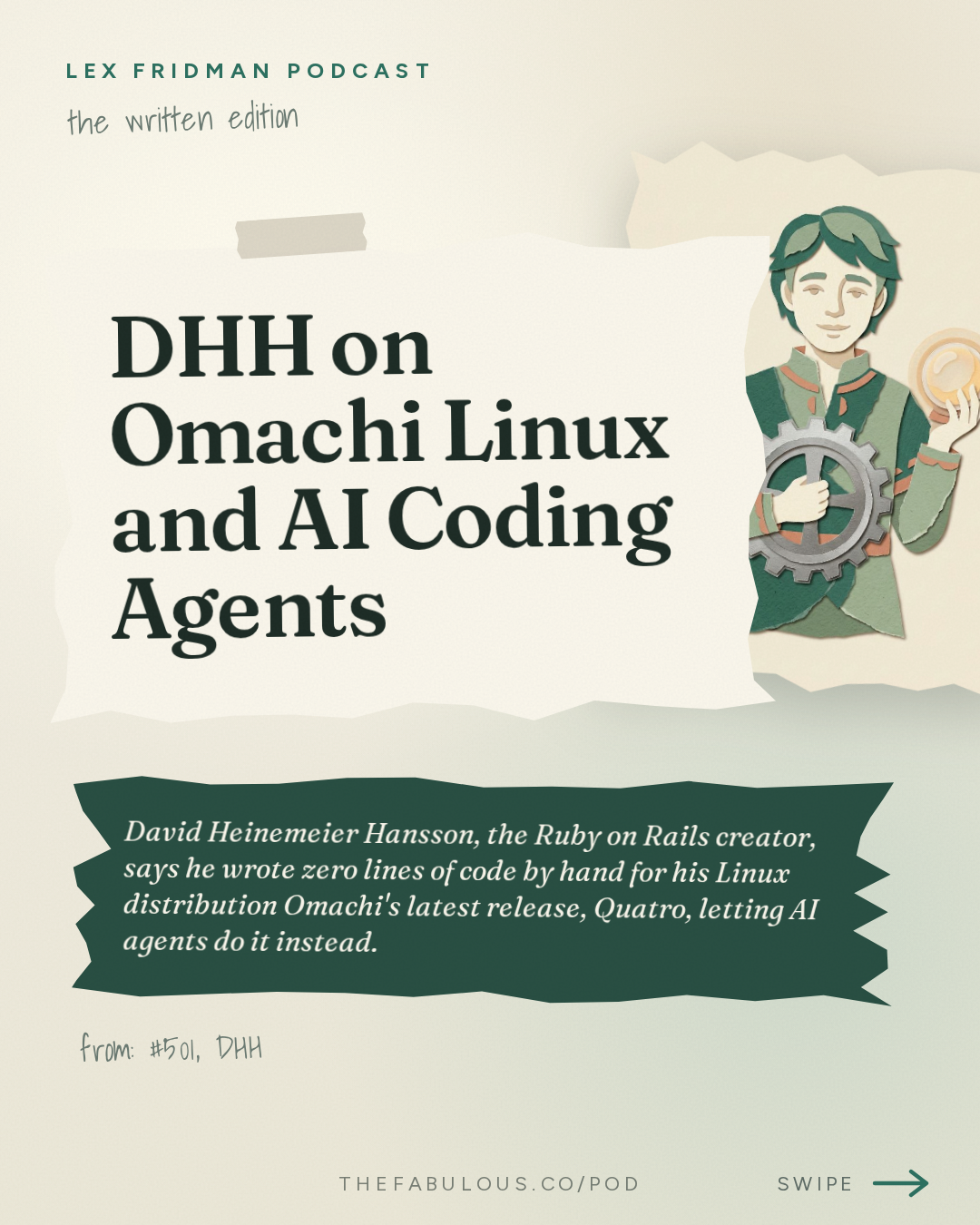
David Heinemeier Hansson, the Ruby on Rails creator, says he wrote zero lines of code by hand for his Linux distribution Omachi's latest release, Quatro, letting AI agents do it instead. He argues Linux, not Mac or Windows, is now the ideal home for AI coding agents, and that installing an OS in under a minute is possible with the same tools (21:41, 126:07).
For twenty five years David Heinemeier Hansson built his name on a single, almost monastic skill: writing Ruby code clean enough to read like prose. He is the creator of Ruby on Rails, the framework behind Basecamp, Shopify, and thousands of smaller web businesses. So it is worth pausing on what he says now. In the last two months of building Omachi Linux, his own operating system, he has not written a single line of the shipped code by hand.
"I have not written any of the code that shipped in Quatro by hand. I've reviewed the shape of all of it... but I've not written any of it entirely by hand." — David Heinemeier Hansson [21:41]
Quatro is the newest release of Omachi, a Linux distribution Hansson started building last summer between racing sessions at Le Mans. He calls the last three months of its development the clearest evidence yet that something changed in how software gets made. That change, in his telling, has a precise start date: November 24, 2025, when Anthropic released a model called Opus 4.5. He did not even try it on release day. Two days later he gave it a few tasks and the output looked uncannily like something he would have written himself (13:22). "There are decades where nothing happens and weeks where decades happen," he says, borrowing the line from Lenin to describe what followed (10:03).
It is easy to hear that kind of talk as hype. Hansson knows this, and he admits he was, until recently, the skeptic in the room. Shopify's chief executive Tobi Lutke had been telling him for months that something big was happening. "I was a skeptic... I was still on Earth. And he had already boarded the rocket and was heading towards space," Hansson says of that period (51:24). What convinces him now is not a chart or a benchmark. It is a specific, almost domestic story: he needed a lightweight writing app to replace a piece of shareware called Typora, told an AI agent to build it in C++ and Qt, and had a working version in about twenty minutes. Two days later he had abandoned Typora for good, and he has written every essay since inside the tool the agent built, a program he calls OmaWrite and has never personally inspected line by line (32:17).
What the machine is actually bottlenecked on
The more interesting argument in the conversation is not that AI can write code. Plenty of tools have claimed that for years. It is Hansson's claim about where the real bottleneck in software has always been: not implementation, but communication between humans. "To get that magical 10X, 100X, in a few rare cases 1,000X productivity boost, you have to interact with the agents directly, and you cannot intermediate that bandwidth with another human because it's simply too slow," he says (25:19). Large companies, he argues, are not slow because writing code is hard. They are slow because a product manager, two designers, a vice president, and a chief technology officer all have to agree on what to build before anyone builds it.
This is not an abstract claim for him. Basecamp's own team learned it the hard way earlier this year. When designers were given agent access and told to "vibe" their way through building Basecamp 5, the individual pull requests looked fine on their own but collectively wrecked the underlying architecture, and engineers had to clean it up by hand (22:41). The lesson, as he tells it, is not that non-programmers should stay away from agents. It is that judgment about system shape still matters, even when the typing is automated.
That same logic extends to open source, where Hansson has maintained projects for about 25 years. He has merged more than 1,000 pull requests into Omachi in the last three months alone (40:02), a volume that would have been unthinkable for a project of its size a year ago. Many came from people who were not traditional programmers but had ideas an agent could translate into working code. His view of maintainers who resent this flood of contributions is unsentimental: "I would rather get an agent-written pull request to one of my projects than I'd get one written by a human, and it's not just because the quality's better," he says, adding that rejecting an AI's work costs no human feelings (38:41).
Speed as a philosophy, not a metric
Some of the most vivid material in the conversation has nothing to do with intelligence and everything to do with obsession. Hansson has been chasing the installation time for Omachi down from minutes to seconds, and the current world record for a full install stands at 45 seconds (126:07), against the 42 minutes it took him to set up and update a brand new Mac before he could even open an app (120:08). He justifies the pursuit with a line borrowed from Ghostty terminal creator Mitchell Hashimoto: "The pursuit of excellence deserves no explanation" (118:48). The point is not that a faster install matters to most users. It is that the search for speed forces discoveries, like preloading packages while a user answers setup questions, that make the whole system better.
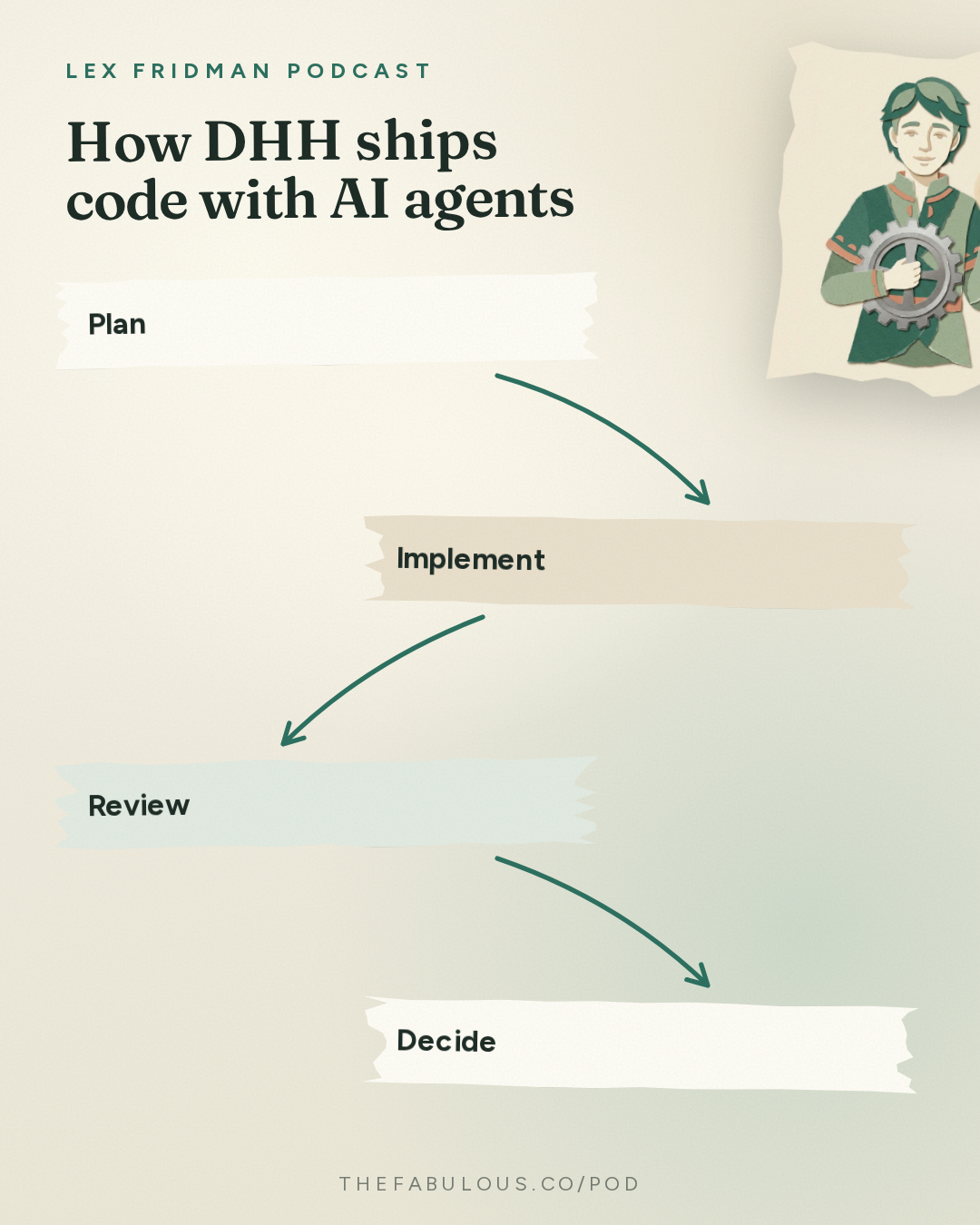
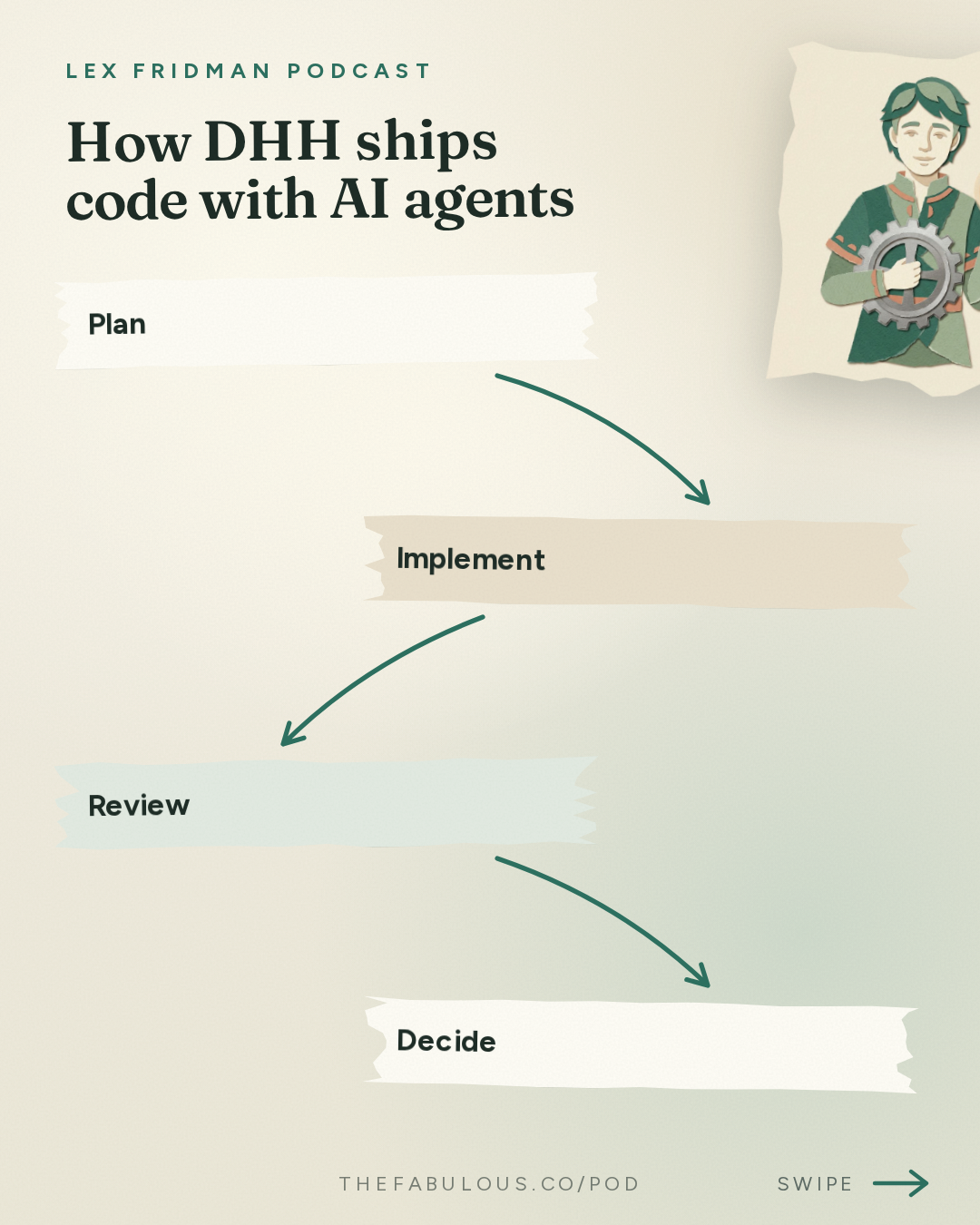
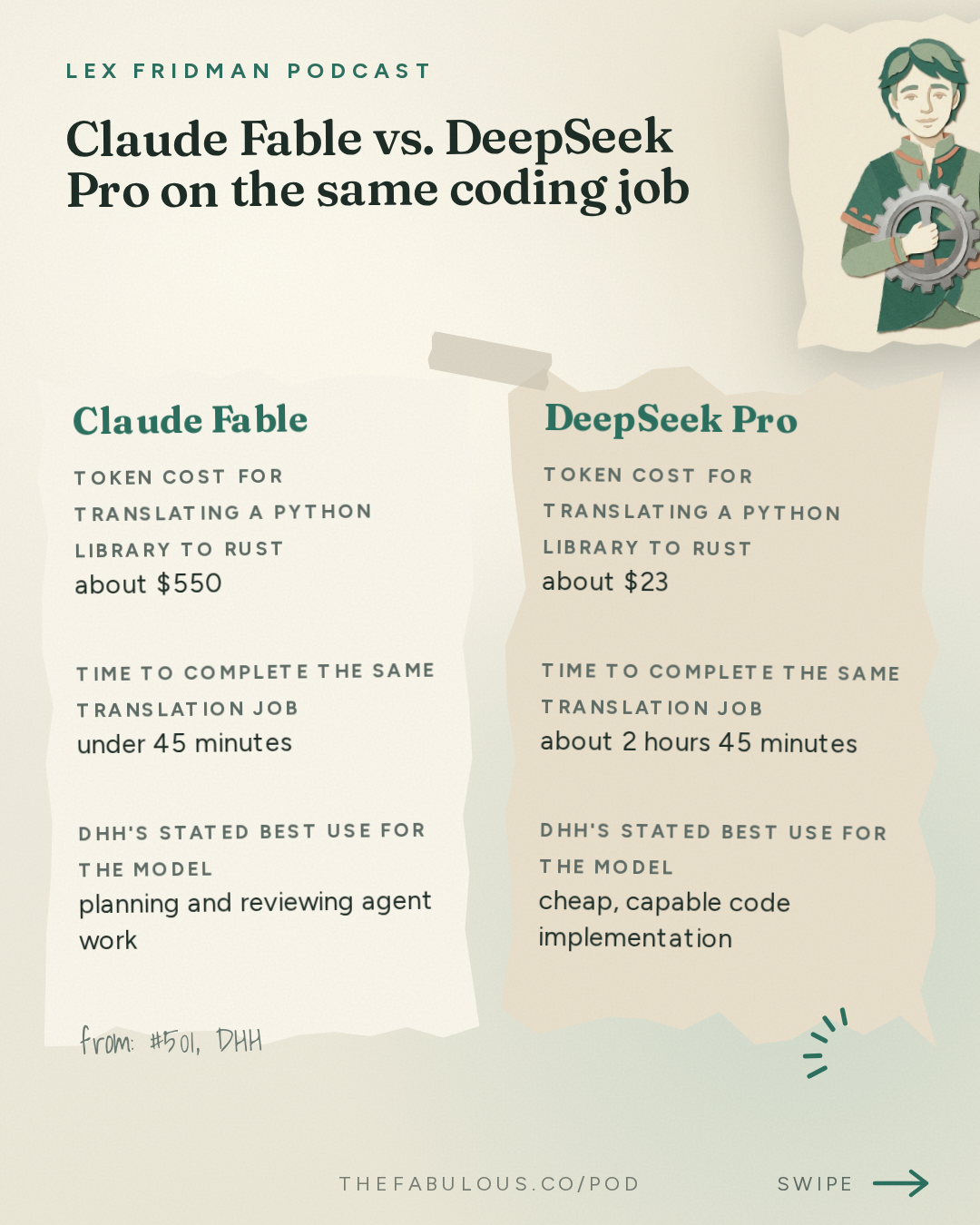
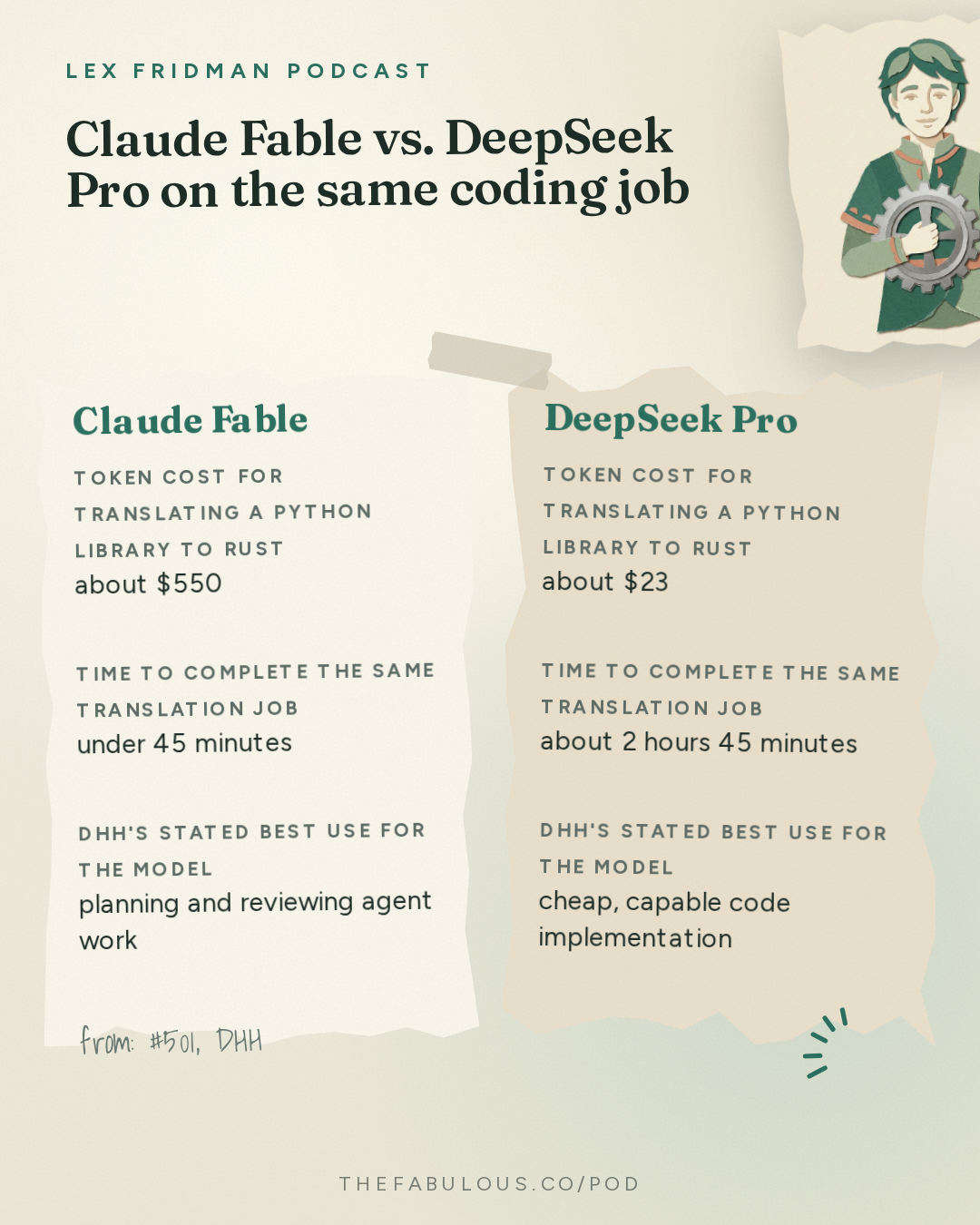
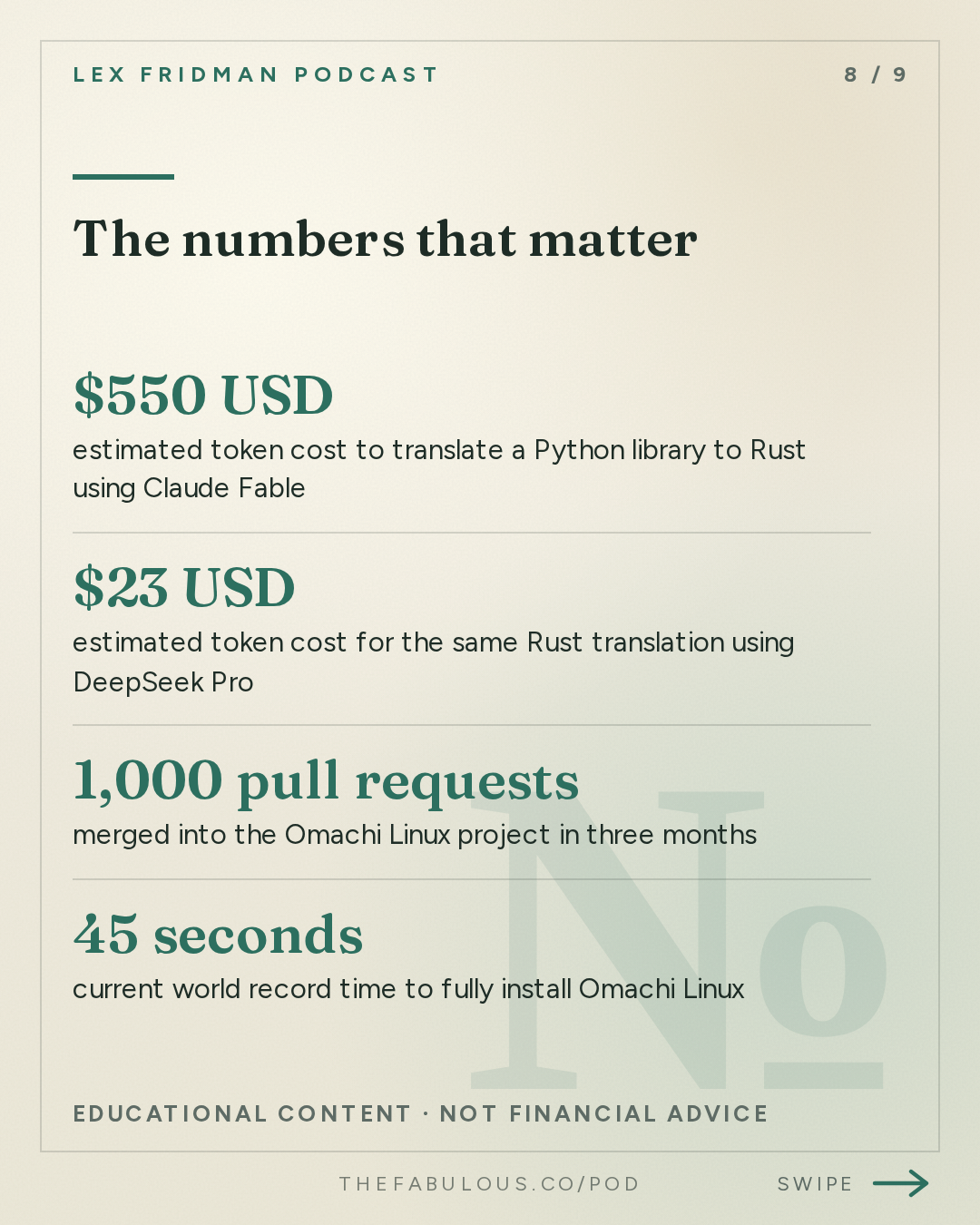
Underneath the showmanship is a real economic calculation about which AI model to use for which job. Hansson ran the same test, translating a Python animation library into a dependency free Rust program, across several models. Claude's Fable model did it in under 45 minutes and produced the cleanest plan, but would have cost about $550 in token spending outside a subscription (160:26). DeepSeek's Pro model did the identical job for about $23, taking roughly two hours and 45 minutes (163:02). His conclusion is practical rather than ideological: use Fable to plan and to review, and use Opus 5 for the grinding work of implementation (164:14).
He extends the same reasoning to hardware itself. Linux has spent three decades losing the desktop war to Windows and macOS partly because its strength, file based configuration and command line tools, was also its weakness for ordinary users. Agents flip that. A large language model trained on millions of lines of Linux source code can read an arcane kernel error message and fix it faster than a human searching forums ever could (150:35), which is why Hansson insists Linux, not Mac, is now "the ideal platform for AI agents" (107:51).
None of this erases the human cost of the shift, and Hansson does not pretend it does. He argues, somewhat bluntly, that productivity gains have always meant fewer people doing a given job, and that this has always been the price of economic growth, citing the historical shift away from field labor as an example (80:26). Late in the conversation, discussing the extreme longevity movement popularized by figures like Bryan Johnson, he repeats an observation from his wife that struck a nerve online: that the pursuit of radical life extension in some men resembles anorexia in some women, a physical expression of anxiety and a wish for control (300:15). It is a strange but fitting closing note for a conversation about a man who spent 25 years perfecting one craft and then, without much mourning, handed most of it to a machine. He built a small memorial to that fact into Omachi itself: a hidden feature on the calendar that, once you enter your birth year, quietly tells you what percentage of your expected lifespan has already passed.
Ask this episode anything
Pod's AI answers from the episode itself, with the minute mark so you can hear it yourself.
Or start with one of these
Ask this episode
Pod's AI listens to the whole episode to answer, and points you to the minute it comes from.
The rest of this answer, and any question after it
Answers come from the episode itself, never from a summary of it.
ContinueKey takeaways
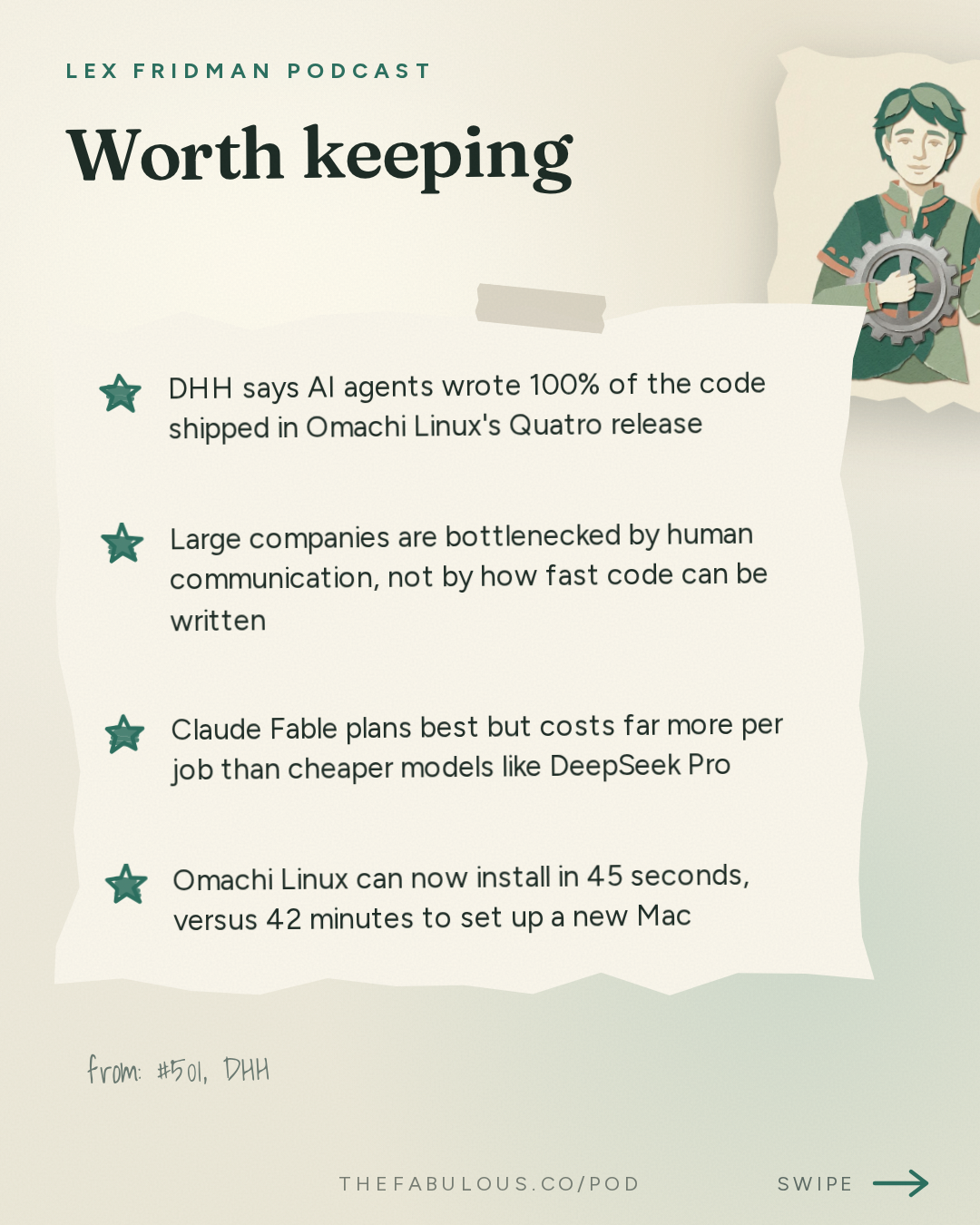
- DHH says AI agents wrote 100% of the code shipped in Omachi Linux's Quatro release
- Large companies are bottlenecked by human communication, not by how fast code can be written
- Claude Fable plans best but costs far more per job than cheaper models like DeepSeek Pro
- Omachi Linux can now install in 45 seconds, versus 42 minutes to set up a new Mac
- DHH argues productivity gains from AI mean fewer workers per task, which he calls necessary for growth
The episode in cards
By the numbers
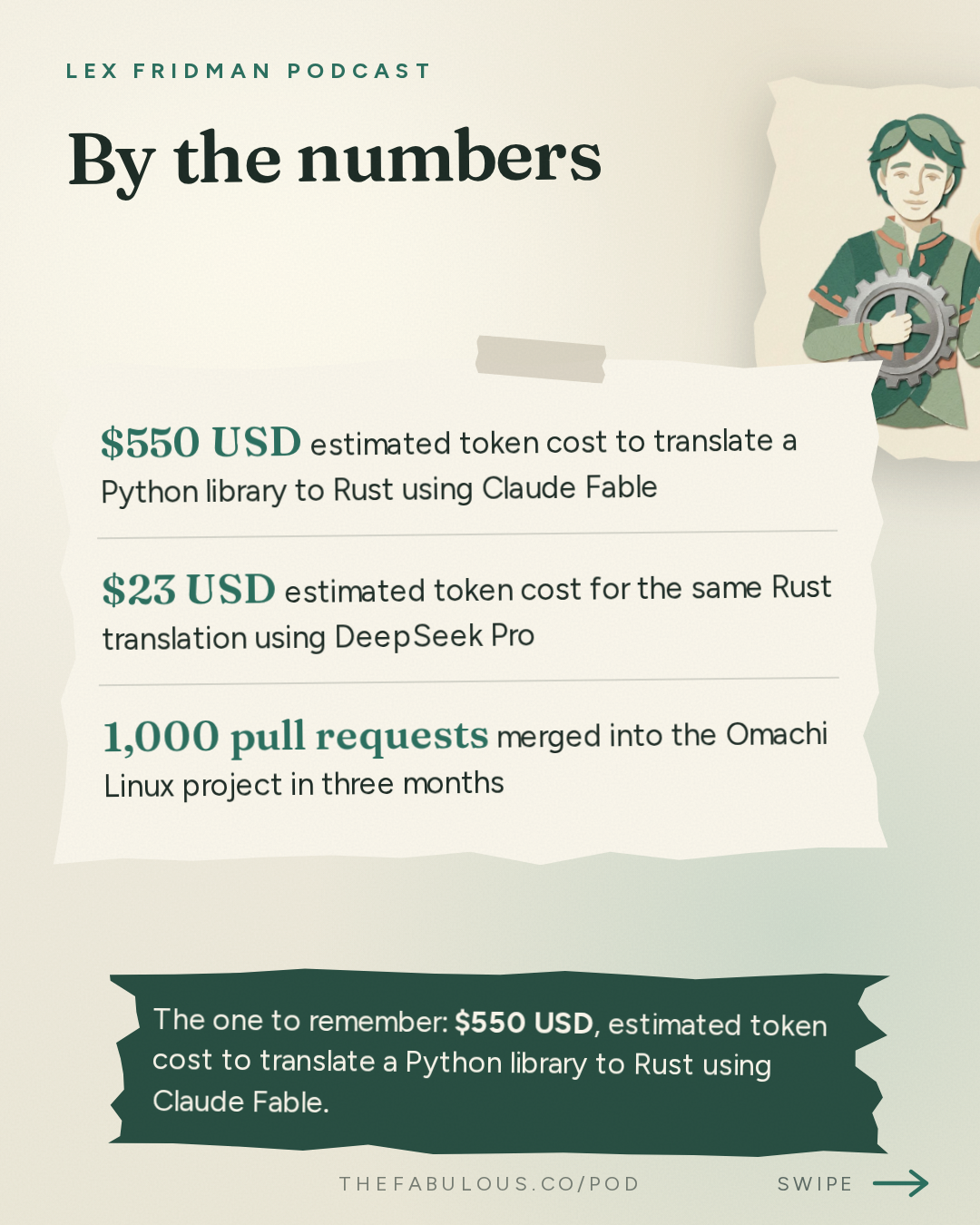
- $550 USD estimated token cost to translate a Python library to Rust using Claude Fable
- $23 USD estimated token cost for the same Rust translation using DeepSeek Pro
- 1,000 pull requests merged into the Omachi Linux project in three months
- 45 seconds current world record time to fully install Omachi Linux
- 42 minutes time it took DHH to update and prep a brand new Mac before using it
In their words
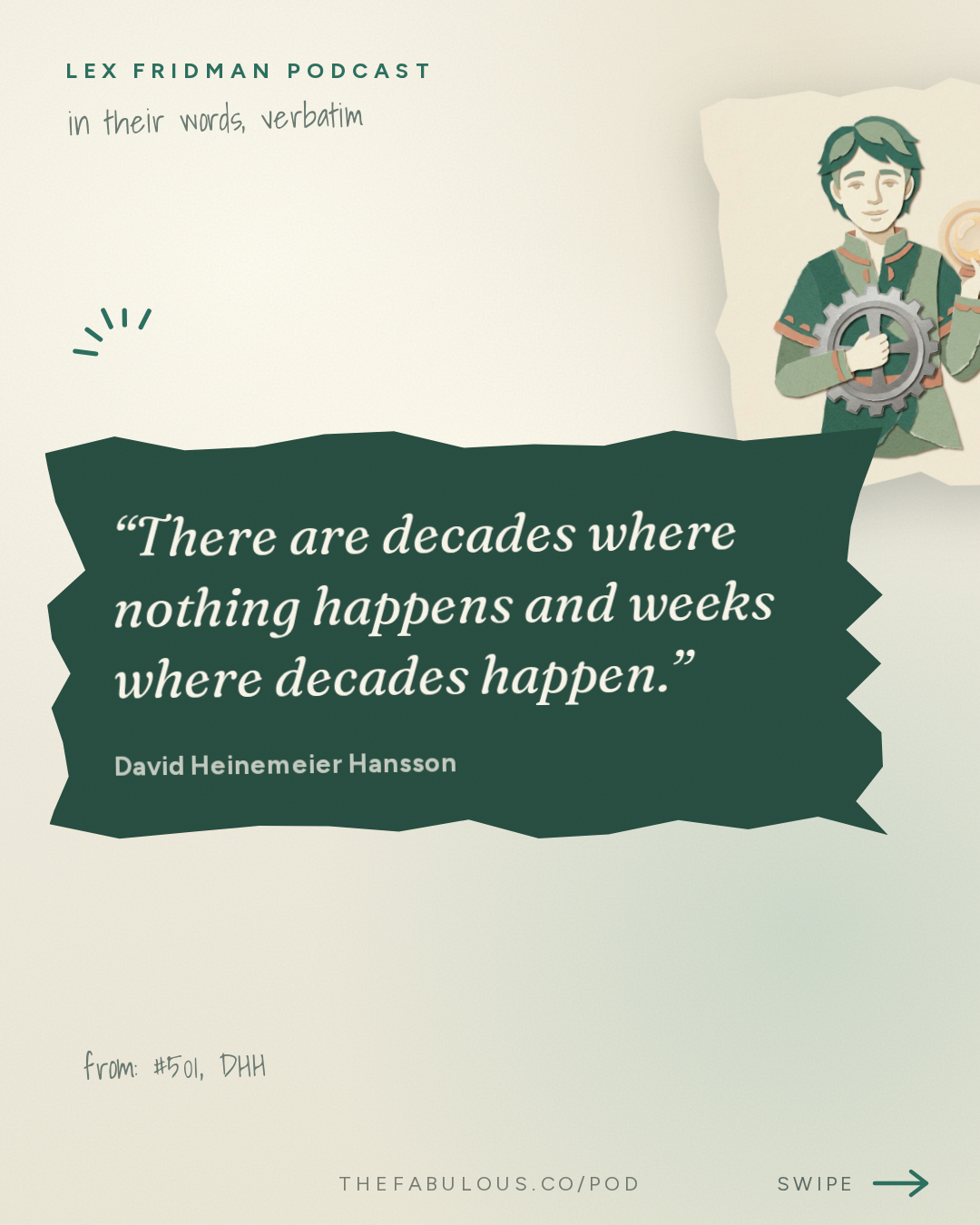
“There are decades where nothing happens and weeks where decades happen.”
“The pursuit of excellence deserves no explanation.”
“I was, I was still on Earth. Okay. And he was... He had already boarded the rocket and was heading towards space”
Protocols
-
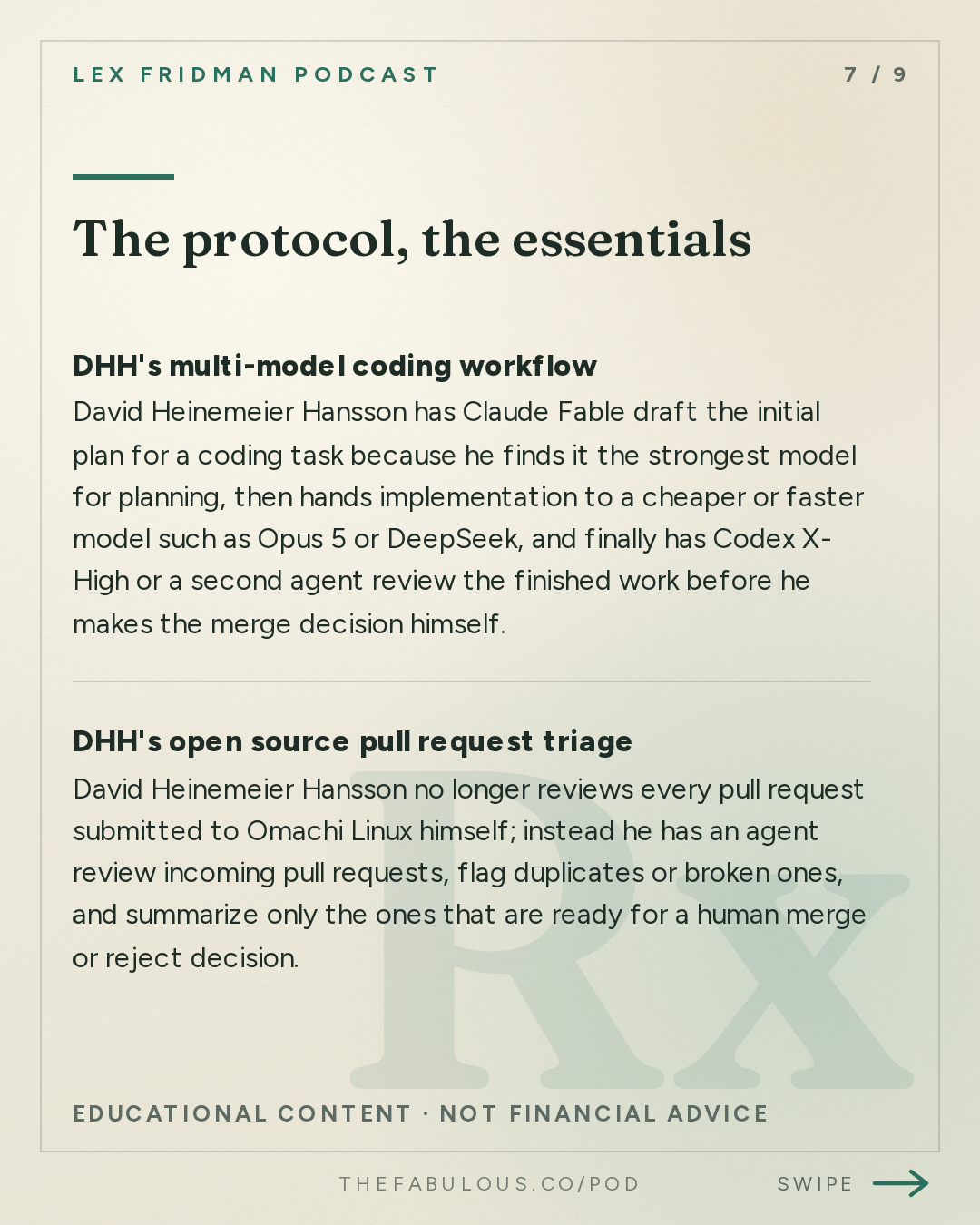
DHH's multi-model coding workflow
David Heinemeier Hansson has Claude Fable draft the initial plan for a coding task because he finds it the strongest model for planning, then hands implementation to a cheaper or faster model such as Opus 5 or DeepSeek, and finally has Codex X-High or a second agent review the finished work before he makes the merge decision himself.
Used on most nontrivial coding tasks
-
DHH's open source pull request triage
David Heinemeier Hansson no longer reviews every pull request submitted to Omachi Linux himself; instead he has an agent review incoming pull requests, flag duplicates or broken ones, and summarize only the ones that are ready for a human merge or reject decision.
Ongoing, as pull requests arrive
-
DHH's parallel agent setup
David Heinemeier Hansson runs multiple AI coding agents at once across several networked machines connected with Tailscale and controlled through a terminal tool called Herder, and he has found that around 16 parallel threads is the practical limit for one person to manage before returns diminish.
Daily, during active development
Questions this episode answers
What is Omachi Linux?
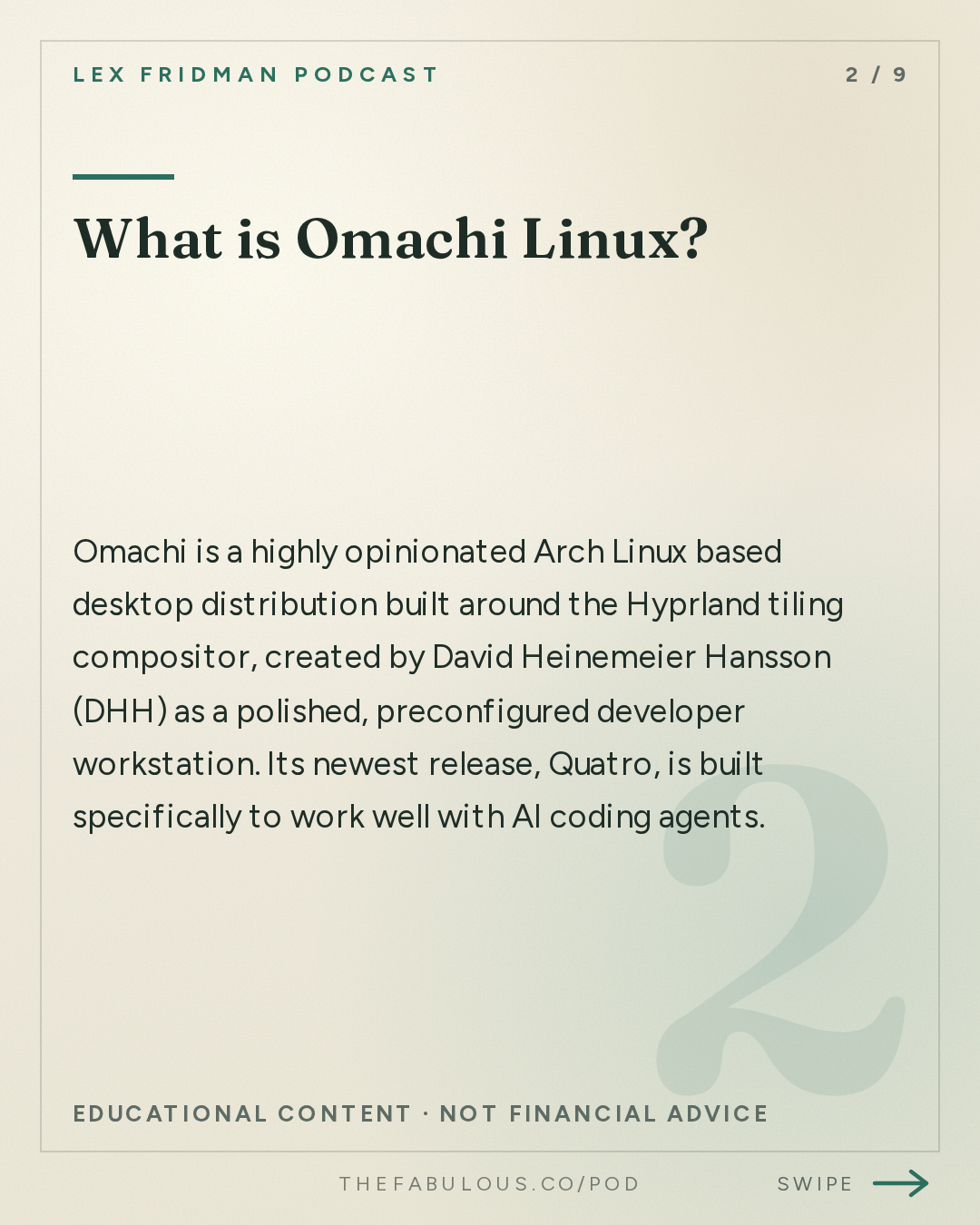
Omachi is a highly opinionated Arch Linux based desktop distribution built around the Hyprland tiling compositor, created by David Heinemeier Hansson (DHH) as a polished, preconfigured developer workstation (45:27). Its newest release, Quatro, is built specifically to work well with AI coding agents.
How much of Omachi's code was written by AI?
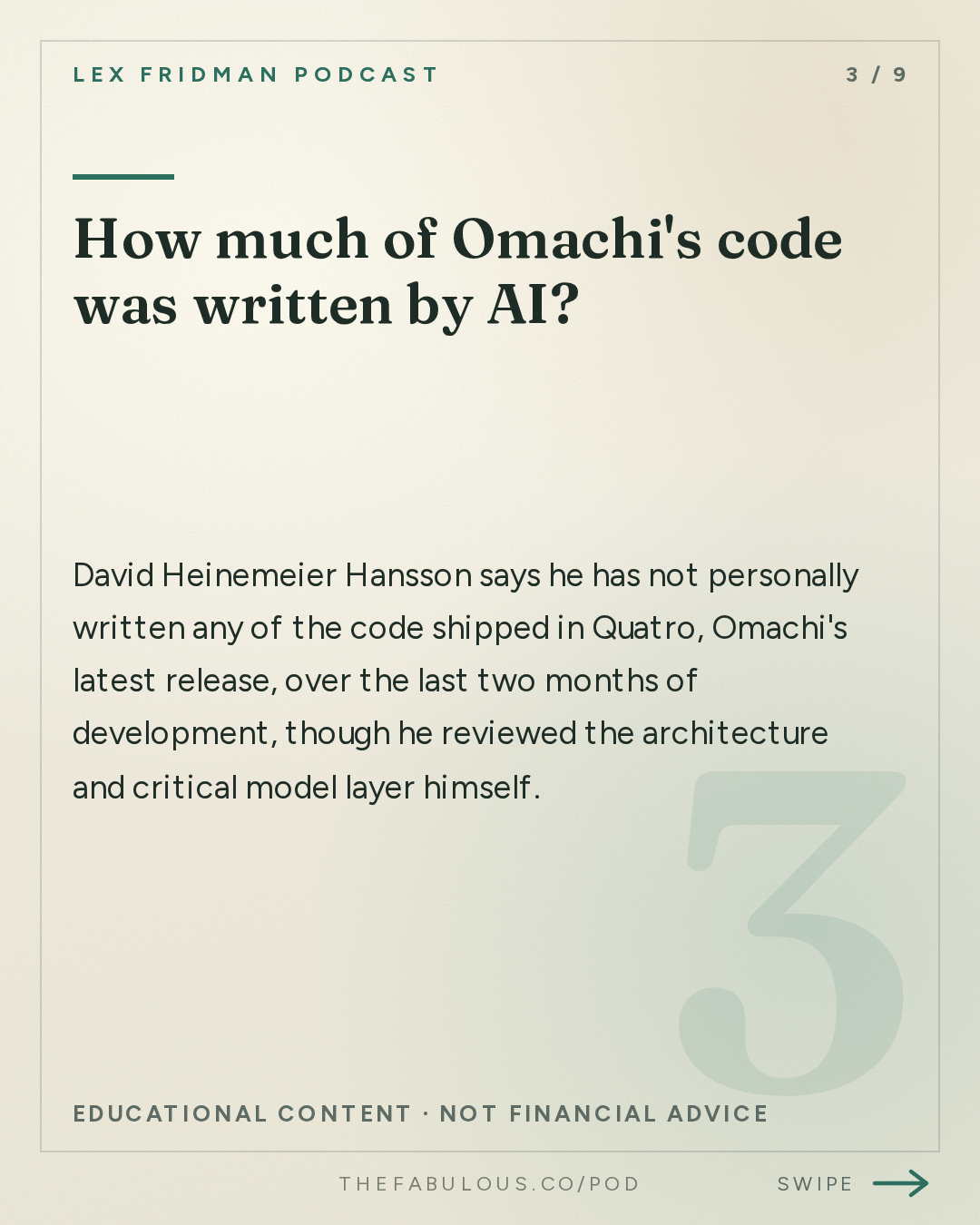
David Heinemeier Hansson says he has not personally written any of the code shipped in Quatro, Omachi's latest release, over the last two months of development, though he reviewed the architecture and critical model layer himself (21:41).
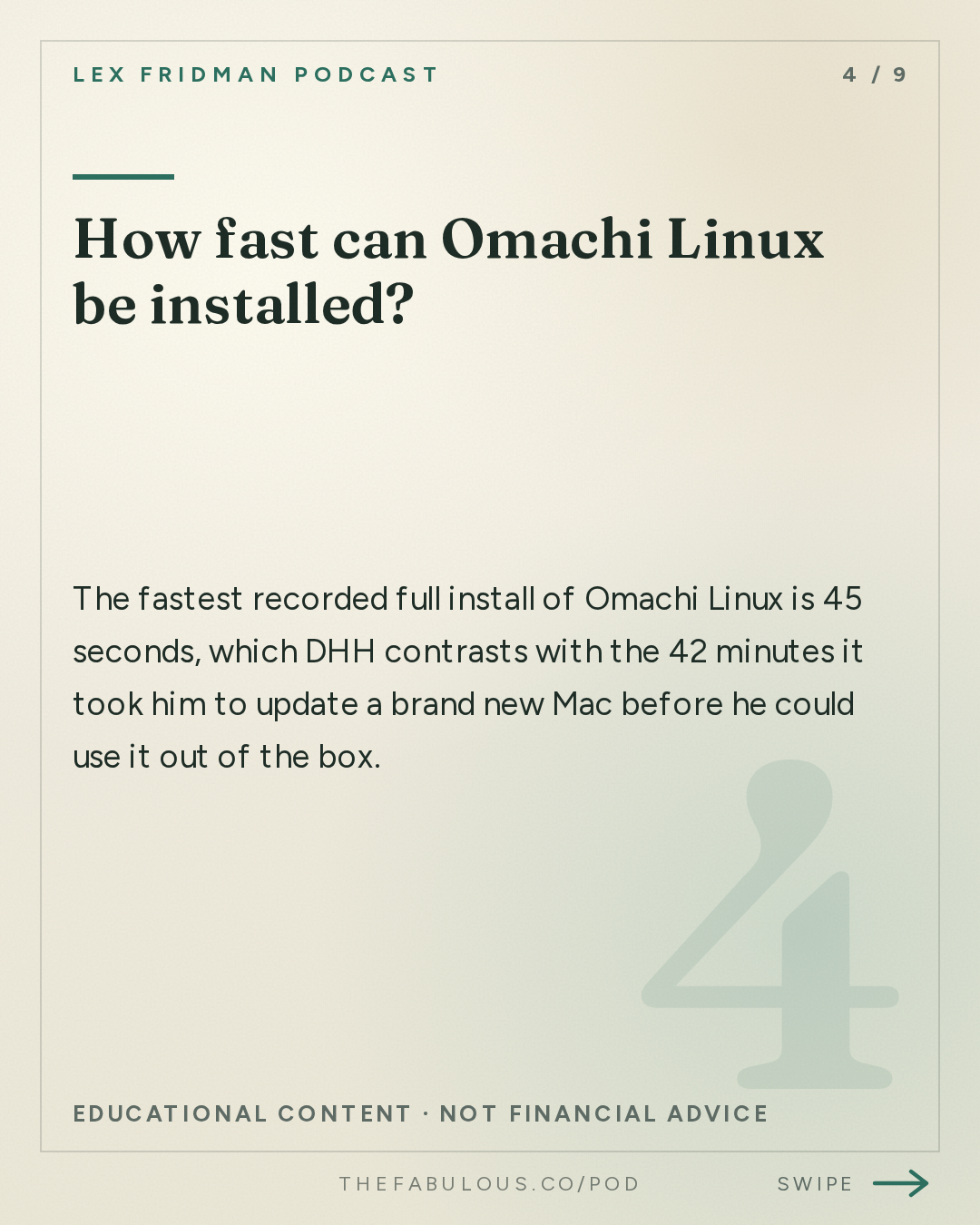
How fast can Omachi Linux be installed?
The fastest recorded full install of Omachi Linux is 45 seconds (126:07), which DHH contrasts with the 42 minutes it took him to update a brand new Mac before he could use it out of the box (120:08).
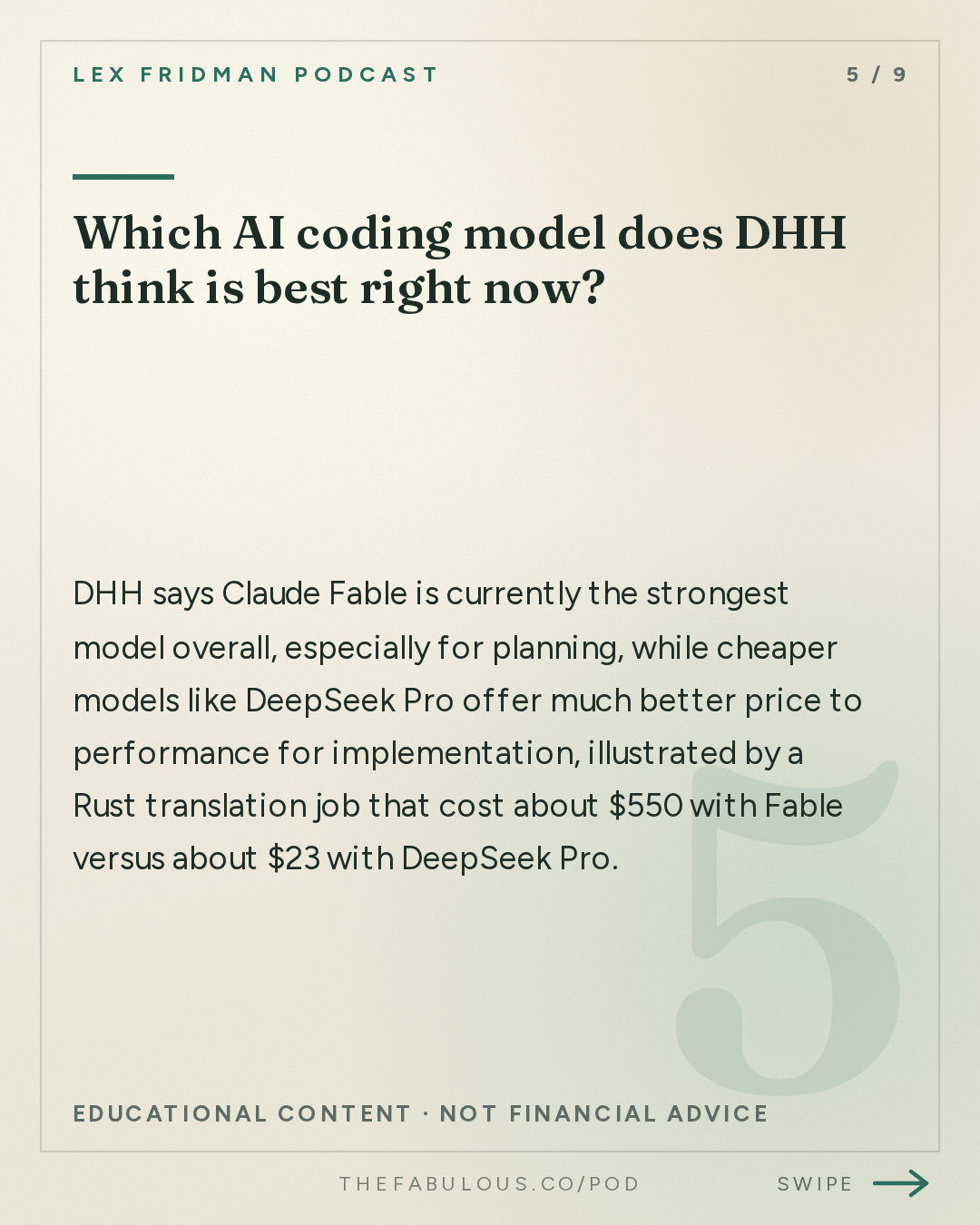
Which AI coding model does DHH think is best right now?
DHH says Claude Fable is currently the strongest model overall, especially for planning, while cheaper models like DeepSeek Pro offer much better price to performance for implementation, illustrated by a Rust translation job that cost about $550 with Fable versus about $23 with DeepSeek Pro (160:50, 163:02).
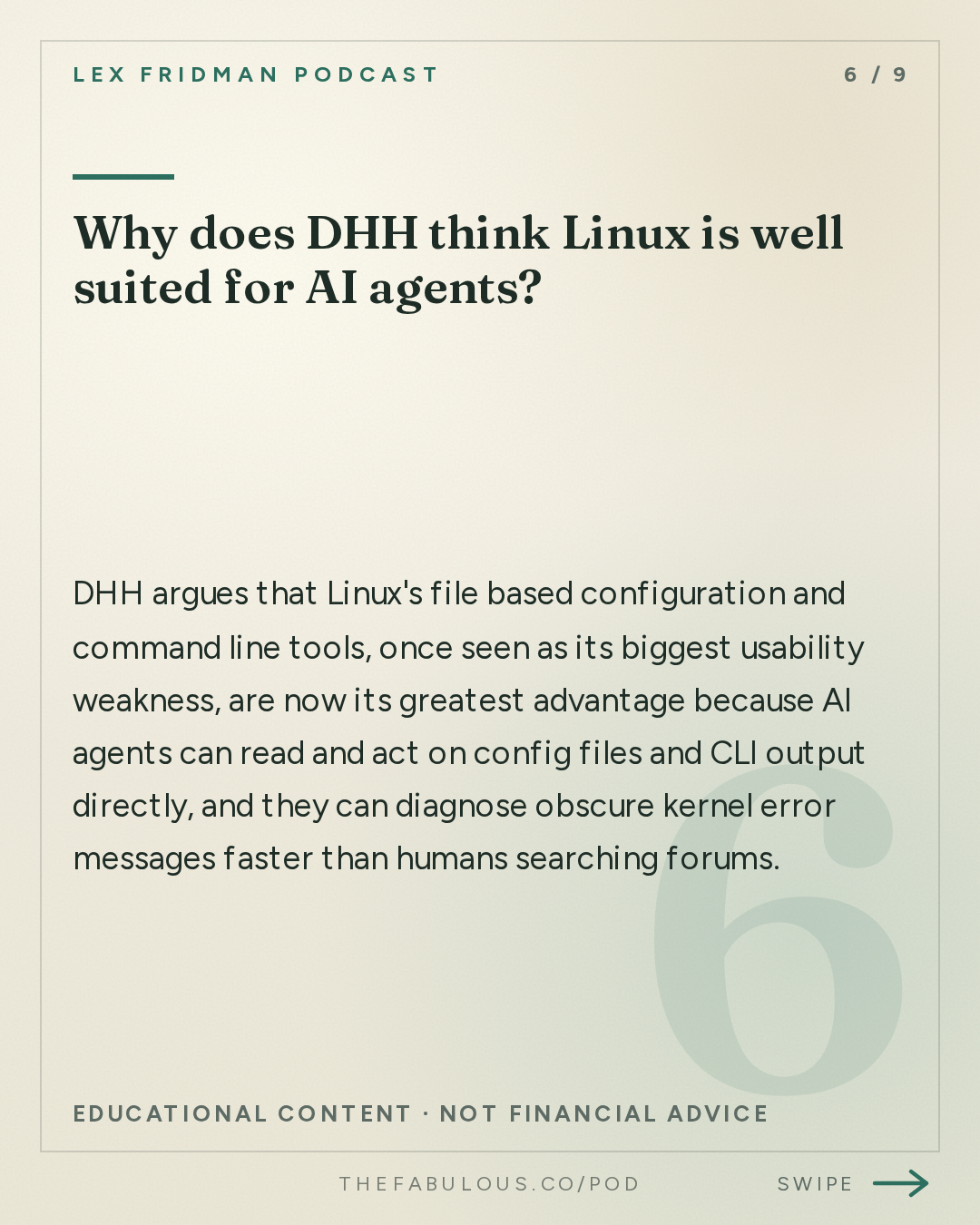
Why does DHH think Linux is well suited for AI agents?
DHH argues that Linux's file based configuration and command line tools, once seen as its biggest usability weakness, are now its greatest advantage because AI agents can read and act on config files and CLI output directly, and they can diagnose obscure kernel error messages faster than humans searching forums (107:51, 150:35).
The full read, in cards
Go deeper
- The Fourth Turning — William Strauss and Neil Howe's theory that history moves in repeating generational cycles, which DHH says helps normalize present anxieties
- Bullshit Jobs — David Graeber's book and UK poll finding roughly a third of workers believed their job produced no worthwhile value, cited by DHH on fake work
- Shopify internal PR quality study — Shopify CTO traced production incidents back to whether the merged pull request was reviewed by a human or an AI agent, finding agent reviewed code caused fewer issues
Mentioned
David Heinemeier Hansson · Ruby on Rails · Omachi Linux · Claude Fable · Tobi Lutke · Linus Torvalds · DeepSeek · Tailscale · Neovim · The Fourth Turning · David Graeber · Herder
More from this show and category
Khabib Nurmagomedov on Hardship, Discipline, and Faith
Khabib Nurmagomedov says hardship, not comfort, builds champions, drawing on Dagestan's Spartan gyms and his father's brutal discipline. The retired UFC lightweight champion, undefeated at 29-0, tells Lex Fridman that staying a champion is harder than becoming one, and that faith keeps wealth in the hand rather than the heart.

Dylan Field: Design Is the New Code
Figma CEO Dylan Field argues design, not code, now drives software's value as AI makes coding cheap and commoditized. He explains how Figma survived a blocked $20 billion Adobe acquisition, why AI lowers production's floor without raising creativity's ceiling, and why human willingness to say non-consensus things remains the real differentiator in an AI-saturated market.

CoreWeave Debt Crisis and the AI Bubble, Explained
CoreWeave's bond selloff this week signaled real doubt about AI infrastructure debt, even as demand for GPUs stays red hot. Anthropic posted $16.8 billion in Q3 revenue, Sacks called its warnings about small AI models a move against open-source rivals, and Chamath named electricity as AI's real bottleneck.

Billy Evans on Elizabeth Holmes: Trial, Prison, Hemantis
Billy Evans, Elizabeth Holmes's husband, says the Theranos founder was acquitted on every patient-fraud count tied to 12.5 million blood tests but convicted of defrauding three investors, a conspiracy charge that let the judge add outside victims like Rupert Murdoch and push her sentence to 11.25 years (00:27, 19:52, 21:31).
