
The Overwhelm Recovery ProtocolWellness & Routines · ~5 min
About this template · Updated September 2026
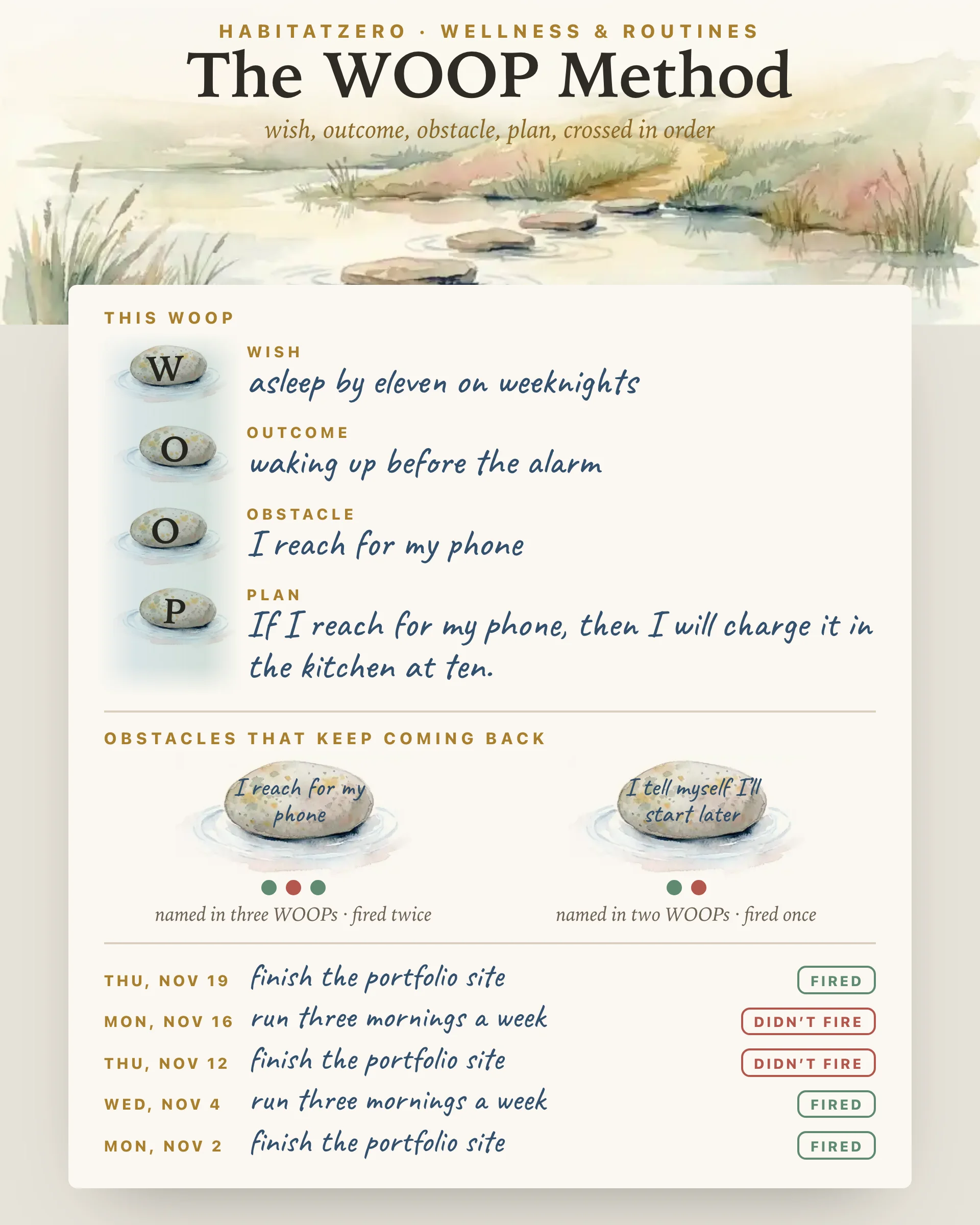
WOOP is the work of Gabriele Oettingen, a professor of psychology at New York University, who boiled some twenty years of motivation research down to four words: Wish, Outcome, Obstacle, Plan. Her team teaches it free of charge at woopmylife.org, with an app, videos and printable guides. The worksheet on this page is an independent practice tool made by Fabulous. Oettingen and her team did not create it, have not reviewed it and do not endorse it.
WOOP goal setting starts where most goal advice stops. It asks you to picture success, and then to look straight at the part of you most likely to wreck it. That second look is the whole trick.
The first half of WOOP is a daydream on purpose. You name a wish, then imagine the best thing about it coming true, vividly, until you can feel why you want it. The second half brings you back to the present and asks what inside you gets in the way. Not the traffic or your boss, but the habit or excuse you know by heart.
Oettingen calls this pairing mental contrasting. Her lab has found that dreaming about the future alone produces only middling commitment, and so does dwelling on the obstacle alone. Holding the two side by side is what turns a wish into a goal you actually chase, as long as the wish is realistic. When it isn't, the same contrast makes it easier to let the wish go.
The plan comes last and borrows from a second line of research: Peter Gollwitzer's implementation intentions, plans written in the shape "if this happens, then I will do that." When your obstacle becomes the "if," the moment of temptation turns into the cue for your plan instead of the end of it.
The page is a stream with four stepping stones, crossed in order. Each one asks for a few words, offers suggestions you can tap, and then asks you to picture what you wrote for eight seconds before the next stone opens. The pause is deliberate, because imagining is the step people skip when nothing slows them down.
On the obstacle stone, your outcome stays in view above the question, so the contrast sits right in front of you. On the plan stone, the sentence already opens with your obstacle ("If I reach for my phone,") and you finish it with one small action.
Filing the WOOP adds it to a log, where you later mark whether the plan fired, didn't, or never got its moment. Any obstacle you name in more than one WOOP gets a stone of its own, with a colored dot for each time, and the line at the top names the one that keeps coming back. The next time you name it, the plan stone reminds you what you tried before and how it went.
In research, the strategy behind WOOP is called mental contrasting with implementation intentions, and it has been tested in randomized trials. In one, seventy-seven fifth graders at an urban middle school learned either the strategy or a positive-thinking exercise, and the first group ended up with better report card grades, attendance and conduct. In another, more than two hundred fifty women between thirty and fifty who learned it alongside a health information session reported being about twice as physically active over four months as women who received the information alone.
The sober summary comes from a 2021 meta-analysis of twenty-one studies. It found a real but small-to-medium effect on reaching goals, and its authors caution that publication bias may make the effect look larger than it is. The effect was also stronger when a person guided the exercise than when people worked through written material alone. A worksheet belongs to the second group, so treat it as a habit you return to, not a one-time fix.
If you want several obstacles and their answers mapped out in one sitting, the Goal Planning Worksheet does exactly that. WOOP is narrower and slower by design: one wish, one obstacle and one plan, each pictured in turn, then done again next week. When the goal itself is still fuzzy, give it edges with the SMART Goals Worksheet first, then WOOP the first week of it.
The obstacle is something the person does, which is exactly the part a plan can reach.
Do one on a Sunday evening for the week ahead, before a conversation you have been putting off, or when the New Year Goals list starts to look optimistic. The best WOOP goals for a first try are near and concrete: this week's runs, tonight's bedtime, one hard email. A full crossing takes about five minutes. If the same obstacle keeps returning to your log, that isn't a failure. It is the most useful thing the log can show you.
WOOP stands for Wish, Outcome, Obstacle, Plan. You name a wish, picture its best outcome, picture the inner obstacle that tends to get in the way, and then write an if-then plan for the moment that obstacle appears. A round takes a few minutes and works best in exactly that order.
Gabriele Oettingen, a psychology professor at New York University, built WOOP from her research on mental contrasting combined with the if-then plans Peter Gollwitzer named implementation intentions. Her team teaches it free at woopmylife.org. This worksheet is a separate practice page from Fabulous, made without her involvement and not endorsed by her team.
It is the habit of imagining a future you want and then imagining the obstacle in your present that stands between you and it. In Oettingen's research, dreaming alone or dwelling on the obstacle alone produced only middling commitment, while contrasting the two committed people to realistic wishes and helped them release unrealistic ones.
SMART sharpens the wording of a goal so it is specific, measurable and dated. WOOP works on the person pursuing it: whether the wish really matters to you, what in you is likely to stop you, and what you will do at that moment. Plenty of people write the goal the SMART way and then WOOP each week of it.
The sample on this page shows a finished crossing and a few weeks of logged WOOPs you can look through. Your own crossings, fired marks and returning obstacles are kept when you open the worksheet in HabitatZero, which costs nothing.
By the team behind Fabulous, the science-based self-care app used by over 30 million people.


