The Overwhelm Recovery ProtocolWellness & Routines · ~5 min
About this template · Updated August 2026
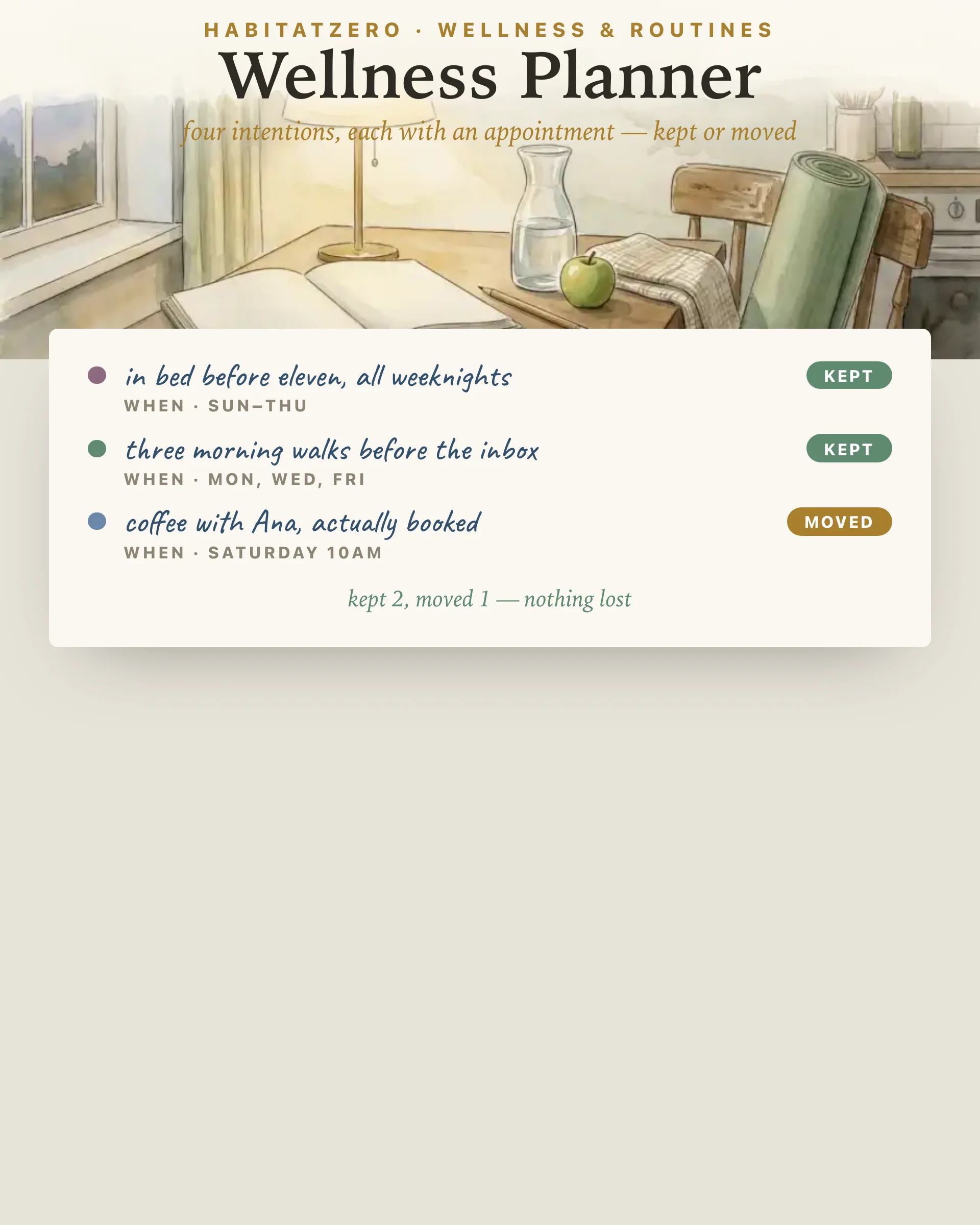
Nobody plans to skip the walk, lose the evening to the phone, and cancel on a friend — weeks just arrive already full, and wellbeing gets whatever's left. A wellness planner flips the order of operations: the levers get their appointments before the week starts spending you. Four intentions, four whens, and at the far end a reconciliation with only two honest options.
The planner holds exactly one intention per lever — sleep, movement, connection, mood — written in your own hand before Monday gets a vote: in bed before eleven, all weeknights. Three morning walks. Coffee with Ana, actually booked. The long bath on Thursday. Four is the whole plan on purpose; a wellness plan you can recite on a Tuesday afternoon is the one that survives Tuesday afternoon.
The line that does the heavy lifting is the small one: when. An intention without a when is a hope, and the difference is measured, not rhetorical. Deciding the time and place of an action in advance — an implementation intention — is among the most replicated effects in behavior change, with Gollwitzer and Sheeran's meta-analysis across nearly a hundred studies finding a substantial boost to goal attainment from that one move. And it scales down to a single prompt: in a large field experiment on planning prompts, simply nudging people to write down the date and time they'd get a flu shot increased actual vaccinations. Same trick, gentler stakes: Mon, Wed, Fri, before the inbox.
At the week's end, each intention gets one tap: kept or moved. There is deliberately no third option, because the third option is how wellness plans actually die — not in honest failure but in silent evaporation, the intention nobody officially canceled and nobody did. Moved keeps the intention alive with a new week attached; it's scheduled honesty, not defeat. When you sweep into a fresh week, the planner records how the last one went — kept 2 of 3 — and that single remembered line is often the only accountability the next week needs.
This planner is the front half of a loop. The Wellness Journal is the back half — it reads the week's four dials after the fact and picks one adjustment — and the two stack into a complete rhythm: intentions on Sunday evening, readings the following Sunday, each one sharpening the other. When a single intention wants to become a durable habit, the Daily Habit Tracker gives it stamps and a streak; and if the connection line keeps getting moved, the Self-Care Journal's nightly noticing usually finds out why.
Four appointments. Two honest outcomes. The week, planned before it's spent.
A page you fill before the week starts rather than after it ends: one intention for each of sleep, movement, connection, and mood, each with a concrete when. At week's end you reconcile every intention as kept or moved - a two-option honesty that keeps plans from silently evaporating.
Because deciding the time and place in advance is one of the most replicated effects in behavior research. Studies of planning prompts - including a large field experiment on appointment-style prompts - show that people who write down when they will do a thing follow through meaningfully more often than people who merely intend to.
Moved means the intention survives with a new week attached, instead of disappearing into vague guilt. The distinction matters: plans die from silent abandonment far more often than from honest rescheduling, and the planner is built to make abandonment impossible to do quietly.
One per lever, because the levers are the point. Wellness plans fail by ambition more than by laziness - a plan you can hold in your head on a Tuesday afternoon is the plan that happens. If a lever needs more than one intention, it probably needs its own dedicated tool for a season.
They are two ends of the same week. This planner sets the intentions on Sunday evening; the weekly wellness journal reads the four dials after the week has happened. Plan here, review there - together they close the loop.
Before the week can argue with you - Sunday evening is the classic slot. The reconciliation takes thirty seconds the following weekend, right before you plan again.
By the team behind Fabulous, the science-based self-care app used by over 30 million people.