The Overwhelm Recovery ProtocolWellness & Routines · ~5 min
About this template · Updated September 2026
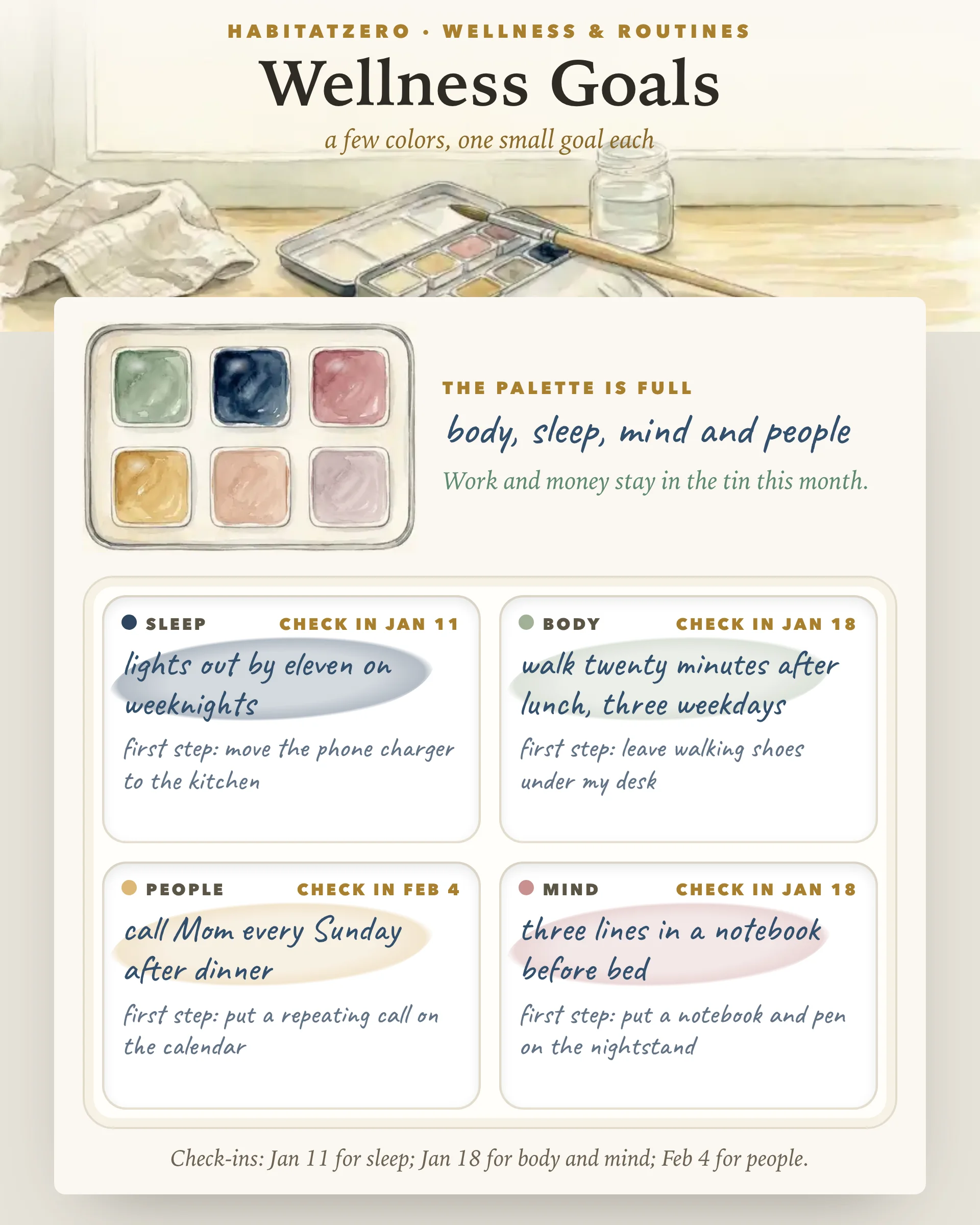
Most lists of wellness goals are long, and most of the goals on them are shaped like wishes: sleep better, stress less, save more. None of those tells you what to do on Tuesday. A wellness goal that lasts is usually smaller than the one you first had in mind, tied to one part of your life, and paired with the next thing you will do about it. This page builds goals of that kind, a few at a time, and then shows you what a list never does: which parts of your life you decided to leave alone for now.
The best-known map of those parts is SAMHSA's eight dimensions of wellness: emotional, environmental, financial, intellectual, occupational, physical, social and spiritual. What the map offers is breadth. It keeps the word wellness from shrinking down to diet and exercise.
This worksheet keeps the breadth but trims the map to six colors you can act on within a month:
If a goal about your surroundings or your sense of meaning does not fit neatly, file it under the color it feels closest to. The colors are for sorting, not grading, and they are this page's own simplification rather than anything SAMHSA publishes.
Tap a pan and a card opens with five examples for that part of life. Each arrives with a first step attached, so one tap gives you lights out by eleven on weeknights along with set a wind-down alarm for ten thirty. Change any word until it sounds like your week. Then choose when you will look at it again: a week, two weeks or a month out, nudged a day at a time onto an evening you can spare.
When the goal, the step and the day are filled in, put it on the palette. Its pan turns glossy, and the goal gets a well of its own, handwritten over a wash of its color. The palette has four wells and not one more. Past four, colors start to run into each other, and goals do the same: they compete for the same evenings.
That limit gives the reading at the top its meaning. Once you have chosen, the page names what went on the palette and what stayed in the tin, say body, sleep, mind and people on the palette, with work and money waiting. Under the palette, the check-in days are listed in order, and when one comes due the page offers three honest options: keep going with a new day, make the goal smaller, or put it back in the tin.
The first step is doing real work. In a review of 94 tests of if-then planning, Gollwitzer and Sheeran found that deciding in advance when, where and how you will act had a medium-to-large effect on reaching a goal. A first step written as a concrete action, such as moving the phone charger to the kitchen, is a pocket-sized version of that planning.
The check-in day earns its place as well. A meta-analysis of 138 studies on monitoring goal progress found that people nudged to keep track of their progress reached their goals more often, and the effect grew when progress was written down or shared with others. Putting the date on the calendar is the plainest way to make sure the looking actually happens.
Here is what that research cannot tell you. Nobody has tested this particular worksheet, and the four-goal cap is a design choice meant to keep each goal in view, not a number taken from a study. The dimensions are a way to reflect on your life, not a measurement of it, so a color left in the tin says nothing about how well you are.
Leaving a part of life alone for a month is not neglect when you choose it. Try to change six things at once and each goal gets a sliver of your attention. Naming what stayed behind turns quiet drift into a decision you can revisit.
So at your first check-in, look at the tin as well as the palette. Perhaps money really can wait. Or perhaps it was the goal you were steering around, and it deserves the next open well.
Reach for it at the start of a month, after a stretch that knocked your routines over, or in January when you want goals that outlast the first week. To survey every dimension before choosing, walk through the 8 Dimensions of Wellness first. When one goal needs sharper edges, the SMART Goals Worksheet can test it. And if a goal is daily, a 30-Day Habit Tracker gives it a grid to fill between check-ins.
They are small, concrete aims for looking after one part of your life, such as sleep, movement, money or the people you love. The useful ones name something you could do this week, rather than a feeling you hope to have someday.
Lights out by eleven on weeknights, a twenty-minute walk after lunch on three weekdays, a Sunday phone call to someone you miss, one no-spend weekend a month, or closing the laptop by six. On any given evening you could say whether you did each of them.
SAMHSA lists eight: emotional, environmental, financial, intellectual, occupational, physical, social and spiritual. This worksheet folds the everyday ones into six colors and gives sleep a pan of its own, because a bedtime goal looks nothing like an exercise goal.
There is no official number. This page stops at four so each goal gets real attention, and whatever stays in the tin simply waits for your next round of choosing.
The filled-in palette on this page is yours to look through for free. To mix your own colors and keep your check-in days, personalize the worksheet in HabitatZero, which costs nothing.
By the team behind Fabulous, the science-based self-care app used by over 30 million people.