
The Overwhelm Recovery ProtocolWellness & Routines · ~5 min
About this template · Updated November 2026
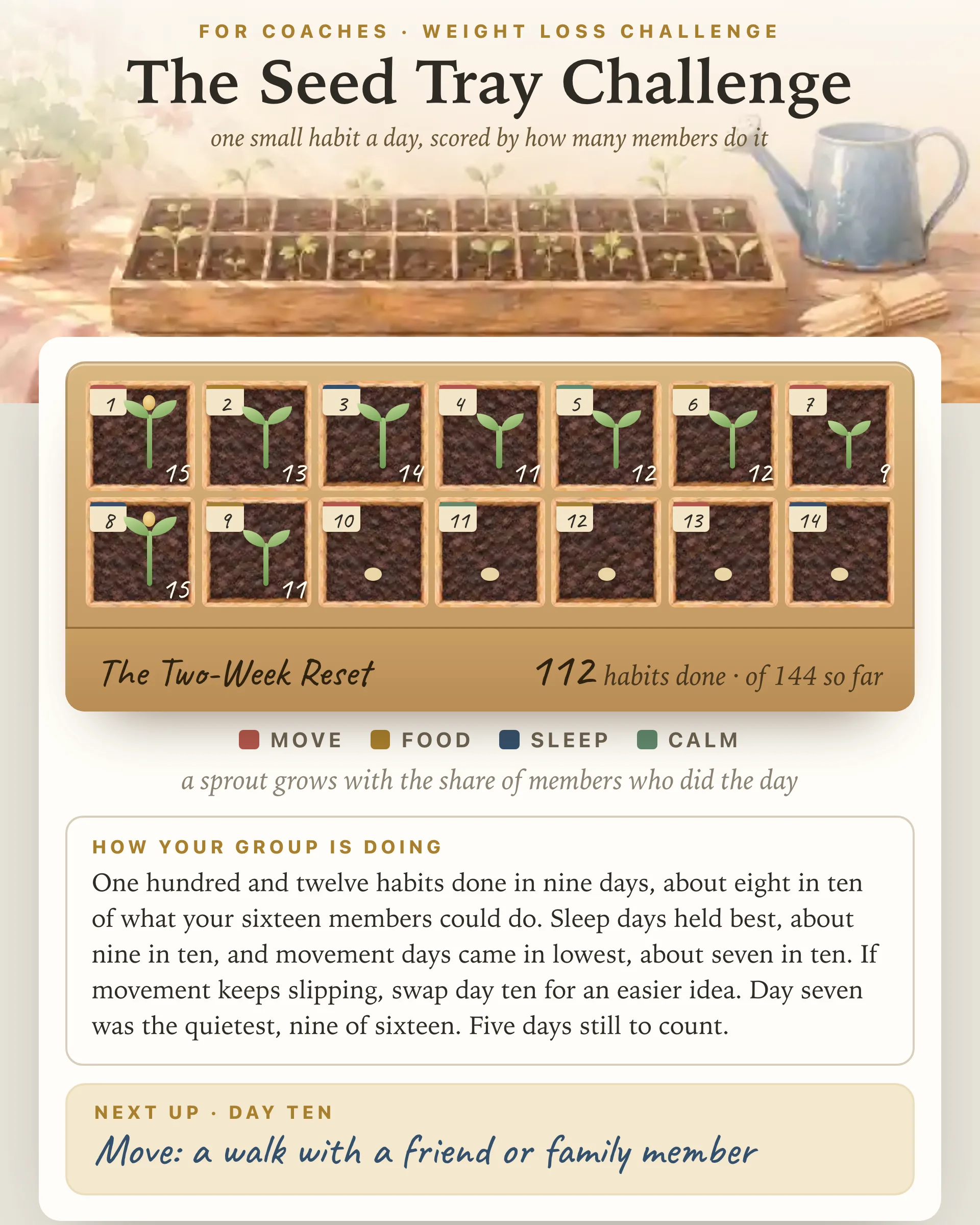
Most weight loss challenges are built around the number on a scale, and that is a hard number to hand a group. It moves slowly, for reasons nobody in the room controls, and ranking it in public weighs heaviest on members who already struggle with food. This planner scores something you can coach: how many of your members did today's small habit. Plant one habit a day for seven, ten or fourteen days, count who did it, and a tray of sprouts shows where the group holds and where it slips.
Each day carries one habit of four kinds, so your group gets a mix, not two weeks of the same push.
Two days sit between any two movement days, so a beginner never trains two days running. If an idea doesn't suit your group, open that day and tap a kind to swap in the next idea of that kind not yet planted, or write your own line. It keeps its color as long as it starts with Move, Food, Sleep or Calm.
Enter how many members you have, then count how many did each day's habit as the day ends. The seed in that cell becomes a sprout as tall as the share who did it, so a quiet day stands out at a glance. Below the tray, a reading adds up the habits done, compares the four kinds, names the quietest day, and points to the next day of the weakest kind as one to swap for something easier.
The counts are one number per day and nothing more: no names, no weights, no photos, no rankings. When the challenge ends, clear the counts and the plan is ready for your next group.
Movement on its own is a modest lever on weight. A Cochrane review of 43 exercise trials found small losses from exercise alone, better results when exercise came with dietary change, and better blood pressure, blood fats and fasting glucose even where weight didn't change. That is the honest case for a habit challenge: some gains never show on a scale. The review found no data on side effects or quality of life, so it can't say how a challenge feels to the people in it.
Sleep belongs beside it. A meta-analysis of short sleep and obesity pooled studies of more than six hundred thousand children and adults and found short sleepers consistently more likely to have obesity. The authors note that most of those studies were snapshots, which can't show that sleeping longer changes anyone's weight. Run sleep days as good care in their own right, not a shortcut.
Time is the part two weeks can't supply. In a study of how habits form in everyday life, volunteers repeating one eating, drinking or exercise behavior took from 18 to 254 days to reach their own plateau of automaticity, and missing a single day didn't knock them off course. It was a small group choosing their own habits, so take it as a lesson in patience rather than a schedule. A short challenge is long enough for each member to find the two or three habits worth keeping.
Before day one, ask members to talk to a doctor if they take insulin or another diabetes medicine, since being more active than usual can push blood glucose low for up to a day afterward, as the National Institute of Diabetes and Digestive and Kidney Diseases explains. The same goes for anyone pregnant, under eighteen, with an eating disorder now or in the past, with a heart or blood pressure condition, or who has had a fall, dizziness, a joint replacement or pain that hasn't settled.
Offer an easier version of every move, keep a sturdy chair or counter within reach for anything that tests balance, and tell members to stop if something hurts. If a member seems unwell, or you notice someone restricting food, refer them to a doctor rather than coaching them through it. This planner organizes a group's habits and is not medical advice.
Plant the tray a week before you start and print the planting list, so day one holds no surprises. For a challenge about exercise alone, The 14-Day Group Challenge gives each day one workout idea for your chosen focus. A member who wants a private place to note their own wins can keep The Weight Loss Journal, and anyone whose favorite days were the walks can carry on with the Walking Plan for Weight Loss.
Pick small daily habits anyone can do the same day: a short walk after a meal, a vegetable at lunch and dinner, lights out at a steady time, a few slow breaths before eating. Mix movement with food, sleep and calm so the challenge is about the whole routine, and keep every food idea about adding or slowing down, never cutting out.
Count habits instead of weight. After each day, note how many members did that day's habit, add the counts up and compare them with what the whole group could have done. This tray stores one number per day and nothing else, so nobody is named, weighed or ranked, and no prize ever rides on a body.
Seven to fourteen days is long enough to try every kind of habit and short enough for a group to finish together. Habits take much longer than two weeks to feel automatic, so treat the end of the challenge as the point where each member picks the two or three habits to keep.
Anyone who takes insulin or other diabetes medicine, is pregnant, is under eighteen, has an eating disorder now or had one in the past, has a heart or blood pressure condition, or has had a fall, dizziness, a joint replacement or lasting pain. If a member seems unwell or is restricting food during the challenge, point them to a doctor.
Yes. Planting the tray, counting each day and printing the planting list all work here at no cost. Tap Personalize to keep the planner, so the same days are ready when your next group starts.
By the team behind Fabulous, the science-based self-care app used by over 30 million people.


