
The Overwhelm Recovery ProtocolWellness & Routines · ~5 min
About this template · Updated November 2026
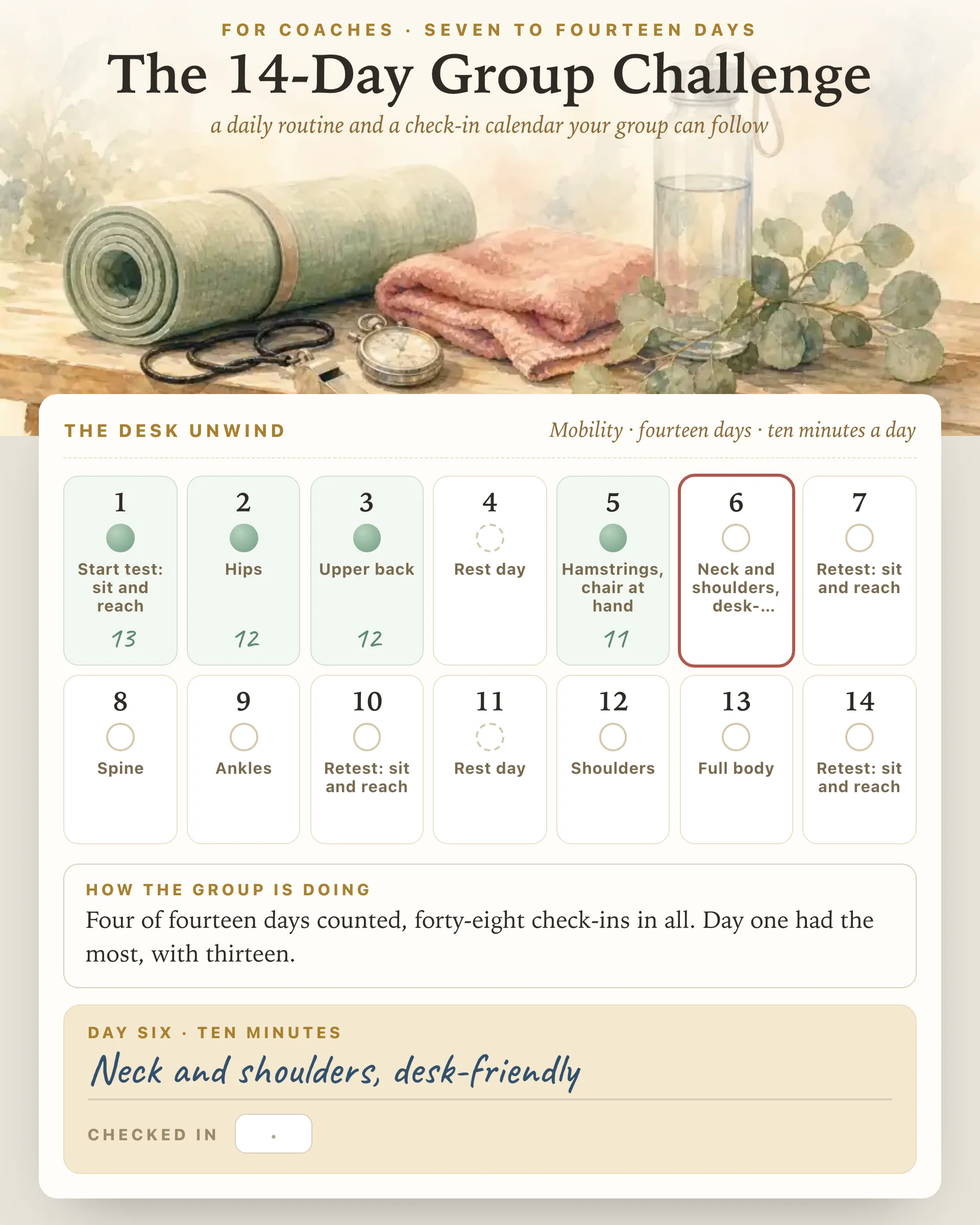
A group challenge falls apart in a predictable place: day three, when nobody is quite sure what today asks of them and the group chat goes quiet. The fix is unglamorous. Give every day one clear idea, decide ahead of time how long it takes, and count who turned up. This planner does those three things. Pick a focus, a length and the minutes a day, and each day fills with an idea you can rename. A grid below the plan holds how many members checked in, day by day.
Each focus comes with fourteen days written for a general adult group, with nothing heavier than a chair, a mat or a low step.
Switching focus later asks before it replaces anything, and you can keep your own days while changing the label.
Day one is a short test everyone can do, such as counting chair stands for thirty seconds or noting how far a run-walk takes you. Days seven, ten and fourteen repeat it, and days four and eleven are rest. So whichever length you choose, seven, ten or fourteen days, the challenge ends on its retest, the longer plans test along the way, and every week holds a day off.
Treat the test as each member's own starting line, not a leaderboard. People join a group at very different places, and the useful number is how far each person moved from where they began.
The CDC's guidelines for adults ask for at least 150 minutes of moderate activity a week, plus muscle-strengthening activity on two days. Ten minutes a day falls well short of that, and it is meant to: it is an easy yes for someone who does very little now. Twenty-five minutes on six days of a week reaches the full amount. Plenty of people start far below it. The World Health Organization counts nearly a third of the world's adults, about 1.8 billion people, as not meeting the 150 minutes.
Set the minutes to what the least active member can manage, and let the keen ones add their own.
The research on exercising together is encouraging, with honest caveats. A meta-analysis of interventions that got people walking in groups pooled 19 studies with 4,572 adults and found a medium-sized increase in physical activity. A review of walking groups covering 42 studies described them as effective and safe, with good adherence, and none of the studies reported notable harms.
What turns a list of people into a group matters too. A realist review of group-based physical activity programs looked at 52 studies built on group dynamics, and 48 of them reported a significant rise in activity. It describes a true group as one whose members share a goal, change one another through how they interact, and see themselves as a group. The programs that worked most often built in conversation between members and support from one another, and many added goals the group held together and a sense of team identity. A name for your challenge and a daily count you share back with the group are small versions of those. The authors are also clear that the studies differed widely and that no one has yet pinned down which ingredient does the work, so read this as a reason to try, not a promise.
The check-in grid stores one number for each day and nothing else. You can print the sheet, post a screenshot to the group or hand it to a co-host without anyone's details on it. If you keep a list of who joined, keep it in your own records.
Offer an easier version of every day: knees down for push-ups, a chair for balance, a shorter walk. Stop for sharp pain, and remind members that soreness a day after a new move is common while pain during one is a signal to stop. Anyone with a heart condition, a recent injury or surgery, or a pregnancy should check with their clinician before day one. This page is a planning tool, not medical advice.
Fill it in a week or so before you start, so the group knows what day one asks. If someone wants a month on their own afterwards, the 30-Day Workout Challenge builds strength circuits that respond to how each day went, and the Walking Challenge turns logged walks into a route on a painted map. For a month of small tasks that have nothing to do with exercise, try the 30-Day Challenge.
Choose one focus that everyone can do at home or in a park, such as mobility, walking or bodyweight strength, and give each day a single clear idea. A short test on day one and the same test at the end let each member see their own change, and a weekly rest day keeps the plan kind to people who are new to moving.
Name it, choose the focus, the length and the minutes a day, then share the day list before day one. Each evening, count how many members showed up and use that number to cheer the group on, never to single anyone out.
Seven to fourteen days suits a first challenge: long enough to find a rhythm, short enough for the group to finish together. Whichever length you choose here, the last day repeats the test from day one, so every member ends by seeing how far they came.
The ideas are written for a general adult group, with a rest day in each week and nothing heavier than a chair, a mat or a low step. Invite members to take any day at an easier pace, and ask anyone with a health condition, an injury or a pregnancy to talk to a clinician before they start.
No. The check-in grid holds one number per day, so it never asks who came. If you keep a contact list for your group, keep it in your own records, away from this sheet.
Yes. You can fill it in right here, and your answers stay in this browser. Tap Personalize to keep the planner in a free Salon account from the makers of Fabulous and carry on editing it there.
By the team behind Fabulous, the science-based self-care app used by over 30 million people.


