
The Overwhelm Recovery ProtocolWellness & Routines · ~5 min
About this template · Updated September 2026
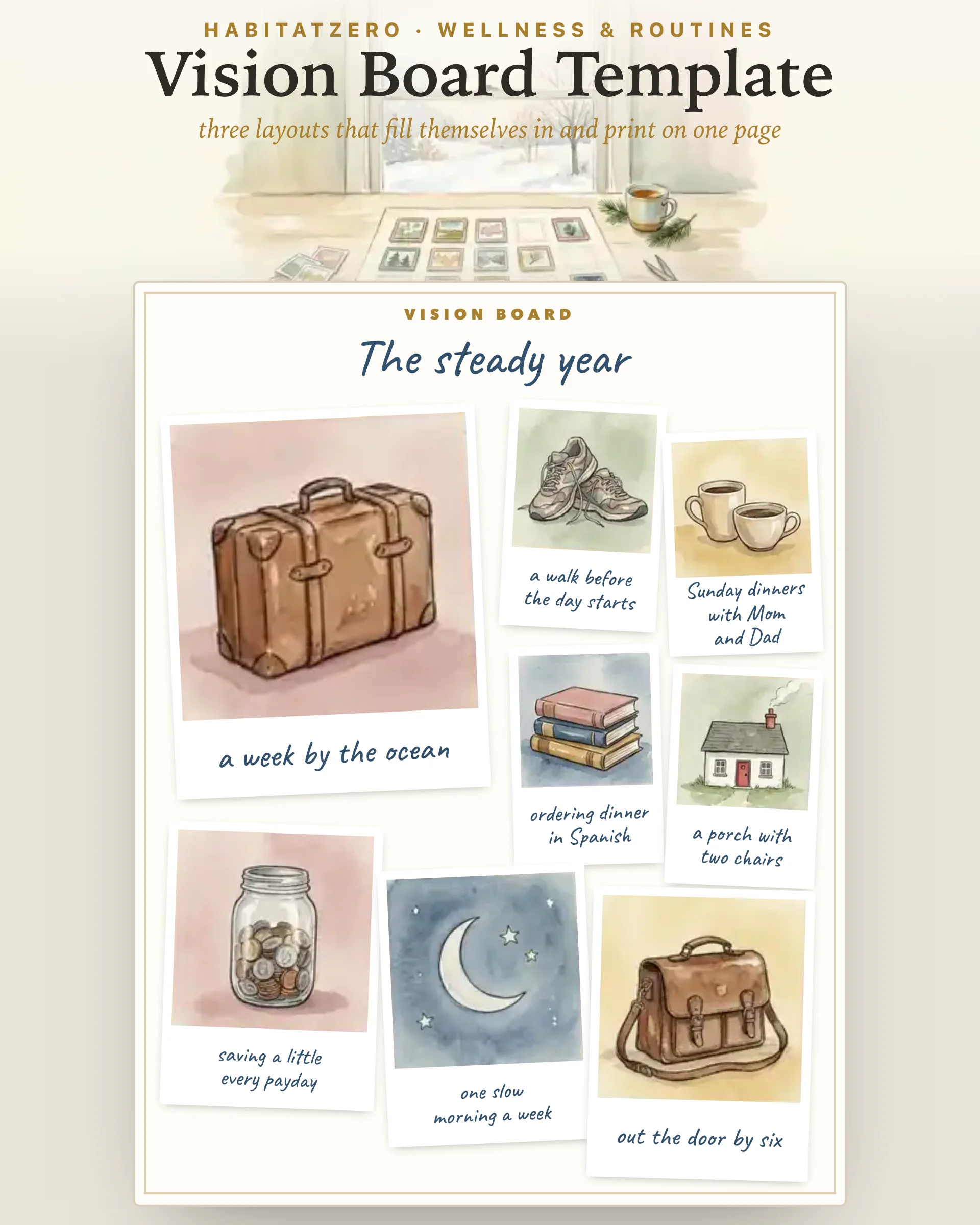
Most people who search for a vision board template end up in a design app, dragging stock photos around a blank canvas. This page does the arranging for you. You choose a layout, pick a painted picture for each part of life you care about, and give it a few words. The board sets each one in the next open frame, sizes the handwriting to fit, and prints on a single letter page.
The grid puts eight equal frames around a sunlit center that holds your title. It is the tidiest of the three and reads well from across a room.
The collage lays the same frames out like photo prints, each tilted a little, with the first one printed large. Choose it when one wish is leading the year and you want the board to say so.
Life areas trades the prints for labeled panels: health, work, money, people, home, learning, travel and rest. Each panel shows its painting and your lines on ruled paper, and any part of life you left out stays visibly blank.
Switching layouts never loses a word, so you can try all three before you print.
Start at the tray of eight paintings. Running shoes stand for health, a work bag for work, a jar of coins for money, two cups for the people in your life, a small house for home, a stack of books for learning, a suitcase for travel and a crescent moon for rest. Tap one and five suggested lines appear, written as scenes rather than slogans: a walk before the day starts, coffee with my sister, monthly, a national park in the fall. Tap a line or write your own, up to thirty-six characters.
The board holds eight frames, and no part of life gets more than two. Those limits are deliberate. A board you can read in five seconds gets looked at, while one with forty images turns into wallpaper, and a board that is all work tells you something worth noticing now rather than in March. When a part of life is full, the page says so.
Tap any frame to move it to the front, which makes it the large print in the collage, or to take it down. Taking one down asks twice, so nothing disappears by accident.
The board is drawn to the proportions of a letter page, so the printer gives you what the screen shows. Print it filled and the paintings and your handwriting come out in full color. Print it blank and you get the same layout with empty picture boxes and caption lines, ready for magazine cutouts, photos or colored pencils, which also makes it an easy activity for a family table or a classroom.
Nothing in the evidence shows that looking at a picture of what you want makes it arrive, and no board on this page promises that. What the research does show is narrower and more useful.
Gabriele Oettingen and her colleagues found that people who only daydream about a wished-for future commit to it no more firmly than people who only dwell on where they stand now. What changed commitment was contrasting the two: people who set the future against present reality committed strongly when their chances looked good and only weakly when they did not. A later meta-analysis of twenty-one studies found that pairing this contrast with if-then plans helped people reach their goals, with a small-to-medium effect that the authors caution may be smaller still once publication bias is accounted for.
Lien Pham and Shelley Taylor add a practical point for anyone choosing words for a frame. College freshmen who spent the five to seven days before a midterm picturing how they would study for it studied more and earned better grades than classmates who pictured the good grade itself. That is why the suggested lines here describe doing rather than having: out the door by six, rather than a corner office.
So treat the finished board as a reminder of what you chose, and keep the plan close by.
Specific beats grand. Put names and places in the lines where you can: your sister, the lake an hour north, the Tuesday class. And leave a frame open rather than filling it with something you only half want; on a printed board, an empty frame reads as an invitation, while a filler line is one your eyes learn to skip.
December and January are the natural season, but a birthday, a move or the start of a school year works as well. If a blank board is what stops you, open Vision Board Examples and borrow the structure of a finished one. If you know the layout but not the content, Vision Board Ideas deals ideas by area and asks each one for a first step. And if your title keeps coming out as a single word, choose it with care in Word of the Year, then write it in the grid's sunlit center.
Hang the print where you pass it every day, and take a frame down the moment it stops meaning anything.
Choose one of the three layouts, then fill frames one at a time: tap a painted picture for a part of your life and give it a short line, either a suggestion or your own words. Each line drops into the next open frame with its handwriting sized to fit, so eight choices become a finished page you can print.
The grid sets your title in a sunlit center with eight equal frames around it, which suits anyone who likes order. The collage scatters the frames like photo prints and makes the first one large, good for a year led by one wish. Life areas gives health, work, money, people, home, learning, travel and rest a labeled panel each, so a missing part of life shows at a glance.
Yes. Every layout prints blank on one letter page, with empty picture boxes, caption lines and a line for the title, ready for magazine cutouts, photos or your own drawings. Print it filled instead and the paintings and your handwriting come out in the same places they sit on screen.
Crowding it is the first: forty images blur into wallpaper, which is why this board stops at eight frames and two per part of life. Filling it only with outcomes is the second, since a study of students before an exam found that picturing the studying helped more than picturing the grade. The third is treating the board as a promise rather than a reminder that still needs a plan beside it.
It costs nothing. The page here shows a sample board; to build your own, keep it between visits and print it, open the template in HabitatZero, which is free as well.
By the team behind Fabulous, the science-based self-care app used by over 30 million people.


