
The Overwhelm Recovery ProtocolWellness & Routines · ~5 min
About this template · Updated September 2026
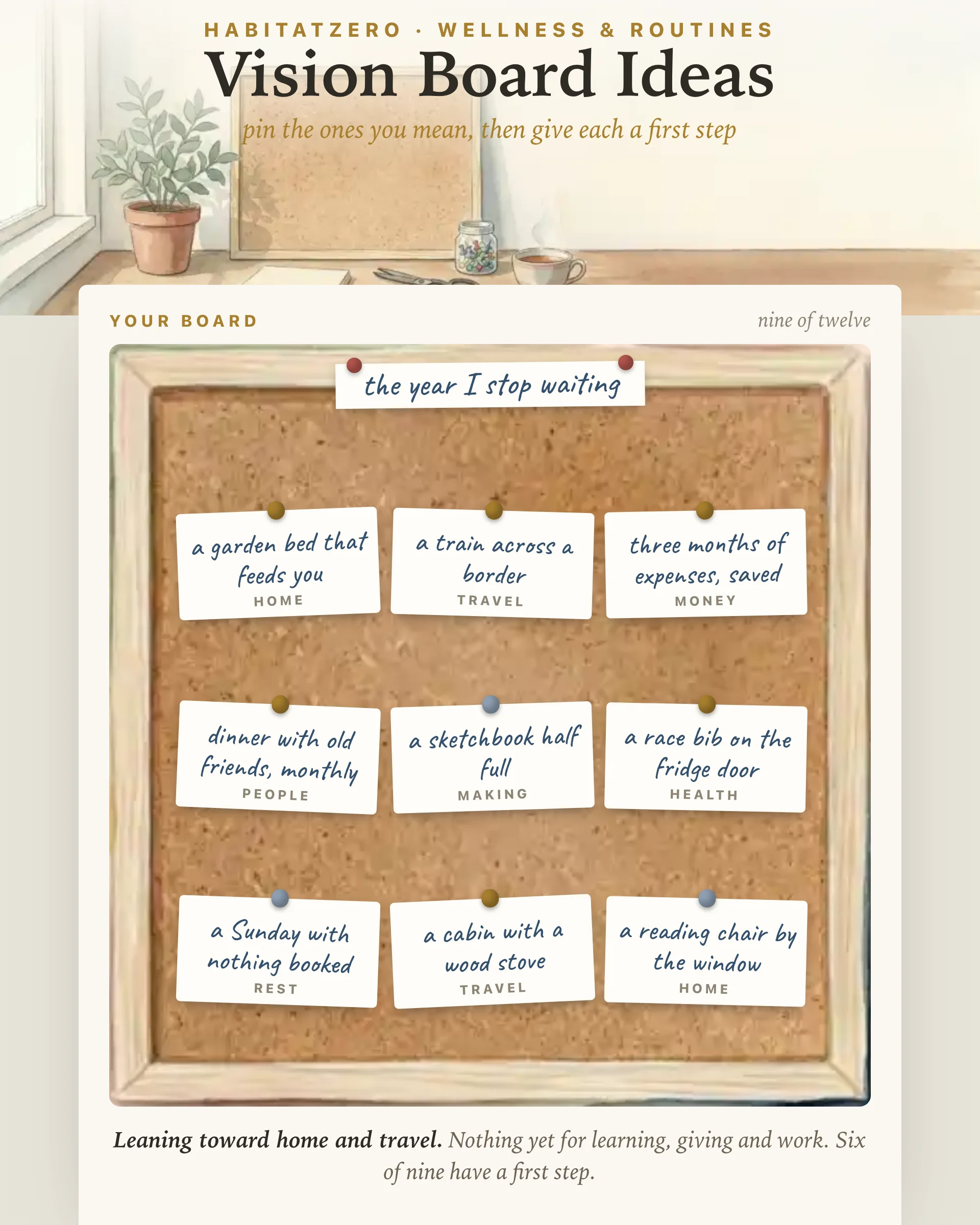
Most vision board advice starts with a stack of magazines and ends with a collage that looks lovely on the wall and changes nothing. The trouble is not the board; it is that a board of outcomes with no route to any of them is the least useful thing you can hang above a desk. This page keeps the board and fixes the missing part: every idea you pin gets asked for the obstacle in its way and one step past it.
Blank cork is the worst place to begin, so the sheet deals ideas six at a time, and you choose the lens.
By life area covers the ten categories most boards are built around: health, work, money, people, home, learning, travel, rest, making and giving. Each pile holds eight ideas written as scenes rather than slogans, because a scene is something you can picture yourself inside. "A bedroom with a clear floor" is a board idea; "declutter" is a chore.
By mood starts from the feeling you want more of, which is often how a vision really begins: calmer, braver, lighter, closer, prouder, freer. Each pile draws on several life areas, and every card shows which one.
By season suits a board built for the next three months rather than a whole lifetime.
Deal again when the six in front of you are not it, or write your own on the line beneath; those are the ones you will still recognize in April.
Tap a card and it lands on the cork in your handwriting, tilted a little, under a gray pin. The board holds twelve. That cap is the point: a board with forty pictures is decoration, a board with nine is a set of decisions, and unpinning one thing to add another is the first honest edit most people make to their goals.
Beneath the cork the sheet reads the board back to you: the life areas you lean toward and the ones with nothing pinned. Nearly everyone finds travel and work well covered and rest or people empty, and seeing that under your own board lands harder than reading it here.
Then tap any pin and a small desk opens with two lines: what gets in the way, and the first step past it. Fill the second line and the pin turns gold. The status line counts pins and gold pins separately, so nine pinned, six with a first step, says how much of the board is still a wish.
No research shows that picturing an outcome causes it; some points the other way. Kappes and Oettingen found that indulging in positive fantasies about an idealized future lowers physiological energy, leaving people less ready to act, not more. A vision board used as a screen saver for daydreaming is working against you.
Oettingen's broader review of future thought and behaviour change shows what helps: mental contrasting, which means holding the wished-for future next to the concrete obstacle in its way. Add an if-then plan and it gets stronger still; Gollwitzer and Sheeran's meta-analysis of implementation intentions found a medium-to-large effect on goal attainment across ninety-four studies. Pham and Taylor reached the same place from another angle: students who visualized the process of studying outperformed those who visualized the outcome of a good grade. The two lines on every pin exist because of these findings.
What a board is genuinely good for is more modest and still worth having. It keeps a few chosen directions specific and in view, which is part of what Locke and Latham's thirty-five-year program on goal setting found to matter, and it shows the imbalance between the areas of your life at a glance. Read it as a planning aid with a memory, not as a wish list the universe is obliged to fill.
A good pin is a scene you could photograph once it has happened: a table set for six, the credit card at zero, a passport with fresh stamps. A bad pin is an adjective, or a number with no story behind it. If a dealt card is close but not yours, unpin it and write the version you mean.
A good first step fits this week and needs nobody's permission: ordering seeds, texting the group for a Thursday, moving fifty on payday. If the step you wrote needs a month, it is a milestone, not a step, and the pin stays gray until you shrink it.
Build the board when a year or a season turns. To see which life areas are thin before you pin anything, The Wheel of Life scores each one. Once a pin has its first step and you want the rest of the route, hand that idea to the Goal Map, which turns it into monthly milestones. And if the board keeps circling one theme, Word of the Year is the shorter, sharper version of the same exercise.
Come back at the end of each month: unpin what you no longer mean, turn a gray pin gold, and let the reading under the cork say whether the year is still balanced.
Things you would actually do something about, phrased as scenes you can picture: a race bib on the fridge, a table set for six, a train across a border. The generator deals ideas like these across ten life areas and lets you write your own, which usually beat the dealt ones.
The ten used here are health, work, money, people, home, learning, travel, rest, making and giving. Most boards overfill travel and work and forget rest and people entirely, which is why the sheet tells you which areas have nothing pinned.
Not as a manifestation device, and the research on positive fantasy suggests that picturing an outcome on its own can sap the energy to pursue it. What does help is pairing each picture with the obstacle in the way and a concrete first step, which is exactly what this board asks of every pin.
Yes. This one is words in handwriting on a painted cork board, which has an advantage over cut-out photos: a phrase like a Sunday with nothing booked is already something you can act on, where a photo of a beach is not.
On the public page you can explore a finished example. Personalize it in HabitatZero, which costs nothing, and your pins, their first steps and the board name are kept between visits.
By the team behind Fabulous, the science-based self-care app used by over 30 million people.


