
The Overwhelm Recovery ProtocolWellness & Routines · ~5 min
About this template · Updated September 2026
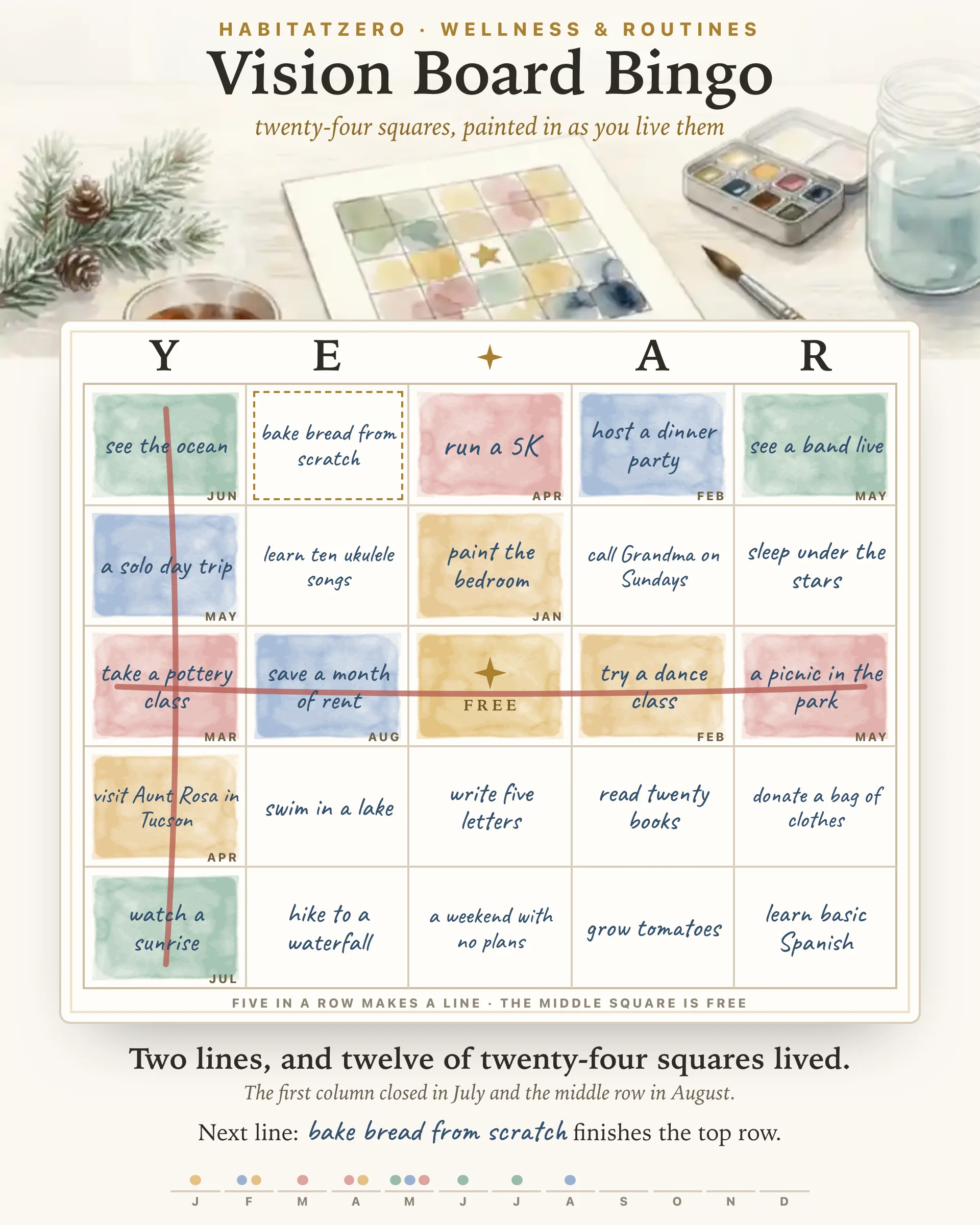
A vision board bingo card is a vision board you can play. In place of a collage that fades into the wallpaper by March, you write twenty-four things you want from the coming year on a five-by-five grid, with a free square in the middle and one rule borrowed from the game: five in a row makes a line. When a square happens, you mark it. By December the card is a record of the year you actually lived, not only the one you pictured.
A board asks you to look at your hopes; a card gives you a reason to come back and mark them off.
A resolution list is usually short and heavy: three large promises, and one bad week makes the whole list feel broken. A bingo card spreads the year across twenty-four bets of different sizes. A slow spring on one goal doesn't sink the card, because a line can run through any five squares, and a small win in February still counts toward one.
The format also pushes you toward goals that tend to hold. In a year-long experiment with 1,066 people, resolutions framed as something to do beat resolutions framed as something to stop: a year on, 58.9 percent of the approach group counted themselves successful, against 47.1 percent of the avoidance group. A square almost forces the first kind. "Swim in a lake" fits in a box; "stop wasting weekends" doesn't.
Then there is the marking. A meta-analysis of 138 experiments found that getting people to monitor their progress helped them reach their goals, and the benefit grew when the progress was physically recorded or shared. Painting in a square on the day something happens is a small, physical record of exactly that kind.
Mix three sizes. Put in a few big goals that will take most of the year, such as a 5K or a month of rent saved. Add a wide middle band of experiences you would hate to miss: a solo day trip, a pottery class, a night under the stars. Then add a handful of easy joys you could manage in the first weeks of January, like flowers on the table or breakfast in bed. The easy ones are not filler. They get you painting early, and a card with nothing on it by March is a card you stop opening.
Write each square so you will know when it's done. "Read twenty books" can be painted; "read more" never can. Squares here hold thirty-six characters, room for a verb and one detail.
Decide placement last. Because the middle square is free, the middle row, the middle column and both diagonals need only four squares each. Put a couple of easy squares on those lines if you want an early bingo, or scatter your big goals across them for a longer game.
Tap a square and write in it, or take an idea from seven themes that run from places to small joys. Your words appear in handwriting right inside the square. The card holds twenty-four, turns away a duplicate, and tells you when it is full.
When something on the card happens, switch to painting and tap it. The square fills with a watercolor wash and keeps the month. Paint five in a row and the card rules a line through them. Underneath, a short reading names the square that would finish your next line, says which month each line closed in, and sets your painted squares under the months they happened, so by summer the year has a visible shape. Paint all twenty-four and you have a blackout.
Prefer paper? The card prints on one page, with the year across the top and any empty squares left blank for a pen.
Nobody has run a trial of vision board bingo, and this page won't promise that a grid changes your year. The parts it is built from have better support: goals framed as things to do, a visible record of progress, and the pull of a fresh start. Three field studies of gym visits, searches for "diet" and goal commitments found that people act on their aspirations more after temporal landmarks, and not only in January: the start of a new week or month, and birthdays, showed the same pattern. A card that stays on the fridge gives each new month a small excuse to begin again.
What the card can't do is choose your goals for you. If a square stops fitting your life by June, rewrite it. It's your card, not a contract.
Fill it in during the weeks around New Year, or on a birthday, while the year ahead still feels open. To explore what the year could hold before committing to squares, Vision Board Ideas deals ideas by life area and season onto a cork board. New Year Goals takes your two or three biggest squares and gives each one a first step. And when December comes, the Year in Review is a good place to look back at what you painted.
It is a vision board in the shape of a bingo card: twenty-four goals and experiences for the coming year, laid out on a five-by-five grid around a free middle square. You mark each square when it happens, and five marked in a row make a line.
Pick twenty-four things you could realistically finish or experience this year, mixing a few big goals with smaller ones, and phrase each one so you can tell when it is done. Keep the free square in the middle and the card somewhere you look often. This page draws the grid, writes your squares in handwriting and counts the lines for you.
Things to do or experience rather than habits to quit: a trip, a class, a race, a savings amount, a dinner you host, a number of books. Add a few easy joys you could mark in January, so the card gets used from the first week.
A bingo is any five marked squares in a straight line, across, down or corner to corner, and the free middle counts toward every line that passes through it. A blackout means every square on the card is marked. Most cards end the year somewhere in between, which still leaves a readable record of it.
Not to look around. The public page shows a sample card halfway through its year. To write your own squares, paint them in and keep the months, open the card in HabitatZero, which is free and saves it between visits.
By the team behind Fabulous, the science-based self-care app used by over 30 million people.


