
Leaves on a StreamEmotional Fitness · ~3 min
About this template · Updated September 2026
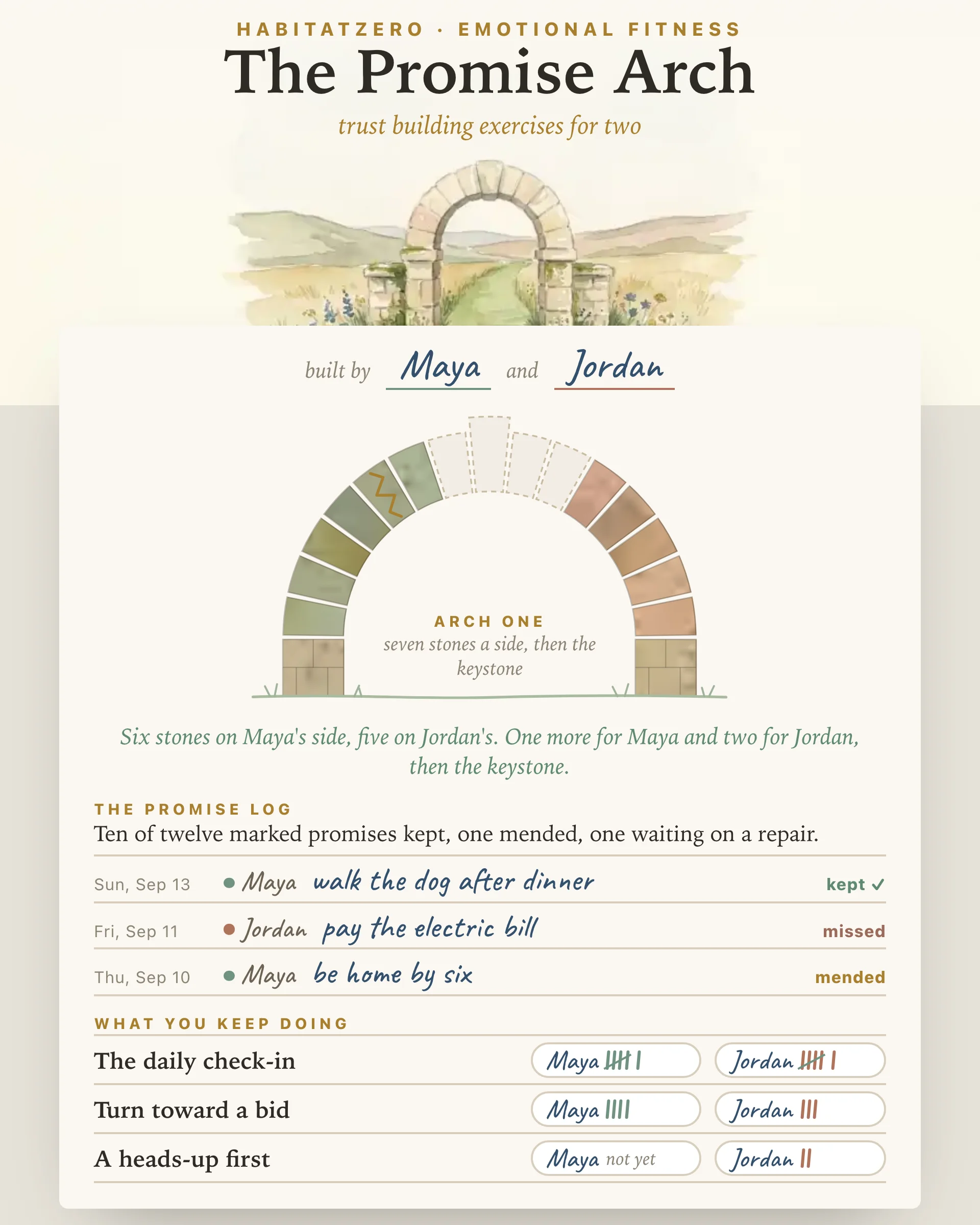
Trust rarely arrives in one grand gesture. It collects out of ordinary follow-through: the text that says you are leaving work, the call to the landlord that actually gets made, the dinner where the phone stays in a pocket. These trust building exercises for couples are built around that plain fact. Each of you says one small promise a day, the two of you mark it together, and the promises you keep become the stones of an arch you raise from both sides.
Psychologists John Rempel, John Holmes and Mark Zanna described trust in close relationships as three linked layers, predictability, dependability and faith, which tend to develop in that order as a relationship matures (Rempel, Holmes and Zanna, 1985). Predictability is the ground floor. You learn that your partner does what they say, again and again, in matters too small to argue about. That record lets you lean on them when something big is at stake, and eventually trust them without keeping score.
So the promises here are modest on purpose. "Be home by six" beats "be more present," because tonight will show whether it happened. A promise you can keep today hands your partner evidence. A vague one hands them hope, and hope is a softer thing to build on.
Put your names on the line above the arch: one of you builds the left side, the other the right. Say your promise in the morning with a tap or a short line of your own, then mark it in the evening. A kept promise sets a stone on your side. A missed one waits on the log until you have talked it through; then tap mend it and the stone goes in with a gold seam, so the repair is what shows. When both sides hold seven stones, you set the keystone together and the arch stands.
The arch needs both sides by design: however diligent one partner is, they cannot finish it alone, because trust between two people gets built by two people.
The other four exercises take one tap per person per day. After a week or two the page reads back which ones you both keep returning to, which belong to one of you so far and which are untried, while the log counts how many marked promises were kept, mended or still waiting on a repair.
The best-supported idea is that everyday moments matter. In the Gottman Institute's summary of a newlywed study, couples still married at the six-year follow-up "turned towards one another 86% of the time," while couples who divorced averaged 33% (Turn Towards Instead of Away). A separate observational study of 49 newlywed couples linked playfulness and enthusiasm during a ten-minute dinner with more humor and affection when the same couples discussed a conflict (Driver and Gottman, 2004). Its authors stress that the design was correlational, so it cannot show that small moments cause kinder arguments.
Nobody has tested this arch in a study. It is a structure for practice rather than a treatment, and a count of stones does not measure trust, so treat its readings as something to talk over, never as a verdict.
Bids and turning toward them come from John Gottman's research; The Promise Arch is our own independent worksheet, not endorsed by or connected to the Gottman Institute.
Everything above assumes that both of you feel safe. If you are afraid of your partner, or they watch, threaten or control you, the work in front of you is safety rather than trust, and nobody owes trust to someone who frightens them. The National Domestic Violence Hotline is free, confidential and staffed around the clock: call 1-800-799-7233 or text START to 88788. If you are in immediate danger, call 911 before anything else.
Begin on an unremarkable week rather than the morning after a fight. Say your promises over breakfast and mark them during the evening check-in. If talking is where things snag, Couples Communication Exercises gives each of you structured turns, and for an honest look at the whole relationship first, take the Healthy Relationship Quiz on your own. For a weekly rhythm to sit beside this daily one, add the Couples Check-In.
The ones that last are small and repeatable: each of you names one thing you will do today and does it, a ten-minute check-in with phones in another room, answering your partner when they reach for your attention, a heads-up before plans change, pointing out a follow-through you noticed, and repairing a miss without excuses.
Researchers who study close relationships describe trust growing from predictability into dependability and then into faith in each other. A promise small enough to keep every day hands your partner steady evidence, and that evidence is what the larger kind of trust rests on.
Name it plainly in one sentence, leave out the explanation that sounds like an excuse, say what you will do now, and ask what would help. On this page the miss stays on the log until you mend it, and the mended stone goes into the arch with a gold seam.
A serious betrayal usually needs more than daily exercises: honest conversations about what happened, often with a licensed couples therapist. Small kept promises can run alongside that work, but they are not a substitute for it.
Then set trust exercises aside, because trust is not something you owe a partner who frightens you. The National Domestic Violence Hotline answers free and in confidence at any hour: call 1-800-799-7233 or text START to 88788. If the danger is immediate, call 911.
By the team behind Fabulous, the science-based self-care app used by over 30 million people.


