
The Overwhelm Recovery ProtocolWellness & Routines · ~5 min
About this template · Updated November 2026
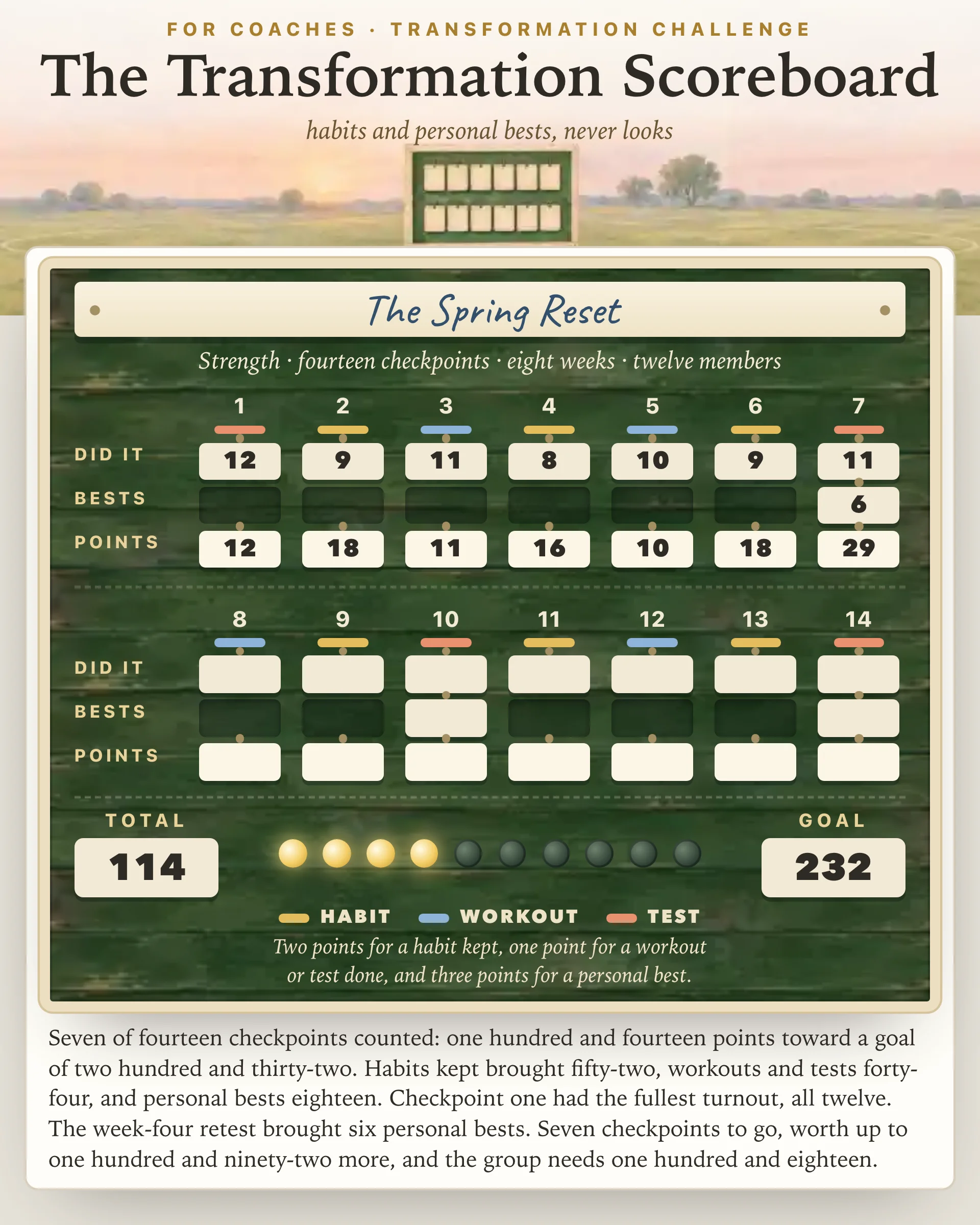
Many transformation challenges are judged at the finish by a scale, a tape measure or a pair of photos. That makes the prize about a body rather than about what anyone did for eight weeks, and it tends to reward whoever started with the most to lose. This board keeps score on two things your members control: the habits they keep and how they perform against their own first test. It counts members, adds points by a rule you set, and shows one score for the whole group.
Every challenge here is a line of checkpoints, seven, ten or fourteen of them, spread over four to twelve weeks. Each checkpoint is one of three kinds:
Pick a focus (strength, running, yoga, Pilates, mobility, walking or an outline of your own) and all fourteen checkpoints fill in. They open with a test and retest at checkpoints seven, ten and fourteen, so a challenge of any length ends on a retest. Rename any line, or tap a kind to change it.
You decide what each thing is worth: a habit kept, a workout or test done, and a personal best on a retest. After each checkpoint, open its column and enter how many members did it, and on a retest how many beat their earlier result. The plates fill, the total climbs, and a row of bulbs lights up as the group closes in on its goal.
The goal is a share of full marks, the score the group would reach if every member did everything and set a personal best at every retest. Half is a gentle target for a new group; three quarters asks a lot. The reading under the board says where the points came from, which checkpoint had the fullest turnout and how many points the group still needs.
The research on exercise goals offers a reason beyond kindness. In a year-long study of 156 healthy women aged 40 to 60, those whose goals were weight loss or health benefits did significantly less physical activity than those who exercised for well-being and stress relief. It was one small study of midlife women, so read it as a signal rather than a rule.
A systematic review of 66 studies on exercise motivation points the same way more broadly. More autonomous motivation, the kind people own, was consistently linked with more exercise, and intrinsic motivation, moving for the activity itself, best predicted who kept exercising over time. Feeling competent also predicted taking part. The evidence on body-related motives was mixed, which is a reason to keep them out of the scoring rather than proof that they always backfire. A personal best on a retest is a plain way to let members feel that competence.
Eight weeks feels long to a group and short to a habit. When 96 volunteers repeated one eating, drinking or activity behavior daily for twelve weeks, the time it took them to get close to their peak automaticity ranged from 18 to 254 days, and missing a single day did not materially set the process back. So count a habit as kept when a member kept it most of the time, and tell the group that a missed day is part of building one.
Fourteen checkpoints over eight weeks gives about two a week, with retests landing in weeks four, six and eight. Seven checkpoints suit a tighter four-week block. Print the board for the studio wall before day one, and color in its bulbs by hand as the total grows.
If members ask for a body transformation challenge, you can still give them one built on what their bodies can do: more push-ups in a minute, a longer plank, a quicker mile. Their own notebook can hold their numbers, while the board holds only counts.
The board stores how many members did each checkpoint and how many set a personal best, never who. Offer an easier version of every workout and test, and let anyone skip a test that hurts. Ask members with pain, a heart or blood pressure condition, a recent injury, a pregnancy or a history of disordered eating to check with a doctor before day one. This page is a planning tool for coaches, not medical advice.
Set it up a week before the challenge starts, so the group sees the first checkpoint early. For a shorter daily outline, the 14-Day Group Challenge gives your group one idea a day. Members who want to follow their own habits can keep the Weekly Habit Tracker, and once the challenge ends, the 12-Week Fitness Planner can carry them into a full training season.
It is a set stretch of weeks, often six to twelve, in which a group works on the same habits and training and checks progress along the way. This version scores what members do and how they perform against their own earlier test, never how anyone looks or what they weigh.
Replace the scale and the photos with things members control: habits kept, sessions done and retests of a simple fitness test. Award points for each, add them up for the whole group and celebrate when the group reaches its goal together, so nobody is measured against anyone else.
A start test in week one, retests around the middle and in the final week, and habits and workouts in between. Fourteen checkpoints across eight weeks comes to about two a week, enough to keep the group engaged without crowding anyone’s calendar.
No. Each checkpoint holds two counts, how many members did it and how many set a personal best, and nothing about who. Members who want their own numbers can keep them in a notebook, and anyone with a health concern should talk to a doctor before starting.
Yes. Filling the board, counting each checkpoint and printing it for the wall all work here at no cost. Personalize keeps the challenge in a free Salon account from the makers of Fabulous, ready to run again with your next group.
By the team behind Fabulous, the science-based self-care app used by over 30 million people.


