Reading JournalStudy & Learning · ~4 min
About this template · Updated September 2026
Every thesis starts blunt. The first version you write usually names the topic, gestures at an opinion, and leans on a word like "good" to do work it cannot do. That is normal. The trouble starts when the blunt version goes straight into the paper, because one sentence near the top now has to steer every paragraph that follows.
The UNC Writing Center puts the job plainly: a thesis makes a claim that others might dispute, usually fits in a single sentence, and most often sits at the end of the first paragraph as a road map for the reader. This page hands you the pieces of that sentence, assembles them, and shows where the point is still dull.
Purdue's Online Writing Lab sorts academic papers into three kinds: analytical, expository and argumentative. An argumentative paper makes a claim and defends it with evidence. An analytical paper breaks a text, event or problem into parts and says what they add up to. An expository paper explains something without taking a side. Purdue also asks for a thesis that covers only what the paper will discuss, and warns that the thesis may need to change once you see what the paper actually argues.
The sharpener builds all three from the same parts, so switching forms shows how one idea reads in each:
You fill four parts. The topic is a few words about what the paper covers. The claim is your position written as a full sentence, and starter chips can open it with your topic plus "should" or "should not." Reasons take up to three short lines, since one sentence starts to sag under a fourth and the body paragraphs can hold the rest. The other side is what a thoughtful opponent would say.
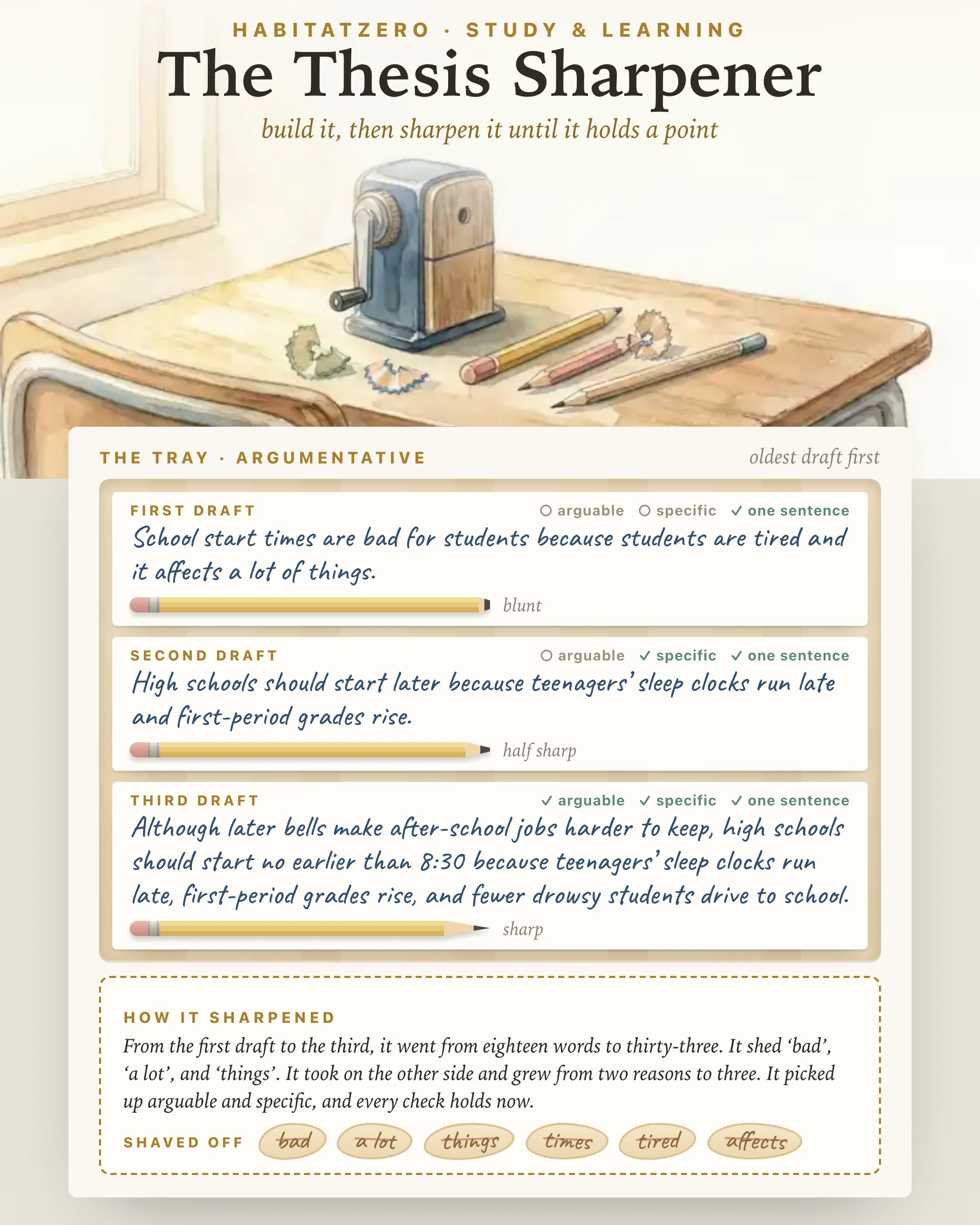
As you type, the strip rewrites itself in your handwriting and a pencil under it sharpens. Three checks move the point:
The expository form skips the arguable check, since an explanation does not need an opponent.
Naming the objection feels like arguing against yourself, which is exactly why writers skip it. In one study, 184 undergraduates wrote essays about TV violence, and those handed specific goals for the essay produced more counterarguments and rebuttals than students without them, while a plain instruction to persuade lowered both the counterarguments and the overall quality of the arguments. In another, sixth graders given explicit subgoals built from the parts of an argument wrote more persuasive essays, with more of those parts included, than classmates told only to convince their reader.
Keep the limits in view. Neither study tested a fill-in sentence like this one, neither measured grades, and a formula followed too closely can produce a stiff thesis. The checks read your words, not your evidence. A sentence can pass all three and still claim something your sources do not support.
When the sentence reads the way you want, press sharpen. That draft goes into the tray exactly as it stood, with its pencil and its three marks, and later edits to the parts leave it untouched. Six drafts fit before the tray asks you to let an early one go.
From the second draft on, the page compares your first kept draft with the latest one. It counts the words in each, lists the blurring words you shed, notes whether you took on the other side or added reasons, and names the checks you picked up along the way. The words that disappeared show up as pencil shavings. UNC calls an early version a working thesis and expects it to change; the tray turns that change into something you can see.
Open the sharpener after you have read enough to hold an opinion, and before you outline. Come back once the first draft of the paper exists, because drafting often shows you what you really think, and the thesis should follow.
Once the point holds, carry the sentence into The Essay Outline so each reason gets its own section. If you still need evidence for a reason, gather it in The Cornell Notes Sheet. And before you hand the paper in, trade drafts with a classmate using Glow and Grow, asking them to aim their grow at your thesis.
A common argumentative formula reads: Although [the other side], [your claim] because [reason one], [reason two], and [reason three]. An analytical thesis often opens with what a close look at the subject shows, and an expository one lays out the points a reader needs to understand it. Treat any formula as scaffolding and rewrite the result in your own voice.
Ask whether a reasonable reader could disagree, whether every word says something exact, and whether the whole idea fits in one sentence that answers the prompt. Words such as good, bad, things or a lot usually mean the point is still blunt.
An argumentative thesis takes a side and backs it with reasons. An analytical one breaks a text, event or problem into parts and says what they reveal. An expository thesis explains a subject without taking a side, so it previews the points instead of defending a position.
No. It arranges the words you supply into a grammatical sentence and flags common weak spots, but the claim, the reasons and the evidence behind them have to come from your own reading.
No account is needed to see the filled-in sample here. Personalizing the sharpener in HabitatZero saves your parts and every draft in the tray for free, so you can return after writing the paper and sharpen again.
By the team behind Fabulous, the science-based self-care app used by over 30 million people.