Reading JournalStudy & Learning · ~4 min
About this template · Updated September 2026
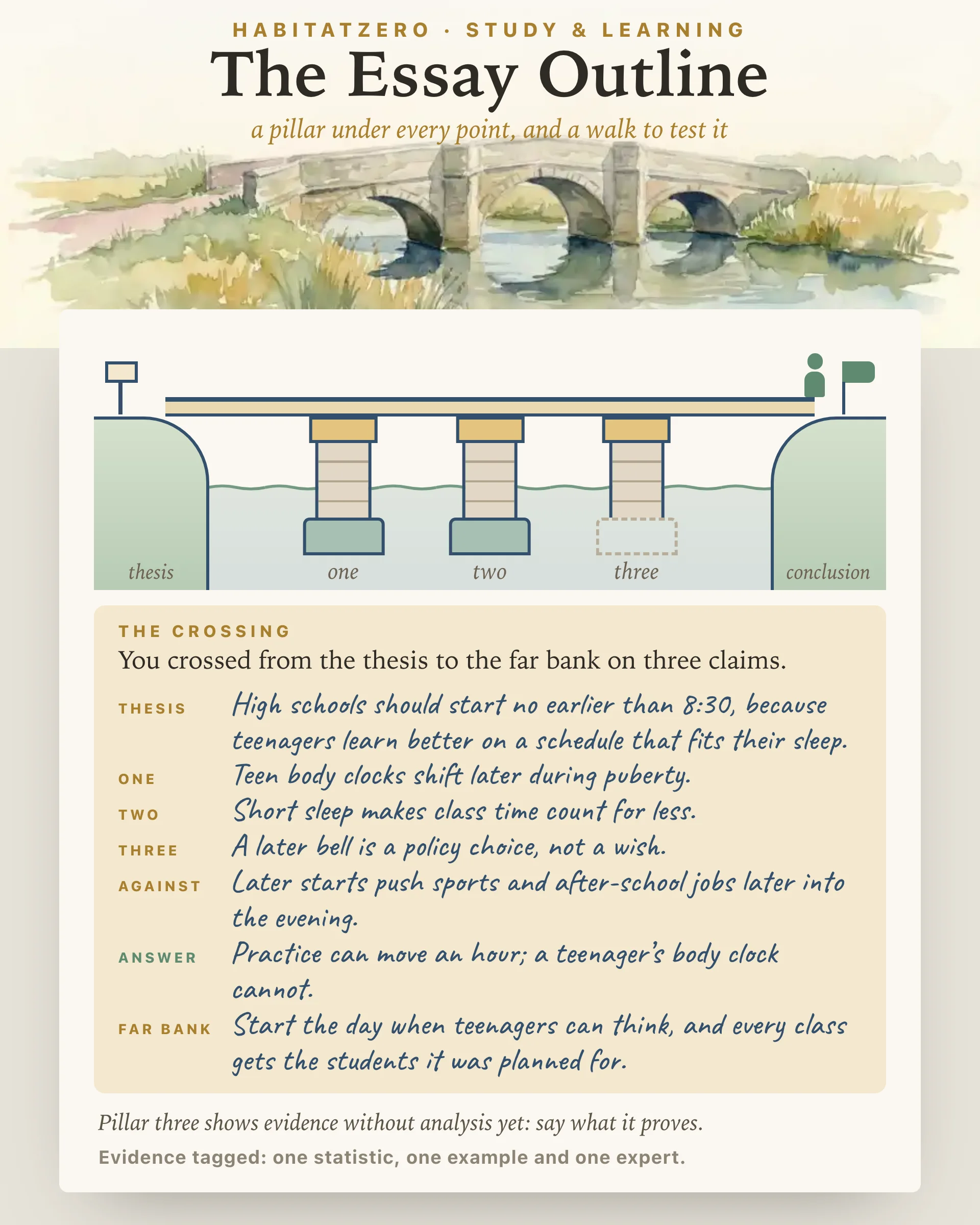
An outline is your essay before the sentences: the thesis, the point of each paragraph, what backs it up and where the argument lands, on one page, before you give an evening to drafting. This template draws it as a bridge: the thesis on the near bank, a pillar for each body paragraph, the strongest objection as the current, and the conclusion on the far bank.
The printed version uses the alphanumeric format that the Purdue OWL calls the most common and most recognizable type of outline: Roman numerals for sections, capital letters for the parts inside them.
Write the thesis and the near bank turns solid. Each pillar is drawn in three courses: the cap fills in with its claim, the stone with the evidence, the footing with the analysis. The deck only spans supports that stand, and a pillar stands on its claim. A paragraph with a strong quote and no claim is a pile of stones in the river, and the drawing shows the gap.
Press walk across and a small figure sets out from the thesis. It stops at the first pillar without a claim, or on the last pillar if the conclusion is missing. After each walk, the page shows the crossing: your thesis and every claim in order. That is a quick form of reverse outlining, which Purdue's writing lab recommends for checking whether each paragraph fits the larger argument. Their test is whether you can state a paragraph's topic in five to ten words, so the page flags any claim that runs past twelve.
Notes under the crossing point at weak spots: evidence without analysis, a claim with nothing under it, an objection named but never answered. Tag the evidence by kind and the page counts what your pillars are built from.
The sample on this page argues about school start times:
Pillar three still has no analysis, and the page says so.
Writing is hard partly because you plan, form sentences and check them all at once, and attention runs out. In a review of how writing skill develops, the psychologist Ronald Kellogg notes that sketching an outline first lets writers give more of the drafting time to sentences and the links between them. The same review reports a limit: in a later study, the benefit of outlining shrank when writers had already thought the topic through. If you have argued this subject a dozen times, a rough list may do.
For the counterargument, a meta-analysis of persuasive messages outside advertising found that answering the other side made an argument more credible and more persuasive than leaving it out, while mentioning it without an answer made the argument less persuasive. That is why an unanswered objection shows up as rough water under the bridge.
Five paragraphs is a frame to start from, not the only good shape, and some writers find their argument by drafting first and outlining afterward. The walk works either way.
Open it once you have a topic and notes, before the first draft. Walk it again when the draft is done: if a paragraph has drifted from its claim, the bridge shows it. If the essay is for an exam you are still preparing for, The Study Techniques Cabinet picks study methods that fit the time you have, and the Study Guide Builder turns likely questions into cards you can practice from memory. Younger writers reporting on a novel may do better with The Book Report, which asks for the story rather than an argument.
Most outlines use the alphanumeric format: Roman numerals for the big sections, such as the introduction, each body paragraph, the counterargument and the conclusion, and capital letters for the parts inside them, such as claim, evidence and analysis. This worksheet prints in that shape on one page.
Give the introduction a hook and a thesis, give each of the three body paragraphs a claim, one piece of evidence and a line of analysis, then restate the thesis in the conclusion. The bridge starts with three pillars for exactly this shape, and each claim should fit in about ten words.
Everything a five paragraph outline holds, plus the strongest objection to your thesis and your answer to it. A large review of persuasion studies found that raising the other side and then rebutting it made a case more convincing, while raising it and leaving it hanging made the case weaker.
For a short research paper, yes: give each pillar one source as its evidence, and use up to five body sections. A long paper with a literature review or a methods section needs a fuller outline with subheadings, though this sheet can still hold its core argument on one page.
The sample outline on this page is open to anyone. Building your own bridge, walking it and printing the result happen inside HabitatZero, which is free to use.
By the team behind Fabulous, the science-based self-care app used by over 30 million people.