The Overwhelm Recovery ProtocolWellness & Routines · ~5 min
About this template · Updated September 2026
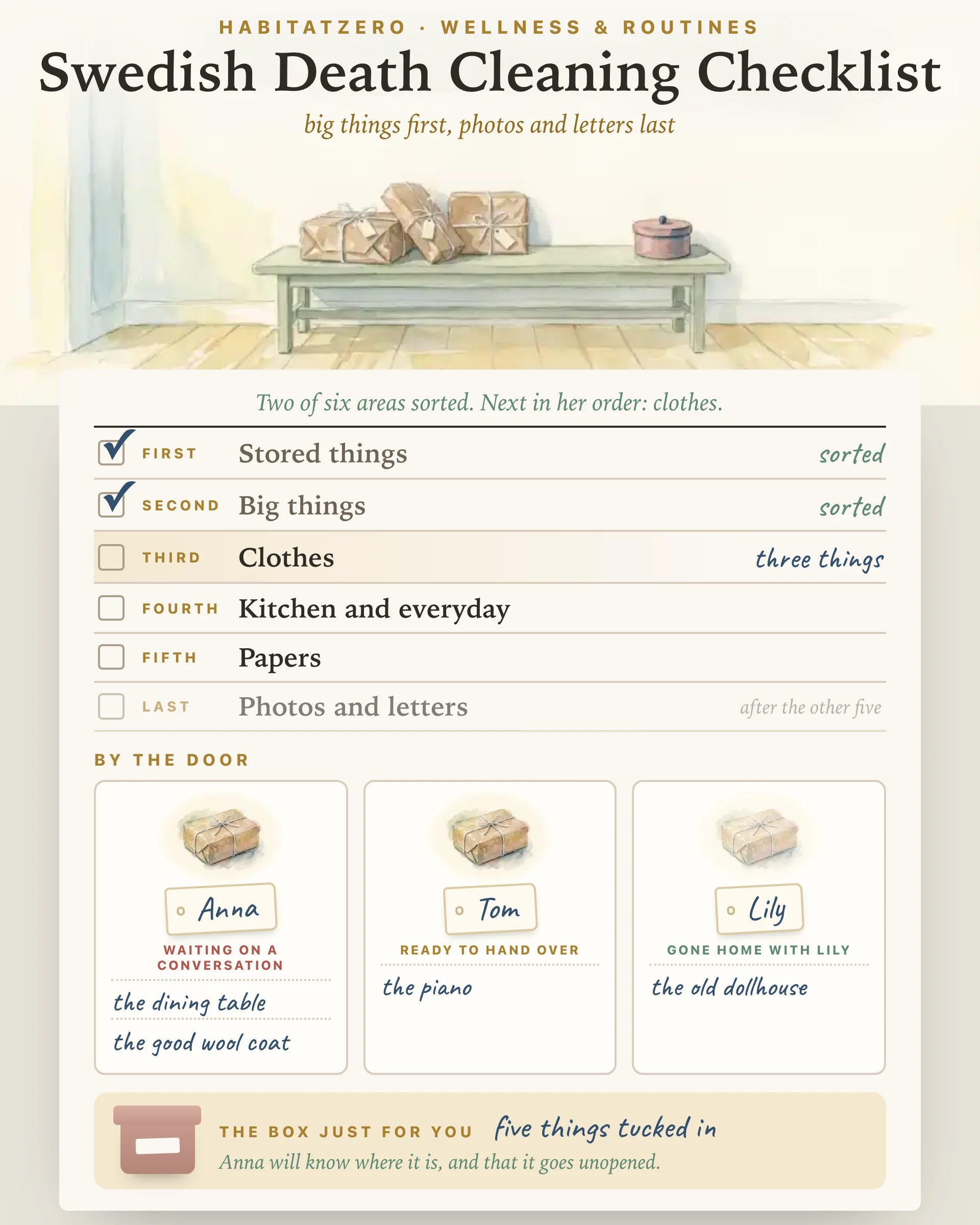
Swedish death cleaning, or döstädning, reached most English-speaking readers through The Gentle Art of Swedish Death Cleaning, the 2017 book by the Swedish artist Margareta Magnusson, who wrote it in her eighties and died in March 2026. The order on this page, the private box and the question behind every tag are hers. We built the checklist on our own: her estate and her publisher had no part in it and have not endorsed it.
Most of us will leave a houseful of things behind, and someone we love will have to sort it. Magnusson's answer was to do that sorting ourselves, while we can still say what each object meant. "Death cleaning is not a sad thing," she told one interviewer.
Her order does much of the work. Start where things are stored and half forgotten: the basement, the attic, the closet by your front door. Move on to the big things, the furniture and heavy pieces that decide how much room you live in, and work down toward the small. Photographs and letters come last; a single album can eat an afternoon and stall everything behind it.
The question most often used to sum up her approach is whether anyone you know would be happier if you kept a thing. When the honest answer points to someone else, she favored giving over bequeathing. Tell the people close to you what you are doing, invite them over, tell them the story behind an object, and let them carry it home that same day. Some things have no heir at all, and those go in one box of private keepsakes, marked to be thrown away unopened. She also suggested keeping a book of passwords for whoever comes after you.
The page lays out her sequence as six areas, opened one at a time. Each thing you add gets a paper tag with three possible fates: keep, give or let go.
A kept thing asks for a short note, so your family knows why the clock stays or which ornament goes on the tree first. Those notes collect under What stays, and why. A gift needs a name, and it moves into that person's package by the door. Each gift then travels from ask first to said yes to handed over, and the page tells you which conversations are still waiting, and with whom.
An area can only be marked sorted once nothing in it is undecided, and photos and letters stay shut until the other five are done. The last part is a box just for you: tuck things in without listing them, write where the box lives, and choose the one person who will know. The print button turns the whole sheet into a paper checklist, with blank lines under every area you have not reached.
Magnusson's order echoes what researchers found when older adults downsized. In interviews with thirty households that had recently moved to smaller homes, Ekerdt and colleagues found that people began with decisions about major furniture and meaningful gifts to family and friends, then sorted the rest into keeping, selling, giving, donating or discarding. People took real pleasure in seeing their things used and valued by someone new.
Left alone, though, most of us keep. Using Health and Retirement Study data, Ekerdt and Baker found that people become steadily less likely to part with belongings after fifty; past seventy, about three in ten had done nothing in the previous year to clean out, give away or donate anything. A study of very old adults in a Swedish town found the same gap: nearly all had thought about sorting their things, but few had started, and while some wanted to spare their children the job, others expected the children to do it once they were gone.
For papers, the National Institute on Aging advises keeping important documents together and telling someone you trust where to find them; a kept tag noting blue folder, second desk drawer does exactly that.
None of this is a trial of Magnusson's method. These studies describe how people handle their possessions; they do not show that death cleaning improves health or happiness. Treat it as a practical kindness to your family and your future self.
Any age works. Magnusson suggested starting around sixty-five, and also said that drawers too full to close are reason enough, even in your thirties. Give it one area per sitting and stop while it still feels light.
If a grandchild is setting up a first place, their First Apartment Checklist shows what they still need, a handy list to shop your own shelves against. If the sorting ends in leaving a rental, the Move-Out Cleaning Checklist handles the last scrub before the keys go back. And for one crowded drawer with no family decisions attached, the Decluttering Checklist is quicker.
One caution, said plainly: if putting everything in order comes with thoughts of ending your life, or you notice someone you love giving away treasured things while seeming hopeless, call or text 988 in the US, or your local emergency number, today.
It is the Swedish practice called döstädning: sorting your belongings while you are well, so the people you love are not left to do it later. Margareta Magnusson made it known worldwide with her 2017 book, and when asked whether it was sad, she said it felt more like a relief.
Magnusson suggested beginning around sixty-five, yet she also wrote that drawers too full to close are reason enough to start, even for someone in their thirties. A move, a retirement or a milestone birthday makes a natural first sitting.
Start with what is stored away in the basement, attic, garage and hall closets, then work from large things such as furniture toward smaller ones. Photographs and letters come last, since one album can swallow an afternoon and stall the rest of the house.
It is a single box of private things that matter to nobody but you, such as old letters, pictures or a diary. Magnusson kept one, marked so her friends could discard it without looking inside, and this checklist asks you to name the one person who will know where yours is.
No. The order on this page and the private box come from her book, credited in the article, but the checklist itself was made independently. Neither her estate nor her publishers reviewed or endorsed it, and her book remains the full account of the practice.
You can read how the checklist works and study the filled example right here. To tag your own things, build a package for each person and keep your notes between sittings, open it in HabitatZero, which is free, and use its print button whenever you want the paper version.
By the team behind Fabulous, the science-based self-care app used by over 30 million people.