The Overwhelm Recovery ProtocolWellness & Routines · ~5 min
About this template · Updated September 2026
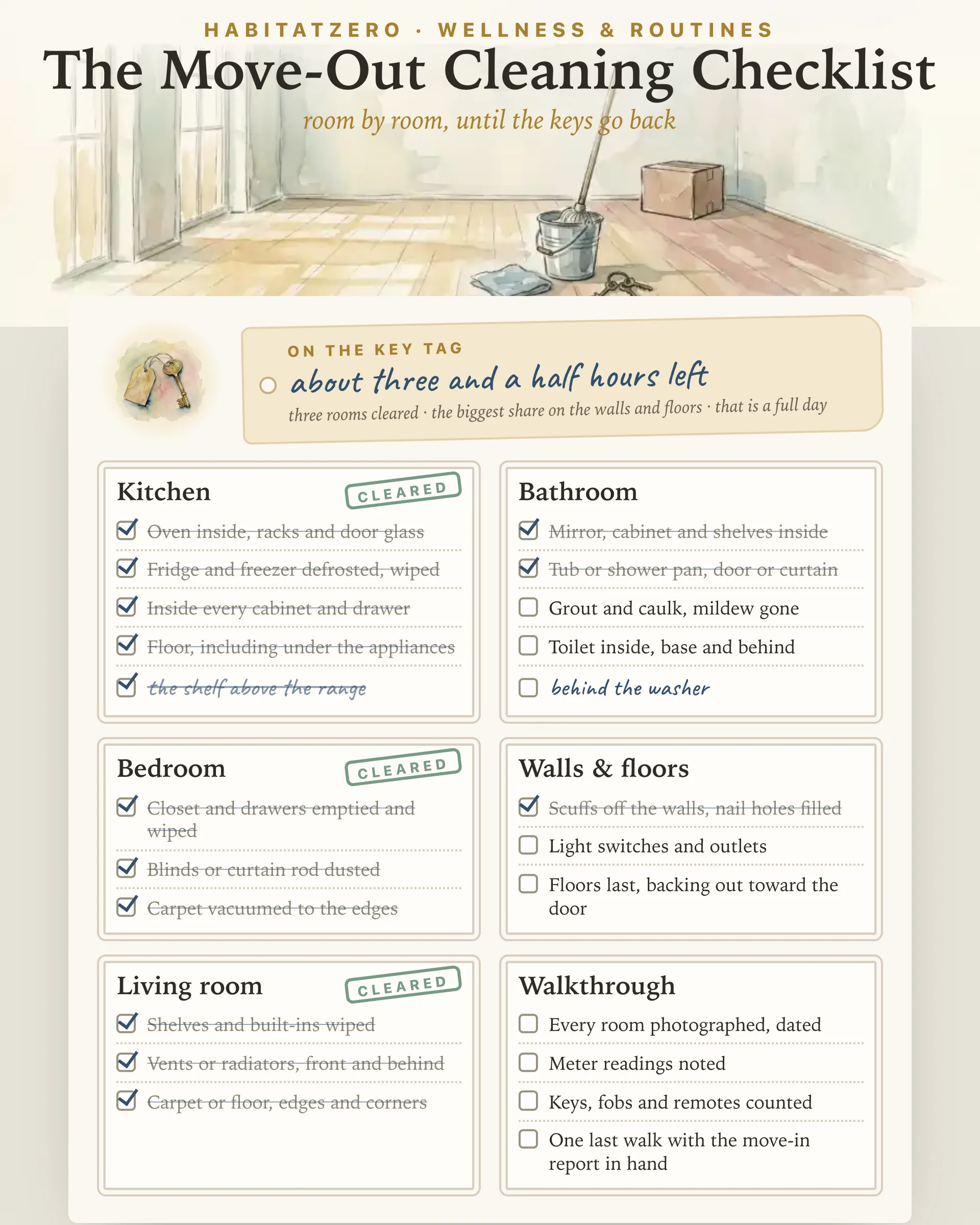
The boxes have gone and the place is suddenly loud with echo. What is left is an apartment that has to be handed back in the condition it was rented, to someone who will open the oven, pull the fridge out, and run a finger along the top of the door frame. This sheet is that inspection, done by you, before they arrive.
Six areas, in the order you should take them: kitchen, bathroom, bedroom, living room, then the whole place for walls and floors, and finally the walkthrough. Every line names one surface the way an inspector sees it, so oven inside, racks and door glass rather than clean the kitchen, and every line carries a rough minute weight. Gold dots sit beside the lines a move-out inspection looks at closely: the oven, the fridge, the inside of the cabinets, grout and caulk, blinds, carpets to the edges, scuffs and nail holes, and the photographs at the end.
Each room takes up to three lines in your own handwriting, fifteen minutes each, for the shelf above the range or whatever your apartment has that the standard list does not. When the last line in a room is checked off, the room earns a stamp. It prints with every room open and your checkmarks in place.
The tag at the top is the part that changes how you plan. It adds up every open line and writes the total in words: with nothing checked it reads about eleven and a half hours for a one-bedroom place done by one person, names the room that holds the biggest share, and says plainly whether that is one push, a long session, a full day or two days. Every check takes its minutes off.
It is there because people are reliably wrong about this. Buehler, Griffin and Ross showed that we underestimate how long our own tasks will take even when we can remember past tasks running over, and moving out is the textbook case: the plan says one evening, the oven alone takes most of it, and the keys are due at noon. The number on the tag is a sum of rough per-line estimates, not a promise, and a second pair of hands or a smaller apartment brings it down fast. It makes the size of the job visible before you book the truck around it.
The standard is not a showroom. It is the state the place was in when you got it. Deposit rules are written country by country, and in the US state by state, but that principle travels well. England is a clear example: Shelter's guidance for tenants there puts it in one line, you only need to clean your home to the same standard as it was when you moved in, and a landlord cannot insist on a professional clean unless one was done before you arrived. So your move-in inspection report is the target. Read it before you start and you will know whether the hard-water marks on the faucet are yours or were there on day one.
In England the deposit also sits in a government-backed protection scheme, and once you and the landlord agree the amount, it has to be returned within ten days. Deadlines differ elsewhere, but the shape is the same: the money is yours unless there is evidence of something to deduct, and evidence cuts both ways, which is what the walkthrough section is for. Shelter's advice on move-out inspections is to be there if you can and, either way, to take a video of the property on the day you move out. Dated photographs of every room, the meter readings, the keys counted and one last walk with the move-in report are the last lines on the sheet.
Start in the kitchen with the oven racks soaking, because the oven is the single longest line and it does most of its own work while you do everything else. Go top to bottom in every room, so nothing you knock down lands on something already clean, and do the floors last, backing out toward the door.
The bathroom is about caulk, grout and hard-water marks rather than the things that are easy to see. Walls catch people out because scuffs and nail holes do not feel like cleaning, so they are their own area on the sheet with the biggest single weight after the oven.
The week before the keys go back, open the sheet once and read the tag with everything still open. That number decides whether you need one Saturday or two, and it is far better to know on Monday.
If half of what is in the cabinets is stuff you do not want to carry to the next place, sort it first with the Decluttering Checklist so you are cleaning around less. On a day when even this list feels like too much, the ADHD Cleaning Checklist breaks a room into five-minute checks with nothing to decide. And once the new place is yours, the recurring rotation belongs on the Cleaning Checklist, where the work is daily, weekly and monthly rather than once and for the deposit.
Everything a move-out inspection opens or looks behind: the oven and fridge inside, every cabinet, bathroom grout and caulk, blinds and sills, baseboards, carpets to the edges, walls and switches, and the floors last. This sheet lists those lines for six areas of a home with a rough minute weight on each.
Close enough to share a sheet. What an inspector checks at the end is what you should photograph at the start, so on move-in day walk the same six rooms with the camera out, and on move-out day clean against the same lines.
Longer than one evening for most homes. With every line open, the key tag on this sheet reads about eleven and a half hours for a one-bedroom place done alone, with the kitchen holding the biggest share. Two pairs of hands or a smaller apartment bring it down quickly, and the tag recalculates with every check.
Cleaning is one of the usual grounds for a deduction, and the standard you are held to is the condition recorded at move-in, not a showroom. The lines that tend to be argued over are the oven, the fridge, the bathroom caulk, the carpets and marks on the walls, so the gold dots on this sheet sit beside exactly those, and you can see at a glance which are still open.
The public page shows a filled example to read. Checking off your own rooms, adding your own lines and keeping the hours-left tag between sessions happens inside HabitatZero, which costs nothing to join.
By the team behind Fabulous, the science-based self-care app used by over 30 million people.