Reading JournalStudy & Learning · ~4 min
About this template · Updated September 2026
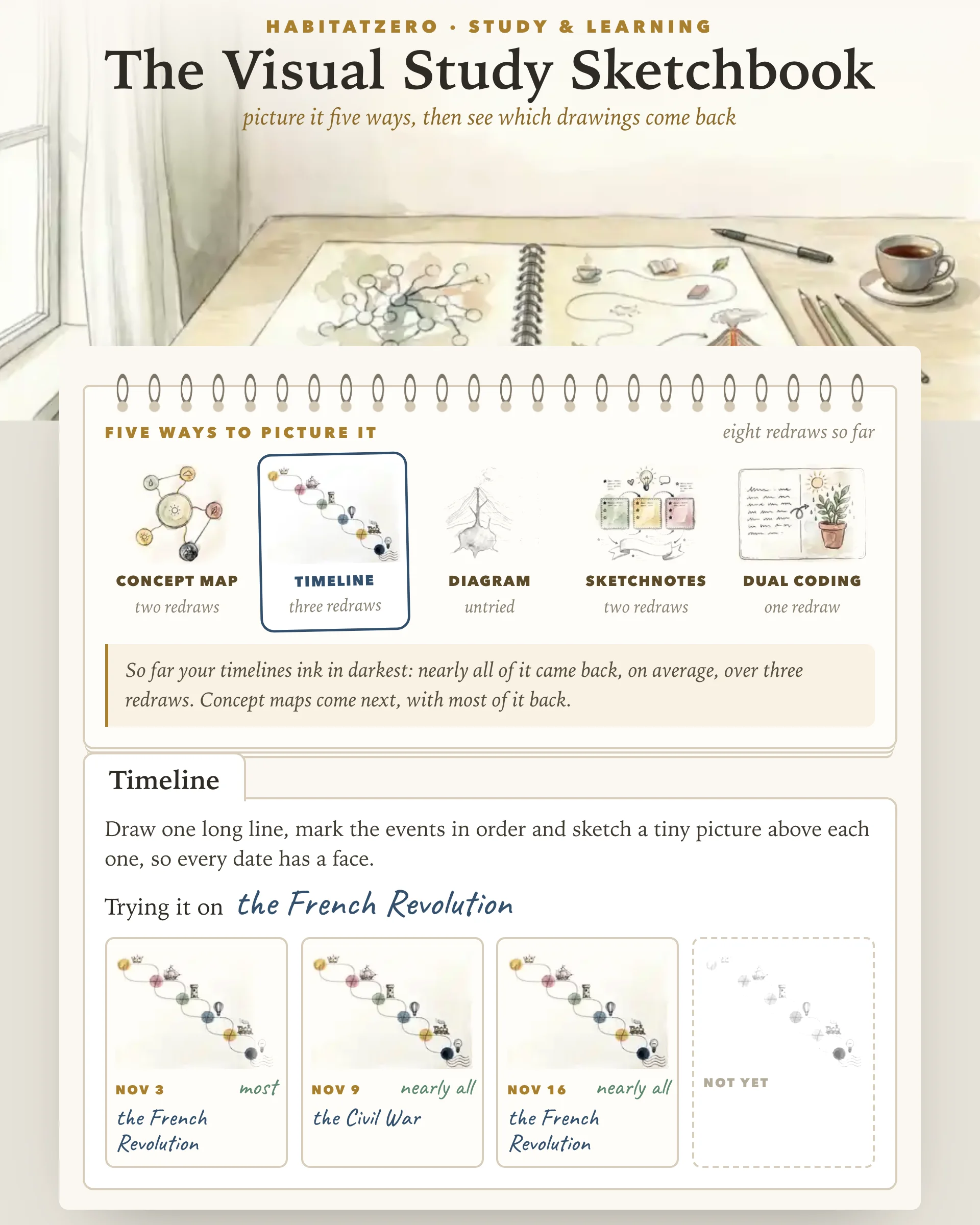
If you reach for a pen to draw arrows before you have finished reading the question, someone has probably called you a visual learner and handed you a list of tips that mostly say "use color" and "watch videos." This page gives you five concrete ways to turn what you study into pictures, and a simple test that shows which of them actually help you remember.
The idea behind it is that each person has a learning style, and that material presented in that style is learned better. Pashler, McDaniel, Rohrer and Bjork went looking for the evidence in 2008, and the visual learner was their own worked example. People readily say how they like information presented, they found, but experiments able to test the matching claim were rare, and several of the sound ones contradicted it.
A later study came at the question from the visual side. Knoll and colleagues scored people on a questionnaire about preferring words or pictures, then had them study word pairs and picture pairs. Those who leaned toward pictures felt more confident about the pictures, but their scores had no link to what they actually recalled. The preference shaped how learning felt, not how much of it stuck.
None of that makes your preference worthless. A method you enjoy is a method you will open again tomorrow. It only means the reason to draw is not that you belong to a type. Drawing helps, when it helps, for reasons that apply to nearly everyone, and the only way to learn which kind of drawing helps you is to try each one on your own material and check.
Building a tidy concept map with the textbook open feels productive, and it does less than it feels like. In Karpicke and Blunt's experiments, students who practiced recalling a science text learned more than students who built concept maps while studying it, and the gap held even when the final test asked everyone to draw a concept map. Pulling the material back out of memory did the heavy work.
Drawing earns its place as well. In the run of experiments summarized by Fernandes, Wammes and Meade, people remembered words, pictures and even textbook definitions better after drawing them, and drawing beat writing the material out, imagining it, and tracing a ready-made picture. So make the drawing with your own hand rather than copying the figure in the book, and then make it again later from memory. That second drawing is the test, and it counts as studying at the same time.
The page opens on five pencil sketches, one for each technique. Tap one and its page opens with a single instruction, the kind of material it suits, and a line for the subject in front of you. Study that way on paper. Later that day or the next morning, cover your notes, redraw it on a blank page, compare the two, and tap how much came back, from very little to nearly all.
Every logged redraw inks its sketch in by how much you recalled, so the techniques that work for you darken while the rest stay in pencil. Each page holds four redraws. Once a technique has two, the reading ranks it against the others, and it warns you when a lead rests on a single subject, because a timeline of the Civil War and a timeline of cell division are not equally hard to recall. It also refuses a second redraw of the same subject on the same day, since a retry an hour later mostly measures what is still fresh.
Open it when you sit down with something you need to remember for a test, and give each technique two honest tries before you decide anything about it. For a wider look at your habits, the Study Style Quiz scores spacing, self-testing and focus. If you think better on your feet, the Hands-On Study Pegboard pairs movement with the same kind of recall. And when you want recall with no drawing at all, the Blurting Pad gives you a silent timer and a blank page.
Draw it once to learn it, and again to find out what stayed.
Concept maps, timelines, labeled diagrams, sketchnotes and dual coding, which puts a small picture beside each idea. The strongest version of every one of them is the redraw: after studying, cover the page, draw it again from memory and check what you left out. Making the drawing yourself counts for more than looking at a finished picture someone else made.
The preference is real. Plenty of people would rather see a diagram than read a paragraph. What the research has not backed is the promise that teaching matched to that preference helps you learn more. When Pashler and three colleagues reviewed the learning-styles studies in 2008, very few were designed to test the matching claim, and several of the sound ones contradicted it. That is why this sketchbook tests techniques on your own material instead of sorting you into a type.
Turn each chapter into one picture. A history reading becomes a timeline, a set of linked ideas becomes a concept map, and anything with parts becomes a quick labeled diagram. Keep the words short and let the layout carry the connections, then close the book and draw the whole thing again without looking.
Color helps most when it carries meaning, such as causes in one color and effects in another along a timeline. Highlighting whole passages rates poorly as a study method on its own, so treat color as a way to organize a drawing and still test yourself by redrawing it with the notes covered.
No account is needed to look over the filled-in sketchbook on this page. Opening the pages for your own subjects, logging each redraw and watching your own sketches ink in all happen in HabitatZero, which is free to join.
By the team behind Fabulous, the science-based self-care app used by over 30 million people.