Reading JournalStudy & Learning · ~4 min
About this template · Updated September 2026
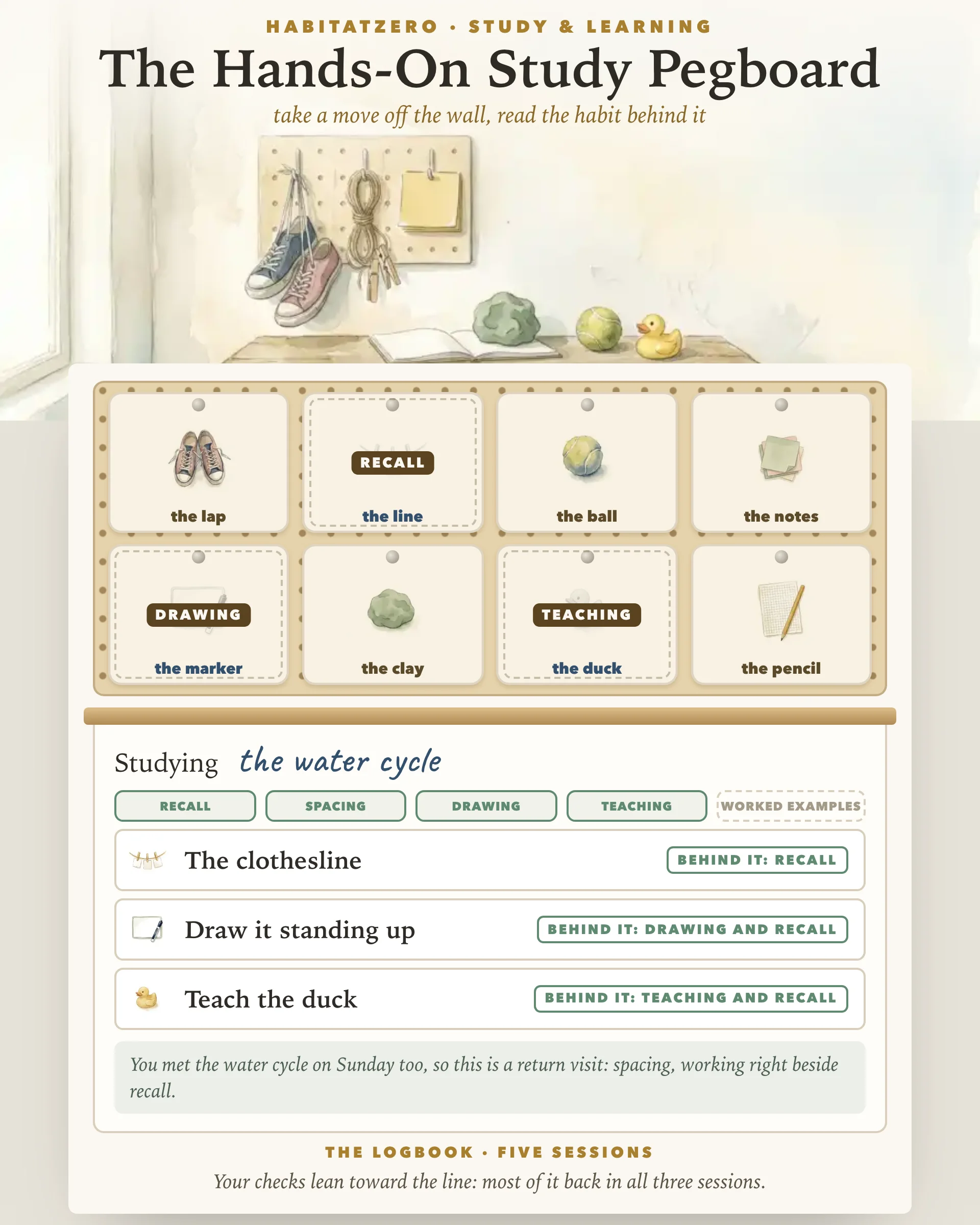
If you think better on your feet, fidget through lectures and remember the lab long after the lecture, someone has probably called you a kinesthetic learner and handed you tips that mostly say "move around." This page gives you eight concrete ways to study with your hands and feet busy, and it names, for each one, what is actually doing the work.
The label comes from the idea that each person has a learning style, and that teaching matched to it works better. When Pashler, McDaniel, Rohrer and Bjork reviewed the research on learning styles in 2008, they found plenty of evidence that people have preferences about how information reaches them, and virtually none that matching instruction to those preferences improves learning. Few studies had even used a design that could settle the question, and several of those came out against it.
So this page does not sort you into a type or promise that moving is the key for you in particular. Your preference is still worth using, because a session you enjoy is a session you will start. But the moves below work because of the habit underneath them, and those habits help anyone.
Recall and spacing carry the most weight. In Dunlosky and colleagues' review of ten popular study techniques, practice testing and spreading study over time were the only two rated high in utility, because they helped learners of different ages and abilities and held up across many kinds of tests, even in real classrooms. Rereading and highlighting, the habits students rely on most, rated low. That is why six of the eight moves make you pull the material out of memory.
Drawing, teaching, and acting material out with objects or gestures all appear in Fiorella and Mayer's review of eight generative learning strategies, activities that make you reorganize new material and tie it to what you already know. Drawing has an especially clear record: across seven experiments, people recalled words they drew better than words they wrote out, and the authors propose that drawing binds together meaning, image and the motion of making it. None of that depends on a learning style.
Worked examples come from research on problem solving: beginners who study a solved example and then try a similar problem tend to learn the procedure faster than beginners left to wrestle alone. Once the steps feel automatic, move on to plain practice problems.
The evidence is weaker for movement with nothing attached. Pacing with no question in mind, squeezing a stress ball or chewing gum may make a long session easier to sit through, but the case that they help memory is thin and mixed.
Take a prop off the pegboard and it lands on your workbench with a plain instruction, while the empty spot shows the habit painted behind it. The bench holds three moves. Five tiles light up for the habits your moves cover, and a short reading names what is missing, including when nothing on the bench tests your memory. Name your topic, and a return to it on a later day counts as spacing.
When the session ends, shut the book and answer one question: how much can you say back? That check is retrieval practice too, and it goes into a logbook of twelve sessions. From the third one on, the logbook shows which moves your checks lean toward. Treat it as a small experiment of your own rather than a verdict; it tells you more than a label can.
Open it at the start of a session, especially when sitting still with the book has stopped working. To see how your wider habits stack up, the Study Style Quiz scores spacing, self-testing, focus, planning and rest. For a technique chosen to fit the subject and the deadline, the Study Techniques Cabinet does the sorting. And if recall is the habit you want more of, the Active Recall Deck turns your notes into question cards that return until you know them.
Pick three moves, get up, and let the habit underneath do the learning.
The best ones keep your body busy and make you practice a proven habit at the same time: walking a loop while you recite answers from memory, pegging the steps of a process on a string and rehanging them in order, drawing a diagram big on a whiteboard with the book shut, building a model with your hands, and teaching the topic out loud. Movement on its own is pleasant; movement that carries the material is what helps.
The preference is real, since plenty of people concentrate better when their hands or feet are involved. What the research does not back is the claim that teaching matched to a learning style works better. A 2008 review by Pashler and colleagues found almost no evidence for that matching idea, which is why this page pairs every hands-on move with a habit that helps any learner.
Shrink the movement rather than dropping it. Sketch the idea in the margin instead of copying sentences, write answers by hand on scrap paper before you check them, count the steps of a process on your fingers, or lay out index cards on the desk and sort them from memory. Each one is a desk-sized version of recall or drawing, and the laps and the whiteboard can wait until you get home.
Movement that acts out the material seems to help, such as drawing a diagram, gesturing through a process or building a model, and it helps learners in general rather than one type. Pacing with no question in mind, squeezing a stress ball or chewing gum may make a long session easier to sit through, but the evidence that they improve memory is thin and mixed.
You can look over a filled-in pegboard on this page without signing up. Taking moves down for your own sessions, logging each check and watching the logbook find your pattern happen in HabitatZero, which costs nothing to join.
By the team behind Fabulous, the science-based self-care app used by over 30 million people.