Reading JournalStudy & Learning · ~4 min
About this template · Updated September 2026
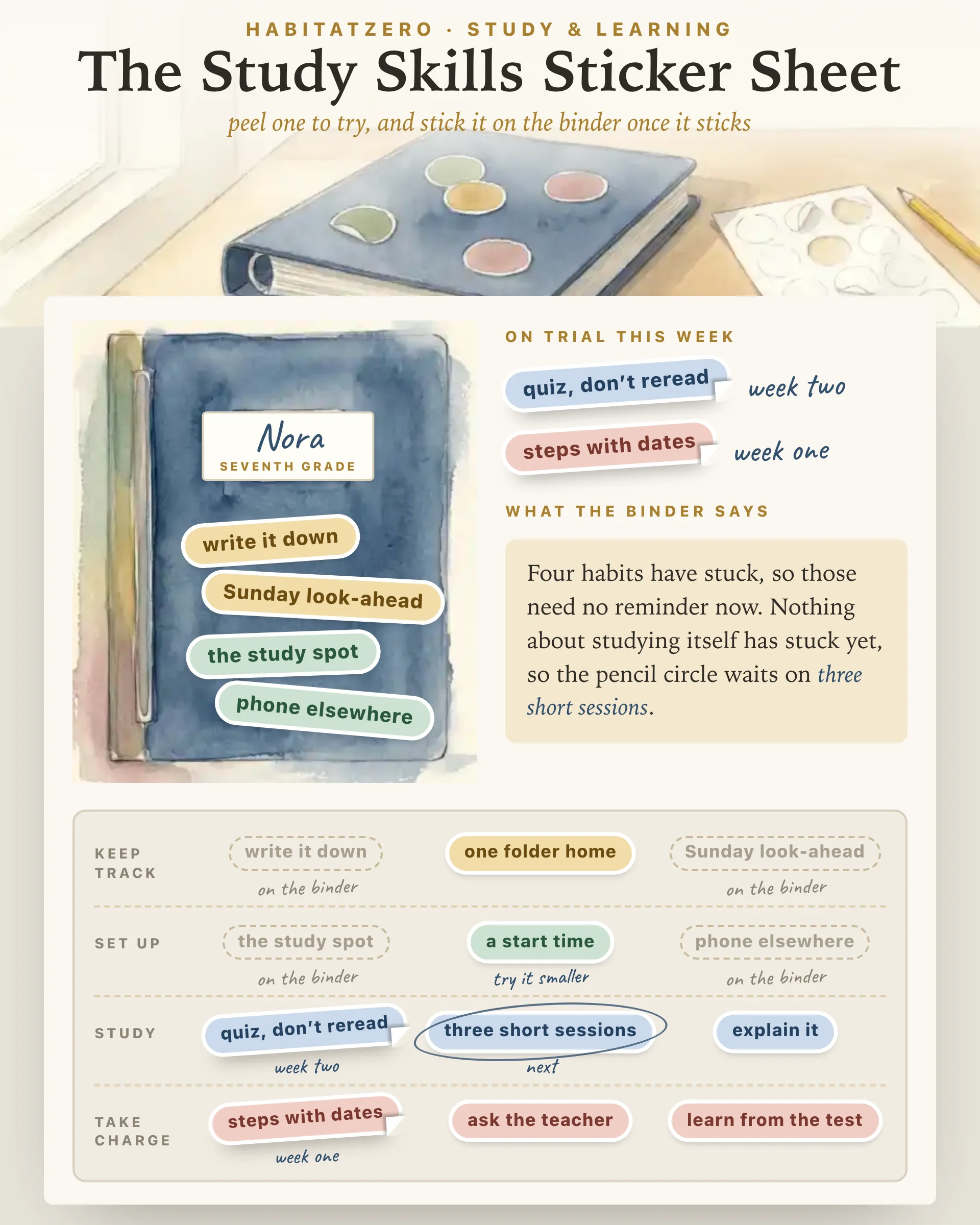
Somewhere around sixth grade, school stops handing out the structure. One teacher often becomes five or six, each with a different way of posting homework, and nobody mentions the quiz on Friday twice. The skills that fill that gap rarely get a unit of their own. Students are expected to absorb them, and plenty don't until a progress report forces the issue.
This sheet is a way to teach those skills on purpose, one or two at a time, and to notice when each one has actually taken hold.
The stickers are grouped by the place where the work usually falls apart.
A fifth row holds up to three of your own, such as packing the bag the night before.
Pick your student's grade, and the sheet circles a sensible first sticker in pencil. Tap any sticker to read what trying it looks like this week and why it helps. When the two of you agree on one, peel it. Two can be on trial at once; the sheet refuses a third so each new routine gets real attention.
Check in on the weekend. A skill on trial can get another week, go back on the sheet, or stick. Call it stuck only when it happens on most school days without a reminder from you; that is the whole test. A stuck skill moves onto the painted binder, and the note beneath it says what you can stop reminding about and which row is still empty. A skill that goes back returns later as a smaller version, such as the planner for the two hardest classes instead of all six.
The pencil circle moves as the binder fills. It follows a usual order for the grade you picked, but it leans toward any row where nothing has stuck yet, so a well-organized student with no study habits will find the Study row circled next.
The strongest evidence sits in the Study row. Reviewing ten common learning techniques, Dunlosky and colleagues gave high utility ratings to practice testing and to spreading study over time, since both helped learners of different ages and abilities. Rereading and highlighting, which students report relying on heavily, were rated low, and the authors suggest practice testing in place of rereading. That is the quiz sticker in a single line.
The effect holds up in real middle schools, not only in laboratories. In three classroom experiments with sixth graders, short low-stakes quizzes on social studies material raised scores on the students' actual chapter and semester exams, compared with material they had not been quizzed on or had simply seen twice.
The sheet's other bet is about your role. A meta-analysis of fifty studies on parent involvement in middle school found that most kinds of involvement went along with higher achievement, with one exception: help with homework. The strongest link was with what the authors call academic socialization, which includes discussing learning strategies with your child and making plans for the future. These are associations rather than proof of cause, but they fit the design here: talk about how to study, then step back.
It does not sort your child into a learning style. A review of the evidence on matching instruction to learning styles found virtually no support for the idea, and several well-designed studies contradicted it. A better question is what the material needs: a map is learned from a map, and a vocabulary list from being quizzed, whatever anyone prefers.
It also cannot say how long a habit takes: for one student the planner sticks in a couple of weeks, and for another the phone rule takes a semester. The six-week limit on a trial prompts a decision rather than predicting one.
The start of the school year is the obvious moment, but the weeks after a rough progress report work just as well. Teachers can use it in a one-on-one check-in, and eighth graders headed for high school can use it to find the bare rows.
For the Study row, the Active Recall Deck turns notes into cards to answer from memory. If writing everything down is the sticker on trial, the Homework Planner gives each day's list a home. Once your student is ready to choose methods, The Study Techniques Cabinet matches a technique to the subject and the time left before a test.
Four groups cover most of it: keeping track of assignments and papers, a regular place and time for homework, studying by quizzing and spacing instead of rereading, and taking charge of big projects and questions for teachers. The sheet gives each group three concrete skills to try.
One or two at a time, practiced for weeks rather than explained once. Choose a skill together, agree on what trying it looks like this week, and check in on the weekend. Your part moves from reminding to noticing, and a skill belongs to them once it happens without you asking.
Two habits do most of the work. Answering questions from memory beats rereading the notes, and three short sessions on different days beat one long night before the test. Both feel harder than rereading while they are happening, and that effort is part of what makes them stick.
They are mostly the same skills with higher stakes. Junior high usually means grades seven and eight, sometimes nine, and the sheet treats it like middle school. High school brings longer tests and bigger projects, so the Study and Take charge rows carry more weight, and the high school setting circles those first.
Not to look around: this page shows a sheet already in use, with two skills on trial and four on the binder. To keep your own student's sheet and return to it every weekend, open it in HabitatZero at no cost.
By the team behind Fabulous, the science-based self-care app used by over 30 million people.