Reading JournalStudy & Learning · ~4 min
About this template · Updated September 2026
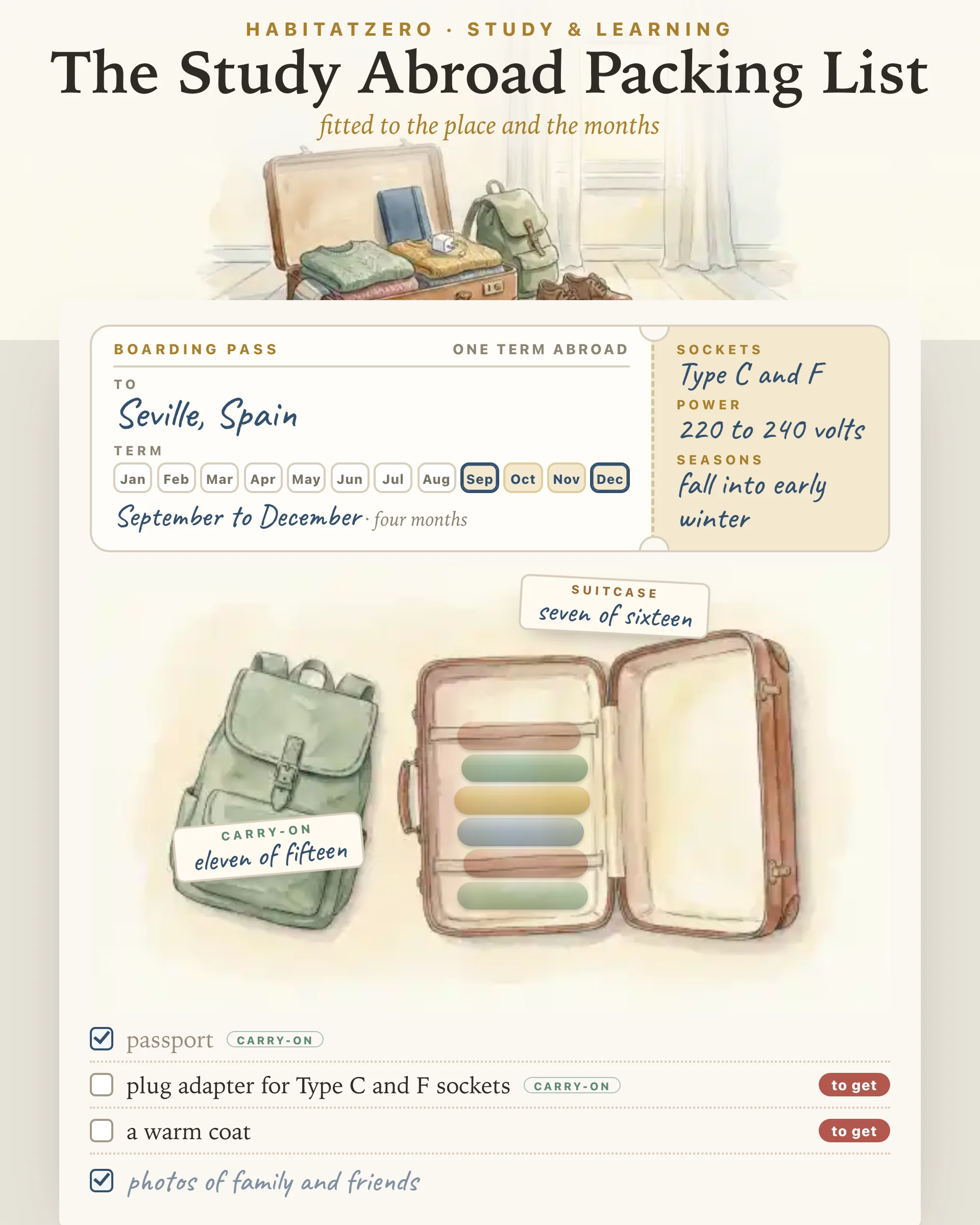
A semester abroad is not a long vacation. You will live somewhere for four or five months, sit exams there, catch a cold there, and probably watch one season turn into the next. That changes what belongs in the bag. A vacation list is built around a week of outfits. A term abroad is built around the few things you cannot easily replace once you land, and around the weather of the months you will spend there.
So this page starts with two questions, where and when, and builds the rest from your answers.
The boarding pass at the top asks for your host country, picked by region, and for the month you fly out and the month you fly home. The stub then fills in three things you would otherwise look up: the socket types used there, the voltage, and the seasons your term runs through. September to December in Spain reads fall into early winter. The same four months in Melbourne read spring into early summer.
The list underneath reacts to both answers. The plug adapter line names the sockets you will meet. The clothes pocket adds a warm coat, gloves and a thermal layer only when a winter month falls inside your term, swimwear and a sun hat only when a summer month does, and light clothes that dry fast if you are heading for the tropics. The hair dryer line tells you to pack it only if its label covers the local voltage, because an adapter changes the shape of the plug and does nothing to the voltage.
Each line carries two marks. Tap get on anything you do not own yet, and the status line keeps count of what is still to buy or sort out. Tick the box when it goes into a bag. Lines that do not apply can be set aside with two taps and brought back later, every pocket takes five lines of your own, and the From home pocket offers a few suggestions for the things that make a new room feel less new.
The painted backpack and suitcase keep a running tally. Lines marked carry-on count toward the backpack, and everything else rolls into the suitcase, which visibly fills as you pack. Under the picture, each bag names what is still out of it, so on the last night you can see that the passport is in and the medication is not.
Some of those carry-on marks are rules. Under TSA rules, spare lithium batteries, power banks and charging cases included, must travel in carry-on bags only. Others are advice from people who deal with the fallout. The CDC guidance on traveling abroad with medicine is to pack medicines in your carry-on in case your luggage is lost or delayed, keep them in their original labeled containers, bring copies of your prescriptions with the generic names on them, and take enough for the whole trip plus extra for delays. Your documents, cards and laptop sit in the same bag for the same reason. A checked suitcase can turn up two days late, and in the meantime you can buy a sweater but not a passport.
The rules that matter most are the ones that change from country to country, and no packing list can settle them for you. Whether you need a visa or a residence permit, how long your passport has to stay valid, and which medicines you may bring in are all set by your host country, and sometimes by the countries where you change planes. The State Department page on studying abroad warns that some drugs that are legal and prescribed in the United States are illegal in other countries, and that the penalties for even a small amount can be severe. Before you pack a single pill, check your own government's travel advice and the host country's embassy, and ask your study abroad office what your program expects.
The socket types on the pass come from a standard world plug table, but sockets can vary from building to building, so a universal adapter is the safer buy when in doubt. The seasons are read from the calendar and the hemisphere, not from a forecast, and a December in Madrid asks for a different coat than a December in Dublin. The TSA rule above covers flights out of US airports, so if you fly from somewhere else, look up that airport's rules as well.
Fill in the pass a month or so before the flight, while there is still time to order a card with no foreign transaction fees or refill a prescription, and mark everything you still need to get. Open it again on packing night and tick lines off as they go in. Before you leave for the airport, read the note under the backpack one last time.
Once you arrive, the term brings its own paperwork. The Semester Deadline Tracker keeps the host school's due dates in one place, and the Semester Goal Worksheet helps you decide what you want from the months away. If you are renting an apartment rather than living in a dorm or with a host family, The First Apartment Checklist covers what the rooms will still be missing.
Begin with what is hard to replace after you land: passport, visa or residence papers if your host country requires them, the acceptance letter, insurance details, prescriptions and a full term of medication. Add two ways to pay, an unlocked phone, a plug adapter for the local sockets and clothes for the months you will really be there. Most toiletries and household things can be bought on arrival.
Whatever you could not manage the first week without if your suitcase went missing: passport and entry papers, bank cards and a little local cash, medication in its original labeled containers, glasses, phone and laptop. Power banks and other spare lithium batteries are only allowed in carry-on bags under TSA rules, so they ride with you too.
Full-size bottles of shampoo, bulky bedding, a separate outfit for every day of the week and hair tools that cannot run on the local voltage. They weigh a lot and nearly all of them are sold where you are going. Leave some room for what you pick up during the term.
That depends on the country. The UK and Ireland use Type G sockets, most of mainland Europe takes Type C plus E or F, and Italy adds Type L. Phone and laptop chargers usually list 100 to 240 volts on the label, so an adapter is all they need, while single-voltage hair dryers and straighteners are the usual casualties.
The page shows a filled-in example, a term in Seville, that you can look through. Your own list, fitted to your destination and months and remembered as you tick things off, lives in HabitatZero, which costs nothing.
By the team behind Fabulous, the science-based self-care app used by over 30 million people.