
The Overwhelm Recovery ProtocolWellness & Routines · ~5 min
About this template · Updated November 2026
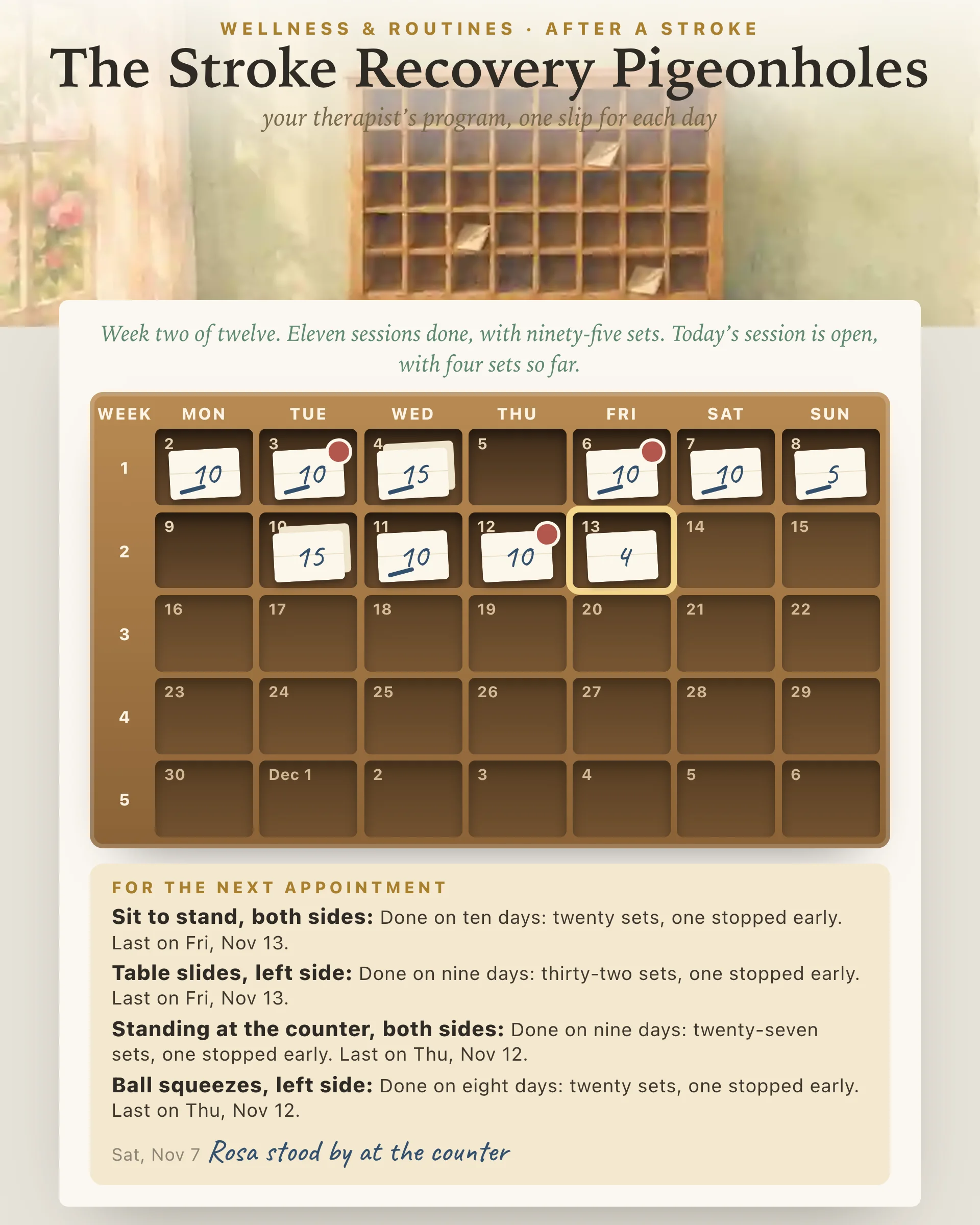
The stroke recovery exercises that belong in your week are the ones on the sheet your therapist gave you. This page is a log for that sheet: copy each exercise as written, count every set as it happens, and bring a day-by-day record to your next appointment. It never suggests an exercise, a number of reps or a next step. If you are helping someone through their program, the page is written for you too.
Since one stroke raises the chance of another, the signs sit at the top of the page and stay there. The CDC's page on stroke signs lists a face drooping on one side, an arm drifting down when both are raised, and slurred or strange speech, plus sudden loss of balance, trouble seeing or a severe headache. If you see any of them, call 911 at once instead of driving to the hospital, and note the time the signs began, because it helps the hospital team choose the best treatment.
A fall, new pain, or feeling dizzy or faint while you exercise is different: stop, sit down, and tell your care team the same day. Dizziness that comes with any sign above is an emergency.
Each exercise goes on the page the way your therapist wrote it: its name, the sets, the reps or time in each set, which side it works, and whether you practice alone, with someone nearby, or with someone helping. Until you type a number, the page shows none. When the program changes, take the old exercise off and copy the new one; sessions already logged keep what you did then.
Start a set and the page counts in real time, even if the phone locks. For reps, tap once per rep, or tap all done if your hands were busy. A timed exercise gets a five-second get-ready, then the clock holds the time your sheet gives. Stop whenever you need to: a stopped set keeps its whole reps or seconds and is marked stopped early, and a set with nothing counted is not logged. Every button is big enough to press with one hand, and a helper can do the tapping. Then add a line about how it went and finish the session; a day holds up to three.
The log is an old wooden sorting case: a row for each week, a pigeonhole for each day, from your first set. Each session leaves a slip with its sets, a red dot when one was stopped early, and a pen mark for a note. Below the case, a box gathers plain facts for your therapist: days with sets, each exercise's sets and stops, and every note in date order. The plan keeps about fifteen minutes a day free, as room rather than a target; your sheet decides how long and how often.
The 2024 US federal guideline for stroke rehabilitation, written for veterans' and military health care, strongly recommends task-specific practice: repeating a whole task, or part of one, such as standing up, reaching or walking. It notes that patients and caregivers can learn to do this practice at home, and that amounts varied across its studies. The 2016 US guideline for adult stroke rehabilitation, from a panel of rehabilitation clinicians and researchers, describes recovery as the work of a team that includes the survivor, family and caregivers, and calls communication among them paramount.
The LEAPS trial compared treadmill training with a home exercise program in 408 adults two months after a first stroke. The home program of strength and balance work, led by a physical therapist in each person's home three times a week for twelve to sixteen weeks, did as well as treadmill training for walking a year later. The trial had no group without exercise, a therapist was present at every home session, and everyone could already walk a short distance with help. So it cannot show that practicing alone works, or how much of any change came from the exercise itself.
A Cochrane review of home-based programs for the arm found only four trials with 166 people, too little good evidence to say whether such programs beat usual care. Another Cochrane review of exercises guided by caregivers pooled six small trials with 333 survivor and caregiver pairs: it found no clear effect on everyday activities, and caregiver burden did not rise. None of this promises any particular recovery.
The Home Exercise Carousel follows a hip replacement, where most sheets share a few early moves, so it shows those moves to mark. Stroke programs differ far more from one person to the next, so this page shows no moves at all and keeps a clock and counter for each exercise. If you are the one helping, The Caregiver's Relief Log is there for your own load.
Ask your doctor or therapist first, and again before any change, if you have had a fall, felt dizzy, had a joint replaced, live with a heart or blood pressure condition, or have pain. Stop anything that hurts, and keep a sturdy chair or counter within reach whenever you practice standing.
The ones your own therapist picks for you, at the sets and reps written on your sheet. A 2024 US government guideline for stroke rehabilitation strongly recommends task-specific practice, which means repeating a whole task or part of one, such as standing up or reaching. Which tasks suit you depends on your stroke, your body and your goals, so that choice stays with your team.
As often as your sheet says, whether that is once a day or a few short sessions. The studies behind current guidance used very different amounts, so the dose is the call of the therapist who knows you. This log keeps about fifteen minutes a day free and holds up to three sessions daily, but the sheet always decides.
Yes, in the way your therapist shows them. A Cochrane review of exercises guided by caregivers found that caregiver burden did not rise, though its trials were small and the effect on everyday activities was unclear. Each exercise on this page records whether you practice alone, with someone nearby, or with someone helping.
Stop and call 911 at once for a drooping face, a weak arm, slurred or strange speech, sudden loss of balance, trouble seeing or a sudden severe headache, and note when the signs began. Do not drive to the hospital. A fall, new pain or feeling dizzy during exercise means stopping and telling your care team that day.
By the team behind Fabulous, the science-based self-care app used by over 30 million people.


