
The Overwhelm Recovery ProtocolWellness & Routines · ~5 min
About this template · Updated November 2026
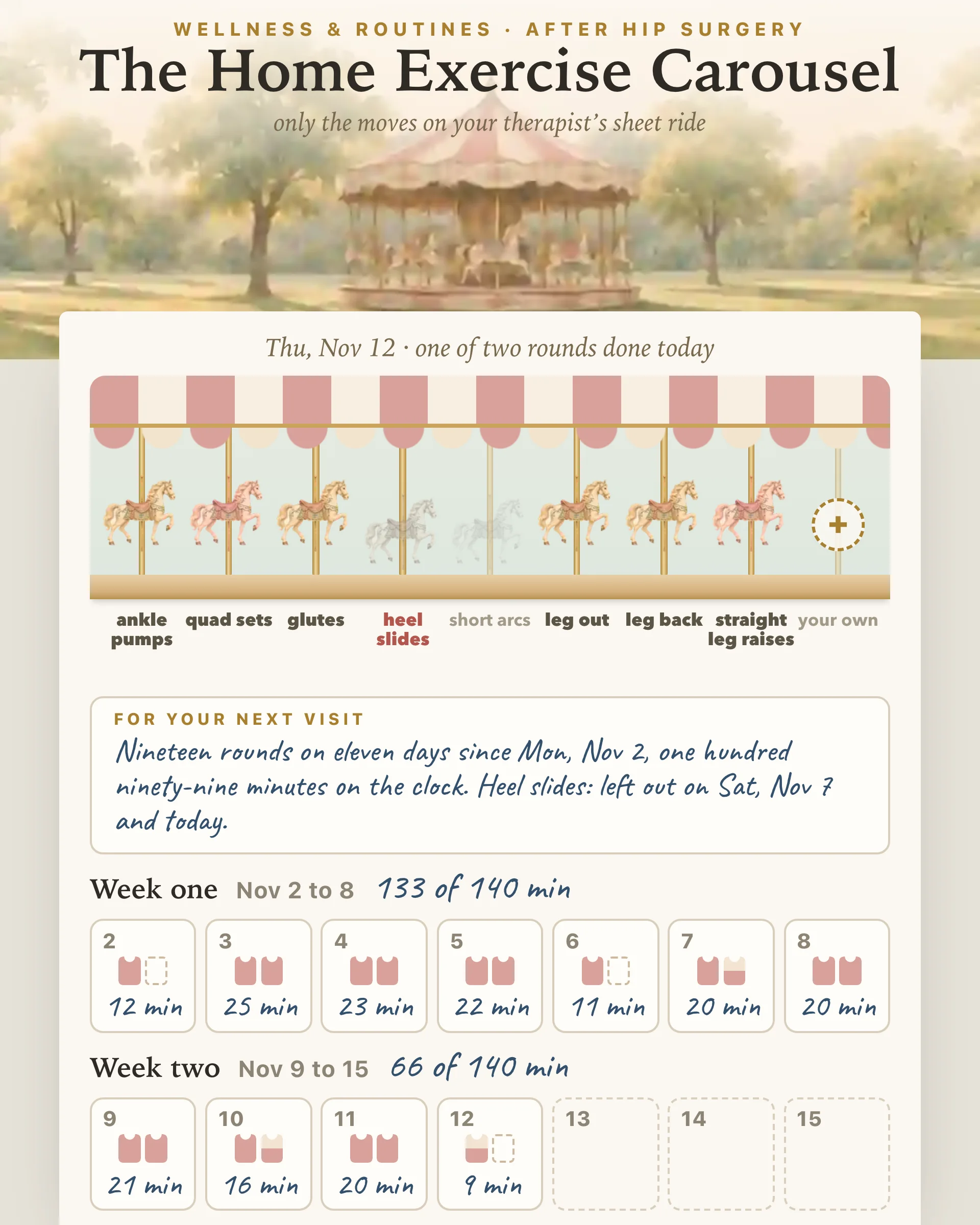
The exercises you do after a hip replacement come from a sheet: the one your physical therapist hands you before you go home, listing moves, sets and reps. This page is a log for that sheet. It shows the common early moves so you can mark yours, and it keeps track of what you actually do. It never decides which moves you do, how far you bend, or when you move on to something harder. Those calls belong to your surgeon and your therapist.
The American Academy of Orthopaedic Surgeons' exercise guide for total hip replacement opens the same way: check with your therapist or surgeon before trying any of the moves it shows. It adds that your team may suggest exercising twenty to thirty minutes a day, or even two to three times a day, in early recovery.
Many sheets start with some of these:
Your list may differ, so two spare poles take moves of your own.
Precautions vary even more. The academy's overview of total hip replacement explains that you may be asked to take special care when sitting, bending or sleeping, usually for the first six weeks, and that these precautions differ from patient to patient with the surgical approach. So this page says it once, plainly: follow the precautions you were given.
Each common move rides a painted horse. Tap the horses for the moves on your sheet, then choose the sets and reps written there. Until you choose, the page shows no number, since that number is your therapist's. If your sheet says how many rounds a day, mark that too.
Before a round, tap your pain from zero to ten, then start the clock and work through your list. Each finished set is one tap on a ring, and each tap raises that move's horse. A horse reaches the top when today's rounds are done. A move that hurts can be left out with one tap, and the page notes it for your next visit.
The clock keeps real time, even on a locked phone. Only whole minutes count, a round stopped under a minute with nothing marked saves nothing, and the clock stops itself at forty-five minutes. After the round, tap your pain again. Your notes sit only beside your own earlier ones, with no label or verdict.
The six weeks match the stretch when precautions usually apply. Each day sets aside about twenty minutes, the low end of the academy's range, the same all six weeks, since only your team changes anything. A small box gathers plain facts for your therapist: rounds, minutes, days with the rounds your sheet asks for, moves left out and rounds ended early.
A systematic review of exercise directed by physical therapists after hip replacement pooled five trials with 234 adults who had gone home after elective surgery. Exercise improved strength in the muscles at the side of the hip, walking speed and steps per minute, and unsupervised home programs did about as well as supervised outpatient ones. Function and quality of life could not be pooled, the trials were small, and every program was directed by a physical therapist. A log only helps you carry such a program out.
On precautions, a Cochrane review found three trials with 492 people and rated the evidence very low quality: the authors could not say whether hip precautions, equipment or activity limits prevent dislocation. That helps explain why instructions differ. It is no reason to drop yours: your surgeon knows how your hip was put in.
Call your surgeon's office right away for calf pain, tenderness or redness, new swelling in your thigh, calf, ankle or foot, a fever over 100°F or chills, or a wound that is redder, more swollen or draining. The academy lists these as signs of a possible blood clot or infection. MedlinePlus discharge instructions add pain your medicine does not control, a fall on that leg, and a hip that feels as if it has slipped out of place.
Chest pain or sudden shortness of breath can mean a clot in the lungs, which MedlinePlus treats as a reason to call 911 or your local emergency number. So is a sudden, severe hip pain with a leg that looks shorter or turned in or out: a medical reference on hip dislocations notes that artificial hips can dislocate too, and that the person should stay still and go to an emergency department, usually by ambulance.
Once the early weeks are behind you and your therapist agrees, The Picket Fence Walking Plan builds walks a few minutes at a time, and The Hip Lanterns offers a broader strength routine with easier and harder versions of each move. Neither is meant for the early weeks.
The ones your physical therapist prescribes, at the sets and reps on your sheet. Common early moves include ankle pumps, quad sets, glute squeezes, heel slides, short arc quads, and standing hip abduction and extension while holding a counter, but your own list depends on how your surgery was done and on your surgeon.
Follow your sheet. The American Academy of Orthopaedic Surgeons says your surgeon and therapist may suggest exercising twenty to thirty minutes a day, or even two to three times a day, in early recovery. This page sets aside twenty minutes a day and counts as many rounds as your sheet asks for.
That depends on your surgical approach and your surgeon. Many people are given precautions about sitting, bending or sleeping for roughly the first six weeks. Research has not settled which precautions help most, so keep to the ones you were given and leave out any move that is not on your sheet.
Orthopedic surgeons' patient guidance says some discomfort with activity is common for several weeks, but how much to expect is a question for your own team. Stop a move that hurts more than they said it would, and treat pain that is sudden, severe or new as a reason to call.
Call right away for a painful, tender or red calf, new swelling in your leg, a fever over 100°F or chills, a wound that is redder or draining, or pain your medicine does not control. Call 911 for chest pain, sudden shortness of breath, or sudden severe hip pain with a leg that looks shorter or turned.
By the team behind Fabulous, the science-based self-care app used by over 30 million people.


