
The Overwhelm Recovery ProtocolWellness & Routines · ~5 min
About this template · Updated September 2026
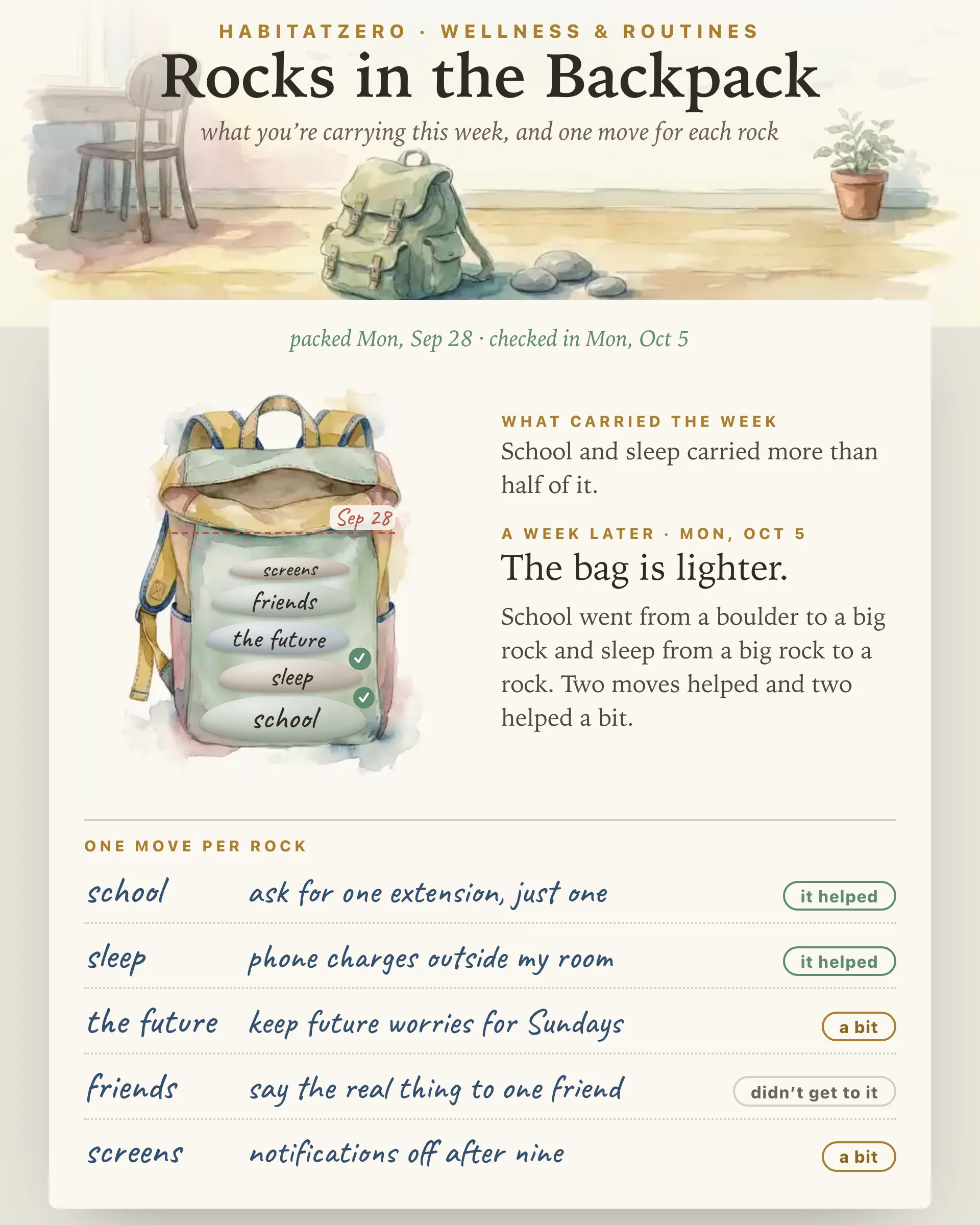
Ask a stressed teenager how things are going and you will usually hear "fine" or "a lot." Both can be true at once, because teen stress rarely arrives as one problem. It is a lab report due Thursday, a group chat that went quiet, a parent who seems tense about money, a college question nobody can answer yet, and six hours of sleep holding all of it up. This page gives that pile a shape your teen can point at.
Each worry becomes a rock and the week becomes a bag. The worksheet adds what a drawing cannot: sizes, one move per rock, and a check-in seven days later that shows whether any of it helped.
The best-known numbers come from the American Psychological Association's 2013 Stress in America survey of 1,018 teens aged 13 to 17. In the full report, 83 percent named school as a source of stress, 69 percent named getting into a good college or deciding what to do after high school, and 65 percent named their family's finances. On school nights they reported about 7.4 hours of sleep, short of the 8.5 to 9.25 hours the National Sleep Foundation recommended then.
The survey was run online, was not a probability sample and is more than a decade old, so treat those figures as a sketch. The only mix that matters is the one in your own teen's bag, which is why the page starts empty.
Your teen taps what is weighing on them from seven pebbles, from school and sleep to the future, or writes their own. Eight rocks fill the bag. Each rock gets a size: pebble, rock, big rock or boulder. The painted backpack stacks them heaviest first and names the smallest group of rocks holding at least half of the week's weight, so "everything" becomes "mostly school and sleep."
Next comes one move per rock, picked from four written the way a teenager would say them (phone charges outside my room, ask for one extension, say the real thing to one friend) or typed in their own words. One move per rock is the whole plan, because a plan with a dozen changes rarely survives Tuesday.
A week later the check-in asks two questions of each rock: did the move help, and how heavy is it now? A dashed line marks where the pile stood on packing day, the reading names what shrank, and packing the next week keeps only the moves that helped.
A meta-analysis of 212 studies on coping in children and adolescents found that problem solving and acceptance-style coping went along with fewer symptoms of anxiety, depression and acting out, while avoidance, denial and bottling feelings up went along with more. Most of those studies measured everything at a single moment, so they show a link rather than proof of cause. Still, it is a fair bet that one honest conversation serves a teen better than trying not to think about it.
Sleep gets special treatment: when its rock is big, the reading puts its move first. In the APA survey, nearly one teen in five said they felt more stressed after too little sleep.
A 2020 meta-analysis of school-based stress programs pooled 54 studies and found a moderate effect on stress overall, yet the significant effects came only in selected groups, students who had signed up themselves or been picked out by screening for high stress, and not in general classrooms. A backpack check is not treatment. It is most useful for a teen who is carrying a lot right now and needs the load in view before changing any of it.
Sit nearby, not in charge. Ask about one rock instead of the whole bag, and let your teen pick the move even if you would have picked another. Put the check-in date somewhere you will both see it. If you catch yourself adding rocks of your own, like "and what about your grades?", stop and ask a question instead.
Stress that comes and goes is part of being sixteen. Stress that settles in is different. The National Institute of Mental Health suggests talking to a professional when stress symptoms won't go away, and treats stress that gets in the way of everyday life, leads to avoiding things or seems always present as a sign of something more. In a teenager that can look like weeks of poor sleep, skipped meals, slipping grades or pulling back from friends. The school counselor and your teen's doctor are good first calls. If your teen ever talks about hurting themselves or ending their life, call or text 988 (US) with them right away, or your local emergency number if they are in danger now.
For a written plan covering steady, rising and too-much days, try Letters From a Calm Day. When the trouble is simply too many hours, The Week That Fits lays the real load onto a week with sleep taped down first. And if worry has started to feel like anxiety, Anxiety Worksheets for Teens has short exercises for the moment itself.
In the American Psychological Association's 2013 survey of teens aged 13 to 17, school led the list at 83 percent, followed by getting into college or deciding what comes after high school at 69 percent and family money worries at 65 percent. It was an online survey rather than a random sample, so read the numbers as a rough guide.
Ask about one worry at a time instead of the whole load, and let your teen choose what to try. Protect their sleep, agree on a day to check back, and hold off on fixing things for them. A small change they picked themselves is one they are more likely to own.
Small, active moves: guarding sleep, one honest conversation, dropping one commitment for the week, or breaking a looming task into its smallest piece. Research on how young people cope links problem solving and acceptance with fewer symptoms, and avoidance and denial with more.
When it stops passing. If stress disrupts sleep, eating, schoolwork or friendships for more than a couple of weeks, makes your teen avoid things, or never seems to ease, start with the school counselor or their doctor. If your teen talks about hurting themselves, call or text 988 right away.
It costs nothing. The filled backpack on this page is an example to look through; packing a bag for your own teen and coming back for the week-later check-in happens in HabitatZero, free of charge.
By the team behind Fabulous, the science-based self-care app used by over 30 million people.


