
The Overwhelm Recovery ProtocolWellness & Routines · ~5 min
About this template · Updated September 2026
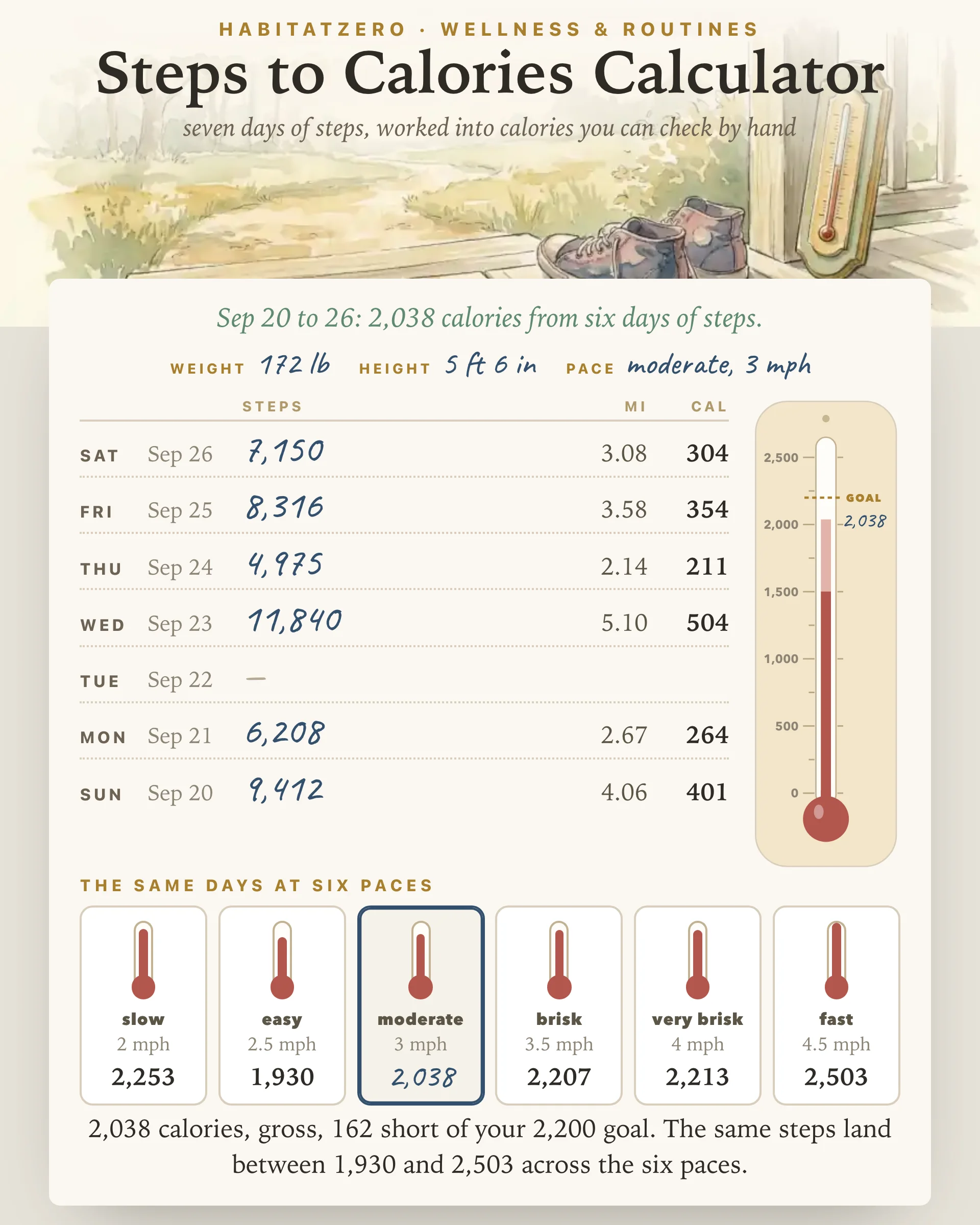
Your phone counts steps all day, yet a step count on its own says little about energy. This calculator turns each day's steps into distance, time and calories from four things you set: your weight, your height, a measured step if you have one, and the pace you usually walk. Every figure arrives with its arithmetic printed beneath it, so you can check the page with a pencil.
The calorie on a food label is a kilocalorie, a unit of heat: enough to warm a liter of water by one degree Celsius. That is why the sheet is drawn as a thermometer. Getting from steps to heat takes three short sums.
First, steps become distance. The sheet multiplies your height by 0.414, the rule of thumb that popular step calculators use for walking step length, then multiplies that step by your count. At 5 ft 7 in, one step is about 27.7 inches, and 10,000 steps come to 4.37 miles. If you have measured your own step on a counted walk, type it in and it replaces the rule.
Second, distance becomes time. Divide the miles by your pace: 4.37 miles at 3 mph takes 1.457 hours.
Third, time becomes calories. The 2024 Adult Compendium of Physical Activities gives every activity a MET value, a multiple of the energy you use sitting quietly, and defines one MET as one calorie per kilogram per hour. Walking on level ground at 2.8 to 3.4 mph is 3.8 METs. Multiply the MET value by your weight in kilograms and by the hours: at 160 pounds, 3.8 × 72.6 × 1.457 comes to 402 calories.
That 402 is a gross figure, and the page labels it that way wherever it appears. Gross counts everything your body used during the walk, including the energy it would have spent anyway had you stayed on the couch. Take away one MET for that resting share and you have the net figure, what the walking itself added: 2.8 × 72.6 × 1.457, or 296 calories. On the thermometer, the solid red is the net part and the pale top is the resting share. When you compare this page with a watch or another calculator, check which of the two numbers it reports before deciding which one is right.
Choose a pace and every row redraws, while six small thermometers hold the same steps walked at six speeds. The result surprises most people. A quicker walk uses more energy per minute, but the same steps take fewer minutes, so across the middle paces the totals stay close together. Per mile, the Compendium's values make walking cheapest at about 2.5 to 3 mph; a very slow stroll costs a little more per mile and a 4.5 mph power walk a good deal more. For the same 10,000 steps at 160 pounds, that spread runs from 381 calories at 2.5 mph to 493 at 4.5 mph. A day's count is mostly unhurried steps around the house, so the easy or moderate pace is usually the honest pick for it.
Treat every figure here as an estimate: useful for comparing one week with the next, weak as an exact count. The one-MET convention traces back to a single 70 kg, 40-year-old man, and a study of 769 adults found that it overstates resting energy use by about 20 percent on average, with body composition explaining far more of the difference than age did. Wrist devices fare no better: when seven of them were checked against laboratory measurements, none estimated energy expenditure to within 20 percent, and walking was the activity where they erred the most. The adult Compendium values also describe people aged 19 to 59. Adults 60 and older have a table of their own, measured against a lower resting baseline, so for them this page is a rougher guide still.
Calorie numbers do not suit everyone. In a group of 105 people diagnosed with an eating disorder, about three in four had used the calorie tracker My Fitness Pal, and 73 percent of those users felt it had contributed to their eating disorder. If that history is yours, it is fine to leave this sheet closed and let a walk be only a walk. The page makes no promise about weight in either direction; it shows your steps as an energy figure and nothing more.
Log each evening, once the count on your phone is final, and read the seven days at the end of the week. If you want a structure that adds steps, the Walking Challenge turns fourteen to twenty-eight days of walking into a route on a painted map, and the Japanese Interval Walking Timer alternates three easy minutes with three brisk ones, the kind of change in pace that the six small thermometers put a number on.
It depends on your weight, your step length and your pace. For someone who weighs 160 pounds and stands 5 ft 7 in, 10,000 steps cover about 4.37 miles; at a moderate 3 mph that takes about 87 minutes and comes to roughly 402 calories gross, or 296 once the calories you would have used at rest are set aside. At 200 pounds the same walk comes to about 502.
Multiply your steps by your step length to get the distance, divide the distance by your walking speed to get the hours, then multiply those hours by the MET value for that speed and by your weight in kilograms. The MET values here come from the 2024 Adult Compendium of Physical Activities, such as 3.8 for level walking at 2.8 to 3.4 mph.
For many adults it comes close. At 160 pounds and a 27.7-inch step, 5,000 steps at 3 mph work out to about 201 calories gross, or 148 net. A lighter walker, or the same steps at an easy 2.5 mph, lands a little lower.
For a 160-pound adult, roughly 87 to 113 calories gross, depending on pace. A mile costs the least at about 2.5 mph and the most at 4.5 mph, and weight scales every figure directly, so at 200 pounds each is about a quarter higher. At a 27.7-inch step that is about 0.04 calories a step.
No sign-up is needed to see the sample week on this page and follow its arithmetic. To log your own days, keep your weight and step length set and let the thermometer fill as the week goes, open the calculator in HabitatZero, which is free.
By the team behind Fabulous, the science-based self-care app used by over 30 million people.


