
The Overwhelm Recovery ProtocolWellness & Routines · ~5 min
About this template · Updated September 2026
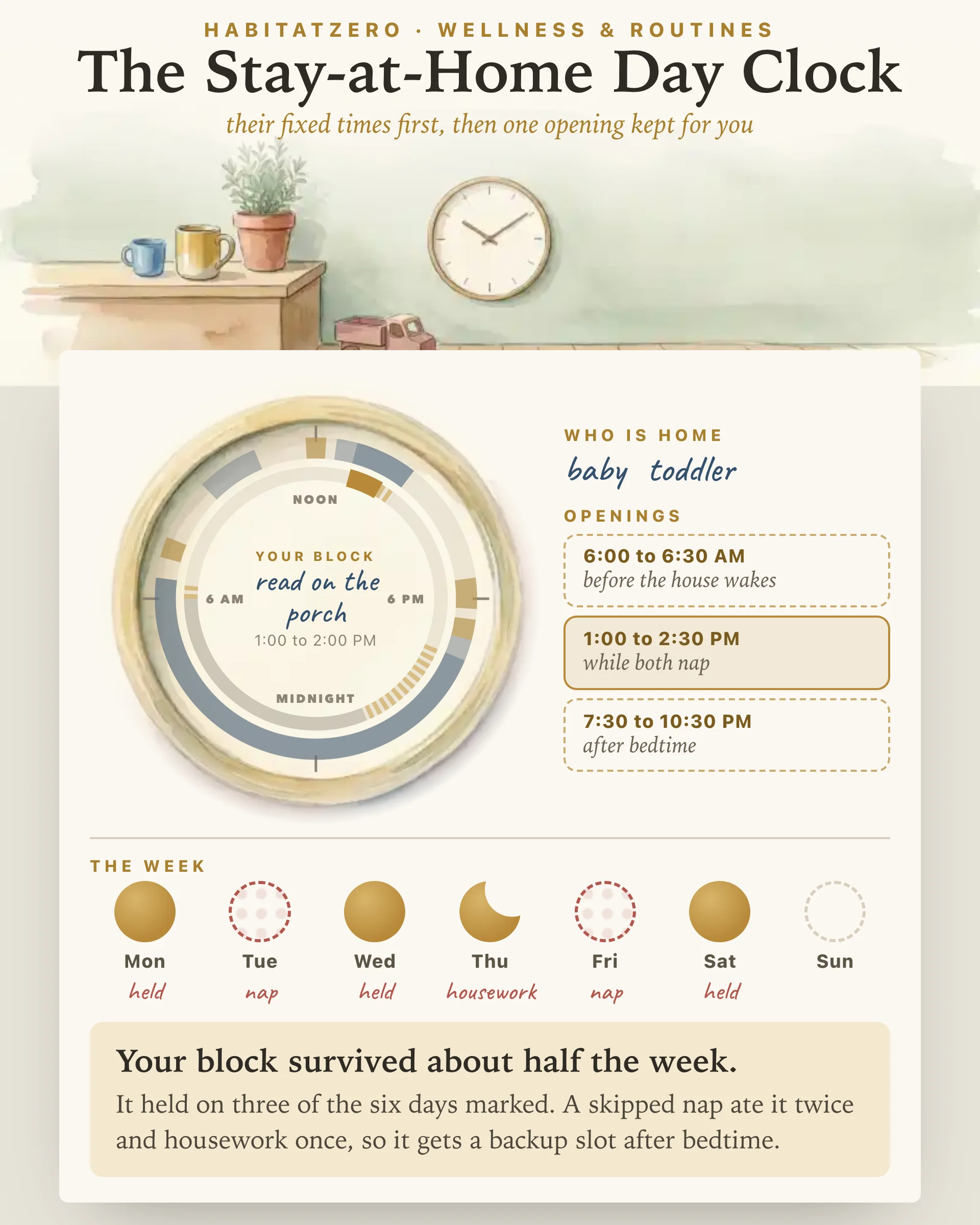
Most stay at home mom schedules you find online are somebody else's day: a 6:30 wake-up, a 9:00 outing, a 1:00 nap, all written for a family that is not yours. What those samples get right is the order they were built in. The children's fixed points go down first, the flexible things fit around them, and any time left for the parent is found last, if it is found at all. This page keeps that order and makes the last step deliberate. It is written for every parent at home with young children. The search phrase says mom, but Pew Research Center counts fathers as 18 percent of stay-at-home parents, up from 11 percent in 1989.
Some parts of the day barely move however well you plan: when the house wakes, meals, naps, school drop-off and pick-up, bath, bedtime. Think of them as anchors. You tap the ages of the children who are home, their anchors land on a twenty-four-hour clock at typical times for that age, and you nudge each one a quarter hour at a time until the clock matches the day you actually live.
The sleep numbers behind those defaults come from the American Academy of Sleep Medicine, whose consensus statement on children's sleep is the guideline the AAP's site for parents points families to. It recommends 12 to 16 hours in every 24 for babies from four to twelve months, 11 to 14 for ages one to two and 10 to 13 for ages three to five, naps included, then 9 to 12 for ages six to twelve. Under the clock, the page adds up the night and the naps you have set for each child and shows where that total falls against the range. The statement gives no range before four months, when sleep varies too much to pin down, so a newborn's day is better left loose.
Once the anchors are in, the clock does the part that is hard to see on paper. It marks every stretch when each child is asleep or at school and you are still up: the half hour before the house wakes, the overlap of two naps, school hours, the evening after the last bedtime. Those are your openings. With a baby and a toddler, the afternoon opening is often shorter than either nap, because it only exists while both are down, and the clock shows exactly how short.
You keep one opening as your block and say what it is for, whether that is reading, a workout at home, a phone call or plain rest. Move it past the edge of the opening and the page tells you that part of it now falls while a child needs you. The flexible pieces, like outside play, errands, laundry and library story time, sit around the anchors by part of the day, with suggestions matched to the ages you picked.
A schedule written once cannot tell you whether it works. So the bottom of the page holds a week of small discs. Each evening you tap the day once if your block held, twice if it ran short and three times if it got eaten, then pick what ate it: a skipped nap, a sick child, housework, errands, a child who needed you, your own tiredness, your phone. After a few evenings the page reads the week back to you. It says how many days the block survived, what took it most often, and one change worth trying, such as a backup slot after bedtime when naps keep failing.
Family routines have a long research record. A review of fifty years of studies on family routines found them linked to parenting competence, children's adjustment and marital satisfaction. The same review is frank about its limits: the studies measured routines inconsistently, leaned on convenience samples and could not separate direct effects from indirect ones. Treat a steady day as helpful rather than as a promise.
The kept block rests on a sturdier finding. People who decide ahead of time exactly when and where they will act follow through more often than people who only intend to, and a meta-analysis of implementation intentions across 94 tests put that effect in the medium-to-large range. Giving your block a time, a purpose and a backup for bad days is that idea applied to your own hour. None of this research looked at stay-at-home parents' free time in particular, and nothing here measures stress or burnout. The page counts one block, honestly logged.
Set up the clock on a quiet evening, and come back to it whenever a nap drops, school starts or a new baby arrives, since the anchors move as the children grow. If you want the children to follow their own day, the Kids Daily Routine Chart and The Visual Schedule are made for them, and the Home Routines Journal keeps the housework in small daily rounds. Keep this page for yourself: the day as it bends around the children, and the part of it that stays yours.
It starts from the children's fixed points, meaning wake-up, meals, naps, school hours and bedtime, and lets the rest of the day float around them. A useful one also names the stretches when every child is asleep or away, since any time of your own has to come out of those.
The American Academy of Sleep Medicine recommends 12 to 16 hours in every 24 for babies from four to twelve months, 11 to 14 for ages one to two and 10 to 13 for ages three to five, naps included, then 9 to 12 for ages six to twelve. It sets no range before four months, when sleep varies too widely.
Look for the openings your children's day already leaves, such as the half hour before they wake, a stretch where two naps overlap, or the evening after bedtime. Claim one, decide what it is for before it starts, and check each night whether it happened. A week of those checks shows what keeps taking it.
Yes. The search phrase says mom, but nothing on the clock assumes it, and any parent at home uses it the same way. Pew Research Center counted dads as 18 percent of stay-at-home parents in the US in 2021, up from 11 percent in 1989.
The sample clock on this page is free to look through. Setting your own children's times and keeping a week of marks happens once you personalize it in HabitatZero, which costs nothing.
By the team behind Fabulous, the science-based self-care app used by over 30 million people.


