The Overwhelm Recovery ProtocolWellness & Routines · ~5 min
About this template · Updated September 2026
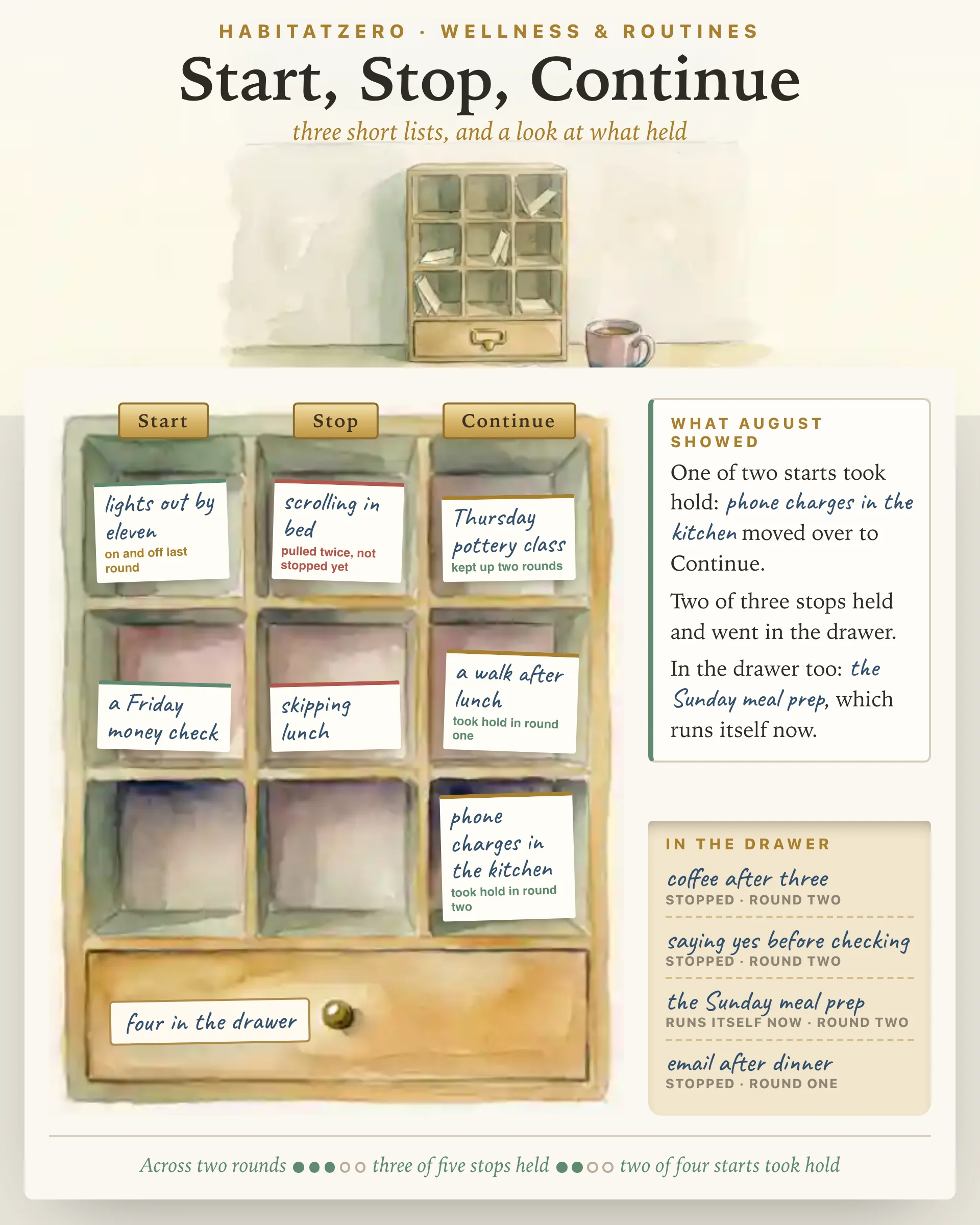
Start, stop, continue asks three questions about a stretch you have just lived through: what to start doing, what to stop, and what is working well enough to keep. Teams use it to close out a sprint, and managers use it to give feedback. We could not find a named originator we could confirm, so this page credits no one. It makes the questions a personal retro for a week, a month or a whole project, with a switch for teams.
The hard part was never the questions; it is the second look. It is easy to write "no more email after dinner" on a Sunday and never read that line again, so you never learn whether it stuck. This worksheet is built around the second look.
Each column has three holes, on purpose. Nine starts make a wish list; three fit in your head on a Thursday afternoon. When a column is full, the page asks you to take a slip out before filing another.
Every empty hole offers an idea: tap it, or write your own in a few words. Say whether you are looking back over a week, a month or a project, and name the stretch if you like.
Then close the page and live the stretch.
When it ends, press pull the slips and answer one question per slip. For a start: did it take hold, was it on and off, or has it not started yet? For a stop: did it stop, was it on and off, or are you still at it? For a continue: are you keeping it up, does it run itself now, or is it slipping?
Your answers rearrange the cabinet. A start that took hold slides over to Continue. A stop that held drops into the drawer, and so does a continue that runs itself now, since it no longer needs a hole. Everything else stays put with a note on how it went, so a stop that has come back twice is hard to miss. Below the cabinet, the record keeps every round and adds up how many stops held and how many starts took hold.
No study has tested start, stop, continue by name. The practice it belongs to, a structured look back, has been studied.
A meta-analysis of team and individual debriefs pooled 46 samples and found that debriefing improved performance by roughly 25 percent on average, with similar gains for individuals and for teams.
The continue column earns its place too. In a study of soldiers doing navigation exercises, those debriefed on both their failures and their successes improved more than those who went over their failures alone. A retro that only hunts for problems throws away half the lesson.
Starts go better when they are concrete. A meta-analysis of if-then planning across 94 tests found a medium-to-large effect on reaching goals when people decided ahead of time when and where they would act. "A walk after lunch" is already halfway there; "exercise more" is not.
And give a start time before you judge it. When researchers followed volunteers building a new daily habit, the time it took to become close to automatic ranged from 18 to 254 days, and missing a single day did not meaningfully set it back. That is why a start marked on and off keeps its hole.
None of this makes the worksheet a treatment. It is a planning habit, and the evidence is about planning and reflection.
Switch the cabinet to a team and the ideas turn into team ones. Have everyone write slips alone first, so the loudest voice does not set the list, then file the three that come up most in each column. At the next retro, pull the slips together before anyone proposes something new. For feedback to one person, use the same shape: one specific behavior per column, tied to a moment that actually happened.
Write each slip so that a week from now you could answer it with a plain yes or no. "Be more present" fails that test; "phone charges in the kitchen" passes it. Give a stop a replacement where you can; holding off is easier when you know what you will do instead. And keep your continues honest: if something only happens when you force it, it may belong back in Start.
If your week needs loose ends swept up before you decide anything, begin with the Weekly Review. For a lighter check-in with a family or a group, Rose, Bud, Thorn takes three minutes and keeps its own history. And if one start keeps refusing to take hold round after round, the Habit Loop Worksheet is the place to rebuild it from the cue up.
It is a review built on three questions: what should I begin doing, what should I quit, and what is working well enough to keep. Teams run it as a retrospective and managers use it for feedback, yet it works just as well for one person looking back at the last week.
For one person, start a walk after lunch, stop scrolling in bed, continue the Sunday meal prep. For a team, start writing decisions down, stop meetings without an owner, continue short written updates. The useful ones are small enough that you could say yes or no about them a week later.
Offer one specific behavior per column and tie each one to something that actually happened, rather than to anyone's personality. Starts and stops land best as requests. If you are on the receiving end, write the three down and go over them together the next time you meet.
Yes. Some teams say keep where others say continue, and some put stop first, but the three questions do not change. Here the Continue column does the job of keep, and a slip that takes hold in Start moves into it.
This page explains the method and shows a filled cabinet you can look over without signing in. Filing your own slips, pulling them at the next check-in and keeping the drawer and the record from one round to the next all happen inside HabitatZero, at no cost.
By the team behind Fabulous, the science-based self-care app used by over 30 million people.