
The Overwhelm Recovery ProtocolWellness & Routines · ~5 min
About this template · Updated September 2026
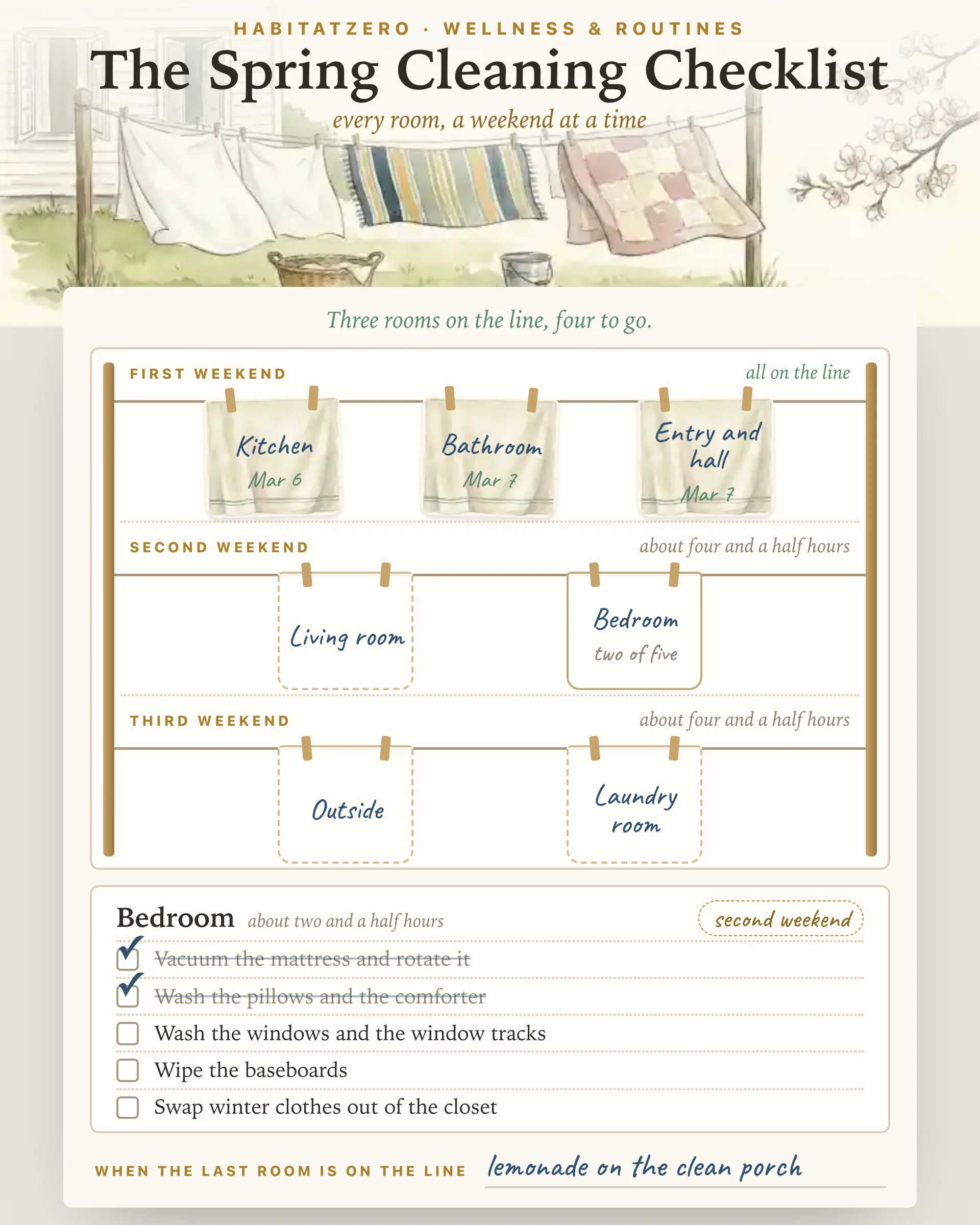
Spring cleaning is the once-a-year pass on the jobs your weekly routine never reaches. The fridge coils collect a year of dust. The range hood filter turns tacky with grease. Baseboards, window tracks and the tops of door frames get skipped week after week because they never look urgent. A spring clean catches all of it in one sweep through the house.
The catch is size. Add up this page's rough times for an ordinary home and you get well over ten hours of work, and squeezing that into one weekend is how it ends half done, with the oven racks still soaking in the tub on Sunday night.
In the kitchen, you vacuum the coils behind or under the fridge, empty the fridge and wash its shelves, soak the range hood filter, clean the oven and wipe down the cabinet fronts. The bedroom is where the mattress gets its yearly vacuum and rotation, the pillows and comforter go through the wash, and winter clothes finally leave the closet. In the bathroom, the grout gets scrubbed, the shower curtain and liner get washed, and the dusty cover on the exhaust fan comes off for a clean.
The living room and the entry are mostly about height and edges: the ceiling fan and light fixtures, the windows and sills, the baseboards, the doormats, whatever lives under the couch. Outside, the gutters and downspouts get cleared, the windows and screens get washed, and the porch gets swept down.
The worksheet opens with six common rooms already listed, each with its deep-clean jobs. Remove the rooms you don't have and add a laundry room, a garage or one you name yourself, up to ten. Trim each room's jobs the same way: ten per room is the ceiling, and a tap on a suggestion brings back anything you took off.
Then choose how many weekends to give it, from two to five. Every job carries a rough time, and the sheet deals the rooms onto the weekends biggest first, each one landing on whichever weekend is lightest so far, so that no weekend runs far longer than the others. The outside jobs wait for the last weekend, which tends to be the warmest. A tap on a room's weekend tag moves it along.
Each weekend is drawn as a clothesline, and each room hangs on it as an empty outline. Once you check a room's first job, it stays on that weekend even if the plan shifts. When you check its last job, the outline becomes a linen towel pegged on the line with the date, so the line turns into a record of what actually got done. There is also a line for the reward you get when the last room goes up.
Printing gives you the lines and every room's list, with boxes to check by pen.
Two findings explain why one-weekend plans slip. In studies of what researchers named the planning fallacy, people's predictions of how long their own tasks would take were consistently too optimistic, because they pictured the plan going smoothly instead of remembering how similar jobs had actually gone. When participants tied their estimate to past experience, the optimism disappeared. Adding up rough minutes per room is a small version of that correction: the size of the job is on the page before you promise it a Saturday.
The second finding is about naming the day. A meta-analysis of ninety-four tests found that plans spelling out when and where you will act, which psychologists call implementation intentions, had a medium-to-large effect on whether people reached their goal. Putting the bathroom on the second weekend is exactly that kind of plan.
What the evidence does not tell you: nothing here shows that spring is the right season, or that a deep clean changes anyone's health. The minutes are rough guesses for an average home, and jobs you add count as half an hour each.
Poison Control's spring cleaning advice is blunt about mixing products. Ammonia mixed with bleach gives off chloramine gas, and an acid toilet bowl cleaner mixed with bleach gives off chlorine fumes that can cause serious breathing problems. Vinegar is an acid too, and so are plenty of household cleaners, including some toilet bowl cleaners. Use one product at a time, keep a window or door open with the fan running, and call Poison Control at 1-800-222-1222 if anyone breathes in fumes. The gutters mean a ladder, so leave them for a day when a second person can stand at the bottom.
Set it up in late winter, a few weekends before you want to start, so the plan is ready when the first warm Saturday arrives.
Some jobs deserve their own page. Clearing out closets goes faster with the Decluttering Checklist, which gives every item a verdict one drawer at a time. To keep the bathroom from sliding back by summer, The Bathroom Cleaning Checklist spreads its care over daily, weekly and monthly rhythms. And if the spring clean belongs to the whole household, The Household Chore List can split the rooms fairly before anyone picks up a sponge.
The jobs a weekly clean never reaches: vacuuming the fridge coils, degreasing the range hood filter, cleaning the oven, wiping baseboards, washing windows and screens, rotating and vacuuming the mattress, washing pillows and curtains, and clearing the gutters. This page sorts them by room so the porch gets as much attention as the kitchen.
More than one Saturday for most homes. By this page's rough estimates, a kitchen, living room, bedroom, bathroom, entry and the outside jobs come to about thirteen hours, which is why the sheet spreads them over two to five weekends.
Decide how many weekends you can spare, then give each room one of them so the hours come out roughly even. The worksheet does that arithmetic for you, keeps the outside jobs for the last weekend when the weather tends to be warmer, and lets you move any room with one tap.
Start high and finish low: ceiling fan and light fixtures first, then shelves and windows, then baseboards, and the floor at the very end. Dust drifts down while you work, so a floor cleaned first only has to be cleaned again.
Keep bleach away from ammonia, which is common in glass cleaners, and away from acids such as vinegar and some toilet bowl cleaners. Poison Control warns that these pairs give off chloramine or chlorine gas. Use one product at a time with a window open, and call 1-800-222-1222 if the fumes cause trouble.
By the team behind Fabulous, the science-based self-care app used by over 30 million people.


