The Overwhelm Recovery ProtocolWellness & Routines · ~5 min
About this template · Updated September 2026
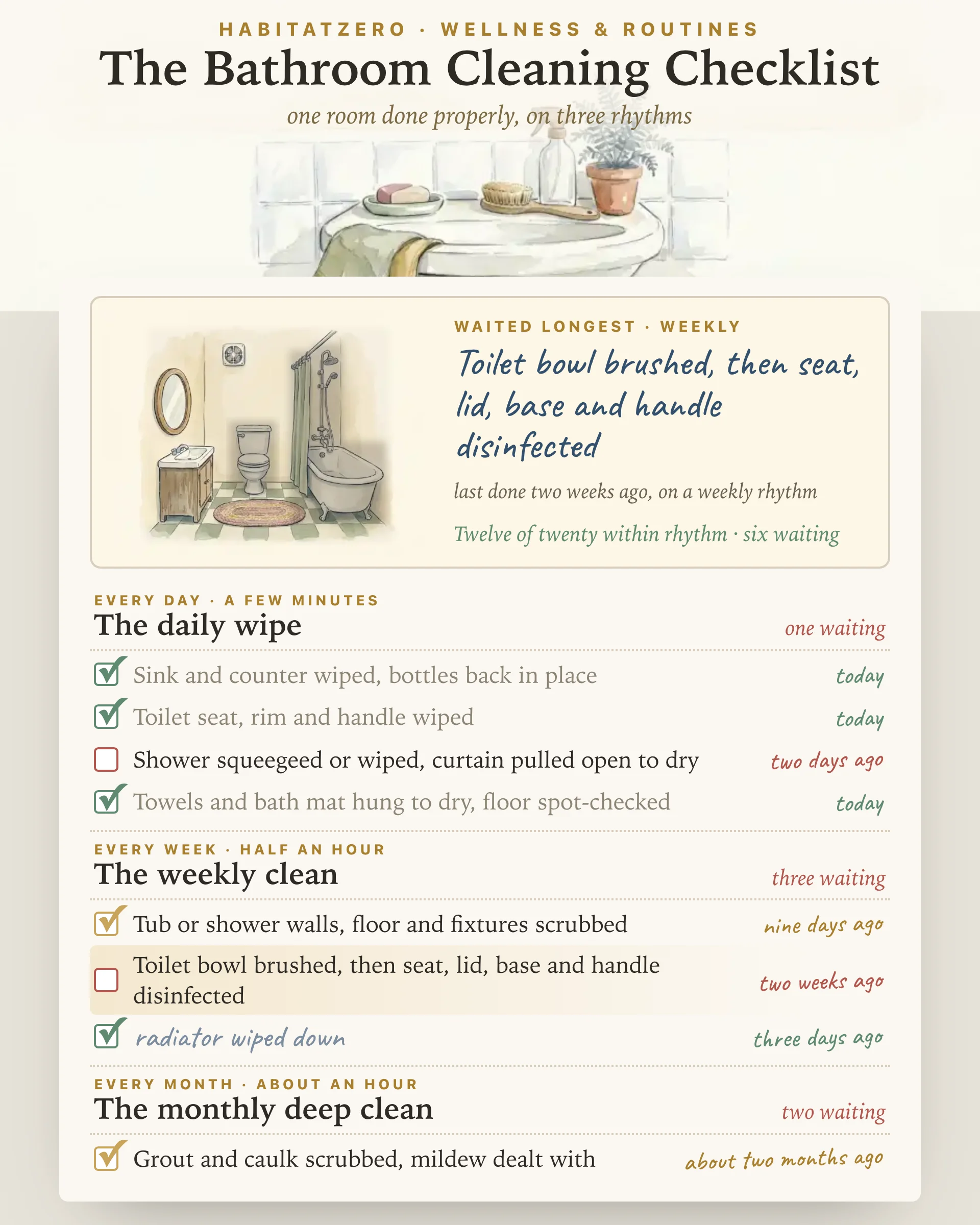
The bathroom is the room that punishes a missed week most visibly. Toothpaste sets on the faucet, the shower glass films over, the grout starts to speckle, and the job grows from ten minutes to a Saturday morning. This page splits the same work into three rhythms, remembers when you last did each line, and paints the result on a small picture of the room so you can see at a glance what has slipped.
The daily wipe takes a few minutes: sink and counter wiped with the bottles put back, toilet seat and handle wiped, shower squeegeed and the curtain pulled open to dry, towels and bath mat hung up. Its job is to keep the weekly clean short.
The weekly clean is half an hour, listed in the order you should take it: mirror, sink, tub or shower, toilet, trash, towels and mat into the wash, floor last.
The monthly deep clean reaches what the weekly clean walks past: the fan cover, walls and baseboards, the cabinet inside, the curtain and liner, the showerhead, grout and caulk, the drains and the toilet brush. About an hour, once a month, and the Saturday-morning state never arrives.
Every line remembers when it was last marked done and shows it in handwriting beside the text. A line is fresh while it is inside its rhythm, due once the rhythm has passed, and late once twice the rhythm has passed. Nothing is ever called failed, and a line you have never marked reads no record.
The painted bathroom above the lists is the same information drawn as a room. Each surface goes dull under a soft film while the lines that belong to it are waiting, and brightens as they are done. Beside the painting, a card names the one line that has waited longest measured against its own rhythm, so a daily wipe three days old outranks a monthly job a week past. On a busy evening you can do that single thing and stop.
Not every bathroom has a tub, a curtain or a fan. Tap not in this bathroom and the line is crossed off. Each rhythm also takes up to three lines of your own, and a whole wipe done today button records a full pass in one tap.
Work top to bottom so what you knock loose lands on something you have not cleaned yet. Dust and sweep before you spray, since wet dust is mud. Then clean before you disinfect: the CDC's guidance on when and how to clean and disinfect your home says to clean surfaces first because dirt can keep the chemical from reaching germs, and to leave the disinfectant on long enough to work, the contact time printed in the directions. The EPA's six steps for safe and effective disinfectant use make the same two points and add that the surface should stay wet for the whole contact time.
The safety rule is the one to memorize. The CDC's page on cleaning and disinfecting with bleach says never to mix household bleach, or any disinfectant, with any other cleaner, because the vapors can be very dangerous to breathe, and to keep the room ventilated while you work. Bleach and ammonia is the pairing people know, but the rule is broader: one product at a time, rinsed away before the next. No brand is named anywhere on this page.
The CDC's disinfecting advice is written with illness in the house in mind. For an ordinary week it says cleaning alone removes most harmful germs, and that disinfecting is likely not needed unless someone at home is sick or at higher risk. So only the toilet and sink lines say disinfected, and in a healthy week plain cleaning covers those as well; the page makes no claim about germ counts or health. The three rhythms are a housekeeping convention that keeps sessions short, not a public health prescription.
There is some evidence on the daily part. Lally and colleagues tracked people repeating a small daily action in the same context and found that automaticity grew along a curve that took anywhere from eighteen to two hundred and fifty-four days to level off, and that missing a single day did not measurably set the process back. That is why the page says waiting rather than missed. A two-minute wipe after brushing your teeth is exactly the cue-and-action pairing that study followed.
Open it the first time with a cloth in hand and mark the daily wipe as you go, so the page has something to remember. After that, open it when the bathroom looks off, read the card, and do the one thing it names. For the rest of the house on the same beat, the Cleaning Checklist prints the whole rotation for the fridge. If the job is a one-time handover rather than upkeep, the Move-Out Cleaning Checklist is built around what an inspection looks at. And on a day when even four lines feel like too many, the Tiny-Win Cleaning Checklist breaks a room into five-minute ticks with nothing to decide.
Three lists rather than one. A daily wipe covers the sink and counter, the toilet seat and handle, the shower walls and the towels. A weekly clean adds the mirror, a scrub and disinfect of the sink, tub and toilet, the trash, the bath mat and towels in the wash, and the floor. A monthly deep clean reaches the exhaust fan, walls and baseboards, the inside of the cabinet, the shower curtain, the showerhead, grout and caulk, the drains and the toilet brush. This page carries all nineteen lines and remembers when each was last done.
The rhythm on this page is a few minutes daily, half an hour weekly and about an hour monthly, which keeps any one session short. The CDC notes that regular cleaning with soap and water removes most harmful germs, and keeps disinfecting mainly for a home where someone is sick or at higher risk. A bathroom shared by several people, or one with a shower used daily, drifts toward the shorter end of each rhythm.
Top to bottom, dry before wet, and the floor last. Dust the fan cover and wipe the mirror before you spray anything, so loosened dust does not land on a wet surface. Clean with soap and water before you disinfect, because grime keeps a disinfectant from reaching what is under it, then leave the surface wet for the contact time on the label. The weekly list on this page is already in that order.
No. The CDC says never to mix household bleach, or any disinfectant, with other cleaners or disinfectants, because the vapors can be dangerous to breathe. Bleach and ammonia is the classic bad pair, but the safe habit is simpler: one product at a time, rinsed away before the next, with a window open or the fan running. This page names no products at all.
The public page displays a sample bathroom that is part way through its week. Marking your own lines, keeping the last-done dates between visits and watching your own painting brighten happens inside HabitatZero, which is free to join.
By the team behind Fabulous, the science-based self-care app used by over 30 million people.