Reading JournalStudy & Learning · ~4 min
About this template · Updated September 2026
You have an exam on a fixed date and a stack of topics to carry there. You already know that cramming the night before feels productive and fades fast. What you want is a spaced repetition schedule: a short list of dates for each topic, spread out so that each review arrives around the time the material starts to slip. This page works those dates out from your exam day and moves them as your reviews go well or badly.
Spacing means dividing the same study time into several sessions on different days instead of one long sitting. A 2006 meta-analysis by Cepeda and colleagues gathered 839 assessments from 317 experiments on verbal recall and found that the gap giving the best retention grew as the time until the final test grew. A later review of ten study techniques by Dunlosky and colleagues gave distributed practice a high utility rating, one of only two techniques to earn it. Practice testing was the other, while rereading and highlighting landed among the low-utility five.
So make each look here a recall attempt: close the notes, write or say what you remember, then open them and check.
The key study on timing is a 2008 experiment by Cepeda and colleagues. More than 1,350 people learned a set of facts, reviewed them after a gap of up to three and a half months, and took a final test up to a year later. The best gap was longer when the test was further away. As a share of the time to the test, though, it shrank: from about 20 to 40 percent for a test one week out to about 5 to 10 percent for a test a year out.
So no fixed list of days, such as one, three and seven, suits every exam. The right spacing depends on how far off the exam is, which is why this schedule starts from your exam date.
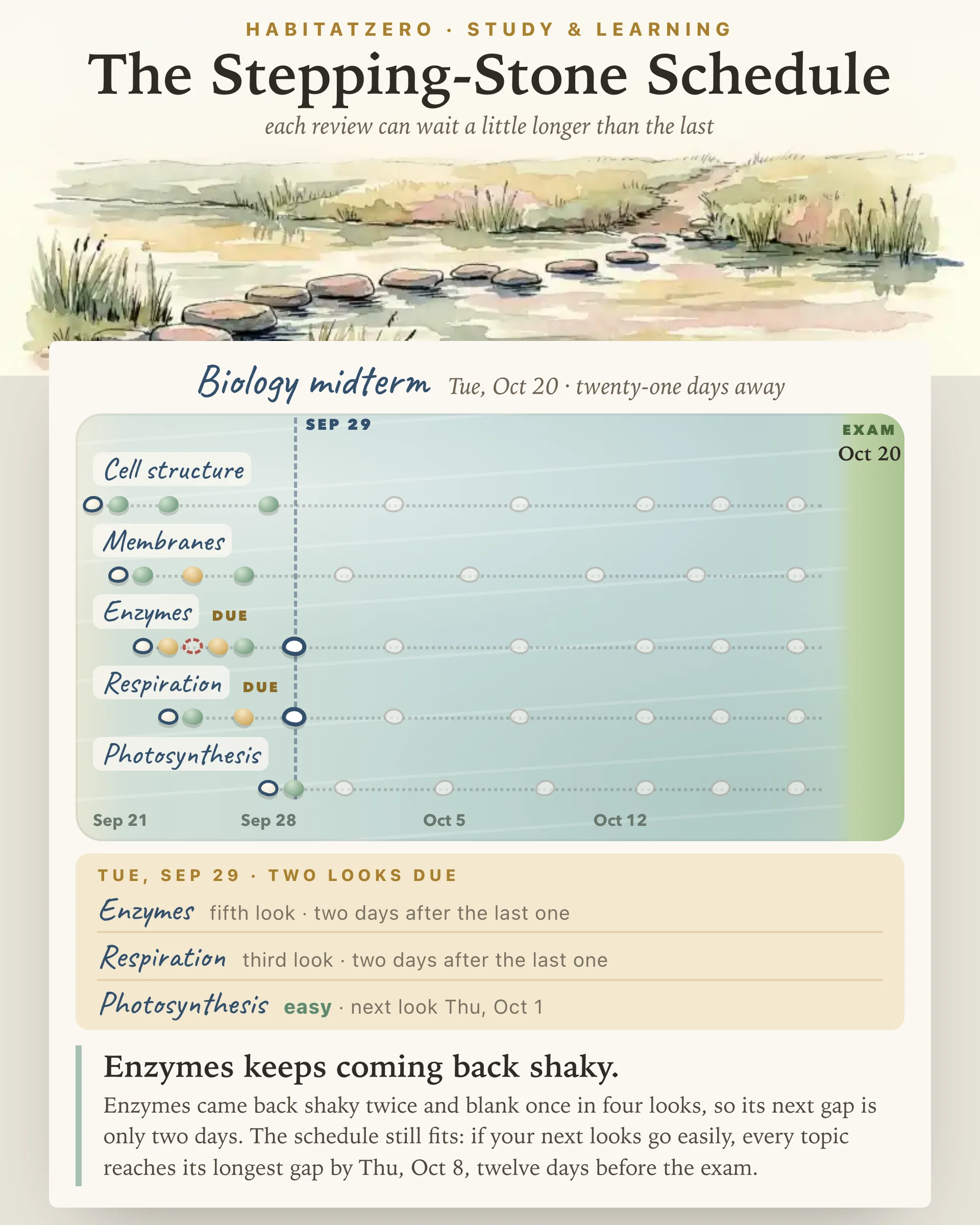
Each topic crosses the river on its own row of stones:
Add up to eight topics; each new one starts a day after the one before, so the looks spread out instead of piling onto the same days. A topic's first study moves with its arrows until its first look is logged. Each day, the stones that are due wear a dark ring. Recall, check, and tap easy, shaky or blank; the stones ahead shift to match, and a tap made by mistake can be taken back the same day.
Under the river, the page names any topic that has come back shaky or blank at least twice, because those topics need a real study session rather than another quick look. It also checks whether the schedule still fits: if every look from here goes easily, on what day does each topic reach its longest gap, and does that happen before the exam? A blank late in the run can make the answer no. Then relearn the topic that day instead of squeezing in extra reviews.
Growing gaps are the familiar pattern, but the research does not show they beat even ones. In experiments by Karpicke and Roediger, growing gaps helped on a test ten minutes later, while evenly spaced practice did better two days later, and what mattered most was holding the first recall back long enough that it took some effort. The widening gaps here are a practical choice that keeps the number of looks manageable. Those studies also used word pairs and short facts, and your topics are bigger, so treat the dates as a sound plan rather than a precise dose.
Flashcard tools such as the Anki app and the Leitner box method schedule single cards, one fact at a time. This page has no connection to either. It plans whole topics against one exam date, and works well beside cards during each look.
Start on the day you first study your first topic, ideally two weeks or more before the exam; with less time than that, no gap can grow past a day or two. Open the page once a day and take the looks it marks. For the recall itself, The Active Recall Deck turns notes into questions, and The Blurting Pad times you while you write out everything you remember before checking your notes. If you have not yet listed what the exam covers, set that out first with the Exam Planner.
No single list of days is best for everyone. A study of more than 1,350 learners by Cepeda and colleagues found that the ideal gap between reviews depends on how long you need to remember, so a good schedule starts from your exam date. Gaps that grow only while recall stays easy are a sensible default.
Pick the exam date, list your topics and give each one a first study day. Review each topic the next day, wait longer after every easy recall, keep each gap within a fifth of the days between that topic's first study and the exam, rounded down and never under a day, and place one last review the day before. This page works out every date for you.
The first review comes one day after first study. An easy recall doubles the next gap, a shaky one keeps it the same, and a blank drops it back to one day. Gaps stop growing at a fifth of the days from first study to the exam, rounded down to whole days (one day at the least), and the final review lands the day before the exam.
Anki and Leitner boxes schedule single flashcards, one fact at a time. This page schedules whole topics, such as chapters or lectures, toward one exam date, and it has no connection to either. You can still drill flashcards inside each review.
The river shown here is a sample: a biology midterm with five topics, one of them wobbling. To lay stones for your own exam and rate your reviews day by day, personalize the schedule in HabitatZero at no cost, and it keeps every date and rating between visits.
By the team behind Fabulous, the science-based self-care app used by over 30 million people.