The Overwhelm Recovery ProtocolWellness & Routines · ~5 min
About this template · Updated September 2026
A ski trip asks more of your bags than almost any other vacation: three layers for every body, awkward hard gear, papers you need before the first run, and a lodge wardrobe on top. The mistakes that hurt are rarely the big items. They are the photo ID left on the kitchen counter, the single pair of gloves soaked through by noon, the goggles bought at resort prices because yours stayed in the car.
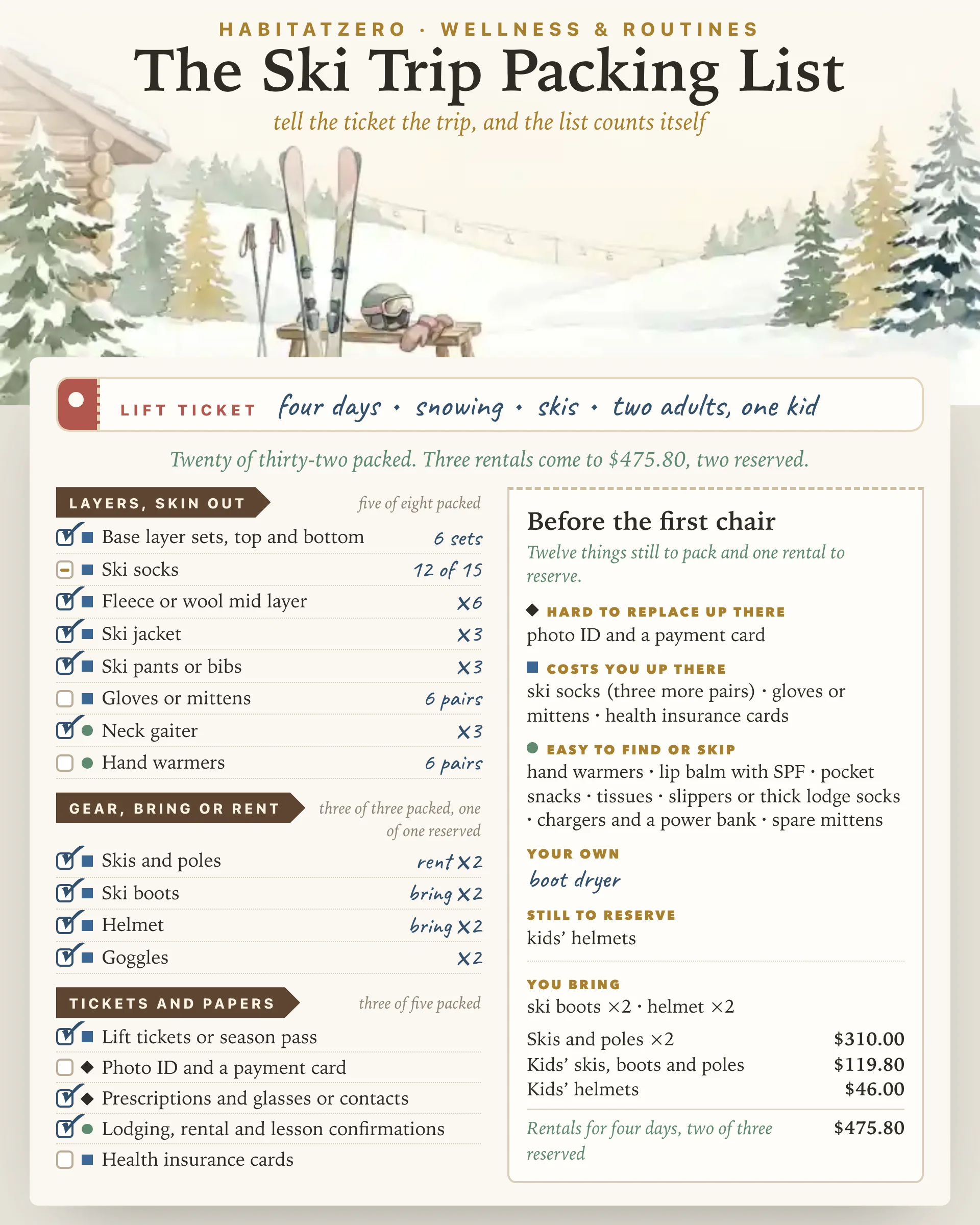
This page is built to catch those. You describe the trip once, on the lift ticket at the top: how many days on the snow, what the weather is doing, skis or snowboard, and how many adults and kids are going. The list counts itself from there.
Every line carries a trail-map symbol with a new job. A black diamond marks the few things that are hard to replace up there: prescriptions, glasses or contacts, your ID and a payment card. A blue square means the resort can sell you one, at resort prices, like goggles, gloves, base layers or sunscreen. A green circle is easy to find or do without. When the slip at the bottom lists what is still out, it sorts by those symbols, so the black diamonds are the first thing you read.
Dressing for a cold day on the mountain follows the same three layers that the CDC's winter safety guidelines describe. Against your skin goes a fabric that holds heat and does not soak up moisture; wool, silk and polypropylene all beat cotton there. In the middle, fleece, wool or down traps warm air close to the body. On the outside, a tightly woven shell keeps wind and snow off. The same page notes that mittens are warmer than gloves and that sweat drains heat, so shed a layer when you start to overheat.
Weather changes the counts. Tell the ticket it is snowing and each person gets a spare pair of gloves and one more pair of socks, because wet ones are miserable by the afternoon. Tell it bitter cold and the list adds an insulated layer under the shell, liner gloves under mittens, a face mask and warmers for hands and toes. Ski socks run one pair per day on the snow, and base layers one set for every two days.
Bitter days carry a specific risk. Frostbite usually shows up on the nose, ears, cheeks, chin, fingers and toes, and the CDC points out that a person may not notice it until someone else does, because the skin has gone numb. Make a habit of checking each other's faces on the chairlift, and head inside at the first white, grayish or waxy patch.
Every piece of hard gear gets a call. Tap bring and it becomes a line to pack. Tap rent and a price box opens: enter what the shop quoted for one day, and the line multiplies it by the people using it and the days on the snow. The slip adds the rentals up to the cent and shows how many you have reserved. If you change the days or the headcount after reserving, the line says the booking no longer matches instead of keeping a check that has gone stale.
Many travelers bring their boots, which are fitted to the foot, and rent the bulky skis.
The National Ski Areas Association urges every skier and rider to wear a helmet and reports that about nine in ten did in the 2023 to 2024 season. The evidence behind that advice is solid but specific. A 2010 meta-analysis of twelve studies found that skiers and snowboarders in helmets had about a third lower odds of a head injury, with no rise in neck injuries, and the studies that included children under thirteen showed a larger drop. Those were observational studies rather than trials, and a helmet protects only the head. The association also asks everyone to ski as though they had no helmet on at all.
Packed lines remember how many you packed. Stretch a snowy trip from four days to five and the sock line shows five of six packed rather than a check that is no longer true. Drop a kid from the ticket, or switch a packed helmet to a rental, and the slip lists it under Off the list now, with a plain instruction to take it out or cancel the booking. Lines you do not need, like a swimsuit with no hot tub, can be skipped, and eight lines of your own sit at the bottom.
Start about two weeks out, while rentals and ski school spots can still be booked. Open it again the night before and pack straight from the slip. If the house will sit empty and cold while you are gone, run through The Winterize Your Home Checklist before you lock the door. If you like to stretch after a long day on the snow, The Daily Stretch Mat lays out a short evening routine. And if this trip has waited years, put it on your Winter Bucket List.
Think in five piles: layers from base to shell, the gear you will bring or rent, tickets and papers, small things for your pockets on the slope, and clothes for the lodge. Pack the few things a resort cannot replace first, such as your ID, a payment card, prescriptions and glasses, then work down to the easy extras.
Three layers do the work. A base layer of wool or synthetic fabric against the skin, never cotton, a fleece or wool middle for warmth, and a shell that blocks wind and snow. Bring a pair of ski socks for each day on the snow, a base layer set for every two days, and in bitter cold add an insulated layer, mittens over liners and a face mask.
Boots are the piece most worth owning, because fit decides how your feet feel by lunch. Skis and boards are bulky to fly with and easy to rent near the mountain, so many travelers bring boots and rent the rest. Enter each shop price on this list to see the rental total for your days before you decide.
Wear one. The National Ski Areas Association urges every skier and rider to, and about nine in ten did in the 2023 to 2024 season. A 2010 review of twelve studies found helmets cut the odds of a head injury by about a third without raising neck injuries. The association also asks you to ski as if you had no helmet on.
No. The page shows a filled-in example trip you can read through. To set your own ticket, check lines off and keep the list between now and the drive up, open it in HabitatZero, where it is free.
By the team behind Fabulous, the science-based self-care app used by over 30 million people.