The Overwhelm Recovery ProtocolWellness & Routines · ~5 min
About this template · Updated September 2026
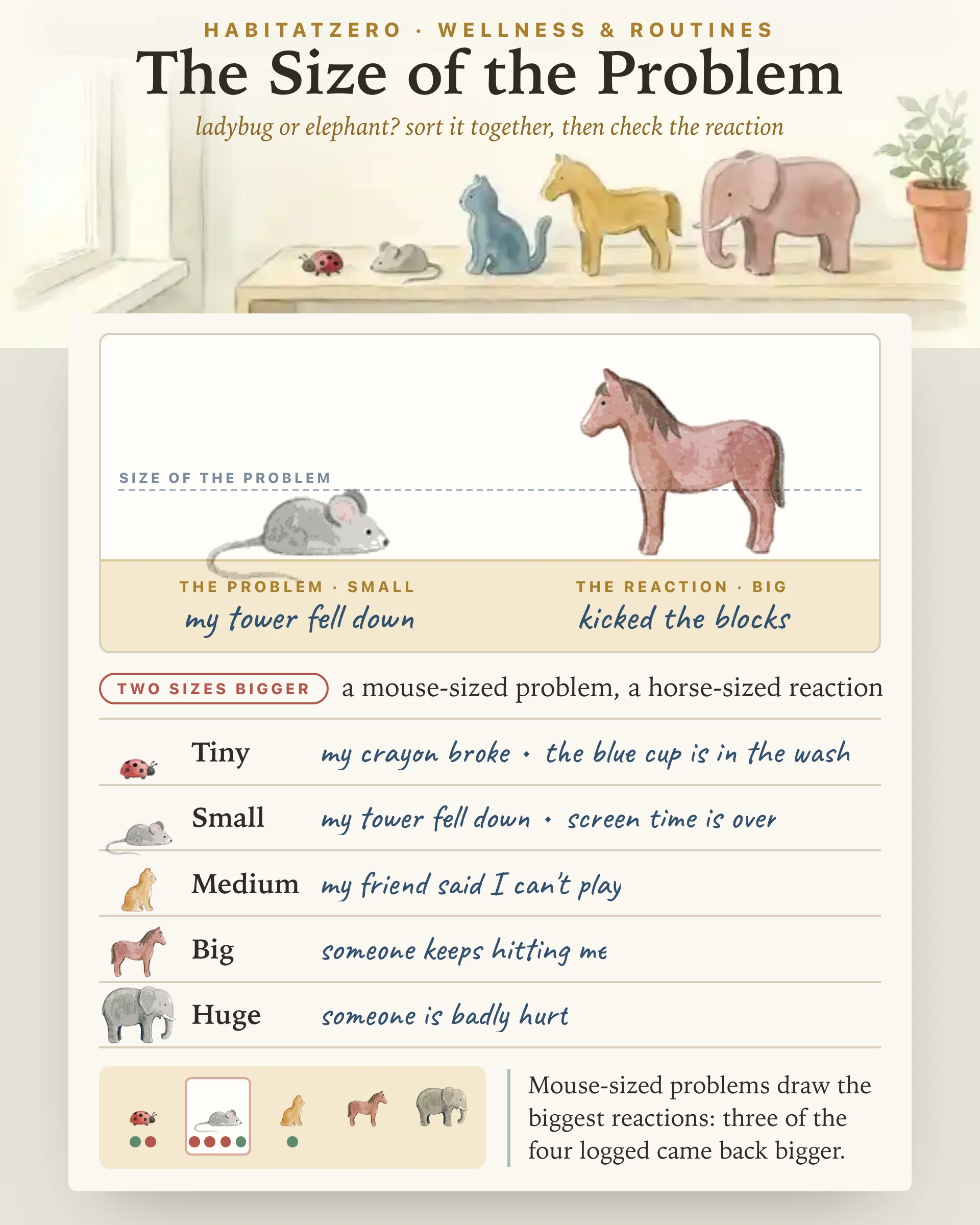
Credit first. "Size of the problem" is most closely tied to Social Thinking®, the teaching method founded by speech-language pathologist Michelle Garcia Winner, and her team lays out its current approach in Teaching the Size of the Problem in a Manner Friendly to All Neurotypes. That article also notes that sorting problems by size is older than any one program: problem thermometers go back to the late 1970s. Their current teaching uses three sizes, small, medium and big; this page offers five so a child can place a problem between them. The toy animals, the wording and the log on this page are our own. Social Thinking had no part in making them and has neither reviewed nor endorsed them.
Problems come in sizes, and the size tells you what kind of response fits. A snapped crayon needs a shrug. A child lost in a shop needs every grown-up nearby.
Children who find this hard are rarely being dramatic on purpose. When every upset arrives at full volume, a sandwich cut the wrong way and a real emergency can feel alike from the inside, because nothing has sorted them yet. The size scale lends your child an outside ruler to hold against the moment until they can carry one of their own.
Sort first, on a calm day. Five wooden toy animals stand on a shelf: a ladybug for tiny problems, then a mouse, a cat and a horse, up to an elephant for huge ones. Tap an everyday problem, or write one that happens at your house, then tap the animal your child thinks it matches. Talk it over, but let their answer stand while you do; a chart built from their sizes gets used, and one handed down to them gets ignored. Each animal holds four problems, which keeps the chart short enough to read at a glance.
Match a moment, later. Once a hard moment has passed and everyone has settled, pick the problem from your chart and tap how big the reaction was, from a shrug to as big as it gets. The two animals appear side by side under a dashed line that marks the size of the problem. When the reaction towers over that line, you can both see it without anyone having to say the word overreacting.
Read the log. Each matched moment drops into one of five columns, one per problem size. After a week or two, the page names the size that keeps drawing oversized reactions, and points out any problem that keeps coming back.
When a small problem draws a huge reaction, resist reading it as defiance. A review of emotion regulation in autism argued that difficulty regulating emotion may be part of autism itself, and may explain many of the outbursts that get filed under behavior problems. So if mouse-sized problems keep drawing horse-sized reactions, ask what is making small things so heavy right now: a skipped snack, a loud room, a transition, a short night.
That is also why nothing here gets logged mid-meltdown. Social Thinking's own guidance says it plainly: feeling overwhelmed by a small problem is allowed, and empathy comes before any lesson.
The log's second job is spotting repeats. If "screen time is over" turns up four times with big reactions, you are looking at a predictable problem, and predictable problems can be solved together before they happen. That is the core of collaborative problem solving, which in a trial with 47 children who had oppositional-defiant disorder and trouble regulating emotion produced gains equal to, and often better than, standard parent training. Agree on a plan during a quiet afternoon, such as a five-minute warning or a timer your child starts, then log the next few endings and watch whether the reaction shrinks.
Evidence for this exact tool is thin. Studies of Social Thinking lessons are few and small: an early report followed six boys through eight weeks of lessons and found more of the social behavior the lessons targeted, in a single-subject design study rather than a randomized trial. We found no trial of a size-of-the-problem chart used on its own. What the chart offers is modest and practical: words and a picture for something your child could not name, and a record for you in place of a vague sense that every day is hard.
It cannot diagnose anything, and the animals are never labels for your child. If reactions are often unsafe, or are getting in the way of school and home, take the log to your pediatrician or a child therapist; a few weeks of matched moments gives them far more to work with than a memory of the worst day.
Sort problems on an easy afternoon, with a snack and no hurry, and match moments later the same day. Teachers can run the sorting with a whole class, collecting the problems the children suggest.
It works best alongside a place and a skill. A Calm Corner gives a horse-sized reaction somewhere safe to land, and Rainbow Breathing is worth rehearsing for the cat-sized moments. If the struggle is naming how big the feeling is rather than the problem, The Feelings Thermometer measures that side.
It is a way to help children see that problems come in sizes, from tiny to huge, and that the size hints at what response fits. A snapped crayon calls for a shrug, while someone getting hurt calls for a grown-up straight away.
Tiny might be a broken crayon or the favorite cup sitting in the wash. Small could be a block tower falling down. Medium might be a friend saying you cannot join the game, big could be someone who keeps hitting you, and huge is someone badly hurt. Your child may size a few of these differently, and that difference is worth a conversation.
The problem is what happened. The reaction is what your child did next, anywhere from a sigh to a meltdown. The goal is for the two to roughly match, and when the reaction runs bigger, treat it as a clue about hunger, tiredness or overload rather than as misbehavior.
The phrase is most closely linked to Social Thinking, the method founded by Michelle Garcia Winner. The Zones of Regulation is a separate curriculum created by Leah Kuypers and published by the same company, and many classrooms teach the two side by side. This worksheet was made independently of both programs.
The filled-in example on this page can be explored exactly as it stands. Sorting problems for your own child, matching their reactions and keeping the log across weeks all happen in HabitatZero, where the chart costs nothing to personalize.
By the team behind Fabulous, the science-based self-care app used by over 30 million people.