The Overwhelm Recovery ProtocolWellness & Routines · ~5 min
About this template · Updated September 2026
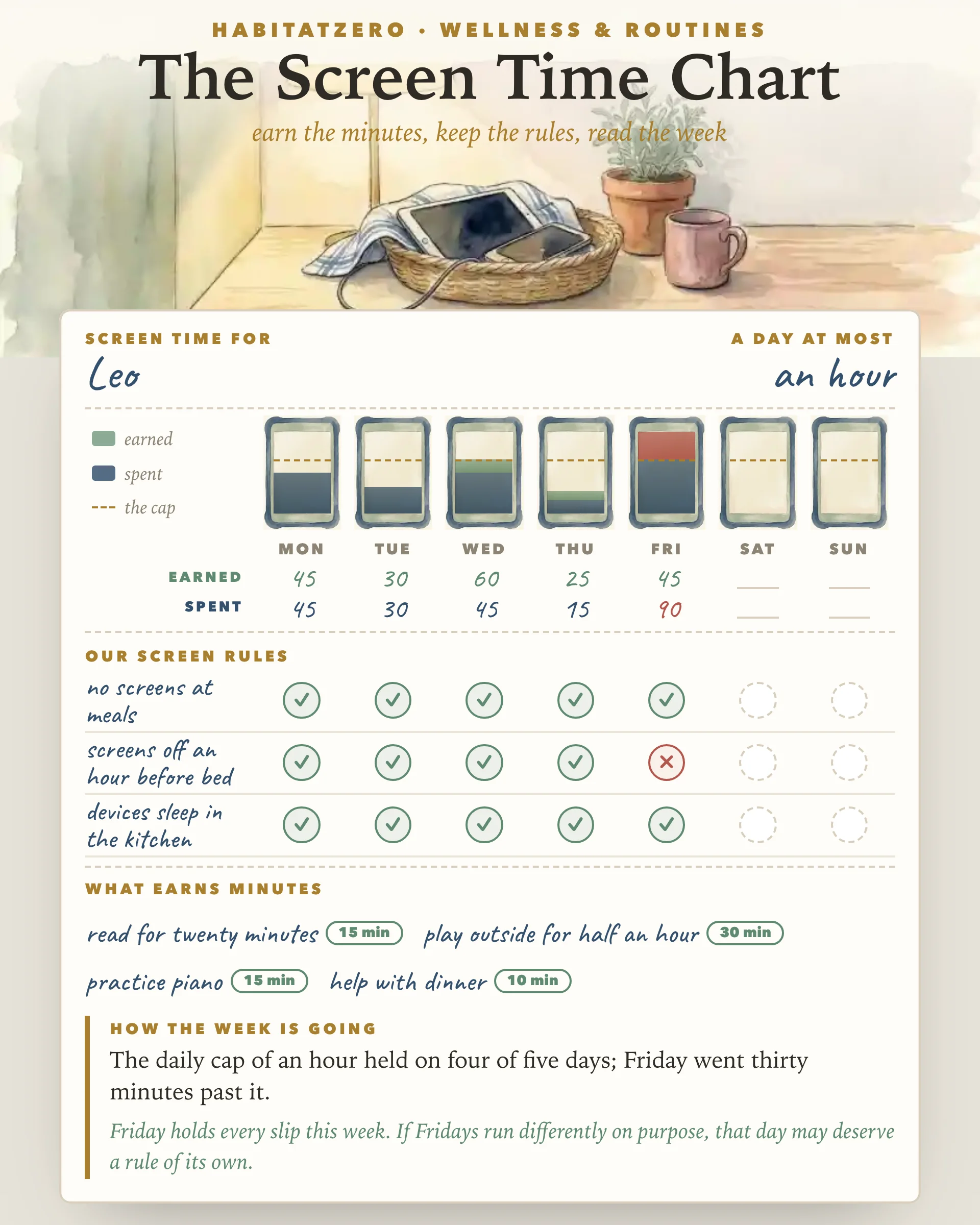
Most arguments about screens start at the worst possible moment: the tablet is already on, the show is halfway through, and somebody has to be the one who ends it. A screen time chart moves that conversation to a calmer hour. You agree the rules once, put them where everyone can see them, and let the chart do the remembering.
This one is a week on the fridge with a little arithmetic built in. Your child earns screen minutes from things you both agreed are worth doing, spends them, and never goes past a daily cap you set. At the end of the week, the chart reads back what actually happened.
Start with the rules. Tap two or three from the suggestions, such as no screens at meals or devices sleep in the kitchen, or write your own. Five is the most the chart will hold, because a rule nobody can remember stops being a rule.
Then choose what earns minutes: reading, playing outside, practicing an instrument, helping with dinner. Each carries a value you can change with a tap and can be earned once a day.
Set the cap, the most screen time any single day can hold. Earning stops there, so a day crowded with good stuff still tops out at the cap.
Each evening, pick the day, tap what was earned and step up the minutes spent. That day's painted tablet fills: green for minutes earned, blue for minutes spent, and red for anything past the dashed cap line. Under each day, tap a circle once for a rule that held and twice for one that slipped.
The reading underneath is the part a paper chart cannot do. It adds up the week, names the activities that earned the most, says which days the cap gave way on, and follows the bedtime rule night by night. When one day holds every slip, it says so: that pattern usually points to a plan nobody has made yet, not to a child who failed.
The American Academy of Pediatrics' 2026 policy statement on children and digital media says plainly that screen use cannot be understood through limits alone. Its advice to families leans on times and places: keep phones away from meals, bedrooms, homework and the hour before bed, and let the amount of screen time vary with each family's needs, school nights and weekends included. When parents want a number, it offers a range, from under an hour a day for toddlers and preschoolers to one to two hours or more of entertainment media for school-age children and teens.
That is why the rules sit at the center of this chart and the minutes sit beside them. For a fuller plan, the AAP's guide to making a family media plan covers screen-free zones, turning off autoplay, choosing content, and writing a plan for the adults in the house too.
Earning is a reward system, so it is fair to ask whether rewards backfire here. The evidence is thin. A small Canadian study of families with toddlers and preschoolers found that offering screen time as a reward, or taking it away as a punishment, went along with more screen time, while keeping track of it and setting limits went along with less. It was one survey of sixty-two children, so it cannot say which came first, and the authors point out that parents may choose screens as a reward precisely because their child already loves them.
The chart takes that seriously in three ways. Earning is capped, so it never grows the daily total. Minutes are never taken away as a punishment; the only removal is a take-back for a mistaken tap. And the two habits that went with less screen time in that study, tracking and a firm limit, are built in. If your child keeps earning more than the cap can hold, the reading can suggest letting the earning fade and keeping just the cap and the rules.
In the same study, mothers who used screens in front of their children had children with more weekday screen time. If your own evenings could use a chart, the Evening Digital Detox is built for adults.
A review of sixty-seven studies found that more screen time went with shorter or later sleep among school-age children and teenagers in nine studies out of ten. The authors are careful to call this an association, not proof that screens cause the lost sleep. Still, it is why the chart follows your bedtime rule on its own line and, if it keeps slipping, suggests a charging spot outside the bedrooms.
Set the chart up at a calm moment, with your child in the room and choosing some of the ways to earn. Fill it in each evening; it takes about a minute. Read it together on the weekend, keep what worked, change one thing, and start a fresh week.
For a younger child who needs a reward within minutes, not by bedtime, The Token Board suits a single hard routine better. And if the week's real friction is about chores, give them their own Chore Chart and keep this one for screens.
It is a family chart that shows how much screen time a child has each day, usually next to a short list of house rules about screens. Some families add a way to earn minutes through reading or outdoor play, which is how this one works.
Your child earns a set number of minutes for activities you agreed on, then spends them on screens the same day. A daily cap keeps earning from becoming a loophole, so even a day packed with good stuff still ends at the limit you chose.
Many families start with rules about times and places rather than totals: no screens at meals, screens off an hour before bed, and devices charging outside the bedrooms overnight. The American Academy of Pediatrics names these same screen-free times and places in its advice to families.
No single number fits every family. When parents ask for one, the 2026 AAP policy statement offers a range, from under an hour a day for toddlers and preschoolers to one to two hours or more of entertainment media for school-age kids and teens, and it puts sleep, play and good content first.
You can look through a filled-in sample right here without signing up. To keep your own family chart from one week to the next, personalize it in HabitatZero at no cost, and print a copy for the fridge whenever you want one.
By the team behind Fabulous, the science-based self-care app used by over 30 million people.