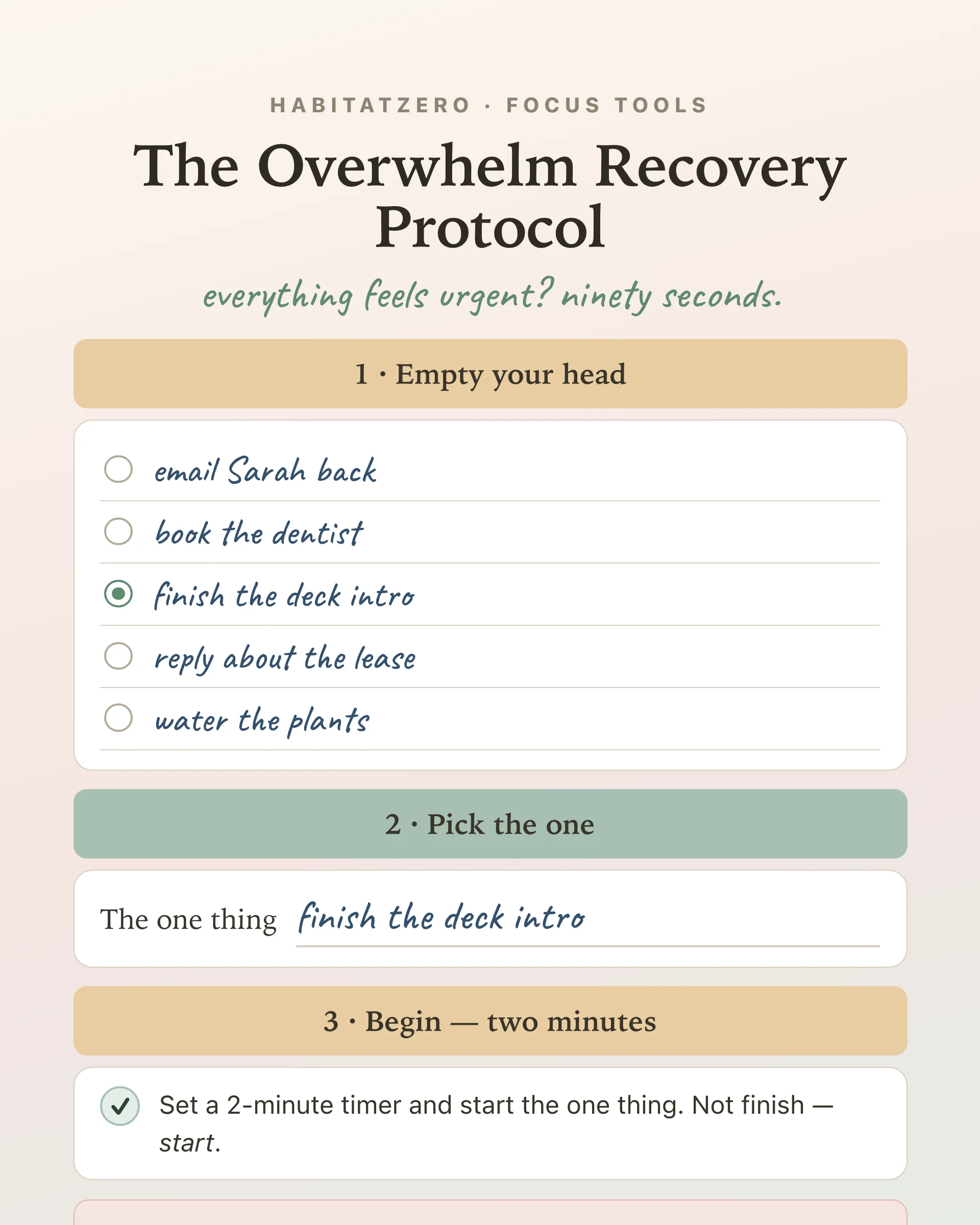
The Overwhelm Recovery ProtocolWellness & Routines · ~5 min
About this template · Updated September 2026
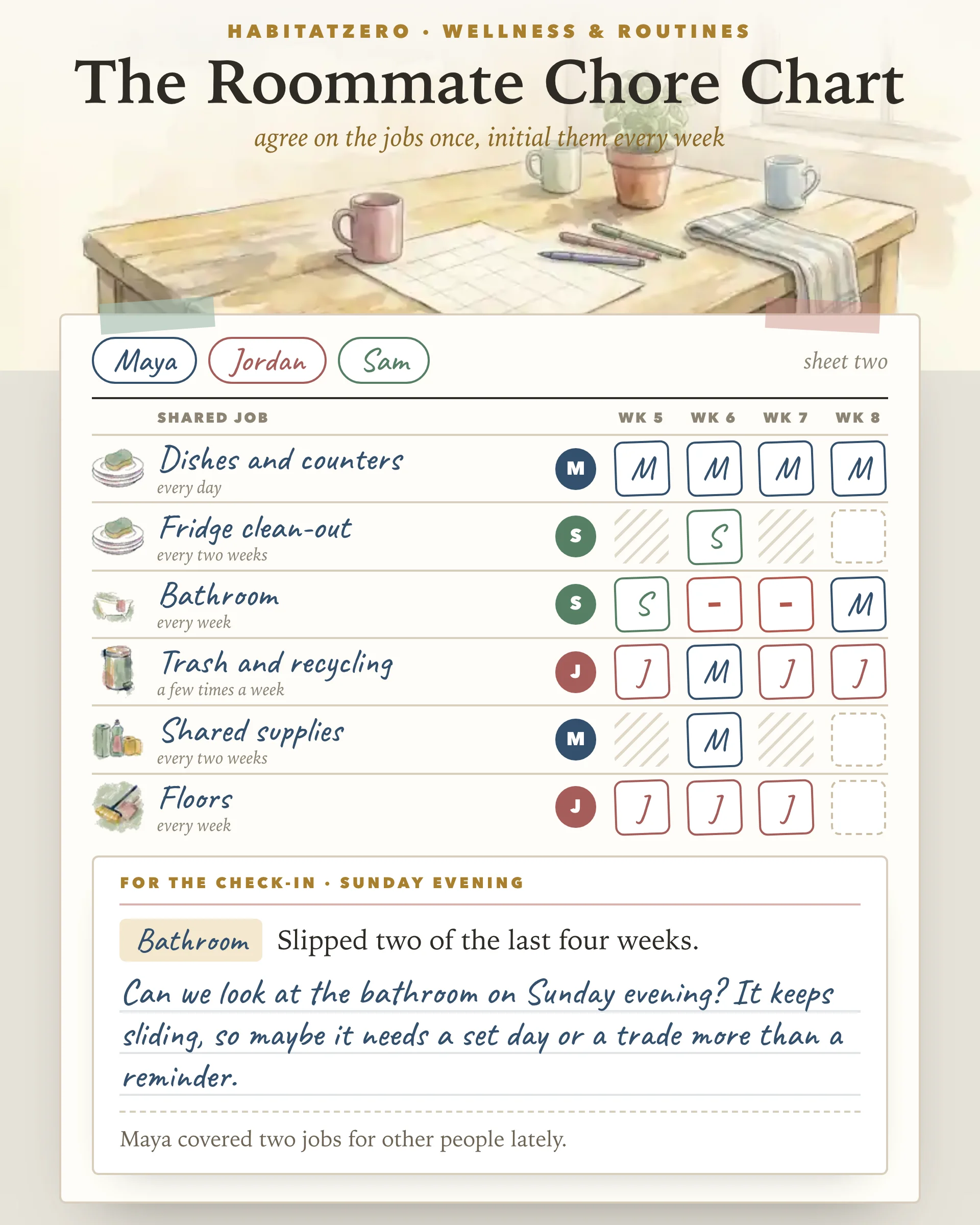
Most roommate fights about chores are not really about the dishes. They are about the fifth time someone did the dishes quietly, kept count, and never said so. A roommate chore chart puts that count on paper before it turns into a mood: which shared jobs exist, who owns each one, how often it happens, and what actually got done this week.
Jobs that belong to everyone tend to belong to nobody. Psychologists call the pattern social loafing, and a meta-analysis of seventy-eight studies found it holds across many kinds of shared tasks: people put in less effort when their work disappears into a group result. Among the strongest influences on it was evaluation potential, whether each person's part could be seen and judged. A chart is a cheap way to make it visible. The bathroom has one name beside it and every box carries initials, so nobody has to wonder or keep a private tally.
That is also why personal jobs stay off. Your own room and your own laundry are yours. The chart is for the kitchen, the bathroom, the trash, the floors in shared rooms, and the supplies everyone uses up, like toilet paper and dish soap. Supplies get a row of their own because that work is mostly noticing, and noticing is the job nobody volunteers for.
Start with who lives here. Each name becomes a pen in its own color, and up to five people fit on one sheet. Five common jobs are already on the chart; keep the ones that fit, take off the rest with two taps, and add your own. Tap how often a job happens to change it, from every day to once a month. A job that comes around every two weeks gets striped boxes in its off weeks, so the sheet only shows boxes someone actually owes.
Then hand out the jobs the way you would at the kitchen table. Pick up Maya's pen and tap the circles of the jobs she is taking, then pick up Jordan's and do the same. If a job lands with the wrong person, hand it straight back.
Each week, whoever did a job initials its box with their own pen, even when the job is someone else's. That is how the chart knows who covered for whom. When a week passes and the job did not happen, use the dash. A sheet runs four weeks. When it fills up, pin up a fresh one: jobs and owners carry over, and the last few weeks keep counting until new boxes fill in.
Under the chart sits a card for your next house check-in. It reads the last four weeks, picks the one thing worth raising, and hands you a line to raise it with. A job that slipped in two of those weeks comes first, because a pattern deserves a conversation and a single miss usually does not. If several jobs slipped once each, the card asks whether the chart is asking too much. If one roommate covered at least two more jobs than anyone covered for them, it thanks them and names one of their jobs someone else could take for a week. And every four or eight weeks, as you agreed, it marks a trade week, when any job can change hands and keeping yours is fine too.
The lines talk about jobs, not people. "Can we look at the bathroom on Sunday evening?" lands very differently from "you never clean the bathroom," even when everyone knows whose name is on that row.
The research here supports the parts of the method, not the chart as a whole. Social loafing explains why unnamed jobs drift. Planning research adds a second piece: a meta-analysis of ninety-four tests found that adding a plan for when, where and how to act had a medium-to-large effect on reaching goals, compared with simply intending to. A job that keeps slipping often lacks exactly that, a fixed evening and a clear trigger, which is why the card suggests a set day before it suggests a trade.
Most roommate research studies college students. A review of that work treats roommates as interdependent, each shaping the other's experience, and covers how the relationship bears on students' mental health and adjustment. That is a good reason to take small frictions seriously early. It is not evidence that a chart can repair a strained house, and if the real trouble is money, respect or safety, chores are the wrong place to start.
Set it up in your first week in a new place, alongside the First Apartment Checklist, or on the evening the sink becomes a sore subject. Whoever takes the bathroom row may want the Bathroom Cleaning Checklist, so everyone agrees on what done looks like. If you share a home with a partner or family and would rather see the week in minutes than in initials, the Household Chore List is built for that.
Print the sheet for the fridge, initial it in pen, and bring the card to each check-in. Ten minutes every few weeks costs far less than a month of silent scorekeeping.
List every shared job first, including the quiet ones like restocking toilet paper, then agree who takes each one and how often it happens. A split feels fair when everyone chose it and it gets looked at again, not when every job is identical. A short house check-in every few weeks lets the split change when schedules do.
Only the shared ones: dishes and counters, the bathroom, trash and recycling, the floors in common rooms, and the supplies everyone uses. Your own laundry and your own room stay off it. Five to ten rows covers most apartments without turning the chart into a second job.
Both work when the house agrees to it. Keeping the same jobs lets each person take what they mind least, while trading now and then keeps anyone from owning the bathroom forever. This chart keeps jobs fixed and marks a trade week every four or eight weeks, so a swap is something you choose at the check-in.
Let the chart hold the reminder. When each job carries one name and a box to initial, nobody has to chase anyone, and a slipped week shows up on its own. Raise patterns rather than single misses, bring them to a regular check-in, and talk about the job instead of the person.
Yes. It prints on a single page with the names, the jobs, four week columns and the check-in card, and any empty box can be initialed by hand in pen. To keep the weeks filled in on your phone as well, personalize the chart in HabitatZero, which costs nothing.
By the team behind Fabulous, the science-based self-care app used by over 30 million people.