Reading JournalStudy & Learning · ~4 min
About this template · Updated September 2026
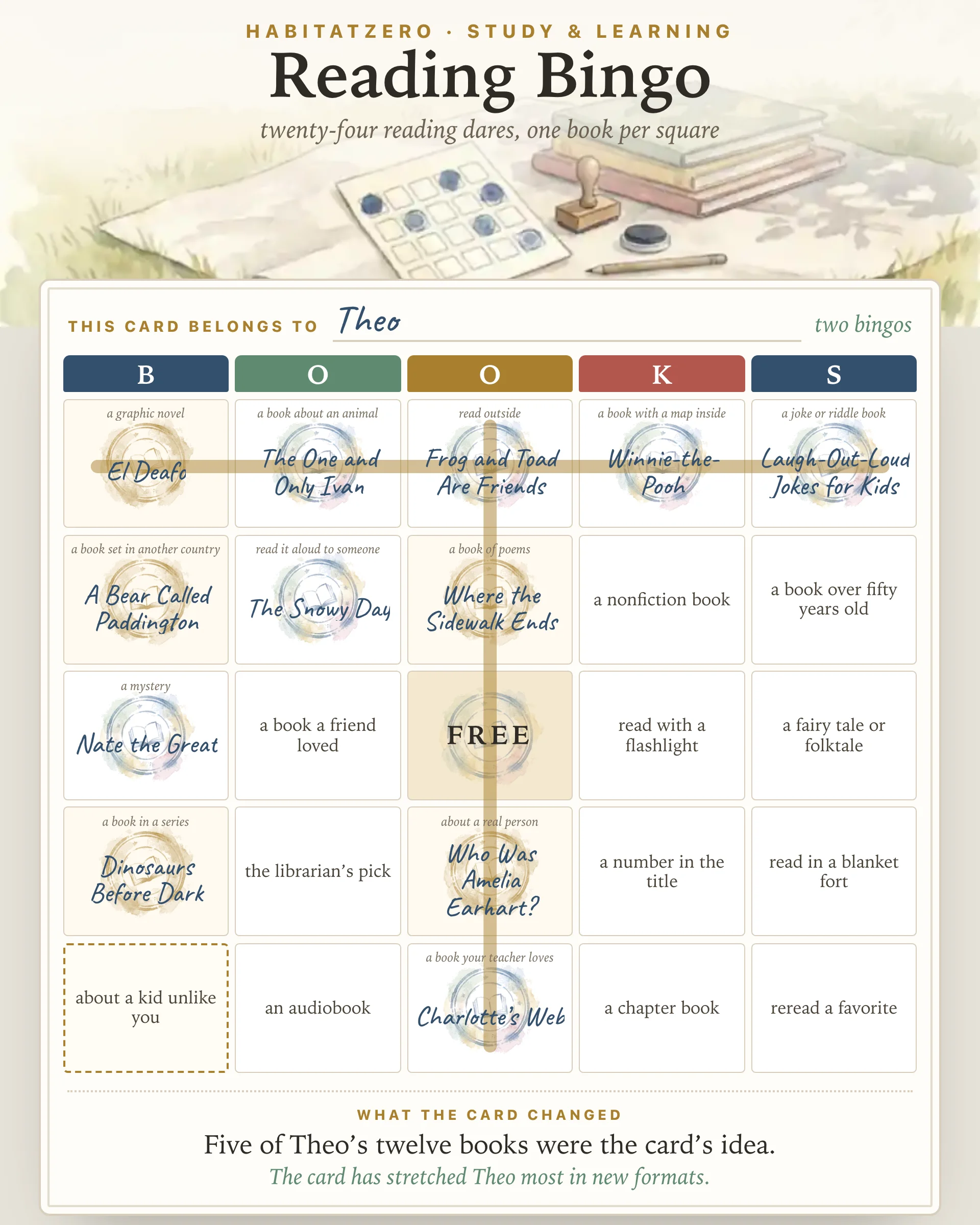
A reading log asks one question: how much? A reading bingo card asks a better one: what else? Each square on the card is a small dare, such as a graphic novel, a book set in another country or a book someone else loved, and the reader fills a square by finishing a book that fits it. Five squares in a line make a bingo. Because it rewards range rather than minutes, it can stand in for a nightly log at home, or serve as a new-year challenge for grown-ups stuck in one genre.
This page deals one of three cards: dares for a kid, for a teen or for a grown-up. Each card keeps its own name and stamps, so a family can run one each.
When a book is finished, tap the square it fits and write the title. Then answer a single question: would the reader have picked this book without the card? A yes gets a blue stamp. A no gets a gold one. That one tap is what turns the card into more than a checklist, because the gold stamps mark the books the card actually changed.
The card draws a line through every finished row, column and diagonal. Squares that sit one book from a bingo get a dashed outline, and the note under the card names them, so the next trip to the library has a target. Below the card, the gold-stamped books gather into a short list with a reading of where the stretch happened: new formats, worlds far from home, other people's picks, books from another time, subjects off the usual shelf or new ways to read.
A few rules keep the card honest. One book fills one square, and the card turns away a title that is already on it. A square without a title stays open, since the stamp belongs to a book and not to a promise. Any dare that does not suit the reader can be swapped for another from the deck or rewritten in your own words, as long as the square is still empty.
A strong card mixes kinds of stretch. Some squares ask for a new format: poems, a graphic novel, an audiobook. Some ask for a new place, like a map inside the cover or a story set far away. Some hand the choice to someone else, such as the librarian or a friend. A few ask for a new way of reading: outside, by flashlight, aloud to a younger sibling.
For younger readers, keep the squares winnable. Picture books count, and so does a read-aloud. If a square has sat empty for weeks and feels like homework, swap it; the point is momentum, not a test. Teens can take the harder dares and write a couple of their own. For grown-ups, the squares that matter are usually the uncomfortable ones: a genre you are sure you dislike, or the book you keep putting off.
The case for reading variety starts with reading volume. A meta-analysis of 99 studies of leisure-time reading, from preschool to college, found moderate to strong links between how much people read for pleasure and their comprehension and spelling, and the authors describe an upward spiral: stronger readers read more, and reading more makes them stronger. Those are correlations, not proof that any one tool works, but they explain why keeping books moving matters.
Summer is where the stakes show. A review of 41 summer reading programs in the United States and Canada found that home programs built around children reading books, along with classroom programs, improved reading outcomes, with larger gains for children from low-income families. A bingo card is one simple way to give a home program some shape without turning the kitchen into a classroom.
Prizes deserve care. A meta-analysis of 128 experiments found that expected, tangible rewards tended to undermine interest in the rewarded activity, more so for children than for college students, while positive feedback raised interest. If the only reason to read a fifth book is a toy at the end, the card quietly teaches that reading is a chore with a payout. Keep prizes small or skip them, and make the list of gold stamps the thing you talk about.
None of these studies tested bingo cards themselves. The card is a practical format for putting their findings to work, not a proven intervention in its own right.
Deal a card at the start of summer vacation, a school term, winter break or a new year. A single line by a set date is a fair goal for most readers, and a full card, called a blackout, makes a good stretch goal. If you also want to track time spent reading, the Kids Reading Log keeps nightly minutes, and when a square's book turns into a school assignment, The Book Report walks a young reader through writing it up. Grown-ups chasing a number of books this year can pair the card with the Reading Log.
Print the card for the fridge, and ask about the gold stamps first.
Reading bingo is a reading challenge laid out as a bingo card. Each square holds a dare, such as a graphic novel or a book set in another country, and it gets marked once a book that fits it is finished. Five marked squares in a row, column or diagonal make a bingo.
Mix four kinds of square: formats (a graphic novel, poems, an audiobook), places (another country, a book with a map inside), other people's picks (the librarian's pick, a book a friend loved) and ways to read (outside, by flashlight, aloud to someone). Dares that ask for a new kind of book do more work than dares that ask for more of the same.
Hand out the card when summer vacation starts, agree on an end date and let the reader choose the order. Each finished book fills one square. One line by the last week of summer is a fair target, with a full card, called a blackout, as the stretch goal for keen readers.
Not on this card. One book fills one square, so the card keeps pointing toward new books instead of rewarding a single clever pick. For a young reader who needs gentler rules, swap a hard square for an easier dare rather than doubling up.
The card shown here is a filled example to look through. To deal your own card, stamp books into it and find it again next week, personalize it in HabitatZero at no cost, and print a paper copy whenever you like.
By the team behind Fabulous, the science-based self-care app used by over 30 million people.