Leaves on a StreamEmotional Fitness · ~3 min
About this template · Updated September 2026
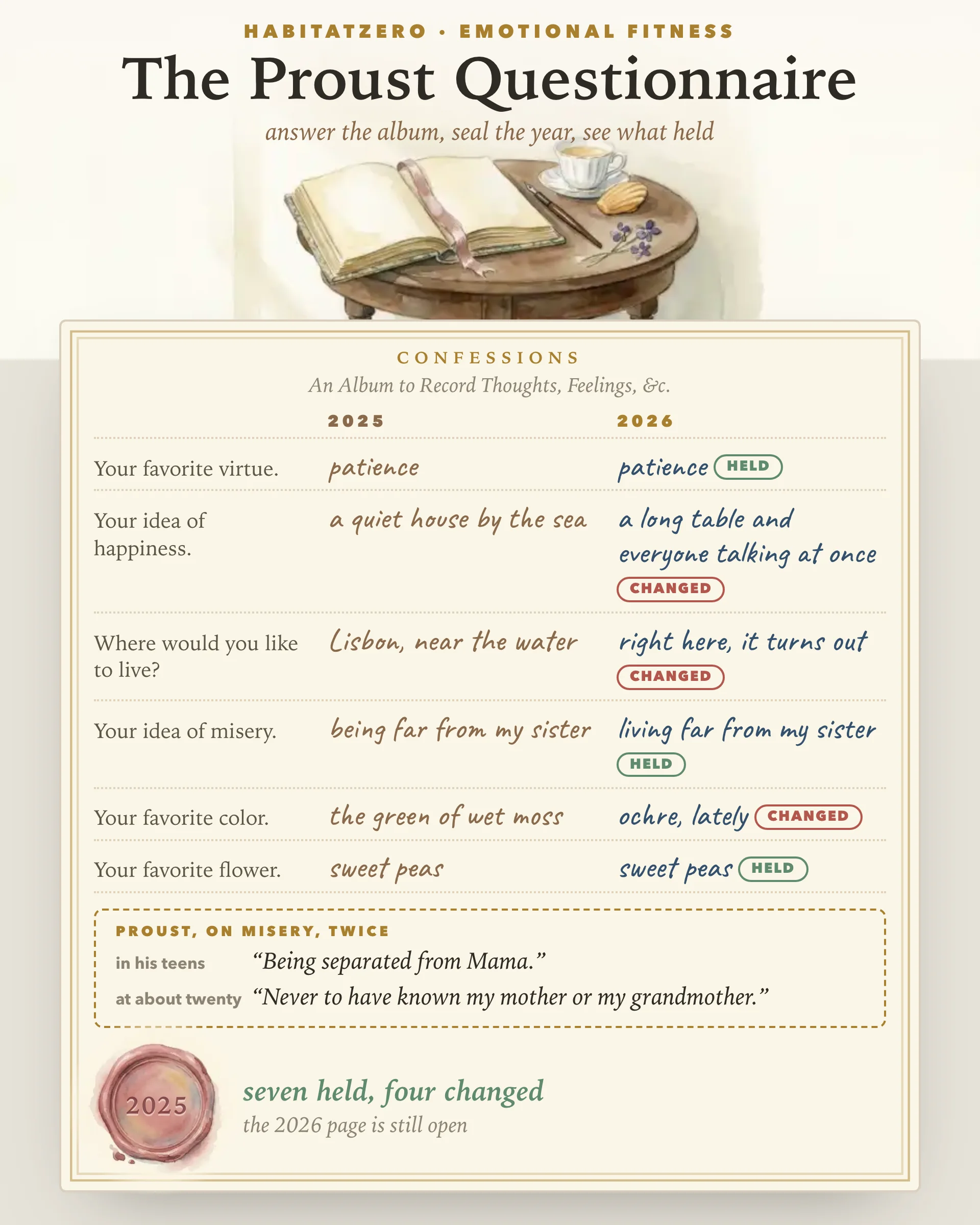
Marcel Proust did not write these questions. He answered them, in a friend's album, and his answers turned an ordinary Victorian pastime into a questionnaire that magazines and talk shows still borrow. Both of the sheets he filled in, the English album from his teens and a French one from a few years later, are transcribed by the Kolb-Proust Archive for Research at the University of Illinois Library, the source of the French on this page; the English renderings are ours. The album here is an independent Fabulous worksheet. Neither the university nor Vanity Fair, whose back-page version most readers know, has any part in it or has reviewed it.
In Proust's youth a "confession album" was a printed book with the same prompts on every page: your favorite virtue, your idea of happiness, your pet aversion. Its owner passed it among friends, and each filled in a page, so the album became a keepsake of who everyone was that year. Proust's friend Antoinette Faure owned an English one titled Confessions. An Album to Record Thoughts, Feelings, &c., and he answered its prompts in French. Some of its pages carry dates between 1884 and 1887.
The album resurfaced in 1924, two years after his death, when her son André Berge found it among her books and published Proust's page. Berge pointed out a crossing-out: for his idea of misery, Proust first wrote that it would be to be away from his mother, then struck out "away" and wrote "separated." Around 1890, near his year of volunteer military service, Proust filled in a second, French sheet and titled it himself: Marcel Proust par lui-même, Proust by himself.
Television hosts later built shorter lists in his honor, and Vanity Fair has run its own adapted set since 1993. This page goes back to the thirty-four prompts on the two sheets he actually answered: the English album's own wording, "favorite" spelling included, and our English for the prompts found only on his French sheet.
The page opens on the first printed prompt with a line waiting for your handwriting. Write a few words, or tap a suggestion to start the line and change it until it sounds like you. Keep it short: one honest phrase is easier to compare next year than a paragraph.
Pass anything. Proust left five lines of his first album blank, including his chief characteristic and his present state of mind, so a skipped prompt is in good company. Passed lines stay open until you come back to them.
Once your own line is written, you can ask what Proust put there. Where he answered twice you see both, and he moved too. His favorite occupation went from reading, daydreaming, verse, history and the theater to a single word: loving. His favorite prose writers came with a hedge, aujourd'hui, for now.
When five or more lines are written, you can seal the page. The wax holds until the calendar turns. In the new year a fresh page opens beside the old one, with last year's answers folded away. Each one unfolds only after you have written this year's line, so the old answer cannot steer the new one. The album then marks the pair held or changed. That mark is a guess from shared words, so it can misread you: "by the sea" and "somewhere near the ocean" share no words and would be marked changed. Tap the mark to set it right.
The yearly comparison has evidence behind it. In a study of more than 19,000 people aged 18 to 68, Quoidbach, Gilbert and Wilson found that people at every age reported a lot of change in the past decade but expected little in the next. They called this the end of history illusion: the person you are today feels like the finished version. A page from last year sitting beside this year's is a plain, private way to check that feeling against your own record.
There is also a reason to write the ordinary answers down. Across four studies, Zhang and colleagues found that people underestimate how interesting it will be to rediscover everyday moments they recorded, and they misjudge this most for mundane experiences rather than big occasions. Your favorite bird and this year's idea of misery are exactly that kind of record.
What the evidence does not say matters as much. The Proust questionnaire is not a validated personality test and has no scoring. Held is not better than changed. A tally of held answers measures nothing about growth or stability; it only shows you where your own words moved.
Pick a date you already keep each year: a birthday, the week between the holidays, an anniversary. Give it a slow evening and answer the easy lines first. If you want the events of the year alongside the person, pair it with a Year in Review. If you suspect people see a different person from the one on this page, The Johari Window lets someone who knows you add their view.
Then leave it alone until next year, when the page will be waiting.
It is a set of personal prompts from a Victorian parlor game, the confession album, which friends passed around so each could write a favorite virtue, an idea of happiness and so on. It carries Proust's name because the page he filled in as a teenager turned up in 1924, two years after his death, and was printed in a French literary journal.
The English album Proust answered in his teens printed prompts such as Your favorite virtue, Your idea of happiness, Your idea of misery, Where would you like to live, and For what fault have you most toleration. His later sheet, written in French, added others, among them his favorite bird, his main fault and how he would like to die. This page gathers both sets, thirty-four prompts in all.
As a teenager he gave his idea of misery as being separated from his mother, and said he tolerated the private lives of geniuses. Around twenty he named his favorite occupation in one word, loving, and wrote that he dared not describe his idea of happiness in case saying it destroyed it. Here his answers stay folded until you have written yours.
No. Vanity Fair has printed its own adapted version on its back page since 1993, answered by well-known guests. This album has no connection to the magazine or its publisher and goes back instead to the prompts Proust himself answered, in their older wording.
The sample on this page already holds two years of someone's answers, so you can see how the seal and the comparison work. To write your own lines, keep them, and find next year's page waiting, personalize the album in HabitatZero at no cost.
By the team behind Fabulous, the science-based self-care app used by over 30 million people.